My Favorite Hymn to St. Philip Neri

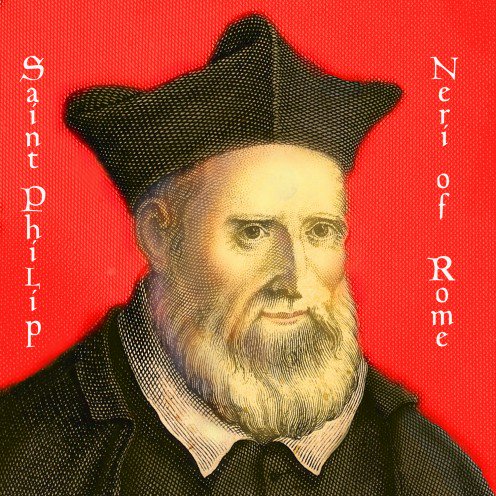
StPhilipImageRed

St. Philip, pray for us (Source)

As my readers will well know, St. Philip Neri is my favorite saint and has been for a long while now. I take every opportunity I can to sing his praises on this blog, and today happens to be one of them. In Oxford, we are celebrating the Feast of the Patronage of St. Philip, a local solemnity that honors the canonical erection of the house here as a Congregation of the Oratory. Please pray for the Oxford Fathers on this, their silver jubilee.

To celebrate, here is my favorite hymn to the Apostle of Rome – Pangamus Nerio, as sung by the choir of the Birmingham Oratory. It is the vesperal hymn of St. Philip.

Pangamus Nerio, debita cantica
Quem, supra nitidi sydera verticis,
Virtus et meritum sustulit inclytum,
Carpturum pia gaudia.

Noctes sub spectabus, corpora martyrum,
Quas implent, vigilat sedulus integras,
Ex ipsis satagens discere mortuis
Normam qua bene viveret.

Nocte dum Nereus fercula pauperi,
Gestans praecipitat, panniger Angelus
Tecto significat, qualiter excidat
Numquam fervida caritas.

Orantis penetrans cordis in intimum,
Laxavit spatium Spiritus impete
De Coelo veniens, esset ut hospiti
Immenso locus amplior!

Coelorum Domino, dum sacra munera
Libabat Nerius, saepius advolans,
Tellurem rapido corpore deserit,
Christo fiat ut obvius!

Corpus deseruit, cum Deus Hostiae
Fertur sub niveae tegmine conditus,
Prudens, in Patriam, pergere splendide
Nolens absque Viatico.

Amen.

Unfortunately, I don’t have an English translation (nor the time and energy to translate from the original myself). Alas.

May St. Philip Neri pray for Oxford, for the Oratorians there, and for all of us who call upon him in filial affection.


Another View of the Sacraments in the Eighteenth Century

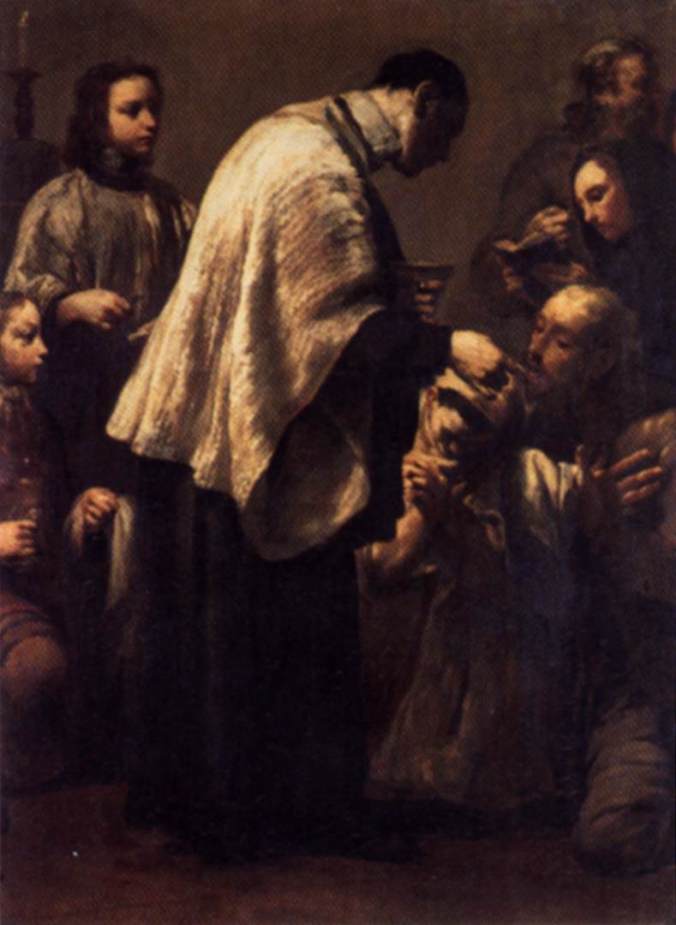
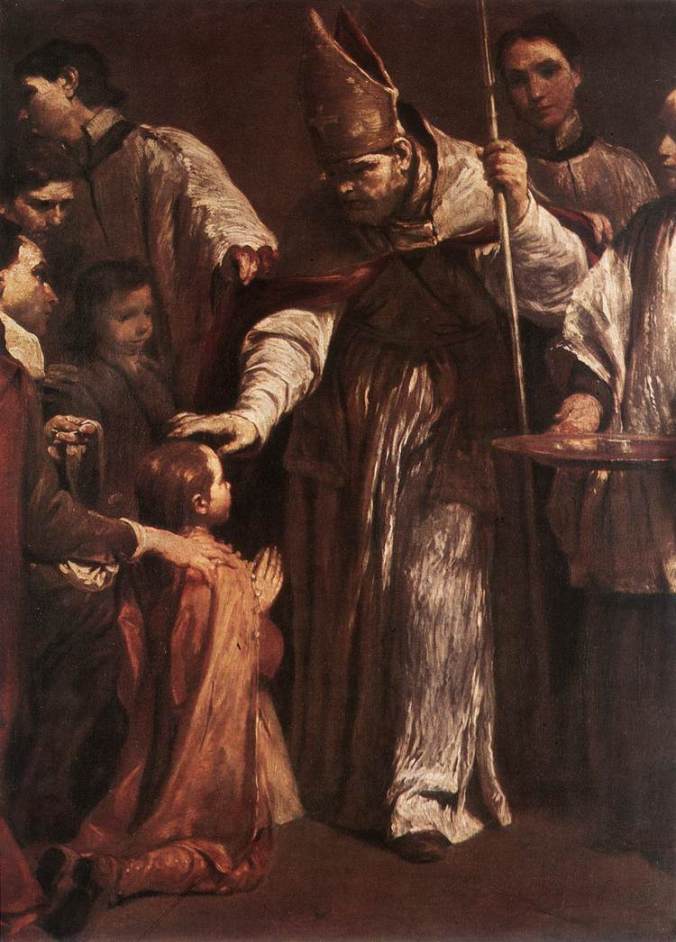
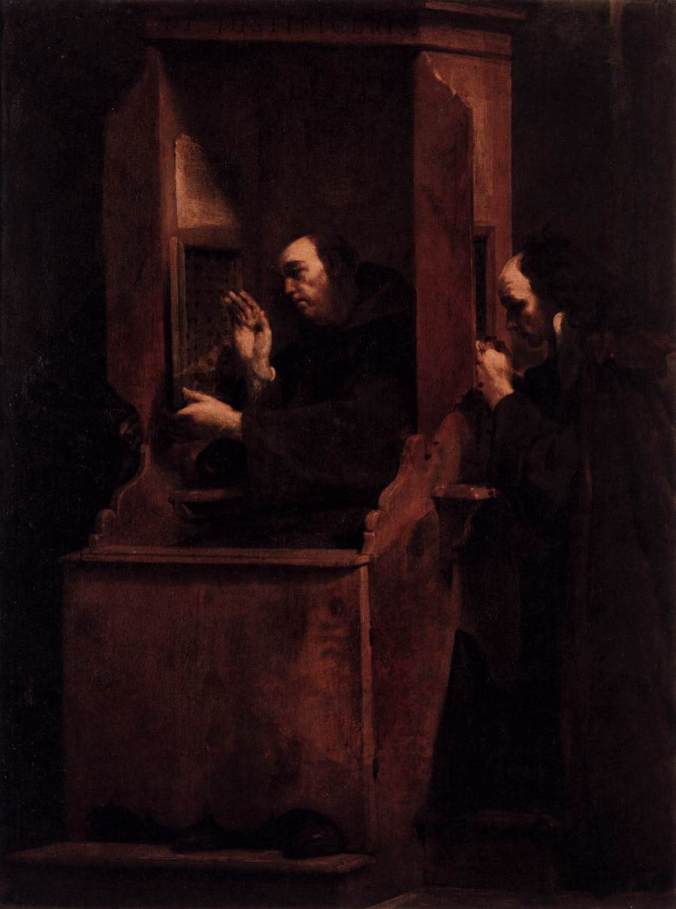
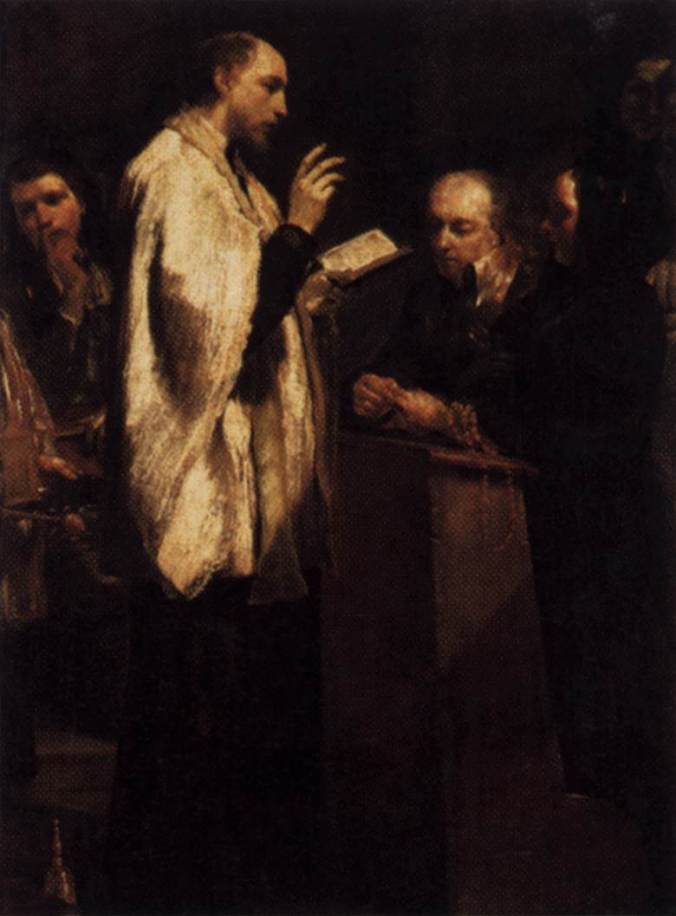
A while back I produced a short post entitled “A View of the Sacraments in the Age of Enlightenment.” Here I give you another series of similar images, this time from the hand of Giuseppe Maria Crespi, also known as “Lo Spagnuolo.” These paintings from 1712, so reminiscent of Rembrandt, hang in the Gemäldegalerie, Dresden. Originally commissioned by Cardinal Pietro Ottoboni, that towering figure of late Baroque culture, they passed posthumously up to Germany, where they made their way into collection of the Elector of Saxony.

Let me begin by saying that, as with the information in the above paragraph, all of the images can be found at Wikipedia.

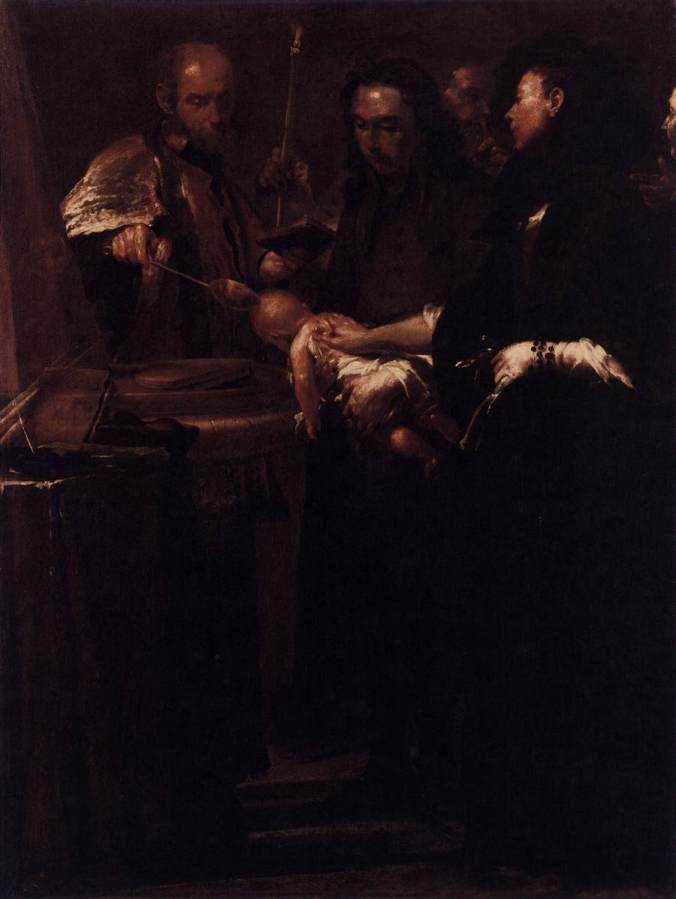
Giuseppe_Maria_Crespi_-_Baptism_-_WGA05763

“Baptism.” Crespi’s sparing use of light demonstrates the central conjunction of the scene. Allowing our eyes to wander along the central line of illumination, we follow the arm of the priest pouring water on the head of the outstretched infant to the mother’s rosary-wrapped wrist just beyond. I am convinced that the use of light in all of these images is the key to their meaning. Crespi uses light to illustrate the work of sacramental grace, and darkness to emphasize the mortality, evanescence, and weariness of our ordinary world. “The people in darkness have seen a great light” – thus spake Isaiah.

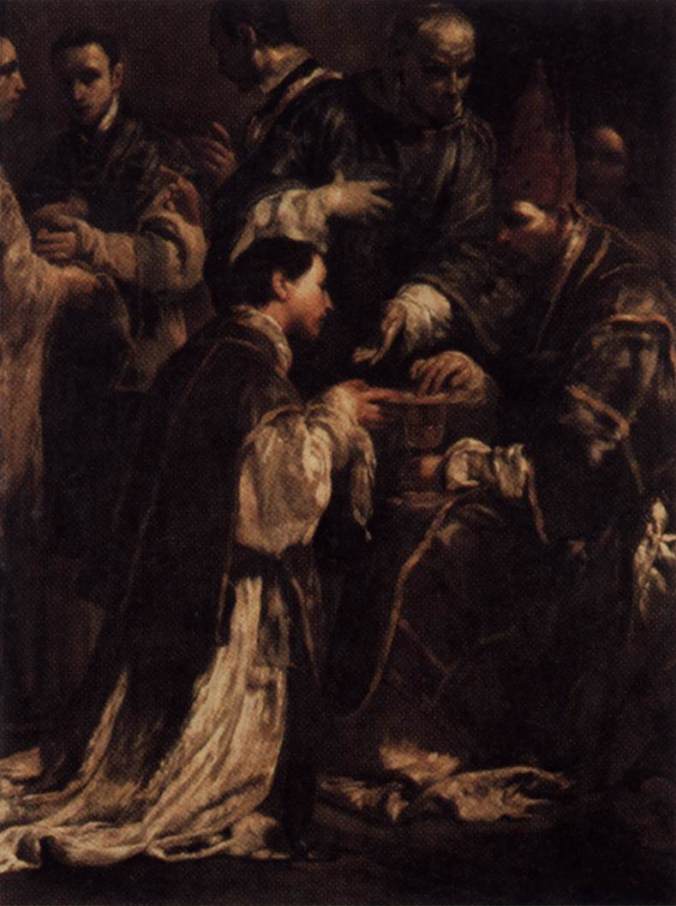
Giuseppe_Maria_Crespi_-_Communion_-_WGA05766

“Communion.” The priest’s face is shrouded in darkness, and rightly so. It is not he who offers the bread of life, but Christ in him. Interesting collar, too. Sure looks familiar. Cardinal Ottoboni was patron of the Congregation of the Oratory at Rome for some time, and it’s entirely possible that Crespi would have taken the Oratorians as his model here. Besides that, the setting of the scene is strikingly barren. Crespi’s choice to leave out the probable altar rail lends the scene an intimacy that captures the very heart of the worship here portrayed.

Giuseppe_Maria_Crespi_-_Confirmation_-_WGA05765

“Confirmation.” Crespi’s lightest and most colorful piece in the series. The vivid red-orange of the boy’s robes call to mind the tongues of flame that appeared on Pentecost, as does the (relatively) diffuse light bathing the scene. The brightest part of the image is the Bishop’s arm, only just anointing the boy’s head.  The strong predominance of vertical and diagonal lines in this piece only reinforce the sense of descent. Like all the paintings, the scene here is crowded without being cramped. Crespi seems to have penetrated to the deeply ecclesial nature of the sacraments. The sacraments are what give the Christian community its underlying spiritual cohesion and form. To quote De Lubac, “The Eucharist makes the Church.”

Giuseppe_Maria_Crespi_-_Confession_-_WGA05764

“Confession.” Quite in contrast to “Confirmation,” we come to Crespi’s darkest piece in the series. The overwhelming color is black. Confession is the sacrament that deals most straightforwardly with the reality of sin. The narrow contraction of the light – it comes only from one side, and very weakly. The formal likeness between confessor and penitent reminds us of the condition of sin common to all men. This painting is also the only one in the series where we don’t see a crowd. Only two figures are visible. In the end, we are always “alone with the Alone.”

Giuseppe_Maria_Crespi_-_Matrimony_-_WGA05769

“Matrimony.” Perhaps the most human of Crespi’s scenes. But we find unusual notes, things I can’t quite interpret with satisfaction. For a painting of matrimony, we hardly see the couple. Indeed, the bride has almost been swallowed up by the shadows. Nigra sum sed formosa. Perhaps. The priest stands like a pillar of cloud before them, blessing their union. That seems straightforward enough. Yet why is the man on the left holding his hand to his mouth, as if to signal silence? Perhaps because the matter of this sacrament is always properly taken in secret…

Giuseppe_Maria_Crespi_-_Ordination_-_WGA05768

“Ordination.” This composition is a swirling mix of blacks, browns, subtle golds, and occasionally, whites. The point that stands out most is the break in this overall scheme – the youthful, rosy visage of the ordinand, coupled with the slightly ruddy shadows that fall across his hand. What a contrast with the other figures, all of whom are shrouded in darkness and invested with a manifest pallor. Here is an image of youth, a prospect of renewal against a backdrop of dignified decay.

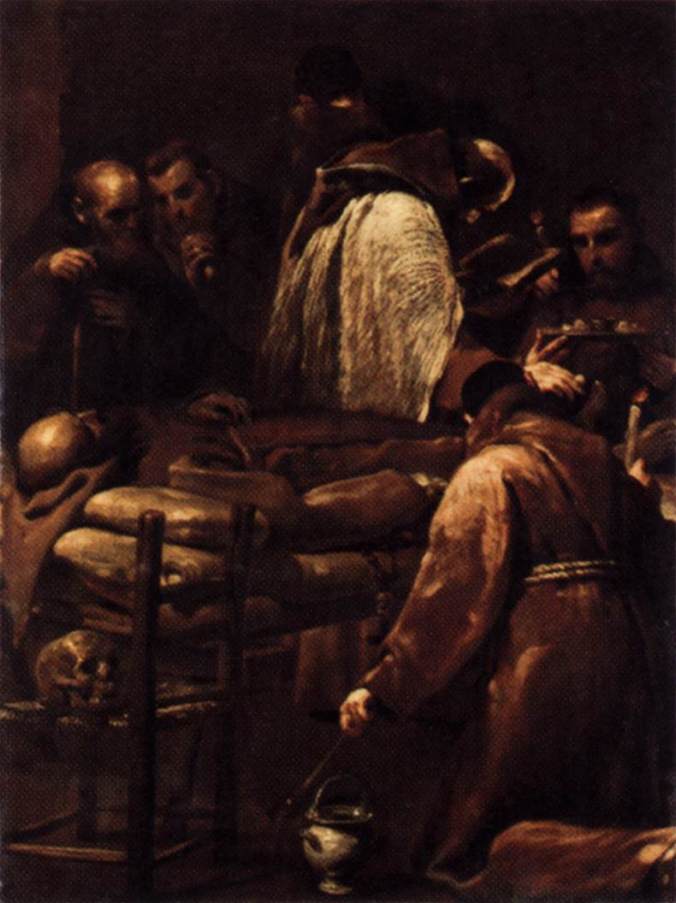
Giuseppe_Maria_Crespi_-_Extreme_Unction_-_WGA05767

“Extreme Unction.” At last we come to the end, the place of the skull. It is only fitting that Crespi should choose to depict a collection of Franciscans for this sacrament. Religious life is always a preparation for death. Yet the bright patch of light improbably illuminating the shoulder of the attendant friar contrasts starkly with the shadowy body of the dying father and points to new hope.

Maurice Zundel on Prayer

zundel-800x450

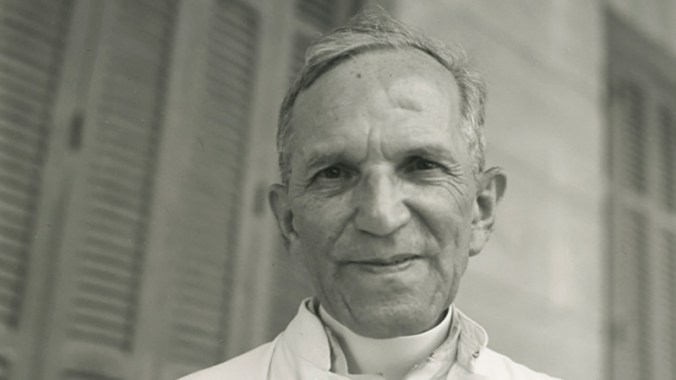
Maurice Zundel in old age. (Source)

Fr. Maurice Zundel was one of the great, if often-forgotten, theologians of the last century. Sometime student of Fr. Reginald Garrigou-Lagrange, he wrote various works of Catholic philosophy in conversation with existentialism, Protestantism, and personalism. This wide-ranging and erudite scholarship led soon-to-be-Saint Paul VI to call him “a mystical genius.” However, he is best known in the Anglophone world for his writing on the liturgy. This extract is taken from his great work, The Splendour of the Liturgy (1943), translated by Edward Watkin for Sheed & Ward. It comes from his chapter on “The Collect” (pg. 61-67). I was struck by this passage’s profound depths of wisdom as well as its light,  imaginative style.

Prayer is the soul’s breath, the creature’s fiat in response to the Creator’s in that mysterious exchange which makes us God’s fellow-workers. Its purpose is not to inform God of needs which He knows infinitely better than we do ourselves, nor to move His will to satisfy them, for His will is the eternal gift of infinite Love. Its sole object is to make us more capable of receiving such a gift, to open our eyes to the light, to throw open the portals of our heart too narrow to give access to the King of glory. There is no need to importune God for our happiness, for He never ceases to will it. It is we who place the obstacle in its way and keep his love at arm’s length.

Jerusalem, how often would I have gathered thy children, as a hen gathers her chickens beneath her wings, and thou wouldst not.

This surely is the most poignant expression of the Divine Tragedy: ‘I would, I, thy Lord and thy Godbut thou, thou wouldst not.’ If we place this complaint side by side with the text already quoted from the Apocalypse, ‘I stand at the door and knock,’ we must conclude that God always hears man’s prayer, that He is the eternal answer to prayer, and that it is man who too often refuses to hear God’s prayer.

And prayer is precisely the response to Love’s eternal invitation, which is made with an infinite regard for our freedom. It is, therefore, superfluous to ask whether every prayer is heard. It is heard if and in so far as it is a genuine prayer. For genuine prayer is the opening of the soul to the mysterious invasion of the Divine Presence, and it is completely summed up in the final appeal of the Apocalypse: ‘Come, Lord Jesus.’ (61-62)

Throughout the chapter, Zundel strikes what we might call a sophiological note. He approaches the most basic substance of the Christian lifeprayerand carries on to the Eschaton, to spiritual nuptials, and to illumination from on high.

It remains true that there is no conversation without answers, no marriage of love without mutual consent. And it is a marriage of love that is to be concluded between God and ourselves. In this marriage whose intimate union must continually grow until its flower unfolds in eternity, prayer is our assent. There is no need to put it into words. It may be confined to a silent adherence, a simple look in which we give our entire being a calm silence in which, without adding anything of her own, the soul listens to Him who utters Himself within her by His single Word. And all prayer tends towards this transparent passivity which exposes the diamond of our free will to the rays of the eternal light. We can pray without asking for anything and without saying anything, that God may express Himself the more freely…

It is ultimately for the sake of God that the soul desires her own Beatitude, that no obstacle may thwart His love, that the world may realise its spiritual vocation, and that throughout creation all may be yea, as all is yea in God. (62-64)

Zundel notes that the peculiar genius of the Liturgy is the way it uses human spiritual needs as launchpads for a “flight” into the eternal. The Collects crystallize this function in that they often speak of our human wants. Zundel writes:

But their very sobriety forbids us to stop at their verbal surface. The soul has but to let herself go and she is launched on the open sea voyaging over abysses of light and darkness, of sorrow and peace. They are more than prayers, they are sacraments of prayer, formulas that induce the essential prayer which we have attempted to describe. (64-65)

MassMeaning

Would that we might be ever mindful of what is really taking place at every Mass! (Source)

Among Prayer-Book Anglicans, there used to be a very old custom of memorizing collects. I do wonder how many still keep it upcertainly, I don’t know of any Catholics who memorize collects. Imagine what would happen to our own spiritual lives, to say nothing of the Church militant, if we committed to learning a few by heart. If you’re looking for a beautiful English translation of the traditional collects, might I recommend a little volume published by W. Knott & Son. Otherwise, there’s another good alternative that came out around the same time. 

A Startling Passage out of Peter Anson

GnosticVestments

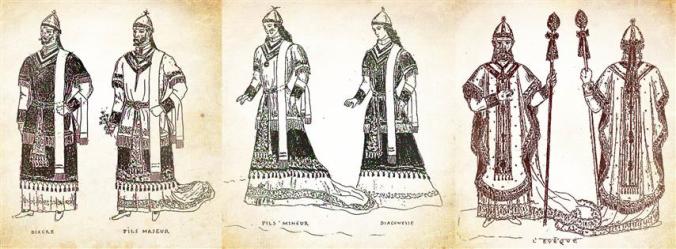
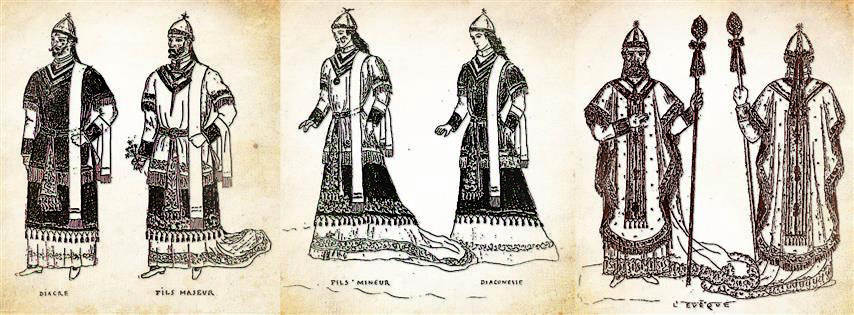
“Gnostic Catholic” vestments from Third Republic France. Note in particular the episcopal vesture at right. (Source)

In Peter Anson’s remarkable volume, Bishops at Large: Some Autocephalous Churches of the Past Hundred Years and their Founders (1964), we learn of many episcopi vagantes and their kindred spirits. It seems that several of these strange fellows dabbled (or more than dabbled) in the occult. Many also coupled that occultism with an interest in ancient heresies, which they sought to resurrect. In a chapter on the succession from René Vilatte, we stumble across a shocking little paragraph:

Mgr. Giraud and most of the priests and layfolk of the Gallican Church, even if not Gnostics themselves, were closely associated with them. Gnosticism was very much in the air fifty or sixty years ago. Even the Benedictine monks of Solesmes felt it worth their while to study what are known as the ‘Magic Vowels’ used in Gnostic rites and ceremonies. In 1901 they published a book entitled Le chant gnostico-magique. (Anson 309)

What an extraordinary claim. The monks of Solesmes, Dom Prosper Gueranger’s own sons, publishing studies of Gnostic chants! Dear readers, do any of you have any information on this bizarre note? I have been able to find evidence, however scanty, that the book Anson mentions was indeed published. But it surely must count as one of the rarest volumes in the assembled miscellanea of liturgical history. I would appreciate any leads whatsoever. Might some of my liturgically minded friends have any clue? Whatever comes of it, there is no doubt a very interesting story lurking behind this utterly unique publication.

A Note of Gratitude at Year’s End

LondonNewYears.jpg

Happy New Year! (Source)

Here are XVII things for which I am grateful in the year of Our Lord MMXVII.

1. Graduating from the University of Virginia and starting the next phase of my academic career at the University of Oxford, as well as everyone who has helped me along the way.

2. All of the friends I have left behind in Virginia, and all of the friends I have made at Oxfordfrom Staggers, my Ecclesiastical History cohort, and the Companions of Malta. Also my wonderful family who have been there for me throughout the transition.

3. Everyone who has taken the time and effort to read, share, and respond to what I have written at this blog. As of this writing, I’ve gotten 44,127 views.

4. All of the support I received when my grandmother died right before Holy Week.

5. The fact that I have several friends who have started the process of entering or returning to the Church.

6. David Lynch, Paolo Sorrentino, Peter Morgan, and Noah Hawley.

7. Rekindling my love of creating art.

8. The new basset hound my family got this winter and the rabbits we received in the spring. Not to mention the continued good health of our other pets.

9. Gin and Tonics, Whiskey Sours, and St. Germaine.

10. All the museums I have worked in or visited.

11. Discovering the joys of sticky toffee pudding.

12. My Marian consecration. The continued friendship of many saints, including St. Philip Neri and the Blessed John Henry Newman. Also the many beautiful liturgies I had the chance to attend this year.

13. The memory of those warm and golden weeks on the Lawn between the end of Spring exams and the beginning of final exercises.

14. All of the great music I have come across this year (The Revolutionary Army of the Infant Jesus, David Lang, a few pieces by John Tavener and Zbgniew Preisner, George Jones and Monteverdi, Bernstein, Gilbert & Sullivan, Chrysta Bell, James Carr and Pokey LaFarge, Gaelynn Lea, Jackson C. Frank, and so much more).

15. A new appreciation for William Blake and an introduction to the poetry of R.S. Thomas.

16. The fact that we haven’t all been nuked to kingdom come yet.

17. The laughter I have happily shared with friends and family.

May the good Lord bless all of us in the coming year of His grace!

Elsewhere: Shawn Tribe on St. Mary’s, Aiken

NewStMarysAiken.jpg

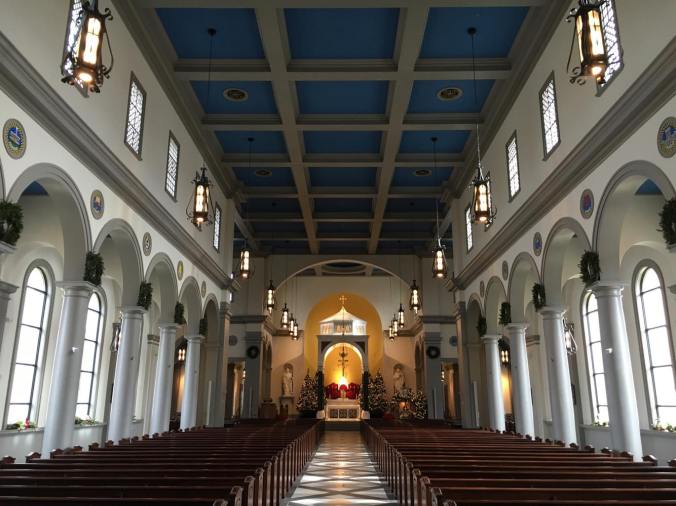
The nave of new St. Mary’s, Aiken. Photo by yours truly.

Over at Liturgical Arts Journal, Shawn Tribe has written a wonderful piece on St. Mary, Help of Christians, in Aiken, SC. He was kind enough to use some of my own photography of the parish. The new church is an excellent example of Neo-Baroque architecture in the American South. I am glad that Mr. Tribe has also devoted some attention to the gorgeous Neo-Classical stations by Leonard Porter. Do check it out!

Elsewhere: A New Blog on English Catholicism

image

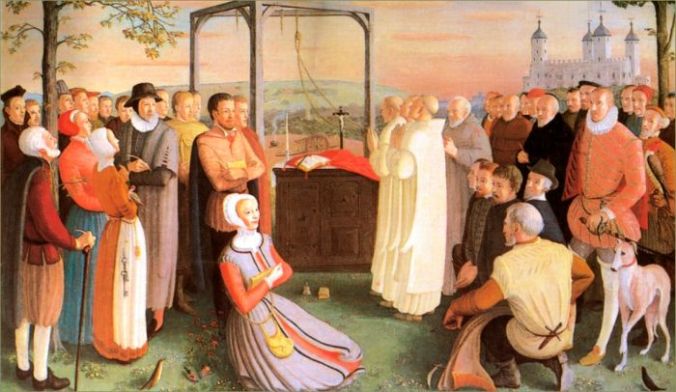
All ye holy English Martyrs, pray for us. (Source)

Anglo-Catholic readers will no doubt have mourned the demise of Conner McNeill’s Merrily on High, what was once among the best and most prolific AC blogs on the web. Never fear! Connor McNeill rides again. He’s back with a new blog called Mary’s Dowry. It looks as tasteful, reverent, and aesthetically sophisticated as the project that preceded it.

Mr. McNeill has decided to depart from the Church of England and join the Roman Communion. As he had been pursuing ordination with the C of E, this conversion is no small undertaking. Pray for him! And check out Mary’s Dowry while you’re at it.


Elsewhere: Fr. Hunwicke on Liturgical Wigs

image

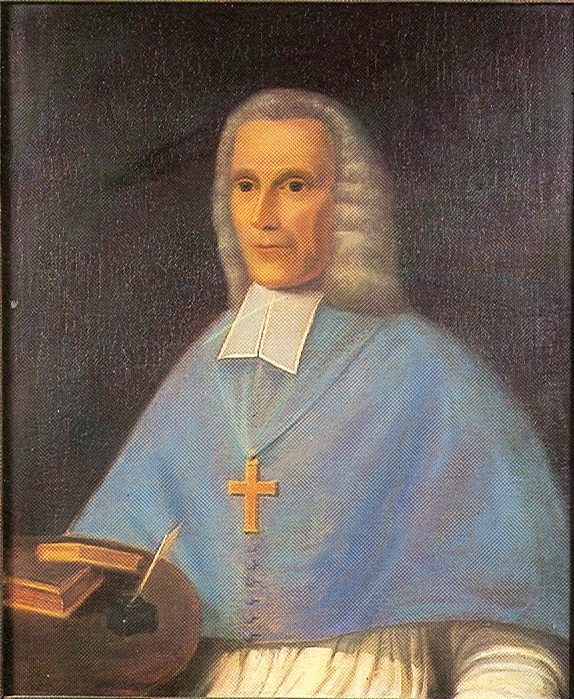
The famous portrait of Bishop Challoner to which Fr. Hunwicke refers in his piece. (Source)

I haven’t written much this week, as I’ve been traveling. However, on this beautiful  St. Bernard’s Day, I thought I’d share this brief and wonderful gem of a piece by Fr. John Hunwicke of the Ordinariate.

An excerpt:

I’m sure there are zillions of you out there who have the following sort of information right at your snuff-stained finger tips: did prelates eo fere tempore wear their wigs all through Mass? Even after their zucchetto had been removed as they approached the Consecration? When did Catholic bishops stop wearing wigs? (I think it went out of fashion in Anglican cicles in the 1830s.)

He also gets into the question of blue episcopal choir dress, mainly used in France and Ireland. Read the whole thing.

Clerical dress is one of my longstanding interests, as is the history of 18th century Catholicism. I’m glad Fr. Hunwicke is using his formidable celebrity to draw attention to these matters. While some may dismiss clerical fashion (particularly that of the Ancien Régime) as a trivial matter, I beg to differ. Clerical dress both during and outside of the liturgy is one more aesthetic component by which we can present “the beauty of holiness.” The nondescript threads worn by so many clergy and religious today are, alas, one more surrender to the cult of stark utility, false equality, failed individuality, and, in the end, boring homogeneity.

At the moment, I don’t have the time or capacity to research the questions Fr. Hunwicke raises. But The Amish Catholic will follow this story with all due attention and gravity. You can count on that. In the meantime, I’ll feast my eyes on this doozy of a cappa magna.

And After the Fire

the-morning-after-the-deluge

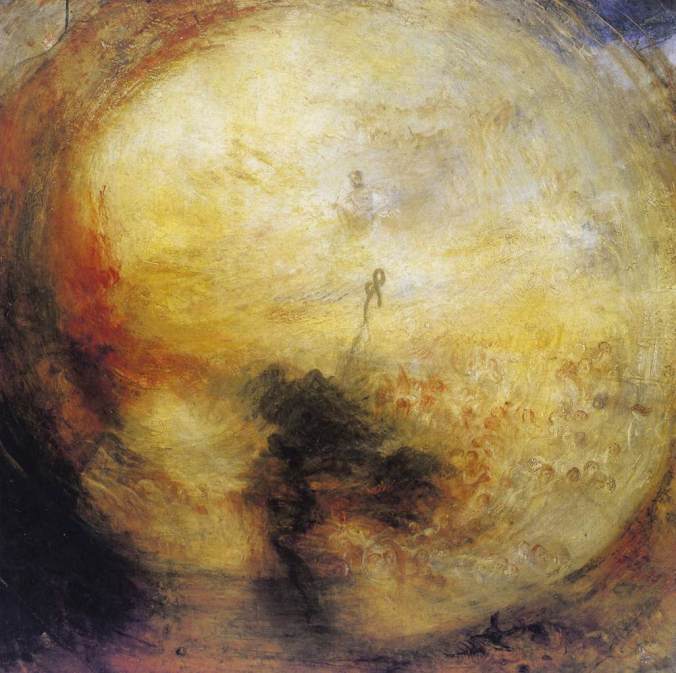
“The Morning After the Deluge,” J.M.W. Turner, c. 1843. (Source).

I am still shocked and furious about the events of the last few days. Fascists of various sorts have descended upon Charlottesville, Virginiaa town I loved and called home for four years—and caused immense pain for the entire community. One woman, a Wobbly protester, died at the hands of a Neo-Nazi who rammed his car into a crowded alley. I had friends in the counter-protest. I had friends who feared for their lives. And all I could do was watch and pray. The Rosary, the Imprecatory Psalms, Invocations to St. Michael. But how I wish I could have done so much more.

I was following the news across Facebook, CNN television, and Twitter. I observed mixed responses. Some, even among baptized Catholics, sympathize with the Alt-Right fascists. They point the finger of blame at Antifa, the several Socialists who showed up in counterprotest, the Media, and Black Lives Matter activists. Likewise, some Christians equivocated. They were happy to condemn the Alt-Right briefly, while also complaining at length about how the Media wasn’t focusing on Antifa, or the Police didn’t do enough, or, incredibly, how all of this is really just the fault of the Democratic Party (here’s looking at you, John Zmirak and Dinesh D’Souza). Then, there were those brave Catholics like Chad Pecknold, Robert George, and Bishop Barron who condemned white supremacy and racism outright. And they received backlashshameful!from those who should know better.

But I haven’t lost hope.

The Liturgical Providence of God is so calibrated to our salvation that we receive the graces we need at precisely the moment we need them, even when we could never have anticipated needing them in the first place. It works even through a deficient calendar, such as we have in the Novus Ordo. For today, we read and hear about a great many disruptions and turbulent tumults. We turn first to the Prophet Elijah at Sinai where, having cast down fire from heaven upon the Prophets of Baal, he hides and waits for the Lord to speak.

At the mountain of God, Horeb,
Elijah came to a cave where he took shelter.
Then the LORD said to him,
“Go outside and stand on the mountain before the LORD;
the LORD will be passing by.”
A strong and heavy wind was rending the mountains
and crushing rocks before the LORD—
but the LORD was not in the wind.
After the wind there was an earthquake—
but the LORD was not in the earthquake.
After the earthquake there was fire—
but the LORD was not in the fire.
After the fire there was a tiny whispering sound.
When he heard this,
Elijah hid his face in his cloak
and went and stood at the entrance of the cave.

1 Kgs 19:9a, 11-13a

The wind rises high all about Elijah; it howls and screams like the very demons of Hell. It rushes up the mountain like the chariots of the wicked King who sought the prophet’s life. But the Lord was not in the wind.

The earthquake causes the whole mountain to tremble. Rocks shake as if they are about to be torn asunder by invisible hands. The trees seem to dance in an unholy rhythm, threaten to crack and topple over. But the Lord was not in the earthquake.

The fire courses across the plain and up the slopes, hungrily devouring the short desert grasses that line the path to Horeb’s cave. The smoke fills the air; the sweltering heat traps Elijah, and threatens to make a furnace of his narrow cell. But the Lord was not in the fire.

The Lord came, instead, in a “tiny whispering sound” that followed all that tumult and trial. The frightful violence of nature may have been sublime, and it may have sorely threatened Elijah. But it was empty. God does not dwell in the frenzy of the wind, the earthquake, and the fire. He comes in peace, and He meets His servant in peace.

This week’s Psalm takes up the same theme.

R. (8) Lord, let us see your kindness, and grant us your salvation.
I will hear what God proclaims;
the LORD — for he proclaims peace.
Near indeed is his salvation to those who fear him,
glory dwelling in our land.
R. Lord, let us see your kindness, and grant us your salvation.
Kindness and truth shall meet;
justice and peace shall kiss.
Truth shall spring out of the earth,
and justice shall look down from heaven.
R. Lord, let us see your kindness, and grant us your salvation.
The LORD himself will give his benefits;
our land shall yield its increase.
Justice shall walk before him,
and prepare the way of his steps.
R. Lord, let us see your kindness, and grant us your salvation.

Ps 85:9, 10, 11-12, 13-14

The peace and salvation of God is near to those who fear Him. A great mystery hovers within these lines: “Kindness and truth shall meet; justice and peace shall kiss. Truth shall spring out of the earth, and justice shall look down from heaven.”

Justice. Peace. Those are words that scare a lot of us traditionalists. After all, haven’t so many abuses of doctrine and the liturgy occurred precisely in the name of “social justice?” Haven’t whole orders been gutted by their worldly capitulation to liberal standards of “social justice” work? And aren’t the proverbial “Social Justice Warriors” the very people who most oppose the Church’s teachings on abortion, marriage, gender, and so many other issues?

All of these criticisms are valid. But they are not complete. Justice is a cardinal virtue. To quote one of the better Anglican principles, “The abuse of a thing doth not take away the good use of it.” Consider what the Psalm teaches us of God’s Justice. Here is a picture of the Last and Eternal Day, when the New Heavens and the Earth will united at the Wedding Feast of the Lamb. But we also find a practical insight for the here and now. When we read, “Justice shall walk before him, and prepare the way of his steps,” we recognize in this a prophecy of Christ. Our Lord, whose way was prepared by St. John the Baptist (that man so like an icon of Justice), is never far from Justice. The wind and earthquake and fire of injustice will one day yield to the peace of Christ. But in the meantime, we must do what we can to realize that justice in our own communities. Indeed, in our own hearts.

This can only begin when we faithfully repair to the sacrament of penance, confessing our sins with compunction, and seek to live always as Christ would have us. For some, this may mean abandoning deep bigotries like white supremacy or a hatred of the poor. It will be difficult for those caught in such snares to relinquish their demonic ideologies, so we must pray for them. But is there anyone among us who does not cherish some prejudice, some little parasite of pride, some vice that blinds us to the manifold ways we are complicit in the oppression of our brethren? Even I am no saint in this respect, and I pray that God’s mercy might change me to better reflect His love for all people.

For some, direct action may be the right course. I am not an activist. I started this essay confessing that I wish I could have done more to help those standing against white supremacists yesterday. Yet I recognize that I have a temperamental aversion to any kind of on-the-ground activism. The task of marching, picketing, and chanting songs of justice may be what some are called to. Dorothy Day provides a wonderful Catholic example of this kind of work.

And there are other strategies, which theologians and activists have pursued for years, that aim at incarnating Justice. It would be redundant to attempt any kind of review here. But no matter how we go about the task of Justice, we musn’t lose hope. Let us hear the commiserating words of St. Paul to the Romans:

Brothers and sisters:
I speak the truth in Christ, I do not lie;
my conscience joins with the Holy Spirit in bearing me witness
that I have great sorrow and constant anguish in my heart.
For I could wish that I myself were accursed and cut off from Christ
for the sake of my own people,
my kindred according to the flesh.
They are Israelites;
theirs the adoption, the glory, the covenants,
the giving of the law, the worship, and the promises;
theirs the patriarchs, and from them,
according to the flesh, is the Christ,
who is over all, God blessed forever. Amen.

Rom 9:1-5

Even amidst the anguish we feel for our brethren, we must not lose sight of the Holy Face triumphant. Nor must we forget that Justice is not itself the highest good. God is. With these two truths in mind, we turn to the Gospel.

After he had fed the people, Jesus made the disciples get into a boat
and precede him to the other side,
while he dismissed the crowds.
After doing so, he went up on the mountain by himself to pray.
When it was evening he was there alone.
Meanwhile the boat, already a few miles offshore,
was being tossed about by the waves, for the wind was against it.
During the fourth watch of the night,
he came toward them walking on the sea.
When the disciples saw him walking on the sea they were terrified.
“It is a ghost,” they said, and they cried out in fear.
At once Jesus spoke to them, “Take courage, it is I; do not be afraid.”
Peter said to him in reply,
“Lord, if it is you, command me to come to you on the water.”
He said, “Come.”
Peter got out of the boat and began to walk on the water toward Jesus.
But when he saw how strong the wind was he became frightened;
and, beginning to sink, he cried out, “Lord, save me!”
Immediately Jesus stretched out his hand and caught Peter,
and said to him, “O you of little faith, why did you doubt?”
After they got into the boat, the wind died down.
Those who were in the boat did him homage, saying,
“Truly, you are the Son of God.”

Mt 14:22-33

We learn from the Psalm that “Justice shall walk before him, and prepare the way of his steps.” So Our Lord sends forth His Apostles, His Church, to “precede him to the other side” of the sea. The Church mystically incarnates Justice at every Mass. And it can only hope to sustain Justice, a Cardinal Virtue, with Faith. For when Peter, Prince of the Apostles, goes out of the boat to walk towards His Lord, he only sinks when he loses his Faith in fear.

But all is not lost. Christ comes through the storm and shows that He is master of it. He walks on water. No tempest can withstand Him, just as no wind, earthquake, fire, flood, protest, or violence of this world can drown out His voice. No slogan of oppression, no act of terrorism, no brawl in the summer streets can overcome the peace that Christ alone brings in and to and through His Church.

I hope that my friends in Charlottesville will take heart. The last few days have been tempestuous, to say the least. But Christ will conquer the waves of this world. Have faith, and He will grant us both justice and peace.
The Uncreated Splendor of this Day

Transfiguration-of-the-Lord-Jesus-Christ-FraAngelioc

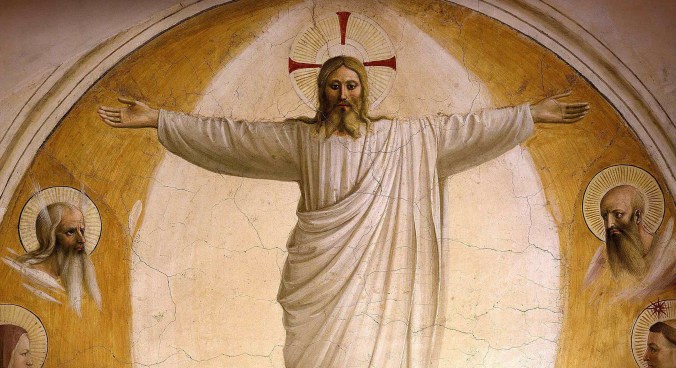
Transfiguration, Fra Angelico. Convento di San Marco, Florence. (Source)

I am currently engaged in an argument on Facebook over whether the Transfiguration or Pentecost is the most Sophiological Feast of the Church. Although I hold that the Descent of the Holy Spirit upon Our Lady and the Apostles in the Cenacle is, in fact, the most Sophiological event commemorated on the Kalendar, I’m willing to concede that today’s liturgy is refulgent with the splendor of Eternal Wisdom. I had the opportunity to attend a Solemn High Mass, complete with asperges and vesting at the chair. All the propers, all the readings, and all the prayers were as so many lights set one by one upon the altar, until their glow was consumed in the Uncreated Light of the Eucharist.

Consider the Propers. At the Introit, we pray:

Illuxerunt coruscationes tuae orbi terrae: commota est et contremuit terra. Quam dilecta tabernacula tua, Domine virtutum! concupiscit, et deficit anima mea in atria Domini.

Your lightening illumined the world; the earth quivered and quaked. How lovely is your dwelling place, O Lord of Hosts! My soul years and pines for the courts of the Lord.

Here, the Church introduces us to one of the great motifs of this holy feast: light. And not just any light. A totally beautiful, all-pervading illumination. The whole of creation responds to this light, and we who have the grace of observing it are inspired to think of the eternal “dwelling place” and “courts of the Lord” [Ps. 82:2-3].

St. Peter takes up this theme, writing to us in his epistle:

And we have the word of prophecy, surer still, to which you do well to attend, as to a lamp shining in a dark place, until the day dawns and the morning star rises in your hearts. [2 Peter 1:19]

The Prince of the Apostles knows that the Light of Lights, glimpsed first on Tabor, enkindles the hearts of all Prophets. That is why Our Lord appears there with two of the greatest Prophets. That is why the Holy Ghost, “who has spoken through the Prophets,” descends upon the assembly to announce the voice of the Father [Nicene Creed]. Yet even the light of Tabor will fade before the dawn of the Eschatonthe “morning star” of the Holy Spirit that “rises in your hearts” [2 Peter 1:19].

Moving on, we come to a Gradual in which the words of David are taken up by the whole Church as she addresses her Spouse with intimate delight:

Speciosus forma prae filiis hominum: diffusa est gratia in labiis tuis.
V. Eructavit cor meum verbum bonum: dico ego opera mea Regi.

Fairer in beauty are You than the sons of men; grace is poured out upon Your lips.
V. My heart overflows with a goodly theme; as I sing my ode to the King.

If you wanted to make the argument that the Transfiguration is the most Sophianic feast, the Alleluia would be particularly pertinent. For we pray the words of the Seventh Chapter of the Book of Wisdom (words, I might add, that are usually read in the feminine and applied to Our Lady):

Alleluia, alleluia. V. Candor est lucis aeternae, speculum sine macula, et imago bonitatis illius. Alleluia.

Alleluia, alleluia. V. He is the refulgence of eternal light, the spotless mirror, and the image of His goodness. Alleluia.

These prayers are like steps to the Temple. For, can we not see in all of these verses the very picture of the Last and Glorious Day? Are we not cast off into a vision of the Heavenly Courts, and of the Everlasting House of God? The Offertory confirms our path and calls to mind our mystical destination, where, by the Epiclesis and Consecration, we shall soon worship the Eucharistic God. We pray the words of Psalm 111:

Gloria et divitiae in domo eius: et iustitia eius manet in saeculum saeculi, alleluia.

Wealth and riches shall be in His house; His generosity shall endure forever. Alleluia.

But the Communion Verse warns us with a passage from St. Matthew:

Visionem, quam vidistis, nemini dixeritis, donec a mortuis resurgat Filius hominis.

Tell the vision you have seen to no one, till the Son of Man has risen from the dead.

Whenever we are privileged enough to enter into a Sophianic mystery, the Blessed Mother is never far away. Nor can she be ignored in this, the month of her Sorrowful and Immaculate Heart, the month in which we celebrate her Glorious Assumption and her Queenship over all Heaven. We should be extra attentive to her quiet presence. Thus, in this Communion verse, we learn to be like Mary. For, “Mary treasured up all these things, pondering them in her heart” [Luke 2:19 ESV]. That is the rule Jesus teaches to the Apostles who witnessed His Transfiguration. This, too, is an expression of Holy Wisdom, in the virtue of Prudence. An experience of such mystical consolation, like the Mustard Seed we learned about in Monday’s Gospel, would one day grow into an enormous tree where “the birds of the air come, and dwell in the branches thereof,” [Matt. 13:32]. But first, it had to be watered by the Blood of Christ.

So must we. If we are to make good use of the many graces we receive, we must offer them back up to Christ to receive His Blessing. Only He can make our hearts Eucharistic like His own; only He can send the Spirit to enkindle our souls with charity and wisdom; only He can impart the Uncreated Light that He first manifested on Mount Tabor.