The Polyphony of Paul Jernberg

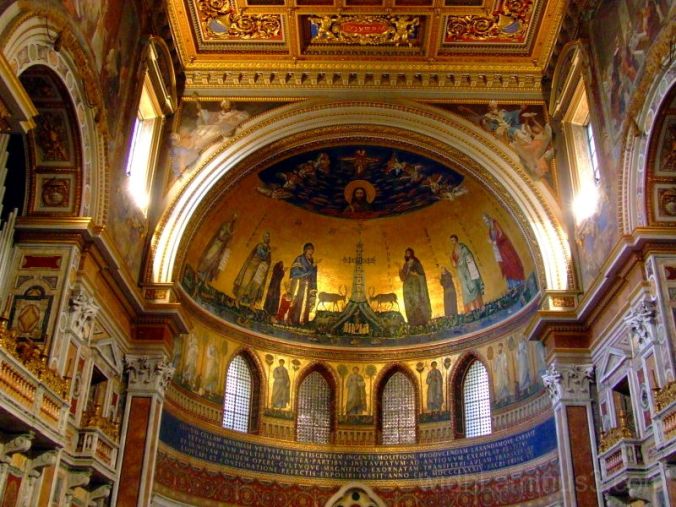
basilica-st-john-lateran

The Basilica of St. John Lateran, Rome. (Source).

What a delectable treat it is to discover a composer of sacred music who really manages to capture something of the transcendent in his liturgical settings. Having just come across the work of Paul Jernberg, I must say that I am gobsmacked. Really. With his Mass of St. Philip Neri, Jernberg has done for the Latin Rite what Roman Hurko accomplished for the Ukrainians with his Liturgy No. 3. Finally, we have a modern polyphonic Mass setting that evokes the eternal, delights the senses, and inspires the heart with a sense of God’s glory. And in English!

I am sure that those more in the loop of liturgical news will be well aware of this recording from 2014, but it came to me as a revelation. My guess is that most Catholics are probably unaware that a musical setting this rich, hieratic, and flat-out beautiful has come to be in recent years. And no doubt, those with Oratorian connections and interests will also appreciate the particular Mass that Jernberg chose.

Do take some time to listen to the Gloria, the Kyrie, the Alleluia, the Eucharistic Ordinary, the Sanctus, and the various other excerpts provided on Jernberg’s own website. You won’t regret it.

Jernberg

What a feat. (Source).

Why I Am a Catholic

Paris-N-Dame-N

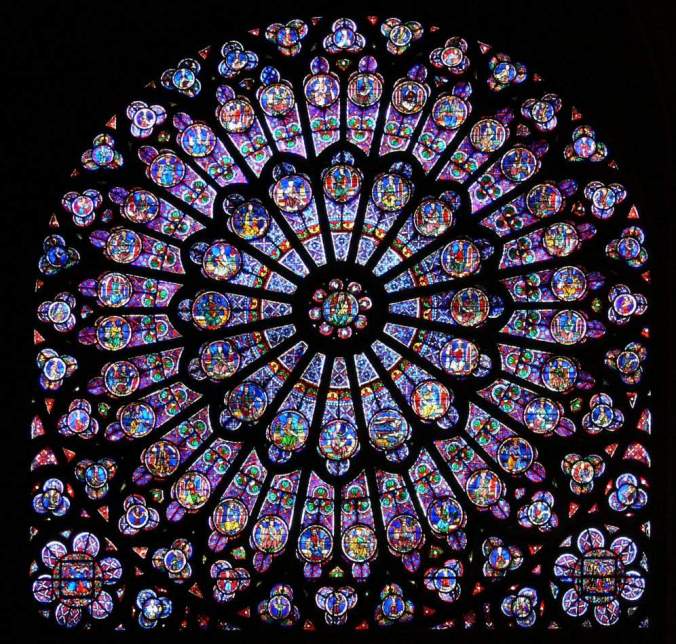
The North Rose Window of Notre Dame de Paris. (Source).

Right around January of 2016, Mr. Owen White (formerly?) of The Ochlophobist, issued a challenge to the religious blogosphere asking writers why they adhered to their faiths. The challenge lay in the rules; if memory serves correctly, you could only answer with five or so selections of media by figures who, to the best of your knowledge, were outside that faith. I wrote up my own list, but as I wasn’t blogging at the time, I didn’t publish it anywhere. I just found it again, decided to add an extra two pieces, and thought I’d put it here for anyone who might care. 

The dove descending breaks the air
With flame of incandescent terror
Of which the tongues declare
The one discharge from sin and error.
The only hope, or else despair
Lies in the choice of pyre of pyre-
To be redeemed from fire by fire.

Who then devised the torment? Love.
Love is the unfamiliar Name
Behind the hands that wove
The intolerable shirt of flame
Which human power cannot remove.
We only live, only suspire
Consumed by either fire or fire.

TS. Eliot, “Little Gidding”


O sages standing in God’s holy fire
As in the gold mosaic of a wall,
Come from the holy fire, perne in a gyre,
And be the singing-masters of my soul.
Consume my heart away; sick with desire
And fastened to a dying animal
It knows not what it is; and gather me
Into the artifice of eternity.

W. B. Yeats, “Sailing to Byzantium”


Rest your cheek, for a moment, on this drunken cheek.
Let me forget the war and cruelty inside myself.
I hold these silver coins in my hand;
Give me your wine of golden light.
You have opened the seven doors of heaven;
Now lay your hand generously on my tightened heart.
All I have to offer is this illusion, my self.
Give it a nickname at least that is real.
Only you can restore what you have broken;
Help my broken head.
I’m not asking for some sweet pistachio candy,
But your everlasting love.
Fifty times I’ve said,
“Heart, stop hunting and step into this net.”

Rumi, “The War Inside,” trans. Kabir Helminski


Somehow it has all
added up to song
earth, air, rain and light,
the labor and the heat,
the mortality of the young.
I will go free of other
singing, I will go
into the silence
of my songs, to hear
this song clearly.

Wendell Berry, “A Song Sparrow Singing in the Fall”


Helplessness Blues” by Fleet Foxes


The Tree of Life, by Terrence Malick


mother-of-the-world-1924.jpg

“Mother of the World,” Nicholas Roerich, 1924. (Source).

The Idea of a Gentleman

JohnHenryNewmanLateral

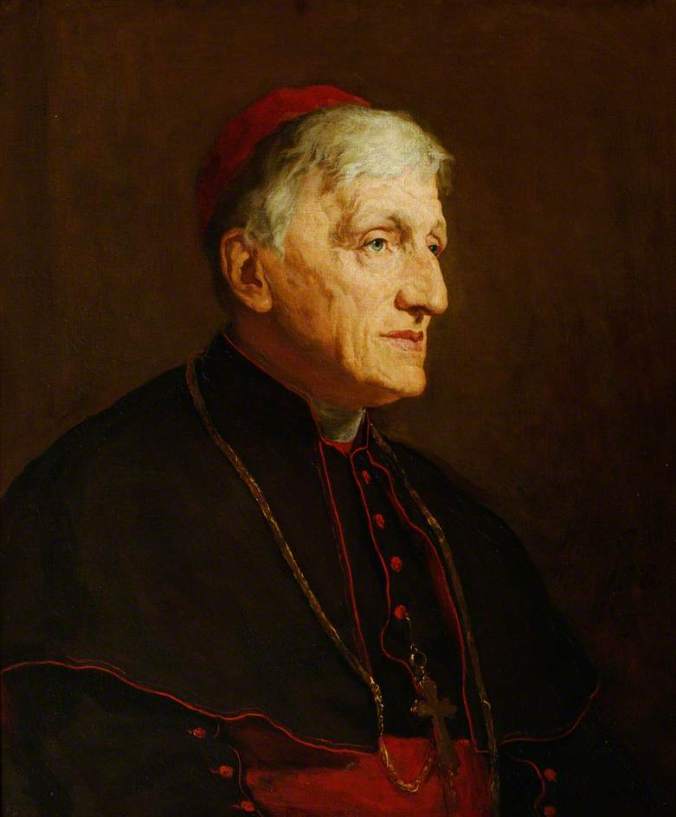
Blessed John Henry Cardinal Newman (Source).

In conducting research for another, soon to be completed blog post, I came across this wonderful passage by John Henry Newman. I first read these words a few years ago, but had since forgotten about them. I thought it might be worth bringing them to your attention. At the very least, I wanted a place to keep the passage so that I might easily and regularly find it again. I took the text, originally appearing in The Idea of a University, from here and here.

It’s worth noting that Newman elucidates his definition to suggest that there is no supernatural merit to being a gentleman. It is a generally commendable though by no means salutary disposition, and can be cultivated without any reference to religious truth. Newman later goes on to argue that a truly Catholic institution of higher learning will thus not be content to form gentlemen, though it will do that civilizing task as well. 

Hence it is that it is almost a definition of a gentleman to say that he is one who never inflicts pain. This description is both refined and, as far as it goes, accurate. He is mainly occupied in merely removing the obstacles which hinder the free and unembarrassed action of those about him; and he concurs with their movements rather than takes the initiative himself. His benefits may be considered as parallel to what are called comforts or conveniences in arrangements of a personal nature; like an easy chair or a good fire, which do their part in dispelling cold and fatigue, though nature provides both means of rest and animal heat without them. The true gentleman in like manner carefully avoids whatever may cause a jar or a jolt in the minds of those with whom he is cast — all clashing of opinion, or collision of feeling, all restraint, or suspicion, or gloom, or resentment; his great concern being to make every one at his ease and at home. He has his eyes on all his company; he is tender towards the bashful, gentle towards the distant, and merciful towards the absurd; he can recollect to whom he is speaking; he guards against unseasonable allusions, or topics which may irritate; he is seldom prominent in conversation, and never wearisome. He makes light of favors while he does them, and seems to be receiving when he is conferring. He never speaks of himself except when compelled, never defends himself by a mere retort; he has no ears for slander or gossip, is scrupulous in imputing motives to those who interfere with him, and interprets everything for the best. He is never mean or little in his disputes, never takes unfair advantage, never mistakes personalities or sharp saying for arguments, or insinuates evil which he dare not say out. From a long-sighted prudence, he observes the maxim of the ancient sage, that we should ever conduct ourselves towards our enemy as if he were one day to be our friend. He has too much good sense to be affronted at insults, he is too well employed to remember injuries, and too indolent to bear malice. He is patient, forbearing, and resigned, on philosophical principles; he submits to pain, because it is inevitable, to bereavement, because it is irreparable, and to death, because it is his destiny.

If he engages in controversy of any kind, his disciplined intellect preserves him from the blundering discourtesy of better, perhaps, but less educated minds; who, like blunt weapons, tear and hack instead of cutting clean, who mistake the point in argument, waste their strength on trifles, misconceive their adversary, and leave the question more involved than they find it. He may be right or wrong in his opinion, but he is too clear-headed to be unjust; he is as simple as he is forcible, and as brief as he is decisive. Nowhere shall we find greater candor, consideration, indulgence: he throws himself into the minds of his opponents, he accounts for their mistakes. He knows the weakness of human reason as well as its strength, its province and its limits.

If he be an unbeliever, he will be too profound and large-minded to ridicule religion or to act against it; he is too wise to be a dogmatist or fanatic in his infidelity. He respects piety and devotion; he even supports institutions as venerable, beautiful, or useful, to which he does not assent; he honors the ministers of religion, and it contents him to decline its mysteries without assailing or denouncing them. He is a friend of religious toleration, and that, not only because his philosophy has taught him to look on all forms of faith with an impartial eye, but also from the gentleness and effeminacy of feeling, which is the attendant on civilization.

Not that he may not hold a religion too, in his own way, even when he is not a Christian. In that case his religion is one of imagination and sentiment; it is the embodiment of those ideas of the sublime, majestic, and beautiful, without which there can be no large philosophy. Sometimes he acknowledges the being of God, sometimes he invests an unknown principle or quality with the attributes of perfection. And this deduction of his reason, or creation of his fancy, he makes the occasion of such excellent thoughts, and the starting-point of so varied and systematic a teaching, that he even seems like a disciple of Christianity itself. From the very accuracy and steadiness of his logical powers, he is able to see what sentiments are consistent in those who hold any religious doctrine at all, and he appears to others to feel and to hold a whole circle of theological truths, which exist in his mind no otherwise than as a number of deductions.

The Waste Land of Father John Misty

image

Father John Misty. (Source).

A Christ in sunglasses is nailed to a papier-mâché cross. He is, in fact, not just Jesus, but also Macauley Culkin and Kurt Cobain at once, the triune victim of philistines and a squad of jackbooted, mocking Romans who are dressed as Ronald McDonald. A Xenomorphic version of the clown himself pops out of the hook-handed captain’s chest and fires a lazer at a bleeding-eyed Virgin in a red Wendy’s wig. The good thief is Bill Clinton on a confetti-colored cross. The titulus crucis has been replaced with a cardboard scroll that reads “King of the Cucks.” Before departing, the last fast-food fascist takes a selfie with the Cobain-Christ. And good old George Washington, Oculus Rift still clasped to his head, burns to a crisp in orgiastic entertainment as the virtual sacrifice concludes.

Was this an Ayahuasca trip, a mystic hallucination, or a rather heavy-handed SNL skit?

The answer, of course, is D, none of the above. It’s just another Father John Misty video. This one is entitled “Total Entertainment Forever,” and the track comes from his new release from Sub Pop, Pure Comedy. Father John Misty (alias Josh Tillman) has long produced a body of work at once blasphemous and baffling, though occasionally given to brief bursts of beauty. There is less of this latter quality in his newest album, and it’s sorely missed. Tillman has instead given us a project bloated with its own sense of self-importance and suffocating on its own shallow satirical spite.

Of course, it’s perfectly fine for an artist to mock, to rally, or to critique. Some of the greatest art does all three at once. Take, for instance, that modernist monolith, The Waste Land. T.S. Eliot may have contended for years that it was just “the relief of a personal and wholly insignificant grouse against life…just a piece of rhythmical grumbling,” but critics of every generation have recognized in the poem a powerful diagnosis of the sickness of Western civilization. Much of Eliot’s “grouse” remains relevant today, in part because, even as he pilloried all kinds of people, he grounded his art in the perennial images of human culture.

Father John Misty, alas, does not. He is content to complain without saying anything all that deep, and without investing his work with the kind of symbolic depth we recognize in Eliot.

The titular track, “Pure Comedy,” sets the mood for the rest of the album. We might as well spend some time looking at the lyrics. They reveal quite a lot about Father John Misty’s priorities and self-perception. Here are the first lines:

The comedy of man starts like this
Our brains are way too big for our mothers’ hips
And so Nature, she divines this alternative
We emerged half-formed and hope that whoever greets us on the other end
Is kind enough to fill us in
And, babies, that’s pretty much how it’s been ever since

The song goes on to announce that mankind’s lot is really just,

Comedy, now that’s what I call pure comedy.
Just waiting until the part where they start to believe
They’re at the center of everything
And some all-powerful being endowed this horror show with meaning

That right there is the little light in the plane that tells us to buckle up and get ready for the hackneyed atheist bits.

Oh, their religions are the best
They worship themselves yet they’re totally obsessed
With risen zombies, celestial virgins, magic tricks, these unbelievable outfits
And they get terribly upset
When you question their sacred texts
Written by woman-hating epileptics

For those of you who didn’t watch the video I linked above, let me save you some time. He’s not talking about Islam and Judaism. Tilman is mainly targeting Catholicism, even if he refrains from becoming explicit about it in the lyrics. Worse, he’s not even terribly original. The verse just distills the common, fedora-tipping New (c. 2006) Atheism of the Internet. Josh Tilman is no Ivan Karamazov.

Tillman has shown a longstanding interest in religious themes, as his previous two album covers demonstrate. He is known to sprinkle his songs with religious allusions. Pure Comedy features a track entitled “When the God of Love Returns There’ll Be Hell to Pay.” Tillman sings about what he would tell Jesus as the Apocalypse unfolds. He says that he would give Jesus a tour of the world, then says:

Barely got through the prisons and stores
And the pale horse looks a little sick
Says, “Jesus, you didn’t leave a whole lot for me
If this isn’t hell already then tell me what the hell is?”

Tillman, never wary of blasphemy, says to Christ, “And now you’ve got the gall to judge us.” One might point out the irony of Tillman posing as a holier-than-thou moral authority when, just a few lines earlier, he equates prisons and stores. If this fatuous and fundamentally unserious judgment doesn’t betray a warped moral sensibility, then I’m not sure what does.

On a more philosophical note, let me say that it is the prerogative of the artist to explore the bounds of the possible, especially when crafting strange hypotheticals like the one that Tillman imagines. Tillman also works in a long tradition of artists who mediate their work through the careful deployment of personae. His stage-name, Father John Misty, is a good example of this tendency (and a religiously-tinged one at that). But even granting these stipulations about the nature of art, we should remember a third point. All art inherently crafts aesthetic experience and therefore “sets the stage” for a presentation and affective reception of beauty. Insofar as art is bound to beauty, it is necessarily tied to the good and the true as well. Art can deny, flatter, hide, contest, mask, or assail goodness and truth, but it can never be rid of them and their own proper criteria. The problems that arise when we try too hard to make art “good” or “true” are many and easy to identify. But we cannot totally separate the aesthetic world from the moral and scientific spheres of life. An artist whose work displays a perverse moral sensibility may produce great art, but it will be somewhat immoral, and it may not correspond to the way things really are.
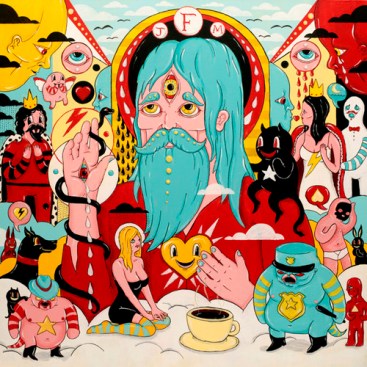
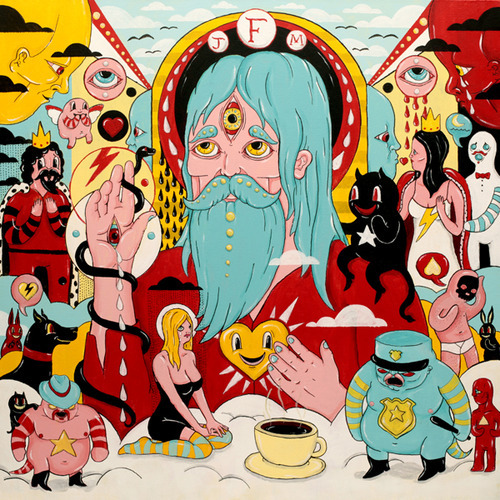
FearFun

Fear Fun (2012). A much better album. Note the religious imagery underneath all the chaos.
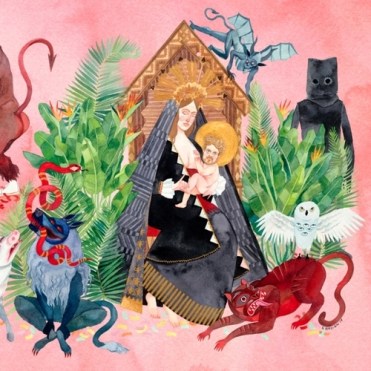
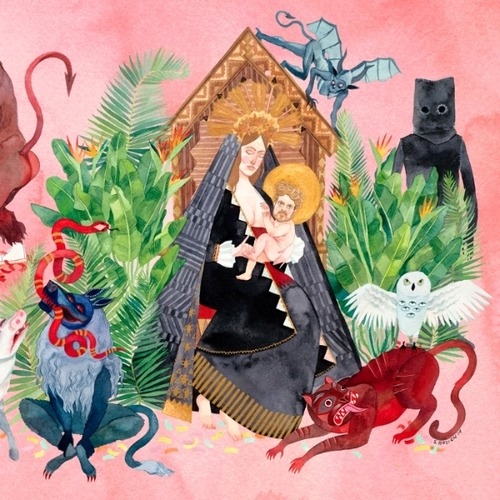
ILoveYouHoneyBear

I Love You, Honeybear (2015). A not very good but still better album. Here, too, FJM appropriates Christian iconography.

But back to “Pure Comedy.”

Perhaps because his criticism of religion/Christianity is so stale, Tillman spices things up a bit in the next verse by trying to be Relevant© and Woke™. Even without watching the video, you can tell that it’s about a certain unsavory Head of State.

Their languages just serve to confuse them
Their confusion somehow makes them more sure
They build fortunes poisoning their offspring
And hand out prizes when someone patents the cure
Where did they find these goons they elected to rule them?
What makes these clowns they idolize so remarkable?
These mammals are hell-bent on fashioning new gods
So they can go on being godless animals

It’s not clear whether Tillman lost his faith in humanity because of Trump, or if the Donald’s ascent merely confirmed a longstanding pessimism. One could perhaps sympathize with the latter position, if only because it would be intellectually honest.

But I digress.

We come to the emotional climax of the song.

Oh comedy, their illusions they have no choice but to believe
Their horizons that just forever recede
And how’s this for irony, their idea of being free is a prison of beliefs
That they never ever have to leave

I would take his point more seriously if it were not a banal and adolescent bastardization of Camus or Rand or Nietzsche or [insert edgelord here]. “Pure Comedy” is not unique in this sense of immaturity. Listening and reading through all the songs, I was repeatedly reminded of angsty teenage poetry. Tillman’s unhappy tendency to be biographical, abstract, and preachy was not nearly as pronounced in his earlier work as Father John Misty (I can’t speak to his releases as J. Tillman).

Unfortunately, the song doesn’t get better from there. In the final verse, Tillman croons,

The only thing that seems to make them feel alive is the struggle to survive
But the only thing that they request is something to numb the pain with
Until there’s nothing human left
Just random matter suspended in the dark
I hate to say it, but each other’s all we got

The idea of our planet being nothing more than a rock in space comes up again and again throughout the album. At the beginning of one track, Tillman calls the earth “this bright blue marble orbited by trash.” It’s Eliot’s “Unreal City,” brought up to date for the space age. But in that last line, we hear the echoes of Auden’s famous poem about the beginning of World War II; “We must love one another or die.” It’s a maudlin sentiment that Auden repented for the rest of his life. One wonders if Tillman will someday look back on the shallow clichés of “Pure Comedy” with the same sense of regret.

The rest of the album continues these themes. Tillman gives us a tour of the imbecility of human nature, especially as manifested by the entertainment industry, pharmaceutical corporations, Republicans, fast food, the religious, Middle America, social media, public intellectuals, and ideologues of all sorts. By the end, the Holden Caulfield act gets old. In most of the songs, the music trundles along aimlessly, neither powerful nor novel enough to sustain Tilman’s puerile lyrics.
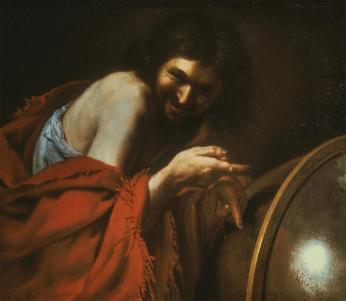
Democritus-laughing

Democritus laughs because he sees that the world is hopeless. (Source).

All of which is a serious disappointment to someone like me, who’s been a fan for years. You see, this ain’t Father John Misty’s first rodeo in the American Wasteland. His earlier work often treated these same themes, but in a more aesthetically and intellectually sophisticated way. Where in Pure Comedy do we find a song that matches the sultry and haunting sense of doom rippling through “Funtimes in Babylon?” Or the perky, quirky, frenzied mania of “I’m Writing a Novel?” Or the languid malaise of “Bored in The USA?” Or the soulfully earnest and operatically desperate madman’s litany, “Holy Shit,” perhaps Tilman’s finest piece yet? All of these songs work, not just because of their evocative lyrics, but because they are genuine musical accomplishments. Each is a gem of a song in its own way. In each, Tillman flexes the considerable powers of his unique voice. His sound manages to swing seamlessly between a controlled vigor and a vulnerability that shines without brittleness.

The album is not without its strengths. The satire does sometimes land pretty well, as in “Birdie” and “Things It Would Have Been Helpful To Know Before the Revolution” and “Ballad of the Dying Man.” In “The Memo,” Tillman wields his well-refined sense of shock value to drive home an unremittingly cynical take on the entertainment and advertising industries. But perhaps I’m just gravitating to songs that are pretty clearly meant to mock the left establishment or deflate the pretensions of neoliberals and transhumanists.

In “Dying Man,” we hear:

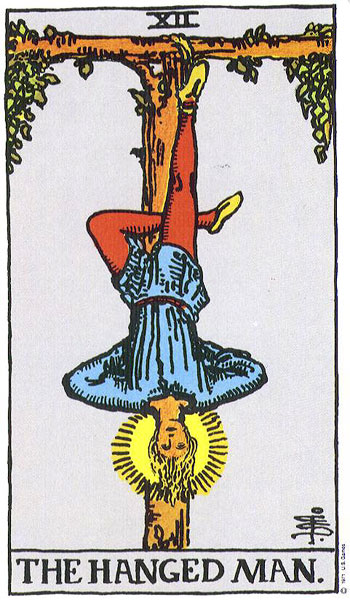
TheHangedManTarot

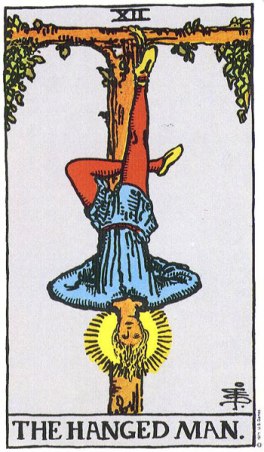
“Consider Phlebas…” (Source)

So says the dying man once I’m in the box
Just think of all the overrated hacks running amok
And all of the pretentious, ignorant voices that will go unchecked
The homophobes, hipsters, and 1%
The false feminists he’d managed to detect
Oh, who will critique them once he’s left?

A nice bit of biting sarcasm there. But sadly, Tilman smothers his wit under clunky dictiona verbose, chatty mess apparently composed without any care for euphony. Paired with lackluster music, the song fails.

The only really superlative work in the entire album is Tillman’s flawless penultimate track, “So I’m Growing Old on Magic Mountain.” Here, too, he is commenting on the madness of our times. But he’s left aside the pose of the pontificating prophet. Gone are the grand and sweeping lines about “human nature” as in “When the God of Love Returns.” Gone, too, are the plastic, pop-culture in-jokes that masquerade as hot takes; gone, the pearl-clutching about the woes of consumerism and fast food and the stupid white people who vote Republican and believe in God.

Instead, Tillman tells a story. A New Year’s Eve party has just ended, and the revelry is fading away. One of the guests describes the scene.

That’s it. Observe:

The wine has all been emptied
And smoke has cleared
As people file back to the valley
On the last night of life’s party
These days the years thin till I can’t remember
Just what it feels like to be young forever

Tillman’s more symbolic and sensitive tack suits his message; our age echoes the cultural moment that led Thomas Mann to write The Magic Mountain, and coming to grips with that realization has aged us. His sonic scene-craft evokes universal images and elevates the song into a testament of the human condition. If Tilman intends to speak to our particular cultural moment in Pure Comedy, he succeeds with “Magic Mountain.”

The only real shame is that there weren’t more songs like it on the rest of the album.

Pure Comedy
Father John Misty, Sub Pop Records, 2017
5.5/10 stars.
Newman on the Sacred Heart

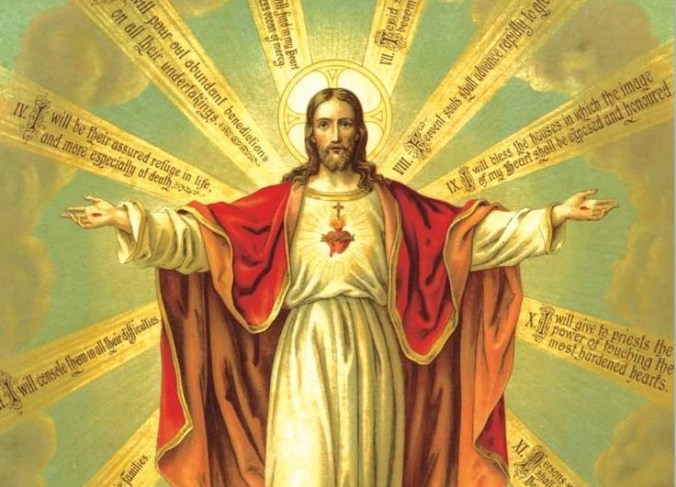
SacredHeartPromises

The Twelve Promises of the Sacred Heart of Jesus. (Source).

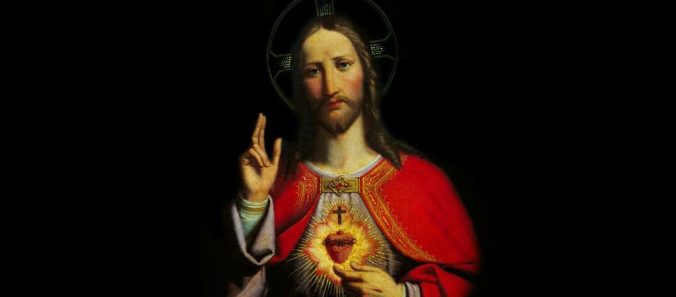
I reproduce below the fine meditation on the Sacred Heart penned by Cardinal Newman. It is number XVI of his Meditations and Devotions, taken here from the Newman Reader.

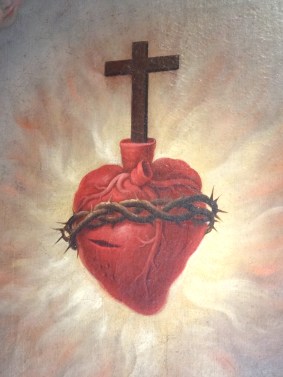
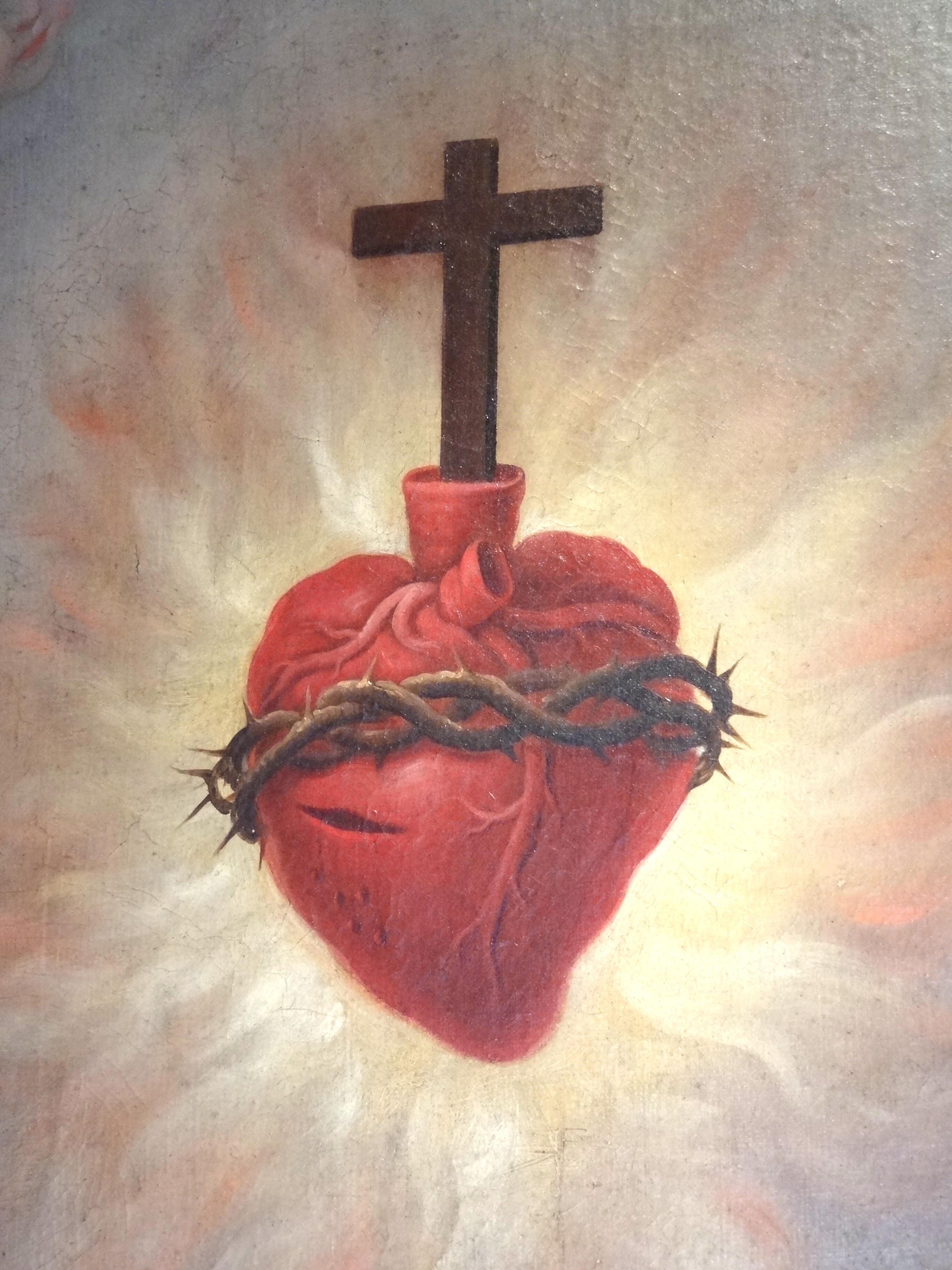
sacred-heart.jpg

Sacred Temple of God. (Source).

O SACRED Heart of Jesus, I adore Thee in the oneness of the Personality of the Second Person of the Holy Trinity. Whatever belongs to the Person of Jesus, belongs therefore to God, and is to be worshipped with that one and the same worship which we pay to Jesus. He did not take on Him His human nature, as something distinct and separate from Himself, but as simply, absolutely, eternally His, so as to be included by us in the very thought of Him. I worship Thee, O Heart of Jesus, as being Jesus Himself, as being that Eternal Word in human nature which He took wholly and lives in wholly, and therefore in Thee. Thou art the Heart of the Most High made man. In worshipping Thee, I worship my Incarnate God, Emmanuel. I worship Thee, as bearing a part in that Passion which is my life, for Thou didst burst and break, through agony, in the garden of Gethsemani, and Thy precious contents trickled out, through the veins and pores of the skin, upon the earth. And again, Thou hadst been drained all but dry upon the Cross; and then, after death, Thou wast pierced by the lance, and gavest out the small remains of that inestimable treasure, which is our redemption.


SacredHeartVintage

Burning Furnace of Charity. (Source).

My God, my Saviour, I adore Thy Sacred Heart, for that heart is the seat and source of all Thy tenderest human affections for us sinners. It is the instrument and organ of Thy love. It did beat for us. It yearned over us. It ached for us, and for our salvation. It was on fire through zeal, that the glory of God might be manifested in and by us. It is the channel through which has come to us all Thy overflowing human affection, all Thy Divine Charity towards us. All Thy incomprehensible compassion for us, as God and Man, as our Creator and our Redeemer and Judge, has come to us, and comes, in one inseparably mingled stream, through that Sacred Heart. O most Sacred symbol and Sacrament of Love, divine and human, in its fulness, Thou didst save me by Thy divine strength, and Thy human affection, and then at length by that wonder-working blood, wherewith Thou didst overflow.

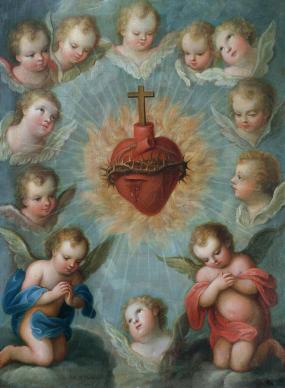
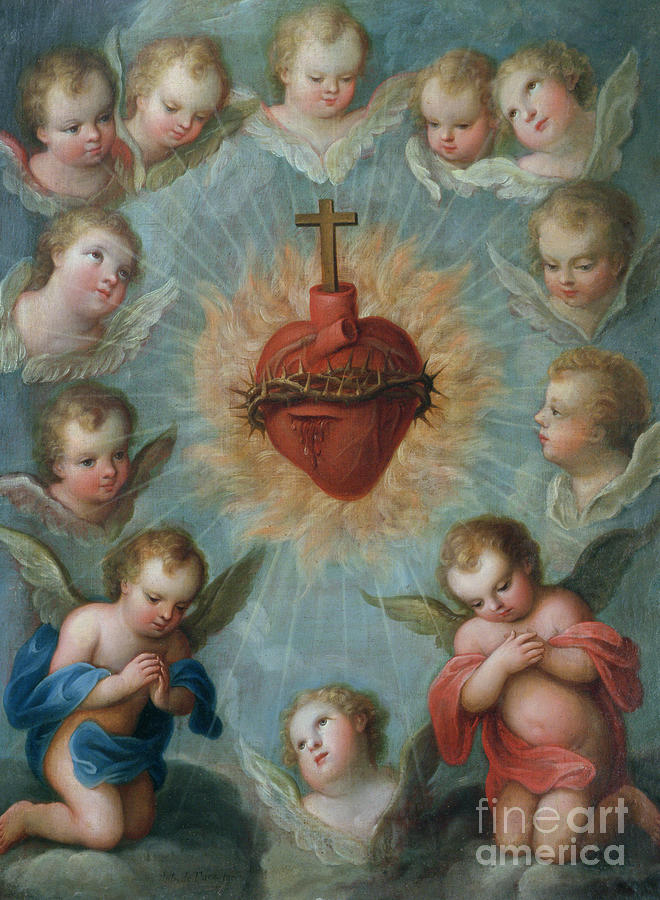
sacred-heart-of-jesus-surrounded-by-angels-jose-de-paez

Tabernacle of the Most High. (Source).

O most Sacred, most loving Heart of Jesus, Thou art concealed in the Holy Eucharist, and Thou beatest for us still. Now as then Thou savest, Desiderio desideravi—”With desire I have desired.” I worship Thee then with all my best love and awe, with my fervent affection, with my most subdued, most resolved will. O my God, when Thou dost condescend to suffer me to receive Thee, to eat and drink Thee, and Thou for a while takest up Thy abode within me, O make my heart beat with Thy Heart. Purify it of all that is earthly, all that is proud and sensual, all that is hard and cruel, of all perversity, of all disorder, of all deadness. So fill it with Thee, that neither the events of the day nor the circumstances of the time may have power to ruffle it, but that in Thy love and Thy fear it may have peace.

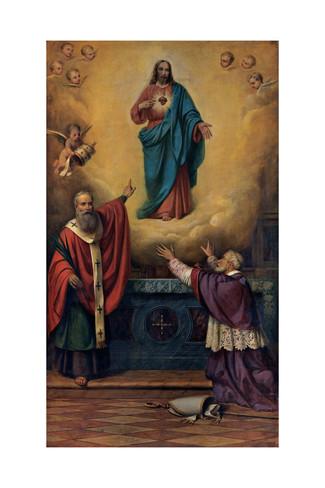
bartolomeo-dusi-sacred-heart-of-jesus-with-st-marcel-and-blessed-juvenal-ancina

“Sacred Heart of Jesus with St. Marcel and Blessed Juvenal Ancina” by Bartolomeo Dusi. (Source).

A Norbertine Poem for the Sacred Heart

SacredHeartBlackBackground

Most Sacred Heart of Jesus, have mercy on us. (Source).

I happened upon this wonderful poem by one Frater Simeon Charles Goodwin, O.Praem., a seminarian at St. Michael’s Abbey. It’s always a delight to find good rhyming verse with a tightly-wound meterand rich theology to boot! Throughout the text, we can detect hints of Chesterton and, in the very last couplet, the sensual, baroque Richard Crashaw. I offer it here for your enjoyment on this solemnity of the Sacred Heart.

The Sacred Heart

    by Simeon Charles Goodwin, O.Praem.

There is a heart that beat with love
When time could mark no beat.
It echoed with a triple-pulse
And surged in thunders sweet.

Too happy not to overflow
It laughed and all was made.
It sighed and angel hosts came forth
In myriad parade.

It sang the seas and skies to be,
Hummed forth the rolling hills.
It beamed out beast and bird in love,
A sweet and mighty will.

It breathed into the mire and muck,
Sweet nothings to the earth;
And clay was made creation’s crown,
Man made with God’s own worth.

And how that heart did pound with peace
When he and man would walk
In silent love in evening winds
Too full of love for talk.

Oh man was glad and God was glad
And all creation too,
But man in madness pierced God’s heart
And rent the world in two.

There is a secret hideaway
Where cosmoi come to cry,
With atrium no bigger than
The needle’s narrow eye.

And there the mighty waters wait
To burst on arid wastes.
Men need but kiss the lance-made lips
To learn how sweet blood tastes.

A Corpus Christi Meditation

GasparroTransustanziazio

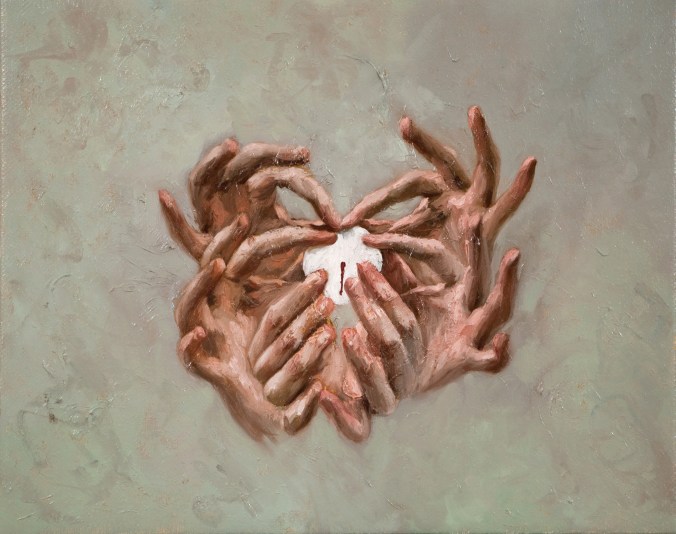
Transustanziazione,” by Giovanni Gasparro. He’s one of the best Catholic artists working today.

In my parish, as in most, the Solemnity of Corpus Christi has been moved from its traditional spot on the Thursday after Trinity to the following Sunday. There are many unfortunate implications of this liturgical change, but today I’d rather focus on what grace I received from the readings and prayers of today’s Ferial Mass.

I’d like to start, however, with a painting, “Transustanziazione,” by Giovanni Gasparro. Only in the work of Salvador Dali do we find a modern artist who captures the mystical dimension of the Eucharist in such an original way. And Gasparro’s piece is far simpler, and therefore more visually striking, than any of Dali’s several Eucharistic paintings.

Three pairs of hands, like the three pairs of wings on the seraphim and cherubim, bear aloft a bleeding host in undifferentiated space. The three sets of hands appear the samethey are, perhaps, the hands of the same priest captured over the lapse of time. This distortion of time and space lends the image a sense of eternity. We are viewing something transcendent. The Eucharist is not just an earthly event. It is also a rite which happens forever in the cosmic liturgy of heaven. And who is the Great High Priest offering that liturgy for us mortals? Who but Christ? In Gasparro’s image, Christ is present as priest and victim.

The three pairs of hands also remind us of the Trinity. When we approach the Eucharist, we truly approach the Triune God. At every Mass, the act of Transubstantiation only happens because of the work of the whole Trinity. Christ offers Himself to the Father in the Holy Spirit, through the hands of His priests and the prayer of His bride, the Church. It is meet and right that we should consider the painting at this point between the Ordinary Form celebrations of Trinity Sunday and Corpus Christi.

The painting has a certain sacramentality, in that, like the liturgy, it captures something of the invisible and manifests it to our earthbound senses. Looking at Gasparro’s painting, we have the sense that we are glimpsing something profound, unsettling, and sacredsomething ordinarily hidden from us. Do we not hear the words of St. Thomas’s Corpus Christi hymn, Lauda Sion?

Here beneath these signs are hidden,
Priceless things, to sense forbidden,
Signs, not things, are all we see.

Today’s liturgy powerfully brings this quality to mind. As we turn to the First Reading from today’s Mass, we encounter the words of St. Paul:

Brothers and sisters: To this day, whenever Moses is read, a veil lies over the hearts of the children of Israel, but whenever a person turns to the Lord the veil is removed. Now the Lord is the Spirit and where the Spirit of the Lord is, there is freedom. All of us, gazing with unveiled face on the glory of the Lord, are being transformed into the same image from glory to glory, as from the Lord who is the Spirit.

Therefore, since we have this ministry through the mercy shown us, we are not discouraged. And even though our Gospel is veiled, it is veiled for those who are perishing, in whose case the god of this age has blinded the minds of the unbelievers, so that they may not see the light of the Gospel of the glory of Christ, who is the image of God. For we do not preach ourselves but Jesus Christ as Lord, and ourselves as your slaves for the sake of Jesus. For God who said, Let light shine out of darkness, has shone in our hearts to bring to light the knowledge of the glory of God on the face of Jesus Christ.

This, from the Second Epistle to the Corinthians.

The Liturgical Providence of God permits us to hear these words of the Apostle on a day which, in the Old Calendar, was the preeminent feast of the Eucharist as such. All Thursdays are to be read in light of the Eucharist, mystically tied as they are to this holy feast and to Maundy Thursday.

RussianHolyFace

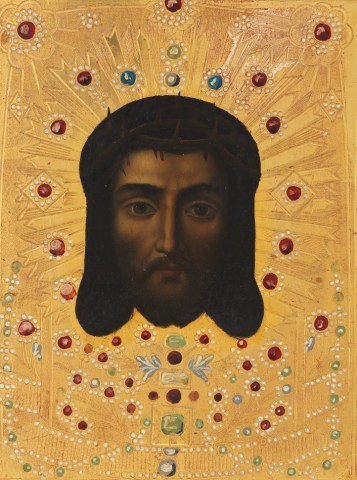
Russian icon of The Holy Face of Jesus “Not-Made-by-Hands”(Source).

St. Paul is doing many things in this passage. It is an extremely rich vein of mystical insight, and it could yield untold spiritual fruit. But one very clear move that St. Paul makes here is the parallel he draws between our faces and the face of Christ. As the Spirit has removed the veil of sin from our faces in Baptism, so too, He removes the veil from Christ’s priestly face in the Eucharist. In the Eucharist, the Baptized stand face-to-face with God Almighty. We must grow in the likeness of Christ’s Holy Face—”from glory to glory”—but only by approaching the glory of that face in the Eucharist.

What does this transformation practically look like? The readings give us hints.

The Gospel Acclamation, drawn from St. John, summarizes the commands of the Lord in the proper Gospel. We sing, “I give you a new commandment: love one another as I have loved you.” Then, Christ tells us,

Therefore, if you bring your gift to the altar, and there recall that your brother has anything against you, leave your gift there at the altar, go first and be reconciled with your brother, and then come and offer your gift.

Eucharistic community is characterized by peace. Its members govern their actions by deliberate and conscientious love. We are obliged to strive for this peace.

The proper Psalm depicts the spiritual condition of that moral environment, when

Kindness and truth shall meet;
justice and peace shall kiss.
Truth shall spring out of the earth,
and justice shall look down from heaven.

What, precisely, is the nature of this union of heaven and earth? Here, too, the Psalm furnishes a deeper insight. We sing in the refrain, “The glory of the Lord will dwell in our land.” There are many meanings bound up in this line of Holy Scripture. Three are immediately relevant to our purposes. The passage’s Sophiological meaning is that God’s glory will ultimately interpenetrate, indwell, and crown the redeemed cosmos. The passage’s Mariological meaning is that Christ will give His own divine-human self to the Church, the New Israel, through the Church’s perfect microcosm and icon, Mary, the true Daughter of Zion.

But the passage also has a Eucharistic meaning. There is a reason we are meant to chant this particular line of the Psalter on the Thursday that was (and at some level, still is) Corpus Christi. The Glory of God will dwell in the land by its fruits—bread and wine. Indeed, the Glory of God will so fill the bread and wine that they will cease to be bread and wine. God will pour out his glory upon our offerings until our “cup runneth over.” They may appear all the same to us, but in truth, they will become the Body and Blood of Christ. No part of their original essence will remain. This single act of outpouring and indwelling is God’s privileged path of union with souls and with all creation.

As the great theologian Jean Daniélou writes, “We have already seen the Eucharist as communion, covenant. Now we see it as presence, shekinah.” It is the same presence that animates the entire liturgy of the Ferial Thursday after Trinity and that hides quietly in the simple and sacramental art of Giovanni Gasparro.

Chesterton on Cheese

ChestertonCape

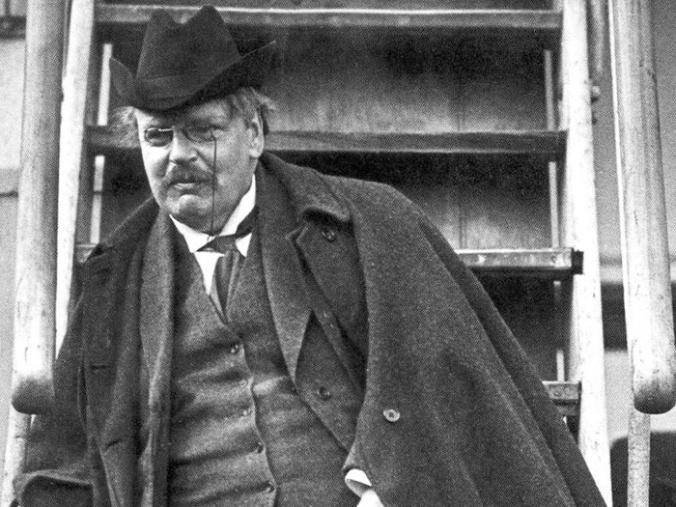
G.K. Chesterton died June 14, 1936. (Source).

In honor of the anniversary of his death, I reproduce for you here G.K. Chesterton’s marvelous essay, “Cheese.” I have taken the text from G.K. Chesterton Daily.

MY forthcoming work in five volumes, “The Neglect of Cheese in European Literature,” is a work of such unprecedented and laborious detail that it is doubtful if I shall live to finish it. Some overflowings from such a fountain of information may therefore be permitted to sprinkle these pages.  I cannot yet wholly explain the neglect to which I refer.  Poets have been mysteriously silent on the subject of cheese.  Virgil, if I remember right, refers to it several times, but with too much Roman restraint. He does not let himself go on cheese.  The only other poet I can think of just now who seems to have had some sensibility on the point was the nameless author of the nursery rhyme which says: “If all the trees were bread and cheese” — which is, indeed a rich and gigantic vision of the higher gluttony.  If all the trees were bread and cheese there would be considerable deforestation in any part of England where I was living.  Wild and wide woodlands would reel and fade before me as rapidly as they ran after Orpheus.  Except Virgil and this anonymous rhymer, I can recall no verse about cheese. Yet it has every quality which we require in exalted poetry. It is a short, strong word; it rhymes to “breeze” and “seas” (an essential point); that it is emphatic in sound is admitted even by the civilisation of the modern cities.  For their citizens, with no apparent intention except emphasis, will often say, “Cheese it!” or even “Quite the cheese.”  The substance itself is imaginative. It is ancient — sometimes in the individual case, always in the type and custom.  It is simple, being directly derived from milk, which is one of the ancestral drinks, not lightly to be corrupted with soda-water. You know, I hope (though I myself have only just thought of it), that the four rivers of Eden were milk, water, wine, and ale. Aerated waters only appeared after the Fall.

But cheese has another quality, which is also the very soul of song. Once in endeavouring to lecture in several places at once, I made an eccentric journey across England, a journey of so irregular and even illogical shape that it necessitated my having lunch on four successive days in four roadside inns in four different counties. In each inn they had nothing but bread and cheese; nor can I imagine why a man should want more than bread and cheese, if he can get enough of it.  In each inn the cheese was good; and in each inn it was different.  There was a noble Wensleydale cheese in Yorkshire, a Cheshire cheese in Cheshire, and so on. Now, it is just here that true poetic civilisation differs from that paltry and mechanical civilisation which holds us all in bondage. Bad customs are universal and rigid, like modern militarism. Good customs are universal and varied, like native chivalry and self-defence. Both the good and bad civilisation cover us as with a canopy, and protect us from all that is outside. But a good civilisation spreads over us freely like a tree, varying and yielding because it is alive.  A bad civilisation stands up and sticks out above us like an umbrella — artificial, mathematical in shape; not merely universal, but uniform. So it is with the contrast between the substances that vary and the substances that are the same wherever they penetrate. By a wise doom of heaven men were commanded to eat cheese, but not the same cheese.  Being really universal it varies from valley to valley. But if, let us say, we compare cheese with soap (that vastly inferior substance), we shall see that soap tends more and more to be merely Smith’s Soap or Brown’s Soap, sent automatically all over the world.  If the Red Indians have soap it is Smith’s Soap. If the Grand Lama has soap it is Brown’s soap.  There is nothing subtly and strangely Buddhist, nothing tenderly Tibetan, about his soap. I fancy the Grand Lama does not eat cheese (he is not worthy), but if he does it is probably a local cheese, having some real relation to his life and outlook.  Safety matches, tinned foods, patent medicines are sent all over the world; but they are not produced all over the world.  Therefore there is in them a mere dead identity, never that soft play of slight variation which exists in things produced everywhere out of the soil, in the milk of the kine, or the fruits of the orchard.  You can get a whisky and soda at every outpost of the Empire: that is why so many Empire-builders go mad.  But you are not tasting or touching any environment, as in the cider of Devonshire or the grapes of the Rhine. You are not approaching Nature in one of her myriad tints of mood, as in the holy act of eating cheese.

When I had done my pilgrimage in the four wayside public-houses I reached one of the great northern cities, and there I proceeded, with great rapidity and complete inconsistency, to a large and elaborate restaurant, where I knew I could get many other things besides bread and cheese.  I could get that also, however; or at least I expected to get it; but I was sharply reminded that I had entered Babylon, and left England behind.  The waiter brought me cheese, indeed, but cheese cut up into contemptibly small pieces; and it is the awful fact that, instead of Christian bread, he brought me biscuits.  Biscuits — to one who had eaten the cheese of four great countrysides!  Biscuits — to one who had proved anew for himself the sanctity of the ancient wedding between cheese and bread! I addressed the waiter in warm and moving terms.  I asked him who he was that he should put asunder those whom Humanity had joined. I asked him if he did not feel, as an artist, that a solid but yielding substance like cheese went naturally with a solid, yielding substance like bread; to eat it off biscuits is like eating it off slates. I asked him if, when he said his prayers, he was so supercilious as to pray for his daily biscuits.  He gave me generally to understand that he was only obeying a custom of Modern Society. I have therefore resolved to raise my voice, not against the waiter, but against Modern Society, for this huge and unparalleled modern wrong.

A Poem for Trinity Sunday

TrinityThrones

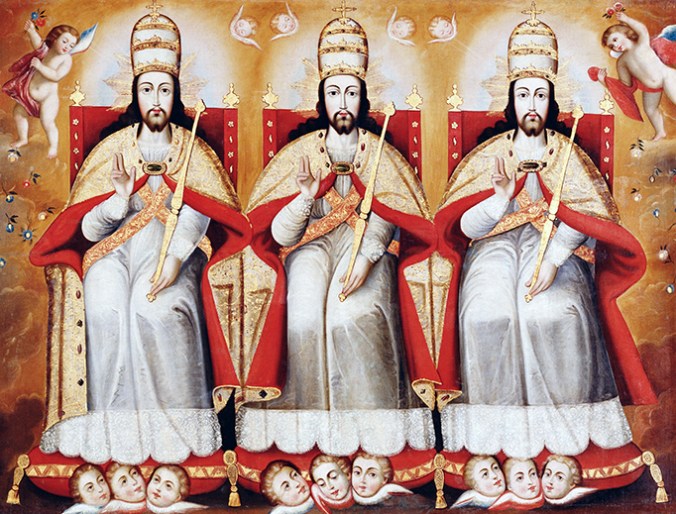
“The Enthroned Trinity.” Cuzco School. c. 1730. (Source).

Holy Sonnet XIV
John Donne

Batter my heart, three-person’d God, for you
As yet but knock, breathe, shine, and seek to mend;
That I may rise and stand, o’erthrow me, and bend
Your force to break, blow, burn, and make me new.
I, like an usurp’d town to another due,
Labor to admit you, but oh, to no end;
Reason, your viceroy in me, me should defend,
But is captiv’d, and proves weak or untrue.
Yet dearly I love you, and would be lov’d fain,
But am betroth’d unto your enemy;
Divorce me, untie or break that knot again,
Take me to you, imprison me, for I,
Except you enthrall me, never shall be free,
Nor ever chaste, except you ravish me.
TrifacialTrinityCuzcoSchool

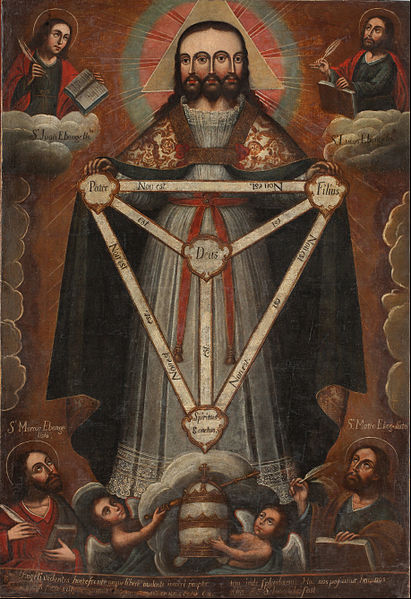
“Trifacial Trinity,” Cuzco School. c. 1750-70. (Source).

You Must Watch “The Keepers”

TheKeeperspromo

Who killed Sister Cathy? (Source).

You must watch The Keepers if you have Netflix. And if you don’t, you should start a subscription or a free trial to watch it. If you are a Catholic, I dare say that you have a duty to do so. I said the same thing about John Michael McDonagh’s Calvary, for much the same reason.

The Keepers tells the story of Sister Cathy Cesnik S.S.N.D., who was found murdered in the woods outside Baltimore in January of 1970. In seven riveting episodes, the series follows the intrepid amateur investigators who have, for years, devoted untold time and energy to solving this case. As private citizens, they have conducted important research into the case that the police should have done years ago. But the series isn’t just a compelling murder mystery (though, at times, it does rise to the level of the best true-crime tv). The Keepers is also a powerful testimony to the grim reality of clerical sex abuse, the corruption that aids the perpetrators, and the strength of the survivors.

If you are content with what I have written thus far and don’t want to risk any spoilers, then please don’t continue reading.

zzdata-basilica_10

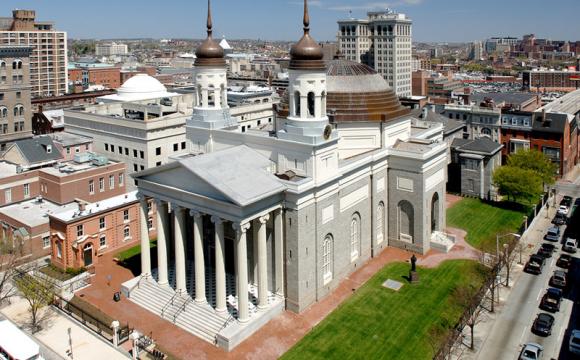
Basilica of the National Shrine of the Assumption of the Blessed Virgin Mary, Baltimore. (Source)

Sister Cathy had previously worked at a local Catholic girls’ school, Archbishop Keough High School. In 1969, she had discovered that the school chaplain and counselor, Father Joseph Maskell, was sexually abusing the students. In November, she disappeared in the night and was never seen alive again.

The series delves deep into the crimes of the priest, which are many and shocking. Maskell was violent and incredibly manipulative. He was a trained psychologist who preyed on his victims’ emotional and personal weaknesses and conducted deeply invasive psychological and physiological tests on them.

JosephMaskell

The affable face of evil. Father Joseph Maskell, c. 1969. (Source).

But, as with so many of these stories, the far more enraging element of it all is the cover-up. And boy is there a cover-up. Notice I used the present tense. The series strongly suggests that the law enforcement agencies of the greater Baltimore area deliberately turned a blind eye to the abuse and failed to properly investigate Sister Cathy’s murder – even today. There are reasons for this that I won’t get into here.

But perhaps more infuriatingly, the Archdiocese of Baltimore not only refused to give an interview to the filmmakers, but a) lied to the filmmakers about the history of complaints against Maskell, b) never mentioned that Maskell was sent to Ireland after a civil suit in the 1990’s, c) has refused to release any of their records related to Father Maskell, and d) repeatedly scuppered legislation to extend the statute of limitations on cases of sexual abuse. The show gets into some of these matters. But the Archdiocese’s reaction since the series premier has been shameful. It has waged a misbegotten social media campaign to smear the series.

Or consider this concatenation of coincidences I happened to just discover.

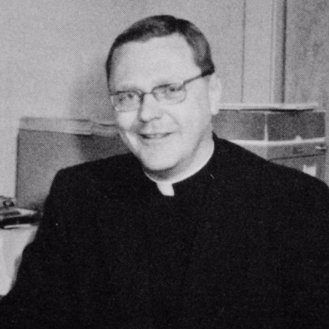
In the very last episode, we hear from one of Maskell’s first victims. He was an altar boy at Maskell’s parish, and when he complained to his mother, she alerted the Archdiocese. That was 1967. As a result, Fr. Maskell was promptly transferred to Archbishop Keough, where he carried on a covert reign of terror for eight years alongside his similarly perverted assistant, Fr. Neil Magness. Maskell’s secrets started to leak in the 1990’s when two brave victims, former students of Keough, filed a Jane Doe-Jane Roe suit against him and the Archdiocese. During that period, the first victim – that altar boy, then a dentist and family man – was contacted by the Archdiocese. They set up a private meeting led by (then) Monsignor W. Francis Malooly. At that meeting, Malooly allegedly attempted to bribe the victim into keeping quiet, so as not to provide corroboration for the complainant’s claims.

These are allegations. You are free to reject them. What you are not free to dispute is that the meeting between Malooly and the first victim happened. Malooly himself admits it, though he characterizes it rather differently (as you can see in the show). Likewise, you cannot dispute that Monsignor Malooly was later raised to the episcopate by Pope St. John Paul II and is currently serving as the Bishop of Wilmington, Delaware.

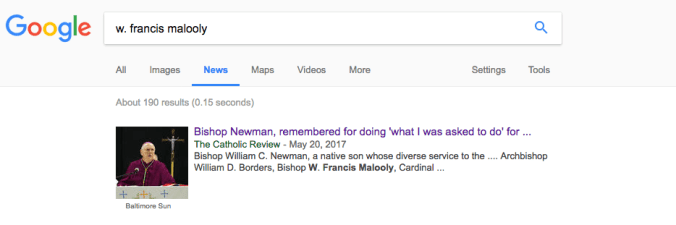
Now, a very strange thing happened when I googled Malooly’s name.

The first news item I got was this:

Screen Shot 2017-06-09 at 4.43.07 AM

But if when I clicked on it, I got this error page:

Screen Shot 2017-06-09 at 4.43.19 AM

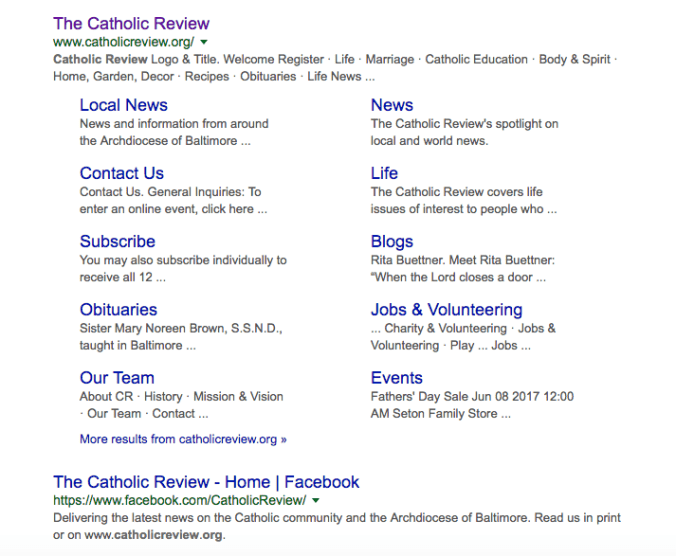
And what is The Catholic Review? Why, the newspaper of the Archdiocese of Baltimore!

Screen Shot 2017-06-09 at 4.43.35 AM

Screen Shot 2017-06-09 at 5.16.37 AM

And if you click on the homepage of the website, you get the same error:

Screen Shot 2017-06-09 at 5.18.23 AM
All of this strikes me as suspicious. There may be a perfectly innocuous reason why the Archdiocese of Baltimore’s newsletter is down at precisely the same time that it’s facing a firestorm over its egregious social media response to these allegations. It doesn’t make a lot of sense why the Archdiocese would bother to do something so drastic. I know so little of technology that I may be fumbling towards nothing here, finding strange connections where there are none.

But that timing. It’s hard to discount.

Ultimately, this is why we need good priests. This is why we need souls given to ministries of reconciliation and reparation to the Sacred and Eucharistic Heart of Jesus. Every abuse of an innocent is one more wound to the Holy Face of Christ. Shows like The Keepers remind us of our guilt, and of our need for salvation. They also remind us of our paramount responsibility towards the defenseless.

I don’t write any of this to scandalize the faithful. I write because Catholics should be furious. We should be filled with the righteous wrath of God that these kinds of abusesboth of innocence and powertake place in our midst. I write to my fellow converts, especially younger ones. We don’t talk about this issue enough, probably because most of us have never had direct contact with it. For us recent converts, the sex abuse crisis can often seem like a phenomenon of past decades, something that happened in stifling parish communities simmering with clericalism, patriarchy, and a ghetto mentality to boot. It is easy as a convert, and particularly as a young convert, to write off the sex abuse crisis (implicitly, if not overtly) as a phenomenon of the hypenated-American-Catholicism of the Northeastern working classes, a faith that was more about social pressure and cultural values than theology, tradition, and mysticism.

And in that, we are wrong. Clerical sex abuse and its cover up are still grievous sins that we have not yet fully grappled with, and whichsadlyI expect will continue to be an issue in the future. Among the many disappointments of this pontificate, perhaps the most bitter is that Pope Francis has proven to have such a poor record when it comes to pedophile priests.

There can be no doubt that those aforementioned -isms and -archies made clerical sexual abuse much harder to prevent, much harder to stop, and much harder to punish. The Keepers gets into some of that, though not as much as it could have. And that’s fine. Instead, it captures and sensitively presents the spiritual, emotional core of the problem. At its heart, The Keepers is about bearing witness. It testifies to the profound failure of the Church to guard its innocents. True, the chief villains are all dead. True, we may never know the full rogues’ gallery of their accomplices. But the horrible pains caused by those villains rippled through hundreds of livesand continue to do so today. And we must never forget it.

Kyrie eleison, Christe eleison, Kyrie eleison.