40,000 Views

image

It’s been a wonderful journey with you thus far. (Source)

Today, I have just crossed the 40,000 view mark, with some 25,310 individual visitors from every continent but Antarctica. Thank you to everyone who has read, shared, or commented upon my work. I appreciate your consideration, and I hope I may continue to produce content worthy of your attention. May God bless you all.

The Five Idols of Christmas

ChristmasScene

A beautiful Christmas scene. (Source)

Five Golden Rings

Christmas is a time of great joy. At the heart of it all is the birth of our savior, Jesus Christ, true God and true man. Yet often, we let lesser things get in the way of the worship we owe to Him in this privileged season of grace. I don’t believe it would be too much to call these distractions “idols.” As the Catholic Encyclopedia puts it, “Idolatry etymologically denotes Divine worship given to an image, but its signification has been extended to all Divine worship given to anyone or anything but the true God.” Many of us unknowingly allow a number of idols into our lives during the holiday season. All of them are good things in themselves, but taken out of proportion, they distort our sense of the feast’s true message as well as our connection with the Living God. I’d like to examine five of these idols, “five golden rings” that often form the chain of our seasonal bondage.

Material Goods

Of all the idols, this one is perhaps the most readily apparent. It seems like each year, we hear new complaints of the commercialization of Christmasonly to watch the process get worse with every passing holiday. Advent washes upon us as a season of cluttered ads rather than prayerful penance. Sacred carols have been reduced to shopping mall muzak. Charlie Brown’s 1965 complaint rings just as true today as it did in the years of the Johnson Administration. For many, Christmas seems to be a time to show off their wealth to the neighbors, to cook and consume lavish amounts of food, or to receive a whole panoply of toys and giftsand little else.

After all, isn’t this what most children look forward to each Christmas? Santa isn’t popular because he’s a jolly old man who likes milk, cookies, and Coca-Cola. He brings gifts! Of course kids love Christmas. The unfortunate thing is that this mentality is extremely hard to break, even for those well advanced in age. Nor does the culture help. After all, Christmas is a nearly half-trillion dollar industry. There’s no reason to think that commercialism in all its forms will go away any time soon.

Happiness

Beneath the idol of material goodswhether that means gifts, food, or all the decorations that beautify our houseshides another idol. Perhaps you’ve seen it elsewhere, at other times and places.

I was blessed enough to go to Disney World a few times as a child. When I later went back as a teenager, though, I noticed something. A kind of frantic, urgent energy pervaded the place. Everyone smiles a bit too widely. Everyone rushes from one amusement to another. And here and there, a tantrum erupts like a tiny pool of scalding water. Why? Because everyone who comes to Disney comes to have a good timeor else. If you don’t enjoy yourself, then something is wrong with you. You must have fun.

The regime of forced fun becomes universal at Christmas time. How many of us come away from the holidays in a state of utter exhaustion? How often have we stopped to think that maybe, just maybe, we’re trying too hard? The Christmas narrative is blissful. But we have substituted the quietly abiding “comfort and joy” of Christ for the plastic and fleeting pleasures of our own culture.

Our fruitless pursuit of happiness is one of the reasons that holiday depression is so rampant. The endless pageants and parades and parties, not to mention all of the work that goes into them, can be such a drain that it leaves us with little energy left for the spiritual life of the holiday. And that’s just when our plans succeed! We’re even more distraught and distracted when things don’t work out as we hoped. How greatly we differ from Mary and Joseph, who dealt with the disappointment of being turned away at the inn with a calm trust in Providence.

Traditions

One thing that bolsters the idol of forced happiness is the idol of tradition. Perhaps more than any other American holiday, Christmas is about the way traditions bring us together. But too often, those traditions can become unbalanced and rigid. Surely we all have one or two thoughts like this upon occasion. If the tree is not up and decorated by a certain day, all is lost! If we don’t make Christmas cookies on Christmas Eve, all is lost! If we don’t do the Elf on the Shelf this year, all is lost! And so on. Instead of a time of refreshment, Christmas becomes a daunting list of tasks and chores. Our freedom and ease vanish.

As Catholics, we need to remember that the only really necessary thing is Mass. That is the still point at the base of our lives and holiday. Taking a step back and detaching from our seasonal traditions can be a salutary reminder that we are not in control. God is. And if our traditions don’t serve His glory, then we should rework them and reclaim our freedom. Chances are, we’ll be saner (and happier) if we do so.

Family

Perhaps the easiest idol to miss is the one that often generates all the others: family. Surely, we may think, there can be nothing wrong with putting our families at the center of the holiday? Isn’t being with family one of the greatest and purest joys known to man? And isn’t the meaning of Christmas bound up with God entering into a human family?

These are all natural notions. But the truth is, we often have a disordered affection for our families. This disorder is frequently expressed in counter-intuitive manifestations. The holiday is poisoned by all the evident ways our own families don’t live up to our (possibly quite unrealistic) standards. So many of us use Christmas to penalize those in our families who are different from us, and who thus shatter our little ideal of what family should be. We make Christmas the occasion of settling scores or sniping about our petty differences. Or, on the other hand, we altogether ignore issues that might be very important. A kind of artificial peace may prevail, even though deep cracks open below the surface. But this is not the “peace on earth” that Christmas promises.

Families are always sites of intense friction and drama, as even the most cursory review of Western literature shows (not to mention our satires). Making family the center of Christmas merely injects that propensity for drama into a holy day where it doesn’t belong. Moreover, our ideological insistence on making Christmas all about family has been particularly hard on single people. Those with no family are left out in the proverbial, and sometimes literal, cold. One poisonous fruit of humanizing the divine holiday in this way is the terrible loneliness we have needlessly exacerbated for thousands.

Family is a high good, but not the highest good. When we forget that, we do an injustice to God. And we cannot love our families (or our lonely neighbors) properly if we don’t love God first.

Spiritual Consolations

I suspect that most of us idolize family at some level. It’s become such a dominant cultural value that even non-Christians who celebrate Christmas are susceptible to its malignant influence. But one idol may only occur to those who see Christmas as a time of potential spiritual gain.

Every Christian runs the risk of valuing God only insofar as he grants us His gifts. Sometimes, this takes fairly low forms. The Prosperity Gospel, for instance, is essentially a quasi-Christian materialism that equates the love of God with his financial blessings. They turn God into a sugar daddy. More subtly, some of us act like God’s fair-weather friends. We’re perfectly happy offering Him our heart as long as we feel we’re receiving some kind of spiritual consolation. It’s almost as if we think that God owes us something if we keep praying through the season, and we’re unnerved when nothing comes. No one likes aridity in prayer. That feeling can be even harder, and an even greater temptation, when it comes to us at Christmas time.

As Catholics, we shouldn’t worry if Christmas isn’t a time of tremendous spiritual growth. Just because at Christmas you’re not experiencing profound graces or consolations, doesn’t necessarily mean that you are doing anything wrong. Even a well-kept Advent may not produce discernible feelings of anticipation or contrition. Too much of a focus on the interior life can distract us from the objective glory of the feast.

God has come down to earth in the Incarnation. He has seen fit to take up human nature for our salvation, transfiguring all by the light of His face. And we who were born so many centuries after Him can nevertheless meet that same Incarnate God at the altar. But none of this depends on us. It doesn’t matter what we feel; the marvelous truth of it all is that God has done this work in an entirely gratuitous way.

That is why Christmas Mass is so important. It grounds our devotions in Christ. And as He did at His first coming, He still sweeps away all of our idols from His new home on the altar.

The Eucharistic Alternative

Christmas doesn’t have to be like this. All of the “idols” I have listed above are good in themselves. It is only our inordinate attachment to them that has twisted them into ugly perversions and distractions from the Incarnate God.

True, our culture has pressed many of these idols onto us, or at least exacerbated them. But we are complicit. We go along with the whole rigmarole. We have made these five golden rings into five golden calves. It follows that in our own small ways as Catholics, we can and should resist.

Instead of focusing on material gain, let us contemplate the poverty of the babe at Bethlehem; instead of mindlessly pursuing happiness at all costs, let us seek a healthy and realistic equilibrium; instead of rigidly clinging to our traditions, let us run in the freedom and flexibility of the Gospel; instead of taking a disordered view of our families, let us love them as creatures of the Most High; and instead of pining for a flood of sensible graces, let us be content to dwell adoringly at the side of the Infant God asleep.

It may all be more easily said than done. But the spiritual life is always a challenge for those who truly seek God. And what aid does Our Lord offer us in the Sacraments! If we avail ourselves of confession and the Eucharist, we will have made a very powerful start. Only then, to paraphrase Dickens, may we honor Christmas in our hearts, and keep it all the year.

Fr. James Martin and the Perils of Imaginative Religious Art

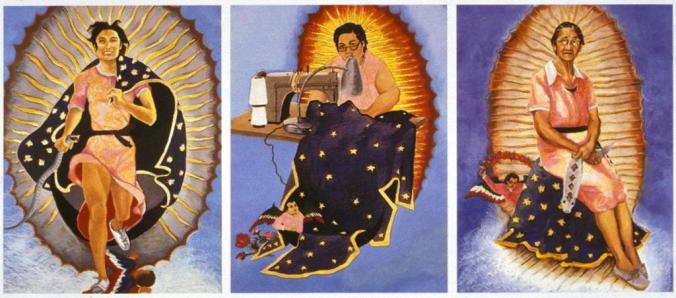
GuadalupeSeries.jpg

The Guadalupe Series, by Yolanda Lopez. 1978. (Source)

Recently, Fr. James Martin SJ posted these three images on his Facebook page with the following caption: “Mira! Look at these beautiful images of Our Lady of Guadalupe, reimagined as contemporary women. Remember that Our Lady lived a real life in Nazareth.” He then included a link to a website about the artist, Yolanda Lopez.

When some of his followers responded negatively, Fr. Martin wrote the following comment, quoted in full:

Some of the comments on this post are truly ridiculous. Yes, there is one beautiful and holy image, given by Our Lady, to Juan Diego at Tepeyac (which I posted earlier today). But reimagining Our Lady has been done since the earliest days of the church. Most of the images we are used to are images in which she was imagined as a woman of the Middle Ages and the Renaissance, in which the Blessed Mother is dressed in contemporary dress (not as a woman in first-century Galilee would have been dressed). The artist, as I see it, was trying to remind us that Mary (Our Lady) was a real woman. And that the artist sees her in those around her, especially in Mexican women. People need really need to calm down, stop picking apart her art, and stop using words like heresy and blasphemy. Of course you don’t have to like it (art is very subjective of course) but you also don’t have to hurl accusations. I’m as devoted to Our Lady as you are, and if I didn’t like something I’d just nod and move on. Not everything has to end up as a crusade.

There are all kinds of problems with the Jesuit’s post, from his Mariology to his aesthetic philosophy. And while he may have been annoyed that his followers dared to turn his humble offering into the occasion of “a crusade,” I’m afraid that he really leaves us no choice. His post is a scandal for a number of reasons.

It bears mentioning that Fr. Martin is right to suggest that our images of Mary are always shaped in part by culture. But there is a difference between the unconscious ethnocentrism of the Medieval imagination and deliberate efforts to portray Mary or Jesus as something other than what they were. If an artist is (a) going to go down that path, and (b) do so as a well-formed Catholic, then there are a few principles that he should probably stick to along the way.

First, all changes to the subject’s probable historic appearance or culture should serve to illustrate the subject’s deeper identity as well as to magnify his or her glory.

AfricanMadonna.jpg

African Madonna, Studio Muti, South Africa. c. 2013. (Source)

A good example of this kind of art is African Madonna, by Studio Muti. This Marian image works well both because it is constructed in dialogue with the tradition of Christian art – specifically, processional statues of the Virgin – and it powerfully captures the dignity of the sacred subject. We could probably guess who this is, even without some of the ordinary symbols of the Mother of God to aid us.

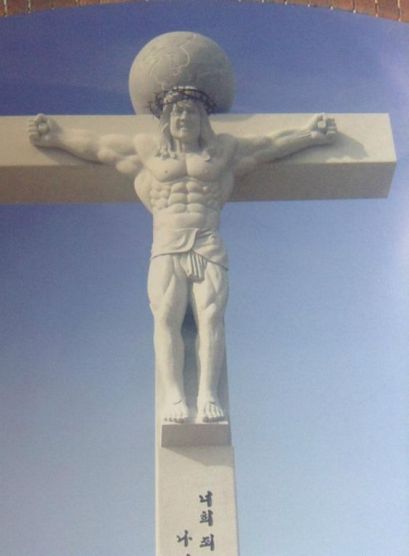
Second, kitsch should be avoided. If the work is devotional or liturgical in any sense (that is, destined for a worship space or context of veneration), then gimmicks become flatly inappropriate. Need we turn to the infamous “Korean Jesus” of 21 Jump Street?

KoreanJesus

Just….why? (Source)

Finally, these kinds of renditions should ordinarily come from the people themselves. Unfortunately, much of it has been produced by well-meaning white liberals like Br. Robert Lentz OFM or Fr. John Giuliani.

RobertLentzNavahoMadonna

Navaho Madonna, Br. Robert Lentz OFM. (Source)

When consciously non-white or non-Western depictions of Christ and the Virgin are created by white and Western artists, the danger of cultural appropriation is at its highest. See Lentz’s canned reduction of Navajo culture in his artist’s statement for the above “icon.” See also Fr. Giuliani’s statement that he “intends that his work celebrate the soul of the Native American as the original spiritual presence on this continent, thus rendering his images with another dimension of the Christian Faith.” One detects in these images a dollop of self-important White Savior mentality beneath the breathless exoticism. It’s all very patronizing.

A much better example comes from Daniel Mitsui, who draws upon the artistic traditions of his own Japanese heritage to lovingly craft intricate renditions of Jesus, Mary, and Biblical scenes in a distinctively Asian setting.

CanaMitsui.jpg

Wedding at Cana, Daniel Mitsui. (Source)

But all of this theorizing applies only to art which depicts sacred subjects. The art that Fr. Martin posted doesn’t do that. His interpretation is simply wrong. As some of the commenters noted, the very link he posted with the three images shows how off his view is. I will quote the source in full:

Yolanda Lopez has received the majority of her fame through the creation of her Guadalupe series. This groundbreaking series has transformed the way in which the iconic image of the Virgin of Guadalupe is viewed into a much more personal and political ideal. Lopez claims that in creating the Portrait of the Artist as the Virgin of Guadalupe she questioned this common icon of the ideal woman in the Chicano culture. The goal of Lopez was to demonstrate and consider the new types of role models Chicanas need and not simply adopt anything just because it is Mexican. Yolanda stated that by doing these portraits of her mother, grandmother, and herself she wanted to draw attention and pay homage to working class women, old women, middle-aged over weight women, young, and self assertive women. By naming each drawing individually Lopez emphasizes the uniqueness of each woman and accentuates the society that allows women of color to go unnoticed.

In the Portrait of the Artist as the Virgin of Guadalupe, Yolanda illustrates the strength and the power by the muscular legs and the long strides as well as the leap she has taking from the crescent moon. Through this long leap Lopez demonstrates that Chicanas are free from the oppressive social stigmas that limit women’s form of expression. In Margaret F. Stewart: Our Lady of Guadalupe, Lopez depicts her mother at work but proposes a new type of beauty. This new beauty is not the typical beauty that is depicted by others as the slender body type, white, young, and glamorous but as the older an fuller woman hard at work. Lastly in Guadalupe: Victoria F. Franco, Lopez illustrates her grandmother as a sad but strong old woman. In each portrait Lopez incorporates a serpent but the serpent in her grandmother’s portrait has been skinned and the grandmother holds the serpent skin in her left hand and the knife that was used in on her right hand. Lopez states “ She is holding the knife herself, because she’s no longer struggling with life and sexuality. She has her own power.” According to Dr. Davalos (author of Yolanda Lopez) the first two portraits represent lived realities of Chicana women and the last portrait address death.

(emphases in bold mine)

The Guadalupe paintings are not, as Fr. Martin insists, “beautiful images of Our Lady of Guadalupe, reimagined as contemporary women.” They are just portraits of the artist, her mother, and her grandmother incorporating the symbolism of Our Lady of Guadalupe. Lopez takes great pains to emphasize that, in her paintings, she is interrogating the received iconography of Guadalupe. The focus is on the poor Chicana as an icon in her own right, an icon that can surpass the role of Our Lady as a role model for contemporary women. This treatment of Guadalupe as an image of primarily moral and social significance is at odds with its presentation and reception by the Faithful. it is basically heretical. However, it’s hardly an uncommon practice today (though it must have been truly radical, if not exactly novel, in 1978). Our Lady of Guadalupe has become a symbolic nexus of all manner of discourses: Catholic, feminist, leftist, Immigrants’ Rights, Latinx, etc. But it doesn’t follow that every image of Guadalupe that engages those questions is properly understood as a “reimagining” of Our Lady.

Simply reading the source statement would have made all of this meaning clear. Fr. Martin must have either (a) not read the link he posted, (b) egregiously misunderstood it, or (c) willfully ignored it. In other words, his post was either lazy, imbecilic, or intellectually dishonest. Regardless, it was irresponsible. If he had bothered to look up some of Lopez’s other work, he might have avoided his grotesque mistake.

PortraitGuadalupe

Portrait of the Artist as the Virgin of Guadalupe, Yolanda Lopez, 1978. (Source)

But even assuming that we take him at his word and accept that he genuinely thought these were perfectly sound “reimaginings” of the Blessed Virgin, what kind of sensibility does that judgment betray? How does Fr. James Martin think Our Lady can and should be “imagined?” It seems that the overt eroticism of Portrait of the Artist as the Virgin of Guadalupe didn’t faze him. Nor did “Mary” trampling on the angel. Nor did her highly unusual connection with the serpent. It is incredible that a priest, particularly one as culturally sophisticated as Fr. Martin, would miss these blasphemous irregularities in an image of the Mother of God. At the very least, his post fails to inspire much confidence in his sense of the sacred.

Fr. Martin’s talk of “imagination” is revealing. Imagination is one of the central components of Ignatian spirituality, as Fr. Martin himself tells us in The Jesuit Guide to (Almost) Everything (2012). He writes of Ignatian contemplation:

Using my imagination wasn’t so much making things up, as it was trusting that my imagination could help to lead me to the one who created it: God. That didn’t mean that everything I imagined during prayer was coming from God. But it did mean that from time to time God could use my imagination as one way of communicating with me. (The Jesuit Guide 146)

St_Ignatius_of_Loyola_(1491-1556)_Founder_of_the_Jesuits

St. Ignatius of Loyola, Peter Paul Rubens. 17th century. (Source)

He then goes on to describe the practical method of Ignatian prayer.

There is much to recommend this spirituality, not least of which is the glorious roll call of Jesuit saints echoing down the centuries. But a danger lies hidden in Ignatian prayer. Grounded as it is upon the working of the individual psyche, it lacks the objectivity of, say, a liturgically-grounded spirituality. Without proper adherence to the mind of the Church, those engaged in Ignatian prayer can recede into a fuzzy personal relativism. In Fr. Martin’s case, it seems to have predisposed him to an overemphasis on the rights of imagination in the production of religious art. Note his use of vision discourse: “The artist, as I see it, was trying to remind us that Mary (Our Lady) was a real woman. And that the artist sees her in those around her, especially in Mexican women” (emphasis mine). Note that he never bothers to investigate the objective meaning encoded in the art itself – its formal characteristics, its use of symbols, its colors and patterns, etc.

Worse, his words imply a quietly Gnostic dissolution of both the meaningful category of physicality as well as the concrete propositions of dogma. Where does that leave us? It doesn’t matter if the Virgin Mary was a Jewish woman of the first century, nor if she was the Immaculately Conceived Mother of God. The imagination and spiritual vision of the artist is primary. Fr. Martin’s point, implicit at first and only later drawn out in reaction to his critics, is that Catholics should be affirming of those “reimaginings.”

But this is an untenable position in the face of actual art. The imagination is inevitably bound up in any artistic process, and it has often produced strange and wonderful innovations on older traditions (see, inter alia, the work of Giovanni Gasparro). But that fact does not isolate the pieces from serious criticism. We must judge; artistic discrimination is the very soul of good taste. And we must be even more critical for art that treats of the spiritual life, even at the cursory level of motifs. It aspires higher. As such, more is at stake. Fr. Martin’s banal pablum is a betrayal of the art he presents. It demands to be taken more seriously.


Terrible as An Army Set in Array

GuadalupeHead

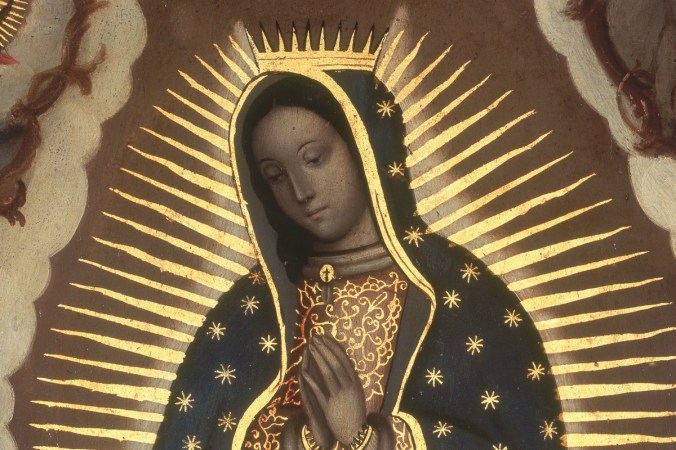
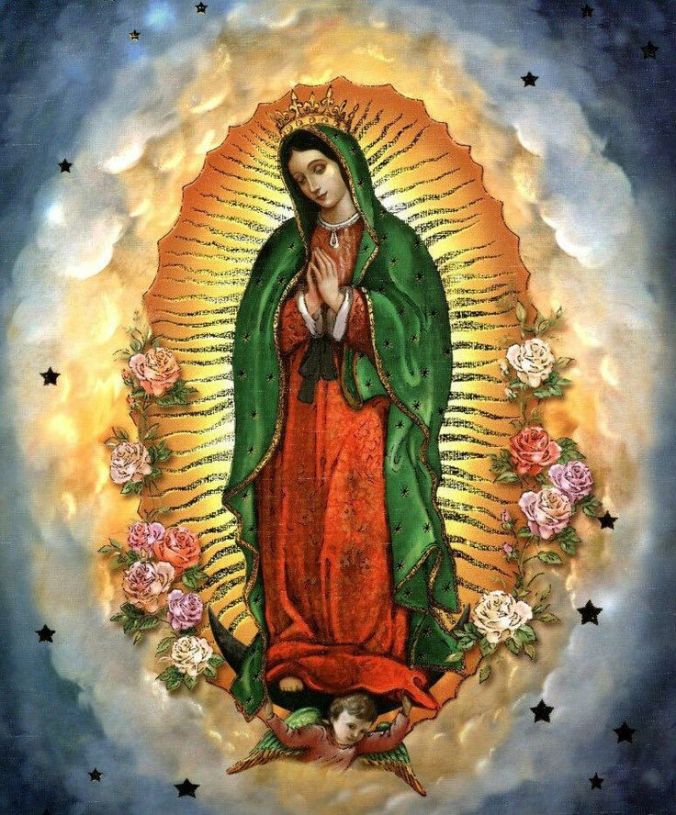
Our Lady of Guadalupe, pray for us. (Source)

“Your deed of hope will never be forgotten by those who tell of the might of God. You are the highest honor of our race.”

Thus does the whole Church sing at Mass today, on the Feast of Our Lady of Guadalupe. And no mean words are they! The Psalm is drawn from the Book of Judith – a frequent verse for feasts of Our Lady – and it lands on our ears like a shout of proleptic joy in this season of preparation and penance. The liturgy draws two special comparisons between Mary and the women of the Old Testament: Mary as the new Eve, and Mary as the second Judith. Today’s feast draws its special energy, its exegetical verve, from the mystical connection between Mary and Judith.

trinityguadalupe

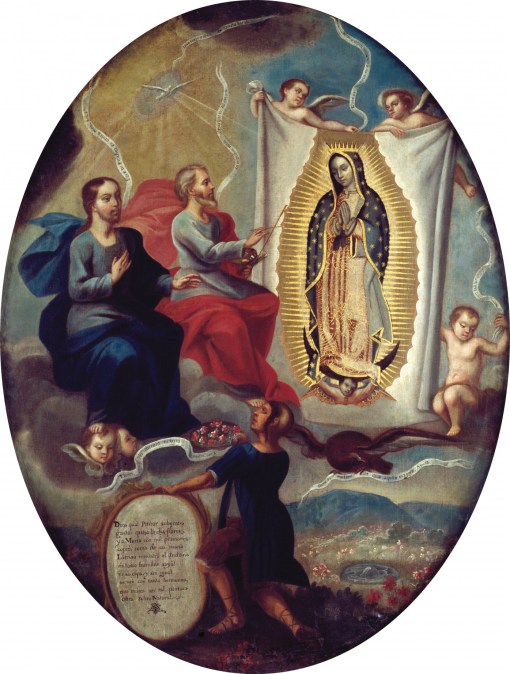
Our Lady of Guadalupe painted by the Trinity. An image worth meditating on. (Source)

The particular verse that the Church applies to Mary comes from Uzziah’s praise of Judith after she has already beheaded Holofernes the Assyrian. Let us turn briefly to the immediately preceding passage.

Then she took the head out of the bag, showed it to them, and said: “Here is the head of Holofernes, the ranking general of the Assyrian forces, and here is the canopy under which he lay in his drunkenness. The Lord struck him down by the hand of a female! Yet I swear by the Lord, who has protected me in the way I have walked, that it was my face that seduced Holofernes to his ruin, and that he did not defile me with sin or shame.” All the people were greatly astonished. They bowed down and worshiped God, saying with one accord, “Blessed are you, our God, who today have humiliated the enemies of your people.” (Judith 13:15-17).

Then come our Psalm verses.

JudithBeheading

Judith Beheading Holofernes, Caravaggio, c. 1602. (Source)

Why would the Church draw our attention to this violent episode on a feast of Our Lady falling so soon after the Immaculate Conception? Haven’t we just contemplated her Sophianic existence? Haven’t we just basked in the light of the Holy Spirit resting upon her Immaculate Heart? Why must we leave those pleasant snow-caps of the spirit? Why turn instead to this grisly tale of murderous deliverance?

We must recall that, although Mary is all sweetness and concord to those who love her Son, she is the terror of demons. Her litanies and devotions include many titles that evoke the clamor of warfare: “Tower of David,” “Tower of Ivory,” even “Gate of Heaven.” She crushes the head of the Serpent. The sword that pierces her heart becomes, by the union of her suffering with that of her Son, a fearful weapon in her mighty hands.

MaryPunchingDevil

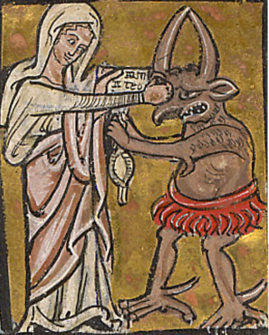
“Hail Mary, full of grace, punch the devil in the face.” (Source)

The story of Guadalupe is just one example of Our Lady exercising this power. Her appearance on Tepeyac, and the miracle wrought on the tilma of St. Juan Diego, was the beginning of the end of Aztec paganism. The demons that held that great people in thrall to the murderous rites of human sacrifice were totally vanquished. Like Judith, Mary rode out from Heaven into the  very camp of the enemy. Like Judith, she conquered. Like Judith, she proclaimed her victory with a visible sign – only, Our Lady’s sign was far more glorious. Judith held up the head of the vanquished foe, the bloody remains of a wicked oppressor. The Mother of God gave us her own image, miraculously imprinted into the convert’s cloak.

Judith delivered the Jews from the army of the Assyrians. Mary came forth to Tepeyac to convert the Mexican people, lifting from them the demonic yoke of a bloodthirsty paganism. What a glorious victory she won! Nine million Aztecs converted within the first ten years of the apparitions. Even today, she continues to spur us to conquer those terrible forces of injustice that oppress so many of God’s people. The collect prayer for today’s feast reads:

O God, Father of mercies, who placed your people under the singular protection of your Son’s most holy Mother, grant that all who invoke the Blessed Virgin of Guadalupe, may seek with ever more lively faith the progress of peoples in the ways of justice and of peace. (Source; emphasis mine)

These days it is rather in vogue to lament a certain kind of triumphalism that is built on self-centered pride. But too often we forget that there is another triumphalism, the shout of a people who have seen their salvation coming from the Lord:

Blessed are you, daughter, by the Most High God,
above all the women on earth;
and blessed be the LORD God,
the creator of heaven and earth
(Judith 13:18).

The Church herself enjoins us to celebrate the works and ways of God through His chosen instruments. And in today’s Mass, we are called to join that praise to the sacrifice of Christ in the Eucharist.

GuadalupeHeresy

Our Lady of Guadalupe, Victrix over All Heresies and Demons. (Source)

In considering Our Lady of Guadalupe and the zeal with which she overcame the forces of evil and in contemplating the beauty of her miraculous portrait, a verse of Scripture comes to mind.

“Who is she that cometh forth as the morning rising, fair as the moon, bright as the sun, terrible as an army set in array?” (Cant. 6:10 DRA)

We who have seen the tilma through the eyes of faith know the answer.

GuadalupeRoses

Our Lady of Guadalupe, Mystical Rose. (Source)

Prayer Request: Retreat

ImmaculateConceptionStatue

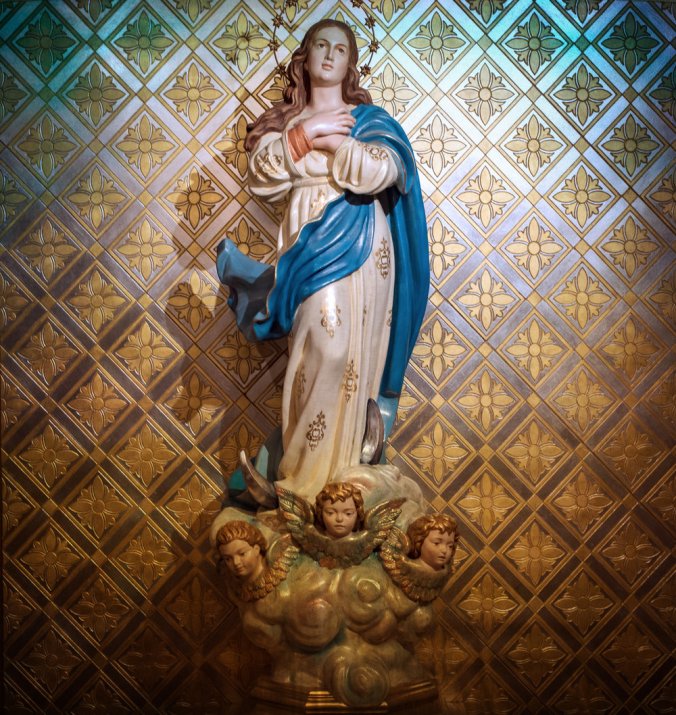
Maria Immaculata, Ora Pro Nobis. (Source)

I haven’t been as active on this blog as I had hoped for the last week or so, but I do have several good posts in store. In the meantime, please do pray for me. I’m off to Ireland for a retreat in honor of the Immaculate Conception, and I would appreciate your prayers as I spend this time unplugging and drawing near to Our Lord in His Blessed Infancy.

I noticed yesterday that I’ve accidentally timed the whole thing rather well. I leave England on the feast of St. Birinus, Bishop of Dorchester. He baptized Cynegils, King of the West Saxons, in what is now Dorchester on Thames, only a short bus ride from Oxford. I leave Ireland to return home to the United States on the feast of St. Juan Diego, the first indigenous saint of the Americas (and a deeply Marian one at that). And of course, the culmination of the retreat falls on the solemnity of the Immaculate Conception, America’s patronal feast. Providence works through these kinds of coincidences.

557px-The_Immaculate_Conception,_by_Giovanni_Battista_Tiepolo,_from_Prado_in_Google_Earth

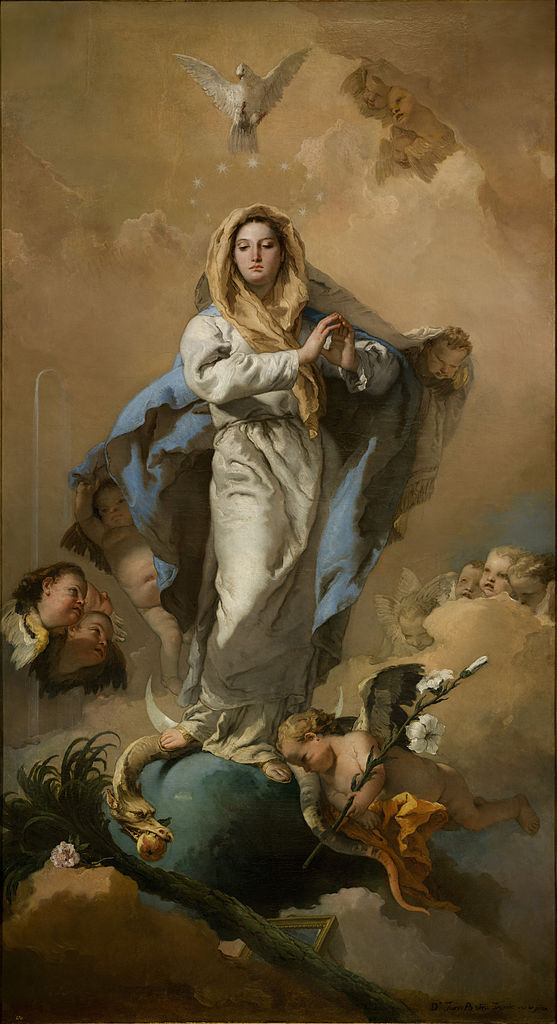
The Immaculate Conception, Giovanni Battista Tiepolo, c.1767. I love Our Lady’s expression –  a mixture of humility before the Spirit above and regal contempt for the Devil at her feet. (Source)

Additionally, by a quirk of the academic calendar, this year is the first time in my life that I will have a genuine Advent. Since seventh grade, I’ve had exams deep into December. Since I became Catholic four and a half years ago, I haven’t had the chance to experience this season for what it is, a time of profound peace, penance, and prayer in preparation for the Nativity of Christ. All of which prompts me to beg for your prayers.

Our Lady, Immaculate, pray for us.
Our Lady, Theotokos, pray for us.
Our Lady, Queen of Heaven, pray for us.

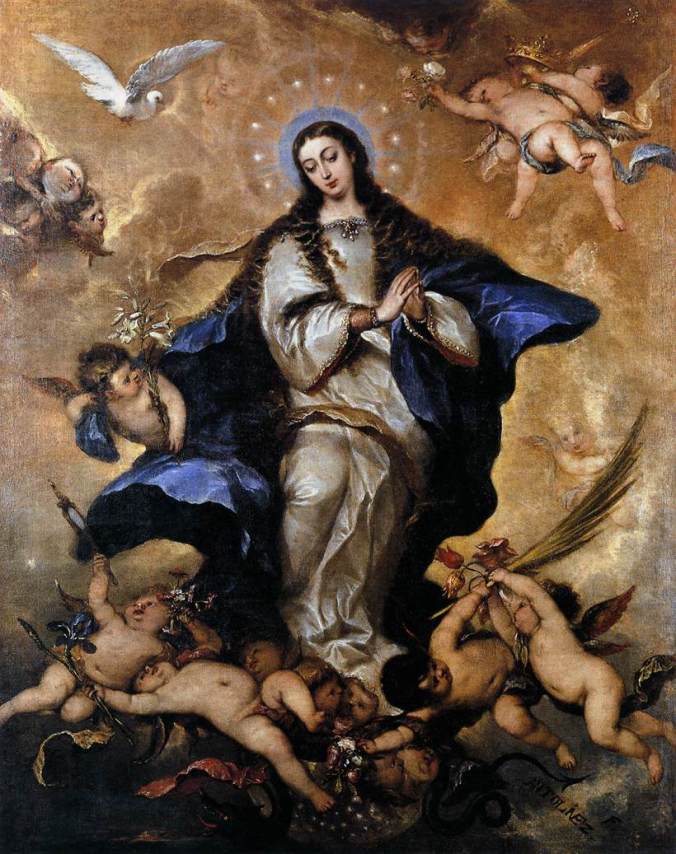
immaculb

Immaculate Conception, José Claudio Antolinez, 17th century. (Source)

The Music of the Holy Ghost

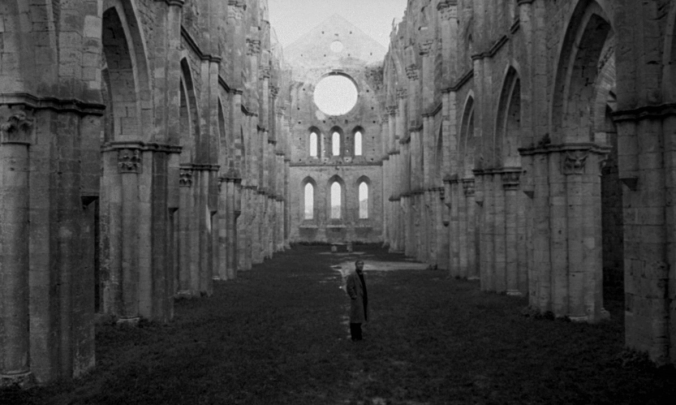
TarkovskyNostalghia.jpg

A still from Andrei Tarkovsky’s Nostalghia (1983). Clips from Tarkovsky’s films are often incorporated into the Rev Army’s music videos. (Source)

Not long ago, I came across a new band. What a singular group it is. Their music crosses and confuses genres. They produce content at a far scarcer rate than other musical acts. Even their name, taken from a Buñuel film, sets them apart from most of the offerings one comes across today.

Little did I know that I had stumbled upon a cult gem. The Revolutionary Army of the Infant Jesus has been on the scene for quite a while. Almost thirty years ago, they released their first album, The Gift of Tears (1987). Since then, they have only come out with sporadic releases, such as 1990’s Mirror and 2015’s Beauty Will Save the World. The long hiatus has well earned them the title of “One of music’s most elusive and enigmatic acts,” as we can read on their BandCamp site.

Tim Cooper has a great review of their work over at The Quietus:

…the attention-averse trio, who regard themselves as a creative collective rather than a band, make wildly eclectic music rooted in liturgical texts and ecclesiastical iconography, contrasting ethereal beauty with stark brutalism. Celestial choirs rub their cassocked shoulders with squalls of industrial noise, political speeches are interwoven with celluloid dialogue, instrumentation ranges from sombre neo-classical piano to pounding dance beats by way of folk, free-form jazz and experimental psychedelia.

They draw together a variety of spiritual and cultural influences: folk Catholicism, peasant mysticism, Russian Orthodoxy, the experience of post-Soviet Europe, Simone Weil, Welsh poetry. Their work can, I think, be described as sophianic, but it is a sophanicity carefully drawn through the harried cracks of the fallen world. The truth that the Rev Army grips and holds up to the light gleams all the more for being refracted in the shards of our earthly mirror.

Here are some favorite songs with their proper music videos, many of which are just as important for the meaning of the piece as the score itself.

Come Holy Spirit” – the very first Rev Army song I discovered. A bit too much flute and too many drums for me, but it was different enough from anything I had ever heard that it caught my attention.

Bright Field” – the first one that captivated me. The upward lift of the music combined with R.S. Thomas’s stirring paraphrase of the Gospel, not to mention Tarkovsky’s silken, dreamlike visuals, all together inspire something like wonder. Whenever I listen to it, I am reminded of a poem by Rilke.

After the End” – a simple and haunting French ditty set to the grainy images of villagers at prayer. They seem to be visionaries.

Psalm” – a few women chant in English against an increasingly dissonant shower of quasi-industrial background noise. The juxtaposition strikes me as an artistic model of transcendence through persistent prayer.

Repentance” – the most Flannery O’Connor thing you will ever see or hear. I’ll just leave it at that.

Théme de l’homme qui n’a pas cru en lui méme” – a Latin-flavored and occasionally jazzy piece featuring footage from a (staged?) Spanish Lenten procession. In case you hadn’t already noticed, the band is extremely Catholic.

Joy of the Cross” – another Lenten procession, but this time with a soft-edged folk music that makes me think of Fleet Foxes.

Before the Ending of the Day” – the Compline hymn surrounded and supported by an airy yet pulsing larger song. Tarkovsky’s Andrei Rublev provides the meditative visuals. Note that one of the commenters on YouTube wrote, “Please keep making more of these. This helped still my soul.”

Something epicletic moves through their music. But one can find that quality in lots of other work. What sets the Rev Army apart isn’t just their obsession with the Holy Ghost, nor their stylistic eclecticism. It’s their powerful sense of mystery. They never shy away from the divine darkness with which the Holy Ghost enshrouds His manifold works of grace. How refreshing, in an age of “Spirit of the Council” muzak and shallow “praise and worship,” to find music that is overtly Christian and even mystical without ever becoming preachy, dated, or emotivist. They treat their subject, the perennial and universal longing of the human heart for God, with a rare artistic and spiritual sophistication.

Caught up in marvel at the saving mystery of the Holy Ghost, the Revolutionary Army of the Infant Jesus is the real Catholic charismatic revival.

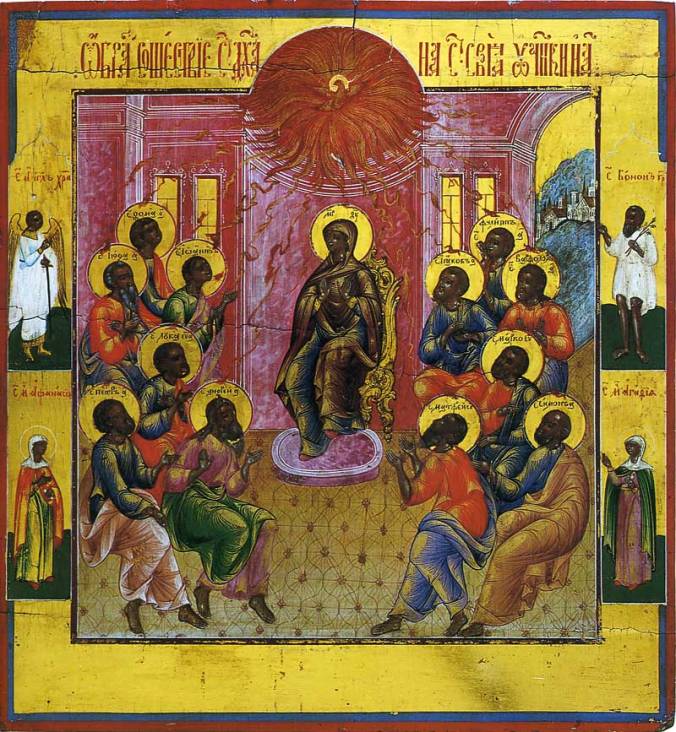
DescentoftheHolySpiritIcon

An icon of the Descent of the Holy Ghost. (Source)

Elsewhere: Two New Blogs on Mystics

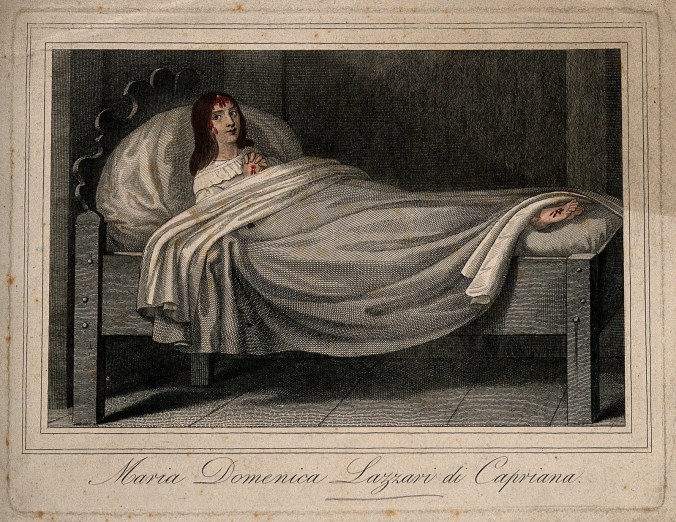
lazzari+print

A stigmatic, c. 1840. (Source)

Recently two very worthy endeavors have come to my attention. The first is the blog of the Stigmatics Project at the Ruusbroec Institute, University of Antwerp. The project “studies the promotion and devotion of the hundreds of stigmatics reported in five European countries during the nineteenth and early twentieth century.” It takes a scholarly, non-confessional approach to its subject. No doubt this new venture will yield greater insights into the stigmata as a social phenomenon.

The second is a much more theological blog called Littlest Souls, and it presents a veritable treasure trove of mystic spirituality. The blogger has clearly read widely in the library of the soul passed on to us from age to age by the Church. He seems to place a special emphasis on the 19th and early 20th century mystics, much like the Stigmatics Project. In fact, they probably cover some of the same figures. But unlike the recently-founded work of the Ruusbroec Institute, Littlest Souls has been up and running since May 2012. There is consequently much more material here to review and contemplate. Fans of that other great blog, Mystics of the Church, will find much here to admire.

In my first post on Father Faber, I noted that he represented a kind of lost world of the faith. Today, it is hard to imagine a Catholicism that once supported the kind of imaginatively baroque and overtly sentimental spirituality that oozes from his pages. Father Faber looks odd to our cynical, postmodern eyes. But in exploring his writings now, I find much in them that’s salutary and beautiful. My hope is that I can play some small part in recovering those gems for our times.

Both of these blogs seem to do precisely that; one at the level of scholarship, and one at the level of spirituality. Both set out to investigate and present a spiritual school that often seems morbid, unhealthy, or slightly daft – certainly one that has little place in our age. But there are real values here, real impressions of humanity in communion with the divine. I can only commend their efforts as important contributions to the memory and mystical life of the Church Militant.

I’ve said it before, and I’ll say it again. The Church is weird because she is supernatural, and the supernatural is always strange. We should embrace that fact.

Father Faber on Extraterrestrials

HelixNebula.jpg

The Helix Nebula, also known as “The Eye of God.” (Source)

When I was an undergraduate, I spent an afternoon in one of my theological societies discussing how Christians should respond to the discovery of alien life, should it ever happen. Our group split between those who believed the question was null anyway, as there were no aliens, and those, like me, who held that if they did exist, we should baptize and catechize them anyway.

It seems that no less a figure than Father Faber himself should have something to say on the matter. Imagine my shock when, quite unexpectedly, I came across the following passage yesterday in Faber’s The Precious Blood (1860/1959):

God made the angels and the stars. The starry world is an overwhelming thing to think of. Its distances are so vast that they frighten us. The number of its separate worlds is so enormous that it bewilders us. Imagine a ray of light, which travels one hundred and ninety-two thousand miles in a second; and yet there are stars whose light would take a million of years to reach the earth. We know of two hundred thousand stars down to the ninth magnitude. In one single cluster of stars, eighteen millions of stars have been discovered between the tenth and eleventh magnitudes. Of these clusters men have already discovered more than four thousand. Each of these stars is not a planet, like earth; but a sun, like our sun, and perhaps with planets round it, like ourselves. Of these suns we know of some which are one hundred and forty-six times brighter than our sun. What an idea all this gives us of the grandeur and magnificence of God! Yet we know that all these stars were created for Jesus and because of Jesus. Mary’s Son is the King of the stars. His Precious Blood has something to do with all of them. Just as it merited graces for the angels, so does it merit blessings for the stars. If they have been inhabited before we were, or are inhabited now, or will at some future time begin to be inhabited, their inhabitants, whether fallen and redeemed, or unfallen and so not needing to be redeemed, will owe immense things to the Precious Blood. Yet earth, our little, humble earth, will always have the right to treat the Precious Blood with special endearments, because it is its native place. When the angels, as they range through space, see our little globe twinkling with its speck of colored light, it is to them as the little Holy House in the hollow glen of Nazareth, more sacred and more glorious than the amplest palaces in starry space. (The Precious Blood 20-21).

The passage stood out to me for a few reasons. First, we might note Fr. Faber’s charming vision of angels flying through outer space. It strikes me as typical of his imaginatively poetic spirituality to find all of reality brimming with several orders of hidden and divine life. Secondly, Faber anticipates the very sentiments that astronauts would feel and describe over a century later. But perhaps most strikingly, Faber seems to suggest both the plausibility of extraterrestrial life and its capacity for redemption, presumably through the sacramental work of the Church. I would never have anticipated this idea from a Victorian priest most famous for his effervescent devotions and moralizing sermons. Evidently Faber was well read in the scienceand possibly the science fictionof his day.

On this Feast of Christ the King, I also find Faber’s words particularly apt. There is no part of reality to which the sovereignty of Christ does not extend: “Mary’s Son is the King of the stars.” One imagines that Faber would have enthused over today’s solemnity, had he lived long enough to see its institution.

The whole chapter is a spiritual gem, but this strange little paragraph seemed particularly worthy of consideration. The more I read, the more disconsolate I am that Faber has been so widely neglected by today’s Catholics.

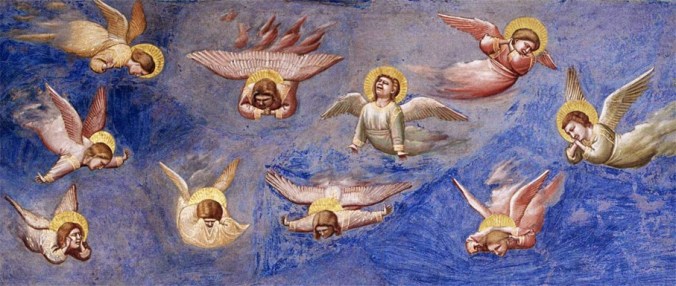
Giotto 1

Angels by Giotto in the Scrovegni Chapel. (Source)

The Lord High Inquisitor’s Song

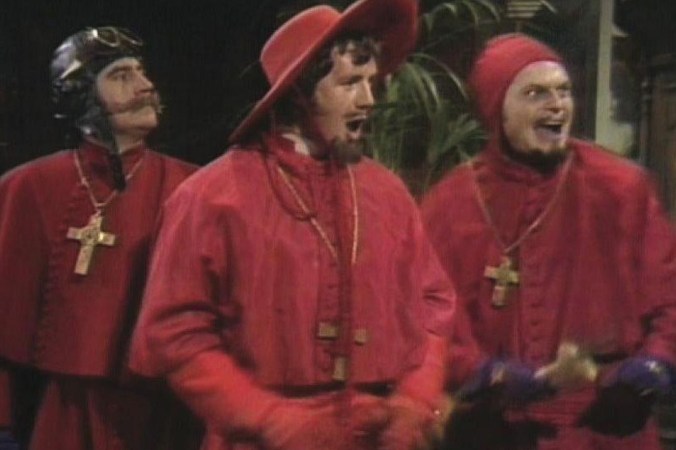
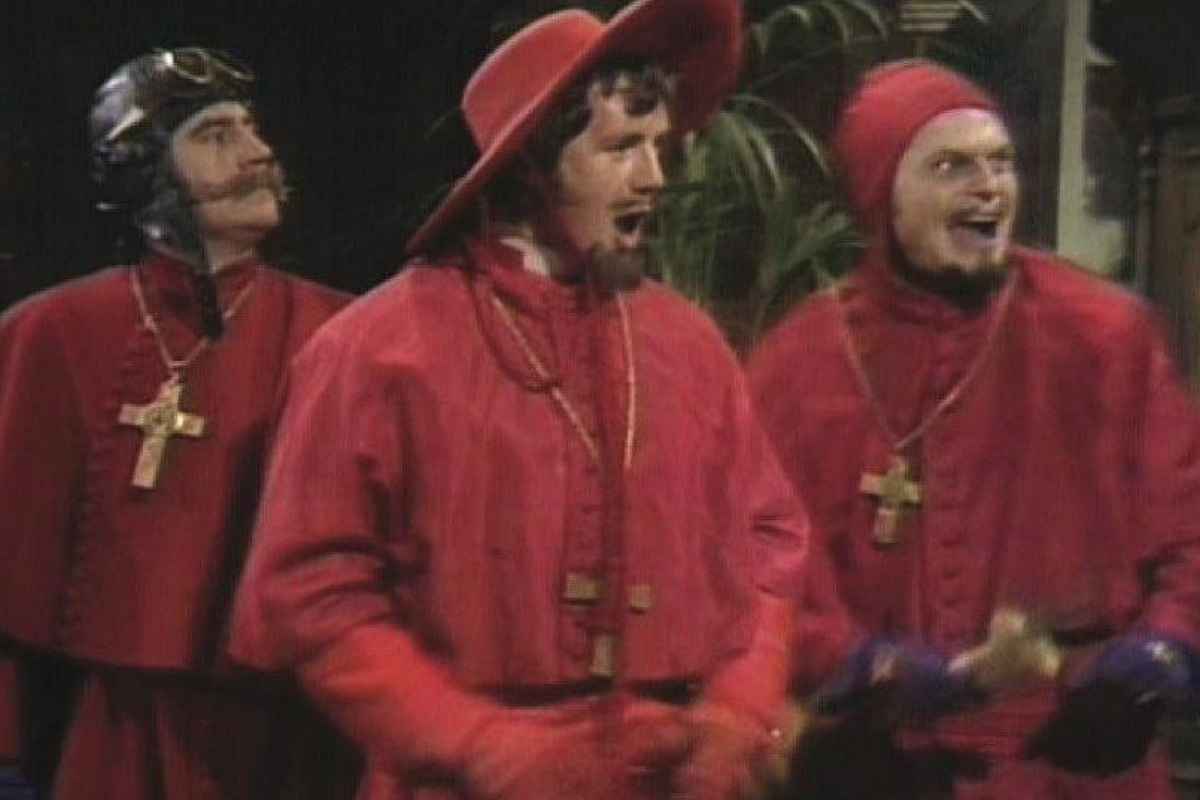
HighInquisitors

Nobody expects it. (Source)

The Lord High Inquisitor’s Song

(tune)

Cardinal Ko-Ko
As some day it may happen that a victim must be found,
I’ve got a little list—I’ve got a little list
Of ecclesial offenders who might well be underground,
And who never would be missed—who never would be missed!
There’s the pestilential journalists who write for NCR,
and all the ultramontanists who think the Pope’s a Czar—
All clergy who wear ugly stoles and vestments as they pray—
And philistines who think that lace is just a little fey—
Theologians from the Argentine who study how to kiss.
They’d none of ’em be missed—they’d none of ’em be missed!

Chorus
He’s got ’em on the list—he’s got ’em on the list;
And they’ll none of ’em be missed—they’ll none of ’em be missed.

Cardinal Ko-Ko
There’s the Jesuit on Twitter who does not believe in hell.
Since God he does resist—I’ve got him on my list!
Then there’s the German Cardinals who pray to Martin L.
They’re just “ecumenist”—they never would be missed!
Then the liberal who praises, with some social justice rage,
The “spiritual but not religious” tenor of the age;
And the parish secretary who makes fruitcake every year
For the congregation’s Christmas Party (and inspires fear);
And that odd phenomenon, theologians feminist
I don’t think they’d be missed—I’m sure they’ll not be missed!

Chorus
He’s got them on the list—he’s got them on the list;
And I don’t think they’ll be missed—I’m sure they’ll not be missed!

Cardinal Ko-Ko
And those mouth-foaming maniacs who write LifeSite clickbait,
Would that they might desist—I’ve got them on the list!
The Neo-Caths at Crisis in a moral panic state.
And a Two-Tiered Thomist—you know he’s on the list!
Then the smug and smarmy statesman who still wears the scarlet hat
Who bows to tyrants’ wishes from a desk chair in the Vat—
And the bishops who decide they want obedience, not truth
All baby boomers who attack the faithful of the youth—
And all the heretics who can be judged quite Modernist.
They’ll none of ’em be missed—they would none of ’em be missed!

Chorus
You may put ’em on the list—you may put ’em on the list;
And they’ll none of ’em be missed—they’ll none of ’em be missed!