Father Faber on the Holy Souls in Purgatory

OLYMPUS DIGITAL CAMERA

We should always remember to pray for the Holy Souls in Purgatory, especially in this, their month. (Source)

Today is Remembrance Sunday here in the U.K. We had a splendid Solemn High Requiem Mass at the Oxford Oratory, complete with black vestments. The setting was a Requiem by Haydn, which seem to draw us on the journey of a holy soul. From an Introit that sounds like the mournful ghosts of the dead, we proceed to a communion that is full of airy light and calm joy – with a great deal of drama in between. 

I realized that I had not posted anything for All Souls’ Day. Since today is yet another day set aside, at least by British Catholics, for praying on behalf of the dead, I decided I’d post something by that spiritual master, Father Frederick William Faber of the London Oratory. In his own life, Fr. Faber was known for his great devotion to the Holy Souls. One of his more famous texts deals with prayer for those in Purgatory. I have selected the following passage from that work, Fr. Faber’s Purgatory. You can also find it on this website. I offer it here for your consideration and in the hope that the good priest’s words might kindle in us a fonder and more steadfast devotion to the Faithful Departed.

Both views [of Purgatory within Catholicism] agree again in holding that what we in the world call very trivial faults are most severely visited in purgatory. St. Peter Damian gives us many instances of this, and others are collected and quoted by Bellarmine. Slight feelings of self-complacency, trifling inattentions in the recital of the Divine Office, and the like, occur frequently among them. Sister Francesca mentions the case of a girl of fourteen in purgatory, because she was not quite conformed to the will of God in dying so young: and one soul said to her: Ah men little think in the world how dearly they are going to pay here for faults they hardly note there. She even saw souls that were immensely punished only for having been scrupulous in this life; either, I suppose, because there is mostly self-will in scruples, or because they did not lay them down when obedience commanded. Wrong notions about small faults may thus lead us to neglect the dead, or leave off our prayers too soon, as well as lose a lesson for ourselves.

Then, again, both views agree as to the helplessness of the Holy Souls. They lie like the paralytic at the pool. It would seem as if even the coming of the angel were not an effectual blessing to them, unless there be some one of us to help them Some have even thought they cannot pray. Anyhow, they have no means of making themselves heard by us on whose charity they depend. Some writers have said that Our Blessed Lord will not help them without our co-operation; and that Our Blessed Lady cannot help them, except in indirect ways, because she is no longer able to make satisfaction; though I never like to hear anything our dearest mother cannot do; and I regard such statements with suspicion. Whatever may come of these opinions, they at least illustrate the strong way in which theologians apprehend the helplessness of the Holy Souls. Then another feature in their helplessness is the forgetfulness of the living, or the cruel flattery of relations who will always have it that those near or dear to them die the deaths of Saints. They would surely have a scruple, if they knew of how many Masses and prayers they rob the souls, by the selfish exaggeration of their goodness. I call it selfish, for it is nothing more than a miserable device to console themselves in their sorrow. The very state of the Holy Souls is one of the most unbounded helplessness. They cannot do penance; they cannot merit; they cannot satisfy; they cannot gain indulgences; they have no Sacraments; they are not under the jurisdiction of God’s Vicar, overflowing with the plentitude of means of grace and manifold benedictions. They are a portion of the Church without either priesthood or altar at their own command.

holy-souls._jpg

Pray for the Holy Souls in Purgatory. (Source)

Those are the points common to both views of purgatory; and how manifold are the lessons we learn from them, on our own behalf as well as on behalf of the Holy Souls. For ourselves, what light does all this throw on slovenliness, lukewarmness, and love of ease? What does it make us think of performing our devotions out of a mere spirit of formality, or a trick of habit? What diligence in our examens, confessions, Communions, and prayers! It seems as if the grace of all graces for which we should ever be importuning our dear Lord, would be to hate sin with something of the hatred wherewith He hated it in the garden of Gethsemane. Oh, is not the purity of God something awful, unspeakable, adorable? He, who is Himself a simple act, has gone on acting, multiplying acts since creation, yet he has incurred no stain! He is ever mingling with a most unutterable condescension with what is beneath Him-yet no stain! He loves His creatures with a love immeasurably more intense than the wildest passion of earth- yet no stain! He is omnipotent, yet it is beyond the limits of His power to receive a stain. He is so pure that the very vision of Him causes eternal purity and blessedness. Mary’s purity is but a fair thin shadow of it, and yet we, even we, are to dwell in His arms for ever, we are to dwell amid the everlasting burnings of that uncreated purity! Yet, let us look at our lives; let us trace our hearts faithfully through but one day, and see of what mixed intentions, human respects, self-love, and pusillanimous temper our actions, nay, even our devotions, are made up of; and does not purgatory, heated seven-fold and endured to the day of doom, seem but a gentle novitiate for the Vision of the All-holy?

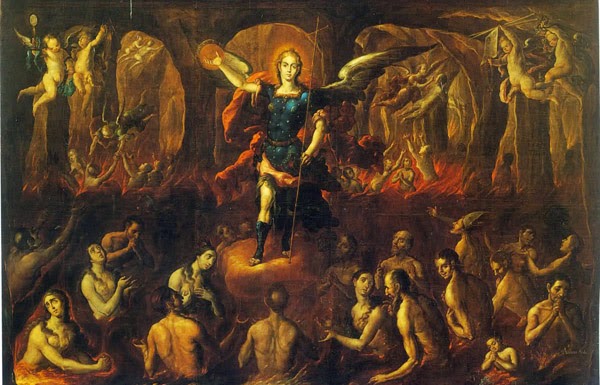
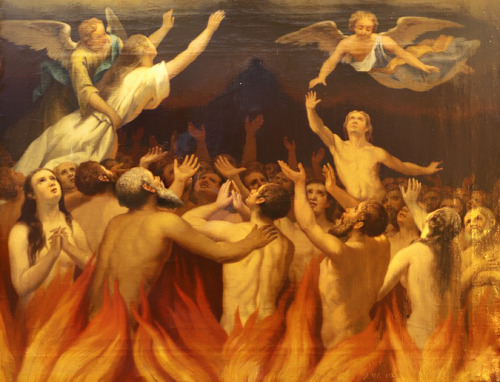
St.-Michael-the-Archangel-and-the-Souls-in-Purgatory

St. Michael the Archangel has traditionally been closely associated with the Holy Souls of Purgatory in the Church’s devotional life. (Source)

But some persons turn in anger from the thought of purgatory, as if it were not to be endured, that after trying all our lives long to serve God, we should accomplish the tremendous feat of a good death, only to pass from the agonies of the death-bed into fire, long, keen, searching, triumphant, incomparable fire. Alas! my dear friends, your anger will not help you nor alter facts. But have you thought sufficiently about God? Have you tried to realise His holiness and purity in assiduous meditation? Is there a real divorce between you and the world which youknow is God’s enemy? Do you take God’s side? Are you devoted to His interests? Do you long for His glory? Have you put sin alongside of our dear Saviours’ Passion, and measured the one by the other? Surely, if you had, purgatory would but seem to you the last, unexpected, and inexpressibly tender invention of an obstinate love, which was mercifully determined to save you in spite of yourself. It would be a perpetual wonder to you, a joyous wonder, fresh every morning, a wonder that would be meat and drink to your soul, that you, being what you know yourself to be, what God knows you to be, should be saved eternally. Remember what the suffering soul said so simply, yet with such force, to Sister Francesca: ‘ Ah! those on that side of the grave little reckonhow dearly they will pay on this side for the lives they live! To be angry because you are told you will go to purgatory! Silly, silly people Most likely it is a great false flattery, and that you will never be good enough to go there at all. Why, positively, you do not recognise your own good fortune, when you are told of it. And none but the humble go there. I remember Maria Crocifissa was told that although many of the Saints while on earth loved God more than some do even in heaven, yet that the greatest Saint on earth was not so humble as are the souls in purgatory. I do not think I ever read anything in the lives of the Saints which struck me so much as that. You see it is not well to be angry; for those only are lucky enough to get into purgatory who sincerely believe themselves to be worthy of hell.

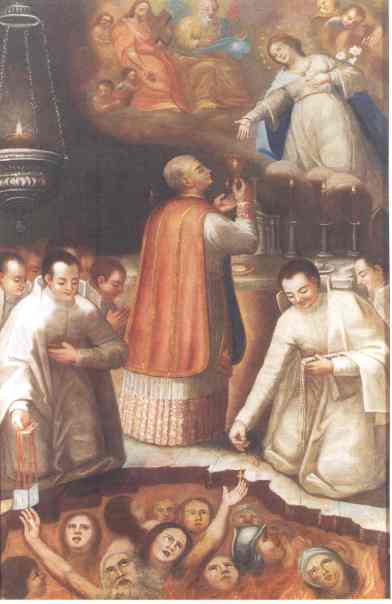
Purgatory_Mass._jpg

Masses and indulgences can be tremendously helpful to the souls suffering in Purgatory. (Source)

But we not only learn lessons for our own good, but for the good of the Holy Souls. We see that our charitable attention towards them must be far more vigorous and persevering than they have been; for men go to purgatory for very little matters, and remain there an unexpectedly long time. But their most touching appeal to us lies in their helplessness; and our dear Lord, with His usual loving arrangement, has made the extent of our power to help them more than commensurate with their ability to help themselves. Some theologians have said that prayer for the Holy Souls is not infallibly answered. I confess their arguments on this head do not convince me; but, conceding the point, how wonderful still is the power which we can exercise in favour of the departed! St. Thomas has at least taught us that prayer for the dead is more readily accepted with God than prayer for the living. We can offer and apply for them all the satisfactions of Our Blessed Lord. We can do vicarious penance for them. We can give to them all the satisfactions of our ordinary actions, and of our sufferings. We can make over to them, by way of suffrage, the indulgences we gain, provided the Church has made them applicable to the dead. We can limit and direct to them, or any one of them, the intention of the Adorable Sacrifice. The Church, which has no jurisdiction over them, can yet make indulgences applicable or inapplicable to them by way of suffrage; and by means of liturgy, commemoration, incense, holy water, and the like, can reach efficaciously to them, and most of all by her device of privileged altars. The Communion of Saints furnishes the veins and channels by which all these things reach them in Christ. Heaven itself condescends to act upon them through earth. Their Queen helps them by setting us to work for them, and the Angels and the Saints bestow their gifts through us, whom they persuade to be their almoners; nay, we are often their almoners without knowing that we are so. Our Blessed Lord vouchsafes to look to us, as if He would say: Here are my weapons, work for me! just as a father will let his child do a portion of his work, in spite of the risk he runs in having it spoiled. To possess such powers, and not to use them, would be the height of irreverence towards God, as well as of want of charity to men. There is nothing so irreverent, because nothing so unfilial, as to shrink from God’s gifts simply because of their exhuberance. Men have a feeling of safety in not meddling with the supernatural; but the truth is, we cannot stand aloof on one side and be safe. Naturalism is the unsafe thing. If we do not enter the system, and humbly take our place in it, it will draw us in, only to tear us to pieces when it has done so. The dread of the supernatural is the unsafest of feelings. The jealousy of it is a prophecy of eternal loss.

It is not saying too much to call devotion to the Holy Souls a kind of centre in which all Catholic devotions meet, and which satisfies more than any other single devotion our duties in that way; because it is a devotion all of love, and of disinterested love. If we cast an eye over the chief Catholic devotion, we shall see the truth of this. Take the devotion of St. Ignatius to the glory of God. This, if we may dare to use such an expression of Him, was the special and favourite devotion of Jesus. Now, purgatory is simply a field white for the harvest of God’s glory. Not a prayer can be said for the Holy Souls, but God is at once glorified, both by the faith and the charity of the mere prayer.

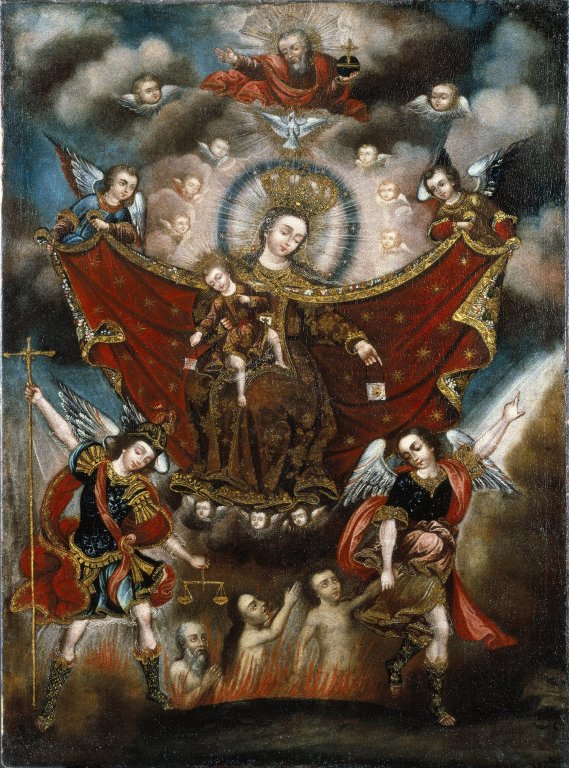
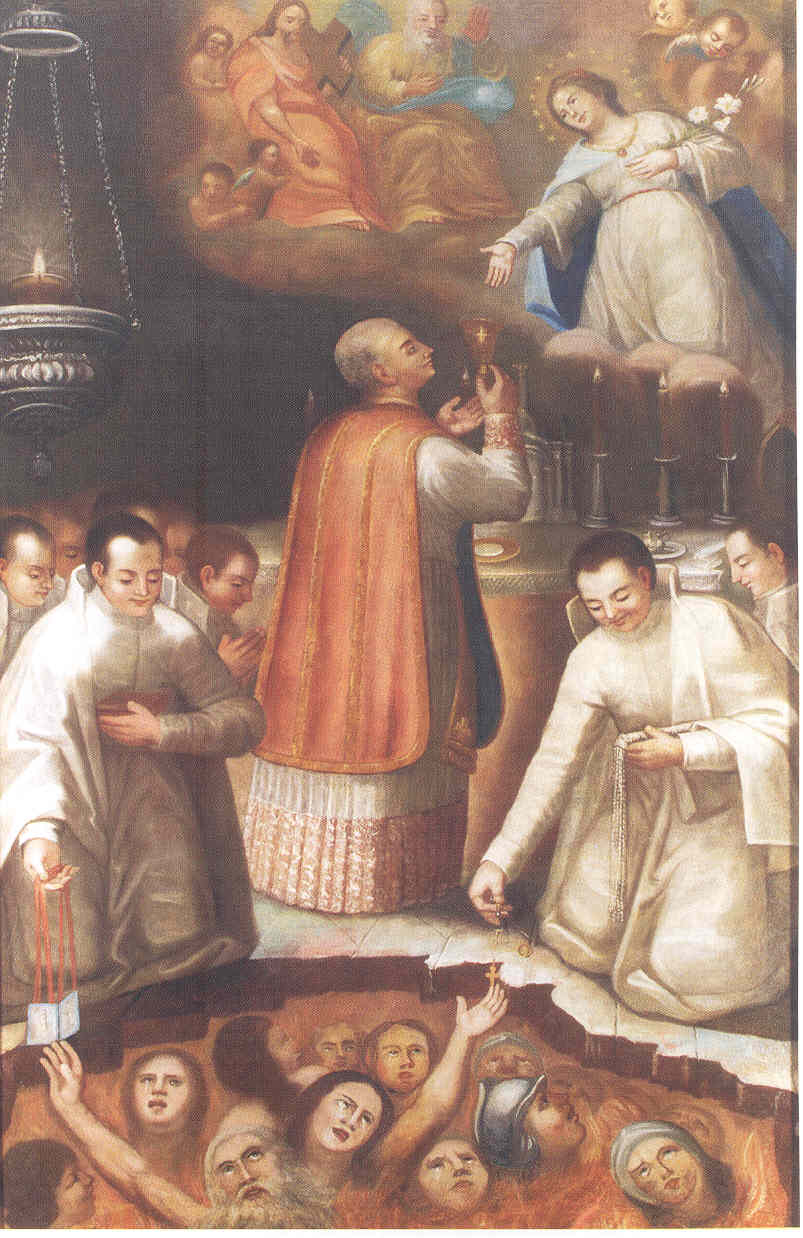
Brooklyn_Museum_-_Virgin_of_Carmel_Saving_Souls_in_Purgatory_-_Circle_of_Diego_Quispe_Tito_-_overall

The Virgin of Carmel Saving Souls in Purgatory, Circle of Diego Quispe Tito, c. 17th century. Brooklyn Museum. (Source)

When the Sacred is Strange: The Art of Giovanni Gasparro

Screen Shot 2017-11-11 at 11.25.56 PM.png

St. John Damascene and the St. Virgin Tricherusa, Giovanni Gasparro. Here we see Gasparro depicting a legend from the Saint’s life that is particularly appropriate for an artist. The work also represents the unity of Western and Eastern visual traditions in the transcendent Divinity. (Source)

UPDATE 4/2/20: It has recently come to my attention that Giovanni Gasparro, the artist profiled here, whose work I have admired at this blog on several occasions, has just produced a painting that reproduces the vicious anti-Semitic trope of Jewish ritual murder. This lie has historically led to violence against the Jews and, to put it lightly, is a subject unbecoming of a Christian painter. I condemn it in the strongest possible terms. While I used to look to Mr. Gasparro as a prime example of what Christian art could be in our postmodern era, his embrace of imagery more fit for the pages of Der Stürmer means that I can no longer endorse him. Nevertheless, I have decided to keep this essay up online because it enunciates certain principles about art that I think remain important. I hope that my readers will understand that they reflect an assessment of Mr. Gasparro’s value as religious art that I no longer hold. 

Recently there came into my newsfeed an article by Hilary White Obl.S.B. of What’s Up with Francischurch?. The piece was an extended criticism of Giovanni Gasparro, an Italian artist whose paintings inspired a few of the meditations I have written before on this blog. As someone who has long admired Mr. Gasparro’s Neo-Baroque art, I was happy to see that Rorate Caeli recently profiled one of his pieces. Ms. White was, it seems, partially responding to this attention. However, the more I read of her article, the more I found myself in stark disagreement with her analysis and broader philosophy.

While I have in the past appreciated her reporting as well as the monastic spirit she brings to her work, I confess that I was surprised at the poor quality of her post. I would not ordinarily seek out controversy, but as it seems that Ms. White’s post is making the rounds of the Tradisphere, I felt it imperative to offer a counter perspective.

There are many problems with the article. It is a textbook example of how not to write about art and theology, failing comprehensively at description, prescription, and imagination. She focuses too heavily on one work, Gasparro’s St. Pius X Pontifex Maximus. When she looks at other examples of his art, her analysis – if that is the right word for her summary denunciations – always remains far too cursory to do justice to such a talented artist. And while she notes that Gasparro is a master draughtsman, she follows up this comment with the presumptive assertion that Gasparro “is someone who still approaches sacred subjects with a distinctly modernist mindset.”
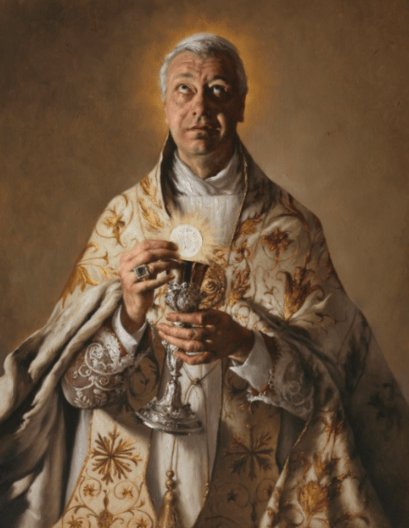
Screen Shot 2017-11-11 at 7.07.49 PM

St. Pius X Pontifex Maximus, Giovanni Gasparro. (Source)

There are overarching philosophical problems with Ms. White’s argument. But I’d prefer to begin with her shoddy treatment of the material itself.

To start with a small, but, I think, a representative example; Ms. White claims that in Gasparro’s portrait of Pope St. Pius X, the light falls on the Pope’s face in a sinister way. She writes,

But the painting of Pius X is underlit, a type of lighting that we associate with evil. If you see horror movies, the light is often placed this way on a face to give it a frightening, even demonic effect. It’s what springs to mind: where does a light come from if it’s up from below? Still, is hell’s light this white, electric glare?

This effect, illuminating the facial structure from an odd and unnatural angle – light doesn’t usually come from the ground up, still less heavenly light – the underside of the brow ridge lit up, giving the eye sockets a sickly, sunken appearance, etc… None of that is going to be found in genuine devotional sacred art.

An interesting idea, but one that misses the mark.

For one thing, the Pope is not underlit. It would be more accurate to say that he’s side-lit. There is a striking similarity in the way the light falls in Gasparro’s piece and the photograph of St. Pius to which Ms. White compares it. Nor is side-lighting unusual in Catholic art. Zubarán’s famous St. Francis in Meditation (1635-39) uses almost exactly the same angle for a much more sinister effect.

Screen Shot 2017-11-11 at 9.57.24 PM.png

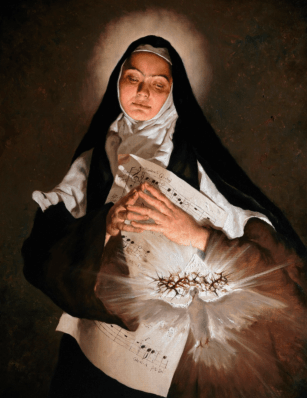
St. Elizabeth of the Trinity, Giovanni Gasparro. In which a saint is underlit, and with good reason. (Source)

Her rather contrived interpretation requires one of two presuppositions: first, that the symbolic lexicon of sacred, or, indeed, Western art is so narrow as to entail only a very limited range of connotations in the use of light, and secondly, that Gasparro’s work is intrinsically profane, deceptive, or downright evil. Neither of these assumptions is fair to the the artwork. They obscure its meaning rather than illuminate it.

But this point is relatively minor compared to some of Ms. White’s other egregious analysis. She dismisses Gasparro’s oeuvre as “surrealist, not sacred art,” with particular attention to his common motif of multiplied hands. She takes exception to the way he depicts faces, as well. Once again, we can see this tendency on display in her take on the Pius X portrait:

Giuseppe Sarto – even in death – had a very “beatific” face, handsome and always with a very assured and calm expression. I can’t imagine him ever making a face like the one in the painting. In fact, it looks more like what you’d get if you cloned Pius X and added a few drops of Nigel Farage.

She goes on to suggest that the “lumps and bumps” on the face of Gasparro’s Pius X are unsound, and that his expression inappropriately reflects “apprehension, not adoration.”

I’ll admit, the likeness is imperfect. She’s not totally off to note the resemblance with Nigel Farage, an unfortunate quality of the painting. Nevertheless, these indignant statements reflect more on Ms. White’s failure of imagination than they do Mr. Gasparro’s art. Moreover, mightn’t the Pope’s face also convey a whole range of emotions? Instead of apprehension, couldn’t the Pope’s expression show humble supplication? Or simply the holy Fear of God that priests ought to hold in their hearts as they offer the Most Holy Sacrifice of the Mass? And might not Pope Sarto have made much the same face at the altar as he spoke the sacred and secret words to the Almighty? Is she really incapable of imagining him “ever making a face like the one in the painting?” Sure it’s not that hard.

Ms. White continues in this vein at some length.

The “light” from the Eucharist isn’t actually light. It illuminates nothing, there is no reflection of it on the face or hands or vestments. The halo is equally dead as a light source, since it falls on nothing. The only light on the figure is from this lower left white source – like a stage light. The non-light from the Eucharist could be a signal; is he saying, “This is NOT the light of the world”?

One gets the impression that the message of the painting is that Eucharistic theology is deception; there is no light from the Host, the celebrant does not believe; his face says “this is all theatre & flummery”

In fact, the more you look at it, the more the feeling grows that this is actually a parody of sacred art. As a friend of mine commented, “His face in no way looks beatific.” There’s something in this hyperrealism, all the lumpiness and the harsh white lighting, that doesn’t say heavenly to me, but psychotic. They seem like subtle corruptions of reality.

What an extraordinary concatenation of assertions.

A few questions come to mind immediately. First, why must the Eucharist necessarily illumine anything? There are, of course, discernible rays of light emanating from it, and any ordinary viewer who sees the painting would probably understand what is meant spiritually. But why should that light be seen to rest on anything in particular, when it’s already an unearthly light to begin with? Secondly, why do halos need to be light sources at all? David Clayton has argued at New Liturgical Movement that:

…the art of the High Renaissance and Baroque is aiming to portray historical man (and not as with the icon eschatological man united with God in heaven), what the artists are doing might in fact be consistent with this. One might propose that because the aura of uncreated light, the nimbus, would not be as visible (to the same degree at any rate) in fallen man, even if that man is a saint. So it would seem that the artist might choose not to portray a halo very faintly, as a slight glow, or even not at all.

Madonna_Benois

The Madonna Benois, Leonard da Vinci. One of the paintings to which Clayton draws our attention – note that the halos of both are just golden circles, not lights. (Source).

Clayton’s division between iconography and art is an important, to which we will return, in a certain sense, later. For now, I’ll merely note two facts: a) it is extraordinarily commonplace in Western art to find halos that don’t function as any kind of light source, and b) the halo in Gasparro’s painting of the Pope is a diffuse but definite illumination. I can’t help but feel I am looking at an altogether different image than Ms. White, based on how badly she has described it. Instead of attempting to determine what the artist is actually communicating with what he has shown, Ms. White has given us a testimony of her own reactions.

Where she does attend to the painting as such, she uses the overly suspicious hermeneutic of a conspiracy theorist. The least probable and most malignant of interpretations come to the fore. Instead of merely asserting, as she is free to do, that Gasparro has painted a bad bit of sacred art, she instead goes so far as to accuse the artist of parodying the sacred.

There may be something grotesque, kitschy, or even campy about Gasparro’s oeuvre. But the grotesque, kitsch, and camp are three typical Catholic idioms. Look at the little prints of the Sacred and Immaculate Hearts surrounded by roses of all colors, adored by angels in little white gowns. Look at the gargoyles that grow like frightful stone pimples from the corners of our Cathedral spires. Look at the contorted muscles and thorn-choked skin of the Isenheim Altarpiece. Look at the Rococo churches that dot the landscape of the old Hapsburg Lands. Look at the Spanish processions of Holy Week, with all those peaked hoods and gilt statues in the streets. Look for the buskins and buckles of the pre-conciliar clerics. Look at the huge folds of watered silk enshrouding cardinals and archbishops and all manner of monsignori in that more confident age of the Church’s triumph. Look indeed at the splendid choir dress of the Institute of Christ the King, Sovereign Priest in our day! Look at Cardinal Burke in his glorious cappa magna (incidentally, Gasparro has done a charming portrait of him, too).

There is something delightfully other, delightfully weird, delightfully over-the-top about our religion. And surely, all of this is meet and right. The priest is other. The Church is other, and should appear mad in a world gone mad. Flannery O’Connor (probably) said, “You shall know the truth, and the truth shall make you odd.” Whatever its actual provenance, I take this saying as a true maxim of Catholic life in the modern world. I don’t mind if our art reflects that tendency for the strange, even if it disturbs us a little. I would be more suspicious if it didn’t.

We are all of us living as strangers, both to the world and to heaven. Gasparro’s art confronts us with this quality of strangeness, throws it back in our face – and startles us. Good. The Gospel is a very startling tale indeed.
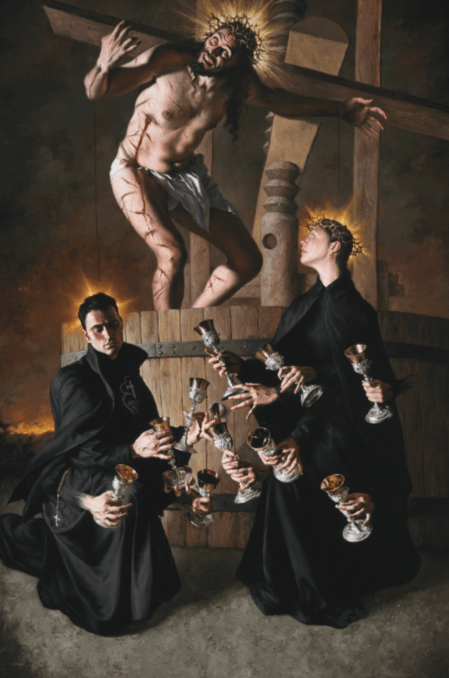
Screen Shot 2017-11-11 at 10.19.19 PM

Torculus Christi. Mystic press with St. Gabriele dell’Addolorata and St. Gemma Galgani, Giovanni Gasparro. One of his more overtly weird pieces, but one that is deeply rooted in Catholic mystical and artistic tradition. (Source)

Moving on to a few of Ms. White’s other statements, we come to her distinction between surrealist and sacred art. I happen to be working on a piece right now that will argue that surrealism is an artistic movement that, purged of its original anticlerical animus, can open up plenty of new avenues for a specifically Catholic spiritual art. Indeed, there is already quite a corpus of work that we might reasonably call Catholic surrealism, and I hope to incorporate it into that argument. In the meantime, I refute her argument thus.

Ms. White also takes exception with Gasparro’s very common use of multiplied hands in his paintings. She writes in one of her more patronizing captions,

He seems to be really big into this creepy thing with the multiple floating hands. This is what I would call “schtick” and it is common among highly trained younger artists who think that having a schtick will get them brand-recognition.

This wholesale dismissal is maybe the worst part of the essay. Once again, it evinces a refusal to engage with what Mr. Gasparro has put on the canvas for our consideration, summarizing it tidily in order to condemn it tout court.

Gasparro’s multiplication of hands – or, in some cases, other body parts – serves two functions in his art. First, it can express the passing of time. In The Miracles of St. Francis of Paola (2015), the doubled set of hands represent discreet acts. Secondly, it can express numerous levels of spiritual meaning that otherwise might be missed through a more conventional image. Manipulating gesture opens up the image. This is particularly true in Gasparro’s Speculum Iustitiate (2014), St. Nicholas of Bari (2016), and his deeply moving portrait of Pius VII, Quum memoranda (Servant of God, Pope Pius VII Chiaramonti) (2014).

Screen Shot 2017-11-11 at 10.28.22 PM.png

The Miracles of St. Francis of Paola, Giovanni Gasparro. (Source)

The doubling invites the viewer to consider each act or spiritual meaning in turn and to ponder how the subject may be acting in each case. The multiplication of hands invites us into a secondary, meditative dimension of the work. As I mentioned at the beginning of this essay, I have found his work a very fruitful spur to precisely this kind of spiritual meditation.

Screen Shot 2017-11-11 at 10.35.58 PM.png

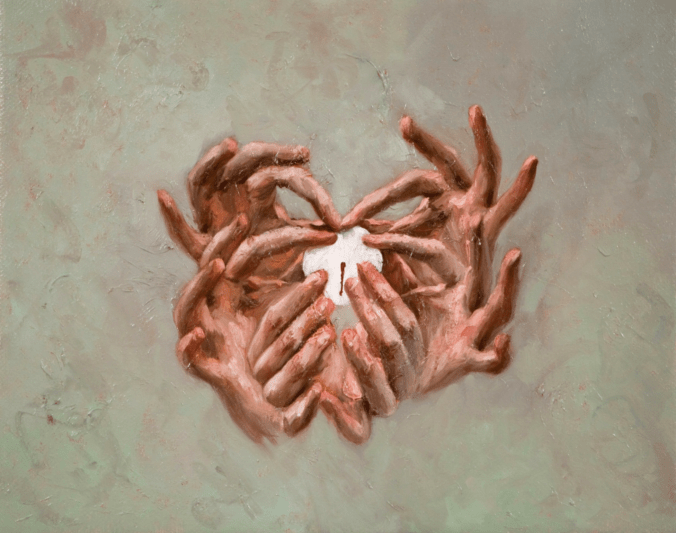
Transunstanziazione, Giovanni Gasparro. This image would be perfectly at home in a church. (Source)

Take one of Gasparro’s finest pieces, Transunstanziazione (2009). I will repeat here what I wrote about it in my Corpus Christi piece:

Three pairs of hands, like the three pairs of wings on the seraphim and cherubim, bear aloft a bleeding host in undifferentiated space. The three sets of hands appear the samethey are, perhaps, the hands of the same priest captured over the lapse of time. This distortion of time and space lends the image a sense of eternity. We are viewing something transcendent. The Eucharist is not just an earthly event. It is also a rite which happens forever in the cosmic liturgy of heaven. And who is the Great High Priest offering that liturgy for us mortals? Who but Christ? In Gasparro’s image, Christ is present as priest and victim.

The three pairs of hands also remind us of the Trinity. When we approach the Eucharist, we truly approach the Triune God. At every Mass, the act of Transubstantiation only happens because of the work of the whole Trinity. Christ offers Himself to the Father in the Holy Spirit, through the hands of His priests and the prayer of His bride, the Church. It is meet and right that we should consider the painting at this point between the Ordinary Form celebrations of Trinity Sunday and Corpus Christi.

The painting has a certain sacramentality, in that, like the liturgy, it captures something of the invisible and manifests it to our earthbound senses. Looking at Gasparro’s painting, we have the sense that we are glimpsing something profound, unsettling, and sacredsomething ordinarily hidden from us. Do we not hear the words of St. Thomas’s Corpus Christi hymn, Lauda Sion?

Every time I return to this painting, I find something deeper in it. I’ll add that the multiplication of hands is a trope that exists in the work of that most unimpeachable of Catholic Artists, the Blessed Fra Angelico, who uses it in virtually the same way as Gasparro.
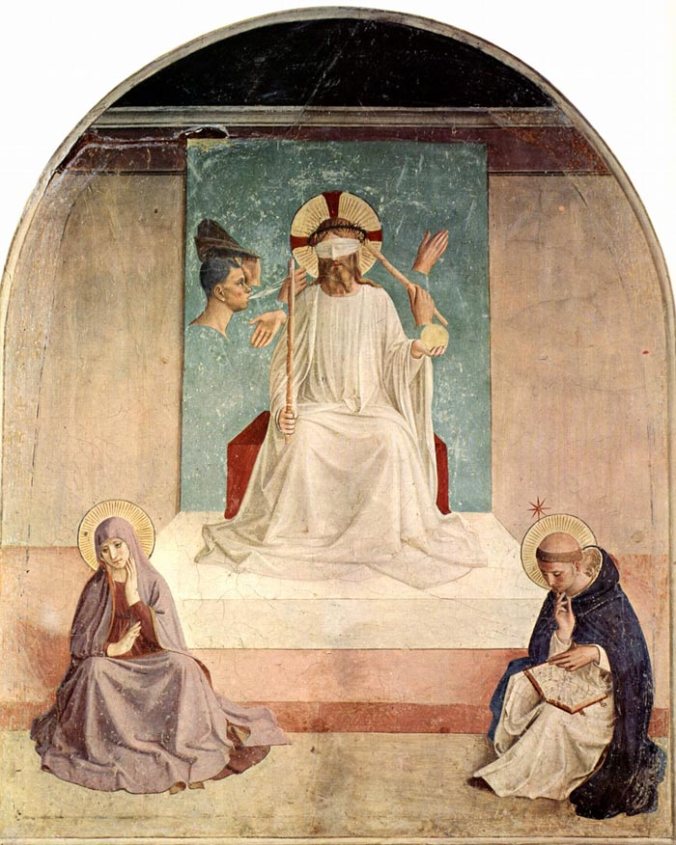
mockingofchrist700

The Mocking of Christ, Fra Angelico. Here he uses hands in the same ways that Gasparro does – to telescope sequential events into one image, to provide an insight into hidden action, and to lead us into meditation. Two of my Facebook friends noticed the formal and spiritual kinship between the two artists. (Source)

Of course, I don’t expect Ms. White or anyone else to have the same approach to every work of art as I do. If she finds Gasparro “creepy,” that is her right. But it is not an argument against Gasparro’s Catholicity. It is a subjective and affective assessment of his art, and thus it lies more in the realm of taste than aesthetic theology. And there’s nothing intrinsically wrong with having and describing a visceral reaction to a work of art. I’m perfectly happy to say de gustibus and leave it at that.

Unfortunately, Ms. White expatiates about what constitutes “sacred art,” which, she claims, is emphatically not what Mr. Gasparro is doing.

She writes,

Knowing nothing about him other than what he paints, I have no idea what this artist intends – and that right there should tell you that he’s NOT doing sacred art – but it seems that in general hyperrealism simply isn’t going to work for devotional art. It’s always going to come across as strange and parodic, because the purpose of devotional painting is not to depict ordinary earthly reality – with all its “warts” – but a supernaturalised, idealised and perfected reality, a redeemed reality, that can only be occasionally glimpsed in this life by seeing the saints.

Sacred art is devotional art. If it isn’t devotional, it’s a parody of the sacred.

Where do I begin?

First of all, it doesn’t matter what the artist intends. We emphatically don’t need to know the artist’s intentions to appreciate what exists in the constructed world of the art-object. It can be helpful, but it really isn’t necessary. “Intention” is one of those terms that is always so heterogeneous and slippery as to be virtually meaningless. Consider the range of “intentions” that might be implicit in any work of art. Most artists of the Renaissance probably intended to produce images that would please their wealthy patrons so that they could keep eating. Moreover, it seems that a great deal of eros generated quite a lot of the Western canon. No doubt at times the souls of the artists were illuminated by the grandeur of their work. But we can’t possibly know to what extent the deeply fallible men (and they were almost all men) intended to invest their work with a consciously spiritual meaning.

What’s more, Ms. White’s dislike for “hyperrealism” as well as “surrealism” leads her to miss the fact that Gasparro’s work strikes an incarnational balance between the two. His subjects are recognizably human, but in the strange art-world he depicts, they are charged with the heavy presence of a mystery far beyond their humanity. They share our condition while pointing towards a world that stands beyond it.

It bears mentioning that her dislike of “ordinary earthly reality – with all its ‘warts'” would necessarily strike Caravaggio from the canon of Catholic masters. Of course, Gasparro resembles Caravaggio more than any other artist. Perhaps she would be glad to see him go. Who else would disappear under Ms. White’s discriminating eye? Rubens and his corpulent maidens? Matthias Grunewald and his unpleasant crucifixions? How about Carlo Crivelli and the sly, malevolent eyes he gives to his saints? What are we to do with the Mannerists and all the distended limbs that litter their canvases? And although he was no Catholic, are we to write off the value of Rembrandt’s religious work because he dares to show the uneven surface of human flesh? Would this not be precisely the least Catholic impulse of all – to fly from the corporeality of our existence, and of the way God uses it?
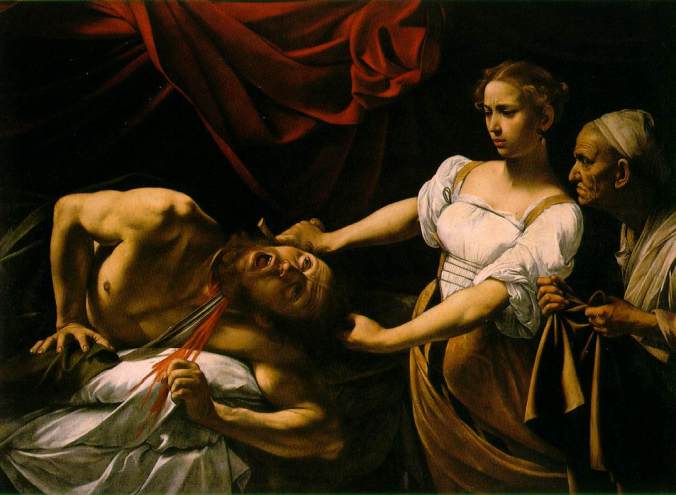
Judith_Beheading_Holofernes_by_Caravaggio

Judith Beheading Holofernes, Caravaggio. This magnificent portrayal of Judith’s triumph over the wicked general is apparently not “sacred art” under Ms. White’s criteria. (Source)

Ms. White insists on idealism and devotionalism in sacred art. Anything that fails in either of these qualities must be consigned to the great heap of Modernist parody.

Yet both of these are deeply misbegotten efforts. First, when she speaks of “supernaturalised, idealised and perfected reality, a redeemed reality,” she is using the language of iconography. There is indeed much to commend the hallowed iconographic traditions of the Greeks and Slavs (not to mention the Armenians). But Byzantine icons are subject to strict canons, types, and lineages. An iconographer’s process and material are, to a certain extent, determined for him. Longstanding customs surround the production and ritual use of the icons. Part of the reason that theologians can work from the icons as a source in their writing is that those customs safeguard and guarantee the orthodoxy of the images. And the spirituality they have fostered over the centuries is one I admire; it has quickened my own Christian life.
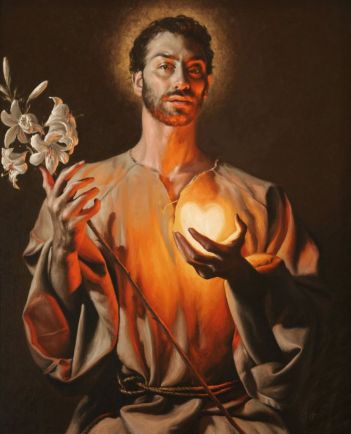
TheMostChasteHeartofStJoseph

The Most Chaste Heart of St. Joseph, Giovanni Gasparro. Something nigh-unprecedented like this devotional image would be impossible if Western art followed strict canons like the Byzantines do. (Source)

Nevertheless, that’s not what we do in the West. While some artists have managed to give us glimpses of a transcendent realm of sophianic glory (one thinks of the Cusco School and some of those Catholic surrealists I was talking about), they are certainly not obliged to do so by force of tradition. One can lament the fact that we developed a much freer sense of sacred art. I don’t, both because I like statues and because I think the relative freedom of artists has been an enormous boon to civilization and the Church.

We can definitely learn from icons, in part because they remind us of where our own tradition has been. Before this year’s terrible earthquake, Ms. White’s own monastery had a wonderful fresco that captured precisely this quality of enrichment from the East that can and should be productively pursued by Catholic artists. But we ought not make the spiritual vision of the East normative in the West, just as we would decry any effort to impose Western forms on the East. And so I entirely reject her attempt to foist on Western Catholic art the strict confines of the icons.

Secondly, I’m bothered by instrumentalist approaches to art, including an assessment that rests heavily on whether the piece in question is “edifying” or “devotional.” That’s a largely meaningless standard – much more indistinct than the question of whether something is beautiful – since it places the center of the art’s meaning and quality in the affective response of the viewer rather than its own constructed reality and the way that construction interacts with transcendental standards. Namely, beauty.

The idea that specifically sacred art should be a) “devotional,” and b) in a church is a narrow, limiting, overly contextual approach to art. It is only helpful in the strict sense of guidance for church decoration. If Ms. White had limited the purview of her argument to what should count as specifically Liturgical Art, that is, what type of art should be placed in a church for the public veneration and instruction of the faithful in a ritual context, she might have a point. But she doesn’t write within that important qualifier. Instead, she uses Mr. Gasparro’s oeuvre to think about sacred art in general, and arrives at the rather flattening dictum that “Sacred art is devotional art. If it isn’t devotional, it’s a parody of the sacred.”
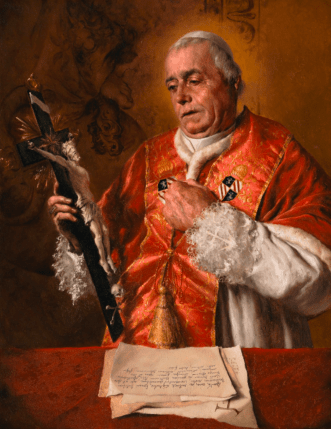
Screen Shot 2017-11-12 at 1.27.39 AM.png

Blessed Pius IX Pontifex Maximus, Giovanni Gasparro. Because artists who are really modernist heretics are drawn to depicting Pio Nono in prayer. (Source)

The conclusions she draws are totally unworkable as a Catholic approach to aesthetics. Imagine how much poetry and how much music we would have to surrender if we tried to carry the standards of idealism and devotionalism into the other arts in any kind of normative way.

Catholics should be concerned about the quality and orthodoxy of their sacred art. Insofar as Ms. White’s article represents that concern, it is an admirable effort. I’ll add that Ms. White and I probably share a similar exasperation with some of the trends in poor church art and architecture that are so maddening today. Likewise, we no doubt share a desire for a renewal of the Catholic arts. But Ms. White’s artistic philosophy smacks too much of Savonarola. While she is willing to summarily cast Gasparro’s art into the bonfire of the vanities, I contend that he is one of the Church’s most important living artists, alongside Daniel Mitsui, Matthew Alderman, Raúl Berzosa, Ken Woo, Alvin Ong, and others. I also share Rebecca Bratten Weiss’s views on the arts more broadly. We Catholics, and especially those of us who consider ourselves fairly Traditional, are sometimes too “self-referential” (if I may borrow a term favored by the Pope). As Weiss notes:

Toni Morrison, for instance, is a Catholic Nobel laureate whose works are filled with themes of community and redemption. But the Catholic critics who enthuse over Flannery O’Connor and Graham Greene regard Morrison only as a controversial writer on race relations. “She’s not practicing,” they might say, as an excuse to ignore her. And yet, C.S. Lewis, who is revered in their circles, was never even Catholic at all.

Mary Karr – the keynote speaker at the conference – not only is a Catholic convert, but wrote extensively about her conversion, but is deemed by some not to be a “real” Catholic writer, because of her openness about certain sexual issues. And yet Graham Greene was a notorious womanizer who slept with over 300 prostitutes, was condemned by church spokespersons in his time, and closed The End of the Affair with the prayer: “O God, You’ve done enough, You’ve robbed me of enough, I’m too tired and old to learn to love, leave me alone for ever.”

Perhaps the critics who are timid about these powerful Catholic writers working right now in our midst are waiting for someone else to “baptize” them? Perhaps they are waiting for someone else to say “I heard God there” – because they, themselves, have not learned to open the inner chambers of the ear? Because we do not have a robust Catholic arts culture that teaches us to open all the portals for reception, but instead have embraced a misnamed “Benedict Option” which is all about putting up walls and barriers, drawing those lines in the sand.

I concur, and would extend the same sort of criticism to Ms. White and those who support her view of the arts. Let us not fall into that old trap of mistaking the modern for Modernism. Christ is King over all. Let Catholic artists explore the plenitude of that Kingship over all, in all, and through all – even if looks strange to our worldly eyes.
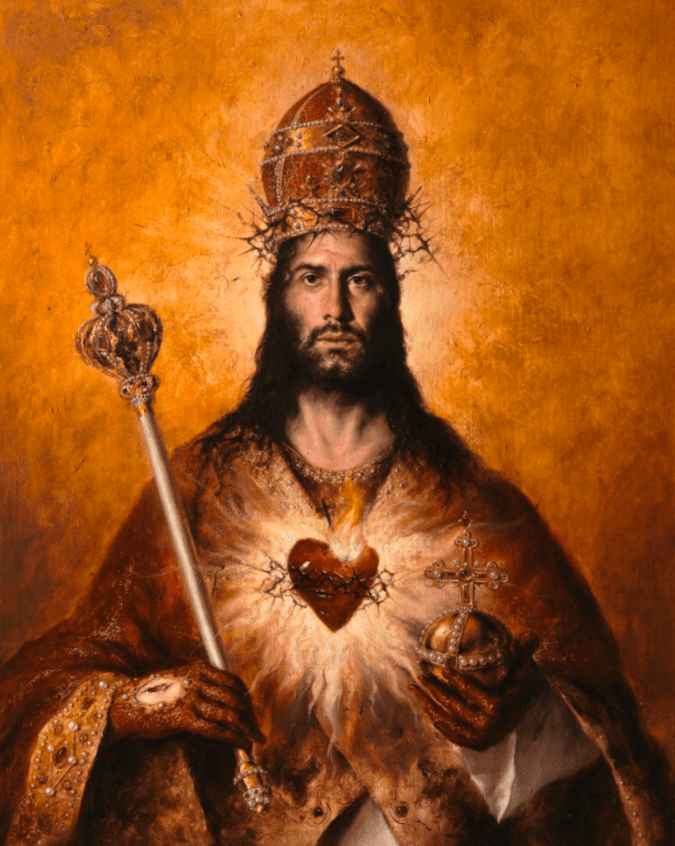
Screen Shot 2017-11-11 at 10.00.45 PM

Christ the King, Giovanni Gasparro. May we always serve Him with ardent charity and zeal for the beauty of His house. (Source)

A Poem for the Feast of the Blessed John Duns Scotus

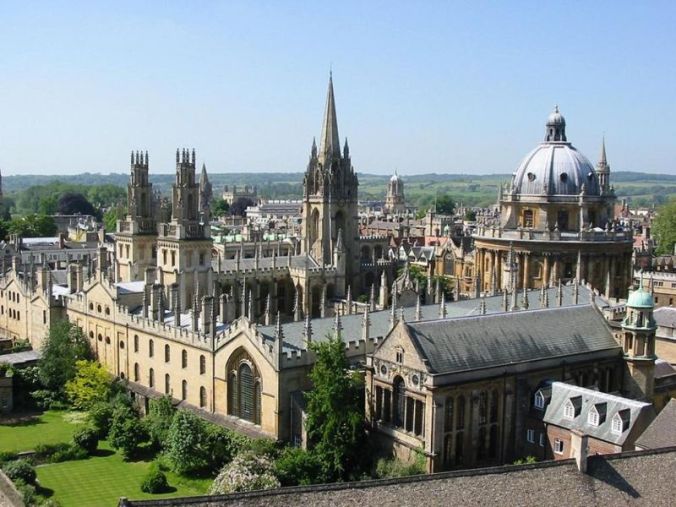
Oxford

Scotus preached and prayed at the University Church of St. Mary the Virgin, now an Anglican parish – there is now a plaque commemorating him on one of the walls. I have heard differing accounts of where his house of Greyfriars would have stood, either near St. Aldate’s or in what is now Brasenose College. (Source)
Duns Scotus’s Oxford

Gerard Manley Hopkins SJ

Towery city and branchy between towers;
Cuckoo-echoing, bell-swarmed, lark-charmed, rook-racked, river-rounded;
The dapple-eared lily below thee; that country and town did
Once encounter in, here coped and posed powers;

Thou hast a base and brackish skirt there, sours
That neighbour-nature thy grey beauty is grounded
Best in; graceless growth, thou hast confounded
Rural rural keeping — folks, flocks, and flowers.

Yet ah! this air I gather and I release
He lived on; these weeds and waters, these walls are what
He haunted who of all men most sways my spirits to peace;

Of realty the rarest-veined unraveller; a not
Rivalled insight, be rival Italy or Greece;
Who fired France for Mary without spot.

scotuseyes.jpg

Blessed John Duns Scotus, Pray for Us. (Source)
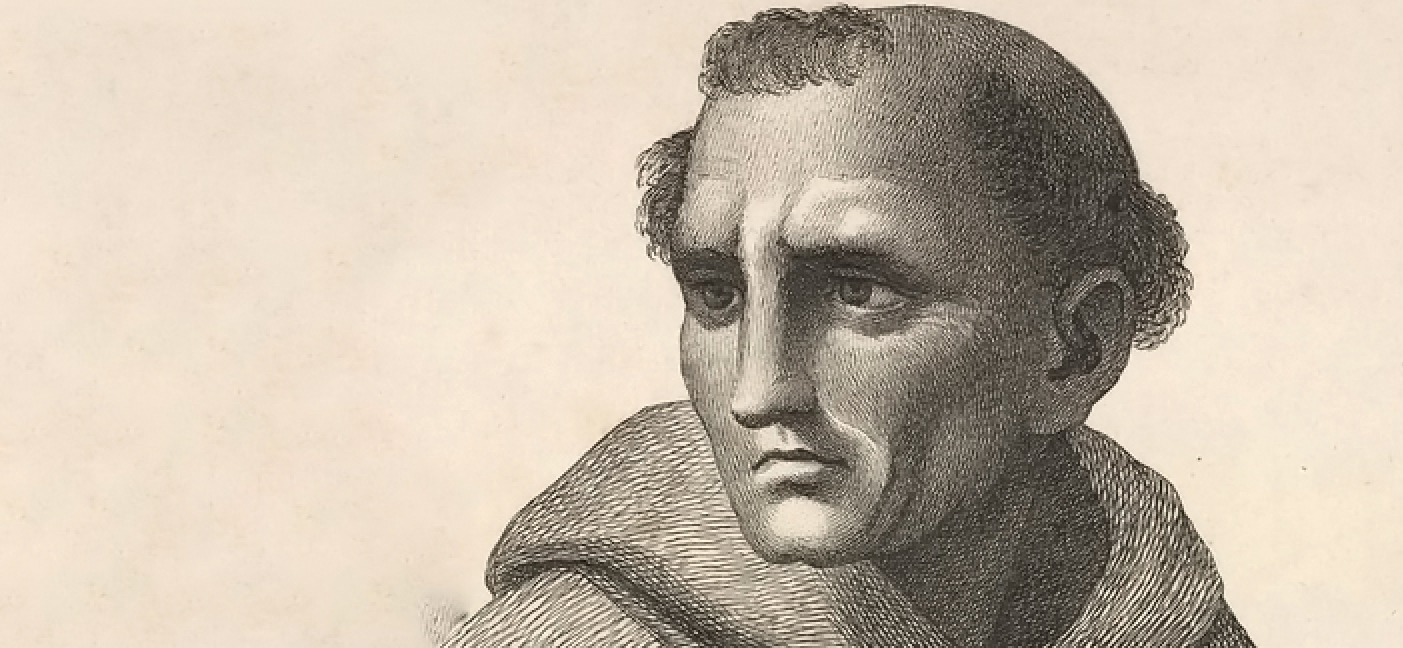
The Best Depictions of the Subtle Doctor

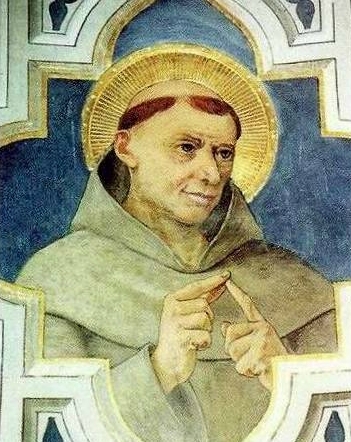
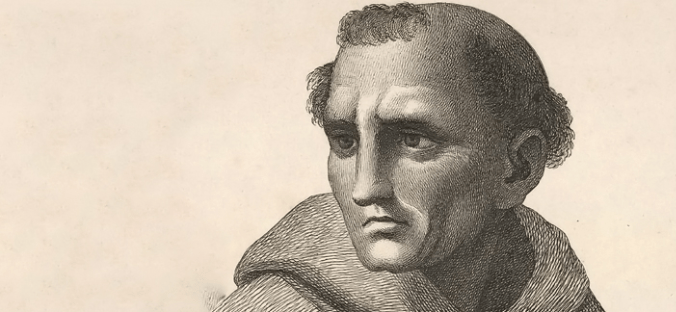
I’ve taken a major interest in Scotus recently. His Christology and Mariology seem to be treasures that remain largely unexploited by contemporary theologians, in part because he was recognized as being in the right about a doctrine that became dogma almost two hundred years ago. He is at the center of ongoing debates about the advent of secularism and modernity, debates which I am not competent to comment on at this time. Nevertheless, I thought it might be fun to examine some of the ways that Catholics (mostly Franciscans) have memorialized him in art over the course of the last several centuries. In some sense, the variety of depictions here tell a story of a lineage long overshadowed by other, more influential streams of thought. Thomism in particular has had a near perennial appeal within the Church, whereas Scotism, it seems, has largely been a niche concern. After all, Scotus has not yet been canonized or joined the ranks of the Doctors of the Church. This inequity arose from a variety of factors. No doubt, the fate of Scotism has come partially from Scotus’s own difficult style and vast intelligence. There’s a reason he’s called the “Subtle Doctor.”

May my small collection here help rectify that oversight on this, his feast day.

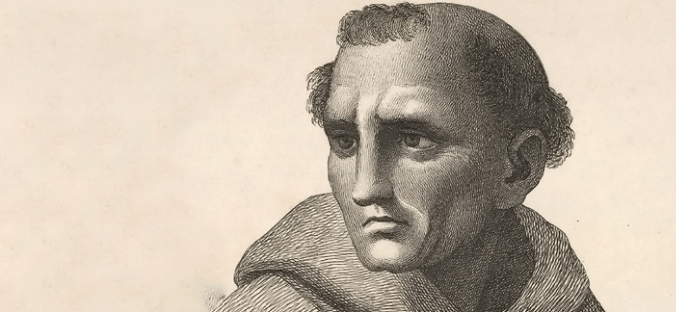
Bl John Duns Scotus-thumb-275x279-4957

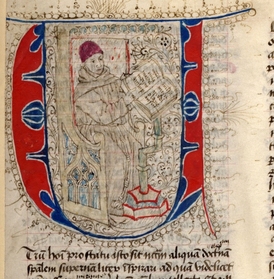
John the Scot (c. 1266 – 8 Nov. 1308), appearing in what must be one of his earliest depictions: an illuminated capital. (Source)
bl-john-duns-scotus

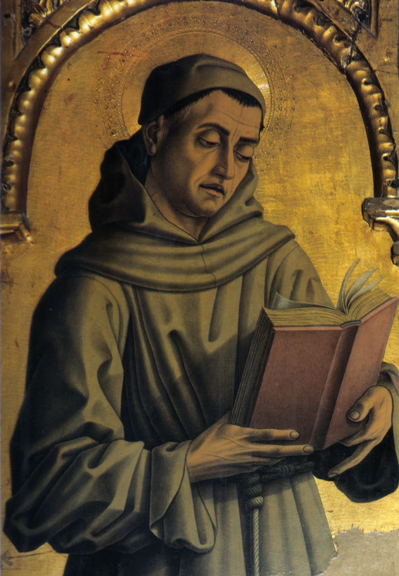
A Renaissance portrait of the Blessed John Duns Scotus. One point that people forget about Scotus is that he defended the rights of the Church against Philip IV, who had wanted to tax church properties. For his bold stance, he was exiled for a few years from Paris. (Source)
JohnDunsScotus_-_full

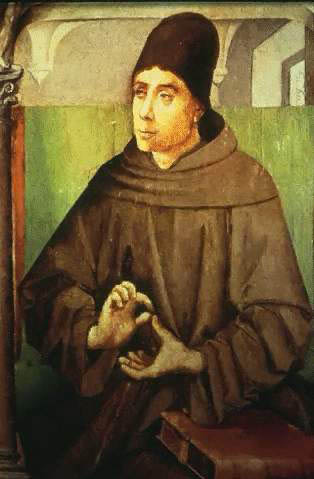
Perhaps the most famous, a late-Medeival, early-Renaissance portrait of Scotus. The name of the artist escapes me. (Source)
Beato_Giovanni_Duns_Scoto_B

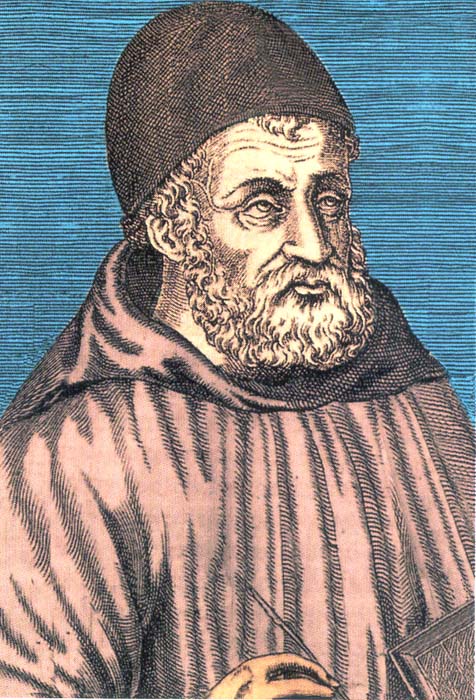
An early modern engraving of Scotus, probably early to mid 15th century. (Source)
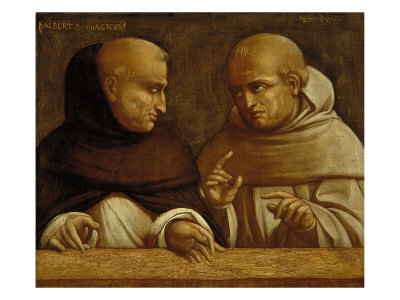
St Albert the Great & Bl John Duns Scotus

Here he is with St. Albert the Great, one of the Dominican Doctors. (Source)
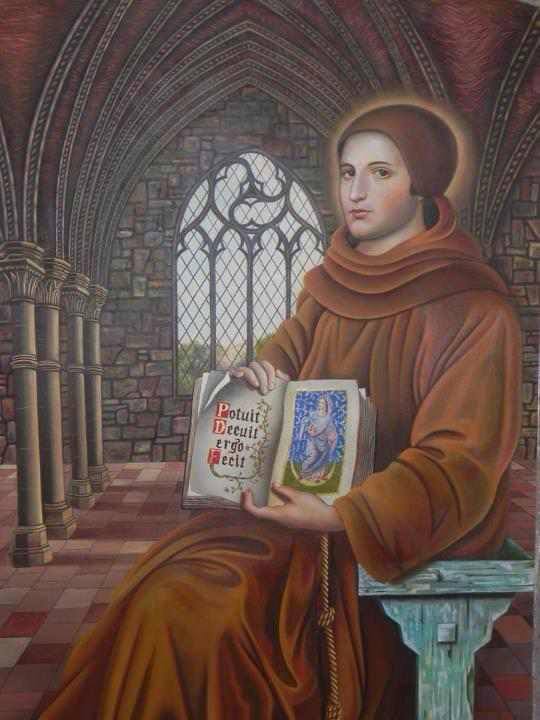
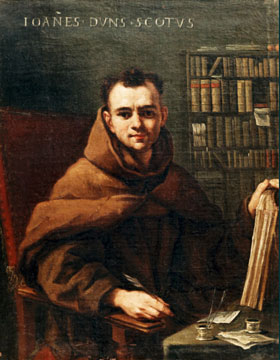
duns-scotus1

Scotus the Scholar. Age and provenance unclear; my guess is late 17th century, though it may be later. (Source)

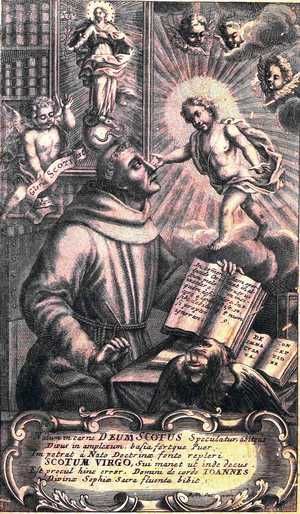
Scotus17thcentury

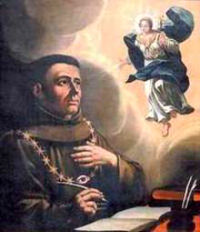
Scotus receiving a vision of the Christ Child, 17th or 18th century. Although chiefly remembered for his metaphysics and Mariology, Scotus made major contributions to Christology, defending the Patristic idea of Christ’s Absolute Primacy. (Source)
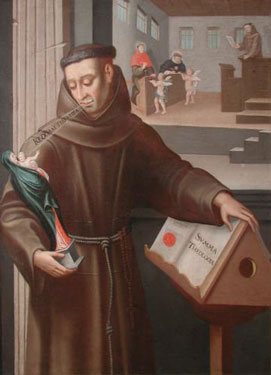
scotusstatue1

From the early modern period, it became typical to depict Scotus with representations of the Virgin Mary, whose Immaculate Conception he famously defended. This piece, probably from the 18th century, is one such example. It also contains a pretty clear criticism of Aquinas – Scotus looks away from the Summa to gaze lovingly at Mary (Source: this very friendly take on Scotus by a prominent popular Thomist)

11_08_duns_scotus2

A slightly more dramatic iteration of the same theme. Scotus is inspired by the Immaculate Conception. (Source)
ScotusChariot

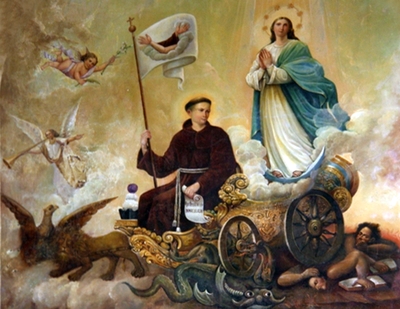
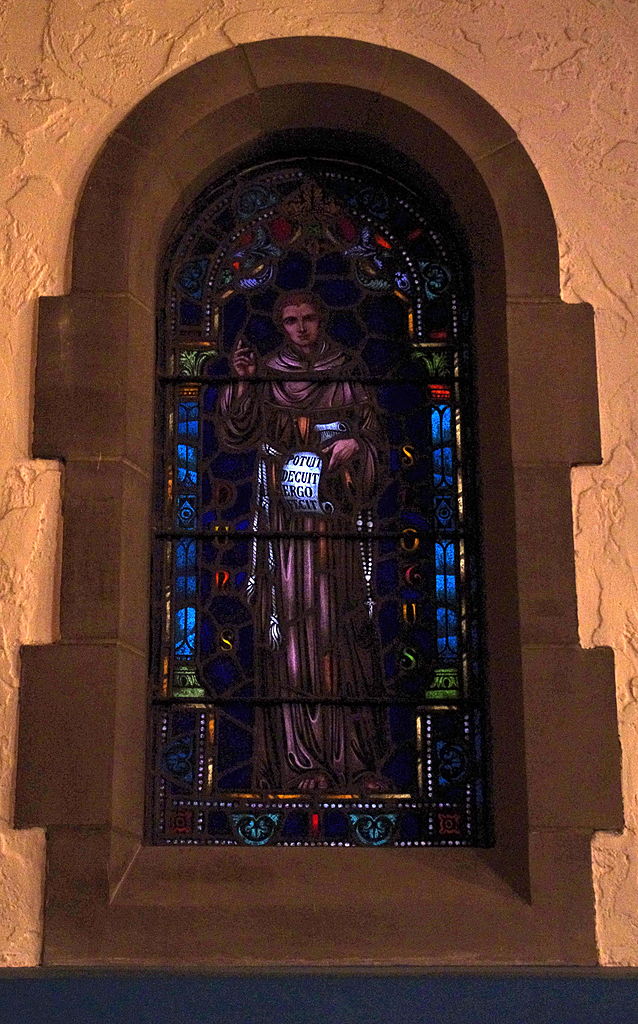
My single favorite image of Scotus is this ludicrously over-the-top Rococo depiction of Scotus and the Immaculate Conception triumphing over heresy and sin. He holds the arms (no pun intended) of the Franciscan order. His defense of the Immaculate Conception surpassed the doubts of even his own order’s great luminary, St. Bonaventure. And what a marvellously simple argument it was, too. Remember: POTVIT DECVIT ERGO FECIT. (Source).
Izamal Duns Scotus Adopte rest

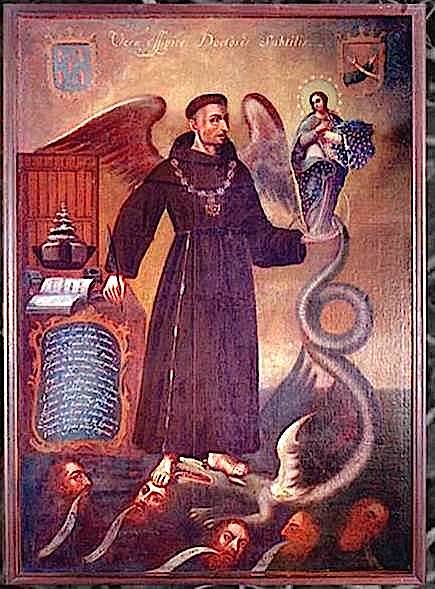
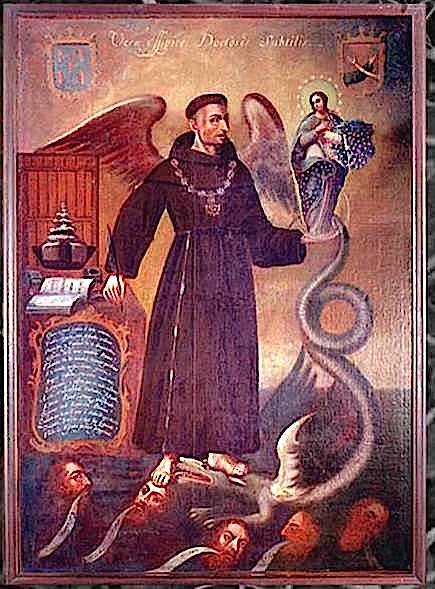
Likewise, this totally marvelous Colonial Mexican painting from the Franciscan monastery of Izamal, Yucatan, is something else. Rare is the saint granted wings in traditional iconography, though the trend was not uncommon in early modern Mexican art (Source)

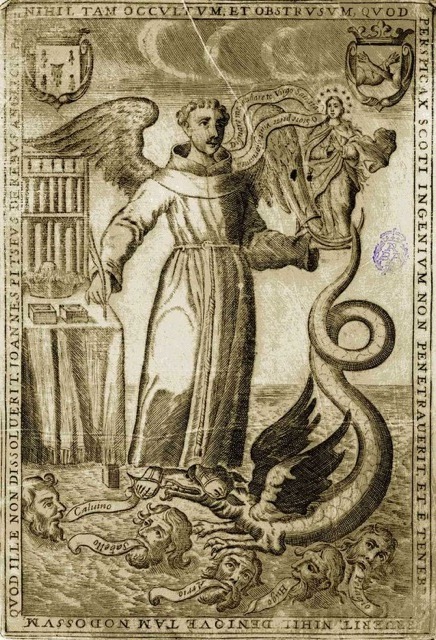
Joannes Pitseus, Scotus 1619

The mystery solved! This version by Johannes Pitseus comes from 1619, and served as a model for the Izamal piece. Here, it’s clearer that the heads represent various heretics, including Pelagius, Arius, and Calvin. (Source)

Landa Duns Scotus

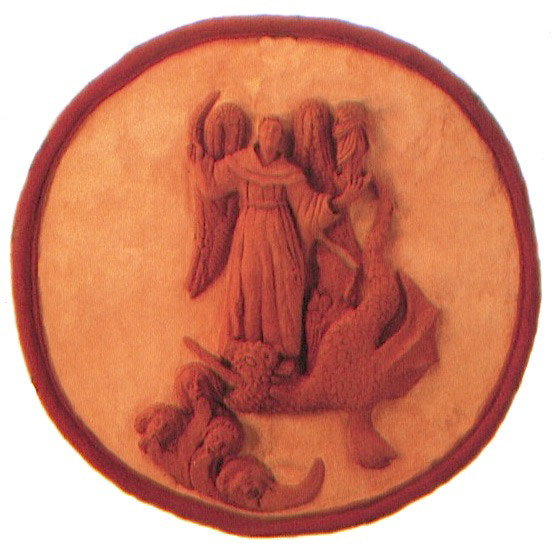
This ceiling relief from Landa, Querétaro, uses the same iconographic lexicon. It seems that the Franciscans of colonial Mexico had a set of stock images to propagate devotion to their own saints. (Source)

huej purisima

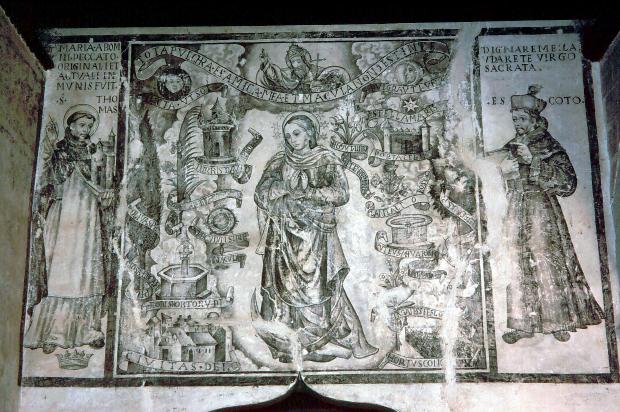
Here’s another unusual image of Scotus. In this mural of Mary Immaculate, or La Purísima, we see Scotus alongside St. Thomas Aquinas…and wearing a biretta! A remarkable addition, unique among all other depictions of the Subtle Doctor that I know of. (Source)

SCOTUS

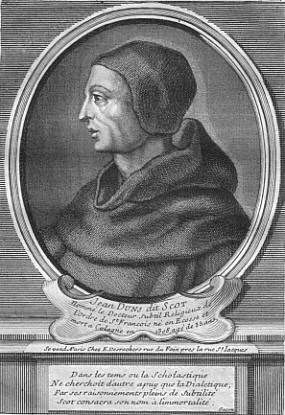
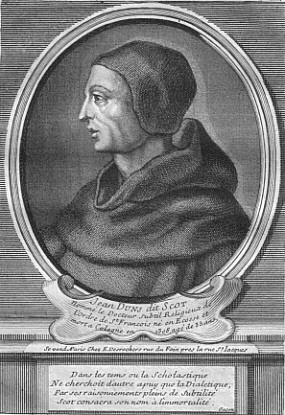
Moving away from Mexico, we come to this rather uninteresting French portrait of Scotus. Not all 18th century portraits of the man are elaborate bits of Franciscan propaganda. (Source)


unknown artist; John Duns Scotus (1266-1308)

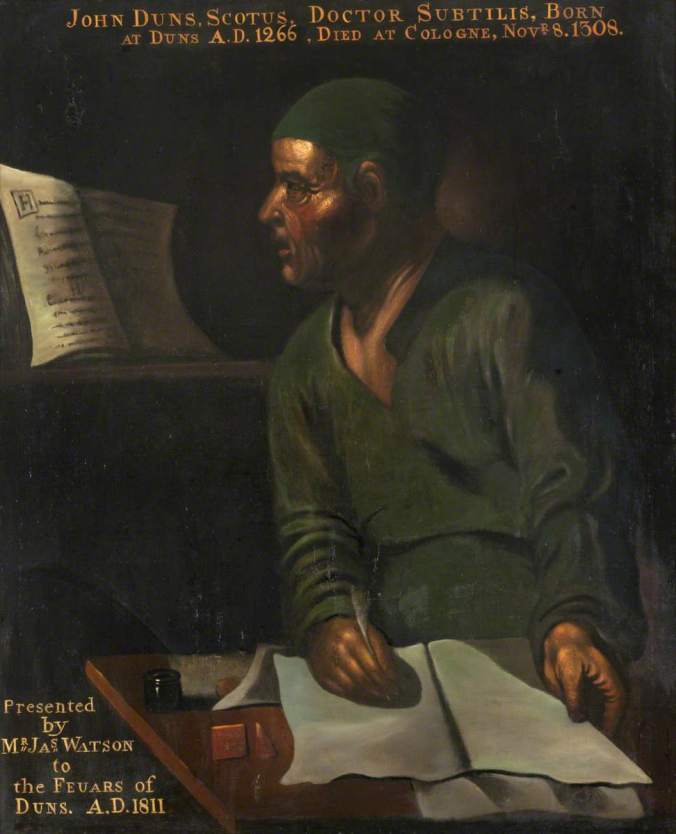
A late 18th or early 19th century depiction of Bl. John Duns Scotus. If this is in fact an English painting, its creation at a time of high and dry Anglican Protestantism poses interesting questions about the use of Scotus as a figure of national pride. (Source)

john-duns-scotus

I’m unsure of how old this image is; my guess, however, is that it represents a 19th century imitation of late Medieval and Renaissance style. (Source)

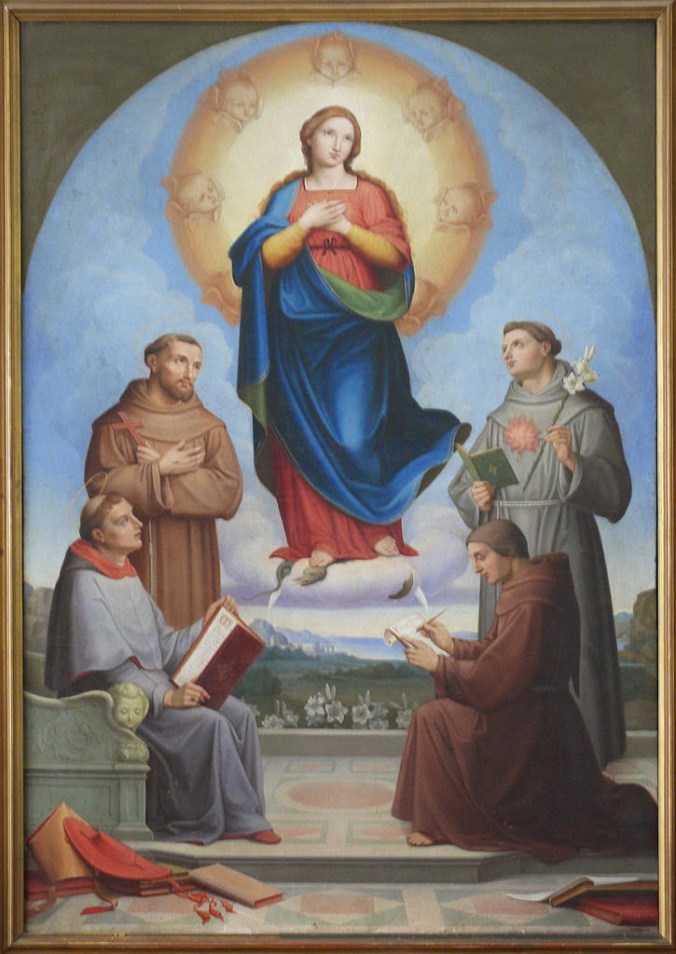
Albert Küchler (Brother Peter of Copenhagen) - Immaculate Conception with St. Bonaventure, Francis, Anthony and Blessed John Duns Scotus - Rome - Pontifical University Antonianum

A great 19th century painting of the Immaculate Conception by Danish Franciscan Albert Küchler. Scotus, who is on the bottom right, is here depicted alongside other Franciscan saints – S.s. Francis of Assisi, Anthony of Padua, and Bonaventure. (Source)

Immaculate_Conception_Church_(Columbus,_Ohio)_-_stained_glass,_Blessed_Duns_Scotus

This looks like a Harry Clarke window, though it may just resemble his style. In anyway, we see here Scotus holding a scroll with his famous argument for the Immaculate Conception epitomized – “He could do it, It was fitting He should do it, so He did it.” (Source)

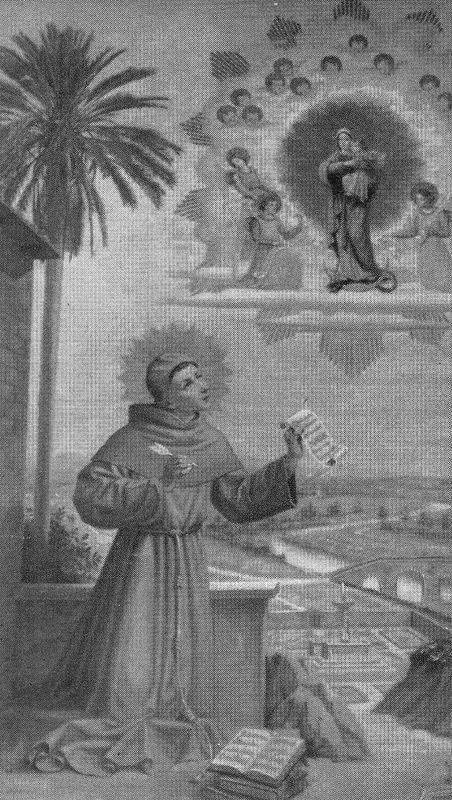
JohnDunsScotusImmaculata

John Duns Scotus, once again contemplating the Immaculate Virgin and offering his mighty works to her. (Source)

dunsscot.2

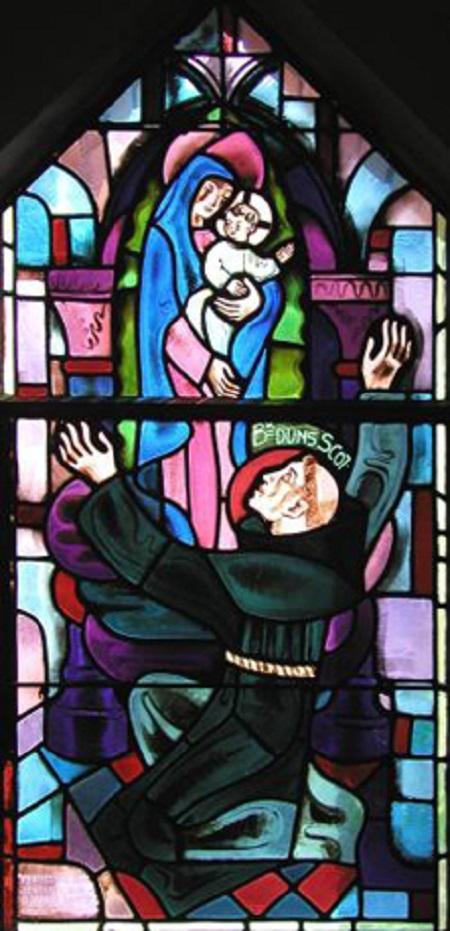
Another stained glass window, this time indubitably from the 20th century. We see here Scotus worshiping the Christ Child and his Immaculate Mother. (Source)

Johannes_duns_scotus_20060501

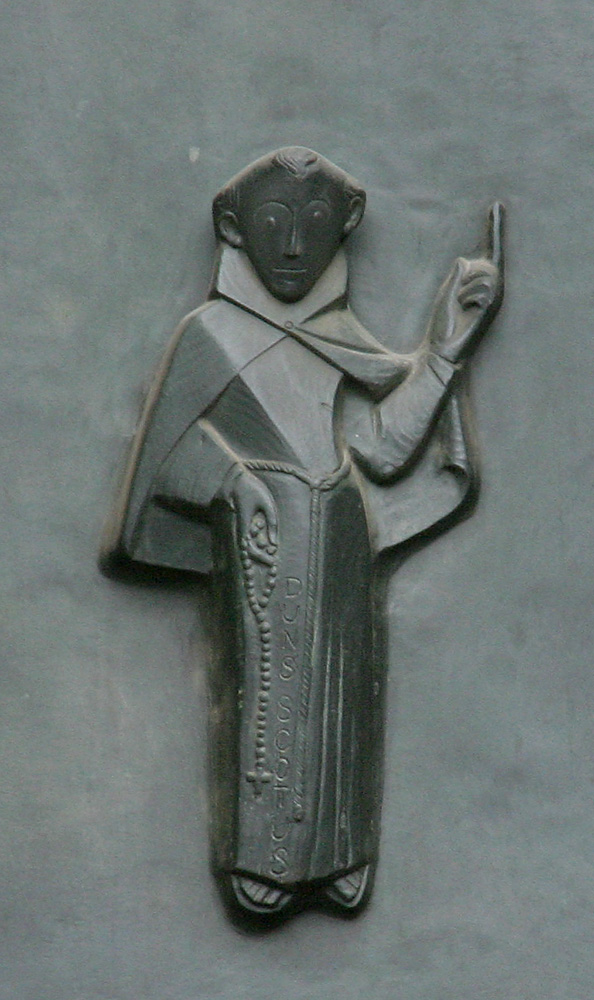
Scotus depicted in on the door of a Cologne Cathedral, 1948. He represents the supernatural gift of Understanding. (Source)

duns-scott_01

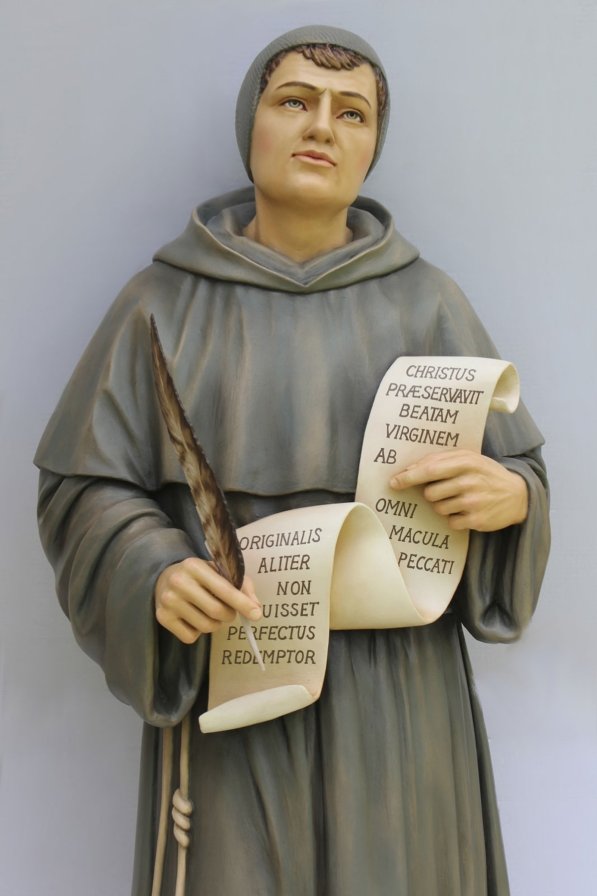
A contemporary statue of Scotus. (Source)

Scoto-2

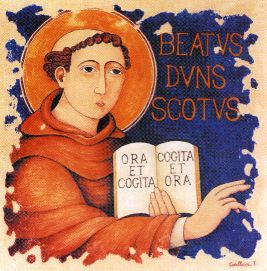
Scotus with a modification of the Benedictine phrase. “Pray and Think. Think and Pray.” Not a bad motto. (Source)


20thCScotus

A 20th or 21st century image of the Blessed Scotus (Source).

The Demonologist: Montague Summers

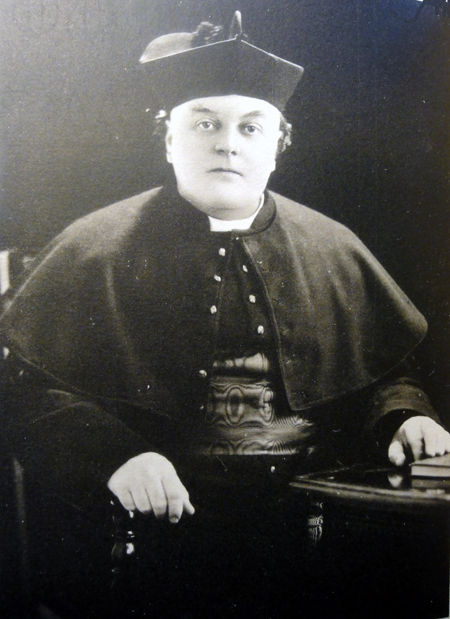
Montague_Summers01.jpg

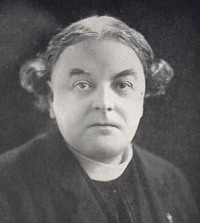
Montague Summers in clerical garb. (Source)

The history of the Church is a history of odd birds, but it is harder to find odder birds than those which inhabited the British Isles in the fruitful years of the Catholic Revival. The eccentricities of certain English clergy are well-known and well-beloved. One of the great flowers of this tendency was Montague Summers.

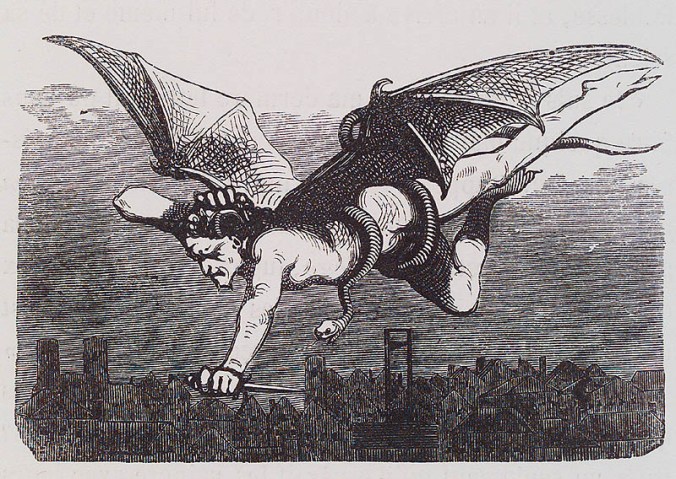
FlyingDevil

A flying devil. (Source)

Augustus Montague Summers was born in Bristol, the youngest of seven. Eventually he went on to study at Trinity College, Oxford, with the intent of seeking ordination in the Church of England. After some time at Lichfield Theological College, he was eventually deaconed and spent his curacy in Bath and the Bristol area. Even at this young stage, he garnered a reputation for eccentricity. In Ellis Hansen’s Decadent Catholicism, we learn the rather delicious fact that at seminary, “he was known to burn incense in his rooms and to wear purple silk socks during Lent” (qtd. by the Modern Medievalist).

This was as far as he made it in the ranks of the C of E, however. As the Oxford Dictionary of National Biography tersely puts it, “Rumours of studies in Satanism and a charge of pederasty, of which he was acquitted, terminated this phase of his career.” The latter charge may have had some truth to it. About this same time, he published a book of Uranian verse entitled Antinous and Other Poems (1907). His interest in pederastic and homosexual themes continued throughout his life. In 1940, he wrote a play about Edward II. Even more scandalously, “Despite his conservative religiosity, Summers was an active member of the British Society for the Study of Sex Psychology, to which he contributed an essay on the Marquis de Sade” (Source 1 and Source 2).

In 1907, though, Summers was out of a job. His hopes of becoming an Anglican clergyman seemed to have been quashed. But as they say, when the Lord closes one door, He opens another. We might imagine that Summers had something like this in mind when, two years later, he converted to Roman Catholicism. He also spent some time on the continent, allegedly for reasons relating to his health. Some have speculated that he might have received valid, if illicit, orders during this sojourn; others have said he spent his time exploring the black arts (vide the Modern Medievalist). We have almost nothing on which to base our speculations.

Now we see him coming to the full bloom of his later, famous eccentricity. It is in this formative period that he lays the foundation for the vivid persona that would make him such a cult literary and religious figure. I will quote the Oxford DNB at length:

On 19 July 1909 Summers was received into the Church of Rome and was granted the clerical tonsure on 28 December 1910; after this his clerical career became murky and remains so. He may have received minor orders as a deacon, but no record of his ordination has ever been found. During his lifetime, he was addressed as the Revd Montague Summers, celebrated mass in his own chapel and those of friends, adopted two names in religion, and invariably wore the dress pertaining to Roman priesthood; his appearance in soutane, buckled shoes, and shovel hat, later with an umbrella of the Sairey Gamp order, was familiar in London and Oxford. He became increasingly eccentric and was described as combining a manifest benignity with a whiff of the Widow Twankey. Some spoke of an aura of evil. It was charitably assumed by his friends that he was indeed a priest, and his devotion was never in question; his biographer Joseph Jerome (Father Broccard Sewell) records that all his life Summers wore the Carmelite scapular.

On a side-note, Fr. Brocard Sewell was a deeply strange man himself. But I digress.

If Summersor, as he was now calling himself, “Reverend Alphonsus Joseph-Mary Augustus Montague Summers”–had simply remained a slightly dubious cleric, we probably wouldn’t remember him. He might have become a little more than a footnote in the history of the Episcopi Vagantes so famous for dispensing illicit orders here and there. But he did not. Instead, he wrote. Prolifically.

Summers started off with genuine and important literary scholarship. Eventually, he even became a member of the Royal Society of Literature. He had certainly earned it with the sweat of his brow. He produced fairly good books on Restoration Drama, including major editions of previously neglected playwrights such as Aphra Behn. In this capacity, he had some connections with the world of the British stage; he was a founder of the Phoenix Theatre. He wrote an important monograph on Shakespeare.  In another work he also proved that the terrible Gothic novels that Jane Austen mentions in Northanger Abbey were all real books. Gothic literature remained a lifelong passion, in part because it dovetailed so well with his overriding obsessionthe occult.

vmps022

Montague Summers in clerical collar. (Source)

Summers is most famous today for his several books on witches, demons, vampires, ghosts, and other supernatural phenomena. He translated and edited the first English edition of the Malleus Maleficarum, that great tome of Medieval witch-hunting. He did the same with several other demonological manuals: The Demonality of Sinistrari, The Discovery of Witches by Hopkins, the Compendium Maleficarum of Guazzo, and the Demonolatry of Nicolas Remy. He wrote a text on The Physical Phenomena of Mysticism, in contrast with his somewhat headier and less decadent contemporary, Evelyn Underhill. He edited more than one collection of horror stories. He wrote three seminal texts on vampirism, one on lycanthropy, and four on various aspects of witchcraft. Following the best scholarship of the day, Summers endorsed the idea of the “Witch-Cult,” long suppressed by Christianity but operating sub rosa in Europe down the centuries (this hypothesis has long since been undermined by scholars across disciplines). He would often draw upon a huge range of historical, theological, ethnographic, and literary sources in constructing his arguments. All of his texts speak to his vast learning. It is probable that upon his death, Montague Summers knew more about the history and practice of the occult than any other Englishman then living.

The Modern Medievalist has preserved some charming anecdotes of the later, esoteric Summers over on his blog. We read, for example, the following passage from Ellis Hansen’s Decadent Catholicism:

…although Summers was a brilliant conversationalist, he had always a thick carapace of artificiality in his demeanor, a kind of mask that recalled the studied falsity of the classic dandy, not to mention the distrustful reserve of Walter Pater and John Gray. His style was decidedly aristocratic, Continental, and decadent, with the inevitable intimation of sexual impropriety. His friend writes of him, “He would often meet me with such an expression as Che! Che!, accompanied by a conspiratorial smile; or he would look closely at me and murmur, ‘Tell me strange things’.”

Or this remarkable scene drawn for us by Fr. Brocard Sewell:

Summers…could often have been seen entering or leaving the reading room of the British Museum, carrying a large black portfolio bearing on its side a white label, showing in blood-red capitals, the legend “VAMPIRES.”

Not to mention the fact that Summers went about town with a cane topped by a depiction of Leda and the Swan (vide the Modern Medievalist).

vmps011

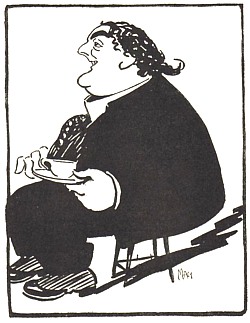
A caricature of Summers from the Evening Standard, probably from 1925. (Source).

What distinguished Summers’ writing on these dark subjects is the absolute credulity with which he approaches his subject. Unlike his predecessor, Dom Calmet, who wrote about ghosts with ambivalence and vampires with manifest doubt, Summers did not hesitate to express his firm certainty about both (and much more). He believed in all the phenomena he wrote aboutthe whole ghastly parade of incubi and succubi, of witches dancing at the Sabbath, of vampires rising from the grave to seek the blood of the living, of werewolves stalking innocent Christians in the night. Everything that belonged to the netherworld was as real to him as the people you or I might meet in the street. His purple prose often slips into breathless passages of scholarly terror. Observe the following lines from Chapter Two of The Vampire: His Kith and Kin:

It has been said that a saint is a person who always cho[o]ses the better of the two courses open to him at every step. And so the man who is truly wicked is he who deliberately always cho[o]ses the worse of the two courses. Even when he does things which would be considered right he always does them for some bad reason. To identify oneself in this way with any given course requires intense concentration and an iron strength of will, and it is such persons who become vampires.

The vampire is believed to be one who has devoted himself during his life to the practice of Black Magic, and it is hardly to be supposed that such persons would rest undisturbed, while it is easy to believe that their malevolence had set in action forces which might prove powerful for terror and destruction even when they were in their graves. It was sometimes said, but the belief is rare, that the Vampire was the offspring of a witch and the devil.

Summers also stood apart from his thoroughly modern era in endorsing “Church-sanctioned methods of destroying” the monsters he wrote about (The Modern Medievalist).

And although his pages are littered with authoritative quotes from long-dead writers, Summers was not unaware of the dark streams that swirled about him in his own day. Richard Cavendish reports in a typically mordant passage from The Black Arts (1967) how Summers treated the claims of the twentieth century’s greatest occultist, Aleister Crowley:

Aleister Crowley could not pass over such an opportunity to scandalize his readers. ‘For the highest spiritual working one must accordingly choose that victim which contains the greatest and purest force. A male child of perfect innocence and high intelligence is the most satisfactory and suitable victim.’ Montague Summers took this seriously, as he took everything else, and quotes it with gratified horror, in spite of Crowley’s footnote in which he says that he performed this sacrifice an average of 150 times a year between 1912 and 1928! (Cavendish 238)

In spite of it all, Summers remained well-liked in certain circles. He moved among the literary elite of his own day, an eccentric among eccentrics. One of his friends, the actress Dame Sybil Thorndike, relates something of his personality:

I think that because of his profound belief in the tenets of orthodox Catholic Christianity he was able to be in a way almost frivolous in his approach to certain macabre heterodoxies. His humour, his “wicked humour” as some people called it, was most refreshing, so different from the tiresome sentimentalism of so many convinced believers.

His caricature in the Evening Standard captures something of this impish quality.

But although he was known and appreciated in his own day, he has been largely forgotten in the intervening decades. There have not been many books about Montague Summers, and he is not widely read. However, that will soon hopefully change. In recent years, Georgetown University has acquired Summers’ papers, once thought irrevocably lost. Fittingly, they have a peculiar provenance, having been “discovered languishing in an old farmhouse in Manitoba.” The story of how they got there is probably as strange as any of Summers’ own books. Georgetown’s collection has made possible a forthcoming biography by Matthew Walther that will hopefully rectify the longstanding neglect of this bizarre yet sincere writer.

But perhaps a question rises. Not every obscure author is worth reviving. Why bother with Montague Summers? A man of outdated style, of dubious subjects, and of very questionable morals to boot…what does he offer the modern reader?

pope's grotto 082

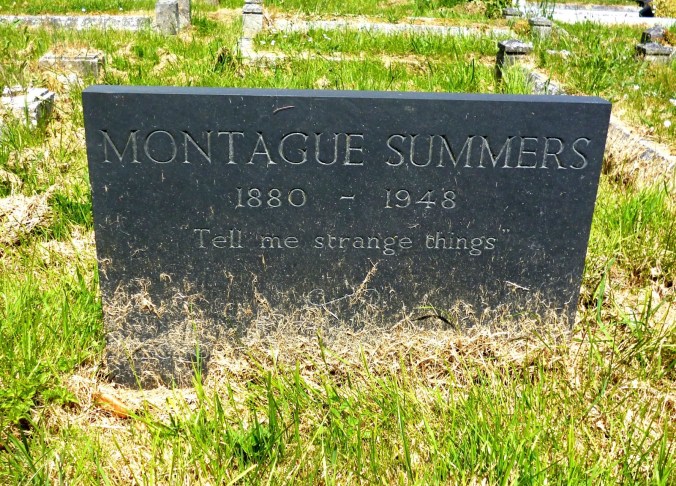
The grave of Montague Summers. (Source)

The Modern Medievalist has a few thoughts on the matter.

Montague Summers is, at best, a good fit for the Institute of Christ the King and a throwback to an age when priests were also arbiters, makers, and preservers of high culture a la Antonio Vivaldi; at worst, a “daughter of Trent” who, if he ever actually was a priest to begin with, wasted his vocation on trivialities rather than the cure of souls.

Perhaps. I am not so convinced that Summers would have fit in any age. He was a decadent, and a great deal of decadence is contrarianism. Though the comparison with ICKSP is hilarious.

I think the message of Summers’s life and work can best be summed up in his epitaph.  On the black stone hat marks his grave in Richmond Cemetery, we read a simple phrase; “Tell me strange things.” These four words that he used to say to his friends encompass his whole life, packed as it was with “strange things.” Summers matters today not because he is a towering figure of literary talent, nor because his scholarly subjects are of vital importance, nor because he is a moral exemplar of impeccable religiosity. He matters because he can remind us to embrace the mystery of life. As we read in one of those plays that Summers so loved, “There are more things in heaven and earth, Horatio,/Than are dreamt of in your philosophy.” Summers lived by those words. The more I learn about the world, the more reason I see in them. And what better day to remember this humbling, bewildering, frightful truth than on All Hallows’ Eve?

My Favorite Scary Movies

Lloyd

What’ll ya have? (Source)

It’s nearly the Eve of All Hallows, and that means it’s time for some spooky stuff. I thought I’d offer up my top 10 favorite horror films for your viewing enjoyment.

I’ll begin with a few honorable mentions, including horror comedies. In no particular order: Sweeney Todd (2007), Halloween (1978), The Rocky Horror Picture Show (1975), The Exorcist (1973), Dracula: Dead and Loving It (1995), What We Do in the Shadows (2014), The Silence of the Lambs (1991), Young Frankenstein (1974), The Others (2001), and Shaun of the Dead (2004). All of these are pretty good films on their own terms, and you should watch them. But for the following list, I wanted to highlight a few I though were especially worth re-viewing this Halloween.

I generally dislike slashers and body horrors, so you won’t see any of the Saw, Grudge, Hostel, Alien, or Ring series here. My tastes run towards the Gothic, psychological, occult, Lovecraftian, and atmospheric. My list reflects that tendency. I don’t claim it will satisfy everyone. Finally, while I have generally tried to avoid SPOILERS, I think I may have left one or two. So abandon all hope, ye who enter here.

10. Jack Frost (1997)

jack-frost-1997-snowman-attack

When he kills this guy, he says, “I only axed ya for a smoke.” And chuckles. Really. (Source)

Admittedly, this is a very bad film. It holds a whopping 7% on Rotten Tomatoes, and I’ve never been able to get through the whole thing myself. But what I have seen makes me esteem Jack Frost as one of the corniest and campiest of horror B-movies. And I adore B-movies, so this one’s gonna stand in for all the crap I could have chosen instead.

The plot is pretty straightforward. A psychopathic serial killer is being transported to death row when his car gets in an accident with a massive container truck full of a biological reagent. He is burned by the acid and seemingly melts away. However, his DNA fuses with the snow and takes on a new form as a Killer Mutant Snowman, hell-bent on terrorizing the community that sentenced him. Hilarity ensues. Complete with over-the-top gore, the very cheapest of special effects, completely maladroit music, a ridiculous sex scene, some of the worst acting you will ever watch, and dad-level one-liners (no, but really), this Christmas-themed whopper of a flop will liven up your Halloween.

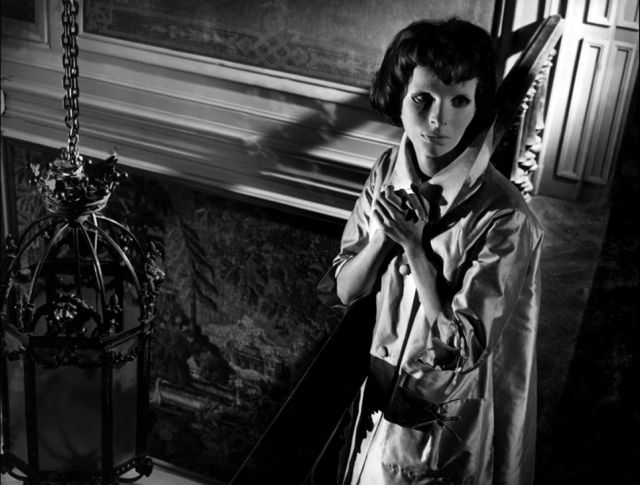
9. Les Yeux Sans Visage (1960)

yeux-sans-visage2_0

Les Yeux Sans Visage – a classic of French horror, with profound Feminist undertones. (Source)

Now on to something actually creepy. This French horror film by Georges Franju is not overly scary, in the sense that it lacks jump scares or the typical fare of, say, slashers or sex-crazed body horrors. But it’s definitely worth seeing, as at times it actually becomes a poignant exploration of power and acceptance. Also, it inspired an eponymous song by Billy Idol.

A mad scientist and his cohort of minions murder young girls in Paris so that he can steal their faces – literally. His daughter Christiane suffers from a terrible facial disfigurement after a motorcycle accident for which he was responsible, and in his guilt, he promises he will graft a new face onto her. Every attempt is unsuccessful. Christiane wanders the halls in an eerie white mask, and we are treated to a gruesome, close-up view of a face transplant. Ultimately, the story examines how men use female bodies as canvasses to represent and expiate their own guilt, especially for violence they have committed against women. It also examines the complicity of other women – the mad doctor’s closest assistant is a lady whom he successful healed after her own scarring accident.

A sensitive, beautiful, and tragic tale with a few disturbing scenes. Worth your time.

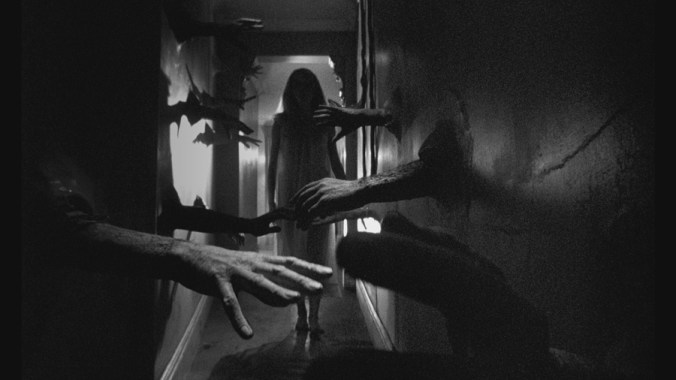
8. Repulsion (1965)

repulsion-hallway-copy

The famous hallway of hands sequence in Repulsion. (Source)

One of Roman Polanski’s early greats, Repulsion remains a standard of Psychological Thrillers. It features some of Polanski’s classic sequences and shots: the buskers, the hallway of hands, the decomposing rabbit. The film follows the mental breakdown of a young girl (played by a youthful Catherine Deneuve) on a weekend she spends alone in her apartment in Belgium. That may sound simple, but boy is there a lot going on. Sex, murder, insanity – not to mention painfully tight close-ups in an era when that was considered artistic. Repulsion is definitely one of the strangest and most harrowing films on this list.

7. Jaws (1975)

Jaws

Duh dum. Duh dum. (Source)

One of the greatest and most popular horror films ever made. Its instantly recognizable theme is one of the few horror scores to rise to the status of auditory icon. I would argue that it’s Steven Spielberg’s finest and scariest foray into the genre, much better than his trope-heavy Poltergeist (1982). The simplicity of Jaws is what makes it so effective as a nail-biter. There’s a murderous shark, and to hunt it, you have to become ever more isolated – and thus ever more vulnerable.

There are plenty of genuinely scary moments in the film, but I think one of the best is also one of the most understated: the tale of the USS Indianapolis. Here, too, the black magic is all in the simplicity. Quint tells a story. That’s it. But it’s one of the most disturbing stories ever told in a film (and what’s worse, it’s true). While all the cast give fantastic performances, Robert Shaw exceeds his peers by that one scene.

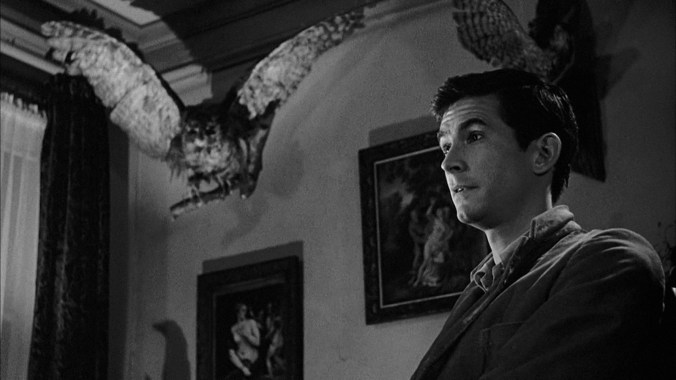
6. Psycho (1960)

psycho-3

“We all go a little mad sometimes…” (Source)

I probably could have chosen several of Hitchcock’s films for this list. Some of his thrillers are remarkably good. Particular favorites include Strangers on a Train (1951), Vertigo (1958), and Rope (1948). But as far as frights go, nothing in the prolific director’s oeuvre surpasses his horrific masterpiece, Psycho. Long before M. Nigh Shyamalan attempted (and subsequently wrecked) the art of the twist ending, Psycho showed generations of directors how it was done. Ans like Jaws, Psycho gave us an iconic score, forever associated with an iconic scene.

Psycho was among the first real horror films I saw, one Halloween night many years ago. I’ve loved it ever since.

5. Eraserhead (1977)

Eraserhead

The woeful Henry Spencer in David Lynch’s first movie, Eraserhead (Source).

David Lynch is one of my favorite directors (I sometimes joke that Twin Peaks is my “second religion”). His first film, Eraserhead, has an affinity with the New Wave horror of Polanski et al. As in Repulsion, we are constantly made to feel the limits of the space the characters inhabit. But Claustrophobia is only one of the fears that Lynch explores. Eraserhead is a great meditation on the terrors that attend some of the most common experiences of life: work, sex, marriage, fatherhood. Jack Nance’s performance as Henry Spencer is riveting as it is tense, and the eerie Lady in the Radiator sequences foreshadow much of what Lynch would later use in his more famous works like Twin Peaks and Mulholland Drive. The film also probably wins the award for creepiest baby in cinematic history; even today, Lynch won’t reveal how they made it. If you like surrealism, body horror, or pencils, I recommend this classic for your consideration.

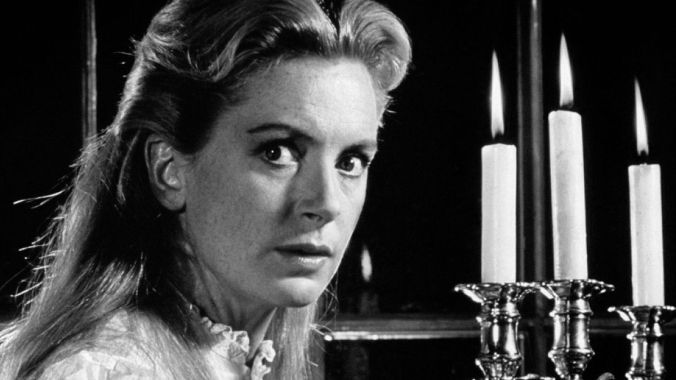
4. The Innocents (1961)

theinnocents

Deborah Kerr gives a masterful performance in this classic Gothic horror. (Source).

If you like your horror set in creepy old English manor homes, full of candlelight and the creak of ghosts on the stairs, then you’ll certainly love The Innocents. Based on Henry James’s classic novella, The Turn of the Screw, the film follows a governess, played by Deborah Kerr, who is sent to care for two orphans in the English countryside. As time passes, she starts to believe that the children are under the malign influence of ghosts. Is she insane? Or is she battling the forces of the supernatural?

While viewers still debate the meaning of the deeply ambivalent ending, one thing’s for certain; this film is a masterful example of mid-century Gothic horror. Not to be missed.

3. The Wicker Man (1973)

lord-summerisle-the-wicker-man2

Traditional British Values. (Source)

The Wicker Man, strictly speaking, really isn’t all that scary. But it is a very good story all the same, and Christopher Lee puts in a marvelous performance as Lord Summerisle. If you like folk-horror, a subgenre the English do better than anyone, you’ll enjoy this creepy little romp through a murderous, pagan island in Scotland. Arthur Machen would have loved it.

I find it somewhat amusing that Lee, a devout Anglo-Catholic, thought that the film was ultimately a Christian one in suggesting that even nice people can commit horrible acts if they are not within the fold of the Church. Maybe. But what a poor argument for Christianity it is! The protagonist is such an unlikable and censorious prude, and the villagers are such fun-loving heathens, that you end up not caring too much about the Christian policeman’s fate in the final showdown. Alas. I suppose I’m biased, though, as I’ve long thought that Catholics are just baptized pagans anyway. Incidentally, I think the community of Summerisle gives a pretty good picture of what the Benedict Option might look like in practice.

Don’t confuse this classic with the highly memeable 2006 sequel starring the one and only Nicolas Cage. There are creepy masks, but no full-on bear suits in Christopher Lee’s version. And definitely no bees.

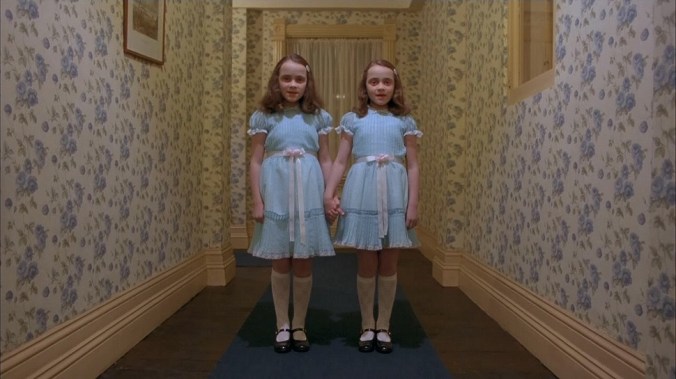
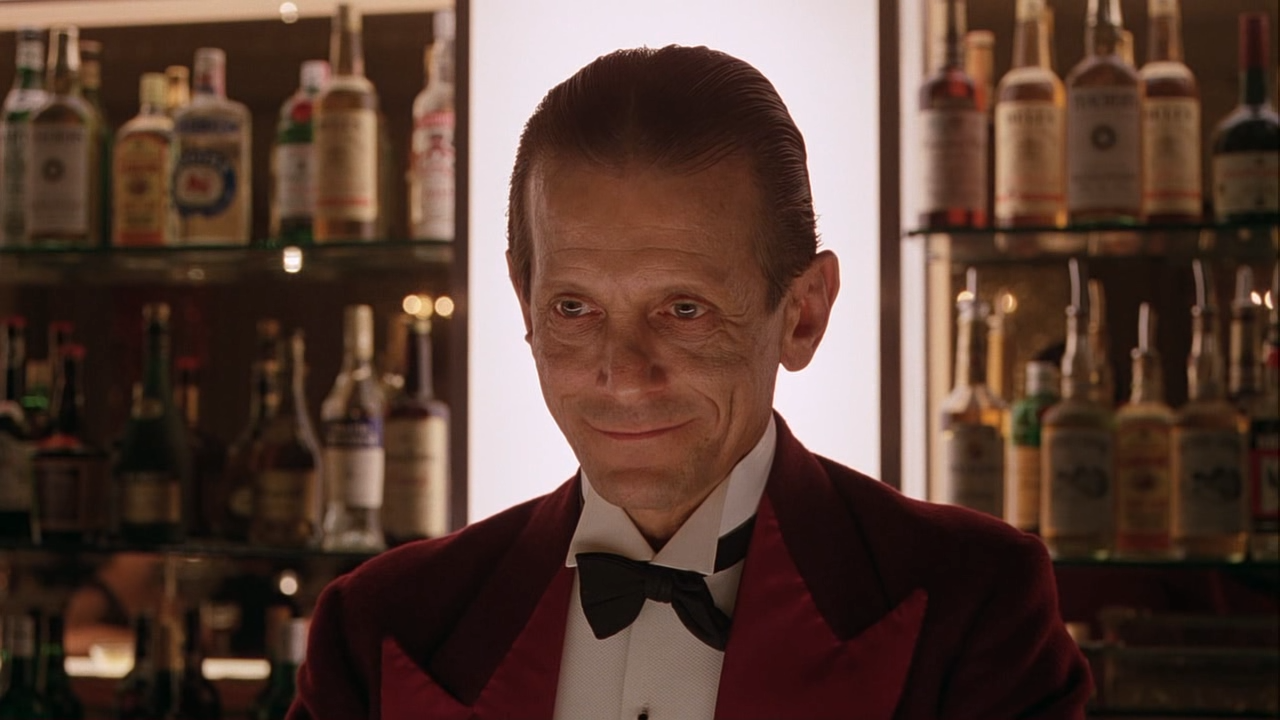
2. The Shining (1980)

the-shining-HD-Wallpapers

“Come play with us, Danny.” (Source)

Stanley Kubrick’s horror masterpiece. Considered in purely artistic terms, there are no better films on this list. It shows what kind of art can happen when a genius director works with a genius actor (Jack Nicholson in one of the best performances of his career). More to our point – the frights are just as potent today as they were in 1980. Unlike a number of other works from the same decade, The Shining has retained its creepiness. It terrified and disturbed me the first time I saw it, and while I mainly pay attention to its formal and aesthetic qualities now, I still jump now and then when I watch it. I will never not find that man in the dog/bear suit (you know the one) absolutely terrifying, and I will never not relish the conversations with Lloyd and Grady with a certain perverse glee.

I could probably go on and on about how great this film is. But why bother? Just watch it yourself. You won’t be disappointed.

1. The VVitch

WitchWoods

“What went we out into these woods to find?” (Source)

Horror has gotten much better lately, with genuinely artistic offerings from bold new directors. The Babadook (2014), Goodnight Mommy (2014), It Follows (2014), The Blackcoat’s Daughter (2015), The Eyes of My Mother (2016), It Comes at Night (2017), and Get Out (2017), among others, have all renewed the genre. But my favorite among the new horror is The Witch (2016). Genuinely creepy, trope-laden without being clichéd, atmospheric, Gothic, full of painstakingly reproduced sets and costumes from Puritan New England, and written entirely in 17th century English, The Witch represents an enthusiastic return to the old legends of Early Modern witchcraft. And it is beautifully shot. At times, it looks like the film that Goya would produce if he lived in our time. There is a black goat. It will change the way you look at the animals. In short, it is a cinematic triumph for A24, a studio that has proven itself to be one of the leaders of the new horror.

I love The Witch for all those reasons – but also because it presents a world in which Christianity is taken seriously. That rather startling quality has been in short supply among horror films since Terrence Fisher’s Hammer flicks of the 1960’s and 70’s. We see these characters as real, dignified people afflicted by indisputably real forces of the supernatural. In the world of The Witch, the Devil is real and so are his servants.

The film can also be read as a profound meditation on the doctrine of original sin. The ruin of the whole family follows from the pride of the father as we see it at the movie’s start. They are effectively damned as soon as they leave the village. There is perhaps some irony in the fact that the Church of Satan both endorsed and promoted the film. It is the only really Calvinist movie I’ve ever seen; no other has so deftly and deeply explored the Reformed idea of reprobation.

Halloween is naturally a time to seek out a good scare. If you’re looking to do that with a movie, I can think of no better option than The Witch. But you’ll get more than that. The Witch immerses us in a world we can hardly fathom, a world where supernatural evil lurks just behind the treeline and in the pale light of an attic. Dipping into that world can be salutary. After all, maybe it’s a good idea on the Eve of All Hallows – the night before the feasts of the Saints in Heaven and the Holy Souls in Purgatory – to spend some time first meditating on the damned.


Mea Culpa, Mea Culpa, Mea Scholastica Culpa

BlessedJohnDunsScotus

The Blessed John Duns Scotus (Source).

In my review of Rod Dreher’s The Benedict Option, I wrote the following:

I’m not suggesting that Dreher is necessarily wrong in his various judgments. He may well be correct in accusing the nominalists of a kind of cultural deicide (although it overlooks the Christian nominalist tendency, closely tied to empiricism, that numbers Berkeley, Burke, Hamann, Newman, and Chesterton among its ranks).

I subsequently received some pushback for making such a claim. After all, eminent philosophers and theologians had long made nominalism the villain of their narratives about the rise of an anti-Christian modernity. Others questioned my assertion about Newman in particular.

At that time, I defended myself by suggesting that, while I may be off in ascribing a specifically nominalist tendency to these thinkers, that nevertheless, they all do share, inter alia, a suspicion of universalizing abstraction, a respect for concrete particularity in its various forms, and a trust in prudence gained from experience. I interpreted this tendency as akin to the nominalist rejection of substantively existent universals. I also thought that one of the reasons this way of thinking might matter is in our dialogue with postmodernity, which is itself so suspicious of universals and grand narratives.

Nevertheless, I erred. I was mistaken to use that label of nominalism. I must thank my critics for pointing this out. In the many months since then, I have learned what would be the proper term to tie together these particular thinkers – not to mention Gerard Manley Hopkins and J.R.R. Tolkien.

The “nominalist tendency” is really a Scotist tendency. (The fact that I could make such an ironic error is, perhaps, a sign of my own ignorance. I own that. Scholasticism isn’t really my thing.) Chastened by my previous mistake, I hesitate to delve too deeply into the technical depths of Scotist philosophy. I will state briefly that a belief in the idea of haecceity as the unique thisness of each particular sums up the tendency’s core point. If I had time, I’d like to investigate if any firmer affinities could be found.

However, I believe I am now on much sounder territory. The Franciscan Daniel Horan’s work has focused on a postmodern engagement with Scotus, and the Scotism of Newman and Hopkins have been well-attested in the literature. Tolkien took up the theological note behind Hopkins’s ideas of inscape and instress, themselves poetic derivations of Scotist haecceity. More work still needs to be done in English on Hamann, but the image that is emerging is of a figure passionately devoted to the disruptive nature of ordinary, particular experience. His willingness to contest the established narratives of the Aufklärung predates postmodernism by a century and a half. Chesterton is cut from the same cloth. Bishop Berkeley, though perhaps not quite so colorful as either of these two, stakes his empiricism on the particularity of the thing perceived (ultimately, by God). And Burke transposes the idea into the realm of politics, tempered by a healthy respect for natural law.

Two observations come to mind. The first is that nearly all of these thinkers are English or Anglophone. An enquiry into the reasons behind English Scotism would be useful. In its absence, I will merely note that Scotus, that medieval Oxford theologian, seems to have been directly reintroduced into the life of modern English spirituality by another Oxford theologian, John Henry Newman. It was Newman’s influence that defined intellectual Catholicism in England until the conclusion of Vatican II.

The second is that several of these thinkers are literary figures in their own right. Hopkins is principally remembered as a poet, Chesterton as a journalist, novelist, and poet, and Tolkien as a novelist. Newman was a prolific writer across genres. He exerted a personal influence over Hopkins, Matthew Arnold, and Oscar Wilde. And Hamann’s own deeply bizarre output constantly blurs the rigid lines of 18th century drama (yet another way he foreshadows our own postmodern era).

I must wonder if Scotist thought is particularly apt for the production of theology in a poetic mode, as the Catholic Sophiologists of our own day are seeking to do. I certainly have friends who think so. At the very least, Scotus’s high Mariology accords well with the extremely high Mariology of some Sophiologists.

If I had more time, I should like to dive more deeply into these questions. For now, I seek only to explain myself a bit, and apologize for what was clearly a serious error.

ADDENDUM: I also meant to say that Delleuze’s appropriation of haecceity as a fundamental concept lends support to my own impulse of putting these thinkers in conversation with postmodernism.