Thus concludes Anno Domini MMXIX. It is strange to think that we are about to enter the third decade of the new millennium. I am by temperament a pessimist, but I hope that this decade is an improvement over the last (a time in which I experienced a tremendous amount of personal growth). Let us pray for God’s continuing mercy and Providence.
Here are some blog stats from the last year, for those who are interested.
In 2019, The Amish Catholic received a total of 66,839 views, with a total of 39,175 visitors. My total views were down this year by 1,035, though I received 3,969 more visitors in 2019. My most popular month was March, in which I received 19,066 views and 12,919 visitors. My least popular month was February, with only 3,011 views and 1,369 visitors. This is really all very good news, since I published many fewer pieces in 2019 than in 2018 – this has been my most intense calendar year of studies ever. Including this summary, I published 42 pieces in 2019 – down from 109 in 2018. Had I been a bit more productive, all my other numbers would have gone up this year.
Humor keeps the top spots, while works of controversy and commentary appear with greater frequency this year than in the past. Spiritual and academic pieces usually don’t have a terribly wide appeal – which is probably good, because I’m a young layman and a lowly grad student.
I suppose I could finish this trying to come up with a list of lessons I’ve learned over the course of the last year – in blogging, in life, etc. The temptation is even greater in view of the closing decade. Yet that often seems rather contrived. I would rather close with what seems to me the best way to end a year and a decade: on a note of gratitude. I could not have gotten where I am today without tremendous help along the way. Friends, family, mentors, and even strangers have made my life better in ways that I cannot begin to describe. Thank you to everyone who has been there along the way. You know who you are.
And thanks to the friends in heaven who have helped with their many prayers. As I concluded 2018, so will I finish the decade – with a prayer that encompasses all of time.
Glory Be to the Father, and to the Son, and the Holy Ghost, As it was in the beginning, is now, and ever shall be, world without end. Amen.
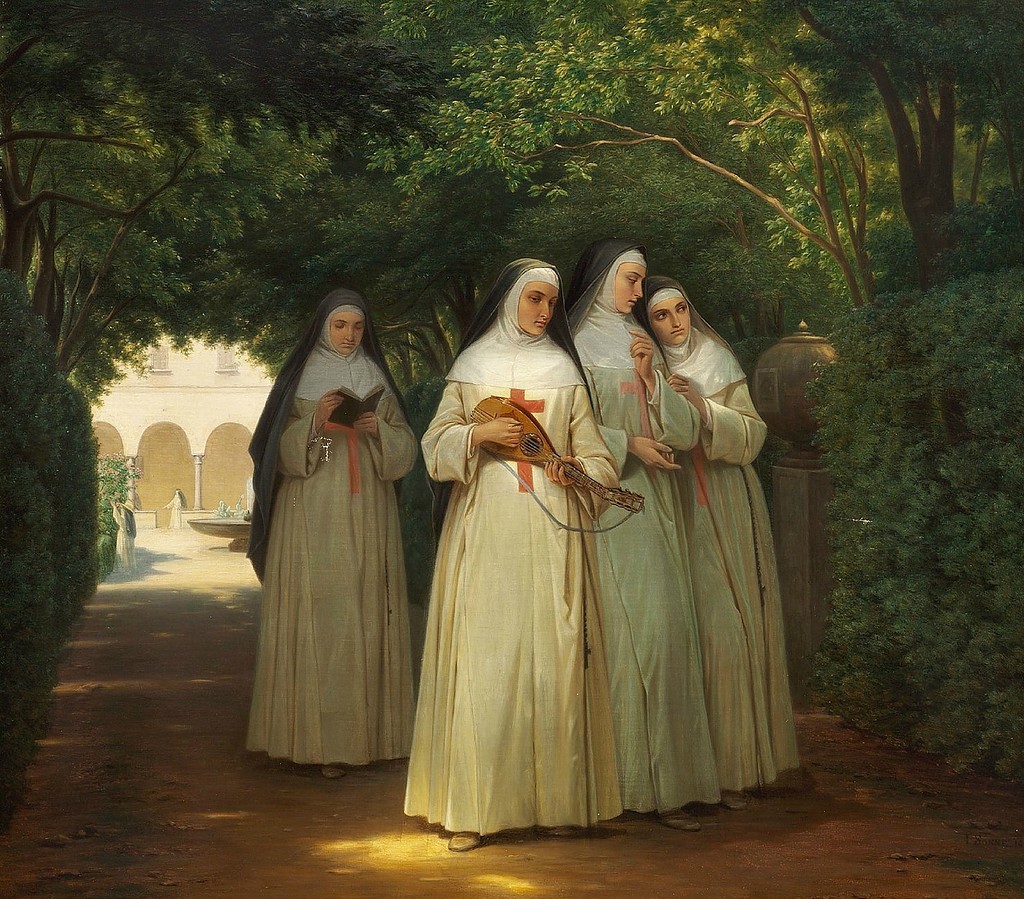
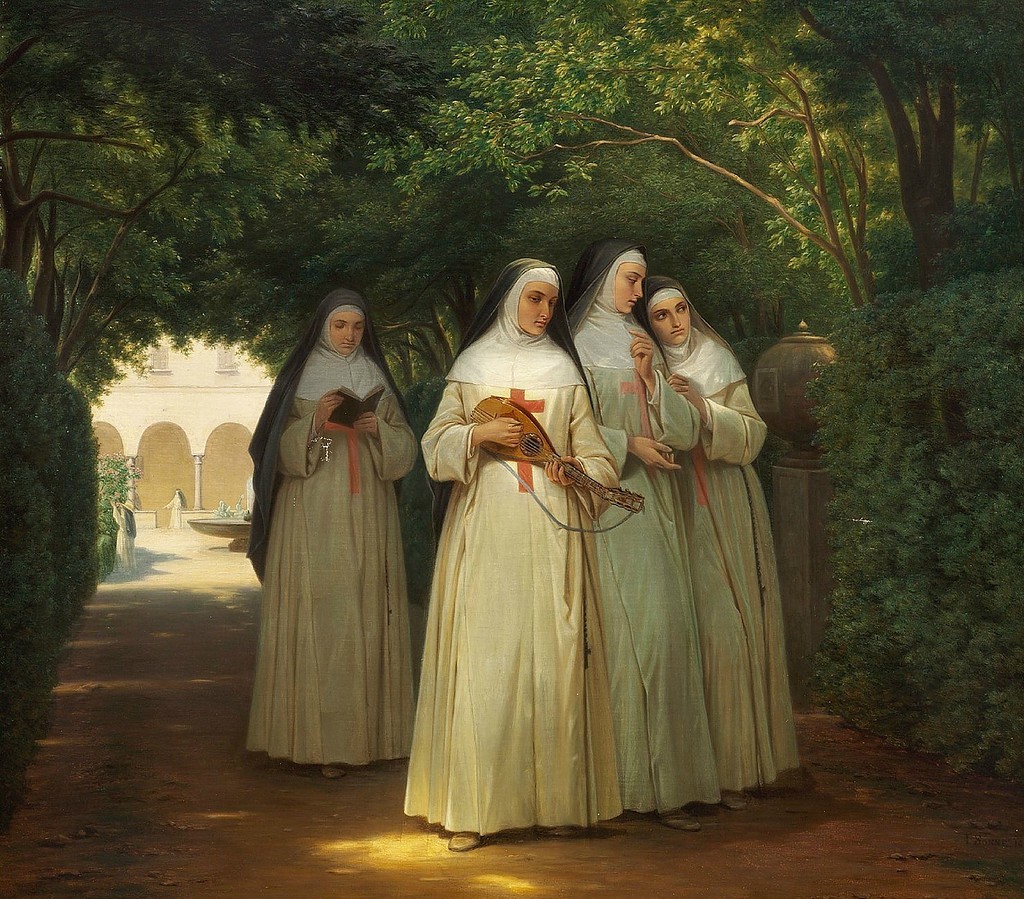
Jorgen Sonne’s 1866 Nuns walking in a cloister garden in Rome. He has, whether intentionally or not, given them the habit of Port-Royal-des-Champs. (Source)
I refer my readers to two articles that have recently appeared in the Notre Dame Church Life Journal. The first, which came out about a month ago, is an excellent piece by Dr. Shaun Blanchard showing that our polemical use of the term “Jansenism” is seriously mistaken. The second is an article I wrote, a church-historical study in which I both defend the Jansenists from various degrading misconceptions as well as point out some parallels between their situation and our own. I’m also very pleased that the Catholic Herald picked it up for Wednesday’s “Morning Catholic Must-Reads.”
I should add that I am particularly grateful to Dr. Blanchard for his kind aid in the preparation of my piece, and Dr. Artur Rosman for his editorial patience.
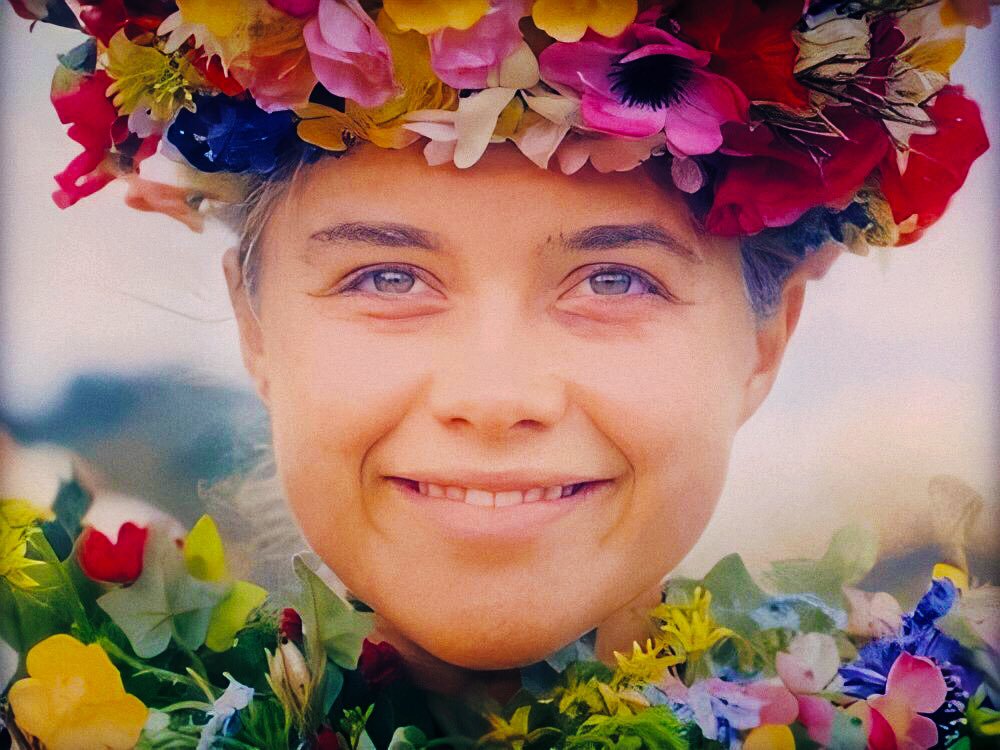
“Don’t cry because it’s over; smile because it happened!” Florence Pugh as Dani in Midsommar. (Source)
I finally saw Midsommar.
Let me begin with the good. I liked it a lot more than Ari Aster’s first offering, Hereditary. The bright Scandinavian aesthetics and Pawel Pogorzelski‘s enchanting cinematography lent the film an undeniable visual appeal. The acting was also to be commended. Florence Pugh’s performance is a masterclass in theatrical distress.
That being said, the film was on the whole, yet another disappointment from Ari Aster. I cannot say the same about Robert Eggers’s The Lighthouse, which I saw with friends last week.
I think I can fairly compare these two horror directors working under the aegis of A24. Not to put too fine a point on it, but Eggers is better in every way that counts. Both have now produced folk horrors centered on the trauma of young women in claustrophobic wilderness. The Witch is more inventive, precisely because it is more traditional, than Midsommar. Or rather, it did what few films are willing to do in its approach to the past; take it on its own terms. Its originality lies in large part due to its embrace of the Puritan myths without judgment, and exposing the horrors we thought we left behind in the seventeenth century. Admittedly, Midsommar doesn’t have the burden (or the gift?) of history to work with. But one can’t help but feel that what we find here is just The Wicker Man gutted of its moral core and set slightly farther north. In fact, the ending is probably a double homage to both Wicker Man films.
Nicolas Cage in a bear skin suit. The Wicker Man (2006) – (Source)
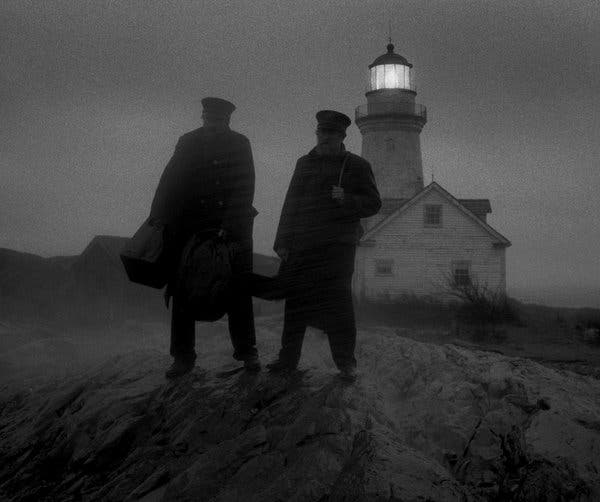
While Midsommar is an improvement over the rather humdrum (if at times shocking and, admittedly, very well researched) Hereditary, it doesn’t push the boundaries of cinema in the way that The Lighthouse does. In The Lighthouse, we discover a radically different kind of film. Its irregular aspect ratio, its black-and-white cinematography, its baroquely salty dialect – these bewildering distinctions from the run-of-the-mill horror flick work together to construct a vision of a world totally unlike our own. And yet, The Lighthouse manages to provide a series of sights, sounds, and even smells so visceral that one feels entirely immersed in this other world.
Midsommar fails to do that. For all its blood-and-guts moments, for all its eros and trauma, one comes away from the experience feeling strangely detached. I couldn’t manage to care too much about what happens to these characters, some of whom are intensely annoying. Not so in The Lighthouse. One cares very, very deeply – or more correctly, you feel the confusion and desperation of the situation in your gut. You are on that island. It is happening to you.
Perhaps the greatest disappointment of Midsommar was its rather predictable plot twists (if I can even call them that). Anyone familiar with the genre will be able to see exactly what is coming, even if they can’t imagine all the precise details. Not so in The Lighthouse. While one can establish a direction of travel – particularly in the film’s first half – after a certain point, you become as disoriented as the film’s unhappy protagonists. Like its great antecedent, Moby Dick, The Lighthouse is full of strange allusions, haunting images, and intensely visceral shocks. It’s a tight, dark, and disturbing maze.
Beyond that, I have a complaint that is, perhaps, too subjective to warrant much value criticism. Midsommar failed to scare me. Not many horrors do, I have to confess. I liked Possum, even though it was more unnerving than actually scary. Two of my favorite horror films, The Shining and the original Wicker Man, don’t actually frighten me. Nor does The Witch. In their cases, I can overlook the lack of fear because of the strength of these movies has as a film. Midsommar wasn’t strong enough for me to forgive the lack of fear.
The Lighthouse however, climaxed with one of the most genuinely frightening scenes I have seen in any film for a very long time. Without saying too much, I will refer my readers to my essay on eldritch horror in the New England literary tradition. Eggers knows that tradition very, very well. The Lighthouse, like The Witch before it, is a superlative contribution to New England’s peculiar darkness. His final, terrifying scene in The Lighthouse is an echo of Pip’s experience in Chapter XCIII of Moby Dick. Eggers, and of many a chapter in Lovecraft.
Powerhouse performances, top-notch writing, historical faithfulness, invocation of the New England horror tradition, black humor, innovative cinematography, and genuine scares make The Lighthouse the best and most beautiful horror film of the year. (Source)
I’m a sucker for folk horror, as my readers may well recall. Midsommar does deserve a place in the folk horror canon. But The Witch and The Lighthouse are higher on that grisly totem pole. They are also better works of art.
I’m very pleased to announce that I have a poem coming out in the Emma Press’s new collection, The Emma Press Anthology of Contemporary Gothic Verse. From the press release:
The anthology was compiled from poems sourced in an open call for submissions launched towards the end of last year. 294 poets entered, of which 26 were chosen for the anthology. Editor Nisha Bhakoo says in her introduction to the book: “My hope for this anthology was to showcase poems that pointed to the uncanniness of our present time, giving traditional gothic tropes a compelling, contemporary flavour. I not only wanted the poems to hold up a mirror to our post-postmodern age, but also to challenge the norms and unwritten rules of it.”
Although I make no money from the sale, please consider buying a copy of the Anthology from the Press’s UK-based store. Small presses need as much support as we can give them, and the Emma Press has published some really great contemporary poetry. Pick up your copy today!
I offer the following propositions to my readers in a spirit of inquiry. Are these not edifying, pious, and – in many cases – straightforwardly true maxims? I have arranged them in thematic paragraphs, but beyond that, they do not issue from my hand. They are indeed far older maxims, drawn from the writings of certain noteworthy Catholic divines. Nevertheless, I should be very curious what my readers think of them – especially those with a theological background.
Are these not, on the whole, quite salutary? Do they not breathe the spirit of the best Fathers and Doctors, especially of those glorious Patriarchs of the West, SS Augustine and Thomas? Or, if anyone should find anything objectionable in them, what is the flaw? I ask sincerely. Those with ears to hear, let them hear.
In vain, O Lord, do You command, if You do not give what you command. Thus, O Lord, all things are possible to him for whom You make all things possible by effecting those same things in him.
All knowledge of God, even natural knowledge, even in the pagan philosophers, cannot come except from God; and without grace knowledge produces nothing but presumption, vanity, and opposition to God Himself, instead of the affections of adoration, gratitude, and love. As there is no sin without love of ourselves, so there is no good work without love of God.
A mark of the Christian Church is that it is catholic, embracing all the angels of heaven, all the elect and the just on earth, and of all times. What is the Church except an assembly of the sons of God abiding in His bosom, adopted in Christ, subsisting in His person, redeemed by His blood, living in His spirit, acting through His grace, and awaiting the grace of the future life? The Church or the whole Christ has the Incarnate Word as head but all the saints as members. The Church is one single man composed of many members, of which Christ is the head, the life, the subsistence and the person- it is one single Christ composed of many saints, of whom He is the sanctifier. There is nothing more spacious than the Church of God; because all the elect and the just of all ages comprise it.
It is useful and necessary at all times, in all places, and for every kind of person, to study and to know the spirit, the piety, and the mysteries of Sacred Scripture. The reading of Sacred Scripture is for all. The sacred obscurity of the Word of God is no reason for the laity to dispense themselves from reading it. The Lord’s Day ought to be sanctified by Christians with readings of pious works and above all of the Holy Scriptures. It is harmful for a Christian to wish to withdraw from this reading. It is an illusion to persuade oneself that knowledge of the mysteries of religion should not be communicated to women by the reading of Sacred Scriptures. Not from the simplicity of women, but from the proud knowledge of men has arisen the abuse of the Scriptures and have heresies been born. To snatch away from the hands of Christians the New Testament, or to hold it closed against them by taking away from them the means of understanding it, is to close for them the mouth of Christ. To forbid Christians to read Sacred Scripture, especially the Gospels, is to forbid the use of light to the sons of light, and to cause them to suffer a kind of excommunication. To snatch from the simple people this consolation of joining their voice to the voice of the whole Church is a custom contrary to the apostolic practice and to the intention of God.
A method full of wisdom, light, and charity is to give souls time for bearing with humility. and for experiencing their state of sin, for seeking the spirit of penance and contrition, and for beginning at least to satisfy the justice of God, before they are reconciled.
To suffer in peace an excommunication and an unjust anathema rather than betray truth, is to imitate St. Paul; far be it from rebelling against authority or of destroying unity.
Nothing engenders a worse opinion of the Church among her enemies than to see exercised there an absolute rule over the faith of the faithful, and to see divisions fostered because of matters which do not violate faith or morals. Truths have descended to this, that they are, as it were, a foreign tongue to most Christians, and the manner of preaching them is, as it were, an unknown idiom, so remote is the manner of preaching from the simplicity of the apostles. and so much above the common grasp of the faithful; nor is there sufficient advertence to the fact that this defect is one of the greatest visible signs of the weakening of the Church and of the wrath of God on His sons. Stubbornness, investigation, and obstinacy in being unwilling either to examine something or to acknowledge that one has been deceived daily changes into an odor, as it were, of death, for many people, that which God has placed in His Church to be an odor of life within it, for instance, good books, instructions, holy examples, etc. Deplorable is the time in which God is believed to be honored by persecution of the truth and its disciples! This time has come…. To be considered and treated by the ministers of religion as impious and unworthy of all commerce with God, as a putrid member capable of corrupting everything in the society of saints, is to pious men a more terrible death than the death of the body. In vain does anyone flatter himself on the purity of his intentions and on a certain zeal for religion, when he persecutes honest men with fire and sword, if he is blinded by his own passion or carried away by that of another on account of which he does not want to examine anything. We frequently believe that we arc sacrificing an impious man to God, when we are sacrificing a servant of God to the devil.
August is the Month of the Immaculate Heart of Mary. While I was too busy moving and adapting to life in Pennsylvania to write anything for Assumption Day, my good friend Keanu Heydari wrote a beautiful meditation on the meaning of the Assumption as well as on Our Lady’s co-redemptive role more generally. I offer it to my readers for their edification and delight as well as for the honor of Our Lady’s Sorrow and Immaculate Heart. Here’s a particularly puissant excerpt:
In this remarkable passage, as the Venerable Fulton Sheen has argued, John’s Jesus invokes the archetypical womanhood of Mary as the New Eve. Mary is the woman. Jesus affirms her role in undoing our devastated humanity in the Garden by affirming her role as the New Eve. Moreover, the Lord makes a startling claim about the dignity of Mary’s personhood and her role in the narrative arc of cosmic salvation as Coredemptrix and Mediatrix. What is true about Christ is also just as true of the Virgin. Only Mary could confess that she, in the purest way, was truly of the flesh of the Son of Man.
Keanu Heydari
Keanu hits upon a fundamental truth of Catholicism, the Marian-Ecclesial analogy with Christ. What is predicated of Christ can be predicated of both the Church, His Bride, and, in a special way, His Mother. This is not to suggest that anyone other than Jesus Christ as a discreet person is the Logos, but to note that all that He is by nature, we can become by Grace – and Mary first of all.
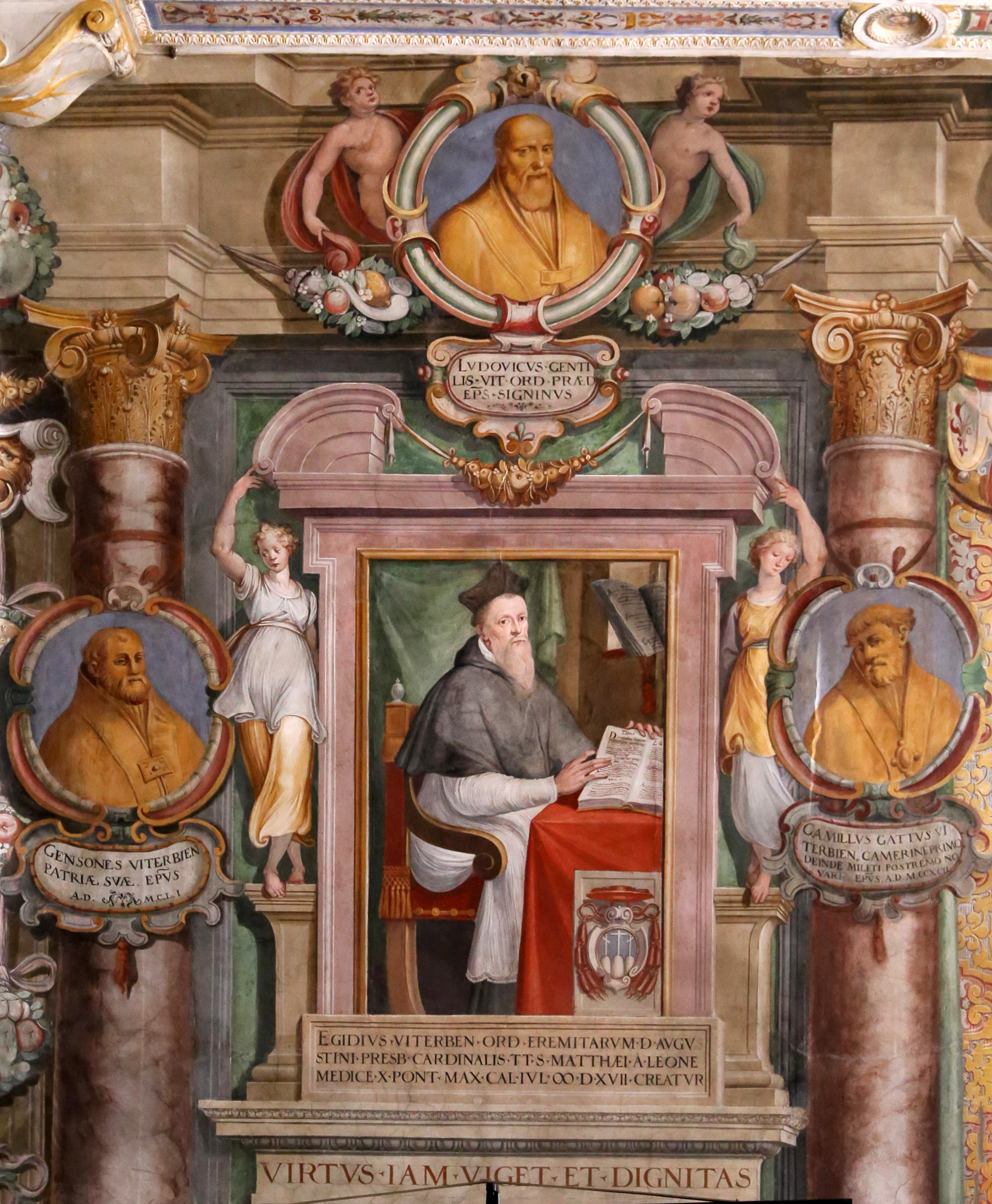
Portrait of Giles of Viterbo in his old Palazzo (Source)
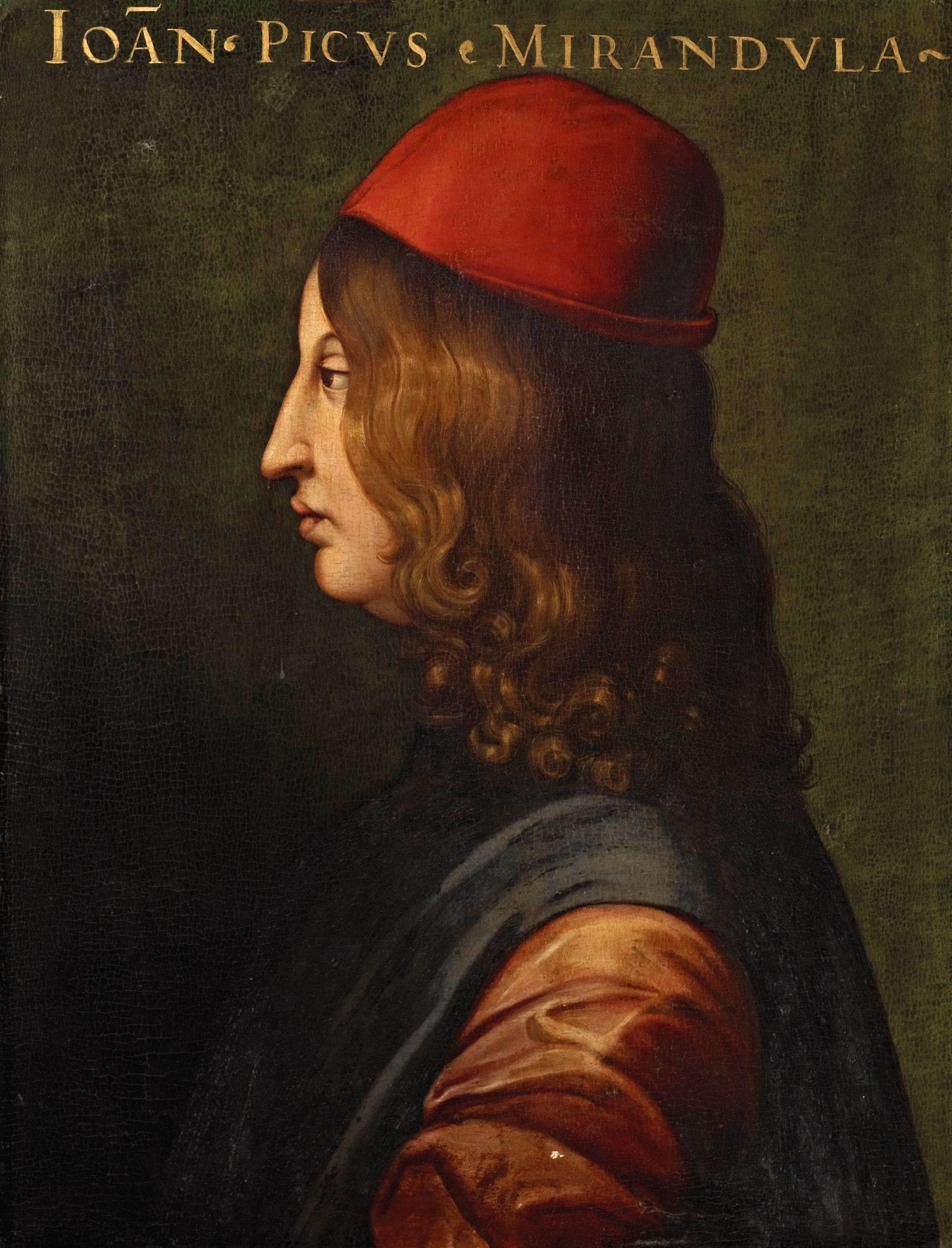
Over at Church Life Journal, Andrew Kuiper has a tour-de-force article on the history and theology of Catholic Kabbalah. His review of four Catholic Kabbalists – Pico della Mirandola, Johannes Reuchlin, Giles of Viterbo, and St. John Fisher – is a model of intellectual history. He does a great job showing the continuing relevance of Kabbalah for Catholic (and other Christian) thinkers throughout the centuries.
The piece is amply cited and provides several helpful theological considerations. I thought Kuiper’s nod towards Sophiology was particularly enlightening. If Christian Kabbalah has a place in Catholic theology today, I predict that it will be in the writings of latter-day Sophiologists.
If I were to offer a criticism of Kuiper’s piece, it would be a very minor one at that: he makes no reference to the works of Margaret Barker. Her research has shed a new light on the roots of Christianity and Jewish mysticism (in both its Merkabah and later Sephirotic developments) in the memory of the First Temple. Reading Kabbalistic texts through a Temple lens can ease their Christian interpretation. But I digress.
Pico della Mirandola, a pioneer in the Christian use of Kabbalah. (Source)
Perhaps the most exciting part of the article, for a historian of the period, is Kuiper’s various references to the Kabbalistic books written by these Christians of the 15th and 16th centuries. I would particularly keen on finding the text of Giles of Viterbo’s Shechina or Pico’s Heptaplus. Some of these hard-to-find volumes have never been translated into English.
It is not easy to summarize the teachings of the Jewish mystics, nor their Christian interpreters. Kuiper does both with commendable attention to detail and obvious competence, all while keeping things clear and concise enough for a lay reader. This article also provides a badly-needed defense of the respectability of Kabbalah as a field of study. Its bastardization in recent times, exemplified most clearly by Madonna et al., has led some to question whether Kabbalah is anything more than a gnostic mishmash of magic with Hebrew letters. I have heard colleagues dismiss it entirely as a field of serious inquiry for a historian or theologian. This tendency seems especially strong with Christian academics, many of whom retain outdated ideas about Jewish mysticism or who simply haven’t up with the post-Scholem rediscovery of Kabbalah. Kuiper’s intervention is a broadside against this boring complacency. It’s not exactly “a cruel angel’s thesis,” but it is one worth defending.
I have, by the merciful grace of God, passed my M.Phil in Theology at Oxford. I could not have done so without the abundant help of my supervisors and tutors, principally Dr. Sarah Apetrei, as well as the many friends and family who supported me throughout the course of my studies there. Latterly this endeavor has caused me to neglect my blogging, for which I must beg pardon of my readers. Editing, submissions, an examination, travelling, and the arduous business of moving back across the Atlantic has distracted me. So has the bittersweet task of saying goodbye to so many friends, men and women I will miss in the years to come.
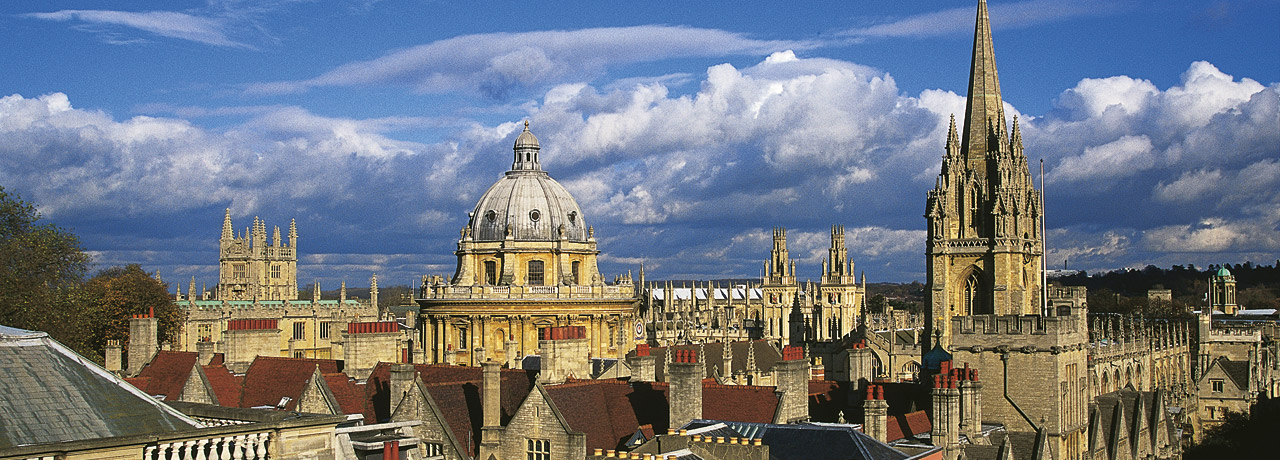
Oxford is most beautiful in the Spring. Photo taken by author.
I can understand why our soon-to-be-Saint Newman had so much trouble getting Oxford out of his blood. The place is a mirage in silver and stone. To have dwelt in such a dream-city for so long a time, to have been part of its inner life, to have shaped it according to one’s own character and to be shaped by it in turn, to watch the sun and the rain succeed in their seasons over streets imbued everywhere with a boundless sense of eternity…yes, I can see why Newman was always looking for a path back to this northern Eden. A Papal angel kept him from the gate. More prosaic barriers have turned me aside, namely, the prospects of an academic career in America.
But, in some way, the greater grief is leaving the United Kingdom. Shakespeare called Albion a swan’s nest in a stream. Having traveled from London to Birmingham, from Cardiff to York, from Tenby to Bournemouth, from Cambridge to Edinburgh, from Bath to Stratford, from Walsingham to Wakefield, in short, across the whole face of this country, I can start to see what he means. Britain possesses a peculiar beauty in grey-green and gold, something delicate and immortal that only reveals itself to an attentive foreigner. I shall miss it.
The St. Sepulchre Chapel, Winchester Cathedral. Photo taken by author.
More than that, I’ll miss the many friends I made in my two years abroad. Not just English either, though there were plenty of those – but also Canadians, Russians, Australians, Irish (both orange and green), French, Armenians, Italians, Romanians, Scots, Sri Lankans, Welsh, Poles, Chinese, and even some of my fellow countrymen. The story of my time in Oxford would not be complete without them. I will feel the absence of each, some more keenly than others.
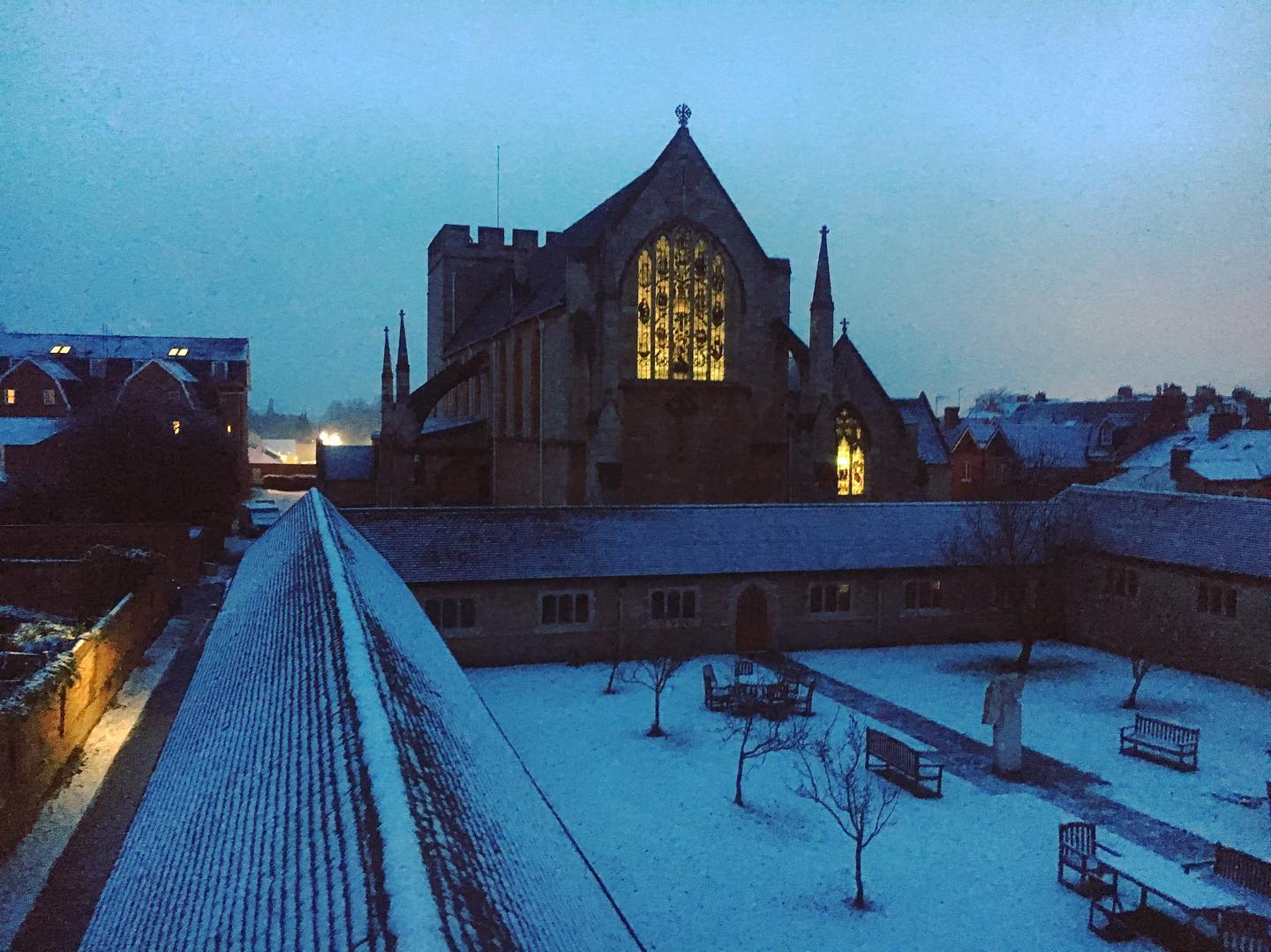
St. Stephen’s House in the snow, January 2019. Photo taken by author.
I suppose this is as good a time as ever to take stock of some of my travels through life at large. I am 24 years old. I have visited 12 countries beyond the borders of the United States:
The United Kingdom France Ireland Belgium The Netherlands Italy Austria The Czech Republic Hungary Romania Bermuda Vatican City
And 14 if one includes layovers and train connections in Germany and Switzerland. I have stood at the banks of the following rivers:
The Thames in London The Thames in Oxford (Isis) The Thame in Dorchester (before it becomes the Thames) The Cherwell The Liffey The Seine The Amstel The Arno The Rhône The Saône The Tiber The Danube The Lys The Usk The Avon in Bath The Loire The Cam
I have spent quite a lot of time in churches. A few favorites in England include the Oxford Oratory, the York Oratory, the Birmingham Oratory, Magdalen College Chapel, Worcester College Chapel, Oriel College Chapel, Merton College Chapel, St. Stephen’s House Chapel, St. Etheldreda’s, Holborn, and the Anglican Shrine of Our Lady of Walsingham. My single favorite church in England remains the Brompton Oratory, as it has been since that first June day I stepped into its vast and holy darkness, four years ago.
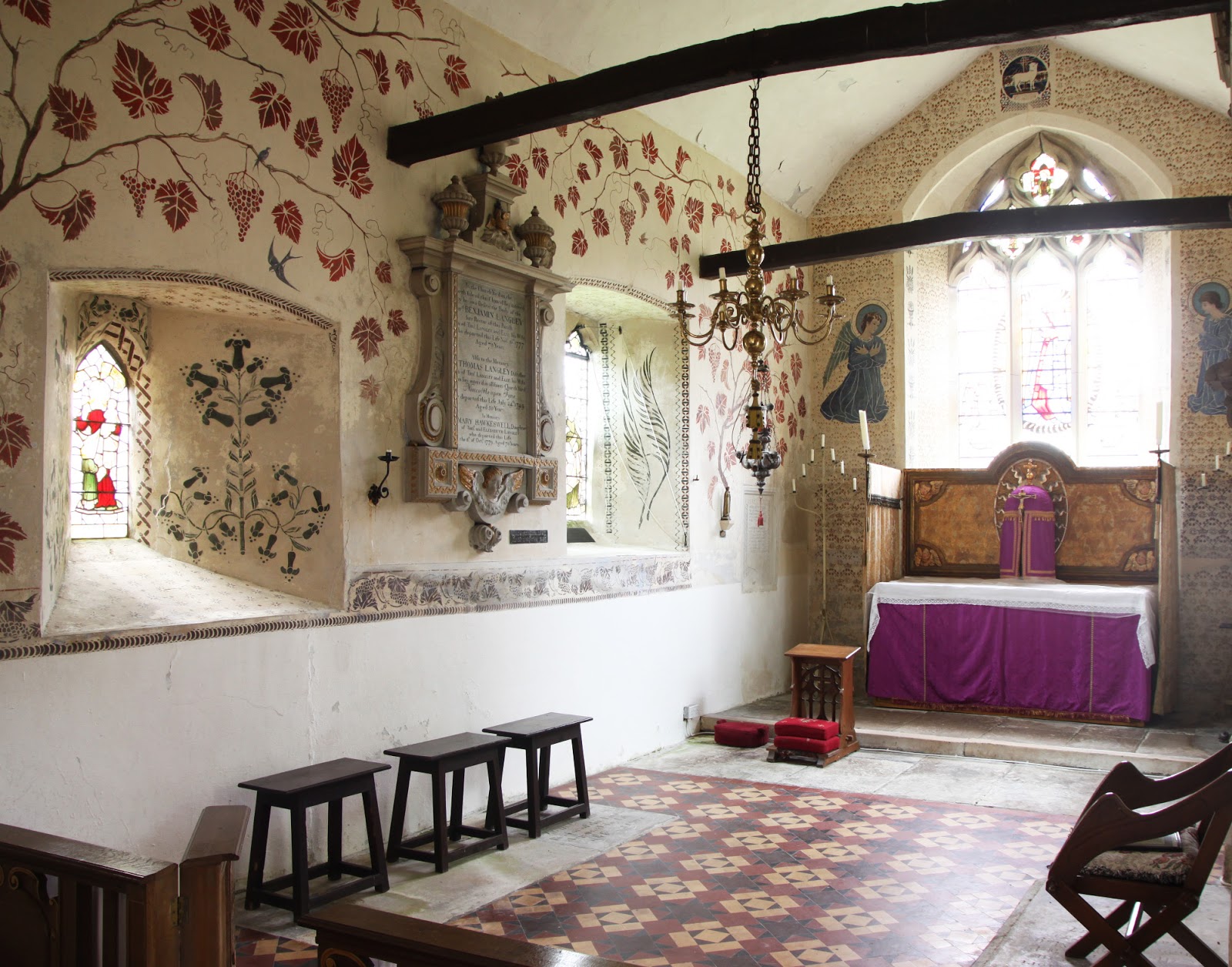
A favorite country church – St. Swithun’s, Compton Beauchamp. Full of delightfully ironic Georgian monuments and a complete refurbishment by Martin Travers in the 1930s. The setting is beautiful, too. (Source)
I have so far managed to get to the following Cathedrals (and Abbeys) in England, of which the first two are my favourites:
Winchester Cathedral Gloucester Cathedral Norwich Cathedral Oxford Cathedral St. Paul’s Cathedral York Minster Wakefield Cathedral Salisbury Cathedral St. Giles’s, Edinburgh Westminster Cathedral Westminster Abbey Bath Abbey Malmesbury Abbey
Plus some lovely country churches – East Coker, Burford, Stow-on-the-Wold, Binsey, and my very favorite, St. Swithun’s, Compton Beauchamp.
In Ireland, Silverstream Priory remains the most spiritually nourishing place I have ever been; its beauty and its holiness are always palpable.
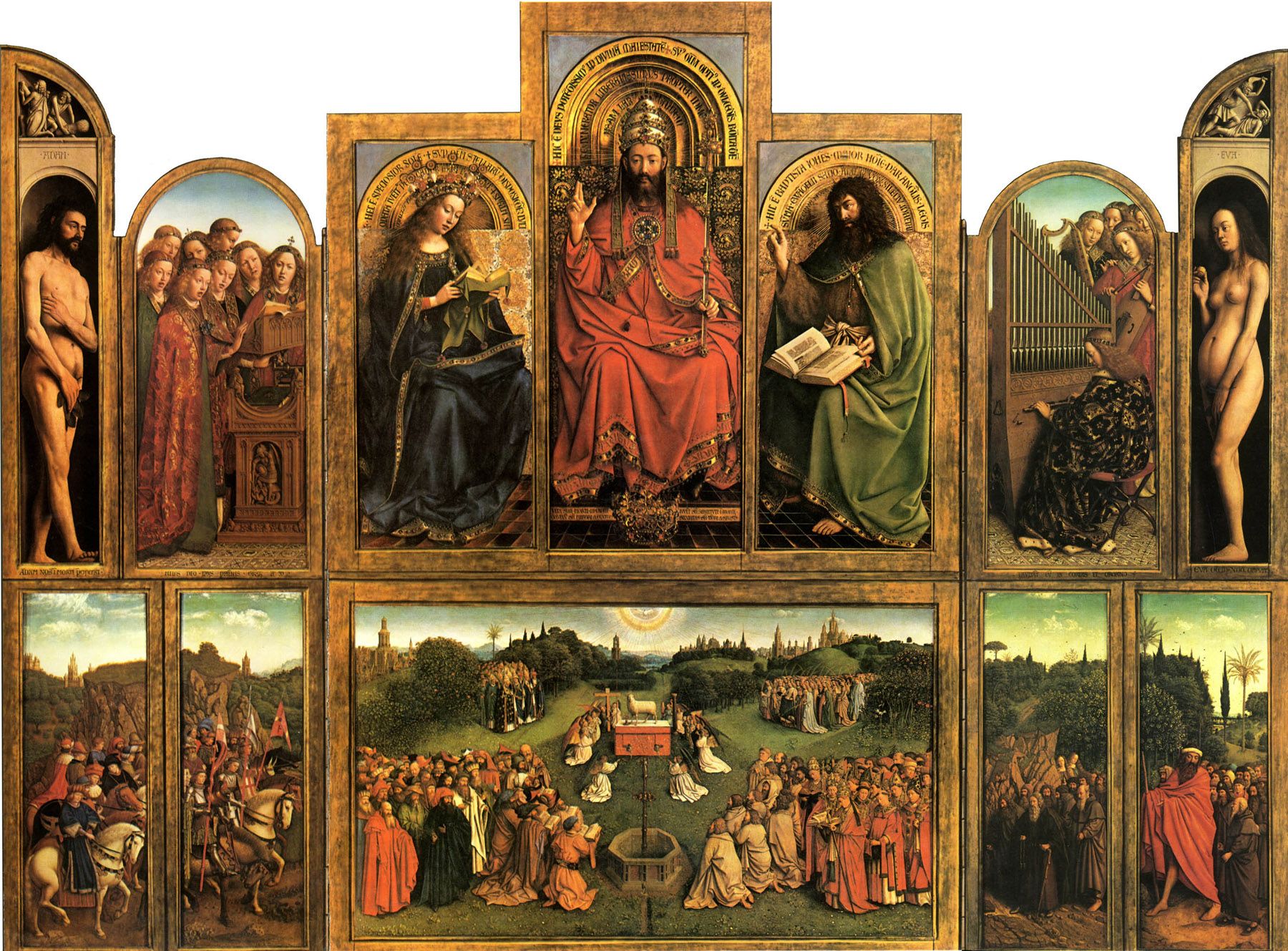
The Ghent Altarpiece. Seeing this for the first time last February in Saint Bavo’s Cathedral was one of the best moments of my two years abroad. (Source)
My travels on the Continent have been full of their own various ecclesiastical delights, so I’ll only mention a few highlights. My favorite cathedral in the world is St. Bavo’s, Ghent, which represents the perfect fusion of Gothic, Baroque, Rococo, and 19th Century styles. In France, the Chapel of the Miraculous Medal in the Rue du Bac, Saint-Étienne-du-Mont, Lyon Cathedral, Notre-Dame de Fourvière, and Saint-Just in Lyon are a few holy places I will not easily forget. Recently, I visited De Krijtberg in Amsterdam, which is the best example of painted Neo-Gothic I have seen beyond the Sainte-Chapelle. Italy is too full of wonderful churches to count, as are the old Hapsburg lands. If I were to choose a favorite in each, I suppose I would have to list the Chiesa Nuova (St. Philip Neri’s home and final resting place) in Italy, as well as Stift Heiligenkreuz in Austria, the Matthias Church in Hungary, and St. Vitus Cathedral in the Czech Republic. Though, to be fair, I visited several of these a few years ago rather than on this late sojourn in Europe.
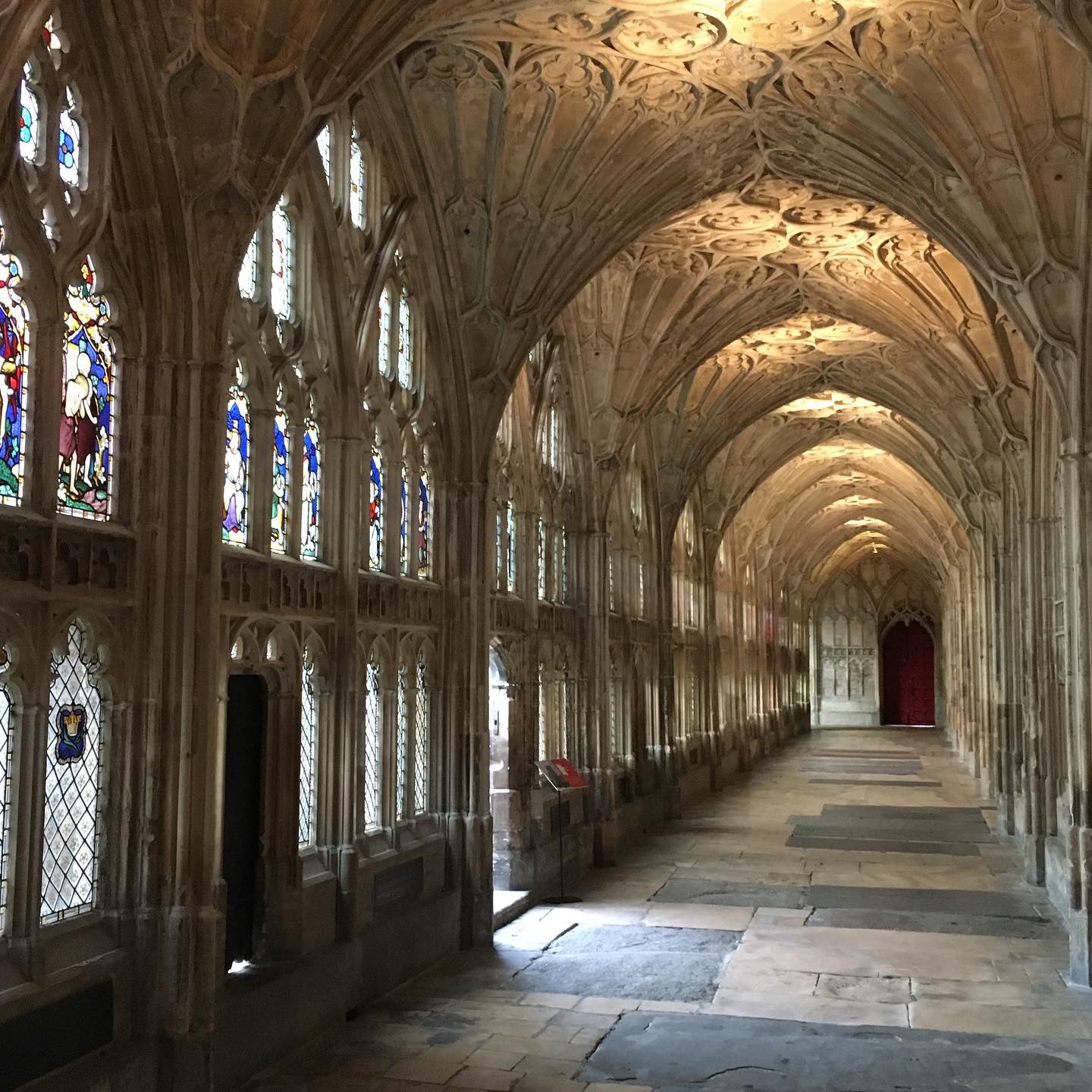
The cloisters, Gloucester Cathedral. America’s greatest fault probably lies in having no Medieval structures in situ. Photo taken by author.
I list these travels not out of any boasting, and, perhaps, not even for my readers. If anything, I do it for myself. I am more interested in remembering these places; writing about them has given me occasion to reminisce, to try and recapture something of the pleasure they gave me once.
I have been very blessed in life. I praise the Good Lord for allowing me the chance to see a bit of the world, to have done useful work, to have read interesting books, to have seen beautiful things, to have drank some good wine, and to have known such wonderful people. What more can one ask for in this brief life?
I am pleased and humbled to announce that The Amish Catholic has received 150,000 views! It’s been a wonderful experience since February of 2017. Thank you to all my many readers, especially those of you who take the time to comment on, share, or promote my work. It means more than you know. May God bless all of you!
As my readers will no doubt be aware, most religious orders have a motto that encapsulates their particular charism. However, many of these are a bit tired and could use with some updating. Here are my proposals:
Benedictines: Prayer, Work, Monk-eying Around
Jesuits: Up to Something
Dominicans: Sed Contra
Franciscans: Need a Bath
Lazarists: Nolite Me Tangere o Pauperes
Carthusians: ——-
Carmelites: Better Than You
Oratorians: O Happy Flowers!
Trappists: Beer, Cheese, Keeping Death Daily Before One’s Eyes
‘Catholicity, Antiquity, and consent of the Fathers, is the proper evidence of the fidelity or Apostolicity of a professed Tradition’ J.H. Newman, Lectures on the Prophetical Office of the Church, 1837, p. 51








 The Amish Catholic