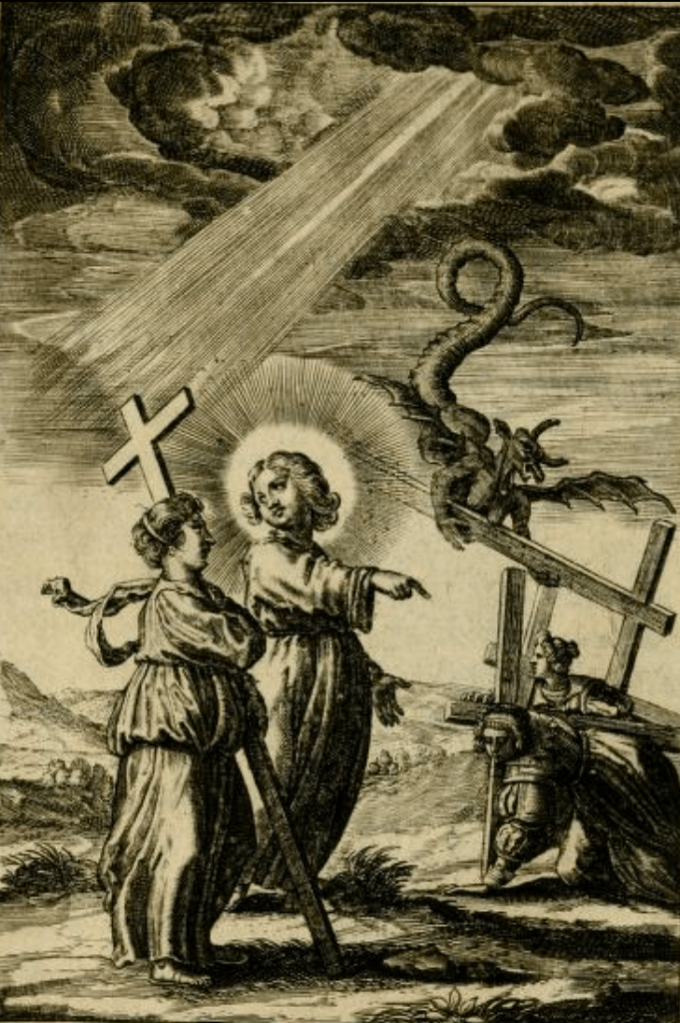
A depiction of the Madonna and Child with Patron Saints against the Plague. Colored engraving by T. Van Merlen. (Source)
“Is it my will that a sinner should die, saith the Lord God, and not that he should be converted from his ways, and live?” – Ezekiel 18:23 DRA.
In Nomine Patris et Filii et Spiritus Sancti, Amen.
Stella Caeli extirpavit, quae lactavit Dominum: mortis pestem quam plantavit primus parens hominum. Ipsa stella nunc dignetur sidera compescere quorum bella plebem caedunt dirae mortis ulcere. O piisima Stella Maris, a peste succurre nobis. Audi nos, Domina, nam filius tuus nihil negans te honorat. Salva nos, Jesu, pro quibus virgo mater te orat.
Kyrie Eleison Christe Eleison Kyrie Eleison
God the Father Almighty, Maker of Heaven and Earth, have mercy on us. God the Son, Redeemer of the World, have mercy on us. God the Holy Ghost, Sanctifier and Vivifier of All Things, have mercy on us.
Holy Mary, Mother God, pray for us. Our Lady, Queen of Heaven, pray for us. Our Lady of Sorrows, pray for us. Our Lady, Help of Christians, pray for us. Our Lady, Health of the Sick, pray for us. Our Lady, Salvation of the Roman People, pray for us. Our Lady, Star of the Sea, pray for us. Our Lady, Untier of Knots, pray for us. St. John the Baptist, pray for us. St. Joseph, pray for us. St. Mary Magdalene, pray for us. St. Michael and All Angels, pray for us. St. Thecla, pray for us. St. Valerian, pray for us. St. Corona, pray for us. SS. Cosmas and Damian, pray for us. St. Zacharias of Jerusalem, pray for us. St. Roch, pray for us. St. Sebastian, pray for us. St. Christopher, pray for us. St. Adrian, pray for us. St. Blaise, pray for us. St. Macarius of Ghent, pray for us. St. Patrick, pray for us. St. Pantaleon, pray for us. St. Dymphna, pray for us. St. Rosalia, pray for us. St. Anthony of Egypt, pray for us. St. Benedict, pray for us. St. Gregory, pray for us. St. Bernardine of Siena, pray for us. St. Anthony of Padua, pray for us. St. Philip Neri, pray for us. St. John Nepomuk, pray for us. St. Charles Borromeo, pray for us. St. Camillus of Lellis, pray for us. St. Aloysius Gonzaga, pray for us. St. Damien of Molokai, pray for us. St. Thérèse of Lisieux, pray for us.
O Sacred Heart, Furnace of Charity, have mercy on us. Lamb of God, Who takest away the sins of the world, spare us, O Lord. Lamb of God, Who takest away the sins of the world, graciously hear us, O Lord. Lamb of God, Who takest away the sins of the world, have mercy on us.
O Crux, ave spes unica hoc Passionis tempore! Piis adauge gratiam reisque dele crimina.
We beseech Thee O Lord, in Thy compassion, to turn away from Thy People Thy wrath, which indeed we deserve for our sins, but which in our human frailty we cannot endure; therefore embrace us with that tenderness which Thou art wont to bestow on the unworthy; through Jesus Christ our Lord.
Gloria Patri, et Filio, et Spiritui Sancto, Sicut erat in principio, et nunc, et semper, et in saecula saeculorum. Amen.
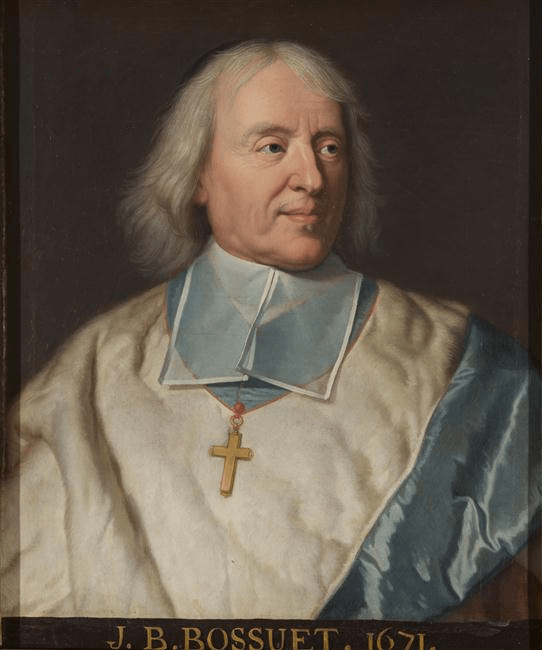
There are many candidates for the title of “Greatest Preacher in Christian History,” but my money’s on Jacques-Bénigne Bossuet (1627-1704), “The Eagle of Meaux,” Bishop and Tutor to the Grand Dauphin of France.Famed in his own day for the clarity of his doctrine, the incisive vigor of his spirituality, and the dazzling versatility of his oratorical skill, Bossuet stands as one of the late flowers of the Grand Siècle. Trumpet of the Gallicans and Hammer of Quietism, Bossuet nevertheless is not merely to be regarded as a relic of dusty seventeenth-century controversies. He still has much to teach us. In this excellent passage, excerpted from a recent translation and edited collection of hisMeditations for Lentby Christopher O. Blum (Sophia Institute Press, 2013), we can see the essentially ascetic cast of Bossuet’s mind. This was the same man who, in a felicitious turn of phrase, elsewhere referred to the Rule of St. Benedict as “a little abridgment of the Gospel.”The relevant passage can be found on pages 10-12 of the source text.
Portrait of Bossuet by Charles Sevin de la Penaye, after Hyacinthe Rigaud, c. early 18th century (Source)
“Lord, show us the Father, and we shall be satisfied” (John 14:8). God alone suffices, and all we need to possess him is to see him, because in seeing him, we see all his goodness, as he himself explained to Moses: “I will make all my goodness pass before you” (Ex. 33:19). We see all that attracts our love, and we love him beyond all limits. Let us join St. Philip in saying with all our heart, “Lord, show us the Father, and we shall be satisfied.” He alone can fill all our emptiness, satisfy all our needs, content us, and make us happy.
Let us then empty our heart of all other things, for if the Father alone suffices, then we have no need for sensible goods, less for exterior wealth, and still less for the honor of men’s good opinion. We do not even need this mortal life; how then can we need those things necessary to preserve it? We need only God. He alone suffices. In possessing him we are content.
How courageous are these words of St. Philip! To say them truthfully, we must also be able to say with the apostles: “Lord, we have left everything and followed you” (cf. Matt. 19:27). At the least we must leave everything by way of affection, desire, and resolution, that is, by an invincible resolution to attach ourselves to nothing, to seek no support except in God alone. Happy are they who carry this desire to its limit, who make the final, lasting, and perfect renunciation! But let them not leave anything for themselves. Let them not say: “This little thing to which I am still attached, it is a mere nothing.” We know the nature of the human heart. Whenever a little thing is left to it, there the heart will place all its desires. Strip it all away; break from it; let it go. To own things as though one had nothing, to be married as though one were not, to make use of this world as though one were not using it, but as though it did not exist, and as though we were not a part of it: this is the true good for which we should strive. We are not Christians if we cannot say sincerely with St. Philip, “Show us the Father, and we shall be satisfied.”
It is from the very depths of faith that these words are spoken, and it is in a certain sense from the very foundation of nature itself. For in the depths of our nature we sense our need to posses God, that he alone is capable of fulfilling our nature, and that we are anxious and tormented when separated from him…Man, abandoned to himself, does not know what to do, nor what to become. His pleasures carry him off, and these very same pleasures destroy him. With each sin of the senses he gives himself a killing blow, and he not only kills his soul by his intemperance, in his blindness and ignorance he kills the very body that he would flatter. Since the Fall, man is born to be unhappy…We do not know how to desire or ask for what we need.
St. Philip’s words teach us everything. He limits himself to what Jesus taught us is the one thing needful. Lord, you are the way.
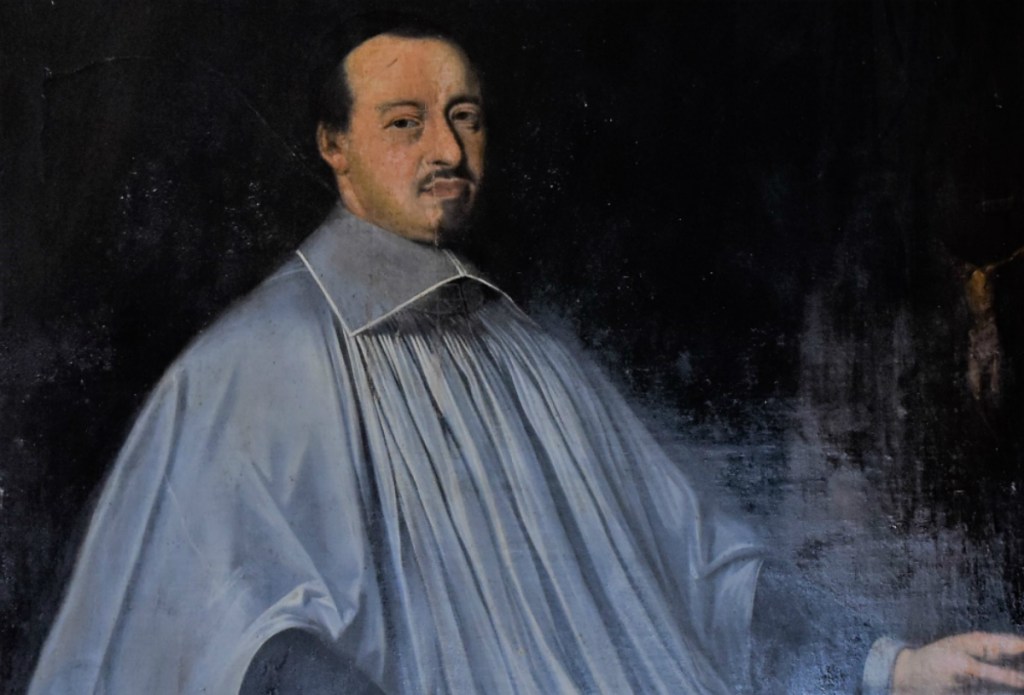
In week two of the Lenten Spirituality Series, we have another treasure from seventeenth-century France. One of the great exponents of the French School of Spirituality, M. Jean-Jacques Olier, writes movingly about our suffering in this life as a means of bringing us closer to Christ. His words on the virtue of Patience, though directly primarily to clerics, have a wider application to all Christians in their Royal Priesthood. The text is excerpted from M. Olier’s “Introduction to the Christian Life and Virtues,” translated by Lowell M. Glendon, S.S. inBérulle and the French School: Selected Writings(Paulist Press, 1989), 244-47.M. Olier’s description of patience crescendos into a typically French, Eucharistic note.
Jean-Jacques Olier, founder of the Sulpicians and a spiritual master of the Grand Siècle. (Source)
We are obliged to be patient. First, in our condition as creatures; for God, sovereign master of life and death, on whom our existence depends absolutely, has the right to dispose of us as he chooses…
Second, as sinners. For in this condition, we must bear with the effects of his justice and wrath toward us. All the punishments that he carries out in this world are nothing compared to what we deserve and what he would make use suffer if he did not choose to be merciful toward us and to treat us with gentleness and clemency in this life. The punishments that God meted out to sinners, as we see in the holy scripture, even the torments of the damned and the penalties the demons suffer and will suffer eternally for one sin, should cause us not only to be at peace, but to rejoice in our sufferings…
Third, as Christians. For as such we should bear with many difficulties and sufferings. This is why we are intitiated into the church. For our Lord only admitted us into it to continue his life, which is a life of opposition, contradiction, and condemnation toward the flesh.
He must then humiliate it and subdue it in us, using the ways he knows and judges to be most useful, so as to win a complete victory, He first achieved victory in his own flesh, and he wishes to continue it in ours in order to show forth in us a sample of the universal triumph that he had achieved over it in his own person.
The church and Christians are only a handful of flesh compared to the whole world. Nevertheless, he still desires to be victorious in them to proclaim his triumph and to give definite signs of his victory. Thus, from this perspective, the Christian should be very faithful to the Spirit and completely abandoned to him in order to overcome the flesh and to destroy it completely.
There will be no lack of opportunities in this life, for he must suffer; first, the attacks of the world through scorn, calumny and persecution; second, the violent onslaughts of the flesh in its uprisings and its revolts; third, the battles with the devil in the temptations he sends us; finally, the ordeals from God through dryness, desolation, abandonment and other interior difficulties, which he afflicts on him in order to initiate him into the perfect crucifixion of the flesh.
Fourth, as clerics. For clerics should participate in the fulfillment of Christianity. This cannot exist without patience.
Patience is a sign that the soul is intimately united to God and that it is rooted in perfection. For it must be very much in God and fully possessed by him in order to bear difficulties and torments with peace, tranquility and even joy and beatitude in one’s heart.
It must be quite profoundly immersed in him and remain quite powerfully and strongly united to him, so that the flesh has no power at all to attract it to itself and share with him the feelings and aversions that it has towards suffering and endurance.
In this state the soul experiences the perfection attainable in this life, since it conforms to our Lord’s perfect submission to God during his sufferings. For although his flesh experienced aversion and revulsion for the cross, he paid no attention to it with his will. Rather, he always adhered perfectly to the wishes of his Father.
Therefore clerics, being perfect Christians chosen from the midst of the church to assist before the tabernacle of God, should pay particular attention to this virtue. This is their very nature. It is the sign by which they can be identified. This is what predisposes them for the honorable rank that they possess. This is how they are recognized as domestics and servants of God.
Finally, priests and pastors should have a very high degree of patience because, in Jesus Christ and with Jesus Christ, they are both priests and victims for the sins of the world. Jesus Christ the priest wished to be the victim of his sacrifice. He became the host-victim for all people. Since priests are like sacraments and representations of him who lives in them to continue his priesthood and whom he clothes with his external conduct and his interior dispositions, as well as with his power and his person, he wishes furthermore that they be interiorly rooted in the spirit and dispositions of a host-victim in order to suffer, endure, do penance, in short, to immolate themselves for the glory of God and the salvation of the people.
In imitation of our Lord, priests should not only be victims for sin through persecution, penance, internal and external sufferings, but also they should be like the victims of a holocaust. This is their true vocation. For they should not merely suffer, as he did, all sorts of difficulties both for their own sins and the sins of the people entrusted to them, but even more the should be entirely consumed with him through love.
The spirit of love strengthens and empowers us to endure affliction and suffering, no matter how great they are. Since he is infinite, he gives us as much as we need to endure those that can occur in our vocation.
All the torments of the world are nothing to a generous soul filled with the power of a God, who is able to shoulder countless sufferings more violent than all those that the world and the devil might afflict us with. It is with this Spirit that Saint Paul said: I can do all things in him who strengthens me (Phil 4:14). Everything he saw seemed little to do or suffer because of the God who dwelled in him.
It is through this same eternal, immense, and all-powerful Spirit that he called his sufferings light and momentary, because Jesus Christ who suffered and bore them in himself and allowed him to see and experience something of his eternity through his presence, caused him to look upon the entire duration of this life as but a moment. This is how our Lord, who allows us to experience interiorly that his power and his strength could support a thousand worlds, leads us to call his burden light.
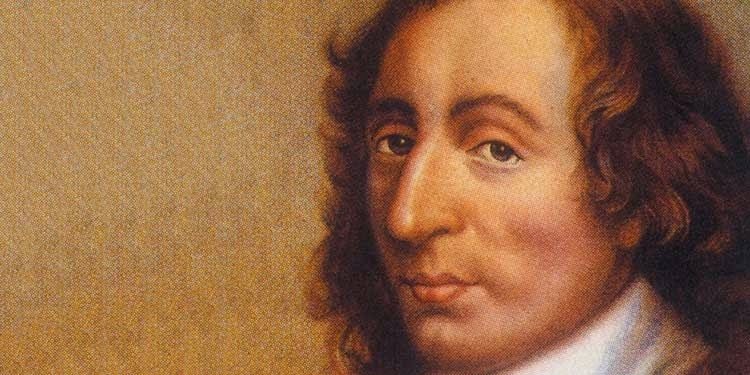
This year, the Lenten Spirituality Series will happen on Fridays. We begin the season with a salutary meditation taken from the Pensées of Blaise Pascal, Section 522 on “The Mystery of Jesus.”
Blaise Pascal, theologian, philosopher, mathematician, confessor, and ascetic (Source)
The Mystery of Jesus.—Jesus suffers in His passions the torments which men inflict upon Him; but in His agony He suffers the torments which He inflicts on Himself; turbare semetipsum. This is a suffering from no human, but an almighty hand, for He must be almighty to bear it.
Jesus seeks some comfort at least in His three dearest friends, and they are asleep. He prays them to bear with Him for a little, and they leave Him with entire indifference, having so little compassion that it could not prevent their sleeping even for a moment. And thus Jesus was left alone to the wrath of God.
Jesus is alone on the earth, without any one not only to feel and share His suffering, but even to know of it; He and Heaven were alone in that knowledge.
Jesus is in a garden, not of delight as the first Adam, where he lost himself and the whole human race, but in one of agony, where He saved Himself and the whole human race.
He suffers this affliction and this desertion in the horror of night.
I believe that Jesus never complained but on this single occasion; but then He complained as if he could no longer bear His extreme suffering. “My soul is sorrowful, even unto death.”
Jesus seeks companionship and comfort from men. This is the sole occasion in all His life, as it seems to me. But He receives it not, for His disciples are asleep.
Jesus will be in agony even to the end of the world. We must not sleep during that time.
Jesus, in the midst of this universal desertion, including that of His own friends chosen to watch with Him, finding them asleep, is vexed because of the danger to which they expose, not Him, but themselves; He cautions them for their own safety and their own good, with a sincere tenderness for them during their ingratitude, and warns them that the spirit is willing and the flesh weak.
Jesus, finding them still asleep, without being restrained by any consideration for themselves or for Him, has the kindness not to waken them, and leaves them in repose.
Jesus prays, uncertain of the will of His Father, and fears death; but, when He knows it, He goes forward to offer Himself to death. Eamus. Processit (John).
Jesus asked of men and was not heard.
Jesus, while His disciples slept, wrought their salvation. He has wrought that of each of the righteous while they slept, both in their nothingness before their birth, and in their sins after their birth.
He prays only once that the cup pass away, and then with submission; and twice that it come if necessary.
Jesus is weary.
Jesus, seeing all His friends asleep and all His enemies wakeful, commits Himself entirely to His Father.
Jesus does not regard in Judas his enmity, but the order of God, which He loves and admits, since He calls him friend.
Jesus tears Himself away from His disciples to enter into His agony; we must tear ourselves away from our nearest and dearest to imitate Him.
Jesus being in agony and in the greatest affliction, let us pray longer.
We implore the mercy of God, not that He may leave us at peace in our vices, but that He may deliver us from them.
If God gave us masters by His own hand, oh! how necessary for us to obey them with a good heart! Necessity and events follow infallibly.
—”Console thyself, thou wouldst not seek Me, if thou hadst not found Me.
“I thought of thee in Mine agony, I have sweated such drops of blood for thee.
“It is tempting Me rather than proving thyself, to think if thou wouldst do such and such a thing on an occasion which has not happened; I shall act in thee if it occur.
“Let thyself be guided by My rules; see how well I have led the Virgin and the saints who have let Me act in them.
“The Father loves all that I do.
“Dost thou wish that it always cost Me the blood of My humanity, without thy shedding tears?
“Thy conversion is My affair; fear not, and pray with confidence as for Me.
“I am present with thee by My Word in Scripture, by My Spirit in the Church and by inspiration, by My power in the priests, by My prayer in the faithful.
“Physicians will not heal thee, for thou wilt die at last. But it is I who heal thee, and make the body immortal.
“Suffer bodily chains and servitude, I deliver thee at present only from spiritual servitude.
“I am more a friend to thee than such and such an one, for I have done for thee more than they, they would not have suffered what I have suffered from thee, and they would not have died for thee as I have done in the time of thine infidelities and cruelties, and as I am ready to do, and do, among my elect and at the Holy Sacrament.”
—I shall lose it then, Lord, for on Thy assurance I believe their malice.
—”No, for I, by whom thou learnest, can heal thee of them, and what I say to thee is a sign that I will heal thee. In proportion to thy expiation of them, thou wilt know them, and it will be said to thee: ‘Behold, thy sins are forgiven thee.’ Repent, then, for thy hidden sins, and for the secret malice of those which thou knowest.”
—Lord, I give Thee all.
—”I love thee more ardently than thou hast loved thine abominations, ut immundus pro luto.
“To Me be the glory, not to thee, worm of the earth.
“Ask thy confessor, when My own words are to thee occasion of evil, vanity, or curiosity.”
—I see in me depths of pride, curiosity, and lust. There is no relation between me and God, nor Jesus Christ the Righteous. But He has been made sin for me; all Thy scourges are fallen upon Him. He is more abominable than I, and, far from abhorring me, He holds Himself honoured that I go to Him and succour Him.
But He has healed Himself, and still more so will He heal me.
I must add my wounds to His, and join myself to Him; and He will save me in saving Himself. But this must not be postponed to the future.
Eritis sicut dii scientes bonum et malum. Each one creates his god, when judging, “This is good or bad”; and men mourn or rejoice too much at events.
Do little things as though they were great, because of the majesty of Jesus Christ who does them in us, and who lives our life; and do the greatest things as though they were little and easy, because of His omnipotence.
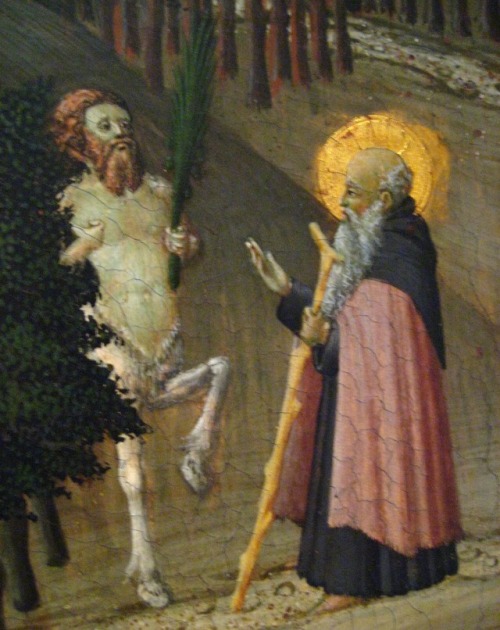
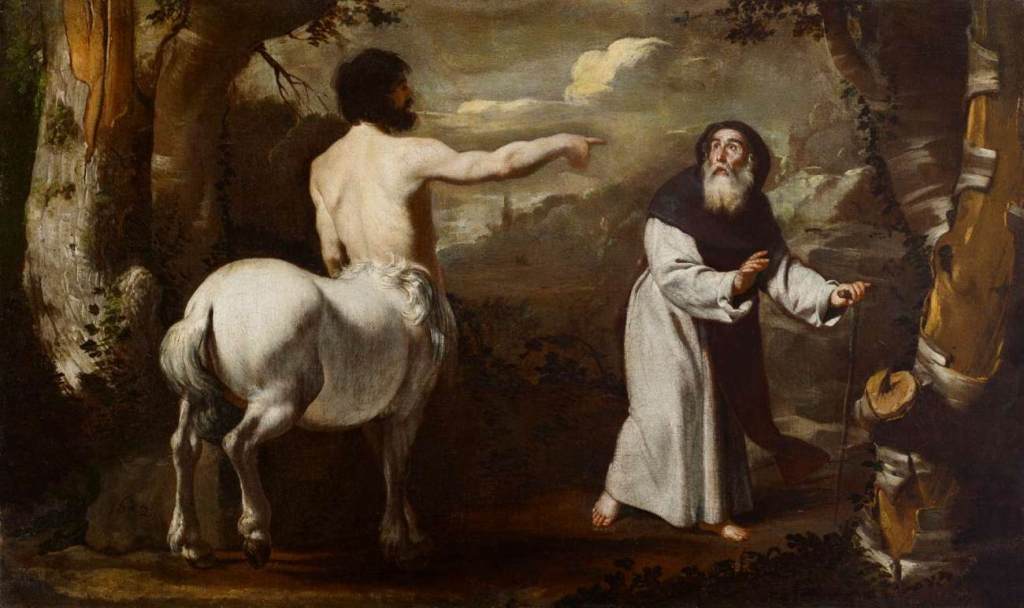
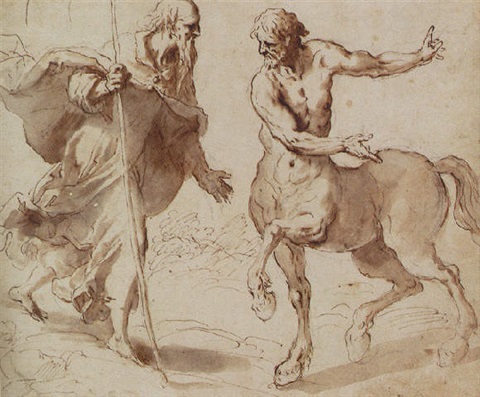
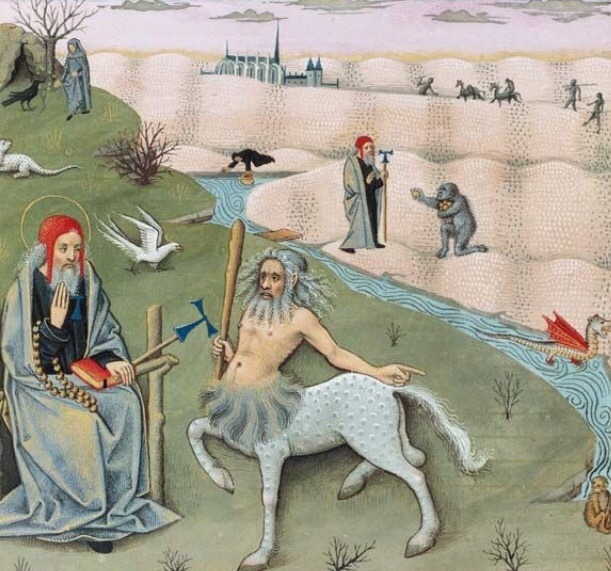
On this feast of St. Anthony the Abbot, I am reminded of a peculiar episode in the life of the saint that St. Jerome records. In full, it reads:
Francesco Guarino, St. Anthony Abbot and Centaur, 1642 (Source)
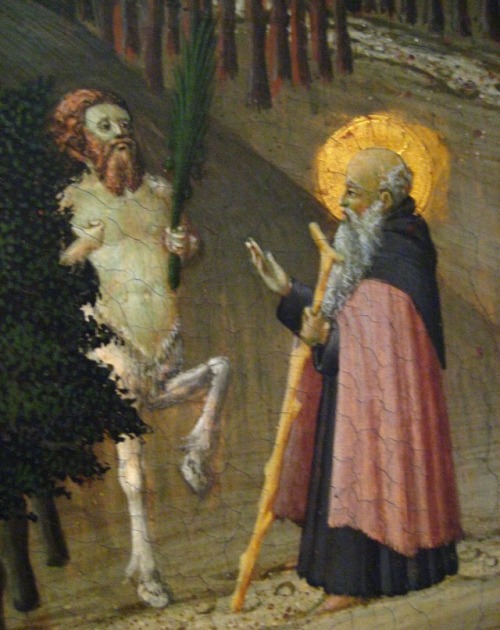
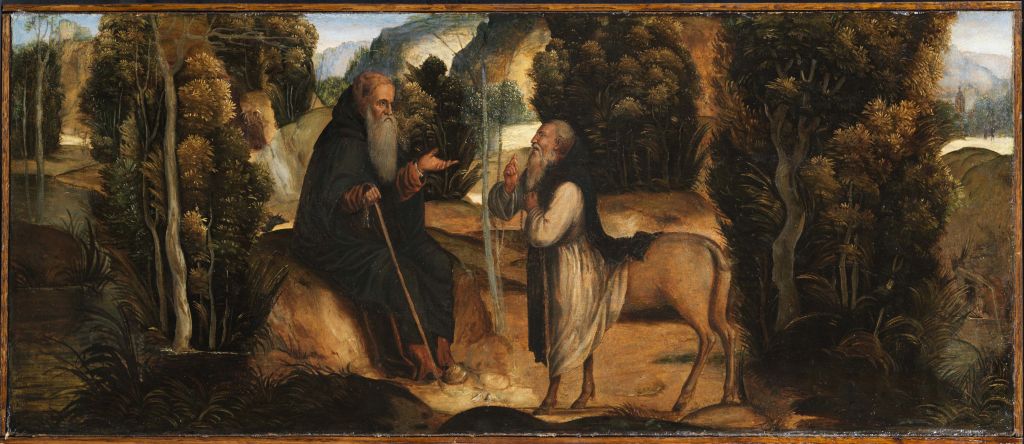
But to return to the point at which I digressed. The blessed Paul had already lived on earth the life of heaven for a hundred and thirteen years, and Antony at the age of ninety was dwelling in another place of solitude (as he himself was wont to declare), when the thought occurred to the latter, that no monk more perfect than himself had settled in the desert. However, in the stillness of the night it was revealed to him that there was farther in the desert a much better man than he, and that he ought to go and visit him. So then at break of day the venerable old man, supporting and guiding his weak limbs with a staff, started to go: but what direction to choose he knew not. Scorching noontide came, with a broiling sun overhead, but still he did not allow himself to be turned from the journey he had begun. Said he, I believe in my God: some time or other He will show me the fellow-servant whom He promised me. He said no more. All at once he beholds a creature of mingled shape, half horse half man, called by the poets Hippocentaur. At the sight of this he arms himself by making on his forehead the sign of salvation, and then exclaims, Holloa! Where in these parts is a servant of God living? The monster after gnashing out some kind of outlandish utterance, in words broken rather than spoken through his bristling lips, at length finds a friendly mode of communication, and extending his right hand points out the way desired. Then with swift flight he crosses the spreading plain and vanishes from the sight of his wondering companion. But whether the devil took this shape to terrify him, or whether it be that the desert which is known to abound in monstrous animals engenders that kind of creature also, we cannot decide.
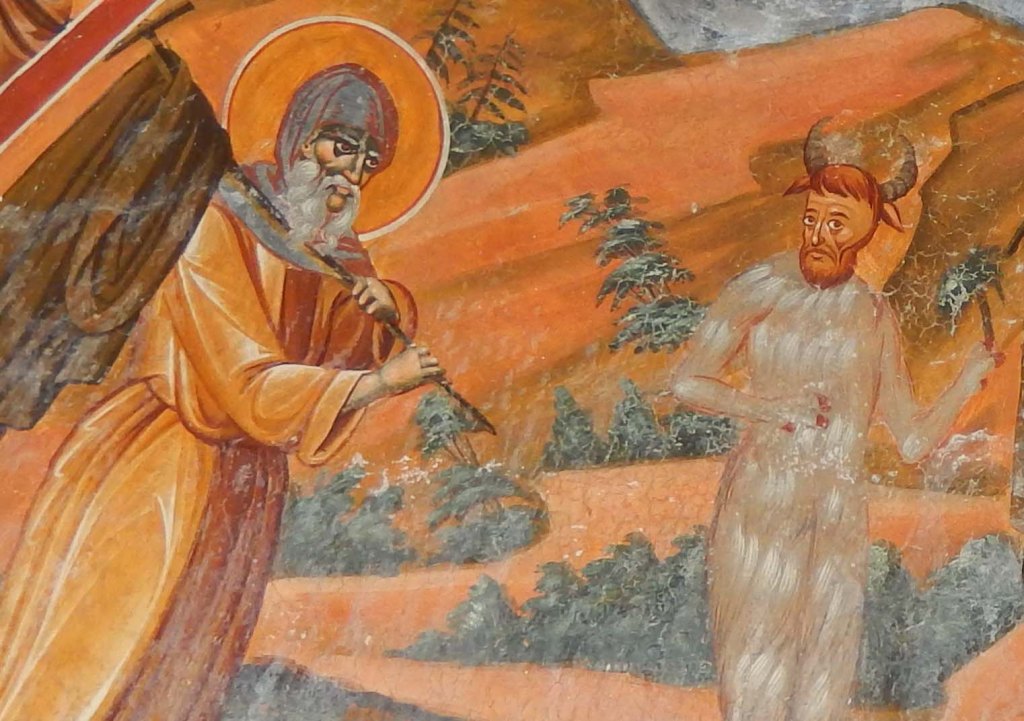
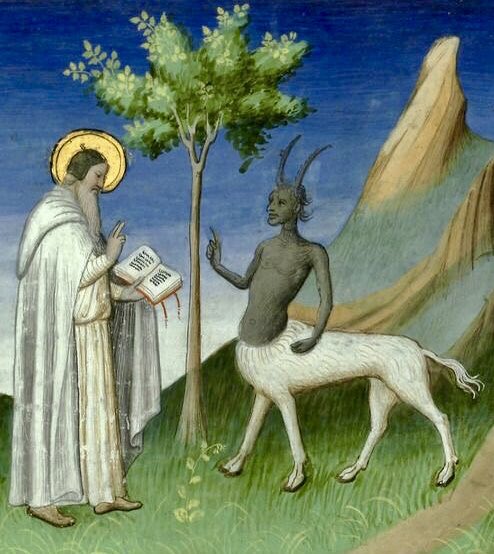
Antony was amazed, and thinking over what he had seen went on his way. Before long in a small rocky valley shut in on all sides he sees a mannikin with hooked snout, horned forehead, and extremities like goats’ feet. When he saw this, Antony like a good soldier seized the shield of faith and the helmet of hope: the creature none the less began to offer to him the fruit of the palm-trees to support him on his journey and as it were pledges of peace. Antony perceiving this stopped and asked who he was. The answer he received from him was this: I am a mortal being and one of those inhabitants of the desert whom the Gentiles deluded by various forms of error worship under the names of Fauns, Satyrs, and Incubi. I am sent to represent my tribe. We pray you in our behalf to entreat the favour of your Lord and ours, who, we have learned, came once to save the world, and ‘whose sound has gone forth into all the earth.’ As he uttered such words as these, the aged traveller’s cheeks streamed with tears, the marks of his deep feeling, which he shed in the fullness of his joy. He rejoiced over the Glory of Christ and the destruction of Satan, and marvelling all the while that he could understand the Satyr’s language, and striking the ground with his staff, he said, Woe to you, Alexandria, who instead of God worships monsters! Woe to you, harlot city, into which have flowed together the demons of the whole world! What will you say now? Beasts speak of Christ, and you instead of God worship monsters. He had not finished speaking when, as if on wings, the wild creature fled away. Let no one scruple to believe this incident; its truth is supported by what took place when Constantine was on the throne, a matter of which the whole world was witness. For a man of that kind was brought alive to Alexandria and shown as a wonderful sight to the people. Afterwards his lifeless body, to prevent its decay through the summer heat, was preserved in salt and brought to Antioch that the Emperor might see it.
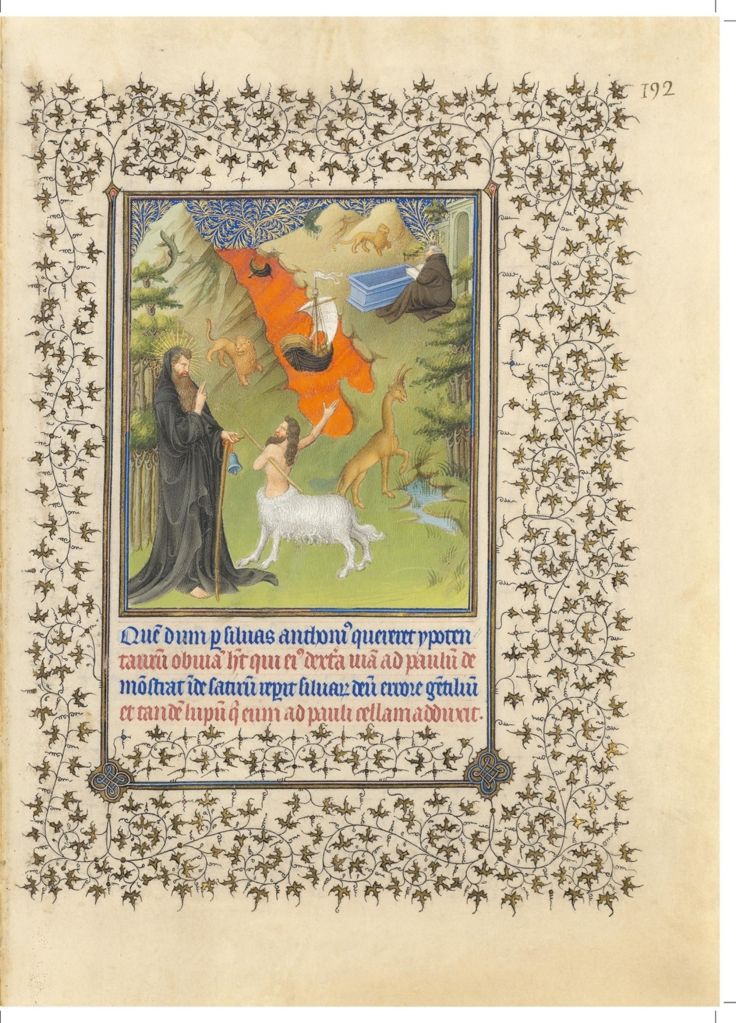
Let it never be said that the lives of the saints are boring. Artists, like Demonologists, have throughout the centuries returned to these scenes again and again. The Centaur shows up a lot, probably because it’s a subject that permits the artist to show off his own talents at depicting both human and equine anatomy. Yet we can also detect here a certain visual sensibility that can only be described as picturesque delight and fascination.
Jacopo Palma il Giovane, Saint Anthony Abbot asking the Centaur the way (Source)
Osservanza Master, The Meeting of Saint Anthony and Saint Paul, 1430-35, detail (Source)
Benedetto di Montagna, St. Anthony and the Centaur. The depiction of the Centaur as a monk is particularly unusual. (Source)
A less common depiction, St. Anthony and the Satyr (Source)
A medieval depiction of St. Anthony with both the Centaur and the Satyr, by Robert Testard. (Source)
John Mandeville’s take on the scene, with color highlighting the hybridity of the Centaur’s nature. (Source)
St. Anthony meets the Centaur in an illumination by Jean de Limbourg (Source)
Thus concludes Anno Domini MMXIX. It is strange to think that we are about to enter the third decade of the new millennium. I am by temperament a pessimist, but I hope that this decade is an improvement over the last (a time in which I experienced a tremendous amount of personal growth). Let us pray for God’s continuing mercy and Providence.
Here are some blog stats from the last year, for those who are interested.
In 2019, The Amish Catholic received a total of 66,839 views, with a total of 39,175 visitors. My total views were down this year by 1,035, though I received 3,969 more visitors in 2019. My most popular month was March, in which I received 19,066 views and 12,919 visitors. My least popular month was February, with only 3,011 views and 1,369 visitors. This is really all very good news, since I published many fewer pieces in 2019 than in 2018 – this has been my most intense calendar year of studies ever. Including this summary, I published 42 pieces in 2019 – down from 109 in 2018. Had I been a bit more productive, all my other numbers would have gone up this year.
Humor keeps the top spots, while works of controversy and commentary appear with greater frequency this year than in the past. Spiritual and academic pieces usually don’t have a terribly wide appeal – which is probably good, because I’m a young layman and a lowly grad student.
I suppose I could finish this trying to come up with a list of lessons I’ve learned over the course of the last year – in blogging, in life, etc. The temptation is even greater in view of the closing decade. Yet that often seems rather contrived. I would rather close with what seems to me the best way to end a year and a decade: on a note of gratitude. I could not have gotten where I am today without tremendous help along the way. Friends, family, mentors, and even strangers have made my life better in ways that I cannot begin to describe. Thank you to everyone who has been there along the way. You know who you are.
And thanks to the friends in heaven who have helped with their many prayers. As I concluded 2018, so will I finish the decade – with a prayer that encompasses all of time.
Glory Be to the Father, and to the Son, and the Holy Ghost, As it was in the beginning, is now, and ever shall be, world without end. Amen.
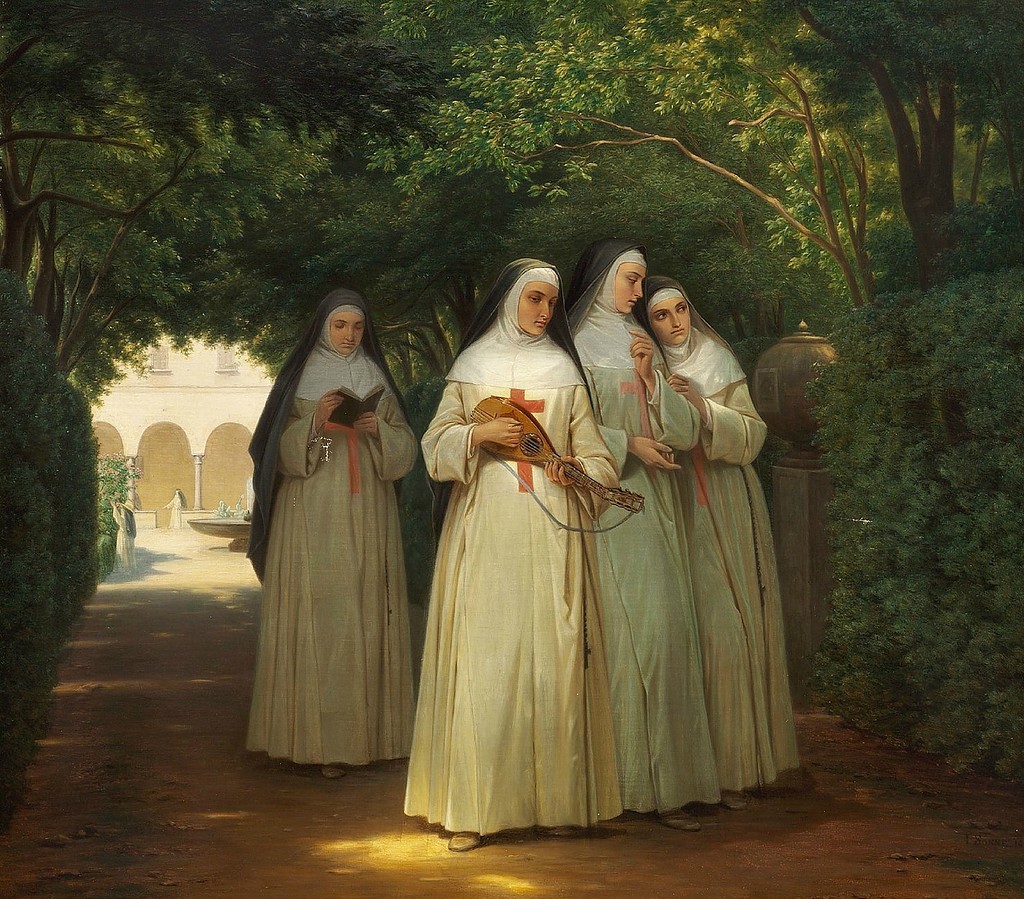
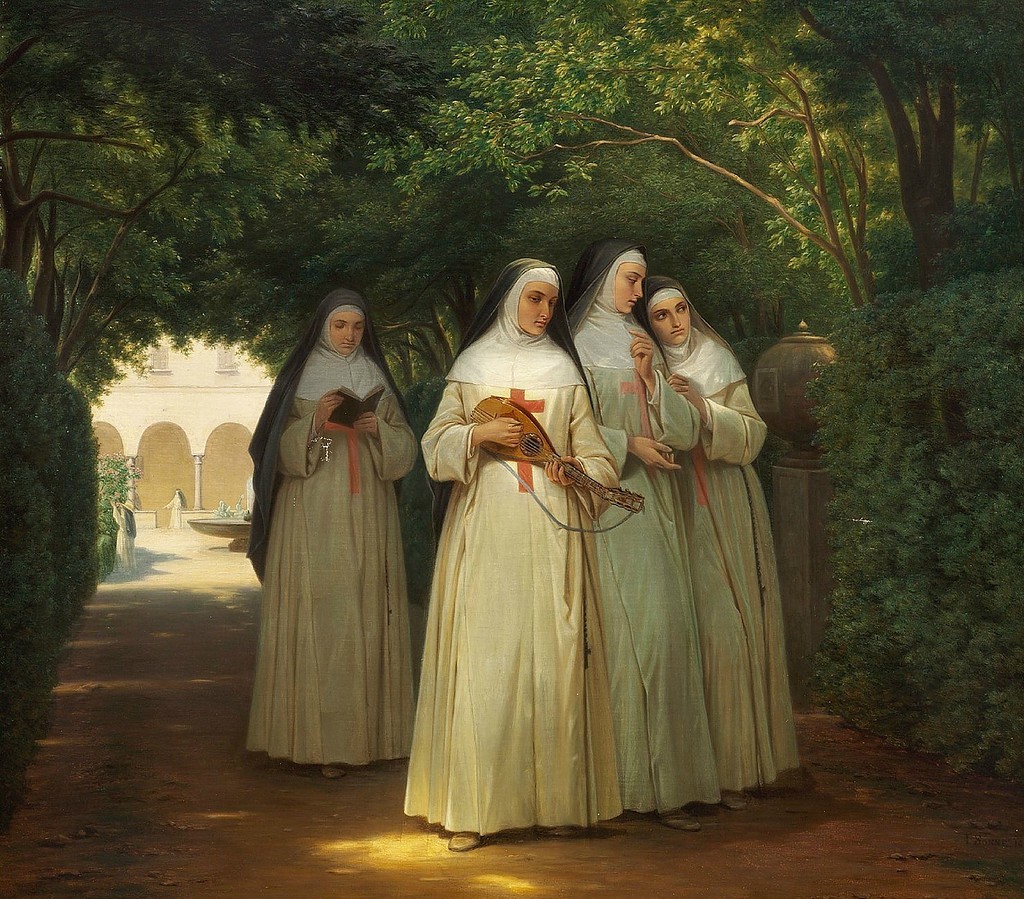
Jorgen Sonne’s 1866 Nuns walking in a cloister garden in Rome. He has, whether intentionally or not, given them the habit of Port-Royal-des-Champs. (Source)
I refer my readers to two articles that have recently appeared in the Notre Dame Church Life Journal. The first, which came out about a month ago, is an excellent piece by Dr. Shaun Blanchard showing that our polemical use of the term “Jansenism” is seriously mistaken. The second is an article I wrote, a church-historical study in which I both defend the Jansenists from various degrading misconceptions as well as point out some parallels between their situation and our own. I’m also very pleased that the Catholic Herald picked it up for Wednesday’s “Morning Catholic Must-Reads.”
I should add that I am particularly grateful to Dr. Blanchard for his kind aid in the preparation of my piece, and Dr. Artur Rosman for his editorial patience.
I offer the following propositions to my readers in a spirit of inquiry. Are these not edifying, pious, and – in many cases – straightforwardly true maxims? I have arranged them in thematic paragraphs, but beyond that, they do not issue from my hand. They are indeed far older maxims, drawn from the writings of certain noteworthy Catholic divines. Nevertheless, I should be very curious what my readers think of them – especially those with a theological background.
Are these not, on the whole, quite salutary? Do they not breathe the spirit of the best Fathers and Doctors, especially of those glorious Patriarchs of the West, SS Augustine and Thomas? Or, if anyone should find anything objectionable in them, what is the flaw? I ask sincerely. Those with ears to hear, let them hear.
In vain, O Lord, do You command, if You do not give what you command. Thus, O Lord, all things are possible to him for whom You make all things possible by effecting those same things in him.
All knowledge of God, even natural knowledge, even in the pagan philosophers, cannot come except from God; and without grace knowledge produces nothing but presumption, vanity, and opposition to God Himself, instead of the affections of adoration, gratitude, and love. As there is no sin without love of ourselves, so there is no good work without love of God.
A mark of the Christian Church is that it is catholic, embracing all the angels of heaven, all the elect and the just on earth, and of all times. What is the Church except an assembly of the sons of God abiding in His bosom, adopted in Christ, subsisting in His person, redeemed by His blood, living in His spirit, acting through His grace, and awaiting the grace of the future life? The Church or the whole Christ has the Incarnate Word as head but all the saints as members. The Church is one single man composed of many members, of which Christ is the head, the life, the subsistence and the person- it is one single Christ composed of many saints, of whom He is the sanctifier. There is nothing more spacious than the Church of God; because all the elect and the just of all ages comprise it.
It is useful and necessary at all times, in all places, and for every kind of person, to study and to know the spirit, the piety, and the mysteries of Sacred Scripture. The reading of Sacred Scripture is for all. The sacred obscurity of the Word of God is no reason for the laity to dispense themselves from reading it. The Lord’s Day ought to be sanctified by Christians with readings of pious works and above all of the Holy Scriptures. It is harmful for a Christian to wish to withdraw from this reading. It is an illusion to persuade oneself that knowledge of the mysteries of religion should not be communicated to women by the reading of Sacred Scriptures. Not from the simplicity of women, but from the proud knowledge of men has arisen the abuse of the Scriptures and have heresies been born. To snatch away from the hands of Christians the New Testament, or to hold it closed against them by taking away from them the means of understanding it, is to close for them the mouth of Christ. To forbid Christians to read Sacred Scripture, especially the Gospels, is to forbid the use of light to the sons of light, and to cause them to suffer a kind of excommunication. To snatch from the simple people this consolation of joining their voice to the voice of the whole Church is a custom contrary to the apostolic practice and to the intention of God.
A method full of wisdom, light, and charity is to give souls time for bearing with humility. and for experiencing their state of sin, for seeking the spirit of penance and contrition, and for beginning at least to satisfy the justice of God, before they are reconciled.
To suffer in peace an excommunication and an unjust anathema rather than betray truth, is to imitate St. Paul; far be it from rebelling against authority or of destroying unity.
Nothing engenders a worse opinion of the Church among her enemies than to see exercised there an absolute rule over the faith of the faithful, and to see divisions fostered because of matters which do not violate faith or morals. Truths have descended to this, that they are, as it were, a foreign tongue to most Christians, and the manner of preaching them is, as it were, an unknown idiom, so remote is the manner of preaching from the simplicity of the apostles. and so much above the common grasp of the faithful; nor is there sufficient advertence to the fact that this defect is one of the greatest visible signs of the weakening of the Church and of the wrath of God on His sons. Stubbornness, investigation, and obstinacy in being unwilling either to examine something or to acknowledge that one has been deceived daily changes into an odor, as it were, of death, for many people, that which God has placed in His Church to be an odor of life within it, for instance, good books, instructions, holy examples, etc. Deplorable is the time in which God is believed to be honored by persecution of the truth and its disciples! This time has come…. To be considered and treated by the ministers of religion as impious and unworthy of all commerce with God, as a putrid member capable of corrupting everything in the society of saints, is to pious men a more terrible death than the death of the body. In vain does anyone flatter himself on the purity of his intentions and on a certain zeal for religion, when he persecutes honest men with fire and sword, if he is blinded by his own passion or carried away by that of another on account of which he does not want to examine anything. We frequently believe that we arc sacrificing an impious man to God, when we are sacrificing a servant of God to the devil.
August is the Month of the Immaculate Heart of Mary. While I was too busy moving and adapting to life in Pennsylvania to write anything for Assumption Day, my good friend Keanu Heydari wrote a beautiful meditation on the meaning of the Assumption as well as on Our Lady’s co-redemptive role more generally. I offer it to my readers for their edification and delight as well as for the honor of Our Lady’s Sorrow and Immaculate Heart. Here’s a particularly puissant excerpt:
In this remarkable passage, as the Venerable Fulton Sheen has argued, John’s Jesus invokes the archetypical womanhood of Mary as the New Eve. Mary is the woman. Jesus affirms her role in undoing our devastated humanity in the Garden by affirming her role as the New Eve. Moreover, the Lord makes a startling claim about the dignity of Mary’s personhood and her role in the narrative arc of cosmic salvation as Coredemptrix and Mediatrix. What is true about Christ is also just as true of the Virgin. Only Mary could confess that she, in the purest way, was truly of the flesh of the Son of Man.
Keanu Heydari
Keanu hits upon a fundamental truth of Catholicism, the Marian-Ecclesial analogy with Christ. What is predicated of Christ can be predicated of both the Church, His Bride, and, in a special way, His Mother. This is not to suggest that anyone other than Jesus Christ as a discreet person is the Logos, but to note that all that He is by nature, we can become by Grace – and Mary first of all.
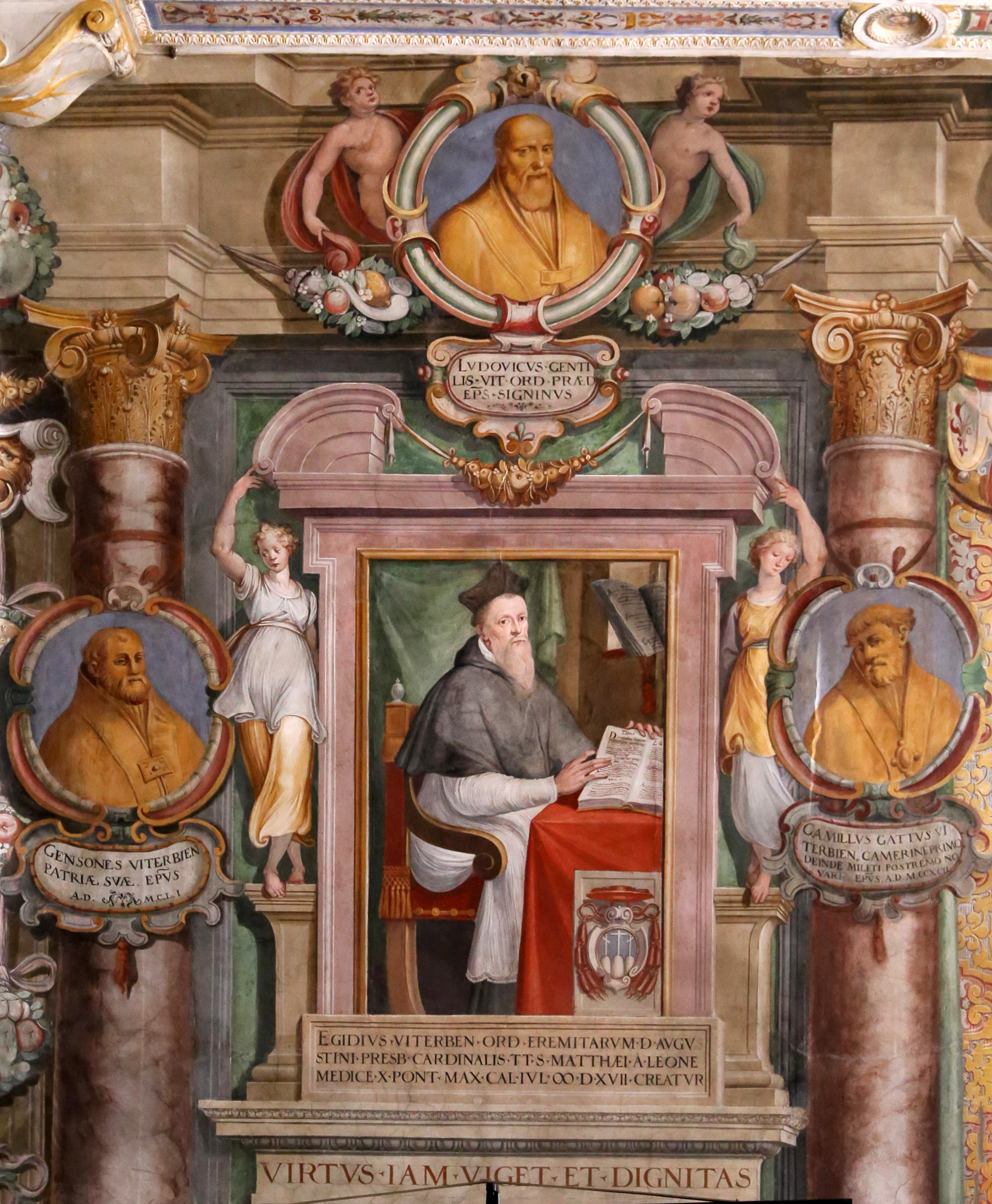
Portrait of Giles of Viterbo in his old Palazzo (Source)
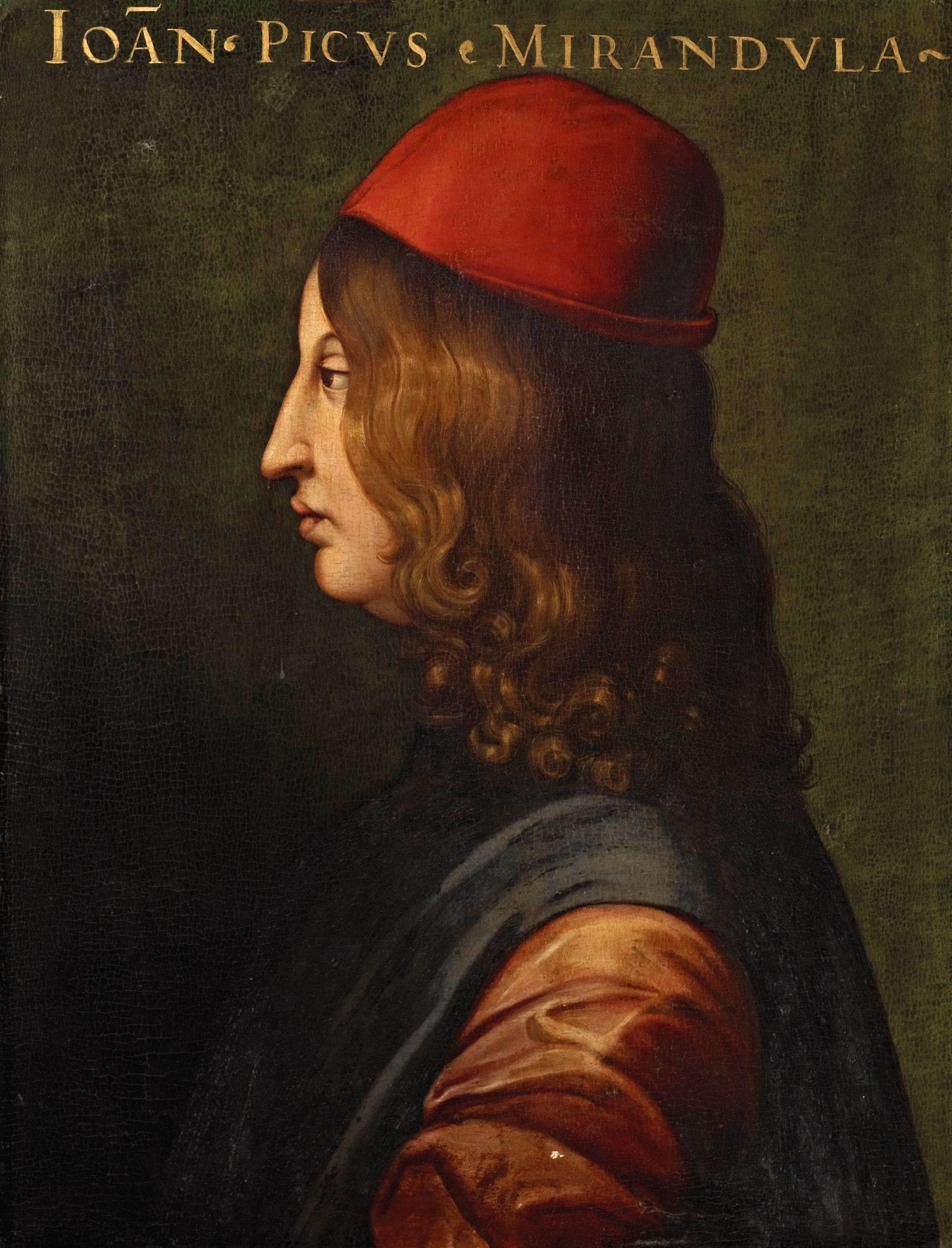
Over at Church Life Journal, Andrew Kuiper has a tour-de-force article on the history and theology of Catholic Kabbalah. His review of four Catholic Kabbalists – Pico della Mirandola, Johannes Reuchlin, Giles of Viterbo, and St. John Fisher – is a model of intellectual history. He does a great job showing the continuing relevance of Kabbalah for Catholic (and other Christian) thinkers throughout the centuries.
The piece is amply cited and provides several helpful theological considerations. I thought Kuiper’s nod towards Sophiology was particularly enlightening. If Christian Kabbalah has a place in Catholic theology today, I predict that it will be in the writings of latter-day Sophiologists.
If I were to offer a criticism of Kuiper’s piece, it would be a very minor one at that: he makes no reference to the works of Margaret Barker. Her research has shed a new light on the roots of Christianity and Jewish mysticism (in both its Merkabah and later Sephirotic developments) in the memory of the First Temple. Reading Kabbalistic texts through a Temple lens can ease their Christian interpretation. But I digress.
Pico della Mirandola, a pioneer in the Christian use of Kabbalah. (Source)
Perhaps the most exciting part of the article, for a historian of the period, is Kuiper’s various references to the Kabbalistic books written by these Christians of the 15th and 16th centuries. I would particularly keen on finding the text of Giles of Viterbo’s Shechina or Pico’s Heptaplus. Some of these hard-to-find volumes have never been translated into English.
It is not easy to summarize the teachings of the Jewish mystics, nor their Christian interpreters. Kuiper does both with commendable attention to detail and obvious competence, all while keeping things clear and concise enough for a lay reader. This article also provides a badly-needed defense of the respectability of Kabbalah as a field of study. Its bastardization in recent times, exemplified most clearly by Madonna et al., has led some to question whether Kabbalah is anything more than a gnostic mishmash of magic with Hebrew letters. I have heard colleagues dismiss it entirely as a field of serious inquiry for a historian or theologian. This tendency seems especially strong with Christian academics, many of whom retain outdated ideas about Jewish mysticism or who simply haven’t up with the post-Scholem rediscovery of Kabbalah. Kuiper’s intervention is a broadside against this boring complacency. It’s not exactly “a cruel angel’s thesis,” but it is one worth defending.
‘Catholicity, Antiquity, and consent of the Fathers, is the proper evidence of the fidelity or Apostolicity of a professed Tradition’ J.H. Newman, Lectures on the Prophetical Office of the Church, 1837, p. 51




 The Amish Catholic