Thoughts on Converting the Young

New-format-for-Coke-Zero-Cherry

The official drink of the movement. (Source)

By now, it has become a commonplace among the Catholic literati that, as one reporter put it, “The Kids are Old Rite.” Traditionalism is on the rise among Millennial Catholics. Several overlapping clans of young, traditional Catholicism have arisen over social media, especially Twitter. Traditional orders get more and younger vocations; older, more progressive orders face extinction in the near future. The Pope himself has taken notice and expressed concerns about this trend. Of course, most of the young trads prefer a pope closer to their own age.

Several unrelated items recently have come up in my news-feed that have collectively crystallized the issue for me.

I

First, a three-part study of FOCUS (The Fellowship of Catholic University Students) has just appeared in the National Catholic Reporter. While I’m often wary of NCR’s coverage on just about anything, I’d encourage you to read it. Sometimes the magazine’s liberal bias gets the best of it, as in a mostly uninteresting examination of FOCUS’s ties to Neo-Conservative and generally right-wing organizations in Part II.

But there are also genuine insights. A lot of the issues raised reminded me of my own somewhat mixed experience with a FOCUS-dominated campus ministry. I certainly made friends, some of whom I still consider important mentors. My first-year Bible Study leader, a fellow student who had been “discipled” by the FOCUS missionaries, was a great influence in my first year of Catholicism (and beyond). But I more or less left the ministry fairly early on, like most of my trad or trad-lite friends. The NCR study gets into some of the reasons why.

For instance, in Part 1, we read:

A FOCUS women’s Bible study group gave Elisa Angevin purpose and strengthened her values — at first. As a freshman at New York University, she met a missionary, who became a mentor and a friend.

But as she met different people outside that community — some of whom were “rubbed the wrong way” by FOCUS — Angevin began to distance herself from the group because it felt exclusionary, rigid and not open to different ways of being Catholic.

“Once you become part of FOCUS, it has a very structured approach,” recalled Angevin, now 25 and a social worker in New York. “It created a lot of passion. But a lot of student leaders looked down on other people who didn’t have the same passion.”

Angevin attended some of FOCUS’ mega-conferences, such as the Student Leadership Summit, and was inspired by the speakers and sense of community. “It was empowering to see people my age who were as excited as I was,” Angevin recalled. “But as I started to get older, the newness had worn off … and it felt very closed.”

A lot of this rings true. Speaking from my own experience, I always got the very strong impression that FOCUS represented a fairly “mainstream” form of Catholicism, the JP2 consensus. Banal liturgy coupled with social conservatism. But there really isn’t any room for traditionalists – or even just those who are friendly to the Old Mass and the piety it sustained. I remember being called “judgmental” for my views. Other trads were  sidelined as well.

I also think that the program’s reliance on *very young* missionaries often leads to a dumbing-down of the vast spiritual and intellectual inheritance that is Catholicism. There’s some call for this at a campus ministry, where ministers have to reach as many people as possible. Not everyone can or even should be St. Thomas Aquinas. Undergraduates don’t often go to ministries looking for lectures, but for some escape from the academic life. Still, must it all be so infantilizing? Perhaps you can see what I mean here:

At the Chicago event, held at the sprawling McCormick Place convention center, FOCUS founder Curtis Martin struts onto the stage, hands in the air, shouting “Woo!” and “Awesome!” to the applauding summit attendees who had been enjoying a contemporary Christian band before his keynote address. Two days earlier, actor Jim Caviezel — Jesus in the Mel Gibson film “The Passion of the Christ” — made a surprise visit to the conference.

“This is how awesome you are,” Martin said. “When the guy who pretended to be Jesus walked in the room, you all stood up and clapped, but when Jesus showed up, you all fell down and knelt. You know the difference. How cool is that?”

What an ineffably stupid way of addressing adults. Mr. Martin manages to strike at once a patronizing and self-congratulatory tone, a true rhetorical feat.
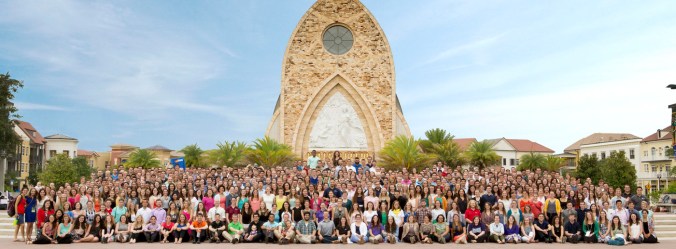
FOCUSavemaria

One thing I learned in the NCR articles is that FOCUS missionaries only get four weeks of training the summer before they begin. And some of that is dedicated to learning how to fund-raise. (Source)

Yet my unease with FOCUS wasn’t just with that sort of standard, if irritating, campus ministry procedure. As a recent convert who had grown up in an Evangelical Protestant school, I found a lot of FOCUS’s Protestant-lite discourse unsatisfying. It was more than just the use of emotivist praise and worship music at Benediction (as grating as that was). It was more than just the way FOCUS mission trips seemed to mirror the sort of make-work vacation mission trips I recognized from my time in the Evangelical world. I got the distinct sense that FOCUS borrowed heavily from the discourse of Evangelicalism, even down to the language it deployed when talking about conversion. Here’s an example from Part III:

As former FOCUS employees (called “missionaries”) or as students involved with the organization on their college campuses, they were taught its “Win, build, send” formula.

“Win” means to build “authentic friendships” with people, with the ultimate purpose of evangelization, while “build” requires helping those friends grow in faith and virtue through what FOCUS calls “the big three” virtues: chastity, sobriety and excellence.

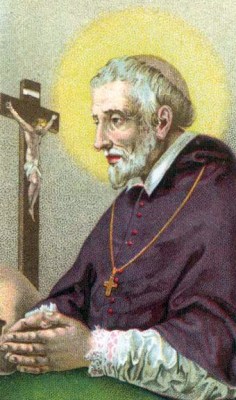
First, we have the shallow reduction of evangelization to a business-like slogan, as if the work of the Holy Ghost could be charted like a marketing campaign. This type of lingo is, in my experience, very common in Evangelical discourse. Paired with it we find the language of authenticity. The first step in FOCUS’s three-part strategy is to “build ‘authentic friendships.'” Authenticity is like obscenity – you can’t define it, but you know it when you see it. The problem, of course, is that you can’t actually plan an “authentic friendship.” The planning is precisely what makes it artificial. Friendships come about organically, and no two look alike. The same can be said of conversions. At best, FOCUS should rather resemble what St. Philip Neri imagined the Oratory to be, though he never constructed any firm plans for the Congregation’s foundation or development. At worst, students get the sense of entering faux, farmed, and framed friendships. Those attract precisely no one.

In the emphasis on “chastity, sobriety, and excellence” as, risibly, “‘the big three’ virtues,” we find a synecdoche of the very strong note of philistine, puritanical prudery ensconced in FOCUS. Encountering this tendency also made me recall the moralistic Calvinism of my youth. Everything in Christianity seemingly came back to sex, drinking, and drugs. No one who ponders the state of American students could seriously suggest that these issues don’t matter, but to hammer on about them to the exclusion of two other triads – Faith, Hope, and Charity, and the Good, the True, and the Beautiful – makes Christianity dull.

 

FOCUSprots

Protestant Sunday worship, or Catholic conference? Hard to tell…and therein lies the rub. (Source)

But why does FOCUS make “chastity, sobriety, and excellence” its threefold mantra? The FOCUS promotional video in Part 1 offers some insight into their worldview. The narrative told there is one of nostalgia and decline. Various clips from the 1950’s are shown in contrast to the sex, drugs, technology, and mass media of today. The message is obvious: society was better back then, and it’s worse now. But it’s not fundamentally true. First of all, evil has always existed. FOCUS’s Manichaean view of the past may not be unusual, but it’s also deeply lopsided. All the terrible things FOCUS decries about our modern society – pornography, addiction, suicide, the disenchantment of consumerist technology – all of these things existed prior to the 1960’s. And lots of bad things about the society of the 1950’s have disappeared or been greatly mitigated in various ways (need I point out segregation as the elephant in the room?). Yet none of those advances are mentioned. It’s not surprising that social justice Catholics, like trads, find themselves ill at ease with FOCUS. Is it all that shocking that “a lack of racial, ethnic and economic diversity among students served by FOCUS is another criticism?”

The FOCUS video also fails to note the role the Church herself played in clearing the way for, hastening, and abetting the worst changes. Nary a peep do we hear about how leaders of the postconciliar Church abandoned her sacred mission to convert a sinful world, nor the way that such a surrender was intimately tied to the loss of the Mass of Ages.

I don’t intend for this post to be a simple laundry-list of my grievances with FOCUS, philosophical and otherwise. After all, I know plenty of wonderful people who got a lot out of their connection with the organization. The FOCUS missionaries themselves were always perfectly pleasant, and seemed orthodox enough. But I also knew others who felt excluded and patronized by the model they brought to campus ministry. I confess a very deep ambivalence about their hopes to expand ministry to parishes (though the veritable clerisy of middle-class lay ministers that Marti Jewell envisions in Part III of the report is hardly any better).
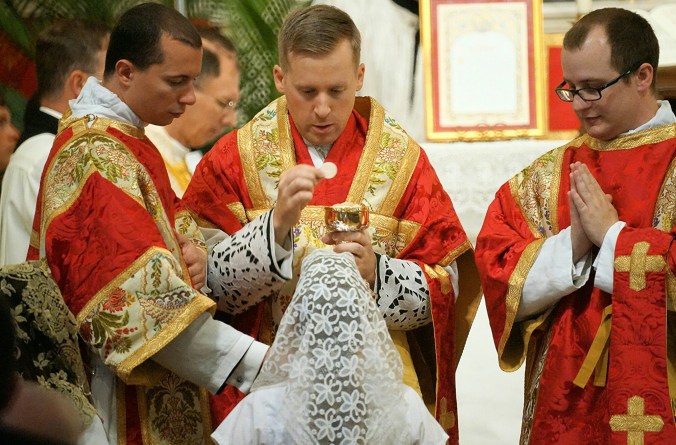
YoungTrads

An alternative. (Source)

If we want to win the youth with “authenticity,” then look no further than the Latin Mass. Or even just the Novus Ordo celebrated according to Fortescue, as you see at the English Oratories. That which is unmistakably Catholic and orthodox has the best chance of bringing about conversion of heart. I would be curious to know how Juventutem compares to FOCUS in terms of outreach, vocations, etc. Regardless, my own view of how this program of evangelization might best function is in my essay, “The Oratorian Option.” Nothing has changed since then, except that I’ve gotten the chance to attend an Oratorian parish consistently, an experience that has corroborated my original theories. The Eucharist and the worthy celebration of the Mass are at the heart of it all.

It’s just unfortunate that FOCUS, at least as I’ve known them, aren’t interested.

II

The New York Times published a piece on the Trappists of Mepkin, monks in my own home Diocese of Charleston. They’re good, quiet priests who farm mushrooms on a prime piece of real estate next to the Cooper River. The Times profile is nice enough, though I think its central flaws are aptly pointed out by my friend, Fr. Joseph Koczera SJ, in his response over at The City and the World. To wit:

Despite the NYT‘s suggestion that the Mepkin “affiliate program” represents “a new form of monasticism,” the monks themselves realize that it does not. As NYT reporter Stephen Hiltner observes, “the monks at Mepkin are cleareyed about the likelihood that their new initiatives — which will probably attract young, interfaith and short-term visitors — will fail to attract Roman Catholics who are interested in a long-term commitment with the core monastic community.” Mepkin’s abbot also frankly admits that the monastery may not survive: “I’d rather be in a community that has a vital energy and a good community life. And if that means closing Mepkin, that means closing Mepkin.”

“New” and dubiously monastic programs substituted for genuine, old-fashioned monasticism? We’ve seen this before. Mepkin’s well-intended program differs even from, say, the Quarr internship insofar as it isn’t primarily targeted to candidates who might plausibly have a vocation, single Catholic men from the ages of 18 to 25. And unlike Quarr, a monastery which retains its Solesmes heritage, Mepkin seems to be failing in part because it holds too tightly to the Spirit of the Council. Mepkin’s new affiliate program is open to women as well as men, “of any faith tradition.” It seems that the solution they’ve come up with to their vocational crisis is to become less Catholic, not more.

Fr. Koczera continues at length:

As Terry Mattingly points out at GetReligion, the NYT article is very one-sided, focusing on monasteries that are dying without ever asking questions about monasteries that actually are drawing vocations. Most Trappist monasteries in the United States seem to be in straits similar to those of Mepkin, at least judging by yearly statistics published by the Trappist Order. On the other hand, it isn’t difficult to find monasteries in the United States (albeit those of other orders) that continue to attract (and retain) young vocations: one thinks of the Benedictines at Our Lady of Clear Creek Abbey in Oklahoma or Saint Louis Abbey in Missouri, or of the Cistercian Abbey of Our Lady of Dallas (a monastery I’ve written about once or twice before)…Despite the evident sincerity of the monks at Mepkin Abbey, their sense of what young people want belies data about what young Catholics in particular are looking for. As the monks acknowledge, seeking to provide a haven for ‘spiritual but not religious’ types will not lead to an influx of new vocations. The monks may realize, too, that Millennial Catholics who take their faith seriously are also serious about commitment and likely to be unimpressed by a strategy that is specifically tailored to seekers who are “interested in the spiritual life journey, but not in institutional religion.” In this sense, it’s interesting to contrast the NYT story on Mepkin Abbey with a NBC News story from just last week that highlighted the rising number of American Millennials who are choosing to enter religious orders – and who enter looking for a solid sense of identity and commitment that is countercultural. They represent a generation of Catholics who find themselves, as Tracey Rowland writes, “in full rebellion from the social experiments of the contemporary era” as they seek “to piece together elements of a fragmented Christian culture.” Some will find the resources they need to assemble those fragments in one or another of America’s remaining monasteries – but not, it seems, at Mepkin Abbey.
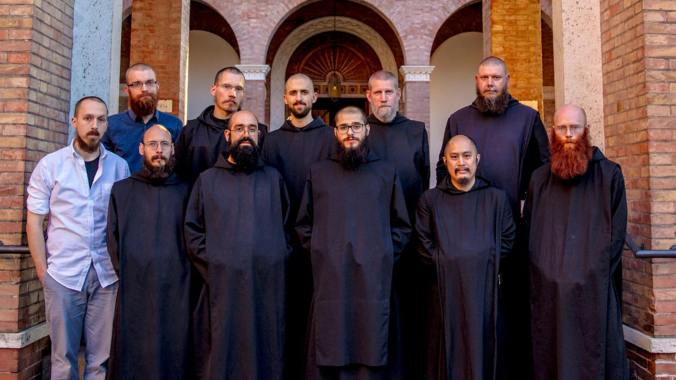
temporary-transfer-to-rome

A 2016 photo of the community of Norcia. The monastery is unlike Mepkin in many ways: young, international, augmented by regular vocations, and above all, Traditional. (Source)

Of the new monasteries that do seem to get vocations (and lots of them), two stand out: Norcia and Silverstream. The lives of these two monasteries are so attractive to young American Catholic men that, though they are in Italy and Ireland respectively, they are mostly inhabited by Americans willing to make the move to Europe. Both are old-rite monasteries. And I would wager that neither Dom Cassian Folsom nor Dom Mark Daniel Kirby went about planning their monastic ventures with catchy slogans or even a very programmatic sense of action. They celebrated the Mass reverently, preached orthodoxy, and, with the help of the internet, they achieved widespread fame. They shared the trust in Divine Providence that St. Philip had as he – or, in his own words, Our Lady – founded the Oratory.

III

My friend John Monaco has just published an excellent personal narrative at his blog, Inflammate Omnia. It describes his Catholic upbringing, difficulties in seminary, extended flirtation with liberalism, and final reversion to a basically Traditionalist position. Parts of it reminded me of my own story: my natural religious sentiment as a child, my vituperative liberalism in High School, my conversion and eventual move towards a more or less Traditionalist orientation, in part through the beneficent influence of the Christian East.
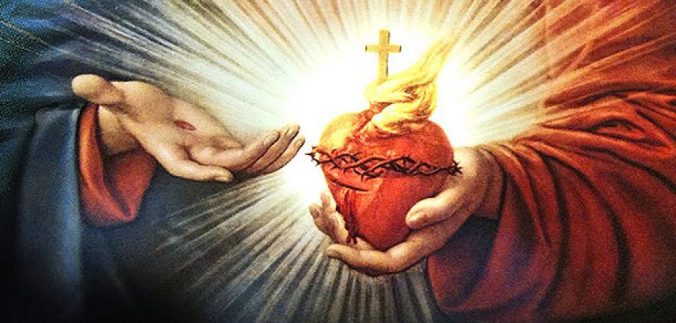
cropped-Sacre-Coeur-940x450

Christ offers us His heart freely and fully. (Source)

I was particularly taken with the way that the Act of Reparation to the Sacred Heart of Jesus, as traditional a devotion as you can get, gently shaped John’s sensibilities over time. His original resistance to the Sacred Heart gave way to the a love of Jesus in precisely this mystery. And by the infallible rule of Lex Orandi, Lex Credendi, the prayer also led him to adhere more perfectly to the Faith as enshrined in Tradition. He writes,

You see, the more I prayed to the Sacred Heart, the more I began to really think about what I was actually praying. Prayer of Reparation? “For what?” I asked. My sins. What does it mean to “resist the rights and teaching authority of the Church which Thou hast founded?” That must obviously mean that the Church has authority, and that Christ founded the Church. The more and more I prayed these prayers, the more I began to question its essence. And even more so, I began to question my own conduct and dispositions.

You see, none of this “mercy” stuff makes sense if we don’t believe that sin actually harms. If all sin is simply personal weaknesses that do not affect our relationship with God and each other, then why do we need forgiveness? Or, in response to some moral theologians, if it is impossible to sin, then what is the purpose of grace? If the Church doesn’t have authority, then why do we consider the command to preach the Gospel? If Christ didn’t found the Church, then why should we bother following it? I also wondered why I was skipping all of the “hard-sayings” of Jesus, such as His words on divorce and remarriage, purity, suffering, obedience, and the promise that the “world” would hate me for preaching the truth. I started examining the fact that people would tell me, “I like you because you’re not talking about Hell and all of that sin stuff all the time”, and that had less to do with me balancing the Christian message than it did with me picking & choosing which parts to speak about.

John also captures the essence of the new, young Traditionalism:

Delving beyond the contemporary face of Catholicism, I was able to re-discover Tradition- not through EWTN or Rorate Caeli, nor through PrayTell or Crux, but rather through a true experience of the sacred liturgy, prayer, and study.

A future church historian will take that line as summative of the entire experience of a generation. The only thing I would add is that in my own case, as with many others, beauty was the central thing. Community, tradition, stability, a sense of history; all these are goods that the Church offers her children. But it was supernatural beauty that captured my imagination and led me to a genuine encounter with the Living God. The Church has the chance to re-present that “beauty ever ancient, ever new” each week at the Mass. It is Christ Himself in the Eucharist who will convert the world. Not our misbegotten, if earnest, attempts to plan out the advance of His Kingdom. If anything, we too often get in His way.
TYPsedia

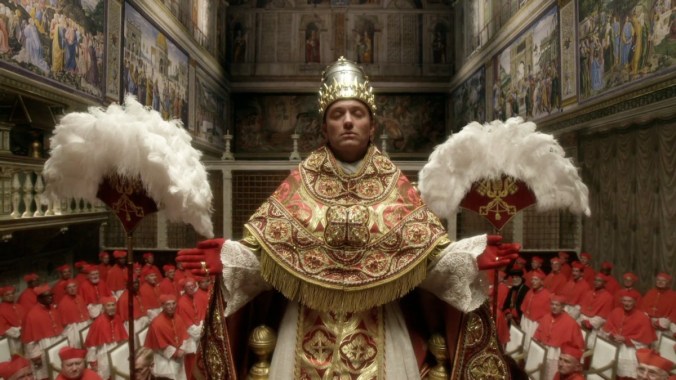
More of this, please. (Source)

Elsewhere: An Anglo-Catholic Designer You Should Know

Screen Shot 2018-03-13 at 1.40.54 AM.png

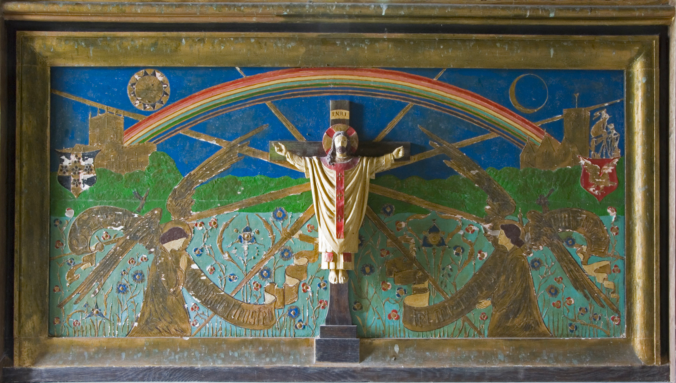
A reredos by John Coates-Carter. (Source)

Over at Liturgical Arts Journal, you will find a very good, brief introduction to an ecclesiastical architect of the Arts and Crafts Movement, John Coates-Carter. He is most famous for his design of the (extraordinary) abbey on Caldey Island. Most of his work can be found in Wales. Perhaps because of his regional interest, I had never heard of him before. Yet his altarpieces are about as Anglo-Catholic as you can get. They have all of the features I noted in my article on AC aesthetics; they’re earthy, colorful, idealized, with a hint of the illustrative verging on the cartoonish. And most importantly, the are deeply human. Anglo-Catholicism restored the human face to British ecclesiastical art. We can see that tendency in the luminous angels and vibrant peasants that appear in Coates-Carter’s sacral art. Do go have a look.

CaldeyIsland

Caldey Abbey, designed by John Coates-Carter. (Source)

“But There, Besides the Altar, There, is Rest”

Ernest_Dowson.jpg

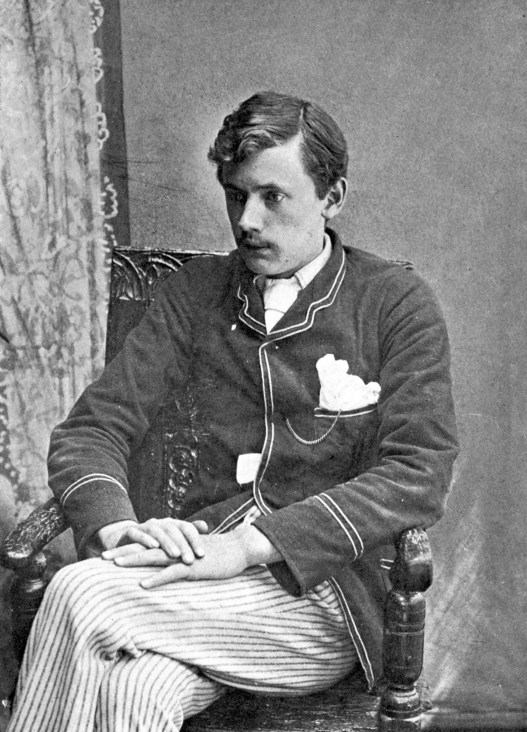
Ernest Dowson – a frail, unhappy poet driven by wild passions. Also a Roman Catholic. (Source)

Recently, I have discovered the work of the poet Ernest Dowson (1867-1900). He has swiftly become a favourite. His Decadent verse originated the phrases “gone with the wind” and “the days of wine and roses.” He was also a Catholic convert. His poetry often explores the contrast between the perishable delights of the world and the undying realm of the supernatural. In Dowson, we see the forked path that comes with the recognition of the world’s vanity: the choice lies between hedonistic decadence and the rigors of ascesis and contemplation. These two monastic poems express precisely that tension in his sad life as well as his powerful artistic vision.

Nuns of the Perpetual Adoration

Calm, sad, secure; behind high convent walls,
These watch the sacred lamp, these watch and pray:
And it is one with them when evening falls,
And one with them the cold return of day.

These heed not time; their nights and days they make
Into a long, returning rosary,
Whereon their lives are threaded for Christ’s sake;
Meekness and vigilance and chastity.

A vowed patrol, in silent companies,
Life-long they keep before the living Christ.
In the dim church, their prayers and penances
Are fragrant incense to the Sacrificed.

Outside, the world is wild and passionate;
Man’s weary laughter and his sick despair
Entreat at their impenetrable gate:
They heed no voices in their dream of prayer.

They saw the glory of the world displayed;
They saw the bitter of it, and the sweet;
They knew the roses of the world should fade,
And be trod under by the hurrying feet.

Therefore they rather put away desire,
And crossed their hands and came to sanctuary
And veiled their heads and put on coarse attire:
Because their comeliness was vanity.

And there they rest; they have serene insight
Of the illuminating dawn to be:
Mary’s sweet Star dispels for them the night,
The proper darkness of humanity.

Calm, sad, secure; with faces worn and mild:
Surely their choice of vigil is the best?
Yea! for our roses fade, the world is wild;
But there, beside the altar, there, is rest.


Carthusians

Through what long heaviness, assayed in what strange fire,
Have these white monks been brought into the way of peace,
Despising the world’s wisdom and the world’s desire,
Which from the body of this death bring no release?

Within their austere walls no voices penetrate;
A sacred silence only, as of death, obtains;
Nothing finds entry here of loud or passionate;
This quiet is the exceeding profit of their pain:

From many lands they came, in divers fiery ways;
Each knew at last the vanity of earthly joys;
And one was crowned with thorns, and one was crowned with bays,
And each was tired at last of the world’s foolish noise.

It was not theirs with Dominic to preach God’s holy wrath,
They were too stern to bear sweet Francis’ gentle sway;
Theirs was a higher calling and a steeper path,
To dwell alone with Christ, to meditate and pray.

A cloistered company, they are companionless,
None knoweth here the secret of his brother’s heart:
They are but come together for more loneliness,
Whose bond is solitude and silence all their part.

O beatific life! Who is there shall gainsay,
Your great refusal’s victory, your little loss,
Deserting vanity for the more perfect way,
The sweeter service of the most dolorous Cross.

Ye shall prevail at last! Surely ye shall prevail!
Your silence and austerity shall win at last:
Desire and mirth, the world’s ephemeral lights shall fail,
The sweet star of your queen is never overcast.

We fling up flowers and laugh, we laugh across the wine;
With wine we dull our souls and careful strains of art;
Our cups are polished skulls round which the roses twine:
None dares to look at Death who leers and lurks apart.

Move on, white company, whom that has not sufficed!
Our viols cease, our wine is death, our roses fail:
Pray for our heedlessness, O dwellers with the Christ!
Though the world fall apart, surely ye shall prevail.

Elsewhere: Two New Blogs on Mystics

lazzari+print

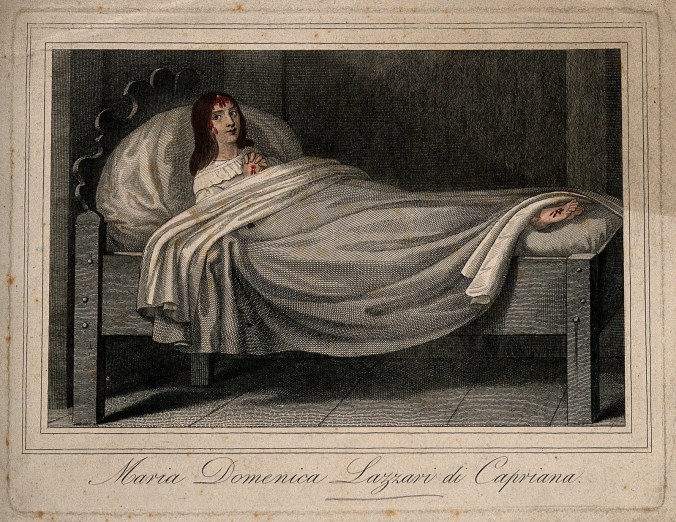
A stigmatic, c. 1840. (Source)

Recently two very worthy endeavors have come to my attention. The first is the blog of the Stigmatics Project at the Ruusbroec Institute, University of Antwerp. The project “studies the promotion and devotion of the hundreds of stigmatics reported in five European countries during the nineteenth and early twentieth century.” It takes a scholarly, non-confessional approach to its subject. No doubt this new venture will yield greater insights into the stigmata as a social phenomenon.

The second is a much more theological blog called Littlest Souls, and it presents a veritable treasure trove of mystic spirituality. The blogger has clearly read widely in the library of the soul passed on to us from age to age by the Church. He seems to place a special emphasis on the 19th and early 20th century mystics, much like the Stigmatics Project. In fact, they probably cover some of the same figures. But unlike the recently-founded work of the Ruusbroec Institute, Littlest Souls has been up and running since May 2012. There is consequently much more material here to review and contemplate. Fans of that other great blog, Mystics of the Church, will find much here to admire.

In my first post on Father Faber, I noted that he represented a kind of lost world of the faith. Today, it is hard to imagine a Catholicism that once supported the kind of imaginatively baroque and overtly sentimental spirituality that oozes from his pages. Father Faber looks odd to our cynical, postmodern eyes. But in exploring his writings now, I find much in them that’s salutary and beautiful. My hope is that I can play some small part in recovering those gems for our times.

Both of these blogs seem to do precisely that; one at the level of scholarship, and one at the level of spirituality. Both set out to investigate and present a spiritual school that often seems morbid, unhealthy, or slightly daft – certainly one that has little place in our age. But there are real values here, real impressions of humanity in communion with the divine. I can only commend their efforts as important contributions to the memory and mystical life of the Church Militant.

I’ve said it before, and I’ll say it again. The Church is weird because she is supernatural, and the supernatural is always strange. We should embrace that fact.

When the Sacred is Strange: The Art of Giovanni Gasparro

Screen Shot 2017-11-11 at 11.25.56 PM.png

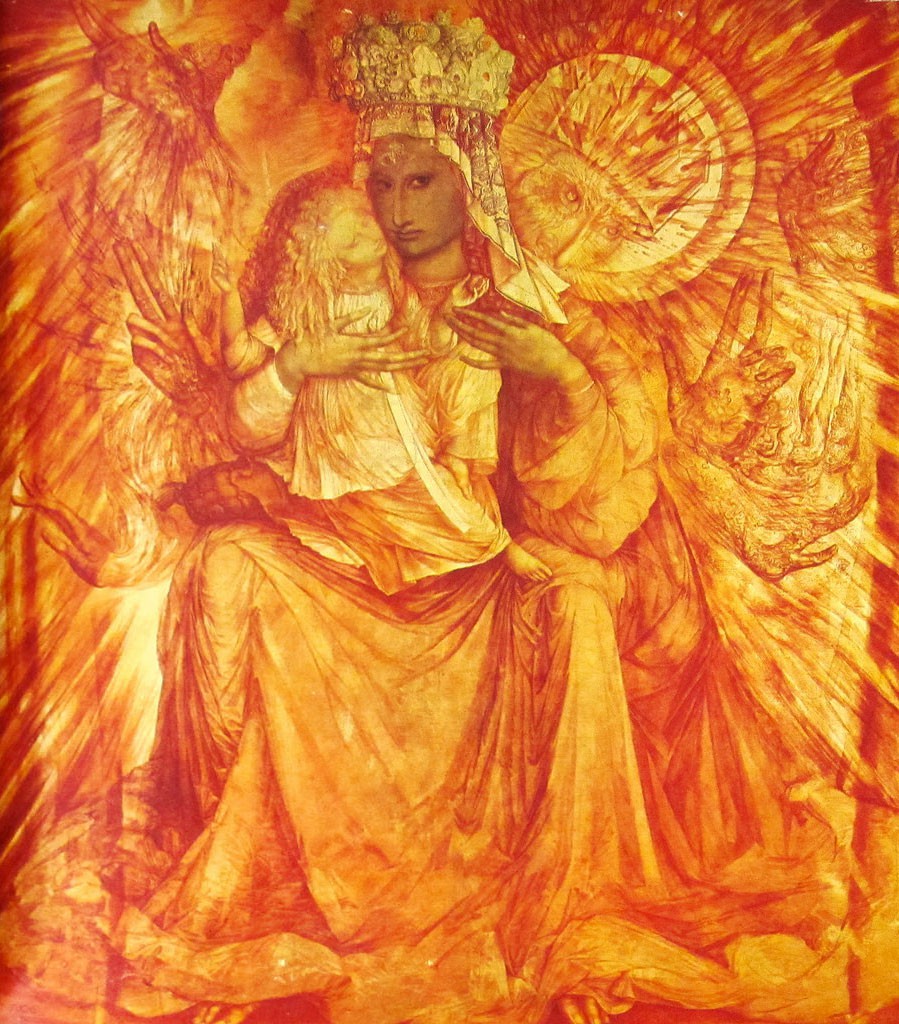
St. John Damascene and the St. Virgin Tricherusa, Giovanni Gasparro. Here we see Gasparro depicting a legend from the Saint’s life that is particularly appropriate for an artist. The work also represents the unity of Western and Eastern visual traditions in the transcendent Divinity. (Source)

UPDATE 4/2/20: It has recently come to my attention that Giovanni Gasparro, the artist profiled here, whose work I have admired at this blog on several occasions, has just produced a painting that reproduces the vicious anti-Semitic trope of Jewish ritual murder. This lie has historically led to violence against the Jews and, to put it lightly, is a subject unbecoming of a Christian painter. I condemn it in the strongest possible terms. While I used to look to Mr. Gasparro as a prime example of what Christian art could be in our postmodern era, his embrace of imagery more fit for the pages of Der Stürmer means that I can no longer endorse him. Nevertheless, I have decided to keep this essay up online because it enunciates certain principles about art that I think remain important. I hope that my readers will understand that they reflect an assessment of Mr. Gasparro’s value as religious art that I no longer hold. 

Recently there came into my newsfeed an article by Hilary White Obl.S.B. of What’s Up with Francischurch?. The piece was an extended criticism of Giovanni Gasparro, an Italian artist whose paintings inspired a few of the meditations I have written before on this blog. As someone who has long admired Mr. Gasparro’s Neo-Baroque art, I was happy to see that Rorate Caeli recently profiled one of his pieces. Ms. White was, it seems, partially responding to this attention. However, the more I read of her article, the more I found myself in stark disagreement with her analysis and broader philosophy.

While I have in the past appreciated her reporting as well as the monastic spirit she brings to her work, I confess that I was surprised at the poor quality of her post. I would not ordinarily seek out controversy, but as it seems that Ms. White’s post is making the rounds of the Tradisphere, I felt it imperative to offer a counter perspective.

There are many problems with the article. It is a textbook example of how not to write about art and theology, failing comprehensively at description, prescription, and imagination. She focuses too heavily on one work, Gasparro’s St. Pius X Pontifex Maximus. When she looks at other examples of his art, her analysis – if that is the right word for her summary denunciations – always remains far too cursory to do justice to such a talented artist. And while she notes that Gasparro is a master draughtsman, she follows up this comment with the presumptive assertion that Gasparro “is someone who still approaches sacred subjects with a distinctly modernist mindset.”

Screen Shot 2017-11-11 at 7.07.49 PM

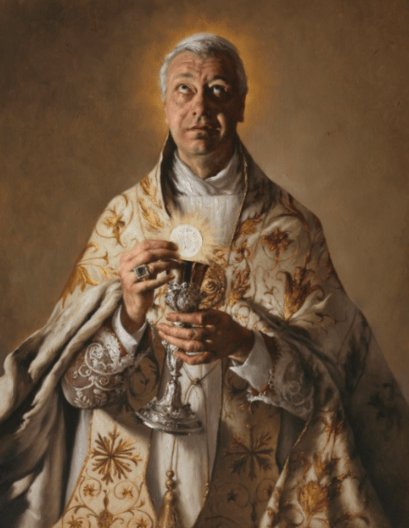
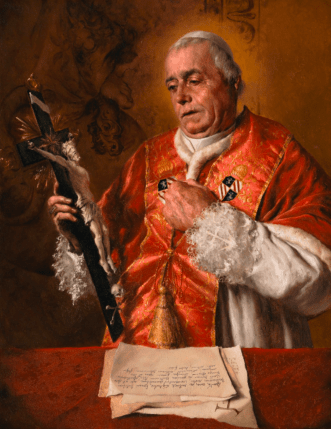
St. Pius X Pontifex Maximus, Giovanni Gasparro. (Source)

There are overarching philosophical problems with Ms. White’s argument. But I’d prefer to begin with her shoddy treatment of the material itself.

To start with a small, but, I think, a representative example; Ms. White claims that in Gasparro’s portrait of Pope St. Pius X, the light falls on the Pope’s face in a sinister way. She writes,

But the painting of Pius X is underlit, a type of lighting that we associate with evil. If you see horror movies, the light is often placed this way on a face to give it a frightening, even demonic effect. It’s what springs to mind: where does a light come from if it’s up from below? Still, is hell’s light this white, electric glare?

This effect, illuminating the facial structure from an odd and unnatural angle – light doesn’t usually come from the ground up, still less heavenly light – the underside of the brow ridge lit up, giving the eye sockets a sickly, sunken appearance, etc… None of that is going to be found in genuine devotional sacred art.

An interesting idea, but one that misses the mark.

For one thing, the Pope is not underlit. It would be more accurate to say that he’s side-lit. There is a striking similarity in the way the light falls in Gasparro’s piece and the photograph of St. Pius to which Ms. White compares it. Nor is side-lighting unusual in Catholic art. Zubarán’s famous St. Francis in Meditation (1635-39) uses almost exactly the same angle for a much more sinister effect.

Screen Shot 2017-11-11 at 9.57.24 PM.png

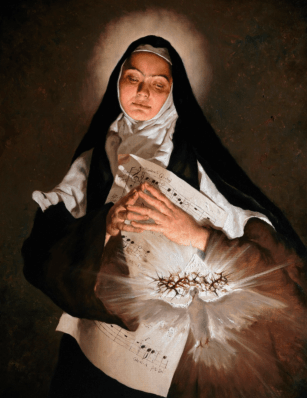
St. Elizabeth of the Trinity, Giovanni Gasparro. In which a saint is underlit, and with good reason. (Source)

Her rather contrived interpretation requires one of two presuppositions: first, that the symbolic lexicon of sacred, or, indeed, Western art is so narrow as to entail only a very limited range of connotations in the use of light, and secondly, that Gasparro’s work is intrinsically profane, deceptive, or downright evil. Neither of these assumptions is fair to the the artwork. They obscure its meaning rather than illuminate it.

But this point is relatively minor compared to some of Ms. White’s other egregious analysis. She dismisses Gasparro’s oeuvre as “surrealist, not sacred art,” with particular attention to his common motif of multiplied hands. She takes exception to the way he depicts faces, as well. Once again, we can see this tendency on display in her take on the Pius X portrait:

Giuseppe Sarto – even in death – had a very “beatific” face, handsome and always with a very assured and calm expression. I can’t imagine him ever making a face like the one in the painting. In fact, it looks more like what you’d get if you cloned Pius X and added a few drops of Nigel Farage.

She goes on to suggest that the “lumps and bumps” on the face of Gasparro’s Pius X are unsound, and that his expression inappropriately reflects “apprehension, not adoration.”

I’ll admit, the likeness is imperfect. She’s not totally off to note the resemblance with Nigel Farage, an unfortunate quality of the painting. Nevertheless, these indignant statements reflect more on Ms. White’s failure of imagination than they do Mr. Gasparro’s art. Moreover, mightn’t the Pope’s face also convey a whole range of emotions? Instead of apprehension, couldn’t the Pope’s expression show humble supplication? Or simply the holy Fear of God that priests ought to hold in their hearts as they offer the Most Holy Sacrifice of the Mass? And might not Pope Sarto have made much the same face at the altar as he spoke the sacred and secret words to the Almighty? Is she really incapable of imagining him “ever making a face like the one in the painting?” Sure it’s not that hard.

Ms. White continues in this vein at some length.

The “light” from the Eucharist isn’t actually light. It illuminates nothing, there is no reflection of it on the face or hands or vestments. The halo is equally dead as a light source, since it falls on nothing. The only light on the figure is from this lower left white source – like a stage light. The non-light from the Eucharist could be a signal; is he saying, “This is NOT the light of the world”?

One gets the impression that the message of the painting is that Eucharistic theology is deception; there is no light from the Host, the celebrant does not believe; his face says “this is all theatre & flummery”

In fact, the more you look at it, the more the feeling grows that this is actually a parody of sacred art. As a friend of mine commented, “His face in no way looks beatific.” There’s something in this hyperrealism, all the lumpiness and the harsh white lighting, that doesn’t say heavenly to me, but psychotic. They seem like subtle corruptions of reality.

What an extraordinary concatenation of assertions.

A few questions come to mind immediately. First, why must the Eucharist necessarily illumine anything? There are, of course, discernible rays of light emanating from it, and any ordinary viewer who sees the painting would probably understand what is meant spiritually. But why should that light be seen to rest on anything in particular, when it’s already an unearthly light to begin with? Secondly, why do halos need to be light sources at all? David Clayton has argued at New Liturgical Movement that:

…the art of the High Renaissance and Baroque is aiming to portray historical man (and not as with the icon eschatological man united with God in heaven), what the artists are doing might in fact be consistent with this. One might propose that because the aura of uncreated light, the nimbus, would not be as visible (to the same degree at any rate) in fallen man, even if that man is a saint. So it would seem that the artist might choose not to portray a halo very faintly, as a slight glow, or even not at all.

Madonna_Benois

The Madonna Benois, Leonard da Vinci. One of the paintings to which Clayton draws our attention – note that the halos of both are just golden circles, not lights. (Source).

Clayton’s division between iconography and art is an important, to which we will return, in a certain sense, later. For now, I’ll merely note two facts: a) it is extraordinarily commonplace in Western art to find halos that don’t function as any kind of light source, and b) the halo in Gasparro’s painting of the Pope is a diffuse but definite illumination. I can’t help but feel I am looking at an altogether different image than Ms. White, based on how badly she has described it. Instead of attempting to determine what the artist is actually communicating with what he has shown, Ms. White has given us a testimony of her own reactions.

Where she does attend to the painting as such, she uses the overly suspicious hermeneutic of a conspiracy theorist. The least probable and most malignant of interpretations come to the fore. Instead of merely asserting, as she is free to do, that Gasparro has painted a bad bit of sacred art, she instead goes so far as to accuse the artist of parodying the sacred.

There may be something grotesque, kitschy, or even campy about Gasparro’s oeuvre. But the grotesque, kitsch, and camp are three typical Catholic idioms. Look at the little prints of the Sacred and Immaculate Hearts surrounded by roses of all colors, adored by angels in little white gowns. Look at the gargoyles that grow like frightful stone pimples from the corners of our Cathedral spires. Look at the contorted muscles and thorn-choked skin of the Isenheim Altarpiece. Look at the Rococo churches that dot the landscape of the old Hapsburg Lands. Look at the Spanish processions of Holy Week, with all those peaked hoods and gilt statues in the streets. Look for the buskins and buckles of the pre-conciliar clerics. Look at the huge folds of watered silk enshrouding cardinals and archbishops and all manner of monsignori in that more confident age of the Church’s triumph. Look indeed at the splendid choir dress of the Institute of Christ the King, Sovereign Priest in our day! Look at Cardinal Burke in his glorious cappa magna (incidentally, Gasparro has done a charming portrait of him, too).

There is something delightfully other, delightfully weird, delightfully over-the-top about our religion. And surely, all of this is meet and right. The priest is other. The Church is other, and should appear mad in a world gone mad. Flannery O’Connor (probably) said, “You shall know the truth, and the truth shall make you odd.” Whatever its actual provenance, I take this saying as a true maxim of Catholic life in the modern world. I don’t mind if our art reflects that tendency for the strange, even if it disturbs us a little. I would be more suspicious if it didn’t.

We are all of us living as strangers, both to the world and to heaven. Gasparro’s art confronts us with this quality of strangeness, throws it back in our face – and startles us. Good. The Gospel is a very startling tale indeed.

Screen Shot 2017-11-11 at 10.19.19 PM

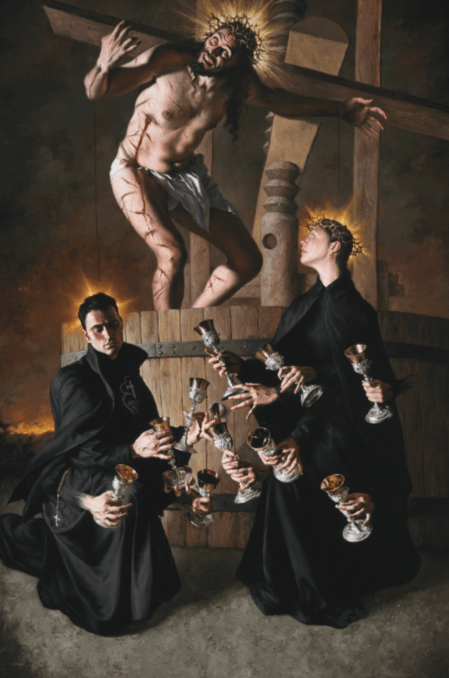
Torculus Christi. Mystic press with St. Gabriele dell’Addolorata and St. Gemma Galgani, Giovanni Gasparro. One of his more overtly weird pieces, but one that is deeply rooted in Catholic mystical and artistic tradition. (Source)

Moving on to a few of Ms. White’s other statements, we come to her distinction between surrealist and sacred art. I happen to be working on a piece right now that will argue that surrealism is an artistic movement that, purged of its original anticlerical animus, can open up plenty of new avenues for a specifically Catholic spiritual art. Indeed, there is already quite a corpus of work that we might reasonably call Catholic surrealism, and I hope to incorporate it into that argument. In the meantime, I refute her argument thus.

Ms. White also takes exception with Gasparro’s very common use of multiplied hands in his paintings. She writes in one of her more patronizing captions,

He seems to be really big into this creepy thing with the multiple floating hands. This is what I would call “schtick” and it is common among highly trained younger artists who think that having a schtick will get them brand-recognition.

This wholesale dismissal is maybe the worst part of the essay. Once again, it evinces a refusal to engage with what Mr. Gasparro has put on the canvas for our consideration, summarizing it tidily in order to condemn it tout court.

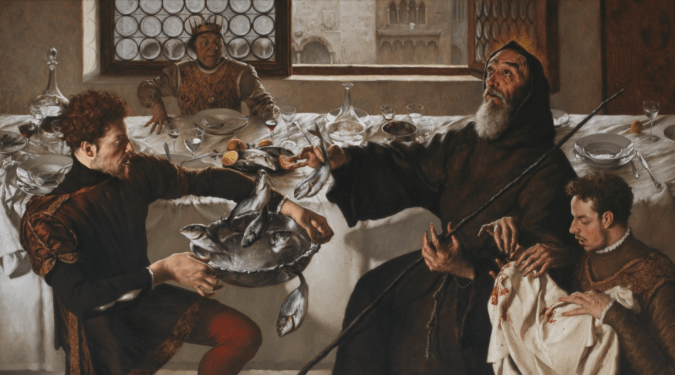
Gasparro’s multiplication of hands – or, in some cases, other body parts – serves two functions in his art. First, it can express the passing of time. In The Miracles of St. Francis of Paola (2015), the doubled set of hands represent discreet acts. Secondly, it can express numerous levels of spiritual meaning that otherwise might be missed through a more conventional image. Manipulating gesture opens up the image. This is particularly true in Gasparro’s Speculum Iustitiate (2014), St. Nicholas of Bari (2016), and his deeply moving portrait of Pius VII, Quum memoranda (Servant of God, Pope Pius VII Chiaramonti) (2014).

Screen Shot 2017-11-11 at 10.28.22 PM.png

The Miracles of St. Francis of Paola, Giovanni Gasparro. (Source)

The doubling invites the viewer to consider each act or spiritual meaning in turn and to ponder how the subject may be acting in each case. The multiplication of hands invites us into a secondary, meditative dimension of the work. As I mentioned at the beginning of this essay, I have found his work a very fruitful spur to precisely this kind of spiritual meditation.

Screen Shot 2017-11-11 at 10.35.58 PM.png

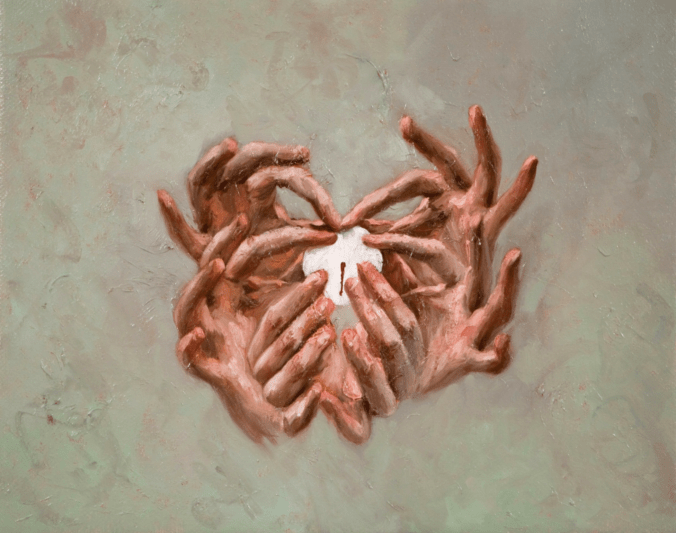
Transunstanziazione, Giovanni Gasparro. This image would be perfectly at home in a church. (Source)

Take one of Gasparro’s finest pieces, Transunstanziazione (2009). I will repeat here what I wrote about it in my Corpus Christi piece:

Three pairs of hands, like the three pairs of wings on the seraphim and cherubim, bear aloft a bleeding host in undifferentiated space. The three sets of hands appear the samethey are, perhaps, the hands of the same priest captured over the lapse of time. This distortion of time and space lends the image a sense of eternity. We are viewing something transcendent. The Eucharist is not just an earthly event. It is also a rite which happens forever in the cosmic liturgy of heaven. And who is the Great High Priest offering that liturgy for us mortals? Who but Christ? In Gasparro’s image, Christ is present as priest and victim.

The three pairs of hands also remind us of the Trinity. When we approach the Eucharist, we truly approach the Triune God. At every Mass, the act of Transubstantiation only happens because of the work of the whole Trinity. Christ offers Himself to the Father in the Holy Spirit, through the hands of His priests and the prayer of His bride, the Church. It is meet and right that we should consider the painting at this point between the Ordinary Form celebrations of Trinity Sunday and Corpus Christi.

The painting has a certain sacramentality, in that, like the liturgy, it captures something of the invisible and manifests it to our earthbound senses. Looking at Gasparro’s painting, we have the sense that we are glimpsing something profound, unsettling, and sacredsomething ordinarily hidden from us. Do we not hear the words of St. Thomas’s Corpus Christi hymn, Lauda Sion?

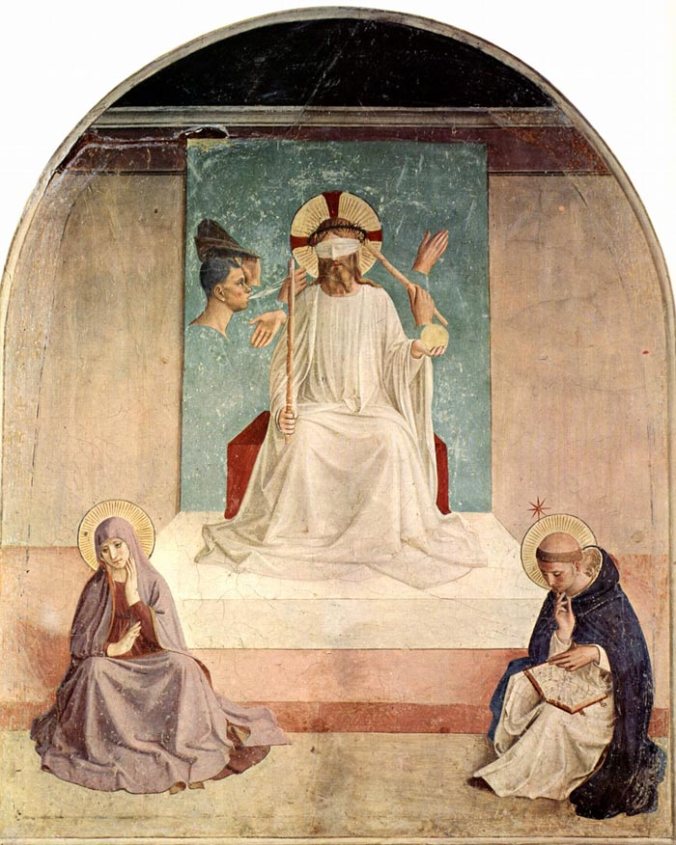
Every time I return to this painting, I find something deeper in it. I’ll add that the multiplication of hands is a trope that exists in the work of that most unimpeachable of Catholic Artists, the Blessed Fra Angelico, who uses it in virtually the same way as Gasparro.

mockingofchrist700

The Mocking of Christ, Fra Angelico. Here he uses hands in the same ways that Gasparro does – to telescope sequential events into one image, to provide an insight into hidden action, and to lead us into meditation. Two of my Facebook friends noticed the formal and spiritual kinship between the two artists. (Source)

Of course, I don’t expect Ms. White or anyone else to have the same approach to every work of art as I do. If she finds Gasparro “creepy,” that is her right. But it is not an argument against Gasparro’s Catholicity. It is a subjective and affective assessment of his art, and thus it lies more in the realm of taste than aesthetic theology. And there’s nothing intrinsically wrong with having and describing a visceral reaction to a work of art. I’m perfectly happy to say de gustibus and leave it at that.

Unfortunately, Ms. White expatiates about what constitutes “sacred art,” which, she claims, is emphatically not what Mr. Gasparro is doing.

She writes,

Knowing nothing about him other than what he paints, I have no idea what this artist intends – and that right there should tell you that he’s NOT doing sacred art – but it seems that in general hyperrealism simply isn’t going to work for devotional art. It’s always going to come across as strange and parodic, because the purpose of devotional painting is not to depict ordinary earthly reality – with all its “warts” – but a supernaturalised, idealised and perfected reality, a redeemed reality, that can only be occasionally glimpsed in this life by seeing the saints.

Sacred art is devotional art. If it isn’t devotional, it’s a parody of the sacred.

Where do I begin?

First of all, it doesn’t matter what the artist intends. We emphatically don’t need to know the artist’s intentions to appreciate what exists in the constructed world of the art-object. It can be helpful, but it really isn’t necessary. “Intention” is one of those terms that is always so heterogeneous and slippery as to be virtually meaningless. Consider the range of “intentions” that might be implicit in any work of art. Most artists of the Renaissance probably intended to produce images that would please their wealthy patrons so that they could keep eating. Moreover, it seems that a great deal of eros generated quite a lot of the Western canon. No doubt at times the souls of the artists were illuminated by the grandeur of their work. But we can’t possibly know to what extent the deeply fallible men (and they were almost all men) intended to invest their work with a consciously spiritual meaning.

What’s more, Ms. White’s dislike for “hyperrealism” as well as “surrealism” leads her to miss the fact that Gasparro’s work strikes an incarnational balance between the two. His subjects are recognizably human, but in the strange art-world he depicts, they are charged with the heavy presence of a mystery far beyond their humanity. They share our condition while pointing towards a world that stands beyond it.

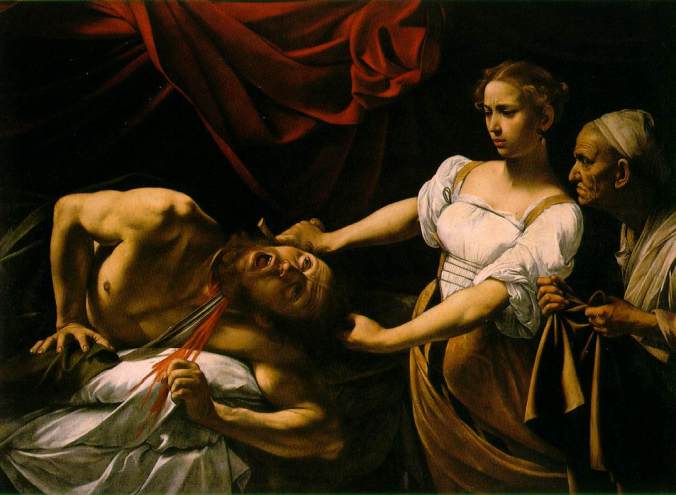
It bears mentioning that her dislike of “ordinary earthly reality – with all its ‘warts'” would necessarily strike Caravaggio from the canon of Catholic masters. Of course, Gasparro resembles Caravaggio more than any other artist. Perhaps she would be glad to see him go. Who else would disappear under Ms. White’s discriminating eye? Rubens and his corpulent maidens? Matthias Grunewald and his unpleasant crucifixions? How about Carlo Crivelli and the sly, malevolent eyes he gives to his saints? What are we to do with the Mannerists and all the distended limbs that litter their canvases? And although he was no Catholic, are we to write off the value of Rembrandt’s religious work because he dares to show the uneven surface of human flesh? Would this not be precisely the least Catholic impulse of all – to fly from the corporeality of our existence, and of the way God uses it?

Judith_Beheading_Holofernes_by_Caravaggio

Judith Beheading Holofernes, Caravaggio. This magnificent portrayal of Judith’s triumph over the wicked general is apparently not “sacred art” under Ms. White’s criteria. (Source)

Ms. White insists on idealism and devotionalism in sacred art. Anything that fails in either of these qualities must be consigned to the great heap of Modernist parody.

Yet both of these are deeply misbegotten efforts. First, when she speaks of “supernaturalised, idealised and perfected reality, a redeemed reality,” she is using the language of iconography. There is indeed much to commend the hallowed iconographic traditions of the Greeks and Slavs (not to mention the Armenians). But Byzantine icons are subject to strict canons, types, and lineages. An iconographer’s process and material are, to a certain extent, determined for him. Longstanding customs surround the production and ritual use of the icons. Part of the reason that theologians can work from the icons as a source in their writing is that those customs safeguard and guarantee the orthodoxy of the images. And the spirituality they have fostered over the centuries is one I admire; it has quickened my own Christian life.

TheMostChasteHeartofStJoseph

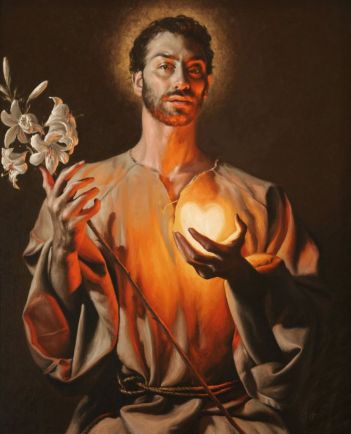
The Most Chaste Heart of St. Joseph, Giovanni Gasparro. Something nigh-unprecedented like this devotional image would be impossible if Western art followed strict canons like the Byzantines do. (Source)

Nevertheless, that’s not what we do in the West. While some artists have managed to give us glimpses of a transcendent realm of sophianic glory (one thinks of the Cusco School and some of those Catholic surrealists I was talking about), they are certainly not obliged to do so by force of tradition. One can lament the fact that we developed a much freer sense of sacred art. I don’t, both because I like statues and because I think the relative freedom of artists has been an enormous boon to civilization and the Church.

We can definitely learn from icons, in part because they remind us of where our own tradition has been. Before this year’s terrible earthquake, Ms. White’s own monastery had a wonderful fresco that captured precisely this quality of enrichment from the East that can and should be productively pursued by Catholic artists. But we ought not make the spiritual vision of the East normative in the West, just as we would decry any effort to impose Western forms on the East. And so I entirely reject her attempt to foist on Western Catholic art the strict confines of the icons.

Secondly, I’m bothered by instrumentalist approaches to art, including an assessment that rests heavily on whether the piece in question is “edifying” or “devotional.” That’s a largely meaningless standard – much more indistinct than the question of whether something is beautiful – since it places the center of the art’s meaning and quality in the affective response of the viewer rather than its own constructed reality and the way that construction interacts with transcendental standards. Namely, beauty.

The idea that specifically sacred art should be a) “devotional,” and b) in a church is a narrow, limiting, overly contextual approach to art. It is only helpful in the strict sense of guidance for church decoration. If Ms. White had limited the purview of her argument to what should count as specifically Liturgical Art, that is, what type of art should be placed in a church for the public veneration and instruction of the faithful in a ritual context, she might have a point. But she doesn’t write within that important qualifier. Instead, she uses Mr. Gasparro’s oeuvre to think about sacred art in general, and arrives at the rather flattening dictum that “Sacred art is devotional art. If it isn’t devotional, it’s a parody of the sacred.”

Screen Shot 2017-11-12 at 1.27.39 AM.png

Blessed Pius IX Pontifex Maximus, Giovanni Gasparro. Because artists who are really modernist heretics are drawn to depicting Pio Nono in prayer. (Source)

The conclusions she draws are totally unworkable as a Catholic approach to aesthetics. Imagine how much poetry and how much music we would have to surrender if we tried to carry the standards of idealism and devotionalism into the other arts in any kind of normative way.

Catholics should be concerned about the quality and orthodoxy of their sacred art. Insofar as Ms. White’s article represents that concern, it is an admirable effort. I’ll add that Ms. White and I probably share a similar exasperation with some of the trends in poor church art and architecture that are so maddening today. Likewise, we no doubt share a desire for a renewal of the Catholic arts. But Ms. White’s artistic philosophy smacks too much of Savonarola. While she is willing to summarily cast Gasparro’s art into the bonfire of the vanities, I contend that he is one of the Church’s most important living artists, alongside Daniel Mitsui, Matthew Alderman, Raúl Berzosa, Ken Woo, Alvin Ong, and others. I also share Rebecca Bratten Weiss’s views on the arts more broadly. We Catholics, and especially those of us who consider ourselves fairly Traditional, are sometimes too “self-referential” (if I may borrow a term favored by the Pope). As Weiss notes:

Toni Morrison, for instance, is a Catholic Nobel laureate whose works are filled with themes of community and redemption. But the Catholic critics who enthuse over Flannery O’Connor and Graham Greene regard Morrison only as a controversial writer on race relations. “She’s not practicing,” they might say, as an excuse to ignore her. And yet, C.S. Lewis, who is revered in their circles, was never even Catholic at all.

Mary Karr – the keynote speaker at the conference – not only is a Catholic convert, but wrote extensively about her conversion, but is deemed by some not to be a “real” Catholic writer, because of her openness about certain sexual issues. And yet Graham Greene was a notorious womanizer who slept with over 300 prostitutes, was condemned by church spokespersons in his time, and closed The End of the Affair with the prayer: “O God, You’ve done enough, You’ve robbed me of enough, I’m too tired and old to learn to love, leave me alone for ever.”

Perhaps the critics who are timid about these powerful Catholic writers working right now in our midst are waiting for someone else to “baptize” them? Perhaps they are waiting for someone else to say “I heard God there” – because they, themselves, have not learned to open the inner chambers of the ear? Because we do not have a robust Catholic arts culture that teaches us to open all the portals for reception, but instead have embraced a misnamed “Benedict Option” which is all about putting up walls and barriers, drawing those lines in the sand.

I concur, and would extend the same sort of criticism to Ms. White and those who support her view of the arts. Let us not fall into that old trap of mistaking the modern for Modernism. Christ is King over all. Let Catholic artists explore the plenitude of that Kingship over all, in all, and through all – even if looks strange to our worldly eyes.

Screen Shot 2017-11-11 at 10.00.45 PM

Christ the King, Giovanni Gasparro. May we always serve Him with ardent charity and zeal for the beauty of His house. (Source)

Some Saints on the Holy Name of Mary

name-of-Mary

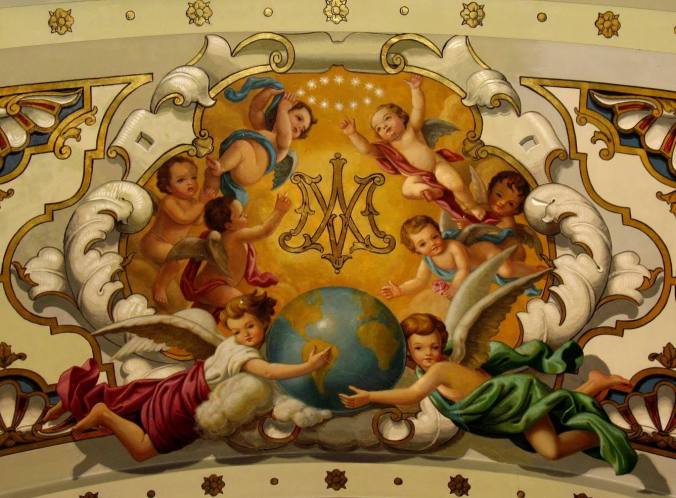
The Holy Name of Mary in a church mural. (Source)

The feast we celebrate today has moved around a bit. It only came to the kalendar in 1683, when Pope Innocent XI wished to commemorate the liberation of Vienna from the Ottoman siege. He originally placed it on the 17th, the Octave Day of Our Lady’s Nativity. The feast was later transferred to the 15th, and then done away with altogether by Archbishop Bugnini in one of his more obnoxious acts of liturgical vandalism. Pope St. John Paul II restored it in 2002, and now we celebrate it as an optional memorial on September 12th.

Accordingly, it behooves us to ponder the writings of the saints. For as it is a maxim in theology that we are led by lower things to higher, so we may pursue the heights of Our Lady’s throne only by the steps which our closer contemporaries have tread before us. Besides, while the feast may be relatively new in the life of the Church, the devotion it honors is much older. There is consequently much to choose from.

Consider the words of St. Bernard of Clairvaux.

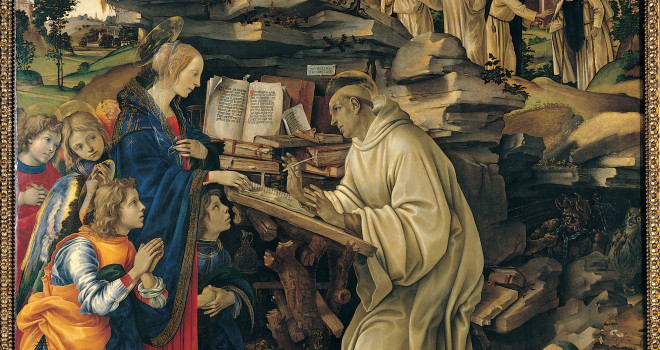
Z_CAP005_052

Apparition of the Virgin to St. Bernard, Detail. Filippino Lippi, 1480. (Source)

“And the Virgin’s name was Mary.” Let us speak a little about this name, which is said to mean “star of the sea,” and which so well befits the Virgin Mother. Rightly is she likened to a star. As a star emits a ray without being dimmed, so the Virgin brought forth her Son without receiving any injury. The ray takes naught from the brightness of the star, nor the Son from His Mother’s virginal integrity. This is the noble star risen out of Jacob, whose ray illumines the whole world, whose splendor shines in the heavens, penetrates the abyss, and, traversing the whole earth, gives warmth rather to souls than to bodies, cherishing virtues, withering vices. Mary is that bright and incomparable star, whom we need to see raised above this vast sea, shining by her merits, and giving us light by her example.

All of you, who see yourselves amid the tides of the world, tossed by storms and tempests rather than walking on the land, do not turn your eyes away from this shining star, unless you want to be overwhelmed by the hurricane. If temptation storms, or you fall upon the rocks of tribulation, look to the star: Call upon Mary! If you are tossed by the waves of pride or ambition, detraction or envy, look to the star, call upon Mary. If anger or avarice or the desires of the flesh dash against the ship o f your soul, turn your eyes to Mary. If troubled by the enormity of your crimes, ashamed of your guilty conscience, terrified by dread of the judgment, you begin to sink into the gulf of sadness or the abyss of despair, think of Mary. In dangers, in anguish, in doubt, think of Mary, call upon Mary. Let her name be even on your lips, ever in your heart; and the better to obtain the help of her prayers, imitate the example of her life:  “Following her, thou strayest not; invoking her, thou despairest not; thinking of her, thou wanderest not; upheld by her, thou fallest not; shielded by her, thou fearest not; guided by her, thou growest not weary; favored by her, thou reachest the goal. And thus dost thou experience in thyself how good is that saying: ‘And the Virgin’s name was Mary.'”

alphonsus_cross

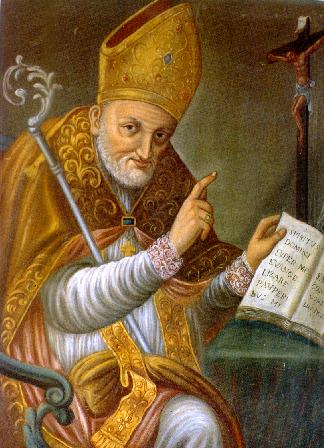
St. Alphonsus Liguori, author of The Glories of Mary. (Source)

St. Alphonsus Liguori, that Mariologist who so scrupulously records the thoughts of prior saints, affirms the antiquity and holiness of this devotion.

To begin with life, the holy anchorite, Honorius, says, that the name of Mary is [full] of all divine sweetness. And the glorious St. Anthony of Padua attributes to the name of Mary the same sweetness as St. Bernard attributed to the name of Jesus. The name of Jesus, said the latter, the name of Mary, said the former, is joy to the heart, honey to the mouth, melody to the ear of their devoted servants. It is related in the life of the venerable Father John Ancina, Bishop of Saluzzo, that when he pronounced the name of Mary, he experienced so great a sensible sweetness that he even tasted it on his lips. We also read that a certain woman in Cologne told the Bishop Marsillius, that whenever she pronounced the name of Mary she perceived in her mouth a taste sweeter than honey. Marsillius made the trial, and he also experienced the same sweetness. We read in the holy Canticles, that at the Assumption of the Virgin, the angels three times asked her name: “Who is she that goeth up by the desert as a pillar of smoke?” “Who is she that cometh forth as the morning rising?” And in another: “Who is this that cometh up from the desert, flowing with delights?” Richard of St. Laurence inquires why the angels so often asked the name of this queen, and answers: The sound of the name of Mary was so sweet to the angels, and they repeated the question that they might hear it repeated also.

But I do not hear speak of this sensible sweetness, since it is not commonly granted to all, but I speak of the salutary sweetness of consolation, love, joy, confidence, and strength, which the name of Mary universally gives to those who, with devotion, pronounce it. Speaking on this subject, Francone the Abbot says, that next to the holy name of Jesus, the name of Mary is so rich in blessings, that no other name is uttered on earth or in heaven from which devout souls receive so much grace, hope, and sweetness. For the name of Mary, he goes on to say, contains in itself something admirable, sweet, and divine, which, when it meets a friendly heart, breathes into it an odor of holy sweetness. And the wonder of this great name is, he concludes, that if heard a thousand times by the lovers of Mary, it is always heard as new, the sweetness they experience in hearing it spoken being always the same.

The blessed Henry Suso, also speaking of this sweetness, says, that in pronouncing the name of Mary, he felt his confidence so much increased, and his love so joyfully enkindled, that amidst the joy and tears with which he pronounced the beloved name, he thought his heart would have leaped from his mouth ; and he affirmed that this most sweet name, as honeycomb, melted into the depths of his soul. Whereat he exclaims: Oh most sweet name! oh Mary, what must thou thyself be, if thy name alone is so lovely and sweet?

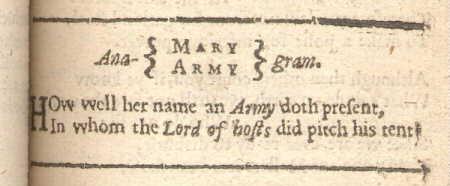
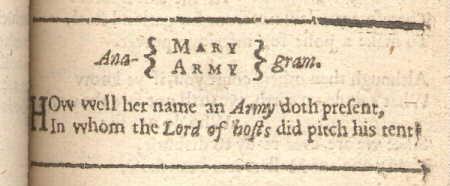
Nor is this devotion entirely absent outside the Church of Rome. One of George Herbert’s better epigrams runs as follows:

HerbertAnagram

“Anagram,” from The Temple. (Source)

Incidentally, the aforementioned Bishop of Saluzzo, Bl. John Juvenal Ancina, was a founder of the Naples Oratory and a personal disciple of St. Philip Neri. Can there be any doubt that the bishop learned his devotion at the side of his spiritual father?

img-Blessed-Giovanni-Giovenale-Ancina

Bl. Juvenal Ancina of the Oratory. (Source)

And we should learn it in turn from the saints who have gone before us, those holy men and women who now stand rejoicing in an eternal contemplation of Our Lady’s beatific name.

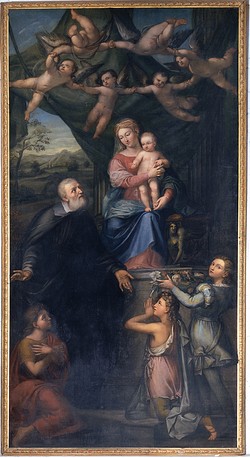
StPhilipNeriExhortinghtheYouth

St. Philip Neri Exhorting the Youth to Pray to the Virgin, Pala Pietro. A good metaphor for how the saints instruct us in Marian devotion. (Source)