The Threefold Maternity of Mary

OurLadyCenacle.jpg

Our Lady of the Cenacle, pray for us. Photo by Lawrence Lew O.P. (Source)

God seems very fond of doing things in a Trinitarian way. Everywhere we look, in nature, in our lives, in the life of the Church, it seems that we constantly come upon things that speak of threeness-in-oneness. So it is with God’s finest creation, Our Lady. Or rather, with her maternity. She has but one singular motherhood – her highest title, Theotokos, means “Mother of God.” Nothing can surpass this supreme gift. Nothing greater can be said of the Lord’s chosen. Nothing can reveal more about Our Lady’s life and mission. Yet we detect a certain triune quality to this one eminent dignity. We can speak of the threefold maternity of Mary.
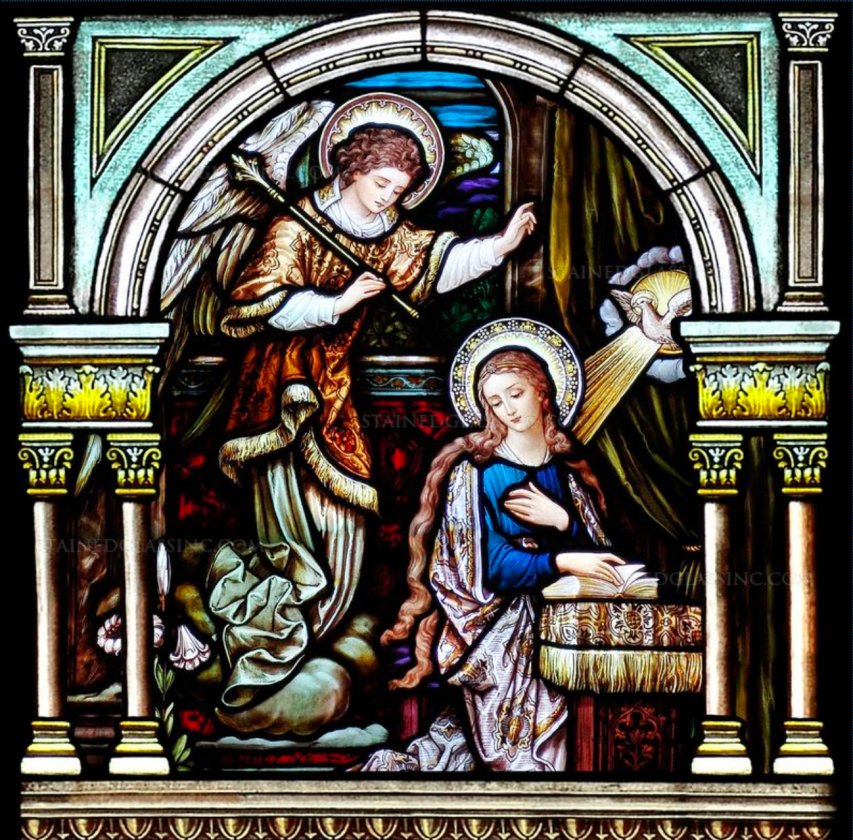
Screen Shot 2018-05-12 at 12.17.34 AM.png

Our Lady of the Annunciation (Source)

First, we encounter Mary’s basic, physical motherhood of Jesus at the Annunciation. In welcoming the will of God into her life, she becomes the mother of the Most High, God Incarnate in Jesus Christ. The Holy Ghost, her divine spouse, conceives the Son in her womb. Her mystical partner and guardian in this parentage is St. Joseph. And in the joy of that maternity, we see Mary and Joseph as two models of chastity. Everything in those joyful mysteries becomes a parable of purity. The sanctity of the Holy Family consists in no small part in the innocence that pervades the hearts of each member. For that innocence is an opening to charity.
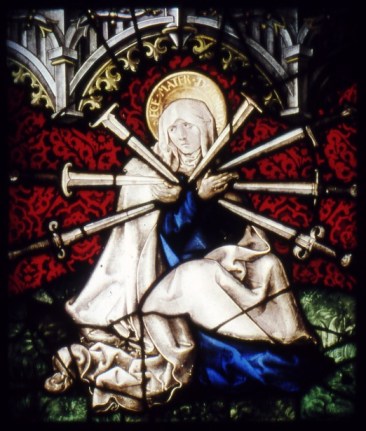
sorrowfulmotherwindow

Our Lady of Sorrows (Source)

Then, after the three and thirty years, Mary stands mournful beneath the cross. It was there that she became Mother of the Eucharistic Christ. For, offering up the sorrow of her own Immaculate Heart in union with her son’s High Priestly sacrifice, she bound herself to all the altars of the world as first adorer and co-redemptrix. Gone is St. Joseph; in his stead we find St. John, the figure of all priests under Christ. He would share the Eucharistic life with Mary forever after, entrusted with her care. Here, the great virtue uniting both of the hearts below the Cross is obedience. Our Lady obeys the paramount Providence of God in consenting to the sacrifice of her son, and St. John obeys the words of Our Lord in taking responsibility for the Sorrowful Mother.

But it is today’s feast of Our Lady of the Cenacle that points to the full and final extension of these two prior forms of motherhood. It falls on a most interesting point in the calendar, Saturday in the Octave of the Ascension. It is as if we are standing in the middle of a bridge between two shining cities, and can hear the mingled music of both. This liminal quality is important. For the feast we celebrate today has a double meaning. Two feasts of different but equal importance and dignity seem to unite in this celebration.

We have just left Christ in his Ascension. The Ascension is a memorial of Christ’s High Priesthood. It is like the prayers at the foot of the altar in the Cosmic Liturgy. Pentecost is a glorious theophany, the arrival of the Holy Ghost. We are thus mid-way between a mystery of veiling, and mystery of unveiling. And who do we turn to, but Mary, she who both hid and manifested God in her person?

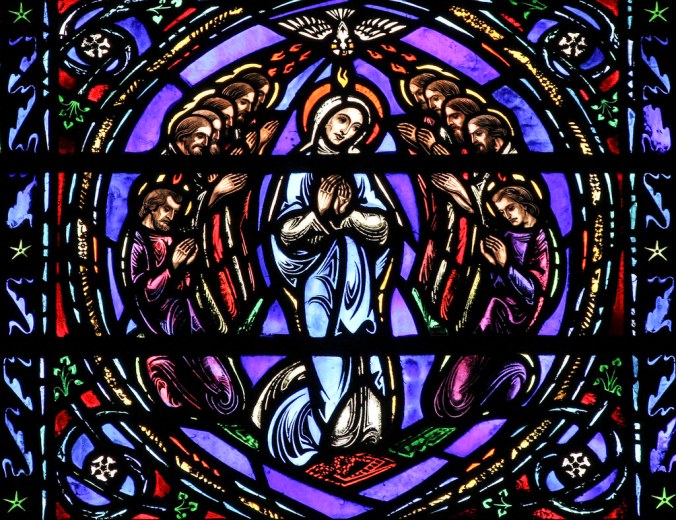
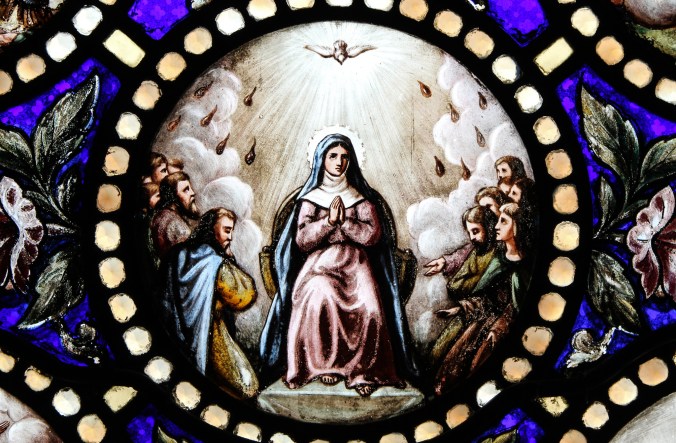
When we celebrate Our Lady of the Cenacle, we commemorate her vigil of silent prayer with the Apostles in the upper room in those intense days following Our Lord’s Ascension. But we also remember the descent of the Holy Ghost into her own Immaculate Heart and into those of her companions. At the deepest level of reality, these constitute a single event in the History of Salvation. And they give us a sense of Mary’s deepening, widening maternity.
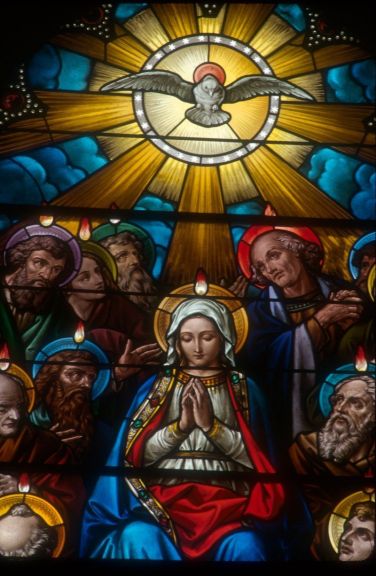
MaryCenacleSpirit.jpg

Our Lady of the Cenacle (Source)

Wherever Mary communes with her divine spouse, the Holy Ghost, there is conceived the Body of Christ. First, that meant the physically Incarnate Word. Then it was the Eucharist extended throughout all time. And finally, as a consequence of these two forms of motherhood, we come to Mary’s maternity of the Church. This maternity is the crown of the other two, for it has never ended. The Holy Spirit came to that silver throne, the Immaculate Heart of Mary, and has never left. In all the rest of Mary’s earthly life and eternal existence in beatitude, she has never been deprived of that intimate union begun in Pentecost. And so the Church remains. Mary’s union with the Holy Ghost is at the very heart of the Church’s being. That union brought forth Christ once. It brings forth the Eucharist at every Mass. And now, at Pentecost, it brings forth the Eucharistic community, Christ in His members.

Yet in what does this exalted maternity consist? Prayer, offered perfectly in the Immaculate Heart united to the Holy Ghost. Contemplation, adoration, reparation, intercession – in all its forms, prayer rises from Mary’s heart like huge storms of incense blowing across a desert plain, raining down graces to make it fertile. Yet one form of prayer does not. Mary cannot be contrite. She has never sinned. But we turn to her mystic partner in this maternity, and find a pillar of penance. Who else shares in the life of the Spirit in such a fiery way, but St. John the Baptist? Such is the heavenly reality expressed by the Deisis icon. It shows the Blessed Virgin Mary, paragon of prayer, and St. John the Baptist, archetype of penance, adoring Christ the Lord. Both Our Lady and St. John represent the twin realities of the Ecclesial life – prayer and penance – ordered to Christ – the Sacraments. We might thus speak of Mary’s motherhood of the Church as her Sophianic Maternity, for it is entirely drawn from and oriented to the Divine Wisdom.
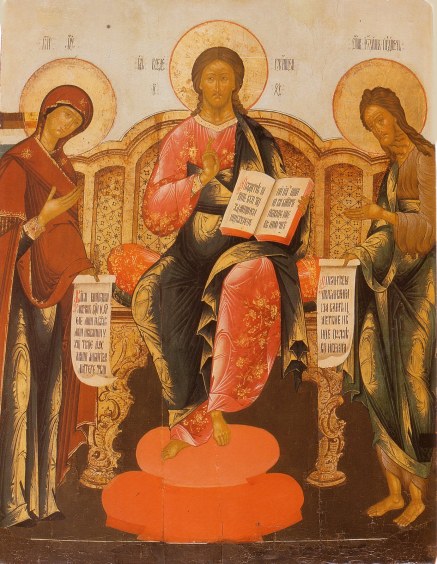
Deisis.jpg

A typical deisis. (Source)

The feast of Our Lady of the Cenacle is thus a profoundly maternal day in the Church’s liturgy. Let us join her in prayer. Perhaps we shall taste something of that everlasting life granted to her in the Cenacle.
CenacleRound.jpg

Monstra Te Esse Matrem (Source)
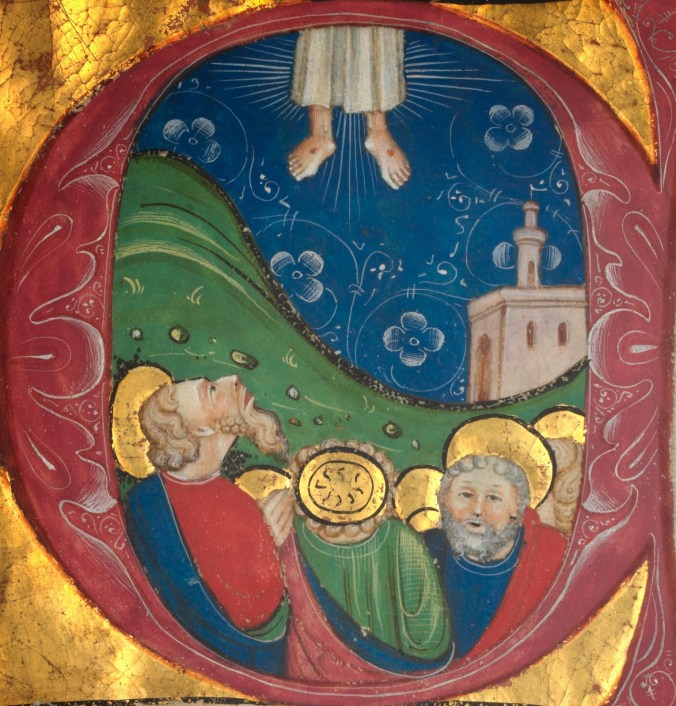
“God is Gone Up With a Merry Noise”

AscensionLetter.jpg

Ascendit Deus in iubilatione, alleluia (Source)

God is Gone Up With a Merry Noise

Rick Yoder

Rear a hill in my heart, O God,
from which Thou might ascend.
But o! How swift I overshoot
and rush on to the end.
For first Thou must come hallow it
with that most kingly flood,
the pearls surpassing every price,
Thine own most precious blood.
And though I wander far, O Lord,
from Thy most holy fount,
yet never shall I lose the sight
of Thine eternal mount.
The shadows of the day grow long
and silence takes the land;
still do I hope in Thy sweet song
and Thy high priestly hand.
“The Lord ascends with gladsome noise
and hath taken the better part.”
So runs the word, so I rejoice,
for He rises there in my heart.

My Favorite Hymn to St. Philip Neri

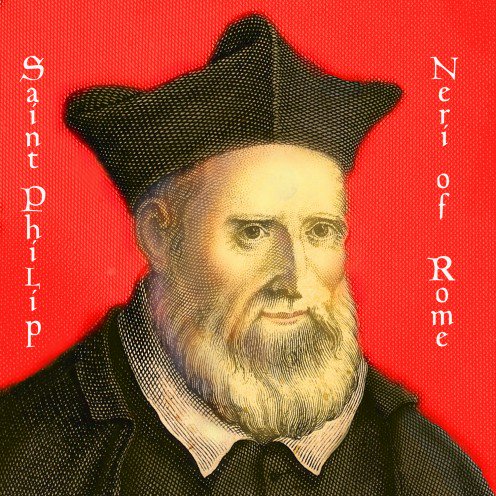
StPhilipImageRed

St. Philip, pray for us (Source)

As my readers will well know, St. Philip Neri is my favorite saint and has been for a long while now. I take every opportunity I can to sing his praises on this blog, and today happens to be one of them. In Oxford, we are celebrating the Feast of the Patronage of St. Philip, a local solemnity that honors the canonical erection of the house here as a Congregation of the Oratory. Please pray for the Oxford Fathers on this, their silver jubilee.

To celebrate, here is my favorite hymn to the Apostle of Rome – Pangamus Nerio, as sung by the choir of the Birmingham Oratory. It is the vesperal hymn of St. Philip.

Pangamus Nerio, debita cantica
Quem, supra nitidi sydera verticis,
Virtus et meritum sustulit inclytum,
Carpturum pia gaudia.

Noctes sub spectabus, corpora martyrum,
Quas implent, vigilat sedulus integras,
Ex ipsis satagens discere mortuis
Normam qua bene viveret.

Nocte dum Nereus fercula pauperi,
Gestans praecipitat, panniger Angelus
Tecto significat, qualiter excidat
Numquam fervida caritas.

Orantis penetrans cordis in intimum,
Laxavit spatium Spiritus impete
De Coelo veniens, esset ut hospiti
Immenso locus amplior!

Coelorum Domino, dum sacra munera
Libabat Nerius, saepius advolans,
Tellurem rapido corpore deserit,
Christo fiat ut obvius!

Corpus deseruit, cum Deus Hostiae
Fertur sub niveae tegmine conditus,
Prudens, in Patriam, pergere splendide
Nolens absque Viatico.

Amen.

Unfortunately, I don’t have an English translation (nor the time and energy to translate from the original myself). Alas.

May St. Philip Neri pray for Oxford, for the Oratorians there, and for all of us who call upon him in filial affection.


Letter to a Catechumen

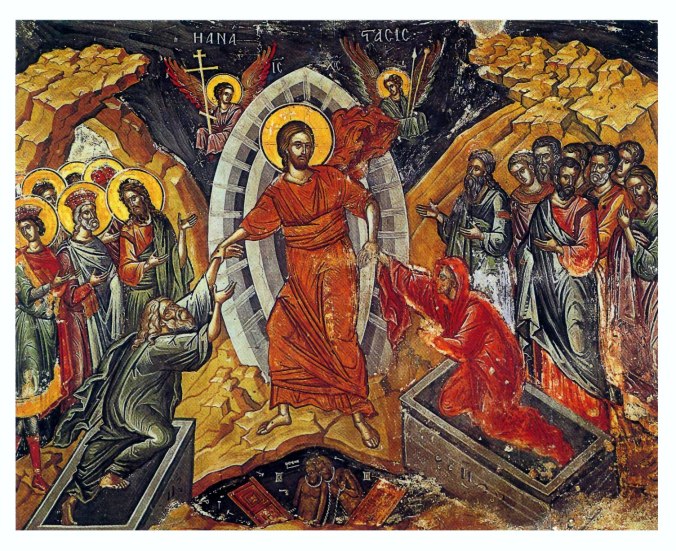
HarrowingHell

“Christ has risen from the dead, trampling down death by death.” (Source)

My Dear Brother Thomas Bede,

Easter brings us from darkness to light, from loss to gain, from death to life. Christ vanquishes the world, the flesh, and the devil. His victory reveals the true meaning of Easter—it is above all the feast of our conversion. The whole of the Christian message is for naught if Christ did not rise from the grave. But He did, and He invites us to share in the superabundance of His sanctity.

We cannot have holiness on our own terms. There is one model—a single life given to us by the Holy Ghost. It is a mercy and a wonder of God that Our Lord impresses His one divine image and likeness into the hearts of so many and so various saints. But light refracted through a prism is still light. We mortals cannot learn the ways of the divine life except by constant recourse to the God-Man.

And where do we receive this sacred pedagogy? Where can we savor the words that bring resurrection? Where do we set our hopes in the long trek through “this valley of tears?”

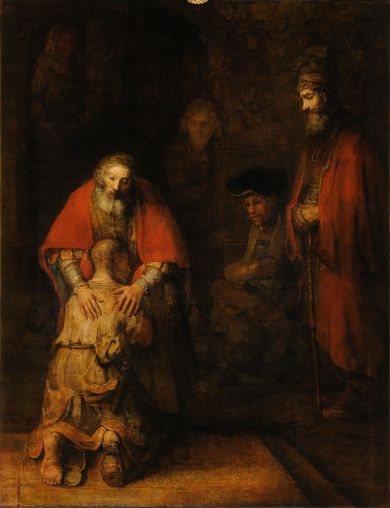
I think you already know the answer: the sacred liturgy. The Catholic life is drawn from, tied to, and led before the Tabernacle. The final end of our journey is to reach the Tabernacle veil, draw it aside with trembling hands, send forth our last breath in a sigh of consummate joy and relief, and step gracefully into the everlasting House of God. The Catholic life lived well is thus a pilgrimage from font to Tabernacle. Our Lord does not abandon us in this long journey. Like the good father of the parable, He rushes out to welcome His prodigal sons with open arms. He has prepared a great banquet in our honor. Indeed, the Savior who died for you gives you His flesh as feast. Every Mass is a homecoming. Every Holy Communion is a kiss of reconciliation.

I know all of this from experience, having already walked the path you are about to take. And I speak from experience when I say, dear brother, that everything in the Christian life must be brought back to the Tabernacle. If we don’t center our lives on the Blessed Sacrament, we shall be like ships adrift in a stormy sea. What fruitless turbulence enters the soul of one far from the Eucharist! What celestial treasures do we miss! Treasures given to us anew every year in the Sacred Triduum. Soon it will all be yours—yours the Supper, yours the Cross, yours the sojourn in the Tomb, yours the descent into Hell, and yours the Triumph in the Glorious Resurrection of Our Lord. In all of these mysteries, Our Lord wishes to imprint His image onto your soul. He will fashion you to be His servant. Pray that in the latter end, you may also be His saint.

You have no idea how long and how ardently Our Lord has desired your first Communion. From the very fathomless heights of eternity, He saw and loved you. As the whips broke His spotless flesh and the hateful wood of the cross bit into His back, He bore your face in mind. And when He hung there, dying, and said the blessed word—Sitio—“I thirst”—He spoke of your union with His heart. There is no point at which Christ did not desire you. He seeks to possess you in your entirety: body, blood, soul, and spirit. In the Eucharist, He offers Himself to you in precisely the same way. And as His gift of self is perfect, He shall make yours perfect, too.

When Dame Julian of Norwich was given a mystic vision of the world, she did not see sin. I believe this is because she was afforded a fleeting glimpse of the world as it will be in the Eschaton, the world as God sees it. Think of that, my brother. All the sins committed by you and me and every human being we have ever met, all the crimes that have soaked the pages of history in blood, all the atrocities that rightly call out to God for vengeance—all will be washed away. The past will be wiped clean.

Your conversion reproduces this grand act of divine mercy in miniature. You come to the altar of God a mere mortal, and a sin-sick one at that. Your burden would torment and crush you. The world of sin affords no rest. But my brother, you have chosen the path of freedom. You have set down one burden, but you are to take up another. Only this one is light and free and easy, giving strength to whoever bears it. It is the Cross, a deadening foolishness to the world, but the “pearl of great price” to those illumined by Divine Wisdom.

At the Easter Vigil, everything will change. When the water flows over your brow, when the oil touches the same spot, and when the Host alights on your lips, you will no longer be the same person you have been all your life. You will become instead one body with Christ crucified. Your life will no longer be yours; the act of surrender must be total. Your words, your breaths, your steps, your very heartbeats will belong to Christ. And He will use you to bring His peace into this world. By that whitest of magic, the sacraments, you will start to become a “little Christ,” a Christian. What an awful, beautiful fate.

I will not give you advice. There will be many closer to you who have a fuller knowledge of the Catholic life than I do. Go to them. Seek the wisdom grown only in many years of faith. And keep close to Mary. Remember that you are but an infant, and she is your mother. She will guide you.

Now, my very dear brother, it is time for you to take up your cross and know the Life Eternal.

In Christ,

Rick

Five Years a Catholic

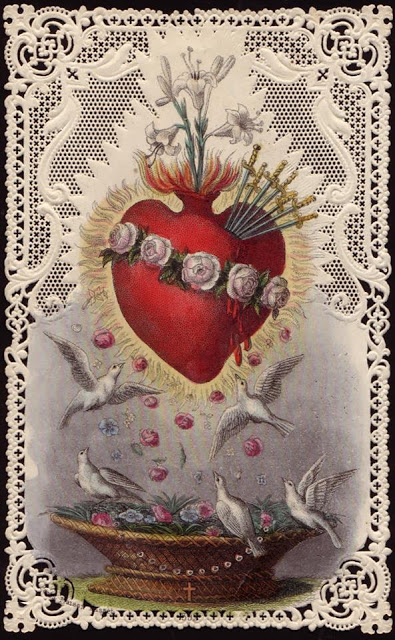
ImmaculateHeartCard

May the Sorrowful and Immaculate Heart of Mary pray for us. (Source)

“To begin and end well, devotion to our Blessed Lady, the Mother of God, is nothing less than indispensable.” – St. Philip Neri, Maxims.

Five years ago, I was received into the Roman Catholic Church at the Easter Vigil. The journey since then has been an adventure, to say the least. Not all of it has been good. I’ve continued to make lots of mistakes, often failing in faith, hope, charity, and all the other virtues. Individual Catholics have often disappointed me. There were moments of doubt along the way, and, like the infamous Pillar of Salt, I am no stranger to the occasional backwards glance.

But in reflecting on those five years, the overwhelming feeling is one of gratitude. The many wonderful people I have met – and, more importantly, the graces I have received – have confirmed for me the essential soundness of my choice. I have no regrets. I only wish more people could know the abiding peace that comes with conversion to the Church that Christ established on St. Peter. And having consecrated myself to Mary, I feel as if I have had a new strength in the spiritual life since last Summer.

Thus far, I have dedicated each year to some mystery of the Faith. It is in that same spirit that I consecrate this sixth year of my Catholic life to the Sorrowful and Immaculate Heart of Mary. I pray that by her triumphant heart, she will continue to guide me to a more perfect knowledge of Her Father, Son, and Spouse. As St. Philip says, “Our Blessed Lady ought to be our love and consolation.” I hope that she ever will be mine.

And thus on this Good Friday, I beg your prayers and those of the saints, that I might persevere in the faith and grow in the love of God.

Most Sacred Heart of Jesus, pray for us.
Our Lady Immaculate, pray for us.
St. Joseph, pray for us.
St. Philip Neri, pray for us.

Amen.

HolyCardMary

The Queen of Heaven. (Source)

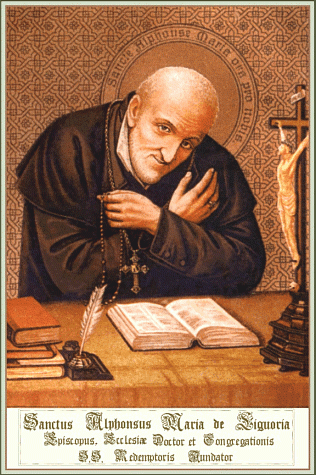
St. Alphonsus on Christ’s Suffering

S_Alfonso02.jp

May St. Alphonsus pray for us always. (Source)

This Wednesday’s spiritual teacher is St. Alphonsus Liguori, Doctor of the Church and founder of the Redemptorists. He was known for his moral theology as well as his Mariological and devotional writings. Here is something Lenten by St. Alphonsus drawn, paradoxically, from The Incarnation, Birth, and Infancy of Jesus Christ (trans. 1927). The bibliographic information can be found on the page from which I took this text. 

The Desire that Jesus Had to Suffer for Us

Baptismo habeo baptizari; et quomodo coarctor, usquedum perficiatur?
“I have a baptism wherewith I am to be baptized; and how am I straitened until it be accomplished?”
—Luke, xii. 50.

I.
Jesus could have saved us without suffering; but He chose rather to embrace a life of sorrow and contempt, deprived of every earthly consolation, and a death of bitterness and desolation, only to make us understand the love which He bore us, and the desire which He had that we should love Him. He passed His whole life in sighing for the hour of His death, which He desired to offer to God, to obtain for us eternal salvation. And it was this desire which made Him exclaim: I have a baptism wherewith I am to be baptized; and how am I straitened until it be accomplished? He desired to be baptized in His Own Blood, to wash out, not, indeed, His Own, but our sins. O infinite Love, how miserable is he who does not know Thee, and does not love Thee!

II.
This same desire caused Him to say, on the night before His death, With desire I have desired to eat this pasch with you. By which words He shows that His only desire during His whole life had been to see the time arrive for His Passion and death, in order to prove to man the immense love which He bore him. So much, therefore, O my Jesus, didst Thou desire our love, that to obtain it Thou didst not refuse to die. How could I, then, deny anything to a God Who, for love of me, has given His Blood and His life?

III.
St. Bonaventure says that it is a wonder to see a God suffering for the love of men; but that it is a still greater wonder that men should behold a God suffering so much for them, shivering with cold as an infant in a manger, living as a poor boy in a shop, dying as a criminal on a Cross, and yet not burn with love to this most loving God; but even go so far as to despise this love, for the sake of the miserable pleasures of this earth. But how is it possible that God should be so enamoured with men, and that men, who are so grateful to one another, should be so ungrateful to God?

Alas! my Jesus, I find myself also among the number of these ungrateful ones. Tell me, how couldst Thou suffer so much for me, knowing the injuries that I should commit against Thee? But since Thou hast borne with me, and even desirest my salvation, give me, I pray Thee, a great sorrow for my sins, a sorrow equal to my ingratitude. I hate and detest, above all things, my Lord, the displeasure which I have caused Thee. If, during my past life, I have despised Thy grace, now I value it above all the kingdoms of the earth. I love Thee with my whole soul, O God, worthy of infinite love, and I desire only to live in order to love Thee. Increase the flames of Thy love, and give me more and more love. Keep alive in my remembrance the love that Thou hast borne me, so that my heart may always burn with love for Thee, as Thy heart burns with love for me. O burning heart of Mary, inflame my poor heart with holy love.

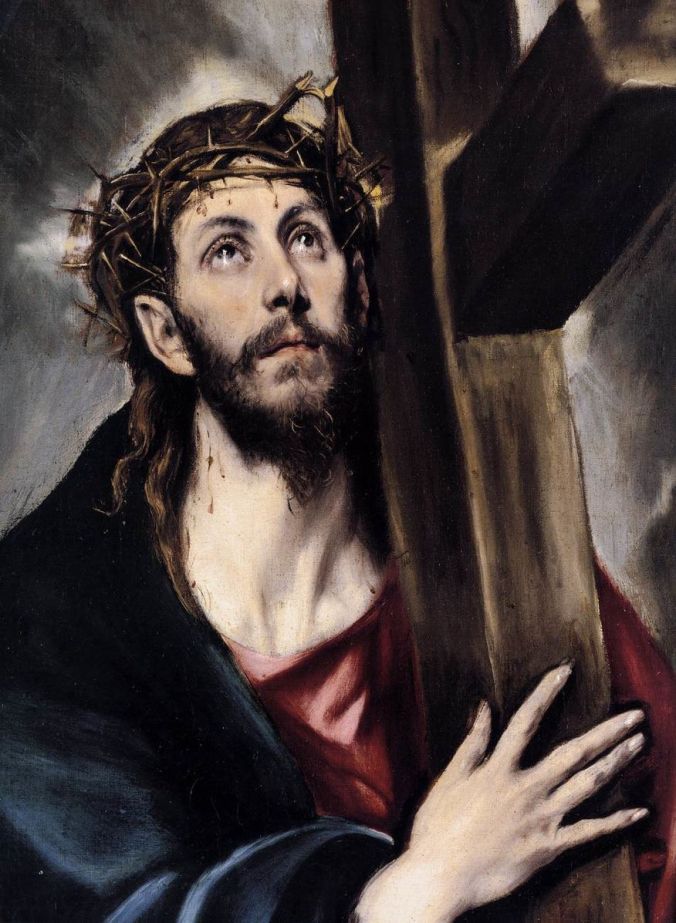
Christ_Carrying_the_Cross_1580.jpg

Detail of Christ Carrying the Cross, El Greco, 1580. (Source)

A Letter on the Face of God

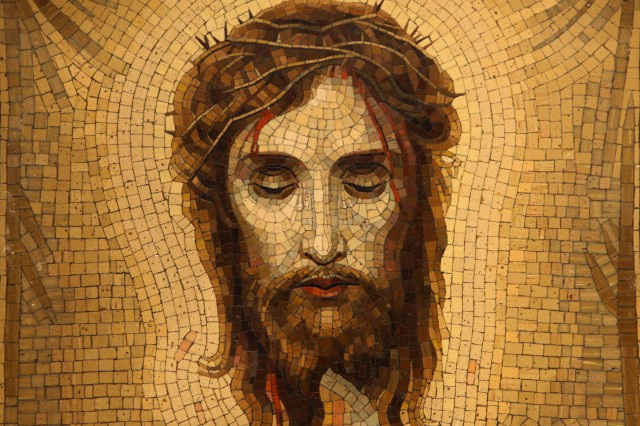
HolyFaceMosaic

The Holy Face of Christ. (Source)

Dear Miriam,

Forgive me for my delay in replying to your message. You pose an excellent question, one that deserves an honest and well-considered answer. Indeed, I am not sure that I’m entirely qualified to speak on the matter. Not being a Biblical scholar, I can’t discuss the critical questions of authorship, Hebrew grammar, and culture that could be so useful. Alas. Nonetheless, I shall try to tell you what I understand the verse to mean, and why I saw fit to use it.

You ask me about what the Priestly Blessing meansespecially what we are to understand by those mysterious words, “The Lord make his face shine upon thee, and be gracious unto thee: The Lord lift up his countenance upon thee, and give thee peace” (Numbers 6:25-26 KJV). You are right to note that there is something odd about this passage.

I believe the prayer is best understood through meditation. Let us look first at the beginning and bulk of the passage:

The Lord make his face shine upon thee, and be gracious unto thee: The Lord lift up his countenance upon thee…

What do we learn from these words? What does it mean to say, however poetically, that God has a “face,” a “countenance?”

First, it means that God is personal. The God of Abraham, Isaac, and Jacob is not an abstract, nameless force. He is not the Tao of the Chinese mysticsor not just that. Rather, He is someone, a who, an infinite yet utterly unique spirit. This truth entails another; God is relational. The face is the chief organ and sign by which we communicate with other people. The full range of our emotions find expression in the human face. The face becomes a symbol or synecdoche of our individual souls. It is the way we share our hearts. It is the bridge between our interiority and the other. Through speech, a kiss, an exchange of glances, the face mediates our personhood and thus becomes the location of communion.

The use of the word “countenance” in English sums up all these ideas, with one rather startling implication. God Almighty desires to be in a relationship with us. More than that, He wishes to dwell with us. The words of the blessing are not that of a God who will reign remotely. If the metaphor of the “face” suggests personality and relationship, it also suggests presence. God wants us to be wholly His, that He may be wholly ours. That is why He goes so far as to establish multiple, connected covenants with Adam, Noah, Abraham, Moses, and David.

But covenants, like great love stories, are exclusive. You are right to point out the negative implication in the verse. If we pray for God to turn His face towards us, then surely God’s face could be turned away from us as well? I think the certain answer of the Bible, not to mention ordinary human experience, is yes. The ancient Israelites believed that they were a privileged, priestly people, subject to a totally unique relationship with God. Yet the whole of the Old Testament’s historical and prophetic corpus also shows that the Nation of Israel repeatedly caused God to “turn His face” away from them, not in loving them less, nor in breaching His covenant, but in permitting them to suffer chastisements that they might return to Him. The Holy only communes with the holy; God cannot abide with sin. And the Israelites often sinned. We all do. Speaking from my own life, I can testify that mortal sin is a terrible thing. To fall away from the face of God, to want to hide from His face as Adam did in the Garden, to feel Him turn His holy face away from yousuch is the interior darkness and desolation wrought by sin.

Yet the ground of your questionwhy God’s face would be turned away from anyone reveals that whether you realize it or not, you already have a basically Christian idea of God. To the ancient Jews who composed the Priestly Blessing for the liturgies of Tabernacle and Temple, the Face of God only turned towards the Nation of Israel. The idea that God loves all, and loves them unconditionally, is a notion that did not exist anywhere before the coming of Christ.

Indeed, the prayer receives its perfect answer and fulfillment when God takes on a human face. Jesus Christ is the Face of God, a divine person who wishes to be in an eternal and perfect communion with all men. That is why He is called Emmanuel, “God with us.” He is our eternal high priest (Hebrews 7:23-28; 9:11-14; 10:10-14).

And as our high priest, He has fulfilled the Priestly Blessing in three ways, all of which were unimaginable when it was written.

First, in His coming. In Christ, God has turned His face towards usin the manger at Bethlehem, in His ministry among the poor and sick, in His companionship with sinners, in His Transfiguration, in His ceaseless prayer for us, in His cruel and unjust death upon the cross, and in His glorious Resurrection and Ascension.

Secondly, in the heart of the Godhead. By assuming human nature, God the Son becomes a human. By His Incarnation, Death, Resurrection, and Ascension into Heaven, He has brought a human face into the inner life of the Most Holy Trinity. God the Father gazes upon the human face of His Son, and He desires to see all mankind in and through that face. God the Spirit, eternal love, is born forth out of this mutual gaze. The Father and the Son only behold each other in the absolute love of the Spirit.

But what is the fruit for us today? The rest of the prayer tells us:

…and give thee peace.

Peace is not the absence of suffering, but the absence of disturbance. The peace of Christ, the peace “which passeth all understanding” is not to be taken as earthly ease and comfort (Philippians 4:7 KJV). That would merely be the false and facile peace of the world. The peace of God is a foretaste of Heaven, an inner rock upon which we may stand when suffering assails us, a seed of the Kingdom that may render us more perfect imitators of Christ. With the peace of God in our hearts, we may hope to know the true joy that, paradoxically, only grows from the cross. This peace is not a quiet meekness. It is the liberating freedom and security that comes from the knowledge of His love. Peace does not paralyzeit propels. It makes us undertake great adventures for God. Why? Because true peace is communion with God.

That is why I made use of the prayer at the end of my “Letter on Loneliness.” It occurred to me that the torment of loneliness is in some way redeemed if we remember the presence of the God who is love, and thus attain to His peace.

I don’t believe we can hope for the fullness of that peace without the sacraments, especially the Eucharist. It is simply impossible to be a Christian without the Eucharist. Any grace, any glory, any goodness in the world is only granted and sustained by Christ present with us in the Most Holy Sacrament of the Altar. Indeed, the graces of all the other sacraments flow from the Eucharist, since it is Christ Himself.

And it is in the Eucharist that we find the third way that Christ has fulfilled the Priestly Blessing and extended its meaning to all peoples and all epochs. In the Eucharist, we once again come face to face with the God of Israelquite literally. His Eucharistic Face can be found in any Catholic Church on earth. Go to a service of Benediction. Chant hymns of adoration as the incense flies up like a ghost into the shadowy heights of the sanctuary. Let your soul rise with it, high above the little lights of the candles that line the altar. Then, as the bell rings and the priest lifts the Host, you will see God. Or at least, you will see His veil. He hides Himself under the sight of mere matter. No matter what, He will see you.

Better yet, go to Mass. Go to the Easter Vigil. Go on any Sunday. There, you will not only see God, but hundreds of perfectly ordinary people communing with Him in the most intimate way imaginablebody and soul. That holy act is the true fulfillment of the Priestly Blessing. It is the seal and crown of all the covenants. Not everyone in the world partakes of itbut happy are those who do! They alone know the Peace that was promised, the Peace that is He.

Forgive me if I have rambled. One could, in theory, write whole volumes on the verses you have asked me about. I am sure someone with more learning and a deeper life in Christ could give you an altogether better explanation. But what I have written is drawn ex corde meo. I hope, at the very least, that I’ve answered your question. I’d be happy to continue discussing the matter.

Until then, I pray that the Good Lord blesses you in all your works and ways.

In Christ,

Rick

“A Vacuum He May Not Abhor”

RS Thomas Obituary

R.S. Thomas in a typical pose. One does wonder if he ever smiled. (Source)

R.S. Thomas (1913-2000), the Welsh nationalist, Anglican minister, and consummate poet belief and doubt has recently become a favorite. Here is a poem of his that, I think, is worth pondering in Lent.

The Absence

It is this great absence
that is like a presence, that compels
me to address it without hope
of a reply. It is a room I enter

from which someone has just
gone, the vestibule for the arrival
of one who has not yet come.
I modernise the anachronism

of my language, but he is no more here
than before. Genes and molecules
have no more power to call
him up than the incense of the Hebrews

at their altars. My equations fail
as my words do. What resources have I
other than the emptiness without him of my whole
being, a vacuum he may not abhor?

Fénelon on the Return to God

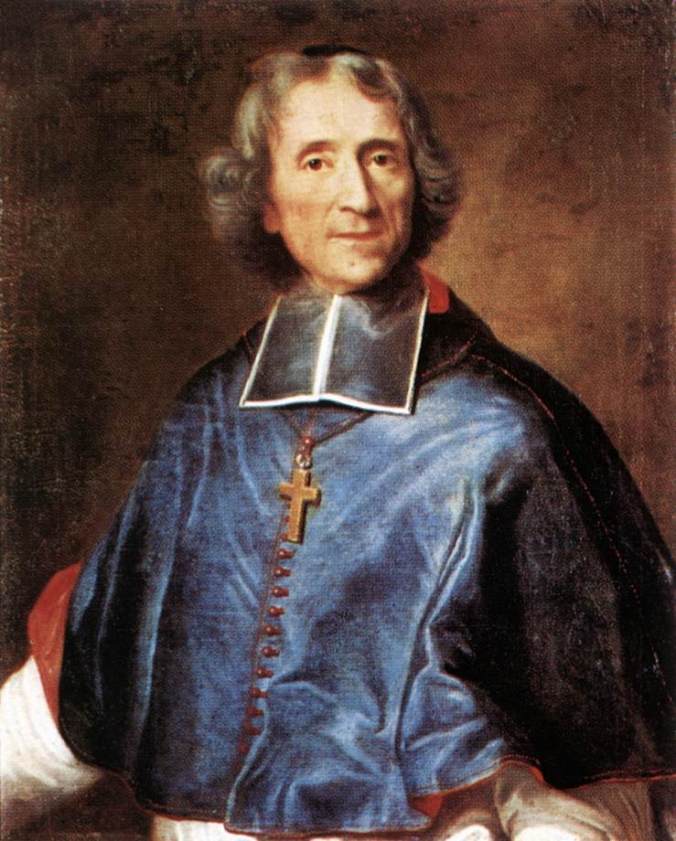
Fenelon

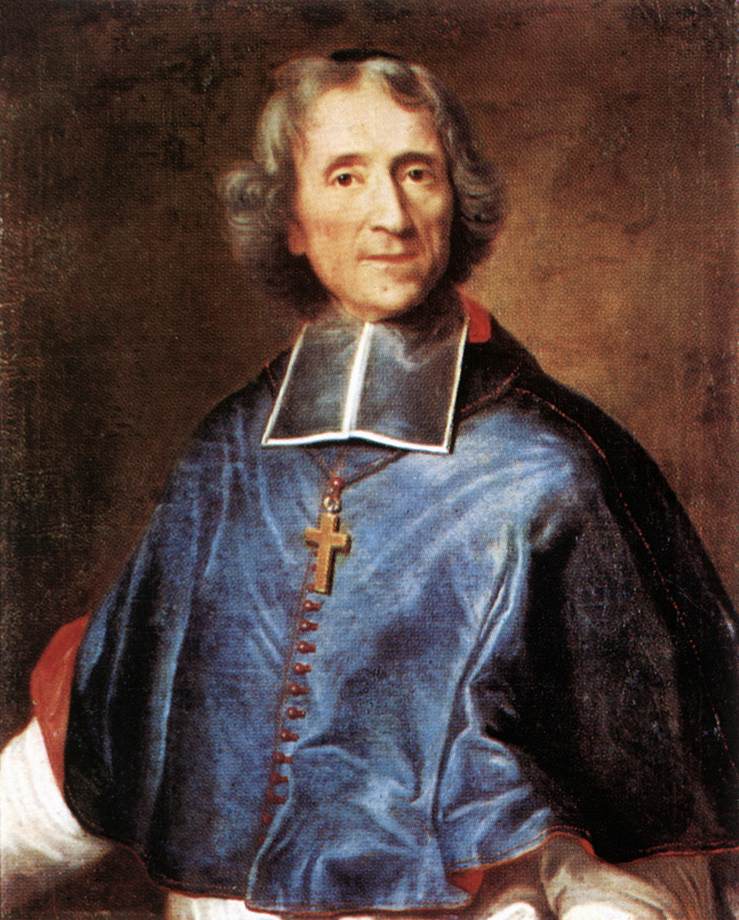
François de Salignac de la Mothe-Fénelon, Archbishop of Cambrai in the age of Louis XIV (Source)

Continuing my Lenten series of Wednesday spiritual masters, I present to you here a letter by Archbishop Fénelon to an officer, often identified as the Chevalier Colbert. The translation I am using comes from 1877, but I would also recommend to you the version by fellow Wahoo Chad Helms in the 2006 Paulist Press edition of Fénelon‘s Selected Writings. It struck me by its beauty and force of feeling, as well as its Lenten spirit. 

You have forgotten me, sir, but it is impossible for me to forget you. Something in my heart continually recalls you, and makes me want to hear of you, as I have more especially felt during the campaign and its perils. Your forgetfulness only makes me feel the more. The friendship you showed me once is of a kind never to be forgotten; and when I recall some of our conversations, my eyes are filled with tears. I trust that you remember how pleasant and hearty they were. Have you found anything since then more acceptable than God? Have the truths which then satisfied you failed? Is the pure light of the kingdom of God quenched? Has the world’s nothingness acquired some fresh value? Is that which was but a wretched dream not still the same? Is the God to Whom you poured out your soul, and Who filled you then with a peace beyond all earthly ken, no longer to be loved? Has the eternal beauty, ever so fresh to pure eyes, no longer charms for you? Is that source of heavenly joy, of unmarred happiness, which springs from the Father of Mercies and God of Consolation, dried up? No, for He has filled me with an urgent desire to recall you to Him. I cannot resist it: for long I have hesitated, and said to myself that I should only worry you. Even as I began this letter, I laid down a limit of discretion to myself; but after the first few words, my heart burst its bounds. Even should you not answer, or should think me absurd, I should not cease to speak sorrowfully to God of you, when unable to speak to you yourself any more. Once more, sir, forgive me if I exceed all due limits. I know it as well as you, but I feel irresistibly urged: God has not forgotten you, since He stirs up so eager a desire for your salvation in me.

What does He ask of you, save to be happy? Have you not realised that one is happy in loving Him? Have you not felt that there is no other real happiness, whatever excitement may be found in sensual pleasures, apart from Him? Since, then, you know where to find the Fountain of Life, and have of old drunk thereof, why would you seek foul, earthly cisterns? Bright, happy days, lighted up by the soft rays of loving mercy, when will ye return? When will it be given me to see this child of God reclaimed by His powerful Hand, filled with His favour, and the blessings of His holy Feast; causing joy in Heaven, despising earth, and acquiring an inexhaustible fund of humility and fervour from his experience of human frailty?

1280px-Rembrandt_Harmensz_van_Rijn_-_Return_of_the_Prodigal_Son_-_Google_Art_Project2

The Return of the Prodigal Son, Rembrandt van Rijn, c. 1661-69. (Source)

I am not dictating what you should do. God will Himself make that plain to you according to your needs, so long as you hearken inwardly to Him, and despise boldly that which is despicable. Do whatever you will, only love God, and let His Love, revived in your heart, be your guide. I have often thanked Him for having shielded you amid the perils of this campaign, in which your soul was even more exposed to risk than your body. Many a time I have trembled for you: put an end to my fears, and fill my heart with gladness. None can possibly be greater than to find myself once more with you in the house of God, united in heart and soul, looking together to one glorious hope, and the Coming of our Great God, Who will fill us with the flood of His pure delights. Your ears are not yet closed to the sublime language of truth, your heart is made to feel its charms. “Taste and see” the pleasant bread daily spread for us at our Father’s table. Why have you forsaken it? With such support, who can fear that anything else will be lacking? Even if you do not feel strong enough to regain the happy position where you were, at least answer me, at least do not shun me. I know what it is to be weak; I am a thousand times weaker than you. It is very profitable to have realised what one is; but do not add to that weakness, which is inseparable from human nature, an estrangement from the means of strength. You shall regulate our intercourse; I will only speak to you of such things as you are willing to hear. I will keep God’s secret in my heart, and shall be always, with unchanging affection and regard, etc.


A Benedictine Prayer to St. Philip Neri in Lenten Time

gueranger4-150dpi

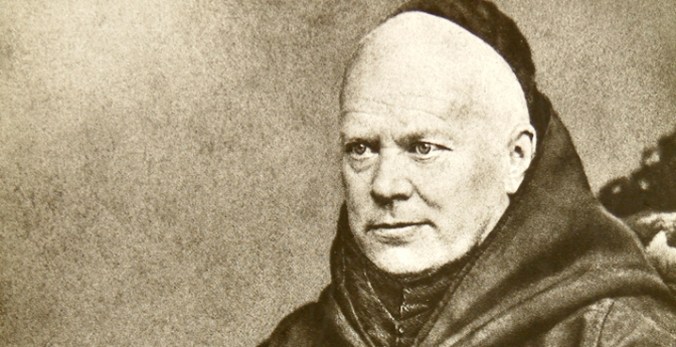
Ven. Dom Prosper Guéranger. (Source)

Many of my readers will know the Venerable Dom Prosper Guéranger (1805-1875) for his monumental work of sacramentology and liturgical exegesis, The Liturgical Year. I happened to be perusing a 1908 French edition of the text and came upon Dom Guéranger’s homage to St. Philip Neri in Volume 3 of his Easter writings. Naturally, this discovery was of great interest to me, as I have written before on the similarities between the Oratorian and Benedictine vocations. I thus present to you my own translation of the prayer, found on pages 548-50 in the edition I was using. I hope it may be thought a fair translation of the great monk’s words. At any rate, I have tried to render his prayer in an elevated style worthy to the subject.

Thou didst love the Lord Jesus, O Philip, and thy whole life was nothing but a continuous act of love; but thou didst not wish to enjoy the highest good alone. All thine efforts tended to make Him known by all men, such that all might love Him with thee and thus reach their supreme end. For forty years, thou wast the indefatigable apostle of the holy city, and nothing could subtract from the action of the divine fire that burned in thee. We who are the posterity of those who heard thy words and admired the celestial gifts in thee, we dare to beg of thee to cast thy gaze upon us as well. Teach us to love our Jesus resurrected. It does not suffice for us to adore Him and to rejoice in His triumph; we must love Him: for the train of His mysteries from His Incarnation to His Resurrection have no other aim but revealing to us, in an ever growing light, His divine kindness. It is by loving him ever more that we shall succeed in elevating ourselves to the mystery of His Resurrection, which fulfills in us the revelation of all the riches of His heart. The more He lifts Himself into the new life that He won in leaving His tomb, the more He appears full of love for us, and the more He desires that our hearts should be joined with His. Pray, O Philip, and beg that “our heart and our flesh might quake for the living God” [Ps. 83:2]. After the mystery of Easter, introduce us to that of the Ascension; dispose our hearts to receive the divine Spirit of Pentecost; and when the august mystery of the Eucharist shines before our eyes with all its fires in the solemnity that approaches, thou, O Philip, who didst celebrate it one last time here below, who didst rise at the end of the day to that eternal rest where Jesus shows Himself unveiled, do thou prepare our souls to receive and to taste “the living bread which giveth life to the world” [John 6:33].

The sanctity that shone in thee, O Philip, had as its character the momentum of thy soul towards God, and all those who approached thee soon participated in this disposition that alone could respond to the call of the divine Redeemer. Thou didst know that thou took hold of souls, and thou drovest them to perfection by the way of trust and generosity of heart. In this great work thy method was never to have any method at all, imitating the Apostles and the ancient Fathers, and thou didst trust in the virtue proper to the word of God. By thee the fervent frequenting of the sacraments reappeared as the surest sign of the Christian life. Pray for the faithful, and come to the aid of so many souls who grow restless and exhaust themselves in the paths that the hand of man hast traced, and that too often retard or prevent the intimate union of Creator and creature.

Thou didst most ardently love the Church, O Philip; and this love of the Church is the indispensable sign of sanctity. Thine elevated contemplation did not distract thee from the dolorous lot of this holy Bride of Christ, so tested in the century when thou wast born and died. The efforts of triumphant heresy in so many countries enkindled zeal in thy heart: obtain for us from the Holy Ghost this living sympathy for Catholic Truth that renders us sensible to its defeats and victories. It does not suffice for us to save our souls; we must desire with ardor and aid with all our means the advancement of the Reign of God on earth, the extirpation of heresy, and the exaltation of our mother the holy Church: it is in this condition that we are children of God. By thine examples, O Philip, inspire in us this ardor by which we must totally associate ourselves with the sacred interests of our common mother. Pray as well for the Church Militant which counted thee in her ranks as one of her best soldiers. Serve valiantly the cause of Rome, which holds as an honor the debt owed to thee for so many of thy services. You sanctified her during thy mortal life; hallow her again and defend her from heaven on high.

sc1119.jpg

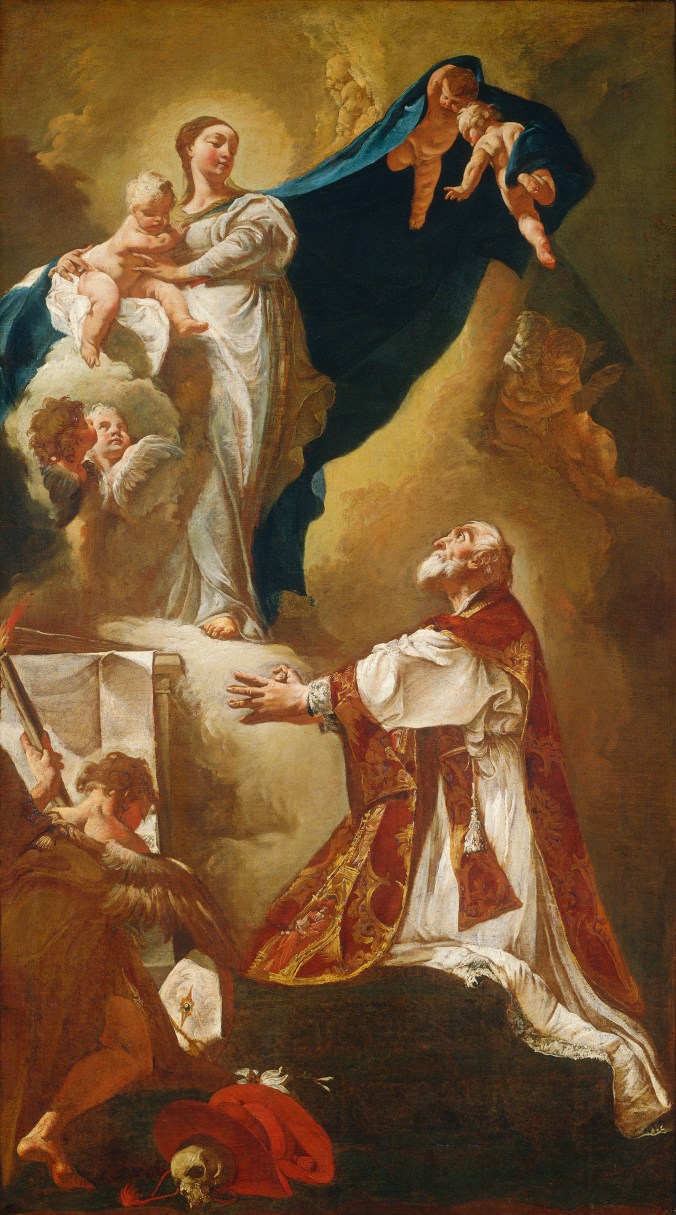
Madonna and Child Appearing to St. Philip Neri, Giovanni Battista Piazzetti, c. 1725. (Source)