Anglo-Catholics and the Occult: My Church Times Debut

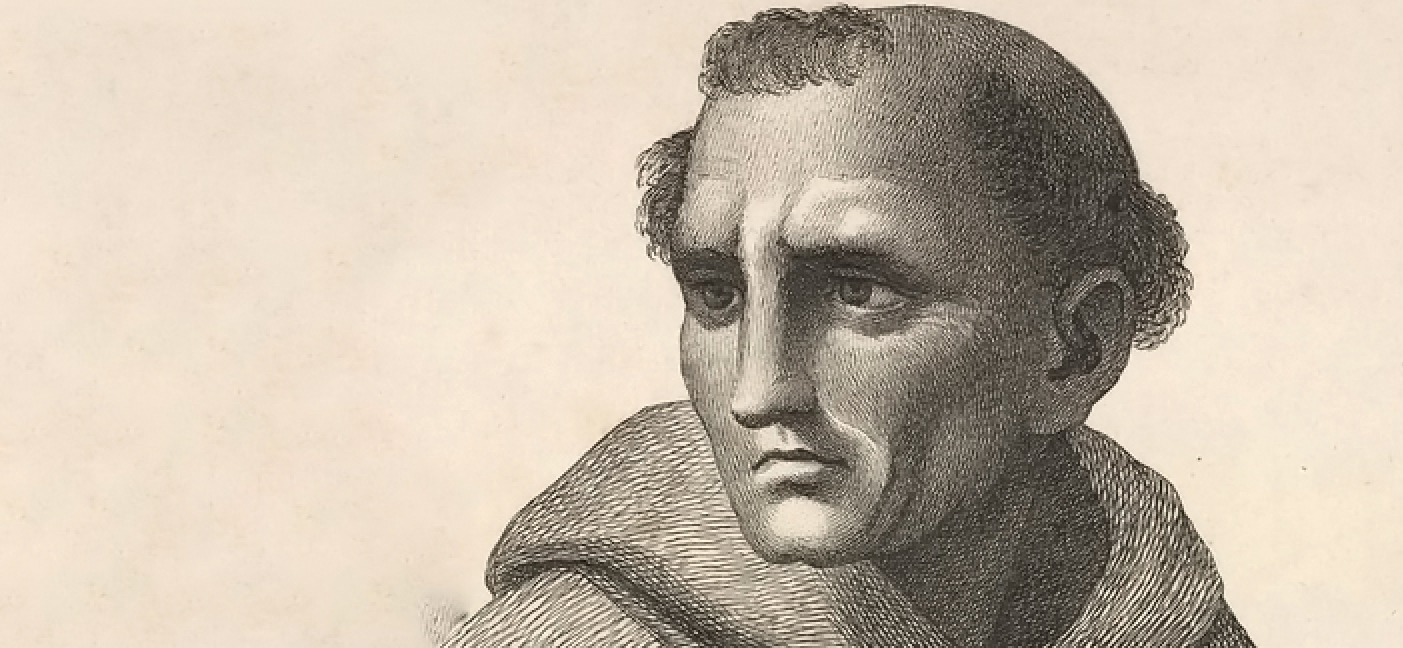
The Abbey in the Oakwood, by Caspar David Friedrich.


The Church Times have just published an article in which I summarize some of my research on the connection of Anglo-Catholics and the occult world. I’d like to thank my supervisor, Dr. Sarah Apetrei, and co-supervisor, the Rev. Canon Robin Ward, for their support throughout all of this. I’d also like to thank Fr. James Lawson for the early help he provided as well as Dr. Michael Yelton and those various other figures who have discussed the matter with me over the past year, often in words of encouragement. Hopefully the full paper will be published someday. For now, read here

On Gallicanism and Ultramontanism

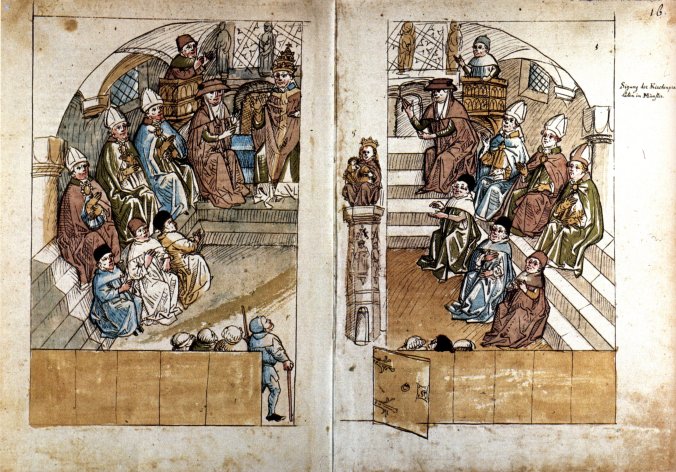
CouncilofConstance.jpg

Scene from the Council of Constance, the Sixteenth Ecumenical Council (Source)

Over at Notre Dame’s Church Life Journal, there are two important pieces worth your time. The first, Dr. Taylor Patrick O’Neill’s “A Defense of Ultramontanism Contra Gallicanism,” is a theological analysis of the recent use of “ultramontanism” as a pejorative in Catholic discourse. Dr. O’Neill, a Neo-Thomist theologian, suggests that Ultramontanism is “the golden mean” by which to preserve a healthy and authentically Catholic respect for the Papacy. He writes:

But how does the historical usage of the term “ultramontane” hold any significance for us today? Given that the term arose as an insult against those who challenged the claims of Gallicanism, and given that those who championed papal primacy over local kings and bishops were legitimized at Vatican I, the term ought not to be associated with heterodoxy but rather orthodoxy.

To equate ultramontanism and orthodoxy is an extraordinary claim. While Dr. O’Neill recognizes that there are some excessively papalist versions of ultramontanism – a phenomenon he would prefer to call “super-ultramontanism” or “ultra-ultramontanism” – he fails to escape the very alienation from the term’s “historical significance” that he attempts to address.

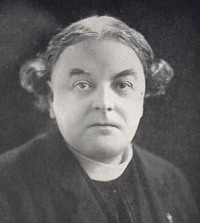
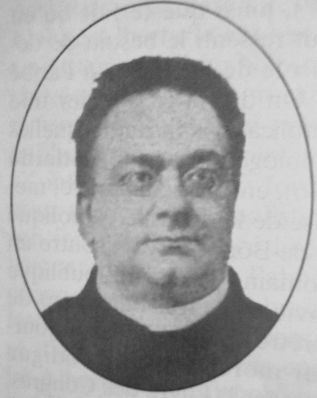
Benigni_Umberto

Umberto Benigni (1862-1934), Ultramontane church historian. (Source)

Take, for instance, his citation of Umberto Benigni’s article on “Ultramontanism” in the 1912 Catholic Encyclopedia. The passage O’Neill cites reads:

For Catholics it would be superfluous to ask whether Ultramontanism and Catholicism are the same thing: assuredly, those who combat Ultramontanism are in fact combating Catholicism, even when they disclaim the desire to oppose it.

If O’Neill had borrowed his words merely for a theological point, we might pass over the citation. But his is an historical judgment, not primarily a theological one. O’Neill doesn’t mention that Benigni is an out-dated, partisan, and sectarian Church historian whose article manifests those faults. It is hard to imagine any contemporary historian making much use of Benigni, whose other works include a volume entitled Ritual Murder Among the Jews (Belgrade, 1926-29).

Ultramontanism arose as a coherent and self-identified ecclesiological tendency under the pressures of post-Napoleonic Europe. While Papalism has always existed in the Church, the emergence of a self-consciously “Ultramontane” party before and after Vatican I was bound up with the Catholic response to modernity. And in some places – especially France – it was synonymous with less savory elements such as antisemitism. This fact alone hardly invalidates O’Neill’s theological point. But if we want to look at the term’s “historical significance,” I see little way to escape the actual history. “Historical significance” might just as well mean “connotations” as any sort of precise theological definition. O’Neill delimits ultramontanism by confining it to the realm of ideas as a functionally timeless truth. Yet he mires Gallicanism in the muck of human history. Ultramontanism is just the consistent teaching of the Church; Gallicanism, by contrast, is the small and fractious complaint of tendentious and self-interested minorities such as French kings and the Old Catholic schismatics. This discursive move may not be disingenuous, but it does set up a problematic historical imbalance. Ultramontanism is just as historically-conditioned as Gallicanism. Both involve something rather more than mere ideas – they enlisted social, political, and ecclesiastical movements, not always with very good results. And unfortunately, some of O’Neill’s history is simply incorrect.

At the same publication, the historian Dr. Shaun Blanchard’s “A Quasi-Defense of Gallicanism” provides some helpful correctives. It is a nuanced and well-argued piece (and well-sourced, too – Dr. Blanchard has seen fit to provide his readers with eight end-notes referring to reputable historical literature).

Against O’Neill’s suggestion that Gallicanism only arose after the Reformation, Blanchard correctly notes that the Medieval Conciliarist tradition most eloquently expressed by Jean Gerson (1368-1429) and the fathers of the Council of Constance (1414-18) provide ample groundwork for what would later be called “Gallicanism.” And Dr. Blanchard is right to point out that “Gallicanism” was never just one phenomenon, but a disparate tendency that crystallized into different forms of resistance to Papal centralization – not all of which were at play in Vatican I. Moreover, Blanchard correctly argues that, against Benigni and O’Neill’s interpretation, the Gallican minority at Vatican I preserved certain ecclesiological truths later vindicated by Vatican II. One could go on. Blanchard provides a great deal more historical background than O’Neill in support of his point.

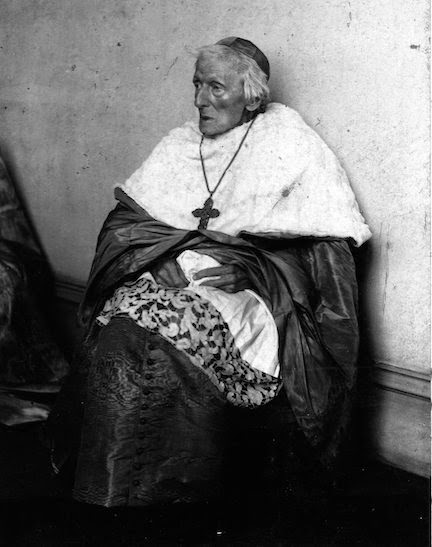
blessed_neman_winter_cappa

Cardinal Newman in his winter cappa. The man was no Ultramontanist. (Source)

Blanchard’s defense of Gallican thinkers such as Gerson, Bossuet, and Fleury is admirable. One could add to their names that of Cardinal Newman, whose soft-conciliarist ecclesiology earned the ire of ultramontanists like Cardinal Manning and W.G. Ward and Monsignor George Talbot, who famously wrote to Manning,

What is the province of the laity? To hunt, to shoot, to entertain? These matters they understand, but to meddle with ecclesiastical matters they have no right at all, and this affair of Newman is a matter purely ecclesiastical…Dr. Newman is the most dangerous man in England, and you will see that he will make use of the laity against your Grace.

None of this broader historical context appears in O’Neill’s piece. Perhaps it’s a little unfair to demand it, insofar as O’Neill is more interested in our contemporary debates than in the genealogy of the terms at play. But if we are to properly recognize “the historical significance” of ultramontanism, then we can’t really dodge the issue. If O’Neill is right to suggest that “the term ought not to be associated with heterodoxy but rather orthodoxy,” then men like Newman are beyond the pale of orthodoxy. And that seems like rather an impoverished vision of the Catholic intellectual life. I will conclude with Dr. Blanchard’s own measured words on the matter.

My point in this qualified defense of Gallicanism is not that we should “return” to Gallicanism, if such a thing were even possible. Neither must we equate ultramontanism with Catholic orthodoxy, simply because ultramontanes triumphed at Vatican I. Catholic orthodoxy is too big to be equated with either. The Catholic faith is big enough and dynamic enough to include what is good and true in ultramontanism and in Gallicanism, and likewise to reject what is harmful, false, or exaggerated in both.

Read them both.

Three New Books for Early Modernists

There are some very exciting publications coming out soon…especially for those of us who study religion in the early modern period.

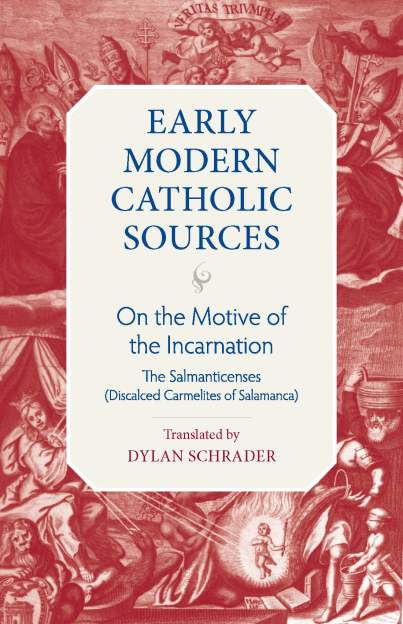
First, there’s a new series from CUA Press on Early Modern Catholic Sources, edited by Ulrich Lehner and Trent Pomplun. The first volume covers Christological debates among the Discalced Carmelites of the School of Salamanca. I think it’s a fair assumption that this material has never been translated before. The first volume should appear in 2019.

Salmanticenses-final-sketch

Vol. I of Early Modern Catholic Sources (Source)

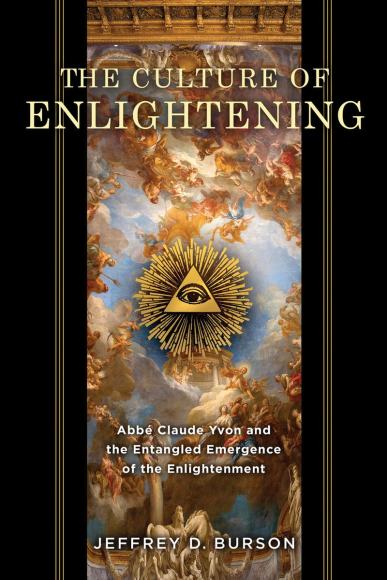
Second, and more germane to my own work, we have Jeffrey Burson’s very promising intervention into the perennial “Enlightenment” v. “Enlightenments” debate. His new book, Culture of Enlightening: Abbé Claude Yvon and the Entangled Emergence of the Enlightenment, is scheduled to be released from Notre Dame Press in May 2019. Burson has already established himself as a major scholar of the Catholic Enlightenment, and his newest foray promises to be his most ambitious work yet.

Bursonbook

Burson’s new book (Source)

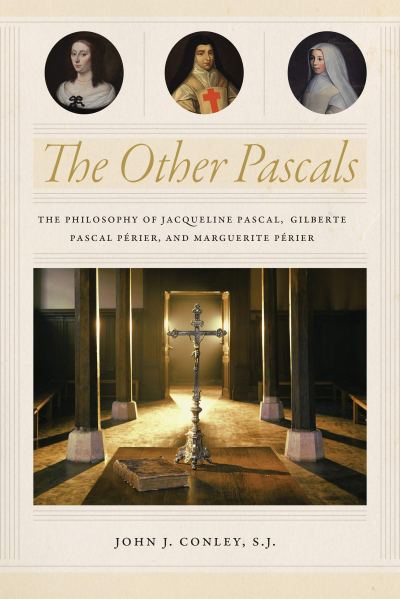
For those of you who, like me, take an interest in the Jansenists and in early modern Catholic women, you’ll be happy to know that there’s a new study of Pascal’s sisters by Rev. John J. Conley, S.J. The Other Pascals: The Philosophy of Jacqueline Pascal, Gilberte Pascal Périer, and Marguerite Périer, another ND Press piece slated for an April 2019 release, will no doubt shed new light on these fascinating figures. Conley has done important work before on Catholic women in the 17th century – I look forward to his newest treatment of the subject.

OtherPascals.jpg

A Jesuit writes about Jansenists (Source)

And if you’re just looking for general book recommendations, might I refer you to Incudi Reddere? You’ll find much more there.

A Startling Passage out of Peter Anson

GnosticVestments

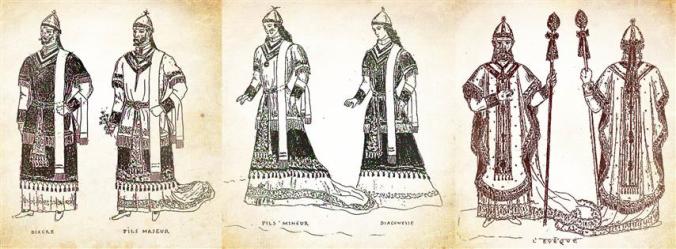
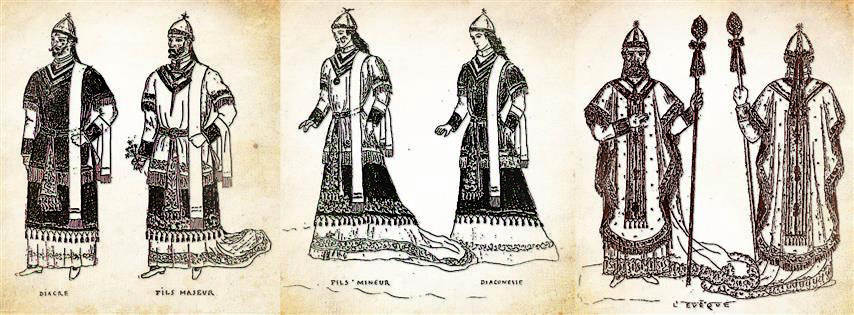
“Gnostic Catholic” vestments from Third Republic France. Note in particular the episcopal vesture at right. (Source)

In Peter Anson’s remarkable volume, Bishops at Large: Some Autocephalous Churches of the Past Hundred Years and their Founders (1964), we learn of many episcopi vagantes and their kindred spirits. It seems that several of these strange fellows dabbled (or more than dabbled) in the occult. Many also coupled that occultism with an interest in ancient heresies, which they sought to resurrect. In a chapter on the succession from René Vilatte, we stumble across a shocking little paragraph:

Mgr. Giraud and most of the priests and layfolk of the Gallican Church, even if not Gnostics themselves, were closely associated with them. Gnosticism was very much in the air fifty or sixty years ago. Even the Benedictine monks of Solesmes felt it worth their while to study what are known as the ‘Magic Vowels’ used in Gnostic rites and ceremonies. In 1901 they published a book entitled Le chant gnostico-magique. (Anson 309)

What an extraordinary claim. The monks of Solesmes, Dom Prosper Gueranger’s own sons, publishing studies of Gnostic chants! Dear readers, do any of you have any information on this bizarre note? I have been able to find evidence, however scanty, that the book Anson mentions was indeed published. But it surely must count as one of the rarest volumes in the assembled miscellanea of liturgical history. I would appreciate any leads whatsoever. Might some of my liturgically minded friends have any clue? Whatever comes of it, there is no doubt a very interesting story lurking behind this utterly unique publication.

Elsewhere: Two New Blogs on Mystics

lazzari+print

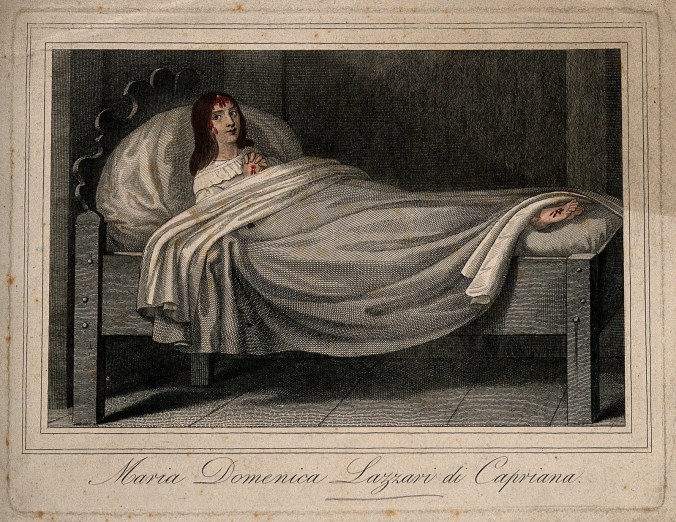
A stigmatic, c. 1840. (Source)

Recently two very worthy endeavors have come to my attention. The first is the blog of the Stigmatics Project at the Ruusbroec Institute, University of Antwerp. The project “studies the promotion and devotion of the hundreds of stigmatics reported in five European countries during the nineteenth and early twentieth century.” It takes a scholarly, non-confessional approach to its subject. No doubt this new venture will yield greater insights into the stigmata as a social phenomenon.

The second is a much more theological blog called Littlest Souls, and it presents a veritable treasure trove of mystic spirituality. The blogger has clearly read widely in the library of the soul passed on to us from age to age by the Church. He seems to place a special emphasis on the 19th and early 20th century mystics, much like the Stigmatics Project. In fact, they probably cover some of the same figures. But unlike the recently-founded work of the Ruusbroec Institute, Littlest Souls has been up and running since May 2012. There is consequently much more material here to review and contemplate. Fans of that other great blog, Mystics of the Church, will find much here to admire.

In my first post on Father Faber, I noted that he represented a kind of lost world of the faith. Today, it is hard to imagine a Catholicism that once supported the kind of imaginatively baroque and overtly sentimental spirituality that oozes from his pages. Father Faber looks odd to our cynical, postmodern eyes. But in exploring his writings now, I find much in them that’s salutary and beautiful. My hope is that I can play some small part in recovering those gems for our times.

Both of these blogs seem to do precisely that; one at the level of scholarship, and one at the level of spirituality. Both set out to investigate and present a spiritual school that often seems morbid, unhealthy, or slightly daft – certainly one that has little place in our age. But there are real values here, real impressions of humanity in communion with the divine. I can only commend their efforts as important contributions to the memory and mystical life of the Church Militant.

I’ve said it before, and I’ll say it again. The Church is weird because she is supernatural, and the supernatural is always strange. We should embrace that fact.

The Demonologist: Montague Summers

Montague_Summers01.jpg

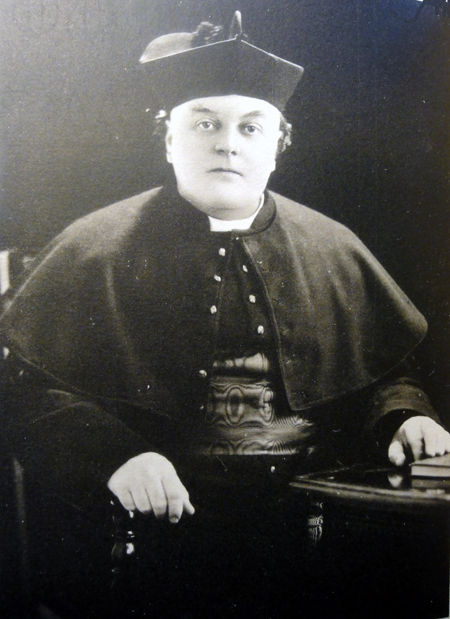
Montague Summers in clerical garb. (Source)

The history of the Church is a history of odd birds, but it is harder to find odder birds than those which inhabited the British Isles in the fruitful years of the Catholic Revival. The eccentricities of certain English clergy are well-known and well-beloved. One of the great flowers of this tendency was Montague Summers.

FlyingDevil

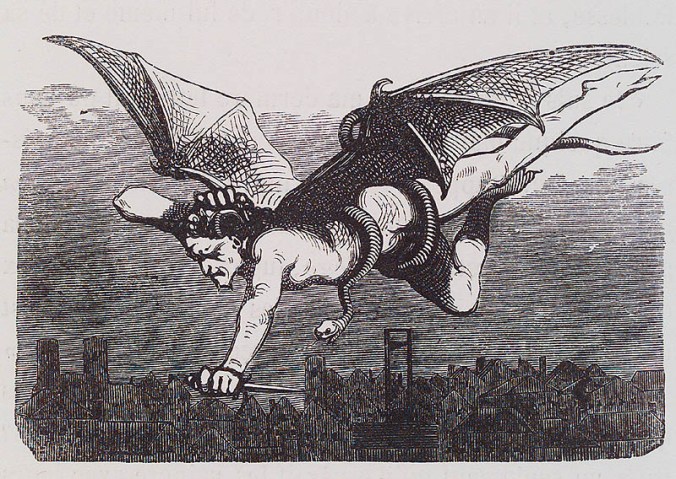
A flying devil. (Source)

Augustus Montague Summers was born in Bristol, the youngest of seven. Eventually he went on to study at Trinity College, Oxford, with the intent of seeking ordination in the Church of England. After some time at Lichfield Theological College, he was eventually deaconed and spent his curacy in Bath and the Bristol area. Even at this young stage, he garnered a reputation for eccentricity. In Ellis Hansen’s Decadent Catholicism, we learn the rather delicious fact that at seminary, “he was known to burn incense in his rooms and to wear purple silk socks during Lent” (qtd. by the Modern Medievalist).

This was as far as he made it in the ranks of the C of E, however. As the Oxford Dictionary of National Biography tersely puts it, “Rumours of studies in Satanism and a charge of pederasty, of which he was acquitted, terminated this phase of his career.” The latter charge may have had some truth to it. About this same time, he published a book of Uranian verse entitled Antinous and Other Poems (1907). His interest in pederastic and homosexual themes continued throughout his life. In 1940, he wrote a play about Edward II. Even more scandalously, “Despite his conservative religiosity, Summers was an active member of the British Society for the Study of Sex Psychology, to which he contributed an essay on the Marquis de Sade” (Source 1 and Source 2).

In 1907, though, Summers was out of a job. His hopes of becoming an Anglican clergyman seemed to have been quashed. But as they say, when the Lord closes one door, He opens another. We might imagine that Summers had something like this in mind when, two years later, he converted to Roman Catholicism. He also spent some time on the continent, allegedly for reasons relating to his health. Some have speculated that he might have received valid, if illicit, orders during this sojourn; others have said he spent his time exploring the black arts (vide the Modern Medievalist). We have almost nothing on which to base our speculations.

Now we see him coming to the full bloom of his later, famous eccentricity. It is in this formative period that he lays the foundation for the vivid persona that would make him such a cult literary and religious figure. I will quote the Oxford DNB at length:

On 19 July 1909 Summers was received into the Church of Rome and was granted the clerical tonsure on 28 December 1910; after this his clerical career became murky and remains so. He may have received minor orders as a deacon, but no record of his ordination has ever been found. During his lifetime, he was addressed as the Revd Montague Summers, celebrated mass in his own chapel and those of friends, adopted two names in religion, and invariably wore the dress pertaining to Roman priesthood; his appearance in soutane, buckled shoes, and shovel hat, later with an umbrella of the Sairey Gamp order, was familiar in London and Oxford. He became increasingly eccentric and was described as combining a manifest benignity with a whiff of the Widow Twankey. Some spoke of an aura of evil. It was charitably assumed by his friends that he was indeed a priest, and his devotion was never in question; his biographer Joseph Jerome (Father Broccard Sewell) records that all his life Summers wore the Carmelite scapular.

On a side-note, Fr. Brocard Sewell was a deeply strange man himself. But I digress.

If Summersor, as he was now calling himself, “Reverend Alphonsus Joseph-Mary Augustus Montague Summers”–had simply remained a slightly dubious cleric, we probably wouldn’t remember him. He might have become a little more than a footnote in the history of the Episcopi Vagantes so famous for dispensing illicit orders here and there. But he did not. Instead, he wrote. Prolifically.

Summers started off with genuine and important literary scholarship. Eventually, he even became a member of the Royal Society of Literature. He had certainly earned it with the sweat of his brow. He produced fairly good books on Restoration Drama, including major editions of previously neglected playwrights such as Aphra Behn. In this capacity, he had some connections with the world of the British stage; he was a founder of the Phoenix Theatre. He wrote an important monograph on Shakespeare.  In another work he also proved that the terrible Gothic novels that Jane Austen mentions in Northanger Abbey were all real books. Gothic literature remained a lifelong passion, in part because it dovetailed so well with his overriding obsessionthe occult.

vmps022

Montague Summers in clerical collar. (Source)

Summers is most famous today for his several books on witches, demons, vampires, ghosts, and other supernatural phenomena. He translated and edited the first English edition of the Malleus Maleficarum, that great tome of Medieval witch-hunting. He did the same with several other demonological manuals: The Demonality of Sinistrari, The Discovery of Witches by Hopkins, the Compendium Maleficarum of Guazzo, and the Demonolatry of Nicolas Remy. He wrote a text on The Physical Phenomena of Mysticism, in contrast with his somewhat headier and less decadent contemporary, Evelyn Underhill. He edited more than one collection of horror stories. He wrote three seminal texts on vampirism, one on lycanthropy, and four on various aspects of witchcraft. Following the best scholarship of the day, Summers endorsed the idea of the “Witch-Cult,” long suppressed by Christianity but operating sub rosa in Europe down the centuries (this hypothesis has long since been undermined by scholars across disciplines). He would often draw upon a huge range of historical, theological, ethnographic, and literary sources in constructing his arguments. All of his texts speak to his vast learning. It is probable that upon his death, Montague Summers knew more about the history and practice of the occult than any other Englishman then living.

The Modern Medievalist has preserved some charming anecdotes of the later, esoteric Summers over on his blog. We read, for example, the following passage from Ellis Hansen’s Decadent Catholicism:

…although Summers was a brilliant conversationalist, he had always a thick carapace of artificiality in his demeanor, a kind of mask that recalled the studied falsity of the classic dandy, not to mention the distrustful reserve of Walter Pater and John Gray. His style was decidedly aristocratic, Continental, and decadent, with the inevitable intimation of sexual impropriety. His friend writes of him, “He would often meet me with such an expression as Che! Che!, accompanied by a conspiratorial smile; or he would look closely at me and murmur, ‘Tell me strange things’.”

Or this remarkable scene drawn for us by Fr. Brocard Sewell:

Summers…could often have been seen entering or leaving the reading room of the British Museum, carrying a large black portfolio bearing on its side a white label, showing in blood-red capitals, the legend “VAMPIRES.”

Not to mention the fact that Summers went about town with a cane topped by a depiction of Leda and the Swan (vide the Modern Medievalist).
vmps011

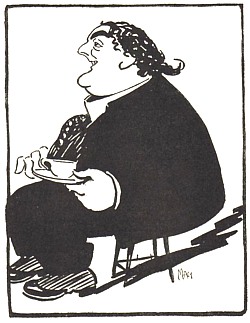
A caricature of Summers from the Evening Standard, probably from 1925. (Source).

What distinguished Summers’ writing on these dark subjects is the absolute credulity with which he approaches his subject. Unlike his predecessor, Dom Calmet, who wrote about ghosts with ambivalence and vampires with manifest doubt, Summers did not hesitate to express his firm certainty about both (and much more). He believed in all the phenomena he wrote aboutthe whole ghastly parade of incubi and succubi, of witches dancing at the Sabbath, of vampires rising from the grave to seek the blood of the living, of werewolves stalking innocent Christians in the night. Everything that belonged to the netherworld was as real to him as the people you or I might meet in the street. His purple prose often slips into breathless passages of scholarly terror. Observe the following lines from Chapter Two of The Vampire: His Kith and Kin:

It has been said that a saint is a person who always cho[o]ses the better of the two courses open to him at every step. And so the man who is truly wicked is he who deliberately always cho[o]ses the worse of the two courses. Even when he does things which would be considered right he always does them for some bad reason. To identify oneself in this way with any given course requires intense concentration and an iron strength of will, and it is such persons who become vampires.

The vampire is believed to be one who has devoted himself during his life to the practice of Black Magic, and it is hardly to be supposed that such persons would rest undisturbed, while it is easy to believe that their malevolence had set in action forces which might prove powerful for terror and destruction even when they were in their graves. It was sometimes said, but the belief is rare, that the Vampire was the offspring of a witch and the devil.

Summers also stood apart from his thoroughly modern era in endorsing “Church-sanctioned methods of destroying” the monsters he wrote about (The Modern Medievalist).

And although his pages are littered with authoritative quotes from long-dead writers, Summers was not unaware of the dark streams that swirled about him in his own day. Richard Cavendish reports in a typically mordant passage from The Black Arts (1967) how Summers treated the claims of the twentieth century’s greatest occultist, Aleister Crowley:

Aleister Crowley could not pass over such an opportunity to scandalize his readers. ‘For the highest spiritual working one must accordingly choose that victim which contains the greatest and purest force. A male child of perfect innocence and high intelligence is the most satisfactory and suitable victim.’ Montague Summers took this seriously, as he took everything else, and quotes it with gratified horror, in spite of Crowley’s footnote in which he says that he performed this sacrifice an average of 150 times a year between 1912 and 1928! (Cavendish 238)

In spite of it all, Summers remained well-liked in certain circles. He moved among the literary elite of his own day, an eccentric among eccentrics. One of his friends, the actress Dame Sybil Thorndike, relates something of his personality:

I think that because of his profound belief in the tenets of orthodox Catholic Christianity he was able to be in a way almost frivolous in his approach to certain macabre heterodoxies. His humour, his “wicked humour” as some people called it, was most refreshing, so different from the tiresome sentimentalism of so many convinced believers.

His caricature in the Evening Standard captures something of this impish quality.

But although he was known and appreciated in his own day, he has been largely forgotten in the intervening decades. There have not been many books about Montague Summers, and he is not widely read. However, that will soon hopefully change. In recent years, Georgetown University has acquired Summers’ papers, once thought irrevocably lost. Fittingly, they have a peculiar provenance, having been “discovered languishing in an old farmhouse in Manitoba.” The story of how they got there is probably as strange as any of Summers’ own books. Georgetown’s collection has made possible a forthcoming biography by Matthew Walther that will hopefully rectify the longstanding neglect of this bizarre yet sincere writer.

But perhaps a question rises. Not every obscure author is worth reviving. Why bother with Montague Summers? A man of outdated style, of dubious subjects, and of very questionable morals to boot…what does he offer the modern reader?
pope's grotto 082

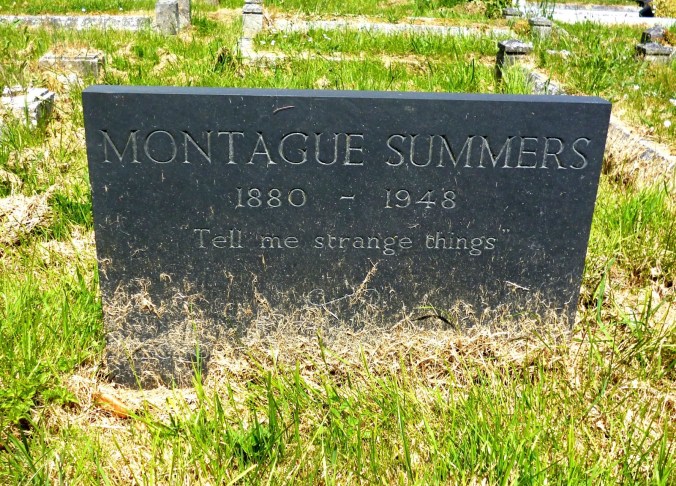
The grave of Montague Summers. (Source)

The Modern Medievalist has a few thoughts on the matter.

Montague Summers is, at best, a good fit for the Institute of Christ the King and a throwback to an age when priests were also arbiters, makers, and preservers of high culture a la Antonio Vivaldi; at worst, a “daughter of Trent” who, if he ever actually was a priest to begin with, wasted his vocation on trivialities rather than the cure of souls.

Perhaps. I am not so convinced that Summers would have fit in any age. He was a decadent, and a great deal of decadence is contrarianism. Though the comparison with ICKSP is hilarious.

I think the message of Summers’s life and work can best be summed up in his epitaph.  On the black stone hat marks his grave in Richmond Cemetery, we read a simple phrase; “Tell me strange things.” These four words that he used to say to his friends encompass his whole life, packed as it was with “strange things.” Summers matters today not because he is a towering figure of literary talent, nor because his scholarly subjects are of vital importance, nor because he is a moral exemplar of impeccable religiosity. He matters because he can remind us to embrace the mystery of life. As we read in one of those plays that Summers so loved, “There are more things in heaven and earth, Horatio,/Than are dreamt of in your philosophy.” Summers lived by those words. The more I learn about the world, the more reason I see in them. And what better day to remember this humbling, bewildering, frightful truth than on All Hallows’ Eve?

Mea Culpa, Mea Culpa, Mea Scholastica Culpa

BlessedJohnDunsScotus

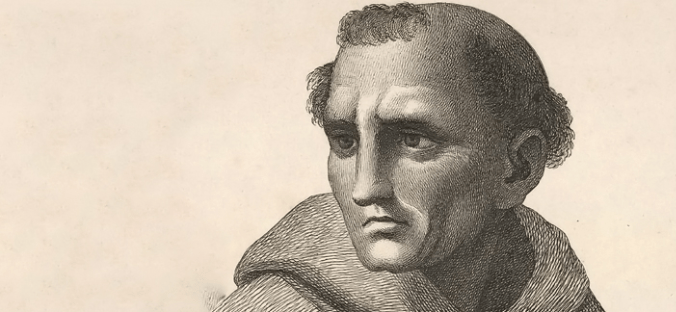
The Blessed John Duns Scotus (Source).

In my review of Rod Dreher’s The Benedict Option, I wrote the following:

I’m not suggesting that Dreher is necessarily wrong in his various judgments. He may well be correct in accusing the nominalists of a kind of cultural deicide (although it overlooks the Christian nominalist tendency, closely tied to empiricism, that numbers Berkeley, Burke, Hamann, Newman, and Chesterton among its ranks).

I subsequently received some pushback for making such a claim. After all, eminent philosophers and theologians had long made nominalism the villain of their narratives about the rise of an anti-Christian modernity. Others questioned my assertion about Newman in particular.

At that time, I defended myself by suggesting that, while I may be off in ascribing a specifically nominalist tendency to these thinkers, that nevertheless, they all do share, inter alia, a suspicion of universalizing abstraction, a respect for concrete particularity in its various forms, and a trust in prudence gained from experience. I interpreted this tendency as akin to the nominalist rejection of substantively existent universals. I also thought that one of the reasons this way of thinking might matter is in our dialogue with postmodernity, which is itself so suspicious of universals and grand narratives.

Nevertheless, I erred. I was mistaken to use that label of nominalism. I must thank my critics for pointing this out. In the many months since then, I have learned what would be the proper term to tie together these particular thinkers – not to mention Gerard Manley Hopkins and J.R.R. Tolkien.

The “nominalist tendency” is really a Scotist tendency. (The fact that I could make such an ironic error is, perhaps, a sign of my own ignorance. I own that. Scholasticism isn’t really my thing.) Chastened by my previous mistake, I hesitate to delve too deeply into the technical depths of Scotist philosophy. I will state briefly that a belief in the idea of haecceity as the unique thisness of each particular sums up the tendency’s core point. If I had time, I’d like to investigate if any firmer affinities could be found.

However, I believe I am now on much sounder territory. The Franciscan Daniel Horan’s work has focused on a postmodern engagement with Scotus, and the Scotism of Newman and Hopkins have been well-attested in the literature. Tolkien took up the theological note behind Hopkins’s ideas of inscape and instress, themselves poetic derivations of Scotist haecceity. More work still needs to be done in English on Hamann, but the image that is emerging is of a figure passionately devoted to the disruptive nature of ordinary, particular experience. His willingness to contest the established narratives of the Aufklärung predates postmodernism by a century and a half. Chesterton is cut from the same cloth. Bishop Berkeley, though perhaps not quite so colorful as either of these two, stakes his empiricism on the particularity of the thing perceived (ultimately, by God). And Burke transposes the idea into the realm of politics, tempered by a healthy respect for natural law.

Two observations come to mind. The first is that nearly all of these thinkers are English or Anglophone. An enquiry into the reasons behind English Scotism would be useful. In its absence, I will merely note that Scotus, that medieval Oxford theologian, seems to have been directly reintroduced into the life of modern English spirituality by another Oxford theologian, John Henry Newman. It was Newman’s influence that defined intellectual Catholicism in England until the conclusion of Vatican II.

The second is that several of these thinkers are literary figures in their own right. Hopkins is principally remembered as a poet, Chesterton as a journalist, novelist, and poet, and Tolkien as a novelist. Newman was a prolific writer across genres. He exerted a personal influence over Hopkins, Matthew Arnold, and Oscar Wilde. And Hamann’s own deeply bizarre output constantly blurs the rigid lines of 18th century drama (yet another way he foreshadows our own postmodern era).

I must wonder if Scotist thought is particularly apt for the production of theology in a poetic mode, as the Catholic Sophiologists of our own day are seeking to do. I certainly have friends who think so. At the very least, Scotus’s high Mariology accords well with the extremely high Mariology of some Sophiologists.

If I had more time, I should like to dive more deeply into these questions. For now, I seek only to explain myself a bit, and apologize for what was clearly a serious error.

ADDENDUM: I also meant to say that Delleuze’s appropriation of haecceity as a fundamental concept lends support to my own impulse of putting these thinkers in conversation with postmodernism.

On the Birthday of Cardinal Baronius

BaroniusPortraitbw

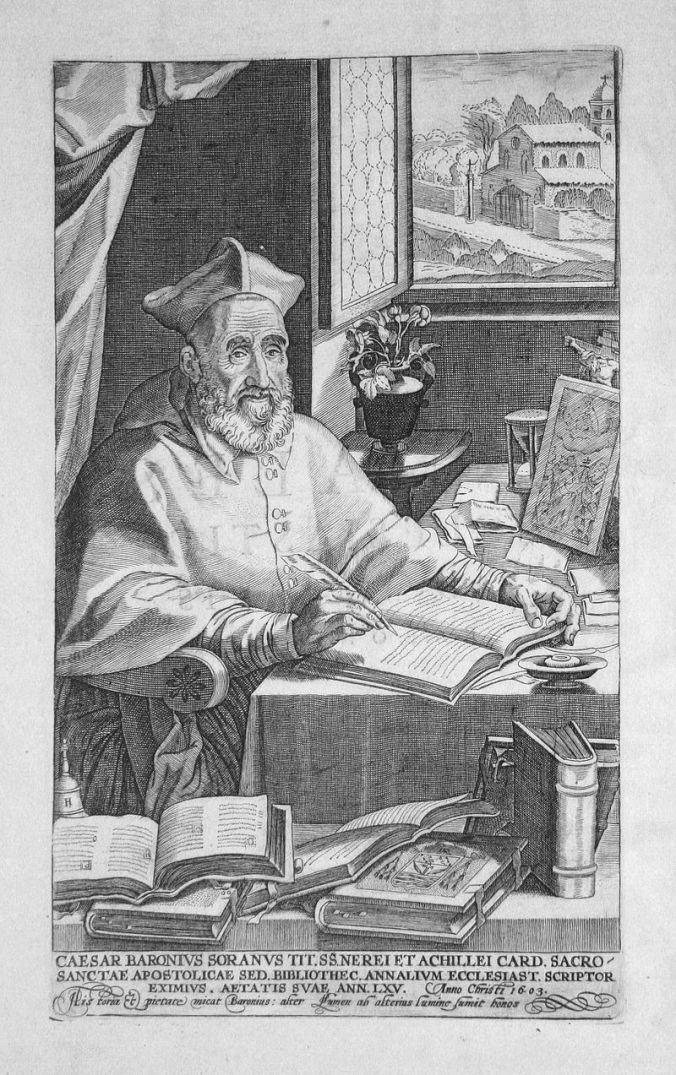
The Venerable Cardinal himself. This portrait is one of the few where his Cardinalatial arms can be glimpsed, on the cover of a book in the foreground. (Source).

Readers of this blog will learn with no surprise that, having finished Lady Amabel Kerr’s biography of the Venerable Cardinal Baronius, my admiration for this great Oratorian has increased tenfold. As I have concluded the volume, so lovingly edited and reprinted by Mediatrix Press, on the very birthday of the illustrious historian, I thought I might reproduce here two extended passages from Baronius’s correspondence that I found particularly edifying.

The first passage is taken from a letter that Baronius wrote to one Justin Calvin. I have thus far been unable to locate much further information about said Calvin, unrelated, I think, to the heresiarch Reformer. Baronius’s Annales and extended correspondence with Justin led to the latter’s eventual conversion. Calvin (or Justus Baronius Calvinus, as he was called once he added Baronius’s name to his own) went on to become a priest and author of, among other works, an Apologia that justified his conversion. God manifestly works in mysterious ways within the long lives of religious orders. He is inordinately fond of strange and unintended coincidences.

Baronius writes to the young convert:

I return many thanks to the great and most high God, whose tender mercies, as sings David, are over all His works, for having called you out of darkness into His marvellous light. No benefit, no grace can be greater than this, so see that you cherish it carefully and guard it jealously. Do not indulge in paeans of victory; but rather remember that exhortation of the Apostle to walk circumspectly, not as unwise but as wise, redeeming the time because the days are evil…When the devil has been overthrown, he is apt to rise up with renewed vigour, and assault his former conqueror more violently than ever. Our Lord tells us of the wicked spirit who, having gone out of a man, did not rest, but fetched seven other spirits more wicked than himself, and retook by fraud the soul whence he had been driven…Be sure that he will seek you who have escaped him and are now fighting in the ranks of the Church. He may not betray his designs, for he fears lest Saul-converted into Paul by his reconciliation to the Church-should by the first of divine love deal destruction on the lies by which he is wont to overcome men. You, a soldier of Jesus Christ, beware, and lose not hold on the shield of faith which you have taken up. Be master of yourself, overcome yourself, and take heed that you, who were once in the employ of the prince of darkness, be not ashamed of being enrolled under the banner of Christ your Captain…You have, however, no real cause for fear, but only for joy. Rejoice if you are found worthy to suffer anything for the Catholic faith and in defence of the truth. I showed your letter to our Supreme Pastor, who rejoiced to hear the bleating of his one-time lost sheep, who has been found worthy to hear the voice of the Shepherd. He is addressing to you an Apostolic letter, by which he embraces you as if with extended arms, and by his written words places you on his shoulders rejoicing. In him you will always find a true pastor and father. (Kerr 295-96).

There is much rich advice here for any convert. Baronius also displayed his perennial wisdom when he replied to a number of fellow Cardinals who censured the liberty with which he defended the independence of the Church against the claims of various princes and potentatesabove all, the King of Spain. His response is inspiring for anyone who hopes to engage in the life of the mind. We read:

It behoves me to imitate our Lord and Master Jesus Christ, of whom the Gospel says that He taught as one having authority and not as the scribes, which means that He preached with truth and liberty, whereas they, in their adulation of Herod, yielded to that king’s taste in everything. Far be it from me, I repeat, to write like the scribes, and not declare the truth freely as did Christ. After Him I turn to the holy fathers of the Church, whose example, in writing, it behoves me to follow. In their maintenance of the truth in the face of those who attacked it, they displayed unbending constancy of soul. They did not make use of cringing, diluted, soft expressions, but, on the contrary, employed a language both grand and strong, mingling with it a sharpness of censure which converted their sentences into so many flashes of lightning. If you look through the Annals you will find scarcely a year in which some such example is not cited.

By studying the fathers and relating their acts I have by habit adopted their manner of speaking, which should not, in my opinion, be despised, for such speech is bestowed as a gift of the Spirit rather than obtained by human learning. When dealing with heretic or schismatic innovators, or else with princes who corrupt ecclesiastical discipline by their violation of the laws of the Church, or endeavour by their tyranny to reduce her to servitude, I have acquired the habit of writing with the indiscretion which you censure. The words of the prophet, “Cry, cease not, lift up thy voice like a trumpet, and show my people their wicked doings,” keep resounding in my ears as if from heaven. When Eugenius IV was made Pope, St. Bernard exhorted him to nominate Cardinals who should act as John did towards Herod, Moses towards the Egyptians, Phineas towards the fornicators, Elias towards the idolaters, Eliseus towards misers, Peter towards liars, Paul towards blasphemers, and, finally, as our Lord Himself acted towards traffickers in the temple. In other words he urged the Pope to choose men armed with zeal against sinners, who should act everywhere and in every way in such a manner as to sweep away the workers of iniquity. Such is the model drawn for us by the Holy Ghost, and if we do not conform ourselves to it we shall be convicted of deformity. (Kerr 318-20).

These are just some of the words which the Venerable Cardinal let slip as so much nectar from his pen and tongue. He was truly one of the greatest scholars that the Church has ever produced, and he revolutionized the discipline of ecclesiastical history. Yet Baronius always saw the Annales as a secondary work to the simple task of salvation. His humility was legendary, and Kerr’s portrait of Baronius captures this peculiar virtue in all its many expressions.

Fénelon writes somewhere that we are all saved with our disposition. And Baronius’s scholarly predilections color his devotional life. Kerr tells us of one of his favorite prayers in a brief but vivid scene:

It may be said that he never wasted a moment of that rare though precious time when it was permitted him to turn his thoughts directly to God. While driving about in his coach he used to pull down the blinds and give himself over unrestrainedly to the things of the soul, bidding his companion recall him to himself if anything occurred which required his attention. When thus shut into darkness he usually repeated the Holy Name over and over again, or else dwelt lovingly on his favourite interjection, “Eternitas, eternitas,” words which were but the epitome of his ceaseless longing for death and the state beyond the grave. (Kerr 282).

Baronius teaches us to use time—that is, our place in historywell. May we follow in his glorious footsteps and one day enjoy with him the eternity he so ardently desired.

Elsewhere: A New Anglo-Catholic Blog

Ordination 1956 by Norman Blamey 1914-2000

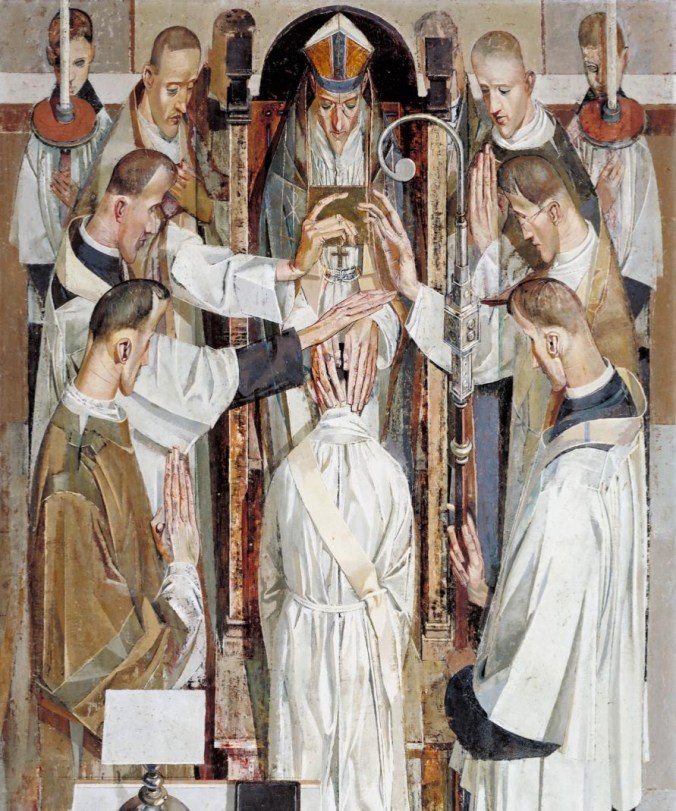
“Ordination,” by Norman Blamey, 1956. (Source)

My friend, Archbishop Mark Haverland, Primate of the Anglican Catholic Church, has just started a new blog called “Anglican Catholic Liturgy and Theology.” You really get what it says on the tin with this one. For those of us with an interest in Anglo-Catholic history, theology, and practice, Archbishop Haverland’s blog will no doubt prove to be a great resource.

The Vampirologist: Dom Augustin Calmet OSB

DomAugustinCalmet.jpg

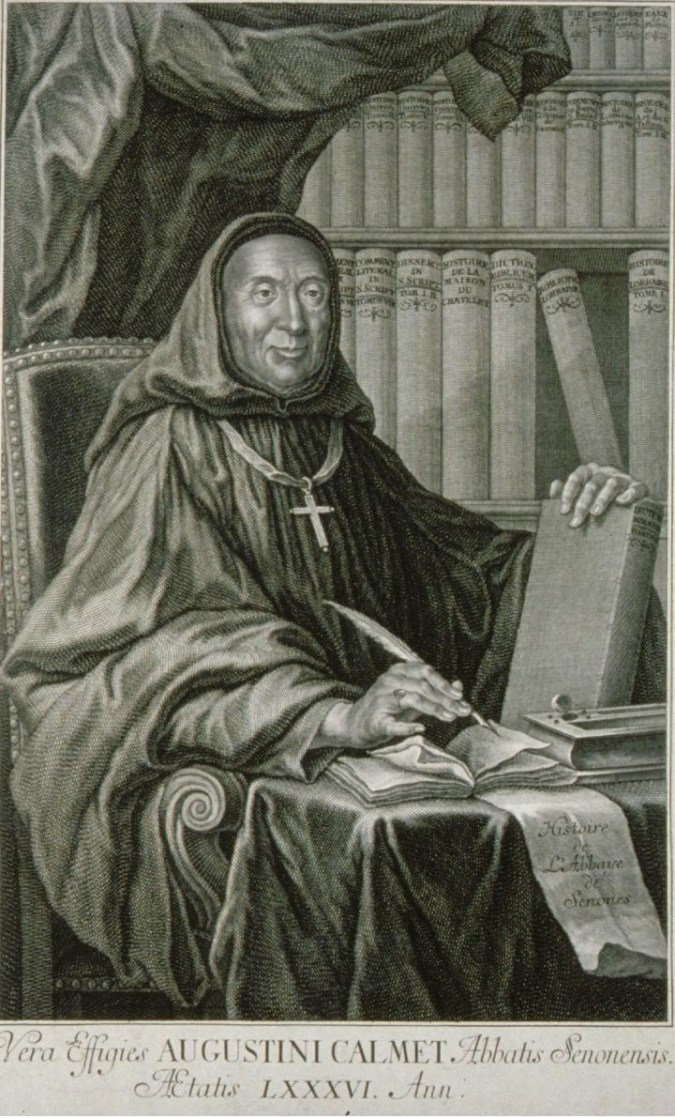
Vera Effigies Augustini Calmet Abbatis Senonensis. (Source).

I was recently asked by the administrator of Catholics from the Crypt to write a brief introduction to Dom Augustin Calmet, Abbot-General of the Congregation of St. Vanne. My qualifications for this task are minimal but, I think, sufficient. First, I know a little about Calmet, which is, sadly, more than many can say. He is an unfairly overlooked figure in our religious and cultural landscape. Secondly, I hope to write my Master’s Thesis on Calmet’s Histoire Universelle, though of course the actual process of research might change my direction. For the time being, I am glad of the challenge, and will likely turn this into the first of a series of short biographies of weird religious figures.

Dom Calmet, born on the 26th of February, 1672, in the then-Duchy of Bar (now Lorraine, France) had a long and impressive career. Entering religious life at the Benedictine Priory of Breuil, he moved around over the years to obtain his education at various abbeys. His itinerary reads like an honor roll of some of the finest establishments of the Franco-German monastic intelligentsia: St. Mansuy, St. Èvre, Munster, Mouyenmoutier, Lay-Saint-Christophe, St. Leopold. Yet the two monasteries most closely associated with his career are Senones Saint-Pierre and Vosges, where he eventually died a holy death.

He achieved widespread scholarly respect for his work in three different fields. First, Calmet distinguished himself as an Exegete. His Biblical method differed from more classical forms of exegesis by focusing entirely on the literal meaning of the text; this exposed him to criticism, even amidst the general acclaim which the book and its abridgements garnered.

DomCalmetTitlePageVampires

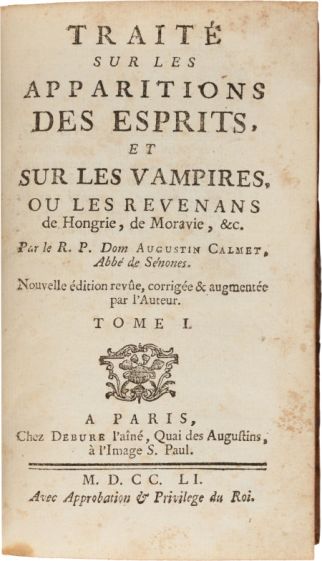
Title page of Book I of his most famous work on Vampires. (Source).

Second, he became an eminent author of sacred and profane history. While my own interest lies most heavily with his Histoire Universelle (1735-47), Calmet also devoted considerable attention to more specific topics. It should come as no surprise, given the libraries to which he had access, that he devoted special care to the region which bore him. His titles include History of the Famous Men of Lorraine (1750), Dissertation on the Highways of Lorraine (1727), Genealogical History of the House of Châtelet (1741), and posthumous histories of both Senones (1877-81) and Munster (1882).

However, Calmet achieved lasting fame for his extremely popular work on Vampires: first, Dissertations on the Apparitions of Angels, Demons, and Spirits, and on the Revenants and Vampires of Hungary, Bohemia, Moravia, and Silesia (1746) He later expanded the text into his famous Treatise on the Apparitions of Spirits and on the Vampires or Revenants of Hungary, of Moravia, &c. in 1752. These texts were, to the best of my knowledge, the first attempt to apply scientific rigor to the tales of the undead then current throughout Europe.

The books were a huge hit, and remain widely respected by occult writers today. To quote one source:

Re-released in 1748, with the most complete edition in 1751, this book is considered to be [the] authoritative treatment on the subject, containing an unprecedented collection of ghostly stories of revenants. It was a best seller for the period, quickly translated into German and Italian for a broader audience. Calmet’s tone considers the possibility of vampires with a certain ambiguity, possibly in light of the larger body of his publications for the church. Still, this is widely regarded as the starting point of all vampiric literature.


The work garnered critical attention from no less a figure than Voltaire. As that eminent source, Wikipedia, relates, Voltaire wrote of Calmet with no small astonishment:

What! It is in our 18th century that there have been vampires! It is after the reign of Locke, of Shaftesbury, of Trenchard, of Collins; it is under the reign of d’Alembert, of Diderot, of Saint-Lambert, of Duclos that one has believed in vampires, and that the Reverend Priest Dom Augustin Calmet, priest, Benedictine of the Congregation of Saint-Vannes and Saint-Hydulphe, abbot of Senones, an abbey of a hundred thousand livres of rent, neighbor of two other abbeys of the same revenue, has printed and re-printed the History of Vampires, with the approbation of the Sorbonne, signed by Marcilli!

[NB: translation is my own]

We can only imagine what conversation transpired between the two thinkers when Voltaire stayed at Senones in 1754, only a few years before the abbot’s death.

It is perhaps unusual that a monk who was, by all accounts, part of the same intellectual circles as the Maurist Enlighteners and the Philosophes would take to such a strange subject. Calmet certainly saw himself as partaking of that wider project. He writes in his preface to the Treatise,

My goal is not at all to foment superstition, nor to maintain the vain curiosity of Visionaries, and of those who believe without examination all that one tells them, as soon as they find therein the marvelous and the supernatural. I do not write but for those reasonable and unprejudiced spirits, who examine things seriously and with sang-froid; I do not speak but for those who do not give their consent to known truths but with maturity, who know to doubt things uncertain, to suspend their judgment in things doubtful, and to refute that which is manifestly false. (Calmet ii).

[NB: translation is my own]

Perhaps we should not be so surprised. After all, the religious history of Europe is peppered with eccentric and erudite men drawn to esoteric studies. And by the time that Dom Calmet died in 1757, the French monastics had not yet reached the height of their oddity. That would come later, with the well-traveled and thoroughly bizarre Swedenborgian and Martinist monk Antoine-Joseph Pernety, whom I hope to someday investigate more thoroughly.

The Revolution changed all that. No longer could monks live their lives freely, let alone attempt serious academic inquiry. It would take the genius of men like Dom Prosper Guéranger to restore the French Benedictines to their former glory.

800px-Senones_88_Saint-Gondelbert.jpg

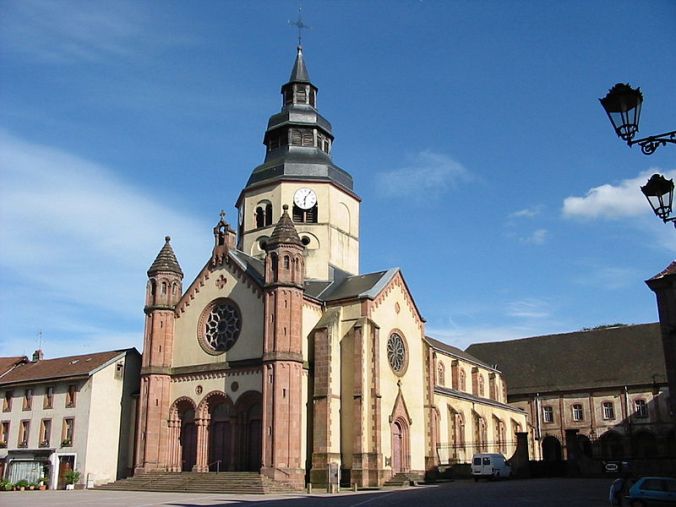
Senones Abbey today. The monastery was dissolved by Revolutionary forces in 1793, then later sold off as State Property and converted into a textile mill. This desecration continued until 1993, when what was left of the abbey became a Monument historique. (Source).