“The Fair and Fatal King”

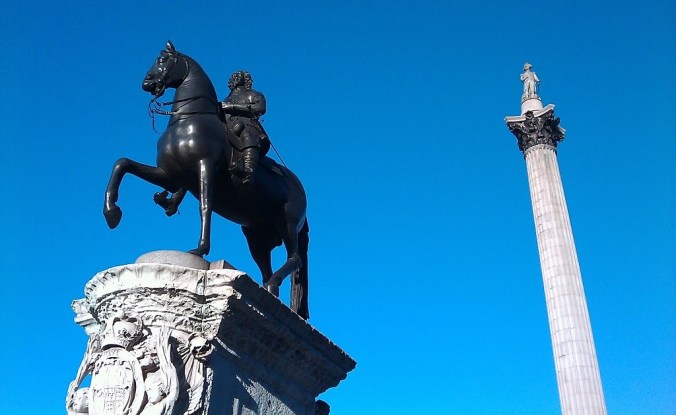
CharlesStatue1

Two heroes, one square: Charles I and Nelson. (Source)

Today may be the anniversary of Louis XVI’s execution, but I just found a wonderful poem about His Majesty Charles I that I wanted to share with my readers. Something to meditate upon before the 30th.

By the Statue of King Charles at Charing Cross

Lionel Johnson
To William Watson

Sombre and rich, the skies,
Great glooms, and starry plains;
Gently the night wind sighs;
Else a vast silence reigns.

The splendid silence clings
Around me: and around
The saddest of all kings,
Crowned, and again discrowned.

Comely and calm, he rides
Hard by his own Whitehall.
Only the night wind glides:
No crowds, nor rebels, brawl.

Gone too, his Court: and yet,
The stars his courtiers are:
Stars in their stations set;
And every wandering star.

Alone he rides, alone,
The fair and fatal King:
Dark night is all his own,
That strange and solemn thing.

Which are more full of fate:
The stars, or those sad eyes?
Which are more still and great:
Those brows, or the dark skies?

Although his whole heart yearn
In passionate tragedy,
Never was face so stern
With sweet austerity.

Vanquished in life, his death
By beauty made amends:
The passing of his breath
Won his defeated ends.

Brief life, and hapless? Nay:
Through death, life grew sublime.
Speak after sentence? Yea:
And to the end of time.

Armoured he rides, his head
Bare to the stars of doom;
He triumphs now, the dead,
Beholding London’s gloom.

Our wearier spirit faints,
Vexed in the world’s employ:
His soul was of the saints;
And art to him was joy.

King, tried in fires of woe!
Men hunger for thy grace:
And through the night I go,
loving thy mournful face.

Yet, when the city sleeps,
When all the cries are still,
The stars and heavenly deeps
Work out a perfect will.

On the Coronation of the Coredemptrix

Corredenzione2

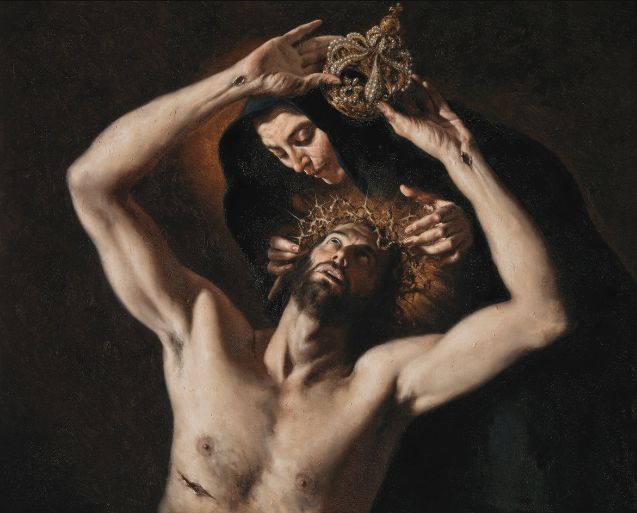
Corredenzione, by Giovanni Gasparro. This painting convinced my heart of the doctrine of the Co-Redemption of Mary. (Source).

It is appropriate on this Feast of Our Lady’s Coronation and Everlasting Queenship that we contemplate the fleeting thrones of this lesser world. Let us commemorate the loss of two great English dynasties, fixed on this day by Providence.

On Aug. 22, 1485, His Majesty King Richard III was defeated on Bosworth Field by a usurper from the House of the Tudors. The Red Dragon of Wales eclipsed the White Rose of York; years later, T.S. Eliot would wear the flower every 22nd of August.

RIII-Banner-RIIIF

The Personal Standard of Richard III. (Source).

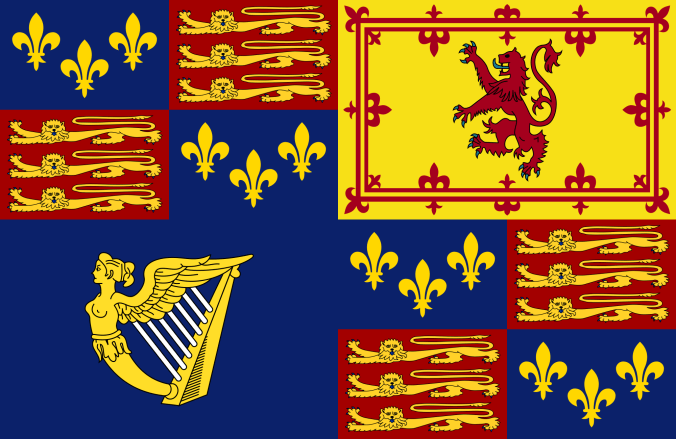
On Aug. 22, 1642, His Majesty King Charles I raised the Royal Standard at Nottingham. This act has widely been considered the formal start of the English Civil War that would end in Puritan dictatorship, the slaughter of the Irish and Scots, and the martyrdom of the King himself for the doctrine of Episcopacy.

RoyalStandardStuarts.jpg

The Royal Standard of the Stuarts, 1603-1649. (Source).

Consider the leaden weight of these crowns. Worn by men alternately noble and feeble, loyal and inconstant, heroic and fearful, they rot away with the passage of time. The gilt of their craft and the earthly acclaim of their subjects have gone the way of all flesh. Those crowns are memories, but even in memory they do not earn the glory and affection they once inspired. Their reputations are occulted with cumbersome connotations. Richard has been much maligned ever since his death, in part by no less a personage than Shakespeare himself. Charles, a more complicated figure, has been swallowed up by his role as the symbolic center of Tory anxieties and Whig acrimony for the better part of four centuries. More bitterly, both kings “Accept the constitution of silence/And are folded in a single party.” They have become an unimportant datum of historical trivia for most people, even in England.
the-coronation-of-the-virginLimbourg.jpg

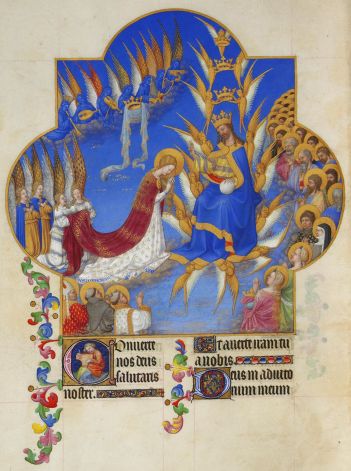
The Coronation of the Virgin, by the Limbourg Brothers. (Source)

How unlike those crowns is that won by Mary! She who was immaculately conceived and preserved from every stain of sin never sullies her crown by any failure of virtue. Having borne the Son of God in her womb, no other glory could ever outstrip what she has already known in her perpetually virginal maternity. Assumed into heaven, she is preserved from the terrible corruption of the grave. And now, as the Church celebrates the Octave Day of the Assumption, we contemplate the eternal joy which her coronation engenders in all the ranks of the blessed. All generations have called her blessed, and all will forevermore. She will never be reduced in the eyes of the world, because no one is more perfect in the eyes of God.

Has there ever been so marvelous a creature as Mary? Can we name, in the orderly chaos of the creation, a being more closely united to the Trinity? Who else among mere mortals has been lauded as “More honorable than the Cherubim, and more glorious beyond compare than the Seraphim?” In her burns the fire of charity; in her grows the ground of humility; in her flows the water of purity; in her soars the mighty wind of patience. She is the New and Sophianic Eve, in which the Wisdom of God is most clearly manifest.

And why? Because she is the threefold Mother of the Redeemer. First, by her Fiat, she assents to a physical maternity of the Word Incarnate. Second, by the sorrows of her Immaculate Heart at the Cross, she wins a sacramental maternity of Christ in the Eucharist. And third, by her prayer in the Cenacle on Pentecost, she gains a mystical maternity of Christ in the whole Church. This threefold motherhood is but one theandric maternityand thus we see the Trinitarian character of Our Lady’s co-redemption. She and she alone of all mankind is so favored and so bound to the work of Christ.
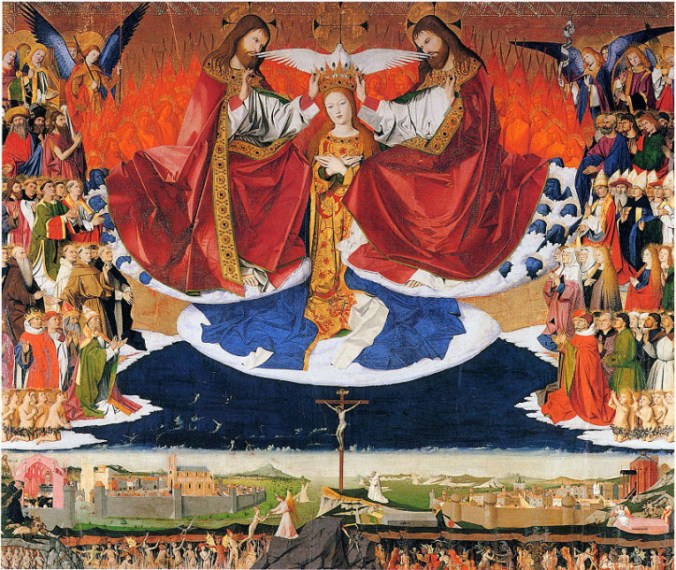
art-and-liturgy-enguerrand-quarton-coronation-of-the-virgin-1454

Coronation of the Virgin, Enguerrand Quarton. 1454. (Source). Mary crowned by the Trinity is surely an icon of the Eschaton.

A friend of mine passed on this passage from St. Amadeus of Lausanne, a Cistercian most famous for his eight homilies in praise of the Mother of God. He took it from Universalis, which gives the full liturgy of the hours online. Thus, the Church particularly commends these words to us on this holy day:

Observe how fitting it was that even before her assumption the name of Mary shone forth wondrously throughout the world. Her fame spread everywhere even before she was raised above the heavens in her magnificence. Because of the honour due her Son, it was indeed fitting for the Virgin Mother to have first ruled upon earth and then be raised up to heaven in glory. It was fitting that her fame be spread in this world below, so that she might enter the heights of heaven on overwhelming blessedness. Just as she was borne from virtue to virtue by the Spirit of the Lord, she was transported from earthly renown to heavenly brightness.

So it was that she began to taste the fruits of her future reign while still in the flesh. At one moment she withdrew to God in ecstasy; at the next she would bend down to her neighbours with indescribable love. In heaven angels served her, while here on earth she was venerated by the service of men. Gabriel and the angels waited upon her in heaven. The virgin John, rejoicing that the Virgin Mother was entrusted to him at the cross, cared for her with the other apostles here below. The angels rejoiced to see their queen; the apostles rejoiced to see their lady, and both obeyed her with loving devotion.
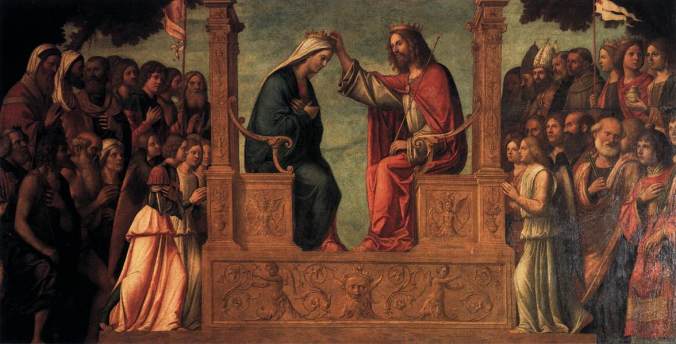
the-coronation-of-the-virginCimaThe Coronation of the Virgin, Cima da Conegliano. (Source).

Dwelling in the loftiest citadel of virtue, like a sea of divine grace or an unfathomable source of love that has everywhere overflowed its banks, she poured forth her bountiful waters on trusting and thirsting souls. Able to preserve both flesh and spirit from death she bestowed health-giving salve on bodies and souls. Has anyone ever come away from her troubled or saddened or ignorant of the heavenly mysteries? Who has not returned to everyday life gladdened and joyful because his request had been granted by the Mother of God?

She is a bride, so gentle and affectionate, and the mother of the only true bridegroom. In her abundant goodness she has channelled the spring of reason’s garden, the well of living and life-giving waters that pour forth in a rushing stream from divine Lebanon and flow down from Mount Zion until they surround the shores of every far-flung nation. With divine assistance she has redirected these waters and made them into streams of peace and pools of grace. Therefore, when the Virgin of virgins was led forth by God and her Son, the King of kings, amid the company of exulting angels and rejoicing archangels, with the heavens ringing with praise, the prophecy of the psalmist was fulfilled, in which he said to the Lord: At your right hand stands the queen, clothed in gold of Ophir.
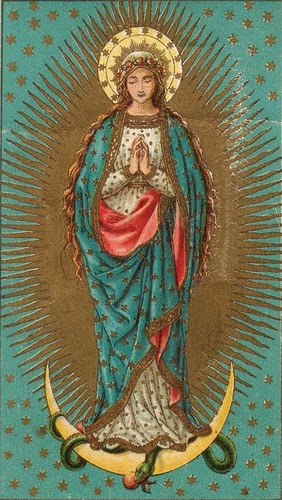
WomanClothedWiththeSun

An illustration of “The Woman Clothed With the Sun.” (Source)

St. Amadeus is right; “Has anyone ever come away from her troubled or saddened or ignorant of the heavenly mysteries? Who has not returned to everyday life gladdened and joyful because his request had been granted by the Mother of God?” We who still struggle with sin on the path to beatitude cannot hope to achieve our goal if we will not be with and like Mary. We, too, are promised crowns. The scriptures mention five: the imperishable crown (1 Cor. 5:24-25), the crown of rejoicing (1 Thess. 2:19), the crown of righteousness (2 Tim. 4:8), the crown of glory (1 Pet. 5:4), and the crown of life (Rev. 2:10). Our Lady wears all these and seven more, for she is the “woman clothed with the sun, and the moon under her feet, and upon her head a crown of twelve stars” (Rev. 12:1 KJV). Are these other seven stars the seven gifts of the Holy Spirit, her spouse? Or the seven cardinal virtues? Or the seven sacraments that constitute the Church? Or the seven lesser ranks of the angels in praise of their queen? Impossible to say. Mary is not only the fountain of all holiness, but the mother of the Church’s deepest mysteries.

How might I end this praise of Our Lady that could properly continue ad infinitum? By returning to those lesser crowns with which I began.

Earthly splendor is no great thing. It can only be built on sufferingeither our own or that of others. Even when turned to good (as, I would argue, Charles I attempted to use his power), it reflects something of our fallen state. It is slippery, contingent, and as mortal as we are. But the glory of heaven is without end. Incorrupt and incorruptible, it abides in the gaze of the Father. Mary, above all creation, receives this kind of glory. She, the New Eve to the New Adam, mirrors Him in all things. Let us run after the course she trod before us, the course of Her Son’s redemption! Only by pursuing a life like Christ’s can we hope for a reward like Mary’s.

May she pray for us as we celebrate her feast today.
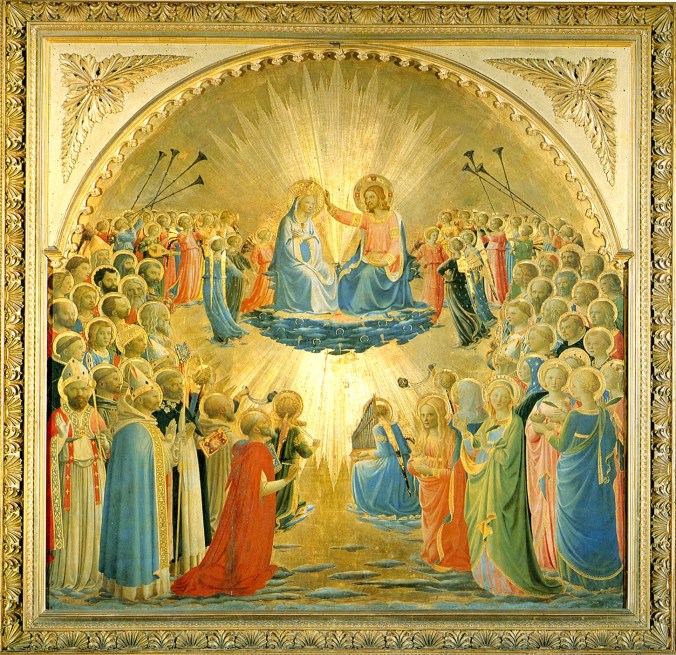
coronation-of-the-virgin-fra-angelico-big.jpg

“Coronation of the Virgin,” Fra Angelico. (Source). The Blessed Angelico returned to this subject throughout his career, but this version, hanging in the Uffizi Gallery, is my favorite.
Life Update: Graduate School

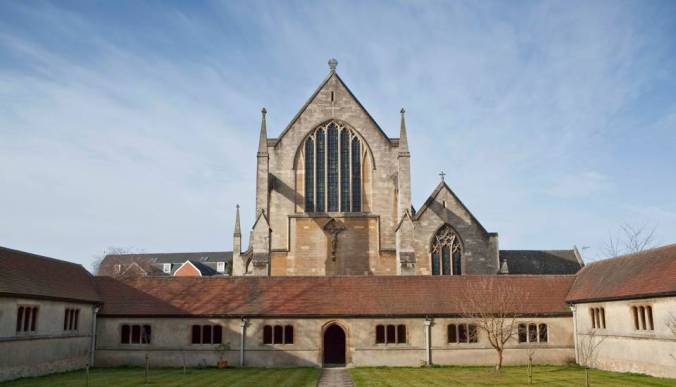
SSHChurchView

St. Stephen’s House, Oxford. Source.

This won’t come as a surprise to those of you who know me personally, but in the interest of honesty, archiving, and my own historical interests, I thought I’d post here that I have decided to attend the University of Oxford next year in pursuit of an M.Phil. in Theology, with a concentration in Ecclesiastical History. I will be living at St. Stephen’s House.

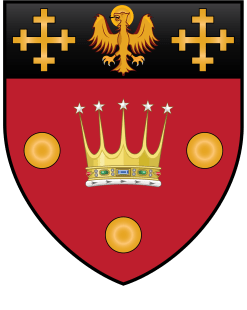
StaggersCrest.jpg

The coat of arms of St. Stephen’s House. It incorporates elements of the coat of arms of its founder, Bishop Edward King. (Source)

I’m very happy to be at St. Stephen’s. It is the Anglo-Catholic seminary in Oxford. I am guaranteed to be around people who are seeking ordination in the Church of England. And very high Anglo-Catholics at that. I’m really looking forward to morning and evening prayer every day. While it may not be the prayer of the whole Church in the Divine Office, the Book of Common Prayer is nevertheless a fine, beautiful way to pray and meditate on Scripture in community. I also think that the liturgical rhythms of life at “Staggers,” as it’s called, will be salutary on the whole. It’s even motivated me to try to memorize a few of the old collects, as Peter Hitchens demonstrates in this debate.

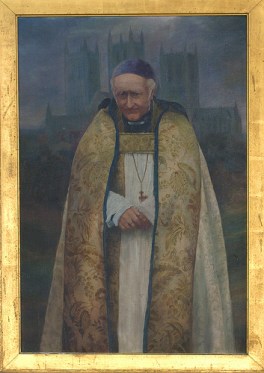
While I realize it has changed a great deal over time, the history of St. Stephen’s House is one of the reasons I’m happy to be here. It may not be one of the well-known colleges (it doesn’t even seem to have very much merchandising in the way of scarves, ties, pins, cufflinks, etc., like all the other ones). But Staggers did play its part in the history of Anglo-Catholicism. Founded by Bishop Edward King of Lincoln in 1876, the house soon became a major center of Anglo-Catholicism. It started to produce Tractarian priests by the dozens, and eventually gained a reputation as a factory of bishops and deans of cathedrals. This prolific connection to the Church of England’s highest chambers has continued into its more recent years.

edward-king

Edward King, Bishop of Lincoln. (Source)

Its relationship with Oxford, on the other hand, has varied. It only attained Permanent Private Hall status in 2003. In moving to that arrangement, it joined other historically religious foundations at Oxford: Blackfriars for the Dominicans, St. Benet’s for the Benedictines of Ampleforth, Wycliffe Hall for Evangelicals, Campion Hall for the Jesuits, and Regent’s Park (nominally) for the Baptists. It was at that time that the House broadened its emphasis to include those who were not seeking ordination in the C of E.

Moreover, Staggers has moved around Oxford. It started as a small community near the heart of town, and only much later moved to its present location across the Cherwell. To wit:

For the House’s first years, it was situated near the centre of Oxford, where the New Bodleian Library now stands. From 1919, the House had a site in Norham Gardens, near to the University Parks. In 1980 it moved to the current site…(St. Stephen’s House Blog).

The accommodations that the House took up were built by the Society of St. John the Evangelist, named alongside the parish church they ran (although it is now largely a concert venue, the House clergy still conduct liturgies there each week). The Society priests were also known as the Cowley Fathers. T.S. Eliot conducted at least one retreat there, although he was generally closer to the Benedictines at Nashdom and the Society of the Sacred Mission at Kelham (see Spurr’s biography, Anglo-Catholic in Religion).

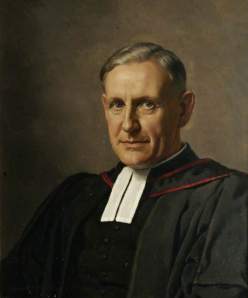
In the mid 20th century, the House prospered under the benevolent influence of Father Arthur Couratin, allegedly referred to by some as “Noël Coward in a clerical collar.”

Halliday, Edward Irvine, 1902-1984; Reverend Canon Arthur Couratin, Former Principal of St Stephen's House

Canon Arthur Couratin, Principal of St. Stephen’s House. (Source)

Although its ethos remains largely Anglican, the House has offered a few important alumni to the Church of Rome. Balthasar scholar and theologian Father John Saward graduated there, as did the one-time Bishop of Ebbsfleet and current priest of the English Ordinariate, Monsignor Andrew Burnham. Indeed, they’ve even produced the Primate of the Western Diocese of the Armenian Church of North America, Hovnan Derderian. He is the youngest Armenian archbishop.

Staggers also gave the Church of England Fr. Kenneth Leach, an important Christian Socialist priest. He was trained at St. Stephen’s when it had become a rather homoerotic place, and Leach would famously sum up his time there as “gin, lace, and backbiting.” The writer and Staggers alum A.N. Wilson composed a bitingly comedic satire of the House in those years, entitled Unguarded Hourswhich, as Ignatius Press’s reviewer puts it, is decidedly “not a Catholic novel.” Alas. Wilson, who would eventually return to Christianity after years of very public atheism, would later recall the custom formerly in vogue at Staggers of taking “religious names” that were actually rather saucy nicknames, often of the opposite sex. If Father Couratin was “Noël Coward in a clerical collar,” it seems that by the 1970’s, you were more likely to find Julian and Sandy in soutanes.

I seriously doubt that any of that persists. Women’s ordination in the C of E means that, while many Anglo-Catholics have become more liberal, their seminaries no longer smack of the kinds of homoerotic associations that fueled so many stereotypes (see Cousin Jasper’s famous quip in Brideshead Revisited). Staggers seems to remain as a pillar of sensible, ornate, properly Anglo-Catholic liturgy at its best.

StStephensLiturgy1

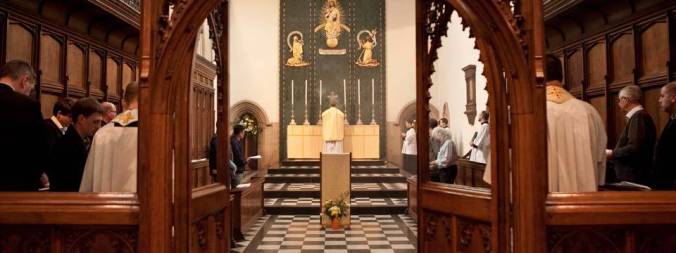
A liturgy at the parish church of St. John the Evangelist, St. Stephen’s House, Oxford. (Source).

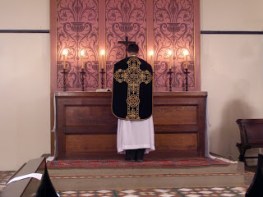
Requiem

A requiem for the founders of the House. (Source)

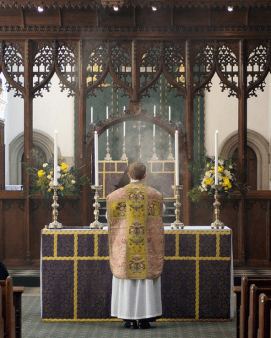
StStephensHouseRose.jp

A priest says a Mass at St. Stephen’s House. I highly recommend the source I took this from, Merrily On High. An excellent source for all things Anglo-Catholic.

Of course, I could also emphasize the importance of Oxford in general as a center of CatholicismRoman and otherwise. Here, the Subtle Doctor “fired France for Mary without spot.” Here, Cardinal Wolsey established a college named for his office and, later, all of Christ’s Body on earth. Here, Archbishop Laud attempted to bring back devotion to Our Lady through a little portico on her church in town. Here, Charles I took refuge while his queen heard the Mass of Ages in Merton Chapel. Here, Keble railed against a “National Apostasy.” Here, Newman battled the liberals, and in doing so, broke ground for the Second Spring. Here, Gerard Manley Hopkins served briefly as curate. Here, Oscar Wilde flirted with men and the Church for the first time. Here, Monsignor Ronald Knox cut his clerical teeth as the chaplain of Trinity College. Here, Montague Summers was first haunted by the Vampyre’s shadow. Here, Tolkien and Lewis and Williams and their friends spoke about God long into the stout-softened night. Here, T.S. Eliot studied briefly before going on to greatness in London. Here, Evelyn Waugh thought up a story about two men and a teddy bear. Here, Father Martin D’Arcy pondered the ways of divine and human love. Here, the Oratory finally arrived in 1990 to fulfill Newman’s dream. Here, the late Stratford Caldecott wrote of God’s undying beauty in all things.

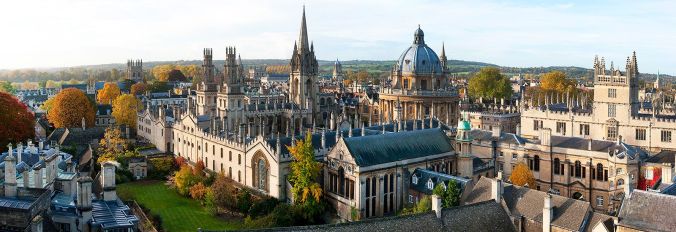
OxfordSkyline1

An Oxford morning. (Source).

I could name more ways in which Oxford has played a special role in the life of the Catholic Church. Perhaps I will do so in another post, or a series of posts. For now, I’m just happy to say that I’ll be in a place with a lot of Catholic history, learning about that history. And thank God for that.

CrivelliStephen

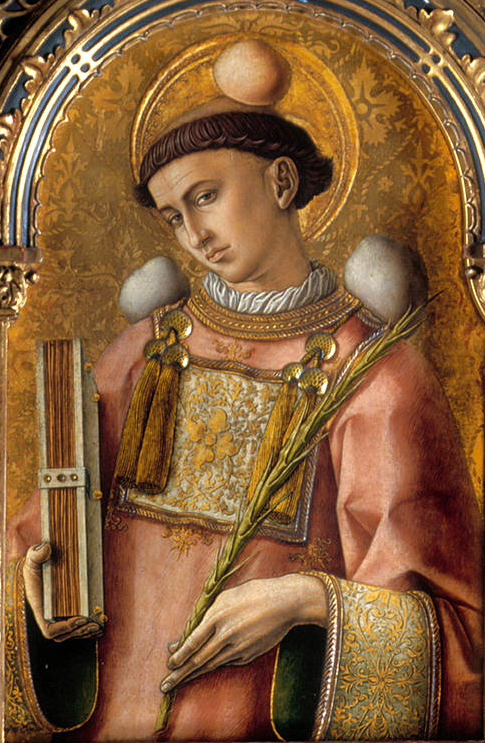
“Saint Stephen,” by Carlo Crivelli. Proto-martyr and patron of St. Stephen’s House, Oxford (and perhaps a rather wan patron at that, by the look of this paintingis that asparagus in his hand?). (Source)

PrinceofWalesatStaggers

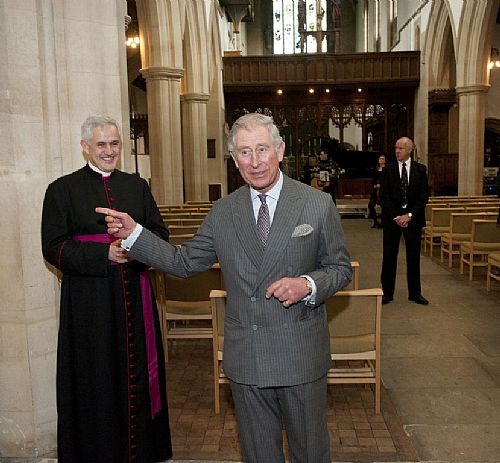
Also, apparently the Prince of Wales sometimes visits. (Source)