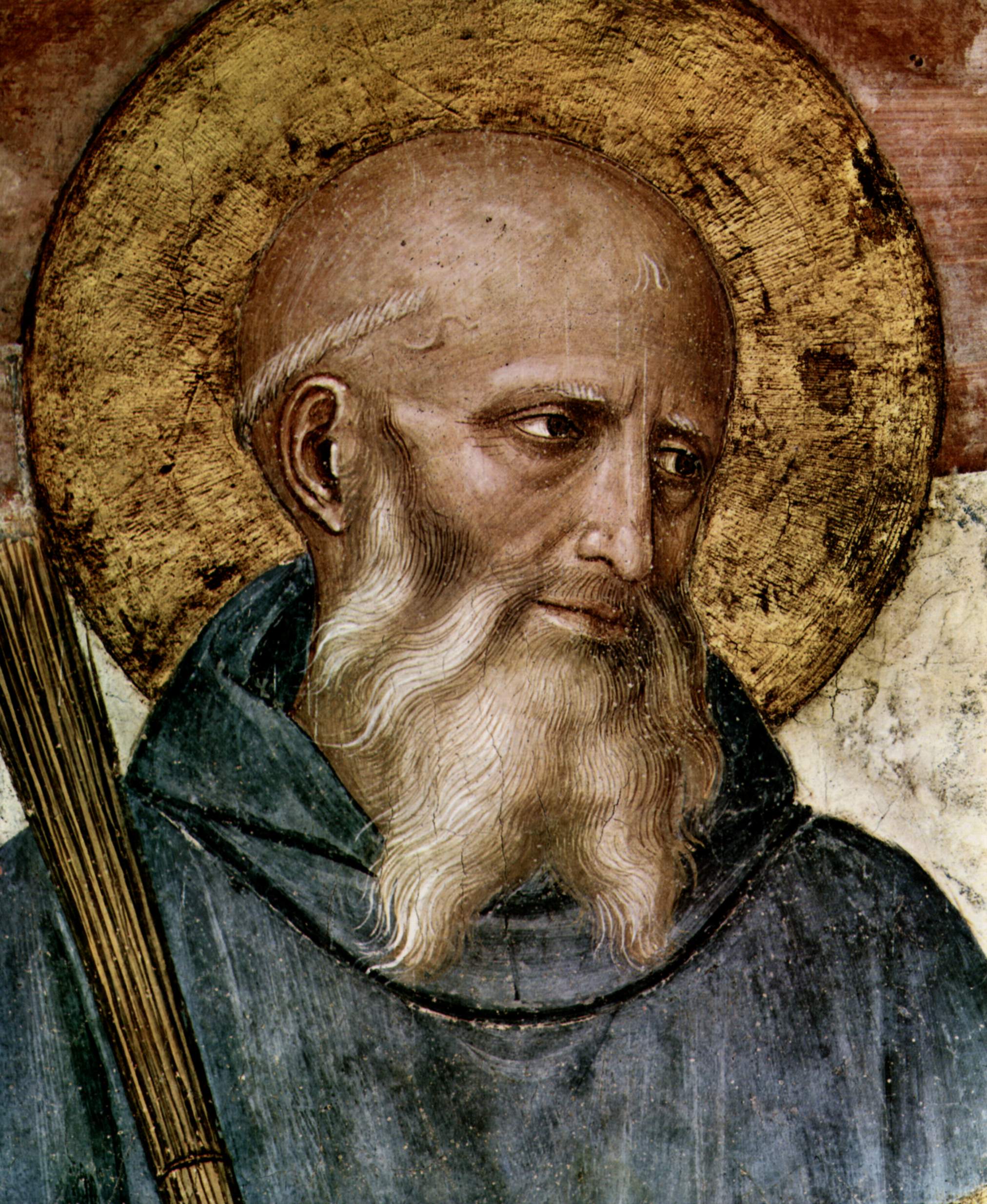
The Saint, the Centaur, and the Satyr

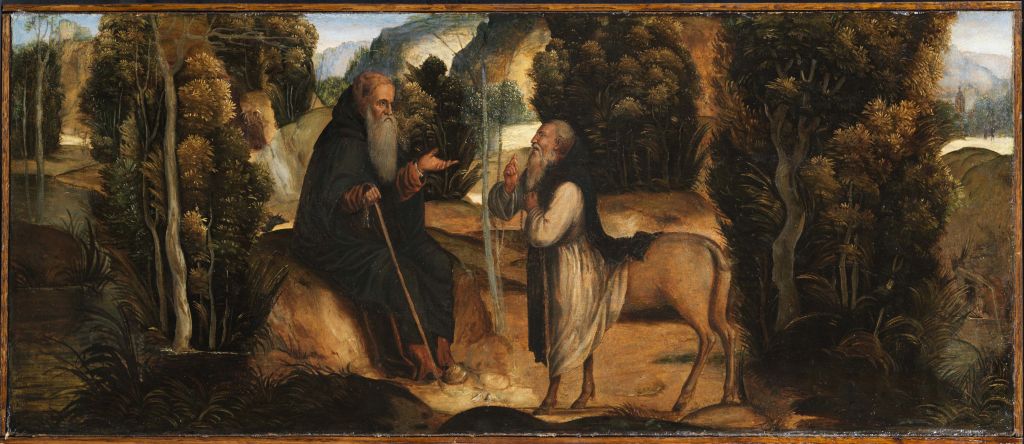
On this feast of St. Anthony the Abbot, I am reminded of a peculiar episode in the life of the saint that St. Jerome records. In full, it reads:
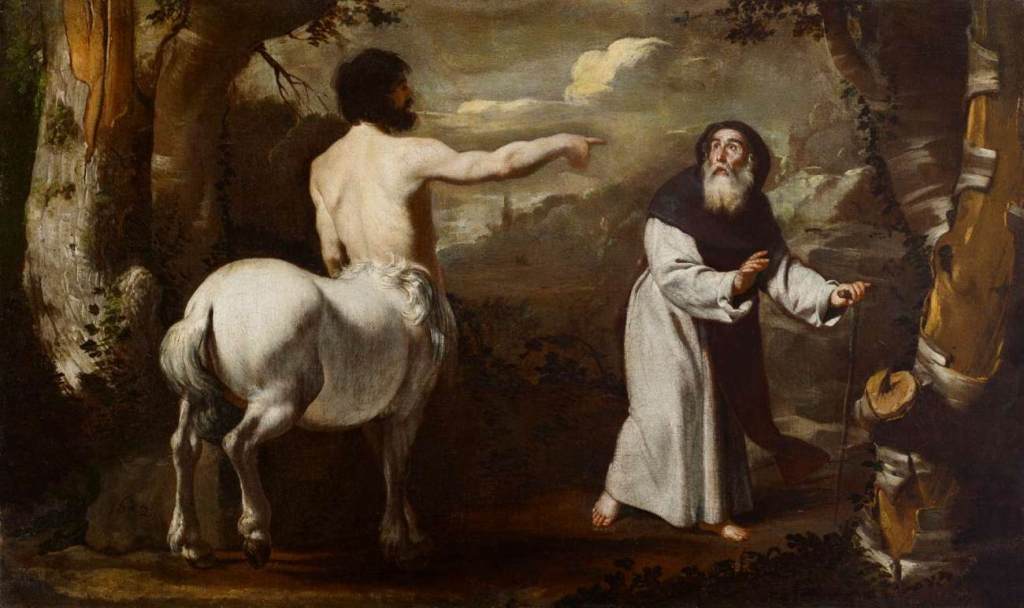
Francesco Guarino, St. Anthony Abbot and Centaur, 1642 (Source)

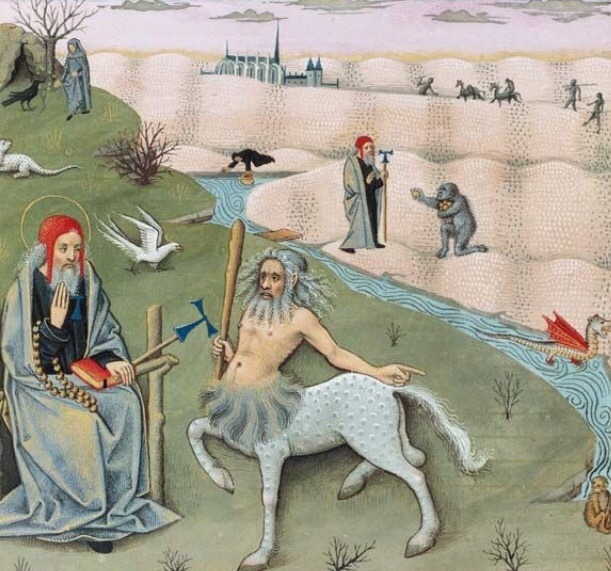
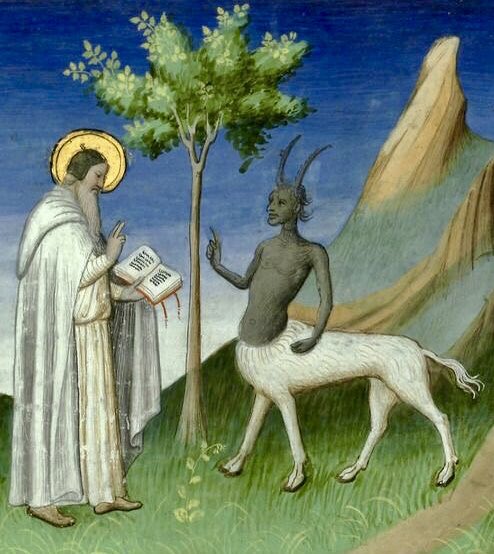
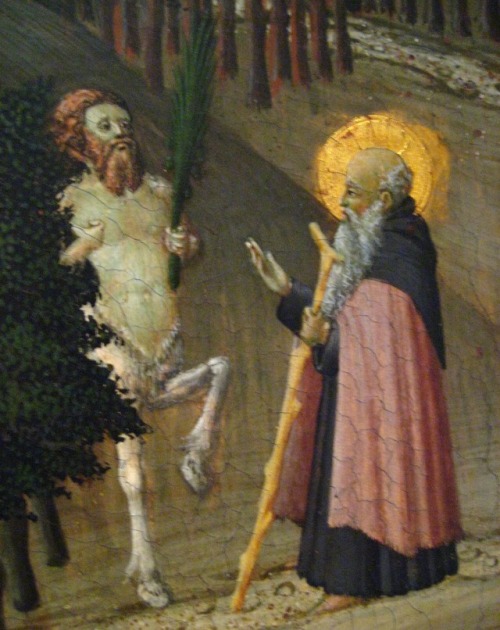
But to return to the point at which I digressed. The blessed Paul had already lived on earth the life of heaven for a hundred and thirteen years, and Antony at the age of ninety was dwelling in another place of solitude (as he himself was wont to declare), when the thought occurred to the latter, that no monk more perfect than himself had settled in the desert. However, in the stillness of the night it was revealed to him that there was farther in the desert a much better man than he, and that he ought to go and visit him. So then at break of day the venerable old man, supporting and guiding his weak limbs with a staff, started to go: but what direction to choose he knew not. Scorching noontide came, with a broiling sun overhead, but still he did not allow himself to be turned from the journey he had begun. Said he, I believe in my God: some time or other He will show me the fellow-servant whom He promised me. He said no more. All at once he beholds a creature of mingled shape, half horse half man, called by the poets Hippocentaur. At the sight of this he arms himself by making on his forehead the sign of salvation, and then exclaims, Holloa! Where in these parts is a servant of God living? The monster after gnashing out some kind of outlandish utterance, in words broken rather than spoken through his bristling lips, at length finds a friendly mode of communication, and extending his right hand points out the way desired. Then with swift flight he crosses the spreading plain and vanishes from the sight of his wondering companion. But whether the devil took this shape to terrify him, or whether it be that the desert which is known to abound in monstrous animals engenders that kind of creature also, we cannot decide.

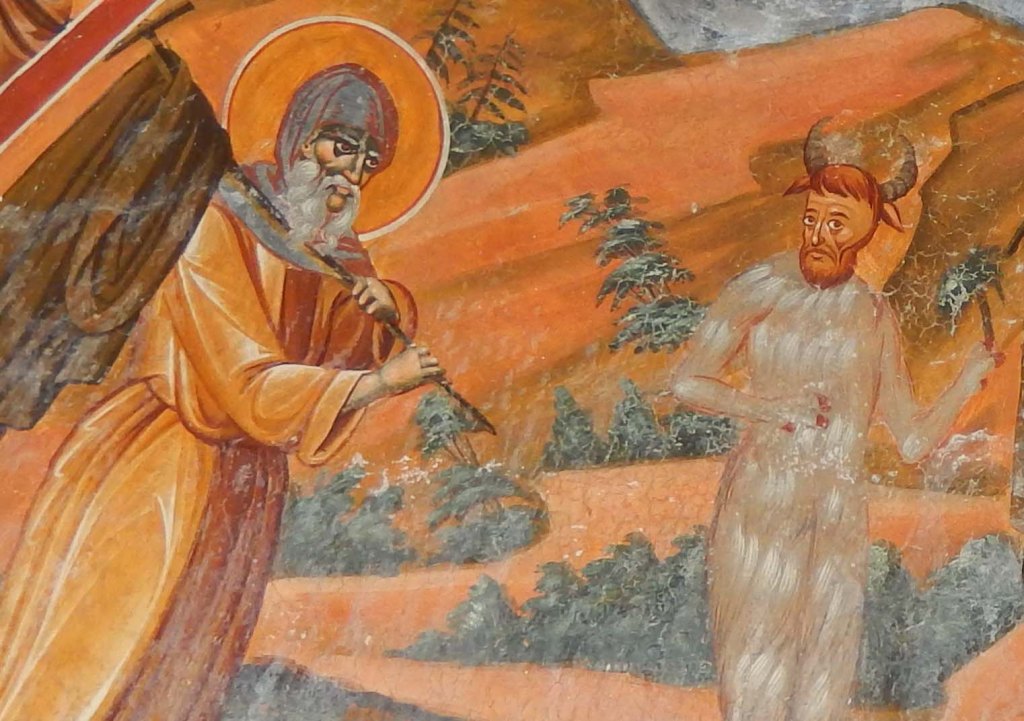
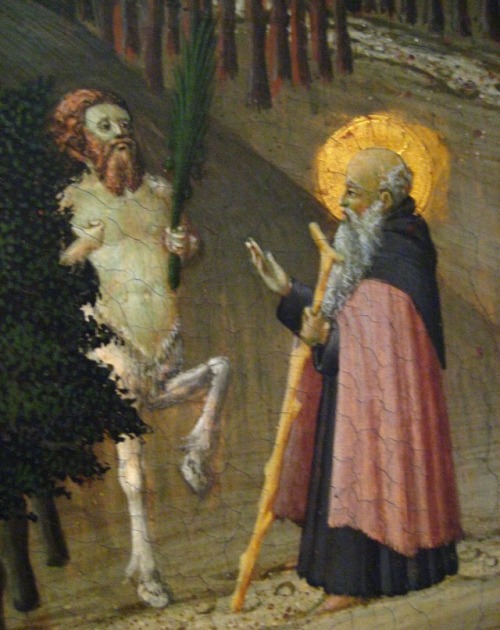
Antony was amazed, and thinking over what he had seen went on his way. Before long in a small rocky valley shut in on all sides he sees a mannikin with hooked snout, horned forehead, and extremities like goats’ feet. When he saw this, Antony like a good soldier seized the shield of faith and the helmet of hope: the creature none the less began to offer to him the fruit of the palm-trees to support him on his journey and as it were pledges of peace. Antony perceiving this stopped and asked who he was. The answer he received from him was this: I am a mortal being and one of those inhabitants of the desert whom the Gentiles deluded by various forms of error worship under the names of Fauns, Satyrs, and Incubi. I am sent to represent my tribe. We pray you in our behalf to entreat the favour of your Lord and ours, who, we have learned, came once to save the world, and ‘whose sound has gone forth into all the earth.’ As he uttered such words as these, the aged traveller’s cheeks streamed with tears, the marks of his deep feeling, which he shed in the fullness of his joy. He rejoiced over the Glory of Christ and the destruction of Satan, and marvelling all the while that he could understand the Satyr’s language, and striking the ground with his staff, he said, Woe to you, Alexandria, who instead of God worships monsters! Woe to you, harlot city, into which have flowed together the demons of the whole world! What will you say now? Beasts speak of Christ, and you instead of God worship monsters. He had not finished speaking when, as if on wings, the wild creature fled away. Let no one scruple to believe this incident; its truth is supported by what took place when Constantine was on the throne, a matter of which the whole world was witness. For a man of that kind was brought alive to Alexandria and shown as a wonderful sight to the people. Afterwards his lifeless body, to prevent its decay through the summer heat, was preserved in salt and brought to Antioch that the Emperor might see it.

St. Jerome, The Life of Paul the First Hermit, 7-8.

Let it never be said that the lives of the saints are boring. Artists, like Demonologists, have throughout the centuries returned to these scenes again and again. The Centaur shows up a lot, probably because it’s a subject that permits the artist to show off his own talents at depicting both human and equine anatomy. Yet we can also detect here a certain visual sensibility that can only be described as picturesque delight and fascination.
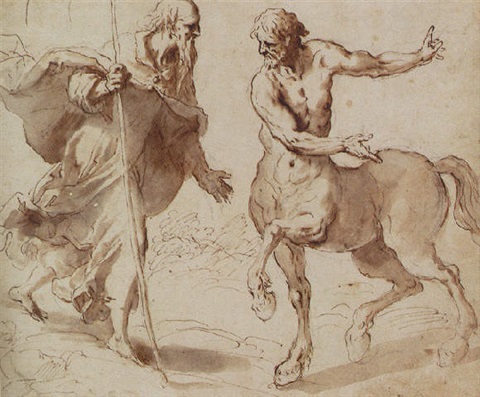
Jacopo Palma il Giovane, Saint Anthony Abbot asking the Centaur the way (Source)
Osservanza Master, The Meeting of Saint Anthony and Saint Paul, 1430-35, detail (Source)
Benedetto di Montagna, St. Anthony and the Centaur. The depiction of the Centaur as a monk is particularly unusual. (Source)
A less common depiction, St. Anthony and the Satyr (Source)
A medieval depiction of St. Anthony with both the Centaur and the Satyr, by Robert Testard. (Source)
John Mandeville’s take on the scene, with color highlighting the hybridity of the Centaur’s nature. (Source)
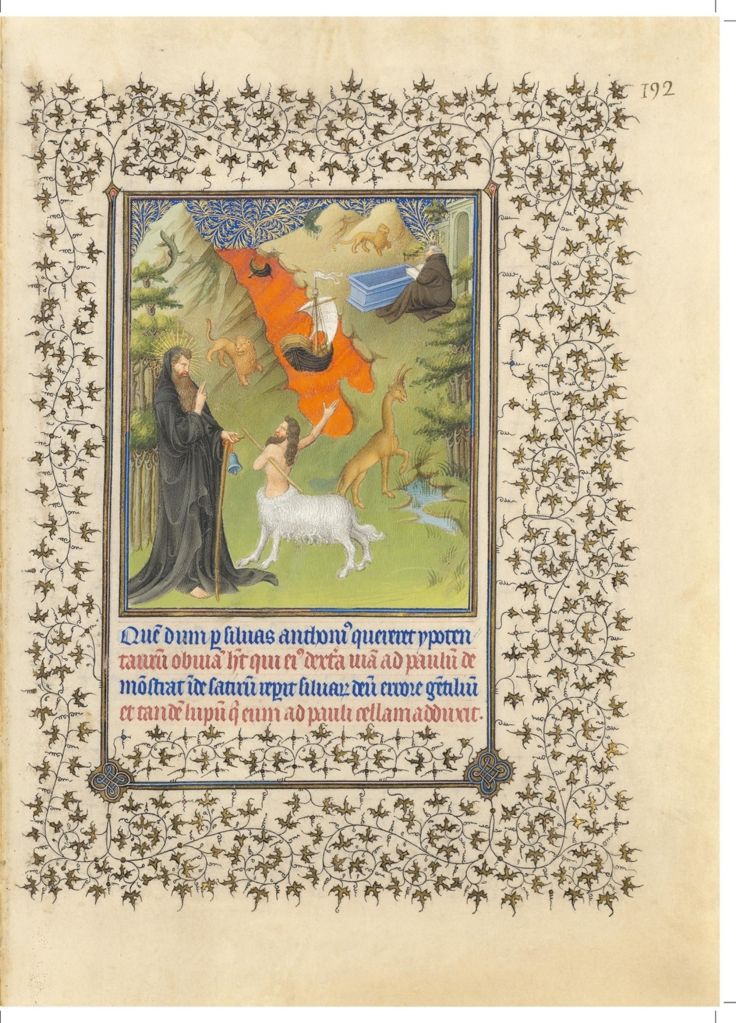
St. Anthony meets the Centaur in an illumination by Jean de Limbourg (Source)

Happy New Year and New Decade!

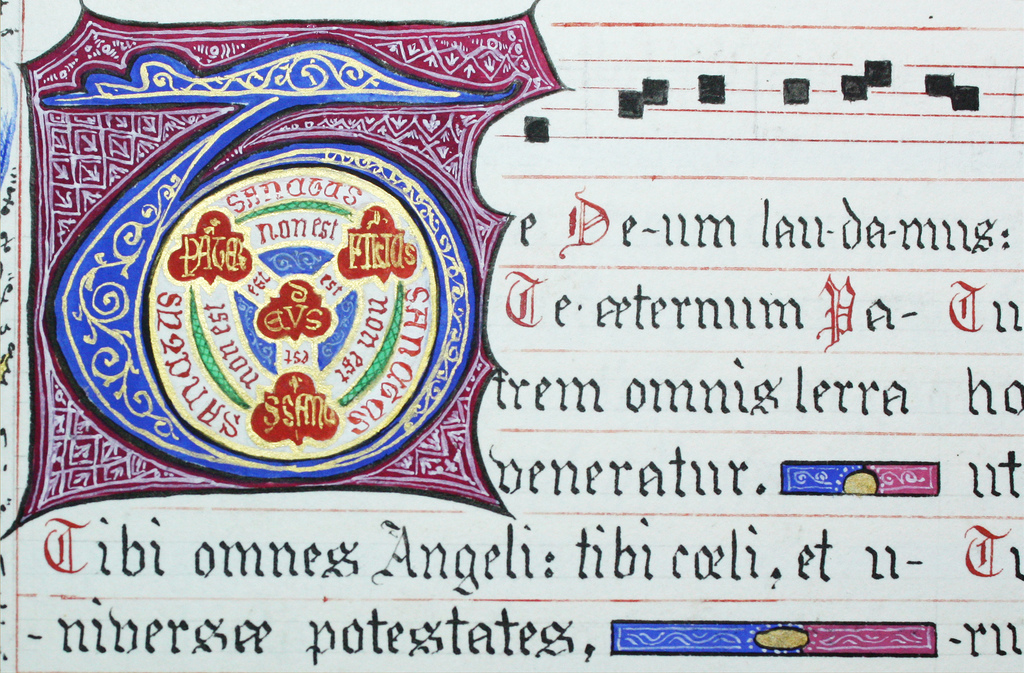
Te Deum, the chant of the New Year. (Source)

Thus concludes Anno Domini MMXIX. It is strange to think that we are about to enter the third decade of the new millennium. I am by temperament a pessimist, but I hope that this decade is an improvement over the last (a time in which I experienced a tremendous amount of personal growth). Let us pray for God’s continuing mercy and Providence.

Here are some blog stats from the last year, for those who are interested.

In 2019, The Amish Catholic received a total of 66,839 views, with a total of 39,175 visitors. My total views were down this year by 1,035, though I received 3,969 more visitors in 2019. My most popular month was March, in which I received 19,066 views and 12,919 visitors. My least popular month was February, with only 3,011 views and 1,369 visitors. This is really all very good news, since I published many fewer pieces in 2019 than in 2018 – this has been my most intense calendar year of studies ever. Including this summary, I published 42 pieces in 2019 – down from 109 in 2018. Had I been a bit more productive, all my other numbers would have gone up this year.

Here are my top 10 posts:

  1. 100 Edifying Lenten Penances (with over 12,000 views, this is my most popular post ever)
  2. 30 Alternate Religious Mottos
  3. Elsewhere: Courage, the Cardinal, and the Sex Abuse Crisis
  4. When the Sacred is Strange: The Art of Giovanni Gasparro (this one is from 2017, but it remains perennially popular)
  5. The Hidden Wound of Christ
  6. We Do Not Need St. Chesterton
  7. The Best Monastic Documentaries (from 2018)
  8. The Ratzinger Letter: A Failure
  9. Chesterton on Cheese (one of my earliest posts, from June of 2017)
  10. Elsewhere: Catholic Kabbalah

Humor keeps the top spots, while works of controversy and commentary appear with greater frequency this year than in the past. Spiritual and academic pieces usually don’t have a terribly wide appeal – which is probably good, because I’m a young layman and a lowly grad student.

I will highlight one academic piece, however, of which I am somewhat proud: my Church Life Journal argument in favor of the fundamental Catholicity of Jansenism and the continuing relevance of these early modern controversies. The Jansenist controversy remains one of the most important and misunderstood chapters in Church history. I hope to expand some of these themes here and elsewhere in the new year.

I suppose I could finish this trying to come up with a list of lessons I’ve learned over the course of the last year – in blogging, in life, etc. The temptation is even greater in view of the closing decade. Yet that often seems rather contrived. I would rather close with what seems to me the best way to end a year and a decade: on a note of gratitude. I could not have gotten where I am today without tremendous help along the way. Friends, family, mentors, and even strangers have made my life better in ways that I cannot begin to describe. Thank you to everyone who has been there along the way. You know who you are.

And thanks to the friends in heaven who have helped with their many prayers. As I concluded 2018, so will I finish the decade – with a prayer that encompasses all of time.

Glory Be to the Father, and to the Son, and the Holy Ghost,
As it was in the beginning, is now, and ever shall be, world without end.
Amen.

“Reversed Thunder, Christ-Side-Piercing Spear”

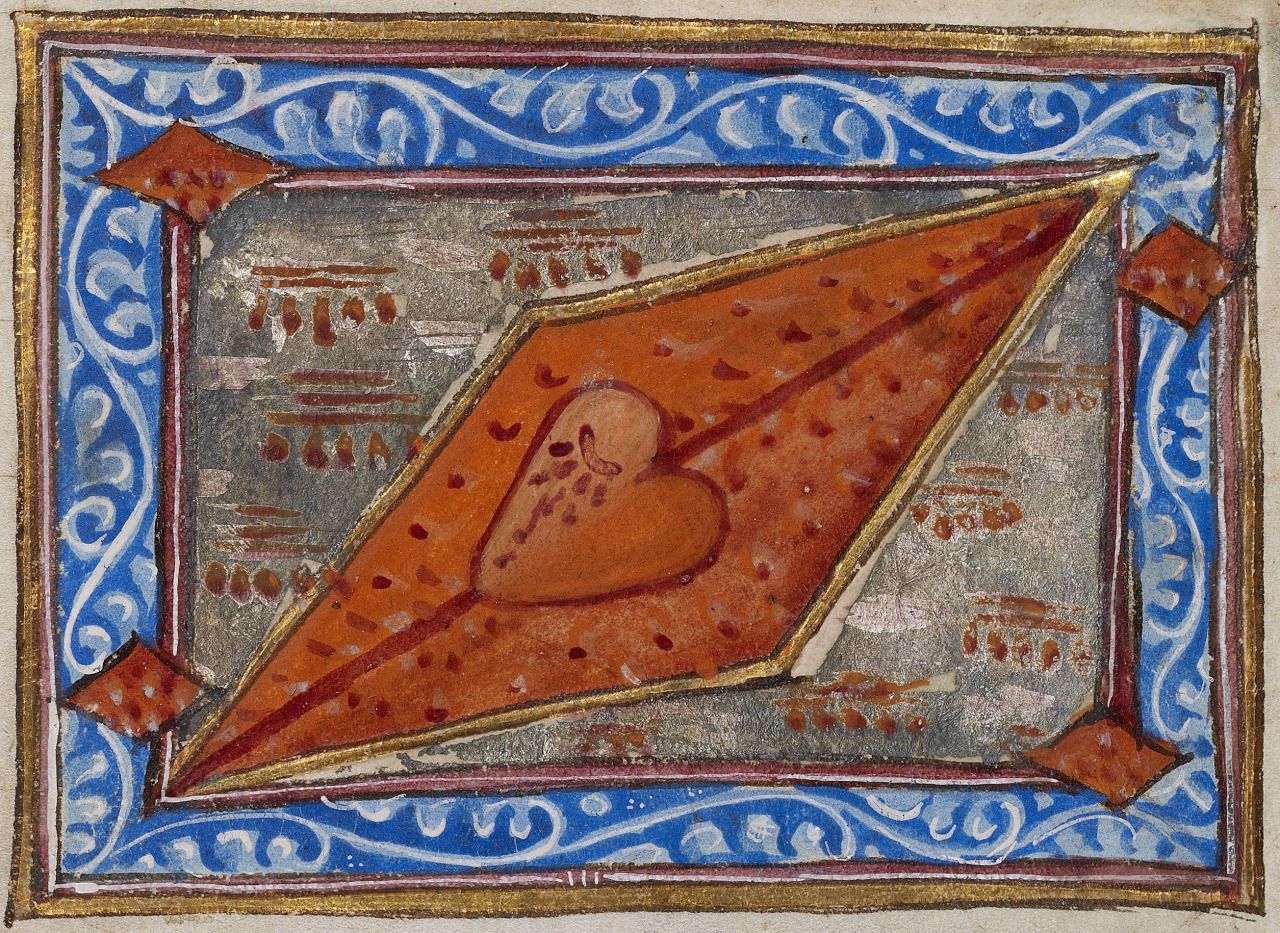
The holy side-wound of Christ, from a Book of Hours (Source)

Today is the Anglican commemoration of George Herbert, the great English cleric and metaphysical poet of the 17th century. He died on March 1st, 1633. In honor of this bard of the spirit, I offer to my readers one of my favorite Herbert poems. Every time I return to it, I find new edification.
“Prayer (1)”

George Herbert

Prayer the church’s banquet, angel’s age,
God’s breath in man returning to his birth,
The soul in paraphrase, heart in pilgrimage,
The Christian plummet sounding heav’n and earth
Engine against th’ Almighty, sinner’s tow’r,
Reversed thunder, Christ-side-piercing spear,
The six-days world transposing in an hour,
A kind of tune, which all things hear and fear;
Softness, and peace, and joy, and love, and bliss,
Exalted manna, gladness of the best,
Heaven in ordinary, man well drest,
The milky way, the bird of Paradise,
Church-bells beyond the stars heard, the soul’s blood,
The land of spices; something understood.

Happy New Year From The Amish Catholic!

Thus concludes Anno Domini MMXVIII. I hope all my readers had a very fruitful year, and I pray for them all to know many blessings in this coming one. I have a lot to be grateful for this year. I made so many wonderful friends, both via this blog and otherwise. You know who you are. My work seems to be progressing well enough. And I was published in First Things, Jesus The Imagination, and The Church Times. This blog received its 100,000th view. So the year was full of activity.

I also feel that I gained more insight into who I am as a person. I’d like to think that in some ways, at least, I’ve become a more self-aware and honest man, and that I’ve learned a little bit more about humility this year.

I encountered God in new ways at different points of the liturgical year and in various holy places. I befriended new saints.

For all this, I am profoundly grateful.

Here are the top 10 posts I published this year, by readership:

1. The Best Monastic Documentaries

2. Thoughts on Converting the Young

3. A Letter on Loneliness

4. A Relic of the 1965 Liturgy

5. A Forgotten Feast

6. The Art of Amoris Laetitia

7. Pascal and Amoris Laetitia

8. Fr. Faber on Unhappiness

9. Maurice Zundel on Prayer

10. St. Francis de Sales Doesn’t Dance

Incidentally, my main New Year’s resolution for 2019 remains the same as it was in 2018. I don’t know if I lived up to it very well this past year, but I shall strive to do so in the next.

And to conclude my writings here for 2018,

Glory Be to the Father, and to the Son, and the Holy Spirit,
As it was in the beginning, is now, and ever shall be, world without end.
Amen.

Terrible as An Army Set in Array

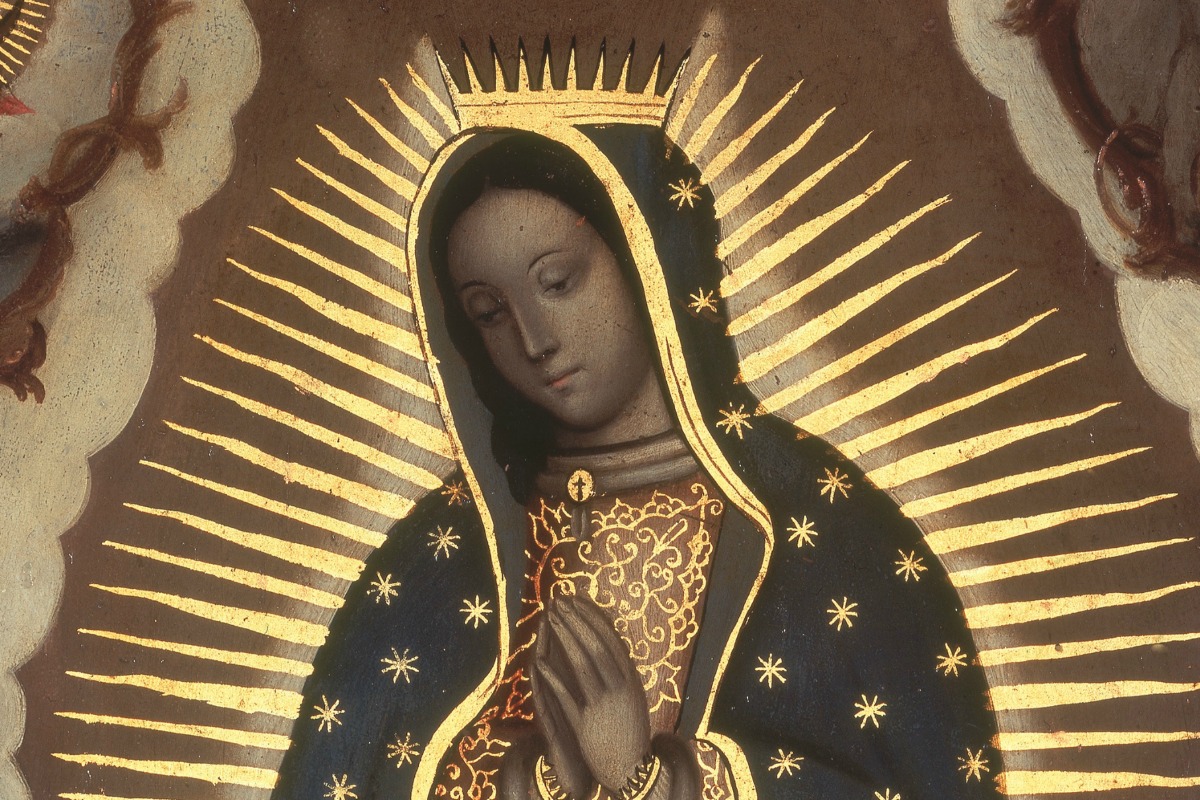
GuadalupeHead

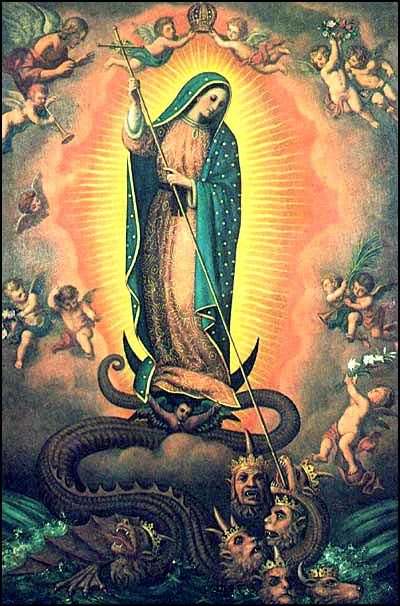
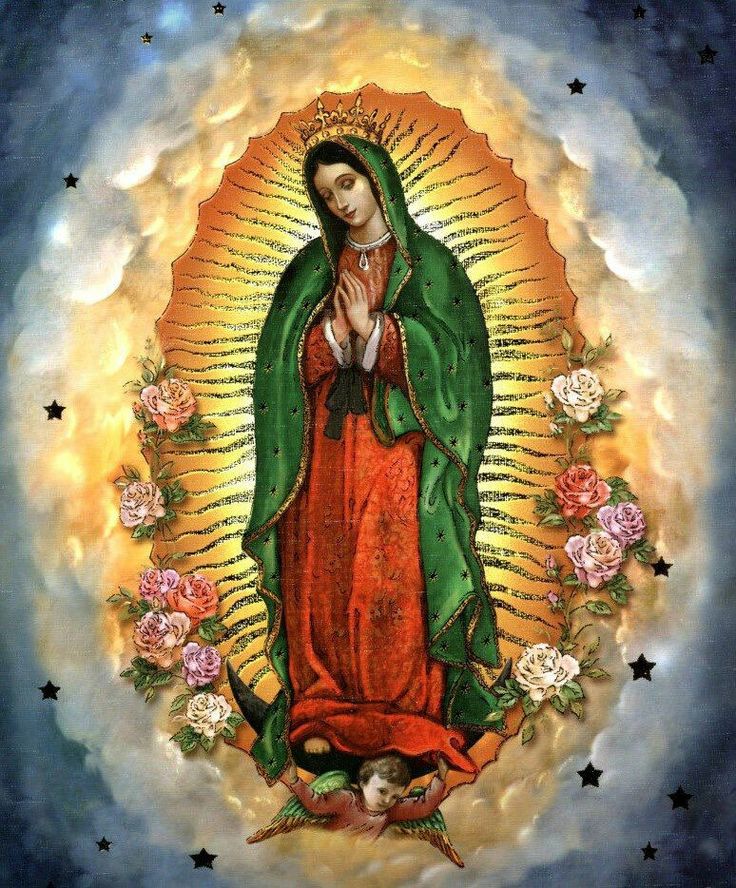
Our Lady of Guadalupe, pray for us. (Source)

“Your deed of hope will never be forgotten by those who tell of the might of God. You are the highest honor of our race.”

Thus does the whole Church sing at Mass today, on the Feast of Our Lady of Guadalupe. And no mean words are they! The Psalm is drawn from the Book of Judith – a frequent verse for feasts of Our Lady – and it lands on our ears like a shout of proleptic joy in this season of preparation and penance. The liturgy draws two special comparisons between Mary and the women of the Old Testament: Mary as the new Eve, and Mary as the second Judith. Today’s feast draws its special energy, its exegetical verve, from the mystical connection between Mary and Judith.

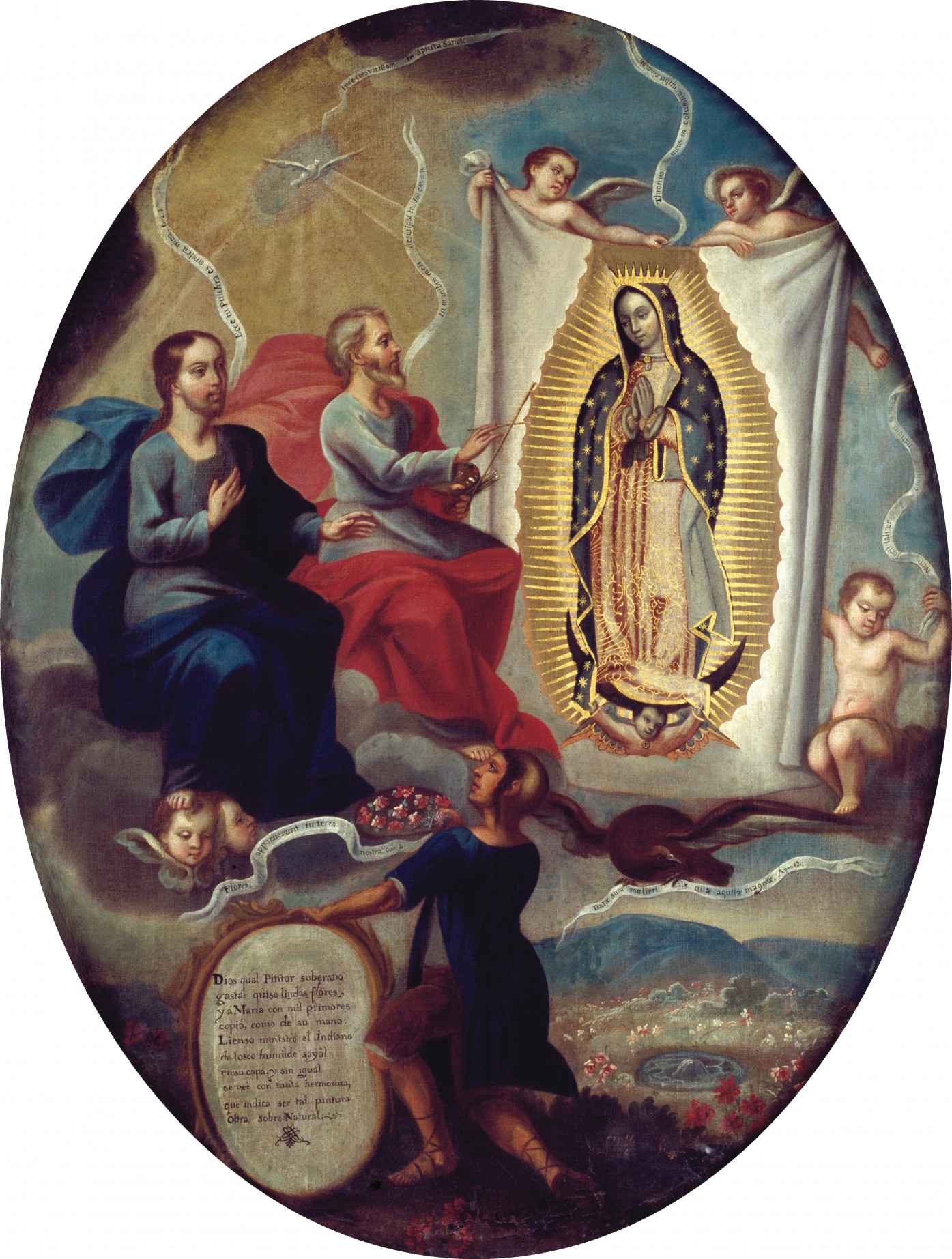
trinityguadalupe

Our Lady of Guadalupe painted by the Trinity. An image worth meditating on. (Source)

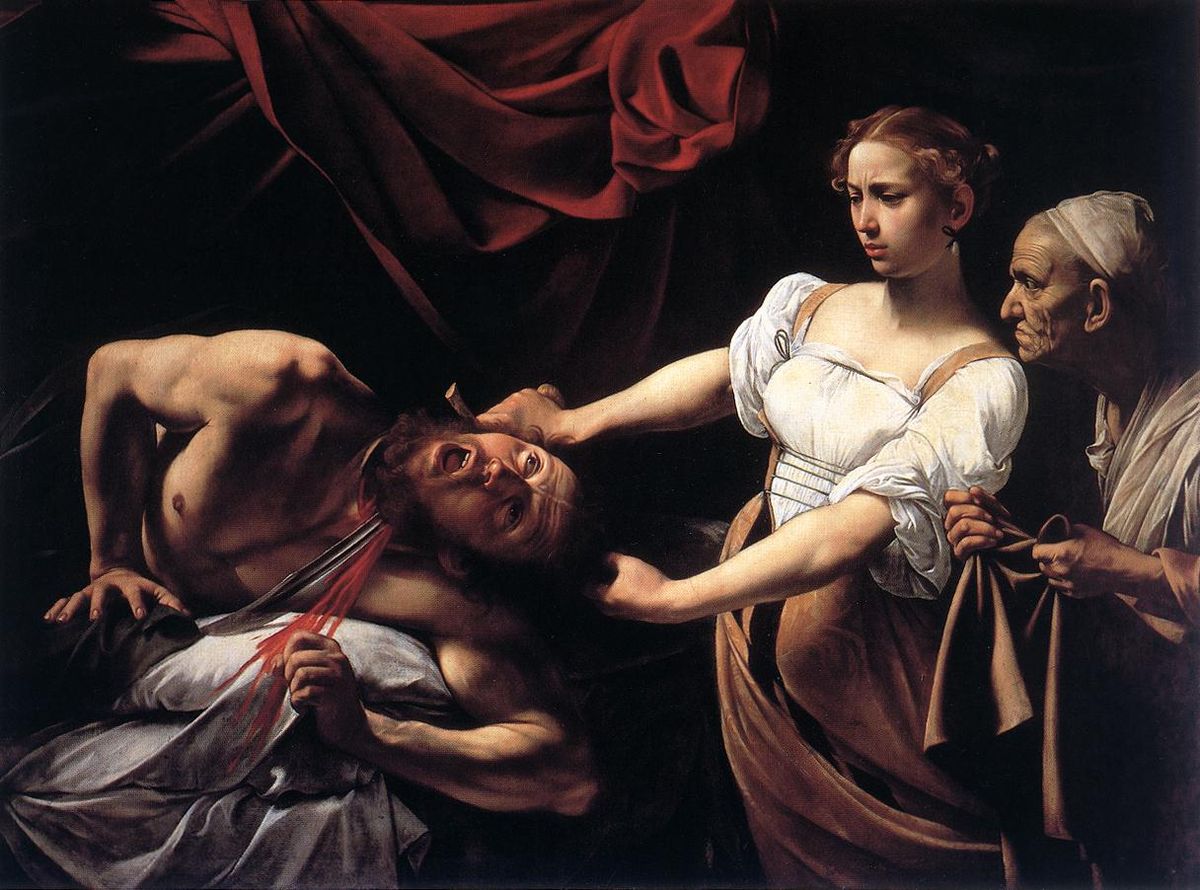
The particular verse that the Church applies to Mary comes from Uzziah’s praise of Judith after she has already beheaded Holofernes the Assyrian. Let us turn briefly to the immediately preceding passage.

Then she took the head out of the bag, showed it to them, and said: “Here is the head of Holofernes, the ranking general of the Assyrian forces, and here is the canopy under which he lay in his drunkenness. The Lord struck him down by the hand of a female! Yet I swear by the Lord, who has protected me in the way I have walked, that it was my face that seduced Holofernes to his ruin, and that he did not defile me with sin or shame.” All the people were greatly astonished. They bowed down and worshiped God, saying with one accord, “Blessed are you, our God, who today have humiliated the enemies of your people.” (Judith 13:15-17).

Then come our Psalm verses.

JudithBeheading

Judith Beheading Holofernes, Caravaggio, c. 1602. (Source)

Why would the Church draw our attention to this violent episode on a feast of Our Lady falling so soon after the Immaculate Conception? Haven’t we just contemplated her Sophianic existence? Haven’t we just basked in the light of the Holy Spirit resting upon her Immaculate Heart? Why must we leave those pleasant snow-caps of the spirit? Why turn instead to this grisly tale of murderous deliverance?

We must recall that, although Mary is all sweetness and concord to those who love her Son, she is the terror of demons. Her litanies and devotions include many titles that evoke the clamor of warfare: “Tower of David,” “Tower of Ivory,” even “Gate of Heaven.” She crushes the head of the Serpent. The sword that pierces her heart becomes, by the union of her suffering with that of her Son, a fearful weapon in her mighty hands.

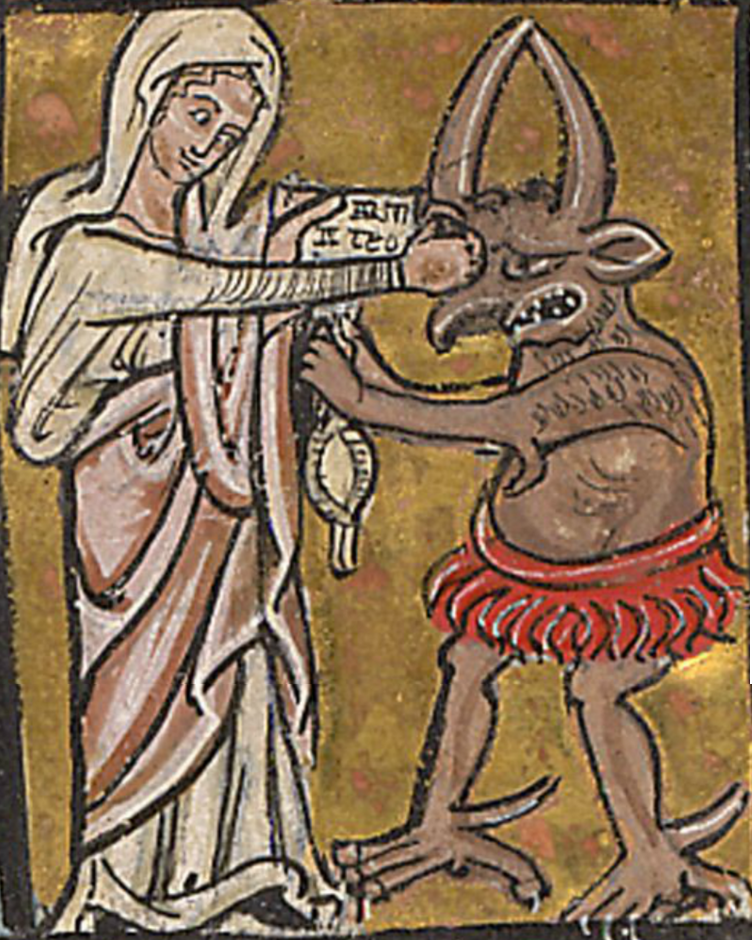
MaryPunchingDevil

“Hail Mary, full of grace, punch the devil in the face.” (Source)

The story of Guadalupe is just one example of Our Lady exercising this power. Her appearance on Tepeyac, and the miracle wrought on the tilma of St. Juan Diego, was the beginning of the end of Aztec paganism. The demons that held that great people in thrall to the murderous rites of human sacrifice were totally vanquished. Like Judith, Mary rode out from Heaven into the  very camp of the enemy. Like Judith, she conquered. Like Judith, she proclaimed her victory with a visible sign – only, Our Lady’s sign was far more glorious. Judith held up the head of the vanquished foe, the bloody remains of a wicked oppressor. The Mother of God gave us her own image, miraculously imprinted into the convert’s cloak.

Judith delivered the Jews from the army of the Assyrians. Mary came forth to Tepeyac to convert the Mexican people, lifting from them the demonic yoke of a bloodthirsty paganism. What a glorious victory she won! Nine million Aztecs converted within the first ten years of the apparitions. Even today, she continues to spur us to conquer those terrible forces of injustice that oppress so many of God’s people. The collect prayer for today’s feast reads:

O God, Father of mercies, who placed your people under the singular protection of your Son’s most holy Mother, grant that all who invoke the Blessed Virgin of Guadalupe, may seek with ever more lively faith the progress of peoples in the ways of justice and of peace. (Source; emphasis mine)

These days it is rather in vogue to lament a certain kind of triumphalism that is built on self-centered pride. But too often we forget that there is another triumphalism, the shout of a people who have seen their salvation coming from the Lord:

Blessed are you, daughter, by the Most High God,
above all the women on earth;
and blessed be the LORD God,
the creator of heaven and earth
(Judith 13:18).

The Church herself enjoins us to celebrate the works and ways of God through His chosen instruments. And in today’s Mass, we are called to join that praise to the sacrifice of Christ in the Eucharist.

GuadalupeHeresy

Our Lady of Guadalupe, Victrix over All Heresies and Demons. (Source)

In considering Our Lady of Guadalupe and the zeal with which she overcame the forces of evil and in contemplating the beauty of her miraculous portrait, a verse of Scripture comes to mind.

“Who is she that cometh forth as the morning rising, fair as the moon, bright as the sun, terrible as an army set in array?” (Cant. 6:10 DRA)

We who have seen the tilma through the eyes of faith know the answer.

GuadalupeRoses

Our Lady of Guadalupe, Mystical Rose. (Source)

St. Benedict in Art History

Certain saints haunt the Western canon. Who could fail to recognize slender St. Sebastian leaning languidly against a tree, or St. Lucy peering primly over her cup of eyes? St. Jerome is the only cardinal known for consorting with lions, and St. Mary Magdalene carries her jar of spikenard from century to century.

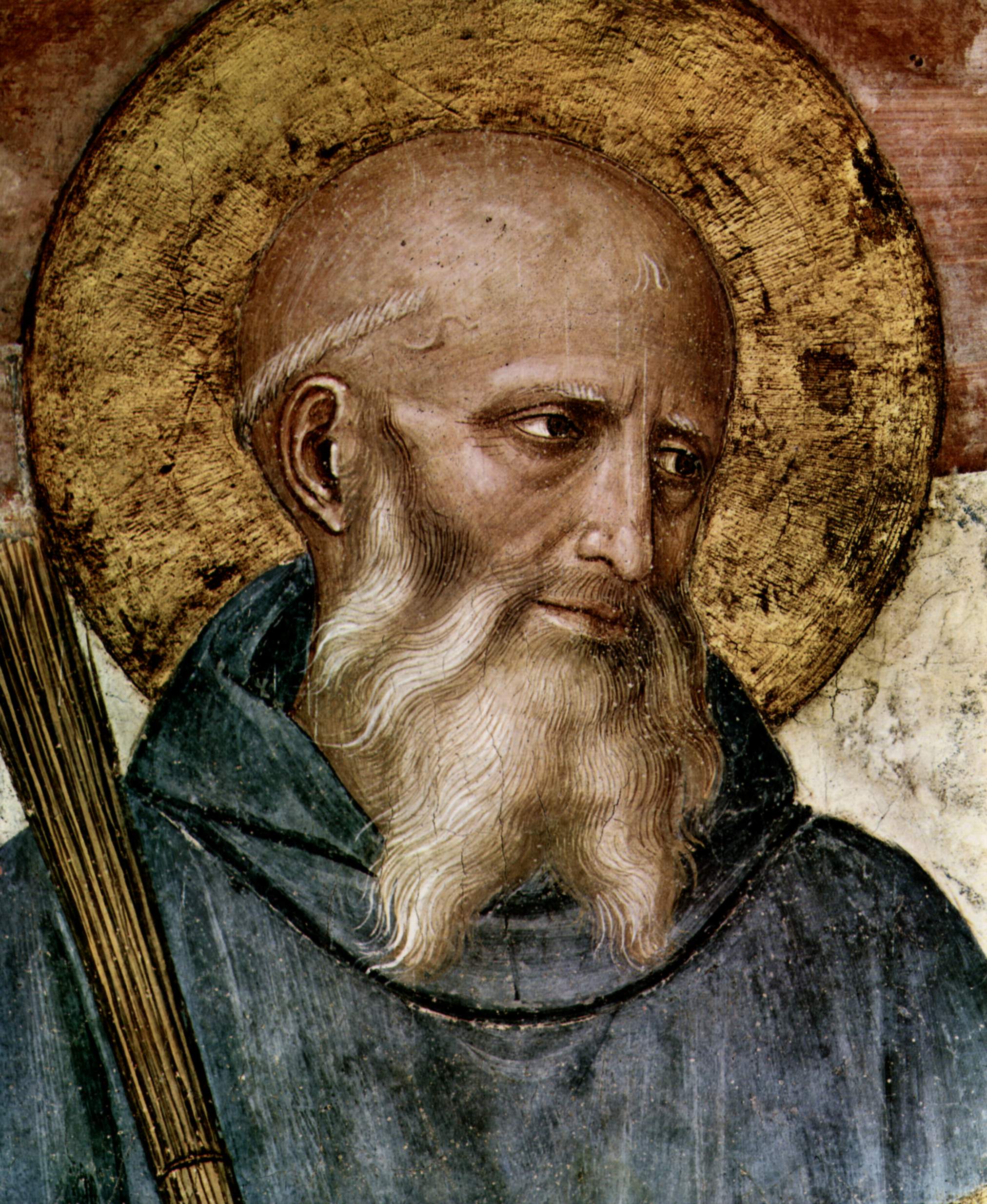
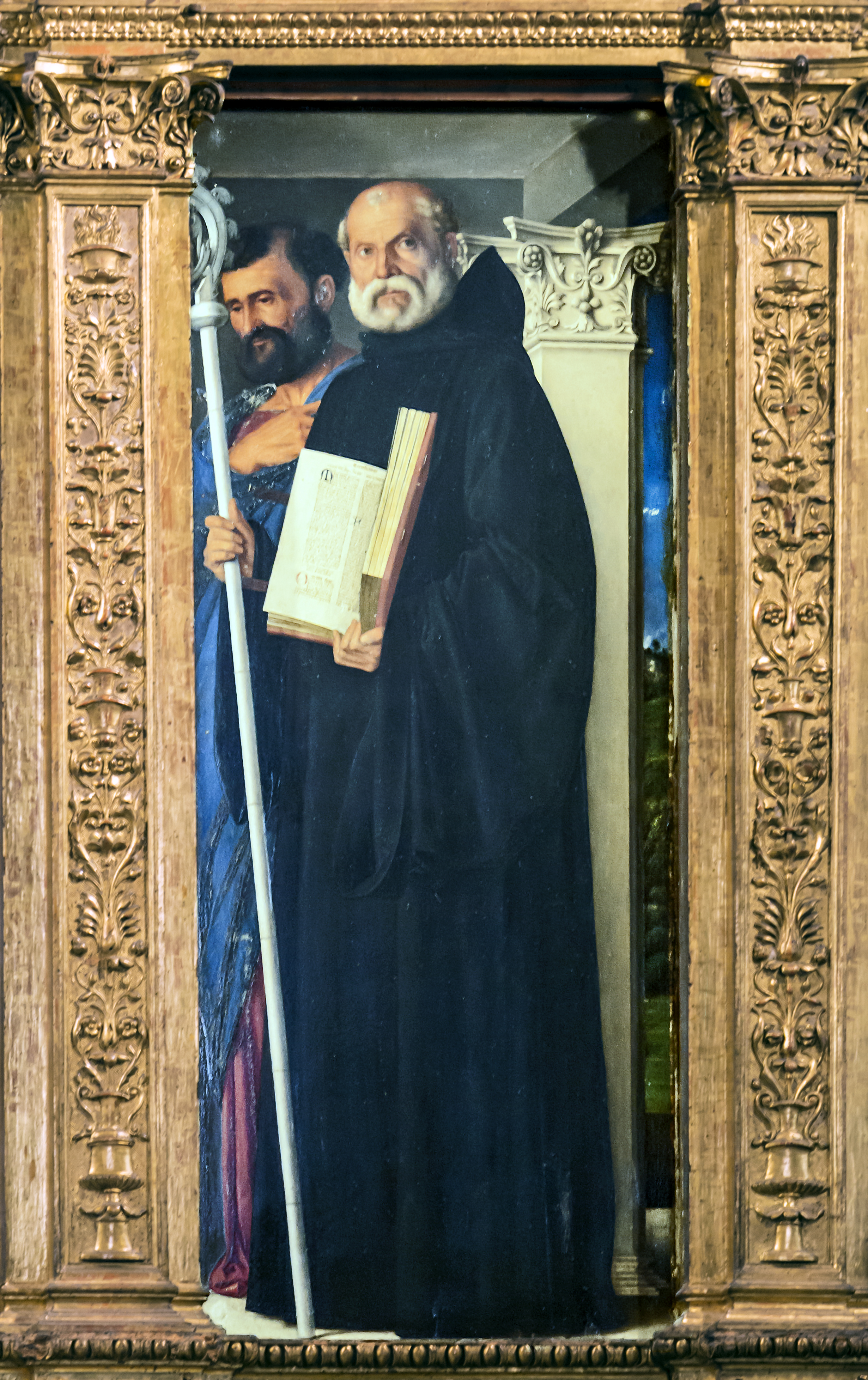
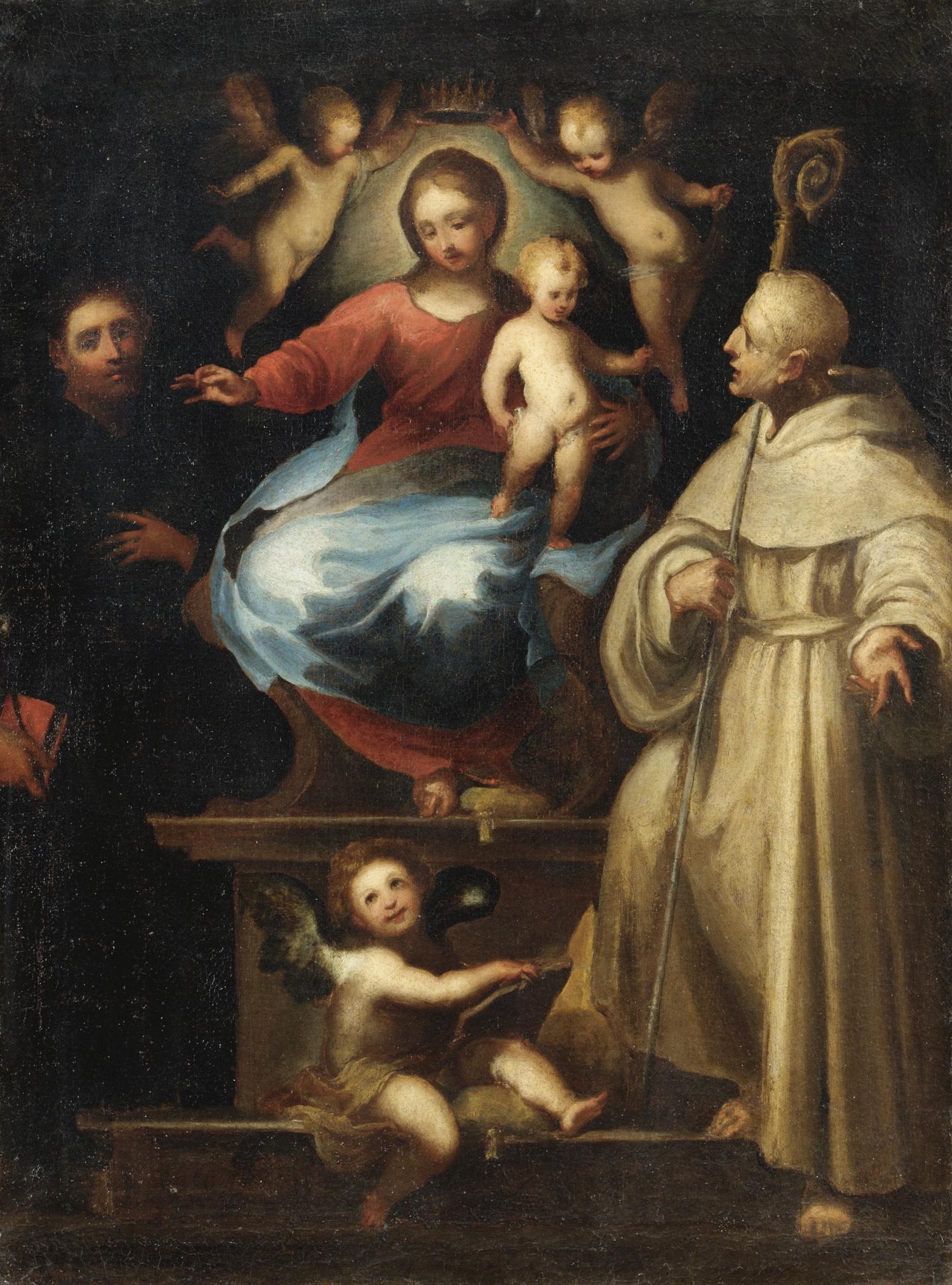
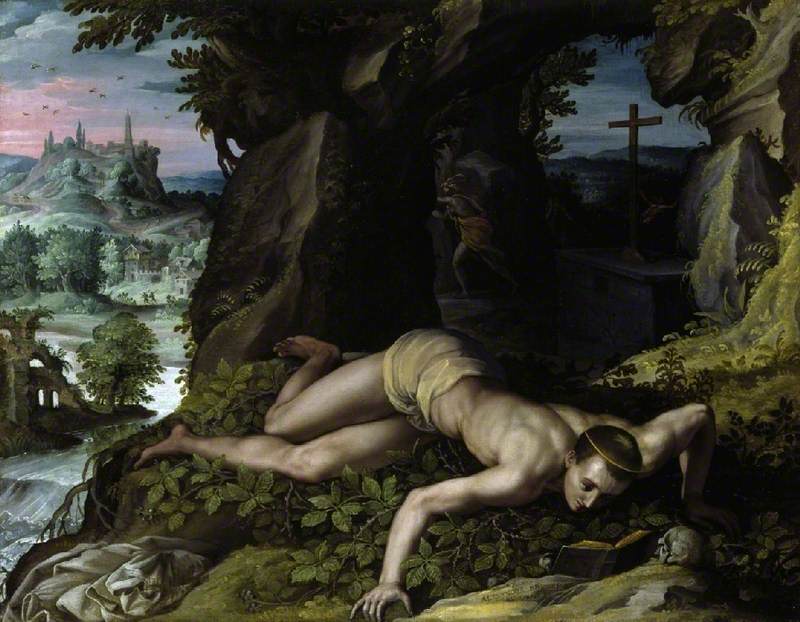
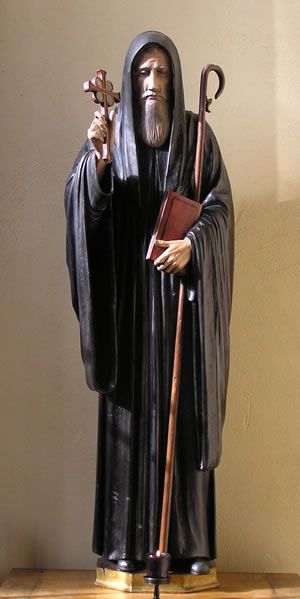
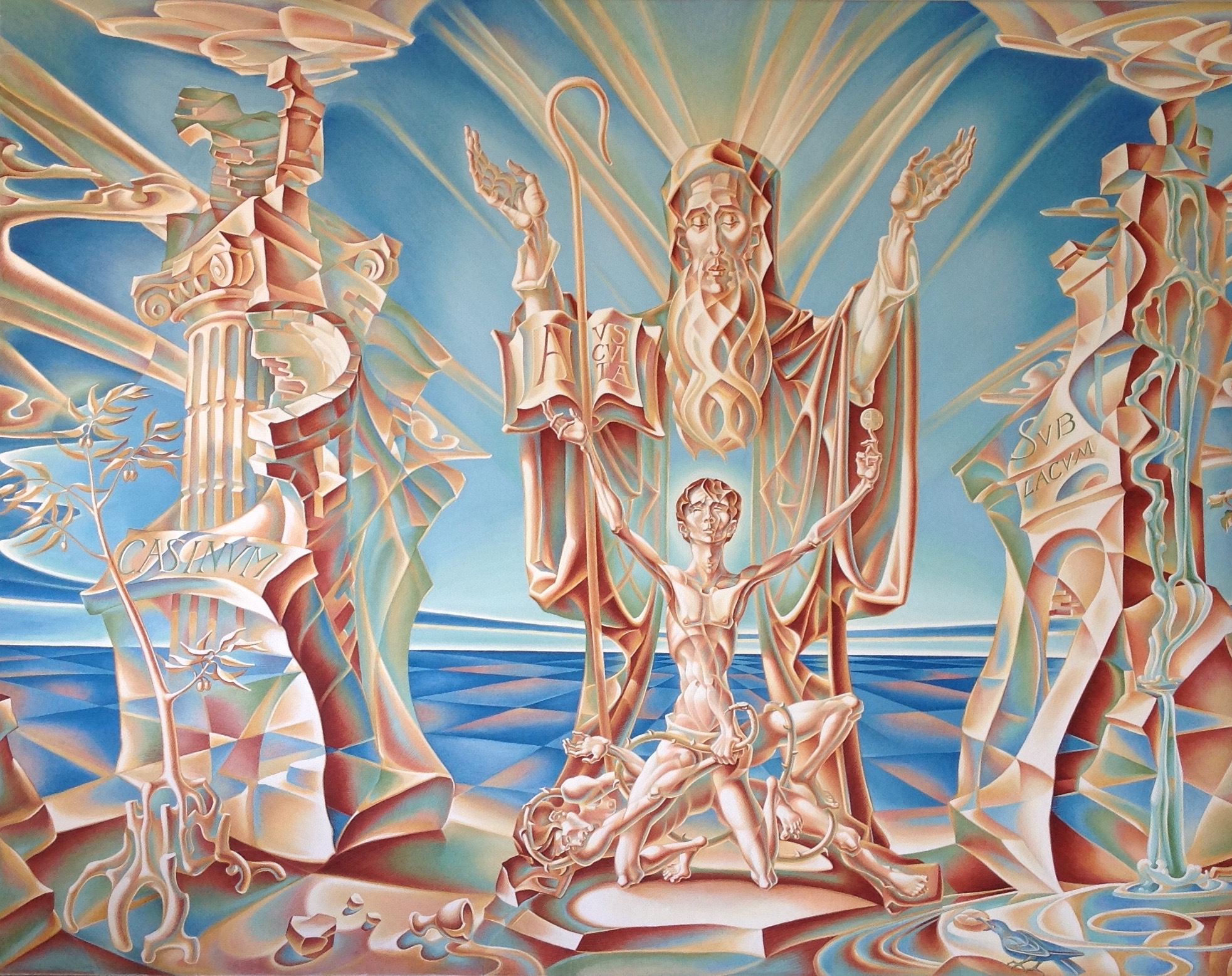
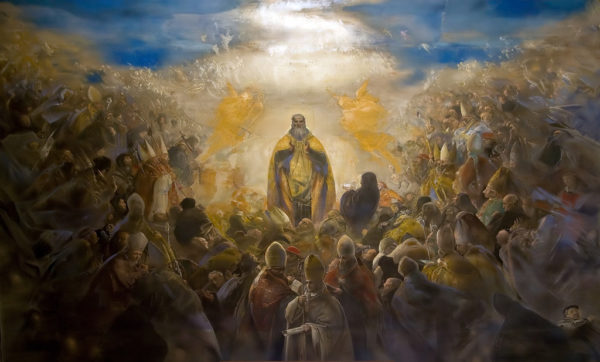
St. Benedict is one such ubiquitous saint. Today, in honor of his feast, I would like to offer a few examples of St. Benedict’s image drawn from the history of Western art. Each offers a unique view of the Patriarch of Monks, and each bears careful examination and meditation. St. Benedict may have one of the most stable iconographic traditions in the Church, but that doesn’t mean he hasn’t inspired a wide variety of artists to bring their own stamp to his image. His life and spirituality are too vast; he fills and spills beyond the few symbols allotted him. Thus, I give you these 21 representative selections.
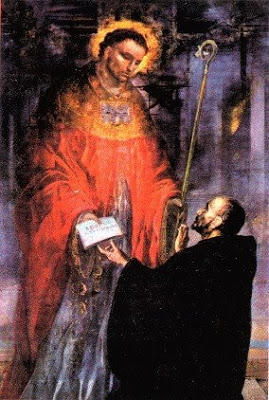
Sancte Pater Benedicte, ora pro nobis.

StBenedictThrone

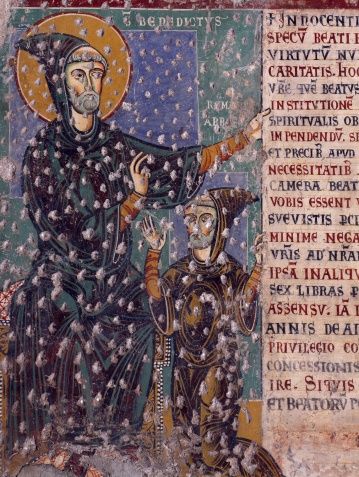
St. Benedict enthroned with Roman abbot, fresco, c. 13th century. (Source)

VisionStBenedict

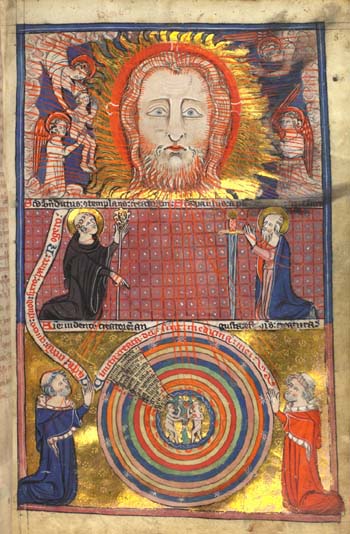
St. Benedict’s Vision of the Universe. 14th century. (Source).

DeathofSt.Benedict

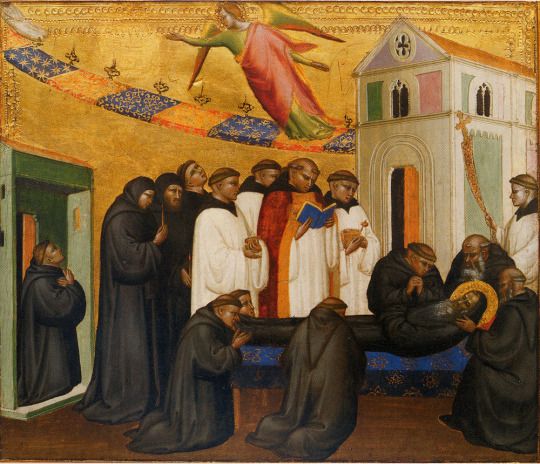
Death of Saint Benedict, Giovanni del Biondo, c. mid 14th century. (SourceSource)

StBenedictTemptation

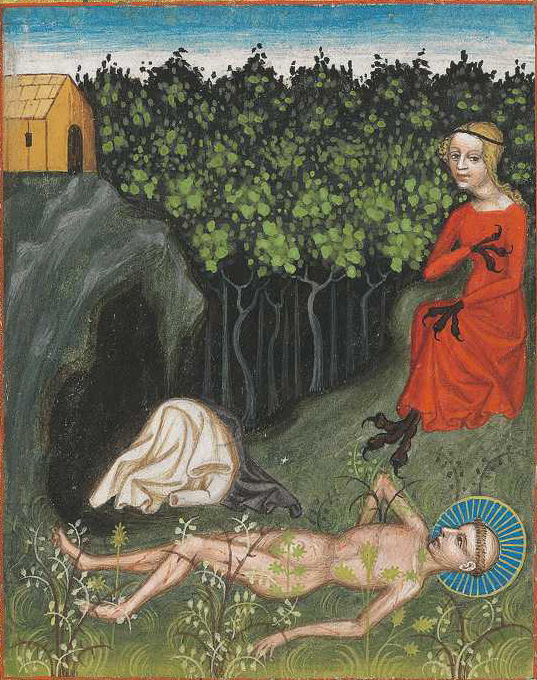
The temptation of St. Benedict from the Mettener Regel. 1414. (Source).

StBenedictVadeRetroSatana

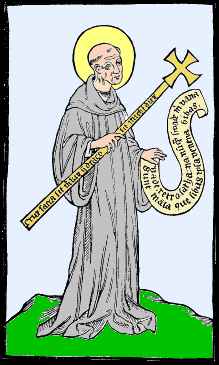
Drawing of St. Benedict, 15th century. (Source).

St Benedict a Bohemian artist

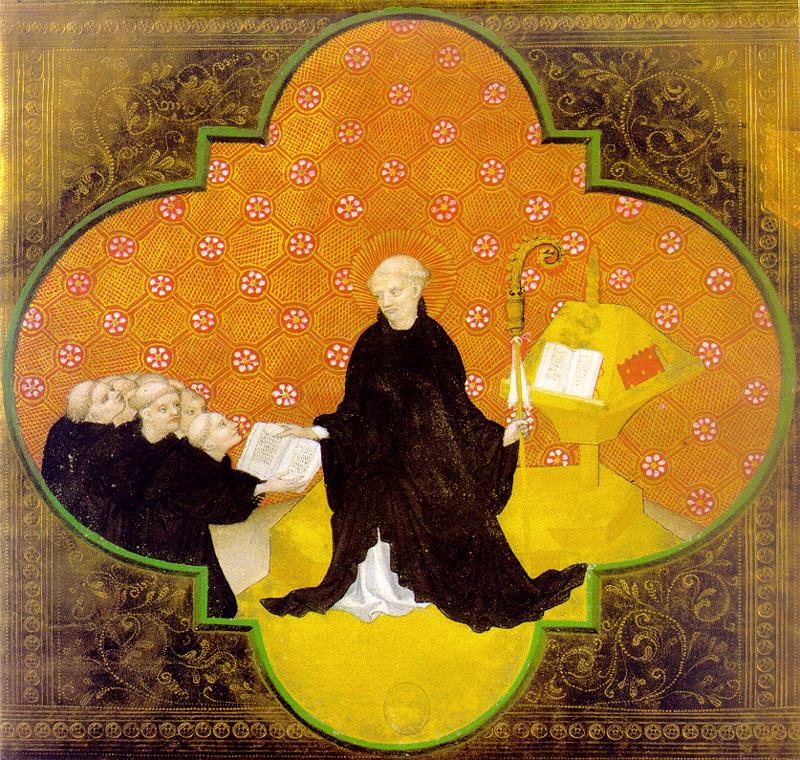
St. Benedict with monks by a Bohemian artist, probably c. mid 15th century. (Source).

Fra_Angelico_Benedict

St. Benedict from Crucifixion With Saints, by Fra Angelico. c. 1441-42. San Marco, Florence. (Source)

BenedictTriptych.jpg

St. Benedict from a triptych by Bellini, c. 1488. (Source)

StPaulandStBenedict

Madonna and Child with St. Paul and St. Benedict, attr. to Francesco Vanni. c. Late 16th century. (Source)

Allori, Alessandro, 1535-1607; The Temptation of St Benedict

The Temptation of St. Benedict, Alessandro Allori. c. 1587. The Fitzwilliam Museum. (Source).

StBenedictZurbaran.jpg

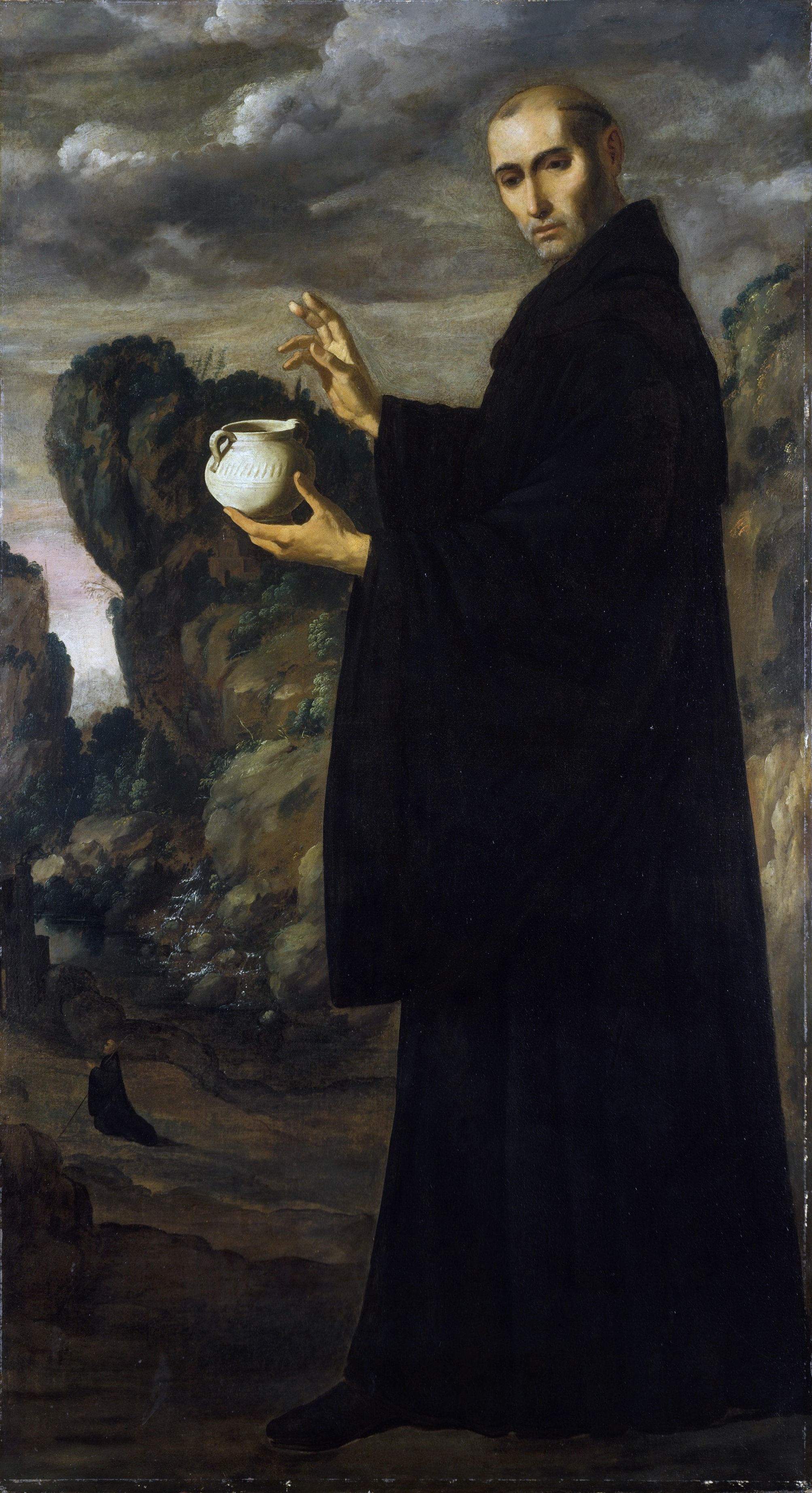
Saint Benedict, by Fransisco de Zurbaran, c.1640-45. The Metropolitan Museum of Art. (Source).

AnneofAustriaBenedictines

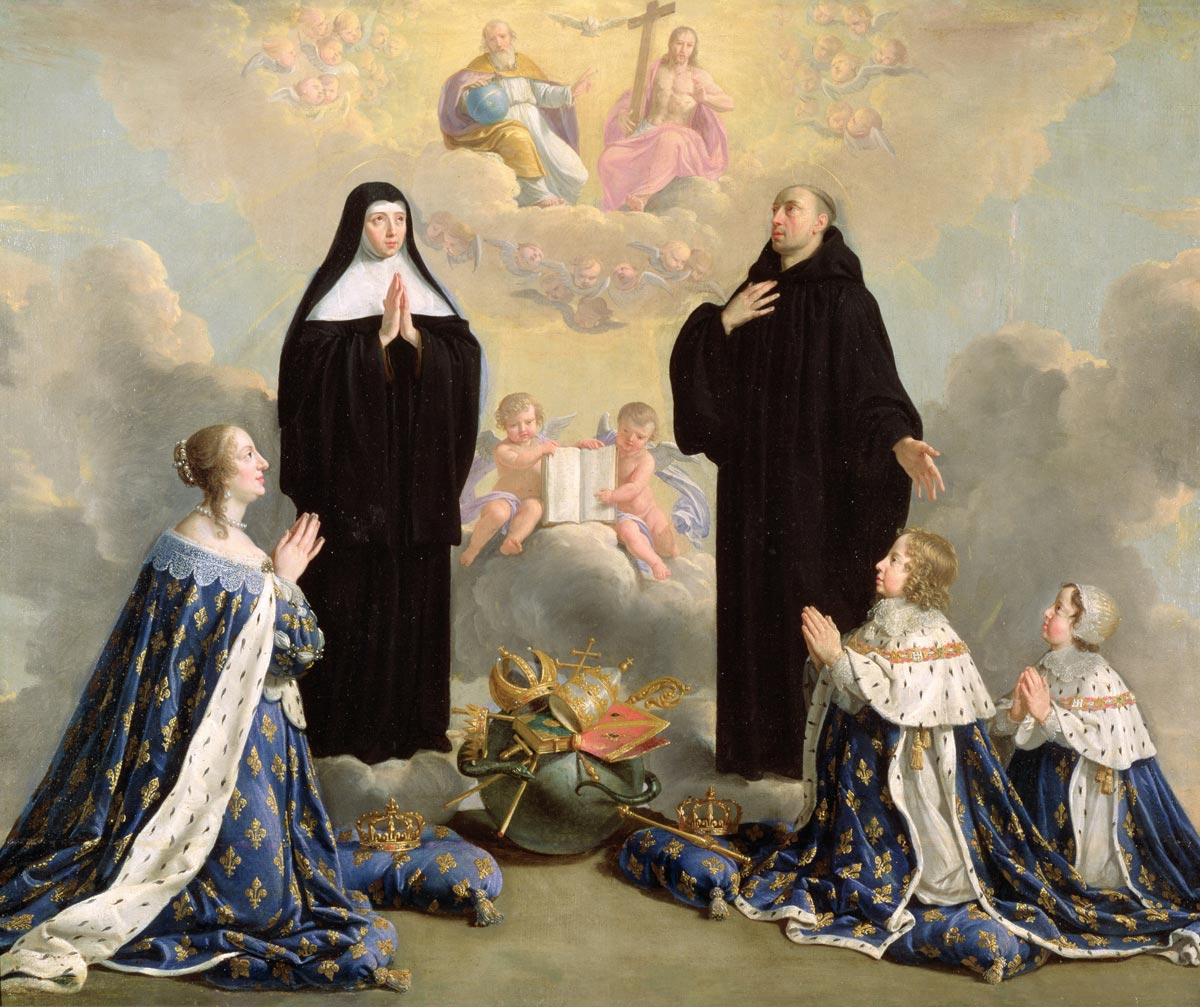
Anne of Austria and her Children at Prayer with St. Benedict and St. Scholastica, Philippe de Champaigne. 1646. Versailles. (Source).

VisionofStBenedictCano

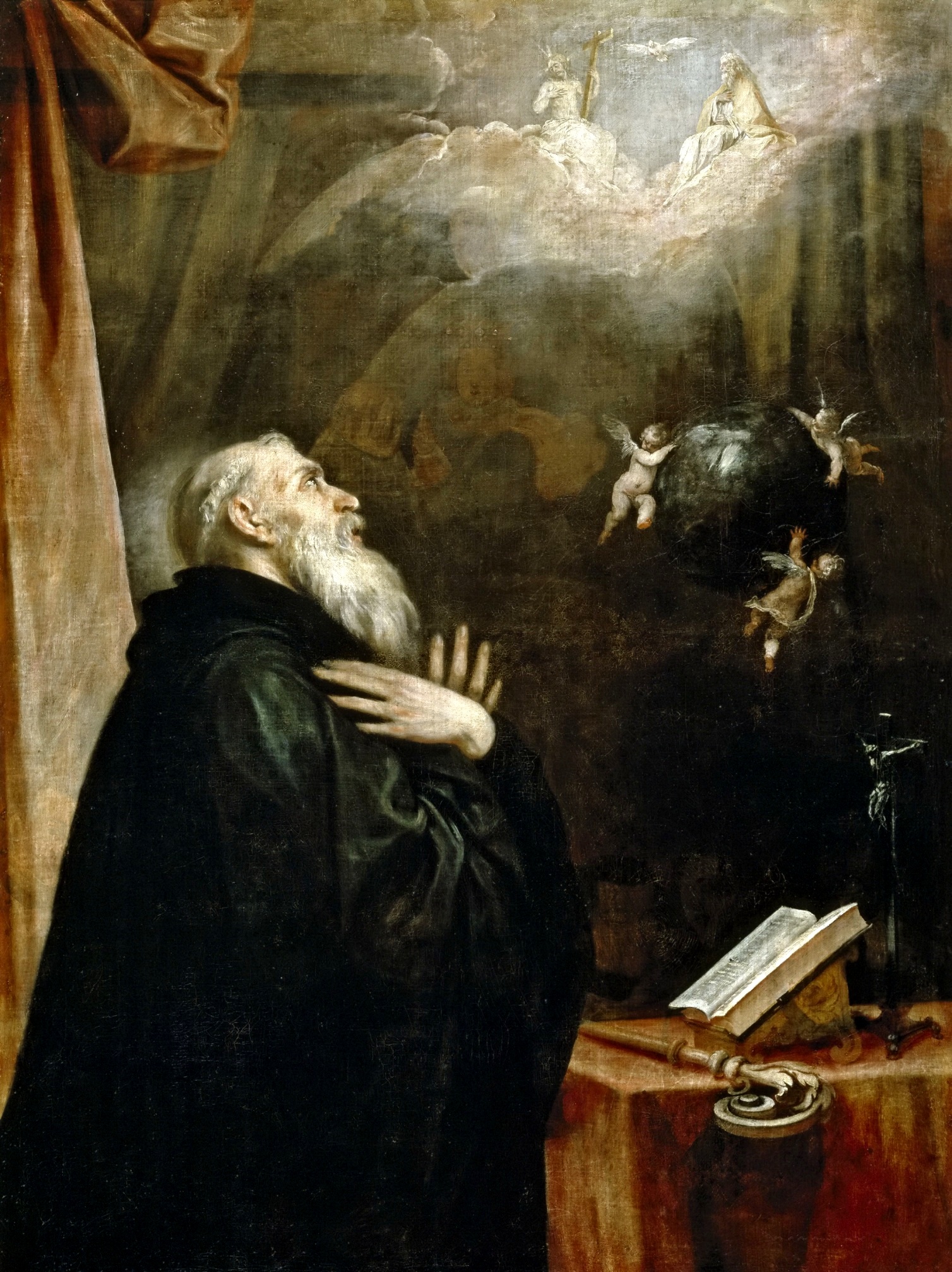
Vision of St. Benedict with Three Angels, Alonso Cano. c.1658-60. El Prado. (Source).

StBenedictMelk

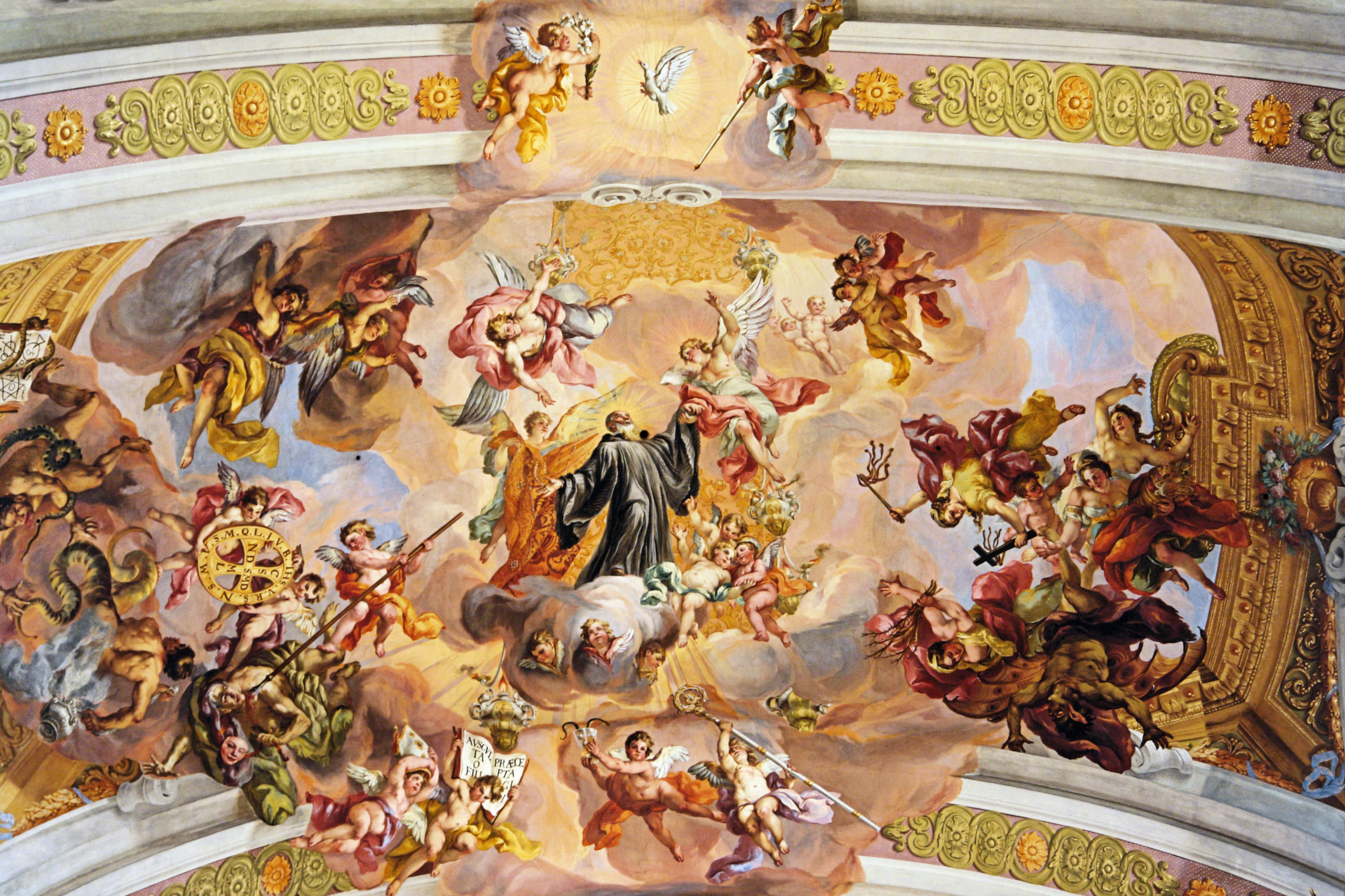
St. Benedict’s Triumphal Ascent to Heaven, by Johann Michael Rottmayr. 1721. Melk Abbey, (Source)

StBenedictStatueBook

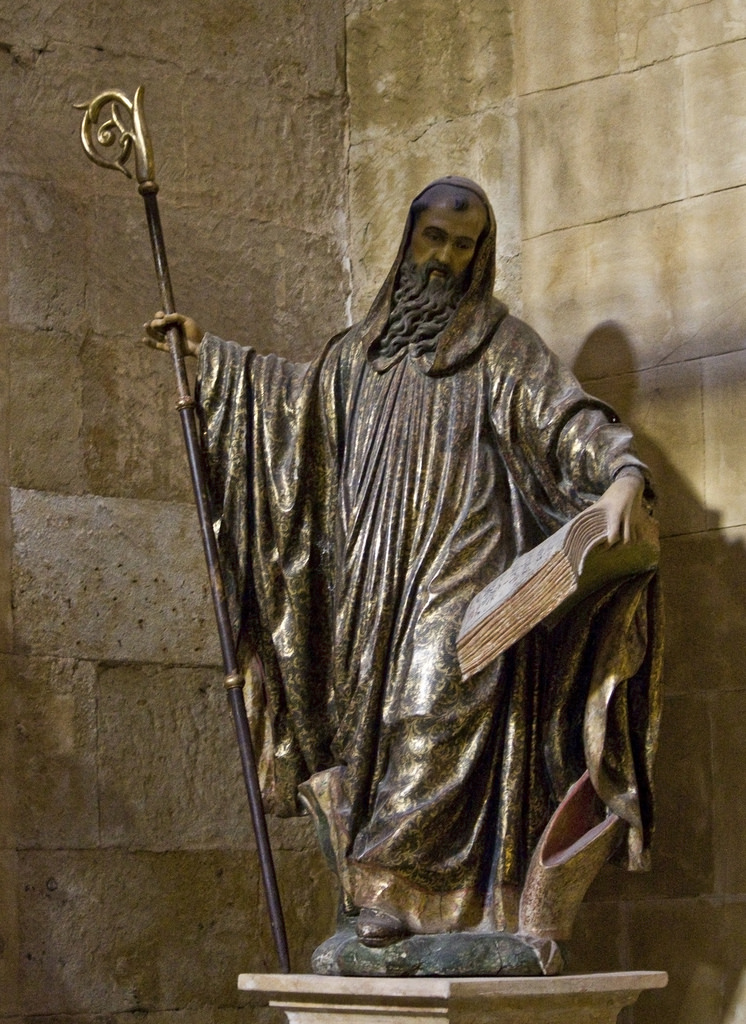
Statue of St. Benedict from the Augustinian church in Salamanca. Photo by Fr. Lawrence Lew OP.  c. 16th-19th century. (Source)

mauruskapelle_med

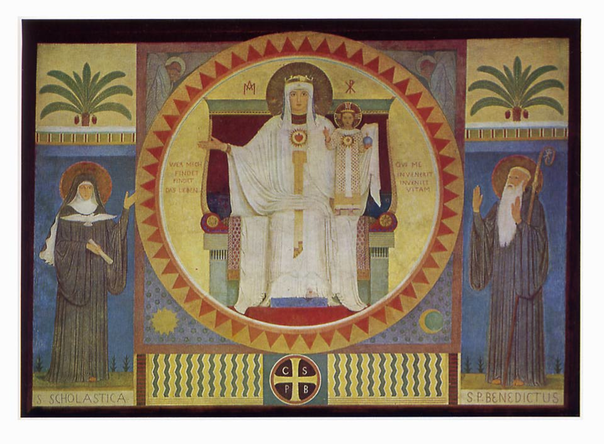
S.s Benedict and Scholastica with Our Lady and Jesus. Peter Lenz, 1869. Beuron (Source).


StBenedictHolyCard

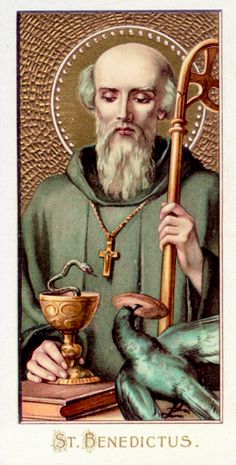
Holy card style portrait of St. Benedict (Source).

StatueStBenedictCross

St, Benedict in an English cowl. Date unknown, probably 19th or 20th century. (Source)

PietroAnnigoniStBenedictHandshisRuletoPopeVictorIII

St. Benedict Hands His Rule to Pope Victor III. Pietro Annigoni. c. Mid to Late 20th century. (Source)

DunstanMasseySt.Benedict

Fresco of St. Benedict, Dunstan Massey OSB. Late 20th century. (Source).

AnnigoniGloryofStBenedict

The Glory of St. Benedict, Pietro Annigoni. Late 20th century. (Source).


Our Lady of the Cenacle in Armenian Iconography

ArmenianOLCenacle

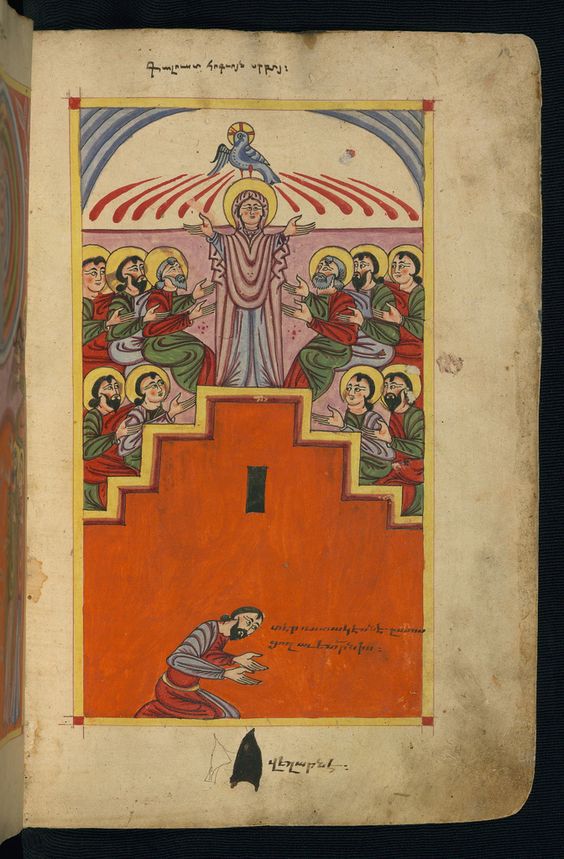
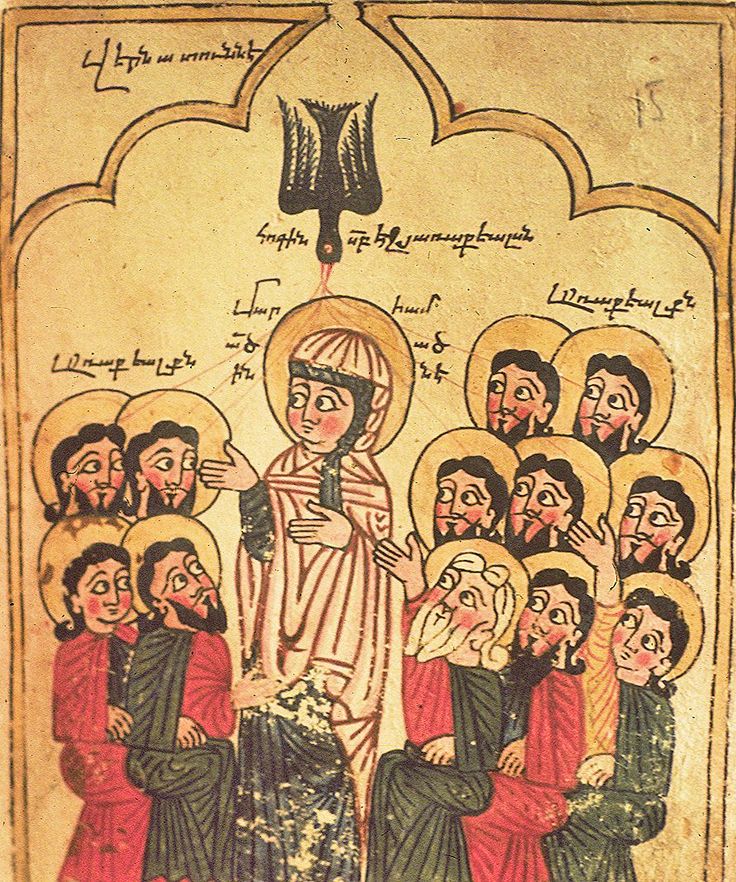
Figure A. Our Lady of the Cenacle, pray for us. From the source: “MINIATURES – Erevan, Matenadaran, MS 8772, Gospel, Aght’amar, Vaspurakan, 1391, artist Dzerun, Pentecost. Photo: Dickran Kouymjian.” (Source)

Throughout the Latin Church, Saturday in the Ascension Octave is kept as the Feast of Our Lady of the Cenacle. On this holy day, we remember the Mother of God keeping vigil with the Apostles in the Upper Room, or “Cenacle.” The place is significant. Here, Christ gathered the Twelve on the night of his betrayal, Maundy Thursday. At that time, He instituted the priesthood and the Eucharist. Later, on Pentecost, the Holy Spirit will descend upon the congregation and truly constitute the Church as such, confirming its sacramental essence and mission in the world of time.

Mary’s position in this unique place at this unique time is captured in the title, “Our Lady of the Cenacle.” But that name conceals a much deeper mystery. What, precisely, was she doing in the Cenacle? Why was she there? And does her presence, never mentioned in the Bible, nevertheless retain important meaning for us today?

As with any mystery unspoken in Scripture but passed on to us by the Tradition, we can approach it by many paths. One of the wonderful things about the Church is that, in her sacramentality, she recasts everything in the light of Christ and opens all things to a deeper meaning than we ordinarily encounter. So today, I’d like to consider Our Lady of the Cenacle through art. Specifically, iconography. Even more specifically, Armenian illuminated manuscripts.

pentecost_kirillo-belozersk-c-1497.jpg

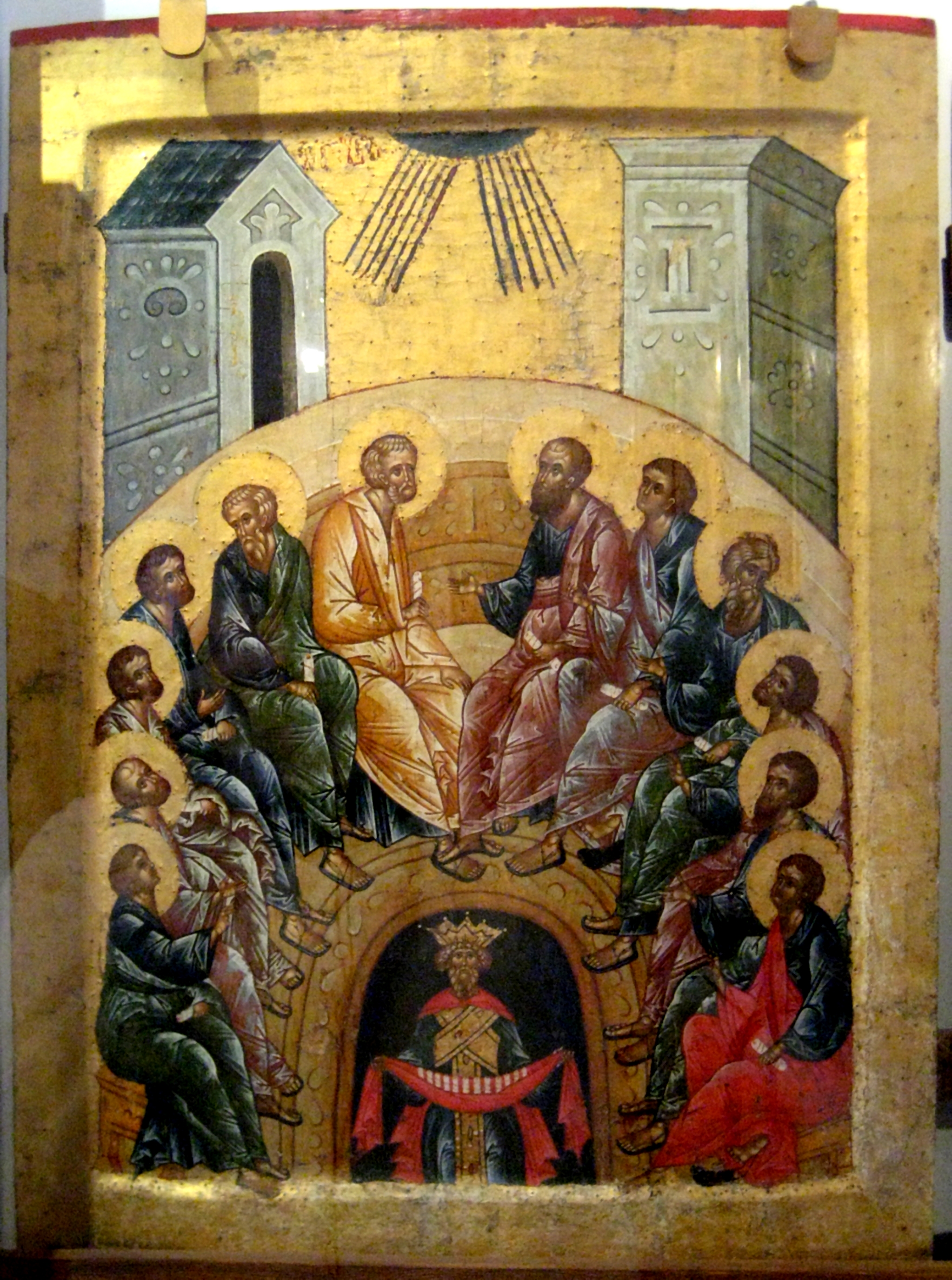
Figure B. A Greek-style Russian icon of 1497. Note the emptimess of the “Teacher’s Seat” at center. (Source)

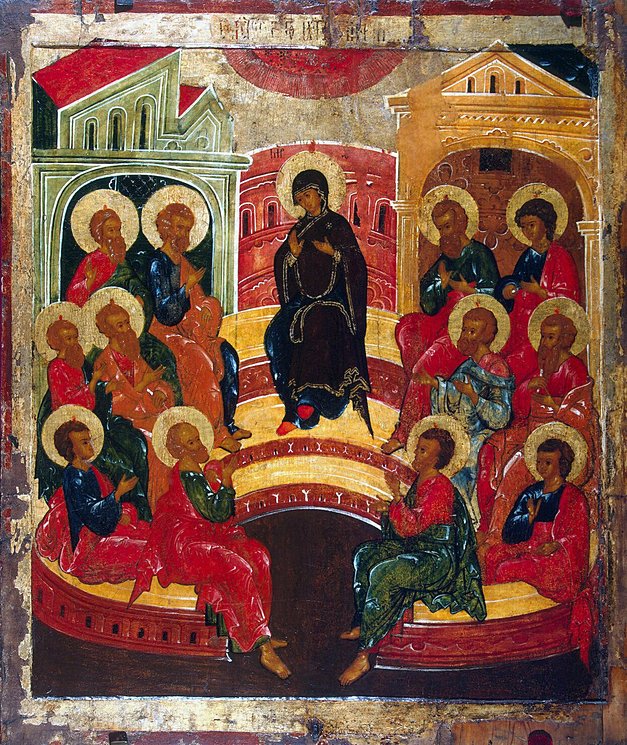
In the Greek iconographic tradition, Pentecost is usually depicted with an empty seat in the center…the place of Christ the King and Teacher, who has ascended and sent the Holy Spirit in his stead. The icon for the feast of mid-Pentecost dovetails with this custom, as it depicts Jesus the youth instructing the teachers of the Law in an arrangement that approximates that of Pentecost proper. The Russian and Slavic iconographic tradition largely copies this model, with one notable exception. Many Russian iconographers include the Mother of God in what would ordinarily be the empty “Teacher’s Seat.” As one writer puts it, “Mary is therefore shown in the ‘teacher’s seat’ as the best example we have, and the person on earth who most resembled Jesus Christ (both physically, as His mother, and spiritually as His disciple).” Indeed.
Icon-The-Descent-of-the-Holy-Spirit

Figure C. A Russian-style icon with the Mother of God in the “Teacher’s Seat,” date unknown. (Source).

The Armenian iconographic tradition differs from both the Greek and Russian streams in important ways, not all of which we can get into here. For our purposes, it is enough for us to observe that the Armenians have a tendency to place the Mother of God at the center of the Pentecostal scene.

Examine, if you will, the illumination at the top of this essayFigure A.

Mary is, by far, the largest character. The Apostles crowd around her on both sides expectantly. Her hands are lifted in the orans position of prayer. She stands in a red mantle and a dark blue robe that matches the hue of the Holy Spirit alighting above her. Every one of the bird’s tongues of flame move through her nimbus to reach the Apostles, some of whom even raise their own hands as if to reach out and take hold of the mystical fire.

A similar placement and posture is written into the following icon:

Pentecost2

Figure D. Description from source: “This Armenian Gospel book was produced in 904 of the Armenian era (1455 CE) at the monastery of Gamałiēl in Xizan by the scribe Yohannēs Vardapet, son of Vardan and Dilšat, and was illuminated by the priest Xačʿatur.” (Source)

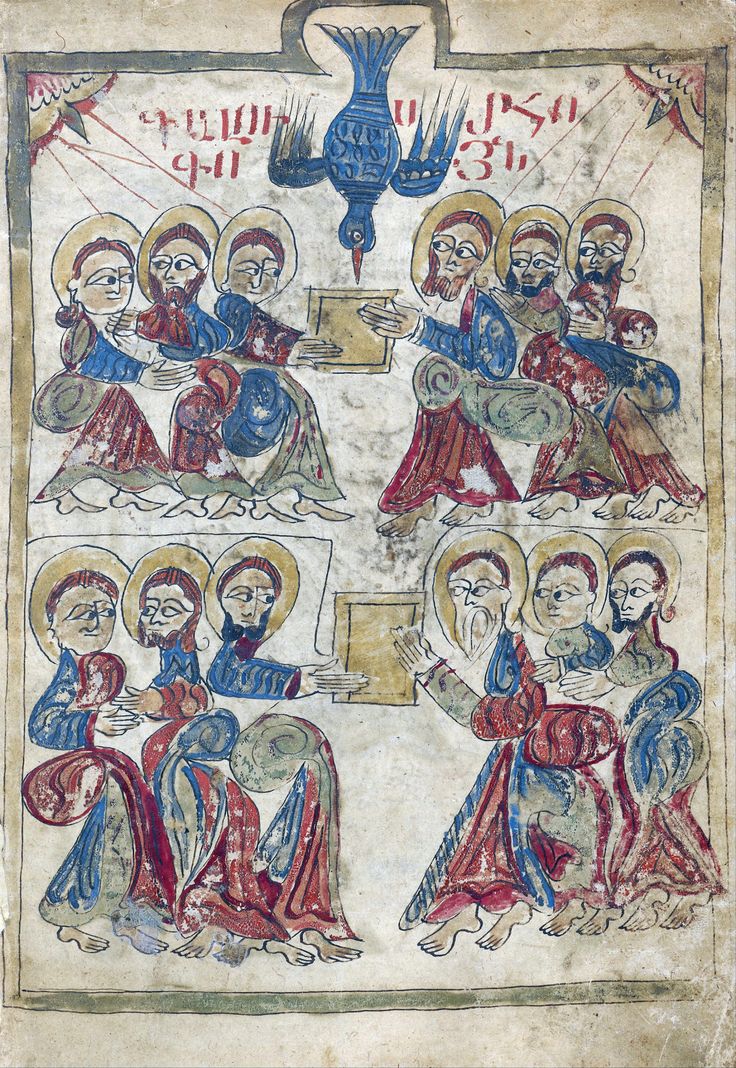
Mary is the central pillar of the icon. The Holy Spirit does not just descend, but rests upon her as He sends forth his tongues of flame. Here, too, their colors match. We can see that the Holy Spirit is customarily written in blue for this festal icon.
Blue is an interesting color, one with mystical associations. I won’t attempt a full symbolic analysis here, but it is worth contemplating the range of natural and supernatural meanings which Christianity has invested in this delicate shade. It suffices to say that blue is a sophianic color, calling to mind the wisdom and beauty of God (see the pertinent chapter in The Pillar and Ground of the Truth, by the great Russian theologian Father Pavel Florensky). The iconographic tradition is of great help in this subject as well; besides gold, blue is the only other color allowed for the background of icons in the Greek and Slavic canons.
DarkDove1

Figure E. An Armenian Pentecost icon without Mary, but with a blue dove of the Spirit. (Source)

SmallIcon

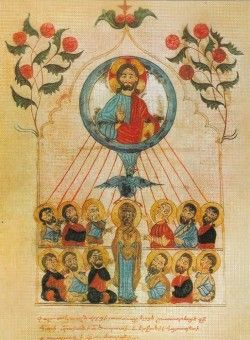
Figure F. Pentecost icon of unconfirmed but probably Armenian origin. Same blue Spirit, roughly the same placement of the Theotokos. (Source).

It is also perhaps worthy of note that in Figure D, Mary doesn’t just match the hue of the Spirit. The colors she wears also match the architecture of the Cenacle. She is one with the Cenacle; the Cenacle is hers, and hers alone. The Cenacle is the Church, the Cenacle is every tabernacle in the world, the Cenacle is Heaven, the Cenacle is the New Jerusalem, the Cenacle is the Throne of God, the Cenacle is the Eschaton, the Cenacle is the final consummation of sophianic being brought about by Christ’s gloriously triumphant Incarnation, sacrifice, and Resurrection.

And in all these mystical dimensions of the Cenacle, Our Lady is Queen.

Mary is the woman who bears the Holy Spirit, the living icon of the Church. When we look at Mary, we are to think of the Spirit. The Mother of God always points us to her son, but also to the Holy Spirit, and through both, to the Father. She is never apart from the Holy Spirit. They abide together, and the Cenacle is where her truly Eucharistic and sophianic state of being is manifested for the awe-struck view of the whole Church. She is the consummation of what is accomplished by the Trinity in the Cenacle, the woman who fully cooperates in the salvation of the world, the Co-Redemptrix and Mediatrix of All Graces. Indeed, do we not read the latter title in the first illumination above? Do we not see it in the slim orange lines of fire that move through her halo to the Apostles below? They only receive the Spirit as it passes through Mary.

Mary does nothing of her own effort. God does all in her, and she freely agrees to accept and work for God’s will. St. Paul can speak of “those things that are wanting of the sufferings of Christ, in my flesh” (Col. 1:24 DRA). Not so with Mary. In her, the cross’s victory is complete. In her, it has become the Tree of Life, “so that the birds of the air,” such as the blue bird of the icons, “come and lodge in the branches thereof” (Matt. 13:32 KJV).

On this feast day, let us remember the manifold graces that Our Lady showers upon us from her throne in the eternal Cenacle. Let us also take heart that, with so powerful an advocate at the heart of the Church, no controversies or troubles can ever overwhelm the Barque of Peter. Finally, let us pray to Our Lady of the Cenacle for the Benedictines of Silverstream on this, their patronal feast.