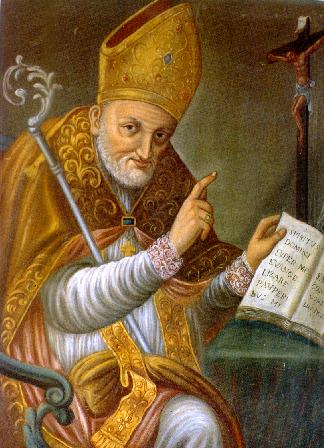
Some Saints on the Holy Name of Mary

name-of-Mary

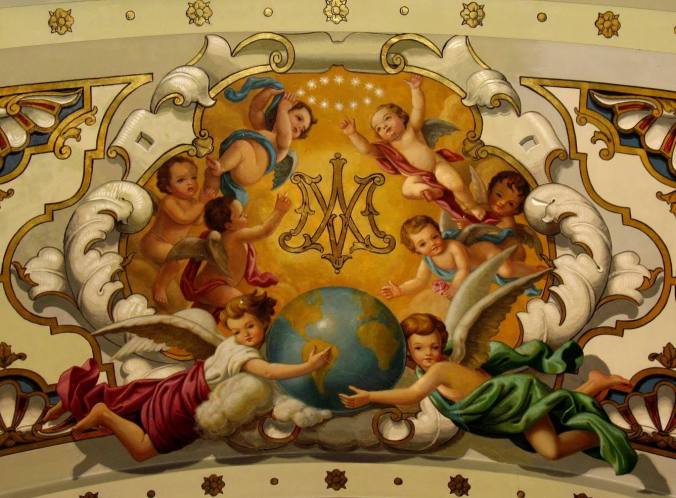
The Holy Name of Mary in a church mural. (Source)

The feast we celebrate today has moved around a bit. It only came to the kalendar in 1683, when Pope Innocent XI wished to commemorate the liberation of Vienna from the Ottoman siege. He originally placed it on the 17th, the Octave Day of Our Lady’s Nativity. The feast was later transferred to the 15th, and then done away with altogether by Archbishop Bugnini in one of his more obnoxious acts of liturgical vandalism. Pope St. John Paul II restored it in 2002, and now we celebrate it as an optional memorial on September 12th.

Accordingly, it behooves us to ponder the writings of the saints. For as it is a maxim in theology that we are led by lower things to higher, so we may pursue the heights of Our Lady’s throne only by the steps which our closer contemporaries have tread before us. Besides, while the feast may be relatively new in the life of the Church, the devotion it honors is much older. There is consequently much to choose from.

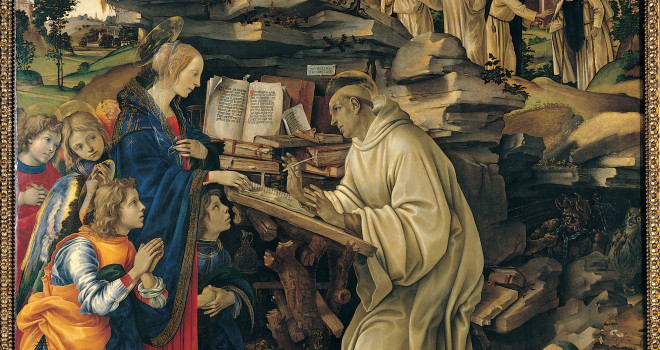
Consider the words of St. Bernard of Clairvaux.

Z_CAP005_052

Apparition of the Virgin to St. Bernard, Detail. Filippino Lippi, 1480. (Source)

“And the Virgin’s name was Mary.” Let us speak a little about this name, which is said to mean “star of the sea,” and which so well befits the Virgin Mother. Rightly is she likened to a star. As a star emits a ray without being dimmed, so the Virgin brought forth her Son without receiving any injury. The ray takes naught from the brightness of the star, nor the Son from His Mother’s virginal integrity. This is the noble star risen out of Jacob, whose ray illumines the whole world, whose splendor shines in the heavens, penetrates the abyss, and, traversing the whole earth, gives warmth rather to souls than to bodies, cherishing virtues, withering vices. Mary is that bright and incomparable star, whom we need to see raised above this vast sea, shining by her merits, and giving us light by her example.

All of you, who see yourselves amid the tides of the world, tossed by storms and tempests rather than walking on the land, do not turn your eyes away from this shining star, unless you want to be overwhelmed by the hurricane. If temptation storms, or you fall upon the rocks of tribulation, look to the star: Call upon Mary! If you are tossed by the waves of pride or ambition, detraction or envy, look to the star, call upon Mary. If anger or avarice or the desires of the flesh dash against the ship o f your soul, turn your eyes to Mary. If troubled by the enormity of your crimes, ashamed of your guilty conscience, terrified by dread of the judgment, you begin to sink into the gulf of sadness or the abyss of despair, think of Mary. In dangers, in anguish, in doubt, think of Mary, call upon Mary. Let her name be even on your lips, ever in your heart; and the better to obtain the help of her prayers, imitate the example of her life:  “Following her, thou strayest not; invoking her, thou despairest not; thinking of her, thou wanderest not; upheld by her, thou fallest not; shielded by her, thou fearest not; guided by her, thou growest not weary; favored by her, thou reachest the goal. And thus dost thou experience in thyself how good is that saying: ‘And the Virgin’s name was Mary.'”

alphonsus_cross

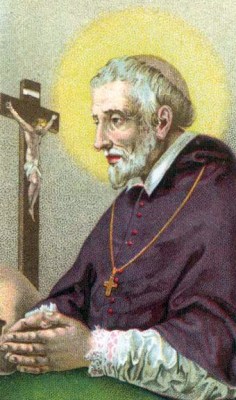
St. Alphonsus Liguori, author of The Glories of Mary. (Source)

St. Alphonsus Liguori, that Mariologist who so scrupulously records the thoughts of prior saints, affirms the antiquity and holiness of this devotion.

To begin with life, the holy anchorite, Honorius, says, that the name of Mary is [full] of all divine sweetness. And the glorious St. Anthony of Padua attributes to the name of Mary the same sweetness as St. Bernard attributed to the name of Jesus. The name of Jesus, said the latter, the name of Mary, said the former, is joy to the heart, honey to the mouth, melody to the ear of their devoted servants. It is related in the life of the venerable Father John Ancina, Bishop of Saluzzo, that when he pronounced the name of Mary, he experienced so great a sensible sweetness that he even tasted it on his lips. We also read that a certain woman in Cologne told the Bishop Marsillius, that whenever she pronounced the name of Mary she perceived in her mouth a taste sweeter than honey. Marsillius made the trial, and he also experienced the same sweetness. We read in the holy Canticles, that at the Assumption of the Virgin, the angels three times asked her name: “Who is she that goeth up by the desert as a pillar of smoke?” “Who is she that cometh forth as the morning rising?” And in another: “Who is this that cometh up from the desert, flowing with delights?” Richard of St. Laurence inquires why the angels so often asked the name of this queen, and answers: The sound of the name of Mary was so sweet to the angels, and they repeated the question that they might hear it repeated also.

But I do not hear speak of this sensible sweetness, since it is not commonly granted to all, but I speak of the salutary sweetness of consolation, love, joy, confidence, and strength, which the name of Mary universally gives to those who, with devotion, pronounce it. Speaking on this subject, Francone the Abbot says, that next to the holy name of Jesus, the name of Mary is so rich in blessings, that no other name is uttered on earth or in heaven from which devout souls receive so much grace, hope, and sweetness. For the name of Mary, he goes on to say, contains in itself something admirable, sweet, and divine, which, when it meets a friendly heart, breathes into it an odor of holy sweetness. And the wonder of this great name is, he concludes, that if heard a thousand times by the lovers of Mary, it is always heard as new, the sweetness they experience in hearing it spoken being always the same.

The blessed Henry Suso, also speaking of this sweetness, says, that in pronouncing the name of Mary, he felt his confidence so much increased, and his love so joyfully enkindled, that amidst the joy and tears with which he pronounced the beloved name, he thought his heart would have leaped from his mouth ; and he affirmed that this most sweet name, as honeycomb, melted into the depths of his soul. Whereat he exclaims: Oh most sweet name! oh Mary, what must thou thyself be, if thy name alone is so lovely and sweet?

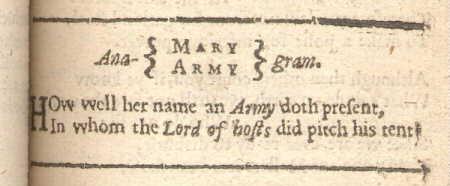
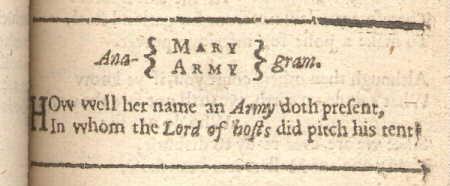
Nor is this devotion entirely absent outside the Church of Rome. One of George Herbert’s better epigrams runs as follows:

HerbertAnagram

“Anagram,” from The Temple. (Source)

Incidentally, the aforementioned Bishop of Saluzzo, Bl. John Juvenal Ancina, was a founder of the Naples Oratory and a personal disciple of St. Philip Neri. Can there be any doubt that the bishop learned his devotion at the side of his spiritual father?

img-Blessed-Giovanni-Giovenale-Ancina

Bl. Juvenal Ancina of the Oratory. (Source)

And we should learn it in turn from the saints who have gone before us, those holy men and women who now stand rejoicing in an eternal contemplation of Our Lady’s beatific name.

StPhilipNeriExhortinghtheYouth

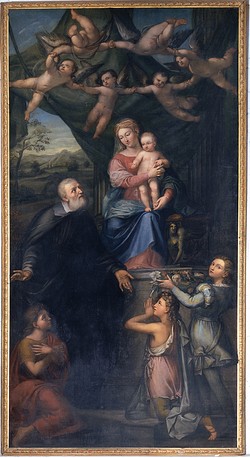
St. Philip Neri Exhorting the Youth to Pray to the Virgin, Pala Pietro. A good metaphor for how the saints instruct us in Marian devotion. (Source)


The Prince of Papist Purple Prose

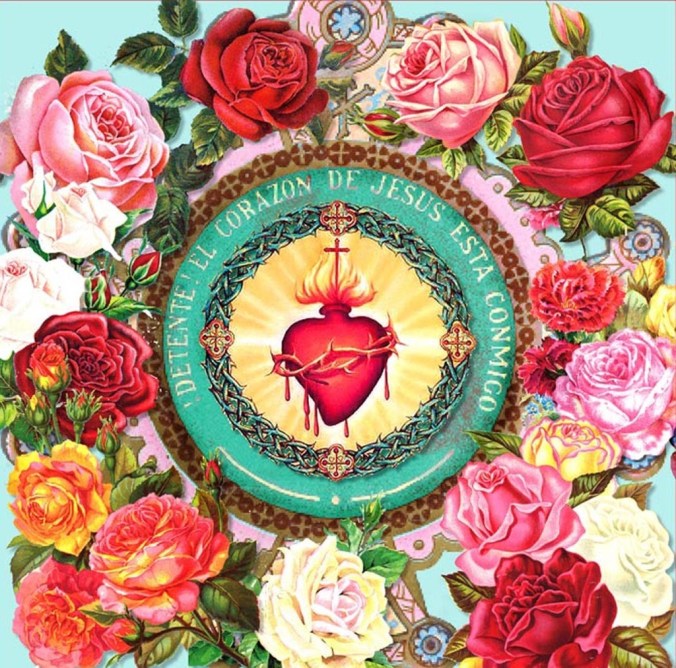
SacredHeartRoses

Faberesque religious art. (Source)

The Church offers us the way of salvation. She declares the destination, Heaven; she notes our provenance, the bondage of our sinful nature. And she furnishes a route from the latter up to the former. Or, I might say, “routes.” For while the Cruciform road to Heaven may appear singular from afar, anyone who enters the Journey will find that it is in fact composed of many different paths. The holy diversity of the Church is one testament of its Catholicity. Like a great Cathedral or Basilica that appears as one massive edifice from the street but harbors dozens of little side-altars within, each distinctly the Table of the Lord, the Church offers more streams of spirituality than we can discern. Some flow still in our midst, giving life to multitudes. Others run dry. And some thought long-extinct may suddenly spring forth in new vim and vigor.

It is only a natural and concurrent fact that the Church should likewise offer her children a diverse array of spiritual writers. There is the beautiful, mysterious Areopagite; the mighty, noble St. Augustine; the dazzlingly imaginative St. Ephrem the Syrian; the logical, pacific Aquinas; the bloody consolations of Dame Julian; the gleaming shadows of St. John of the Cross; the brooding brilliance of Pascal; the soaring eloquence of Bossuet; the roseate cheer of St. Thérèse of Lisieux; the luminous fragmentation of T.S. Eliot; the Gothic grotesquerie of Flannery O’Connor.  The list goes on and on.

The English Catholic Revival was a fertile time for spiritual writers. At the fountainhead of the entire movement stands Cardinal Newman, whose massive influence is still being felt by theologians and writers today. The founder of the English Oratory was a masterful stylist, so much so that James Joyce considered him the greatest master of English prose. Every ecclesiastical development proves that Newman’s theology is more timely than ever. He has been lauded by subsequent generations, and rightly so. When he is eventually canonized, he will certainly be declared a Doctor of the Church for his labors.

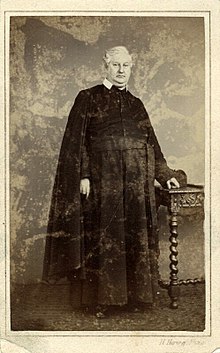
But he has, sadly, overshadowed another figure, one no less deserving of praise for his own work on behalf of the Gospel. That man is Fr. Frederick William Faber, the founder of the London Oratory.
Faber1860

Fr. Frederick William Faber, Father of the Brompton Oratory. (Source)

Faber was an Oxford convert like Newman. After leaving the University, he first served as an Anglican parish priest in Northamptonshire. He would later bring eleven men with him across the Tiber when he resigned his post. After shepherding the community for a short time, he eventually joined forces with Newman and co-founded the English Oratory. They split the country. Newman went to Birmingham, and Faber went to London. In the course of his time there, he gained notoriety as a preacher of remarkable versatility and power, a widely-respected hymnodist, a constant friend of the poor, and an authoritative teacher of the spiritual life. As one source has it, his written works

…are a mine of spiritual gold of the highest purity, refined and drawn from Faber’s deep understanding of Catholic spiritual theology. For he had delved deeply, not only into the standard Scholastic philosophy and theology, but especially into the mystical schools. Father Faber was a brilliant man whose theology of the Absolute Primacy of Christ and Mary is grounded in that of the Subtle Doctor, Blessed John Duns Scotus (1266-1308), all recast in simple ordinary English. (174).

When he died, all the great Catholics of England honored his memory. In France, even the formidable abbot of Solesmes, Dom Prosper Guéranger, admired his writings and wrote of him fondly.

But Faber is a largely forgotten figure today, at least among American Catholics. While most have probably heard at least one or two of his hymns, such as “Faith of Our Fathers,” few read more deeply into his life or thought. Why? What has caused this lacuna in our collective memory?

There are, I think, two primary reasons.

The first is that he is eclipsed by Newman. The two had differences in their own day. Newman was resolutely opposed to the pretensions of Ultramonatism; Faber, like Cardinal Manning, was a strong advocate of Rome’s prerogatives. Newman always wanted to return to Oxford and restore some traces of his old, academic life; Faber was content to build the finest church of Great Britain in London, to better minister to the poor. Newman was always a little wary about Marian titles and devotions; Faber practically bathed in them. As Monsignor Rondald Knox writes in 1945,

While Faber is introducing the British public to the most luscious legends of the Counter-Reformation, Newman is still concerned over the difficulties of Anglicans, still asking how and in what sense Catholic doctrine has developed, still cautiously delimiting the spheres of faith and reason. (“The Conversions of Newman and Faber,” Pastoral and Occasional Sermons, 875).

The tensions surrounding Faber’s spirituality eventually led Newman to formally, judicially separate the two houses. Sadly, “While Newman visited Faber shortly before his death, the two men were not able to fully resolve their differences.”

The second, related to the first, is part stylistic, part spiritual. Consider an analogy. Among the Metaphysical Poets, the meditative Donne has always outshone the ebullient Crashaw. Logos is easy to parse. Its analysis is a straightforward, if sometimes arduous task. Pathos, however, is a more slippery beast altogether, and one less communicable and less persistent than we should like to think. It may fire one breast and repel another. Not all hearts chime the same tune in the same wind. Likewise, Newman’s depth, intellect, and style have garnered more attention than Faber’s flowery devotions. His devotional prose is as purple as it gets. Consider the following passage, taken from Part I of “The Mystery of the Precious Blood.”

SALVATION! What music is there in that word – music that never tires but is always new, that always rouses yet always rests us! It holds in itself all that our hearts would say. It is sweet vigor to us in the morning, and in the evening it is contented peace. It is a song that is always singing itself deep down in the delighted soul. Angelic ears are ravished by it up in Heaven; and our Eternal Father Himself listens to it with adorable complacency. It is sweet even to Him out of Whose mind is the music of a thousand worlds. To be saved! What is it to be saved? Who can tell? Eye has not seen, nor ear heard. It is a rescue, and from such a shipwreck. It is a rest, and in such an unimaginable home. It is to lie down forever in the bosom of God in an endless rapture of insatiable contentment. (“The Mystery of the Precious Blood“)

Or, later in the same volume, when he writes the following passage.

Green Nazareth was not a closer hiding-place than the risen glory of the Forty Days. As of old, the Precious Blood clung round the sinless Mother. Like a stream that will not leave its parent chain of mountains, but laves them incessantly with many an obstinate meandering, so did the Blood of Jesus, shed for all hearts of men, haunt the single heart of Mary. Fifteen times, or more in those Forty Days, it came out from under the shadow of Mary’s gladness and gleamed forth in beautiful apparitions. Each of them is a history in itself, and a mystery, and a revelation. Never did the Sacred Heart say or do such ravishing things as those Forty Days of its Risen Life. The Precious Blood had almost grown more human from having been three days in the keeping of the Angels. But, as it had mounted Calvary on Good Friday, so now it mounts Olivet on Ascension Thursday, and disappears into Heaven amidst the whiteness of the silver clouds. It had been but a decree in Heaven before, a Divine idea, an eternal compassion, an inexplicable complacency of the life of God. It returns thither a Human Life, and is throned at the Right Hand of the Father forever in right of its inalienable union with the Person of the Word. There is no change in the Unchangeable. But in Heaven there had never been change like this before, nor ever will be again. The changes of the Great Doom can be nothing compared to the exaltation of the Sacred Humanity of the Eternal Word. The very worship of the glorious spirits was changed, so changed that the Angels themselves cannot say how it is that no change has passed on God. Somehow the look of change has enhanced the magnificence of the Divine immutability, and has given a new gladness to their adoration of its unspeakable tranquility (“The History of the Precious Blood“).

Or this passage from The Blessed Sacrament, taken from a friend who posted it on Facebook for the Nativity of Mary.

Let us mount higher still. Earth never broke forth with so gay and glad fountain as when the Babe Mary, the infant who was the joy of the whole world, the flower of God’s invisible creation, and the perfection of the invisible and hitherto queenless angels of His court, came like the richest fruit, ready-ripe and golden, of the world’s most memorable September. There is hardly a feast in the year so gay and bright as this of her Nativity, right in the heart of the happy harvest, as though she were, as indeed she was, earth’s heavenliest growth, whose cradle was to rock to the measures of the worlds vintage songs; for she had come who was the true harvest-home that homeless world.

His devotion to Our Lady was legendary. He was, in fact, the first English translator of St. Louis de Montfort’s famous text, True Devotion to Mary…and that even before he had become an Oratorian! He was also probably the first English author to think of Mary as Co-Redemptrix. In one of his hymns, he declares:

Mother of God! we hail thy heart,
Throned in the azure skies,
While far and wide within its charm
The whole creation lies.
O sinless heart, all hail!
God’s dear delight, all hail!
Our home, our home is deep in thee,
Eternally, eternally.
(Source)
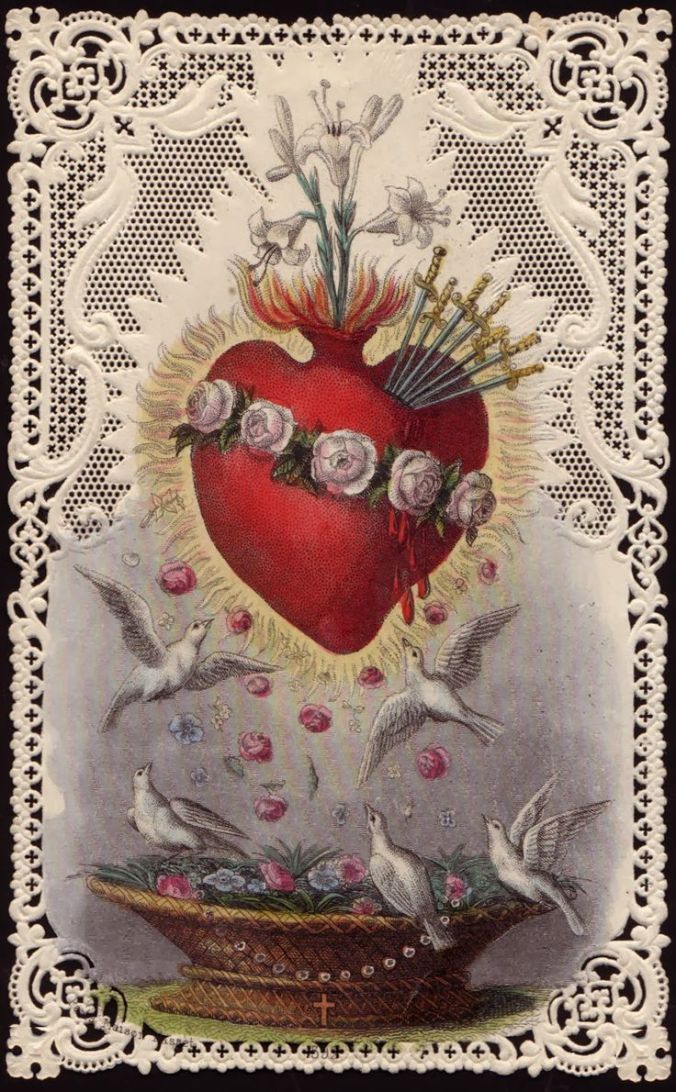
ImmaculateheartRosesDoves

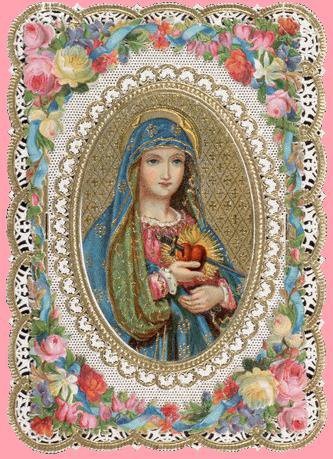
Lace holy card of the Immaculate Heart of Mary. Extremely Fr. Faber’s aesthetic. (Source)

Fr. Faber’s devotion to Our Lady extended beyond his prolific writings. He not only translated St. Louis’s book. In 1846, he undertook his own Marian consecration in the Holy House of Loreto. He had a tendency to refer to the Mother of God as “Mama.” A famous episode related by Monsignor Knox depicts Fr. Faber at one of his more florid moments. After a particularly high Marian procession at the Oratory, he was observed weeping. Without any care for who heard, he cried out, “Won’t Mamma be pleased?” (“The Conversion of Faber,” Pastoral and Occasional Sermons, 891).

None of this spirituality or the writing in which it comes to us fits our modern tastes. It is too perfumed, too sickly-sweet, too campy, too Victorian, too decadent, too redolent of pastel holy cards mouldering in antique prayer books. One critic puts it thus:

There are great slabs of passages, sometimes chapters at a time, which glow with ethereal light but have little content. Hypnotized by his own fluency Faber flows on and on, melodious and tedious…There are awful lapses of taste. (Chapman, quoted here).

And certainly, Faber cared not one shred for taste. The only thing that mattered was the salvation and sanctification of souls. Knox tells us that “‘Art for art’s sake’ had no meaning for him…if a bad verse would have more chance of winning souls than a good verse, down the bad verse would go” (“The Conversion of Faber,” Pastoral and Occasional Sermons, 891). There is much to criticize in this tendency from a purely aesthetic standpoint. Christians should commit themselves to the highest standards in all artistic and literary endeavors.

But it is hard not to like the man weeping after the procession; it is harder still to feel totally averse to passages that glow purple as the evening sky. One has the sense that Fr. Faber would have been a remarkable presence today, if only because his emotionalism and baroque, slightly kitschy aesthetic would have made him an ironic celebrity on Weird Catholic Twitter. Imagine what he would have done with memes!
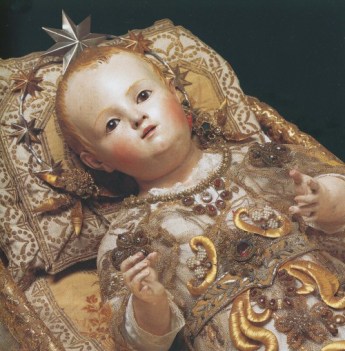
SantaMariaBambina1

Santa Maria Bambina, Southern Italy. (Source)

Yet he would also be a sign of contradiction. We have seen a renewed emphasis on Muscular Christianity, with a proliferation of websites, associations, and thinkpieces all dedicated to restoring “authentic masculinity” and resisting the “feminization” of the liturgy. This is a particularly popular movement within the larger Traditionalist wing of the Church. In brief, the narrative usually runs as follows:

1) After Vatican II, the Novus Ordo initiated a new, “feminine” form of the Mass.
2) This innovation was a substantive capitulation to the Sexual Revolution.
3) Men don’t want to serve a feminized Church in a feminized liturgy, with altar girls, felt banners, versus populum, happy-clappy music, etc.
4) The vocations crisis of the last 30-40 years ensues.
5) As such, we need to restore more pronounced gender binaries and hierarchies along with the Usus Antiquior.

Some of this narrative may be correct. I refrain from judging its particular historical claims, social implications, or theological presuppositions.
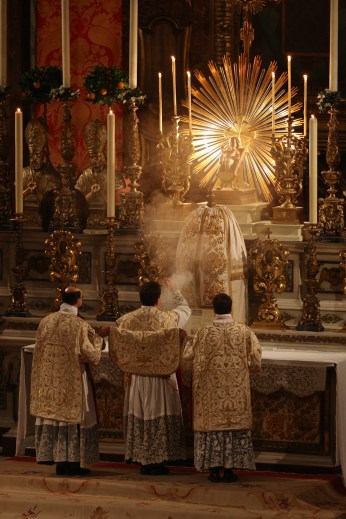
midnightmass3

Midnight Mass at the Brompton Oratory. (Source)

Nevertheless, Fr. Faber confounds that entire way of thinking. He was anything but a “Muscular” Christian. His personality, style, and spirituality were so clearly “feminine” that his own nephew, the publisher Geoffrey Faber, considered him a probable closet case (see David Hilliard’s famous essay “UnEnglish and Unmanly,” page 5). Whether or not his (disputed) conclusions about the priest (and all the leaders of the Oxford Movement) are true, it suffices to say that Fr. Faber was far from the “authentically masculine” man fetishized by the new Muscular Christianity.  Yet liturgically he was known as one of the highest of the high, and his sons at the Brompton Oratory continue that admirable tradition. If nothing else, Fr. Faber’s legacy is the Oratory that still stand as a landmark of reverence, beauty, and transcendent holiness in the midst of postconciliar banality.


What’s more, Fr. Faber is not just a fine hymnodist and devotional writer. He penetrated deep mysteries of the faith. A thoroughgoing Scotist, he advocated the thesis (shared by this author) that Christ probably would have been incarnated anyway even if Adam had never fallen. And as the Church’s Mariology continues to develop, his arguments on behalf of Our Lady’s Co-Redemption may yet prove invaluable. Sophiologists should take note. Here is a man after our own heart.
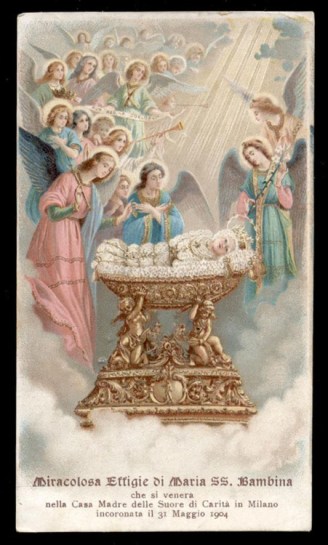
SantaMariaBambina2

A holy card of Santa Maria Bambina. (Source)

Fr. Faber writes of Our Lady’s suffering in a passage worth quoting at length:

But this is not all. She co-operated with our Lord in the redemption of the world in quite a different sense, a sense which can never be more than figuratively true of the Saints. Her free consent was necessary to the Incarnation, as necessary as free will is to merit according to the counsels of God. She gave Him the pure blood, out of which the Holy Ghost fashioned His Flesh and bone and Blood. She bore Him in her womb for nine months, feeding Him with her own substance. Of her was He born, and to her He owed all those maternal offices which, according to common laws, were necessary for the preservation of His inestimable life. She exercised over Him the plenitude of parental jurisdiction. She consented to His Passion; and if she could not in reality have withheld her consent, because it was already involved in her original consent to the Incarnation, nevertheless she did not in fact withhold it, and so He went to Calvary as her free-will offering to the Father. Now, this is co-operation in a different sense from the former, and if we compare it with the co-operation of the Saints, their own co-operation, in which Mary herself alone surpassed them all, we shall see that this other peculiar co-operation of hers was indispensable to the redemption of the world as effected on the Cross. Souls could be saved without the co-operation of the Saints. The soul of the penitent thief was saved with no other co-operation than that of Mary, and, if our Blessed Lord had so willed it, could have been saved without even that. But the co-operation of the Divine Maternity was indispensable. Without it our Lord would not have been born when and as He was; He would not have had that Body to suffer in; the whole series of the Divine purposes would have been turned aside, and either frustrated, or diverted into another channel. It was through the free will and blissful consent of Mary that they flowed as God would have them flow. Bethlehem, and Nazareth, and Calvary, came out of her consent, a consent which God did in no wise constrain. But not only is the co-operation of the Saints not indispensable of itself, but no one Saint by himself is indispensable to that co-operation. Another Apostle might have fallen, half the Martyrs might have sacrificed to idols, the Saints in each century might have been a third fewer in number than they were, and yet the co-operation of the Saints would not have been destroyed, though its magnificence would have been impaired. Its existence depends on the body, not on the separate individuals. No one Saint who can be named, unless perhaps it were in some sense St. Peter, was necessary to the work, so necessary that without him the work could not have been accomplished. But in this co-operation of Mary she herself was indispensable. It depended upon her individually. Without her the work could not have been accomplished. Lastly, it was a co-operation of a totally different kind from that of the Saints. Theirs was but the continuation and application of a sufficient redemption already accomplished, while hers was a condition requisite to the accomplishment of that redemption. One was a mere consequence of an event which the other actually secured, and which only became an event by means of it. Hence it was more real, more present, more intimate, more personal, and with somewhat of the nature of a cause in it, which cannot in any way be predicated of the co-operation of the Saints. And all this is true of the co-operation of Mary, without any reference to the dolors at all…Our Lord had taken a created nature, in order that by its means He might accomplish that great work; so it seemed as if the highest honor and the closest union of a sinless creature with Himself should be expressed in the title of co-redemptress. In fact, there is no other single word in which the truth could be expressed; and, far off from His sole and sufficient redemption as Mary’s co-operation lies, her co-operation stands alone and aloof from all the co-operation of the elect of God. This, like some other prerogatives of our Blessed Lady, cannot have justice done it by the mere mention of it. We must make it our own by meditation before we can understand all that it involves. But neither the Immaculate Conception nor the Assumption will give us a higher idea of Mary’s exaltation than this title of co-redemptress, when we have theologically ascertained its significance. Mary is vast on every side, and, as our knowledge and appreciation of God grow, so also will grow our knowledge and appreciation of her His chosen creature. No one thinks unworthily of Mary, except because he thinks unworthily of God. Devotion to the Attributes of God is the best school in which to learn the theology of Mary; and the reward of our study of Mary lies in a thousand new vistas that are opened to us in the Divine Perfections, into which except from her heights we never could have seen at all.
(“The Compassion of Mary,” emphases in source.)

There is much in this text, and in so many like it, to warm a Catholic’s flagging devotion to the Mother of God. For that treasure alone, we should be grateful.

KitschyMaryCard

A Marian Holy Card. (Source)

As his writing on this subject demonstrates, Father Faber was in all things the most enthusiastic and the most Roman of Catholics. Yet his prodigious work on behalf of the Gospel, and the ardor with which he was wont to express himself, made him a popular figure even among Protestants. His hymns are sung by traditional and mainline Protestant churches even today.

A.W. Tozer held him in high esteem, going so far as to write:

Spinoza wrote of the intellectual love of God, and he had a measure of truth there; but the highest love of God is not intellectual, it is spiritual. God is spirit and only the spirit of man can know Him really. In the deep spirit of a man the fire must glow or his love is not the true love of God. The great of the Kingdom have been those who loved God more than others did. We all know who they have been and gladly pay tribute to the depths and sincerity of their devotion. We have but to pause for a moment and their names come trooping past us smelling of myrrh and aloes and cassia out of the ivory palaces. Frederick Faber was one whose soul panted after God as the roe pants after the water brook, and the measure in which God revealed Himself to his seeking heart set the good man’s whole life afire with a burning adoration rivaling that of the seraphim before the throne. His love for God extended to the three Persons of the Godhead equally, yet he seemed to feel for each One a special kind of love reserved for Him alone. The Pursuit of God, p. 40 (quoted here)

If a modern master of Protestant spirituality can appreciate the peculiar wisdom of this effusive little man, then what excuse do we have? The Church has entrusted him to our memory and will, I hope, some day do so formally at the altar of God.

I began this essay describing the various spiritualities that have animated the Church from its earliest days. Some remain vital, others have disappeared, and some may yet come back from quietude. The strange and fragrant spirituality Father Faber let out into the world may appear as one of those dried-up streams, never again to impart life to the desert of our world. We are not Victorians. Yet this great Oratorian offers his gift to us still. We are the ones who must accept it. I have little doubt that his life, example, and thought are welcome aids in our pursuit of Heaven.
Our Lady of the Vallicella

MadonnaoftheVallicella1

Our Lady of the Vallicella. I don’t know who painted this version. (Source)

Today is the Feast of Our Lady’s nativity. Nine months after the Immaculate Conception, we celebrate the luminous and holy birth of the one who would some day give birth to God Himself. As the Church rejoices with S.s. Anne and Joachim, perhaps we should consider the manifold titles under which Mary has come to be known over the centuries.

Some religious orders have devotions to Our Lady under particular titles. The Cenacle Sisters are devoted to Our Lady of the Cenacle, the Institute of the Incarnate Word takes as its patron the Virgin of Luján, and most famously, the Redemptorists were commissioned by Pope Pius IX to care for and propagate devotion to Our Lady of Perpetual Help. The Dominicans appeal to Our Lady of the Rosary, the Augustinians to Our Lady of Good Counsel, and the Franciscans to Our Lady, Queen of Angels.

But what of the Congregation of the Oratory of St. Philip Neri? Is there a Marian image, title, or devotion proper to the Oratorians? Since the Oratory is not a religious order, the question may seem ill-put. Nevertheless, some research shows that there is in fact a specifically Oratorian icon of the Mother of God: Our Lady of the Vallicella.

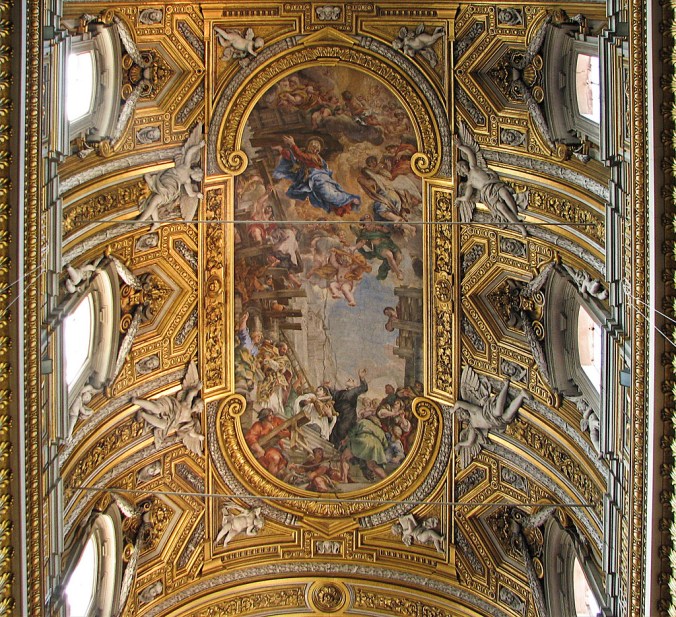
It is related in various lives of St. Philip that, during the construction of the Chiesa Nuova, Our Lady miraculously saved the church. As Gallonio relates in his Vita:

In the following year, 1576, something happened during the building works, which I must not pass over in silence. When the old church had been demolished, along with other buildings on the site of the new construction, one little hovel remained roofed, after the others had been levelled. Suddenly one day Philip had Giovan Antonio, the clerk of works, summoned, and as soon as he arrived he told him to have the roof taken off the hovel immediately. “Last night,” he explained, “I saw the Holy Mother of God, who was holding it up with her own hands.” (The place was being used as a chapel to say Mass and administer the sacraments to the people, for the old church had the responsibility of souls attached to it.) Giovan Antonio went back and ordered the workmen to demolish the roof. As soon as they set to, they noticed that the beam which supported the roof had no support for itself; one of its ends (what they call the beam’s head) was quite out of the wall, which quite astonished those who saw it [Gallonio, Para. 112 – trans. Fr. Jerome Bertram CO].

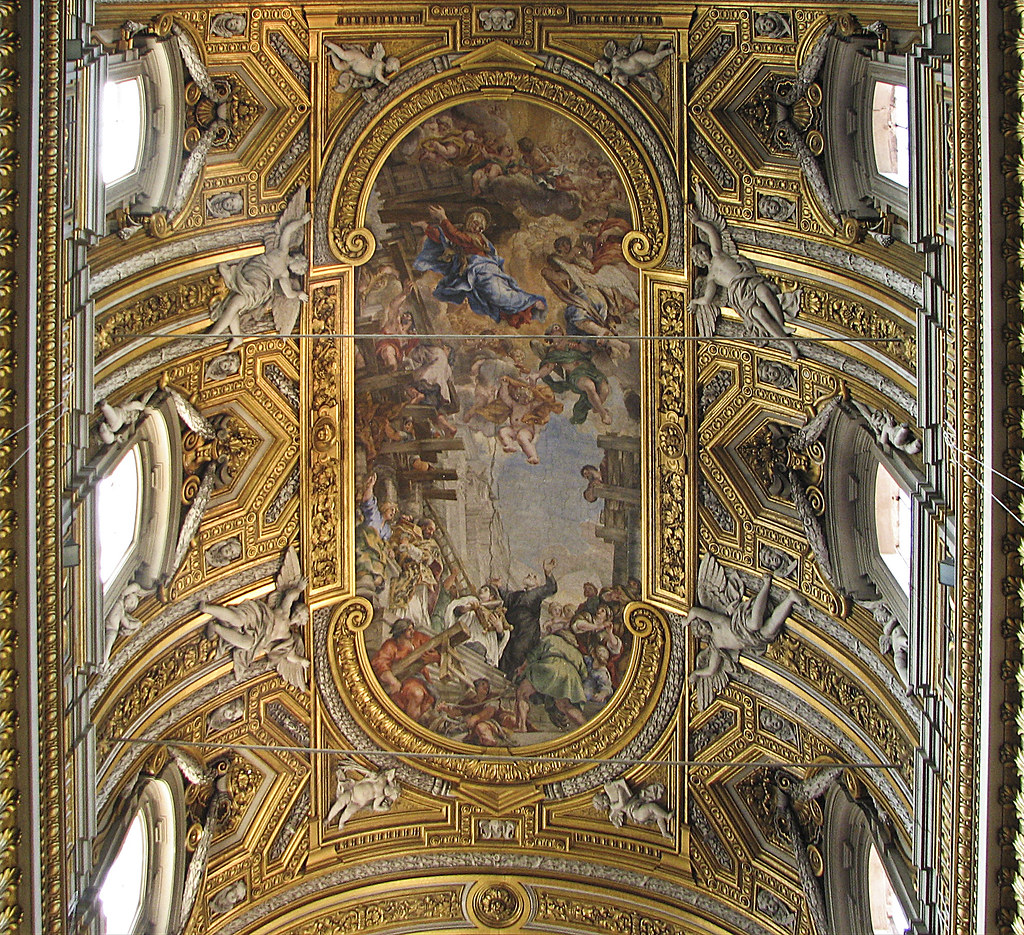
This incident is memorialized in the ceiling of the Chiesa Nuova.

CNCeiling.jpg

The ceiling of the Chiesa Nuova, in which is depicted the scene of Our Lady preserving the Vallicella from collapse and ruin. (Source)

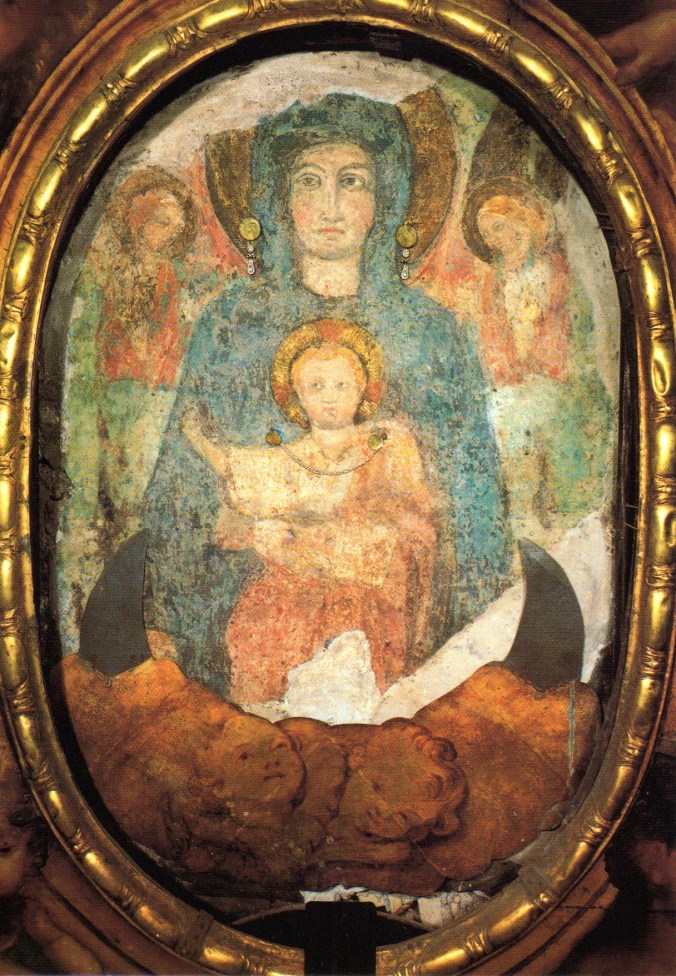
It is my understanding that the Saint and his sons attributed the miraculous intervention of Our Lady to an ancient fresco they uncovered during construction. The image depicts Our Lady in blue holding the Infant Christ. Jesus raises his hand in blessing. Both are seated in the moon, while three adoring cherubs look up with rapt attention. These are the essentials of the icon, which canonically follows the “Nicopeia (bringer of victory) or Kyriotissa (enthroned) type.”

This conjunction suggests something about the icon’s meaning. The Mother of God brings us the ultimate victory, Christ Himself; His victory over death is truly her victory and, by extension, ours. What’s more, their relationship is a mutual enthronement. She takes all of her dignity as Queen of Heaven from Christ, and He is most magnified in Her Heart.

It seems appropriate that an image that bears such a meaning would fall to St. Philip and his sons as a kind of special inheritance. After all, Cardinal Newman’s motto encapsulates the entirety of Oratorian life: Cor ad Cor Loquitur, “Heart Speaks to Heart.” This phrase of the Psalmist describes God’s Liturgical communion with us, our spiritual communion with each other, the key process of evangelizationbut also the intimacy between the Sacred Heart of Jesus and the Immaculate Heart of Mary. And let us not forget that third heart, the Flaming Heart of St. Philip Neri. All in all, communion and reciprocity are key to Oratorian spirituality in a way that is perhaps more pronounced than in other religious families.

12-vallicelliana

The ancient, miraculous fresco-icon of Our Lady of the Vallicella. Currently hidden in the Chiesa Nuova behind the Rubens rendition. (Source)

The story of Our Lady of the Vallicella is not just theological, though. It also winds through some of the more important chapters of Art History.

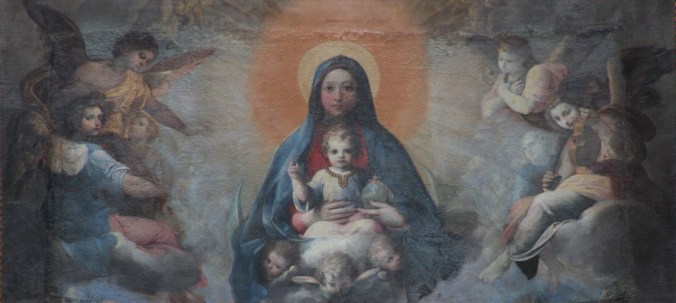
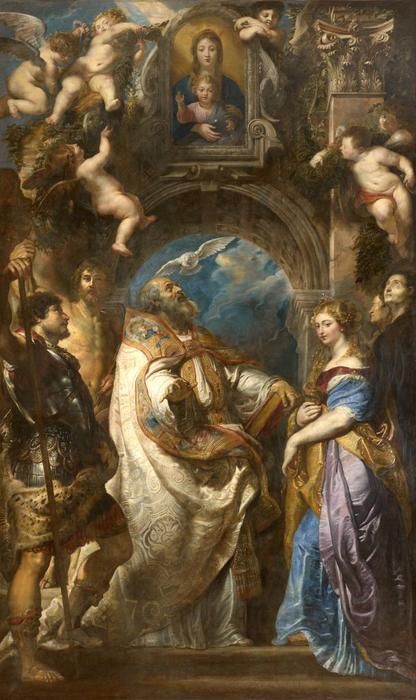
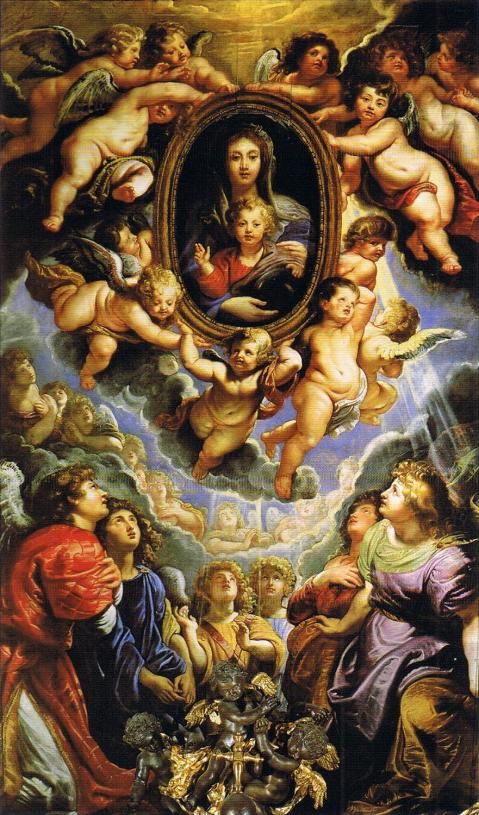
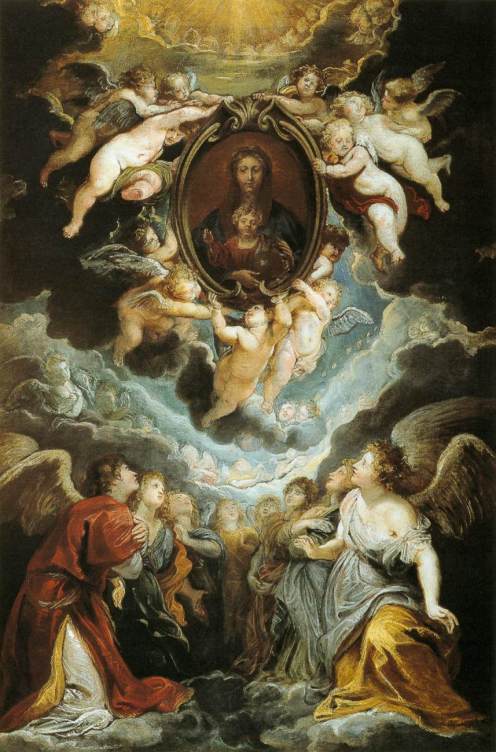
The great Baroque artist Peter Paul Rubens was commissioned by the fathers of the Roman Oratory to paint the church’s high altar. He ended up painting a few. The first, a canvas, was rejected because it was too reflective and is now in a museum at Grenoble. The second, a painting on slate, remains in situ. He later painted a somewhat rougher third version that now hangs in the Academy of Fine Arts in Vienna.

RubensVallicella1

Pope St. Gregory, Surrounded by Saints, Venerating the Miraculous Image of the Virgin and Infant, called Santa Maria of the Vallicella, Rubens, c. 1606-07. The first altarpiece of the Chiesa Nuova, now in Grenoble. (Source)

RubensVallicella2

Madonna della Vallicella, Rubens, 1606-08. The second altarpiece, now in situ at the Roman Oratory. The central image of the Madonna is removable and covers the miraculous fresco. (Source).

RubensValicella3

The Madonna della Vallicella Adored by Seraphim and Cherubim, Rubens, 1608. Now in Vienna. (Source)

Of course, devotion to Our Lady of the Vallicella is, like so many other elements of Oratoriana, not restricted to the sons of St. Philip. As the whole city of Rome is imbued with his spirit, we find her image among the many picturesque street shrines that stand as one of the Eternal City’s most distinctive forms of public piety.

AleteiaValicella.jpg

Our Lady of the Vallicella in a Roman street shrine. Note the way the hands are positioned; Our Lord’s left hand on the Orbis Mundi, with Our Lady’s right. Conversely, His right hand rises in blessing as her left seems to hold or even crown him. This posture is consistent with earlier renditions. (Source).

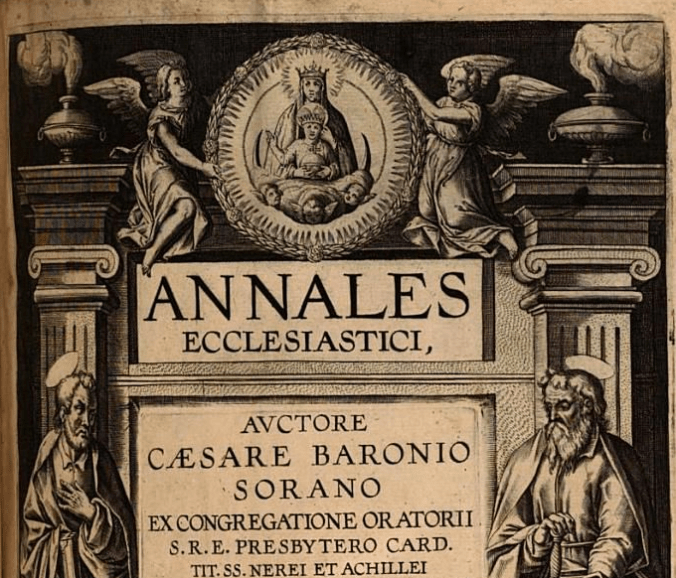
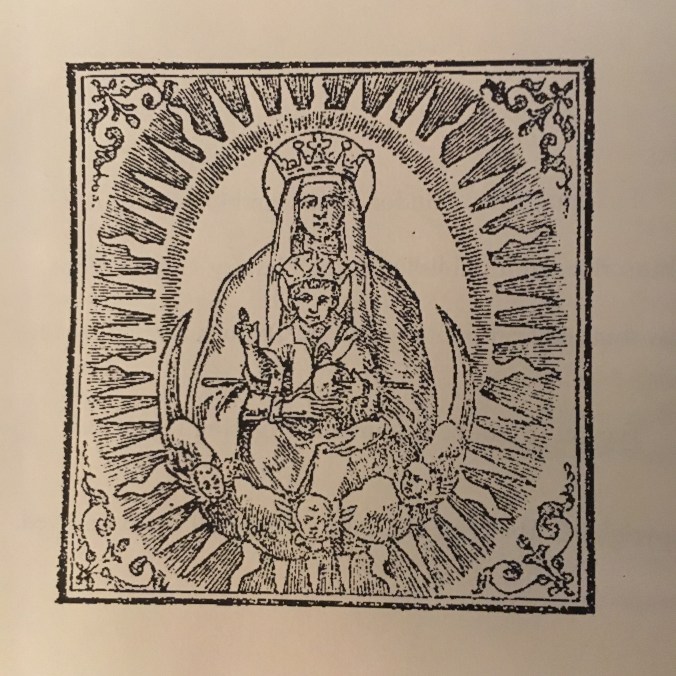
Regardless, Our Lady of the Vallicella quickly became a major emblem of the Congregation. She adorns most of the first-edition title pages of Baronius’s Annales Ecclesastici, as you can seen in this image from the Twelfth Volume.

Screen Shot 2017-09-08 at 2.02.58 AM.png

The title page of the Twelfth Volume of the Ecclesiastical Annals of Cardinal Baronius. (Source)

image.jpeg

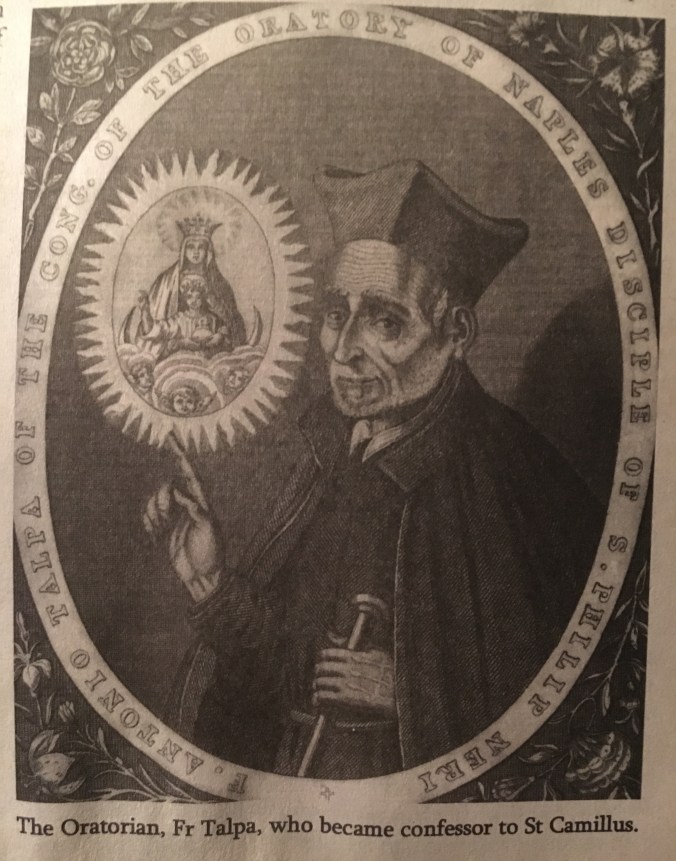
Our Lady of the Vallicella in a portrait of Fr. Antonio Talpa, one of the founders of the Naples Oratory and the confessor of St. Camillus of Lellis. I don’t know how old the image originally is. Photo taken from the 2008 English Edition of Cardinal Capecelatro’s Good Philip, produced by The Desert Will Bloom Press. Page 111.

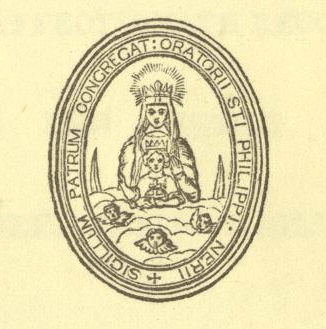
Later Oratorians also made use of the icon in their publications. This was particularly true of works brought out by the Fathers of the London Oratory. A publication of Fr. Faber’s Spiritual Conferences from 1859 includes the following sigil on its title page:

Screen Shot 2017-09-08 at 2.11.38 AM.png

Our Lady of the Vallicella in one of Father Faber’s many books (Source).

More recent Oratorians have also included this image of the Mother of God on the volumes they have published. For example:

image

Our Lady of the Vallicella as seen on the title page of my copy of Agnelli’s The Excellences of the Congregation of the Oratory of St. Philip Neri, Third Edition (Oxford 2012).

What I have not found yet is any evidence that Our Lady of the Vallicella was enshrined or venerated as an icon anywhere outside of the Roman Oratory. Further research may prove otherwise. Nevertheless, it is my sincere hope on this Feast of the Nativity of Mary that, as we are living in an Oratorian age, devotion to Mary under her Oratorian title will continue to spread.


Original Art: Four More Pieces

Here are the fruits of my labor for the last week or so.

image

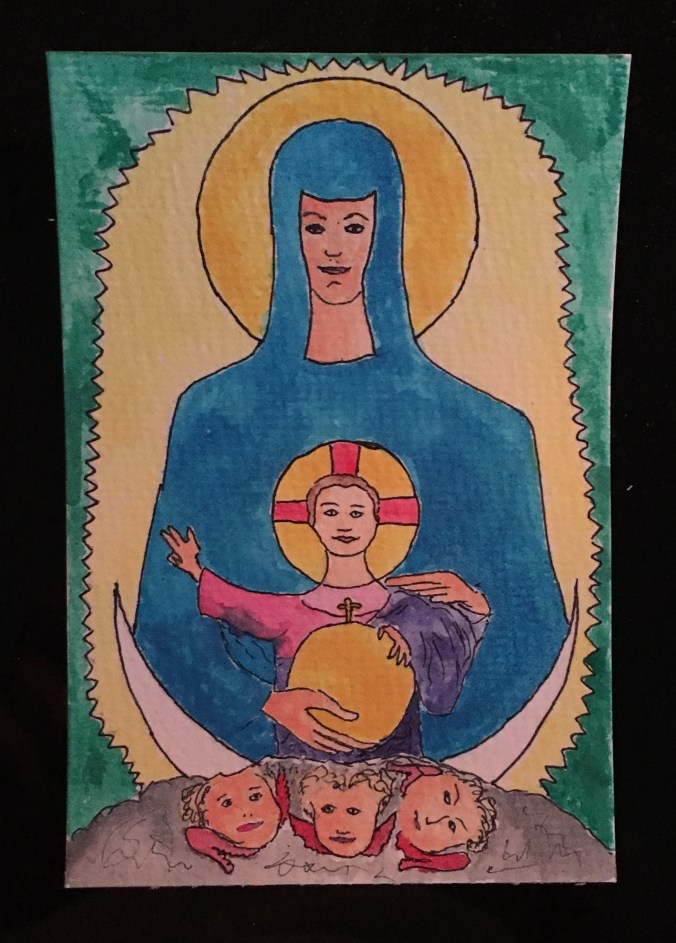
“The Madonna of the Vallicella,” photo taken by artist. The chief Marian icon associated with the Oratory of St. Philip Neri. This is a smaller study for what I hope will one day be a larger piece.

image

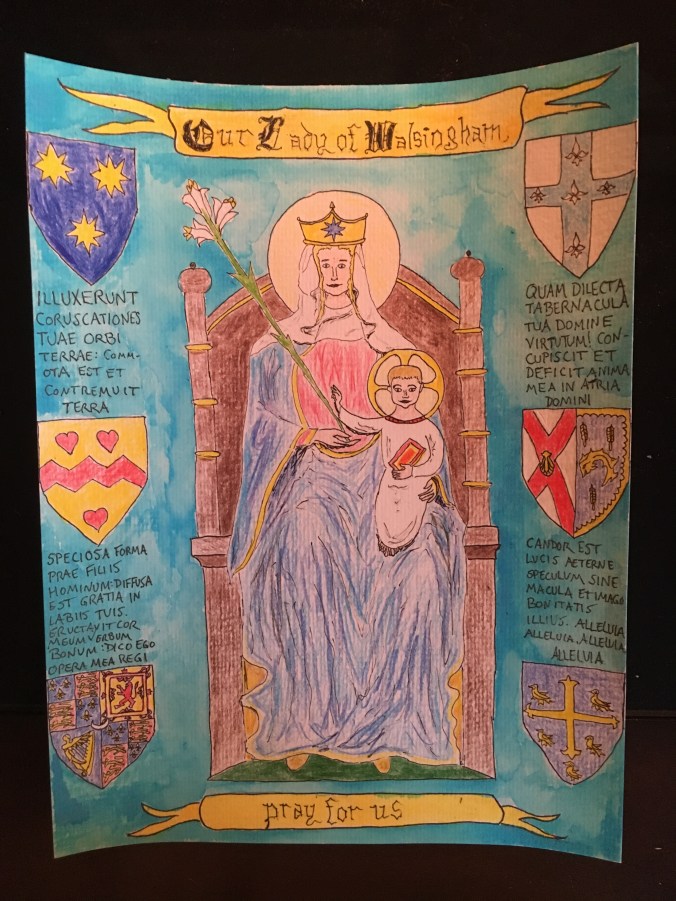
“Our Lady of Walsingham,” photo taken by artist. Included are the arms of (top to bottom): on the left, the Oxford Oratory, Cardinal Newman, and the Cardinal Duke of York, and on the right, Our Lady of Walsingham, St. John Fisher, and St. Edward the Confessor.

image

“St. Dominic,” photo taken by artist. Dedicated to all the wonderful Dominicans in my life.

image

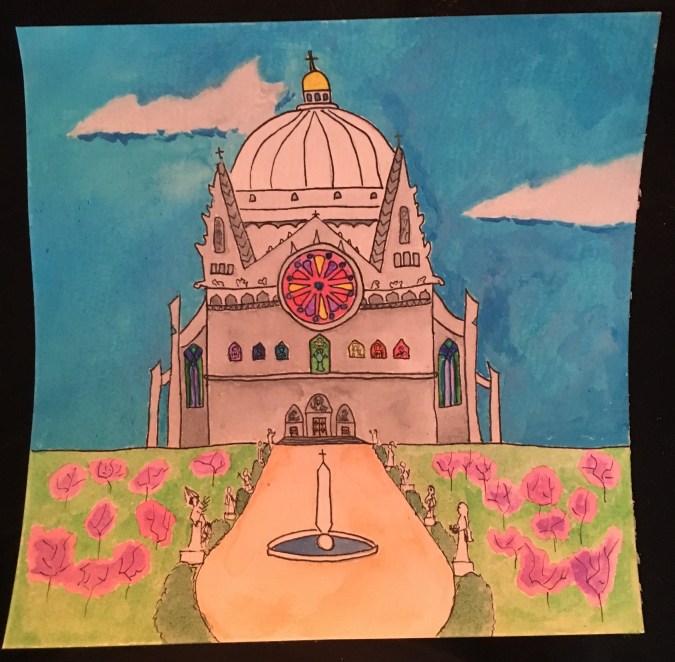
“The Basilica of Saints Catherine and Lucy,” photo taken by artist. Very pleased with how this turned out, as it’s my first largely free-drawn project, and my first without any use of a model.

Original Art: First Four Pieces

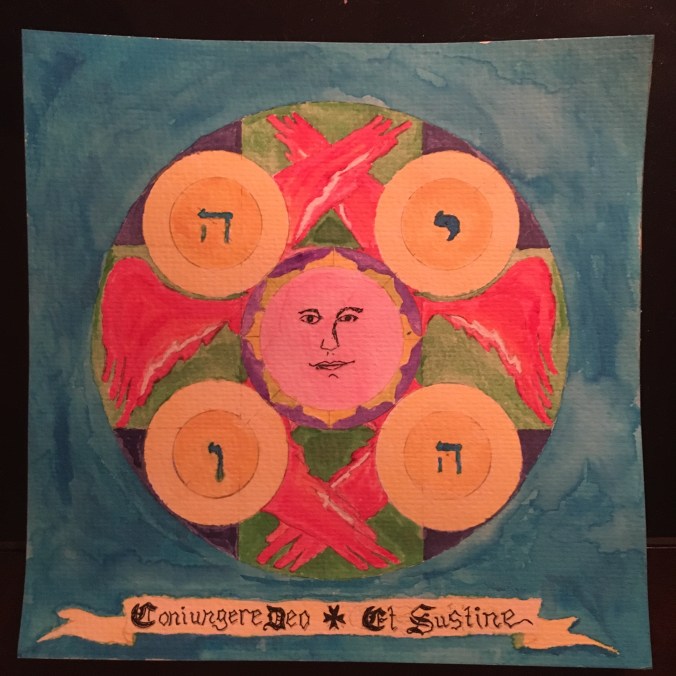
As part of my August challenge, I’ve gone back to painting. It’s been wonderful. Here are the first four works I have created. Apologies for the skewed black borders – some of the pages are a little warped from the watercolors. At this point, I’m primarily trying to get back my sea-legs, so to speak. Hopefully soon I’ll be able to move away from models and into more imaginative, creative territory. For now, I’m happy with the start I’ve made.

image

“Guardian Angel.” Photo taken by artist.

image

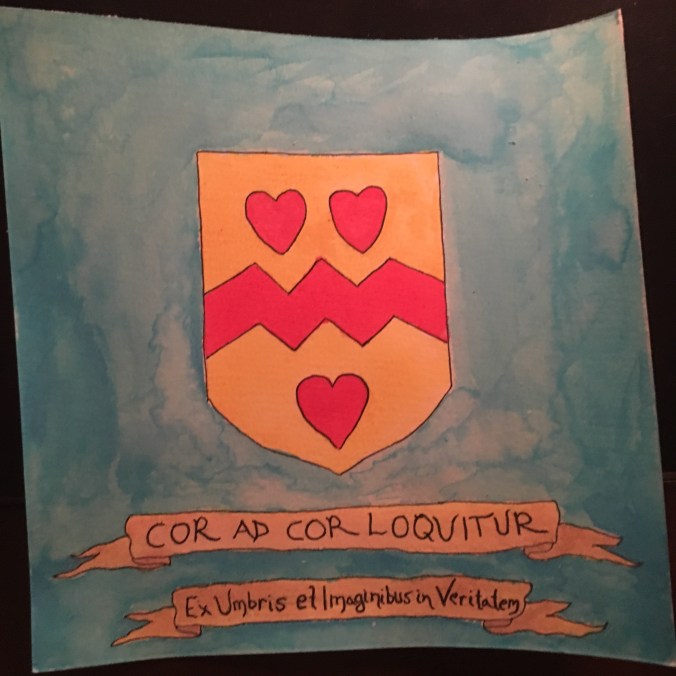
“Cardinal Newman’s Coat of Arms.” Photo taken by artist.

image

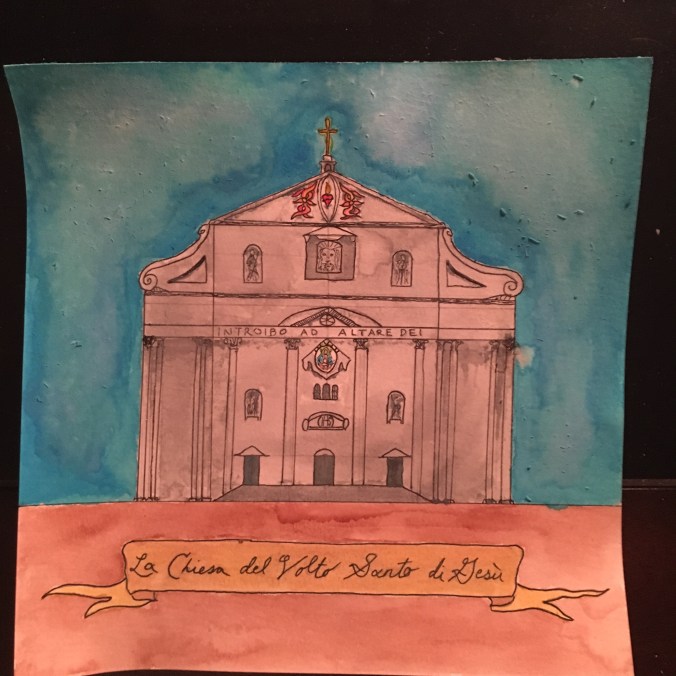
“La Chiesa del Volto Santo di Gesù.” Photo taken by artist. A riff on the Gesù proper. I worked from a photo and added my own design details.

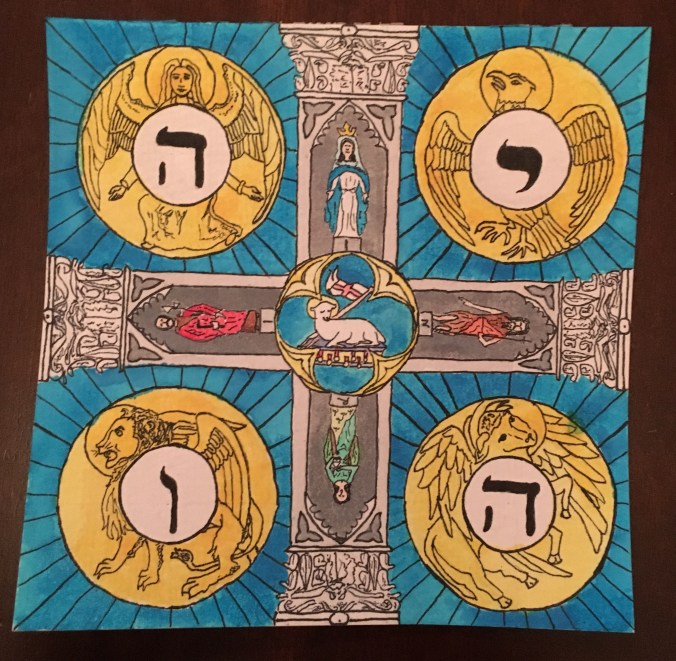
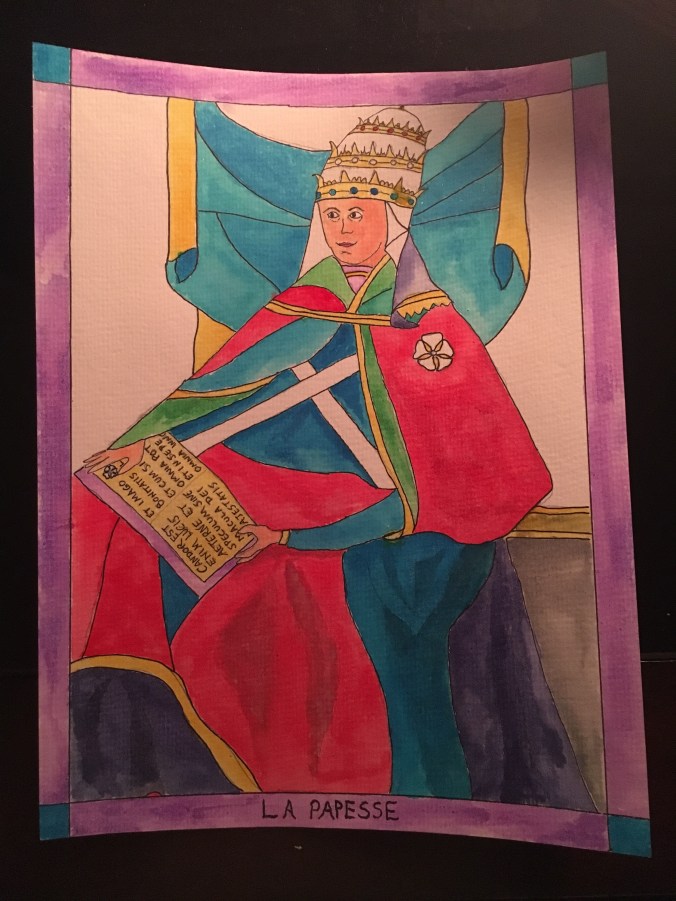
image.jpeg

“The Papess.” Photo taken by artist. I used the Marseilles Tarot as my starting model, and made various changes. The Papess is one of my favorite cards, and I prefer the earlier, Christian versions to the orientalist pagan “High Priestess” that Pamela Colman Smith and A.E. Waite bequeathed to us.

The Catholic Poems of Oscar Wilde

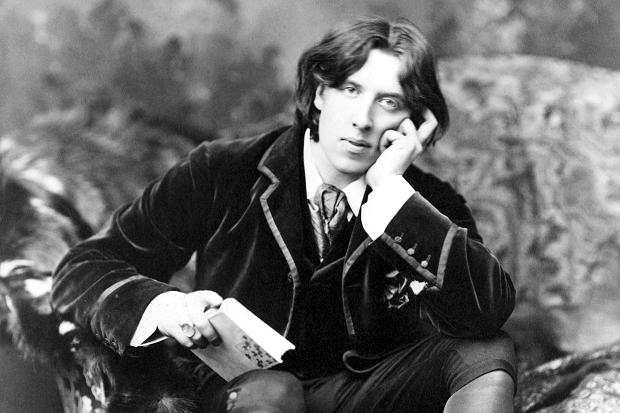
OscarWildeBook

Oscar Fingal O’Flahertie Wills Wilde (Source).

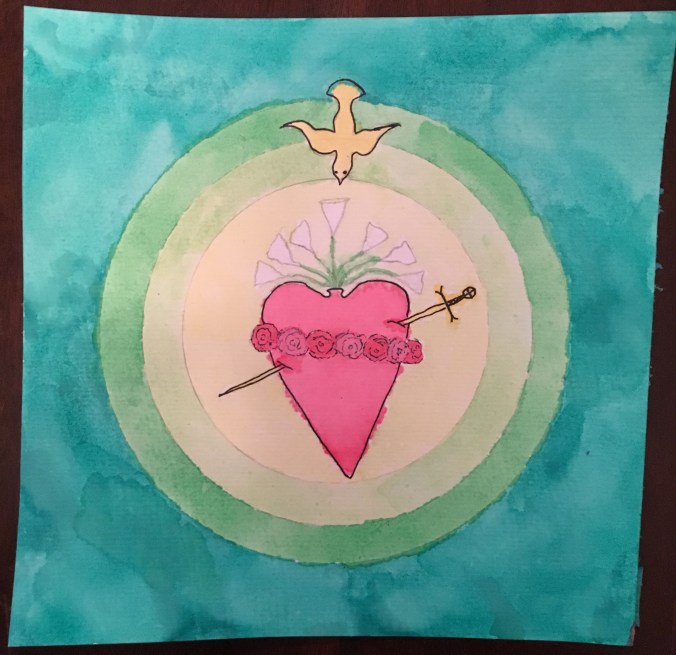
As I mentioned in my last post, during the month of August, I am dedicating myself to daily acts of creativity in honor of Mary’s Immaculate and Sophianic Heart. As Providence would have it, the Holy Father’s intentions for August include prayers for artists. Thus, I’m going to make my blog especially aesthetic for the rest of the month.

And what better way to start than examining work by one of the modern era’s great philosophers of art, Oscar Wilde? It is not often remembered today that Oscar Wilde was a Catholic. True, he was only formally received on his death bed. But Wilde maintained a lifelong flirtation with the faith. Catholicism infused his imagination from very early on in his productive career. When he was a student at Oxford, he visited Rome and wrote quasi-Catholic poetry that even Cardinal Newman admired. In some of the work, the influence of Dante is manifest. The aesthetics and romance of Catholicism appealed to Wilde, and he was nearly converted by Fr. Sebastian Bowden of the London Oratory. Only much later did he definitively turn to the Lord, in his last hour. However, many members of his circle also converted…a topic I shall, perhaps, explore some other day.

Ave Maria Gratia Plena

Was this His coming! I had hoped to see
A scene of wondrous glory, as was told
Of some great God who in a rain of gold
Broke open bars and fell on Danae:
Or a dread vision as when Semele
Sickening for love and unappeased desire
Prayed to see God’s clear body, and the fire
Caught her white limbs and slew her utterly:
With such glad dreams I sought this holy place,
And now with wondering eyes and heart I stand
Before this supreme mystery of Love:
A kneeling girl with passionless pale face,
An angel with a lily in his hand,
And over both with outstretched wings the Dove.

Sonnet on Approaching Italy

I reached the Alps: the soul within me burned
Italia, my Italia, at thy name:
And when from out the mountain’s heart I came
And saw the land for which my life had yearned,
I laughed as one who some great prize had earned:
And musing on the story of thy fame
I watched the day, till marked with wounds of flame
The turquoise sky to burnished gold was turned,
The pine-trees waved as waves a woman’s hair,
And in the orchards every twining spray
Was breaking into flakes of blossoming foam:
But when I knew that far away at Rome
In evil bonds a second Peter lay,
I wept to see the land so very fair.

Urbs Sacra Æterna

Rome! what a scroll of History thine has been
In the first days thy sword republican
Ruled the whole world for many an age’s span:
Then of thy peoples thou wert crownèd Queen,
Till in thy streets the bearded Goth was seen;
And now upon thy walls the breezes fan
(Ah, city crowned by God, discrowned by man!)
The hated flag of red and white and green.
When was thy glory! when in search for power
Thine eagles flew to greet the double sun,
And all the nations trembled at thy rod?
Nay, but thy glory tarried for this hour,
When pilgrims kneel before the Holy One,
The prisoned shepherd of the Church of God.

Sonnet on Hearing the Dies Irae Sung in the Sistine Chapel

Nay, Lord, not thus! white lilies in the spring,
Sad olive-groves, or silver-breasted dove,
Teach me more clearly of Thy life and love
Than terrors of red flame and thundering.
The hillside vines dear memories of Thee bring:
A bird at evening flying to its nest
Tells me of One who had no place of rest:
I think it is of Thee the sparrows sing.
Come rather on some autumn afternoon,
When red and brown are burnished on the leaves,
And the fields echo to the gleaner’s song,
Come when the splendid fulness of the moon
Looks down upon the rows of golden sheaves,
And reap Thy harvest: we have waited long.

Holy Week at Genoa

I wandered through Scoglietto’s far retreat,
The oranges on each o’erhanging spray
Burned as bright lamps of gold to shame the day;
Some startled bird with fluttering wings and fleet
Made snow of all the blossoms; at my feet
Like silver moons the pale narcissi lay:
And the curved waves that streaked the great green bay
Laughed i’ the sun, and life seemed very sweet.
Outside the young boy-priest passed singing clear,
‘Jesus the son of Mary has been slain,
O come and fill His sepulchre with flowers.’
Ah, God! Ah, God! those dear Hellenic hours
Had drowned all memory of Thy bitter pain,
The Cross, the Crown, the Soldiers and the Spear.

San Miniato

See, I have climbed the mountain side
Up to this holy house of God,
Where once that Angel-Painter trod
Who saw the heavens opened wide,

And throned upon the crescent moon
The Virginal white Queen of Grace,–
Mary! could I but see thy face
Death could not come at all too soon.

O crowned by God with thorns and pain!
Mother of Christ! O mystic wife!
My heart is weary of this life
And over-sad to sing again.

O crowned by God with love and flame!
O crowned by Christ the Holy One!
O listen ere the searching sun
Show to the world my sin and shame.

Madonna Mia

A lily-girl, not made for this world’s pain,
With brown, soft hair close braided by her ears,
And longing eyes half veiled by slumberous tears
Like bluest water seen through mists of rain:
Pale cheeks whereon no love hath left its stain,
Red underlip drawn in for fear of love,
And white throat, whiter than the silvered dove,
Through whose wan marble creeps one purple vein.
Yet, though my lips shall praise her without cease,
Even to kiss her feet I am not bold,
Being o’ershadowed by the wings of awe.
Like Dante, when he stood with Beatrice
Beneath the flaming Lion’s breast, and saw
The seventh Crystal, and the Stair of Gold.

E Tenebris

Come down, O Christ, and help me! reach thy hand,
For I am drowning in a stormier sea
Than Simon on thy lake of Galilee:
The wine of life is spilt upon the sand,
My heart is as some famine-murdered land,
Whence all good things have perished utterly,
And well I know my soul in Hell must lie
If I this night before God’s throne should stand.
‘He sleeps perchance, or rideth to the chase,
Like Baal, when his prophets howled that name
From morn to noon on Carmel’s smitten height.’
Nay, peace, I shall behold before the night,
The feet of brass, the robe more white than flame,
The wounded hands, the weary human face.

At Verona

How steep the stairs within Kings’ houses are
For exile-wearied feet as mine to tread,
And O how salt and bitter is the bread
Which falls from this Hound’s table,–better far
That I had died in the red ways of war,
Or that the gate of Florence bare my head,
Than to live thus, by all things comraded
Which seek the essence of my soul to mar.

‘Curse God and die: what better hope than this?
He hath forgotten thee in all the bliss
Of his gold city, and eternal day’–
Nay peace: behind my prison’s blinded bars
I do possess what none can take away,
My love, and all the glory of the stars.

On the Massacre of the Christians in Bulgaria

Christ, dost Thou live indeed? or are Thy bones
Still straitened in their rock-hewn sepulchre?
And was Thy Rising only dreamed by her
Whose love of Thee for all her sin atones?
For here the air is horrid with men’s groans,
The priests who call upon Thy name are slain,
Dost Thou not hear the bitter wail of pain
From those whose children lie upon the stones?
Come down, O Son of God! incestuous gloom
Curtains the land, and through the starless night
Over Thy Cross a Crescent moon I see!
If Thou in very truth didst burst the tomb
Come down, O Son of Man! and show Thy might
Lest Mahomet be crowned instead of Thee!

Queen Henrietta Maria

In the lone tent, waiting for victory,
She stands with eyes marred by the mists of pain,
Like some wan lily overdrenched with rain:
The clamorous clang of arms, the ensanguined sky,
War’s ruin, and the wreck of chivalry,
To her proud soul no common fear can bring:
Bravely she tarrieth for her Lord the King,
Her soul a-flame with passionate ecstasy.
O Hair of Gold! O Crimson Lips! O Face
Made for the luring and the love of man!
With thee I do forget the toil and stress,
The loveless road that knows no resting place,
Time’s straitened pulse, the soul’s dread weariness,
My freedom and my life republican!

On Easter Day

The silver trumpets rang across the Dome:
The people knelt upon the ground with awe:
And borne upon the necks of men I saw,
Like some great God, the Holy Lord of Rome.
Priest-like, he wore a robe more white than foam,
And, king-like, swathed himself in royal red,
Three crowns of gold rose high upon his head:
In splendor and in light the Pope passed home.
My heart stole back across wide wastes of years
To One who wandered by a lonely sea,
And sought in vain for any place of rest:
“Foxes have holes, and every bird its nest,
I, only I, must wander wearily,
And bruise My feet, and drink wine salt with tears.”

Wilde did just that until he lost his duel with the wallpaper on November 30th, 1900. But having received the last rites of the Church, perhaps he is already in heaven as a saint. One can only imagine what he would think of his portrait bedecked with a golden halo.

On the Birthday of Cardinal Baronius

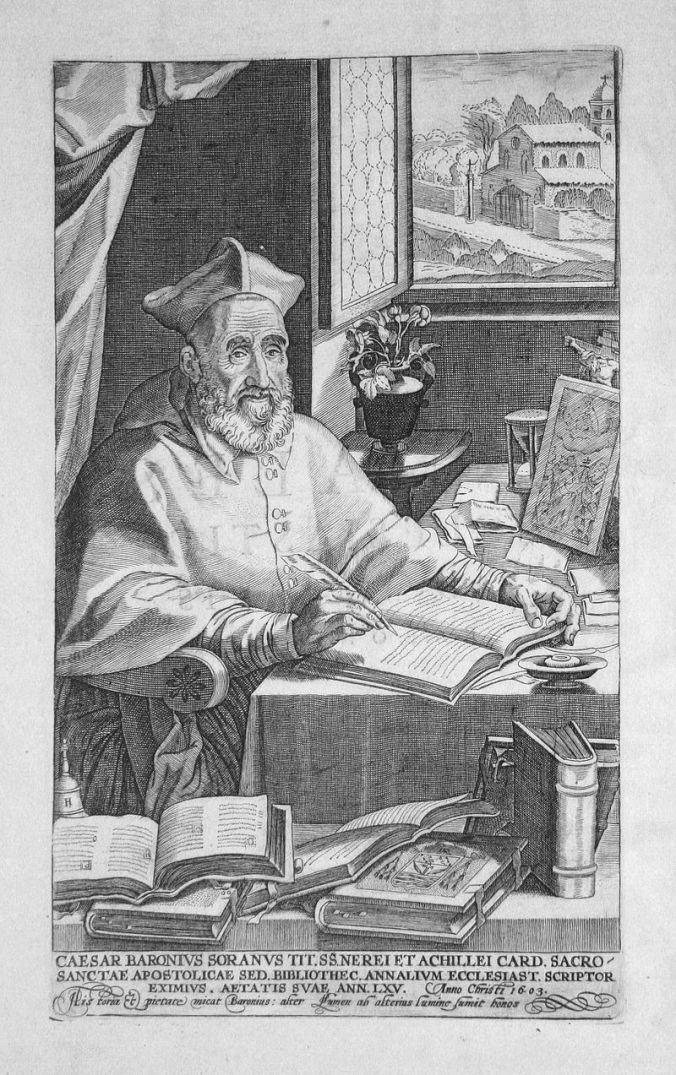
BaroniusPortraitbw

The Venerable Cardinal himself. This portrait is one of the few where his Cardinalatial arms can be glimpsed, on the cover of a book in the foreground. (Source).

Readers of this blog will learn with no surprise that, having finished Lady Amabel Kerr’s biography of the Venerable Cardinal Baronius, my admiration for this great Oratorian has increased tenfold. As I have concluded the volume, so lovingly edited and reprinted by Mediatrix Press, on the very birthday of the illustrious historian, I thought I might reproduce here two extended passages from Baronius’s correspondence that I found particularly edifying.

The first passage is taken from a letter that Baronius wrote to one Justin Calvin. I have thus far been unable to locate much further information about said Calvin, unrelated, I think, to the heresiarch Reformer. Baronius’s Annales and extended correspondence with Justin led to the latter’s eventual conversion. Calvin (or Justus Baronius Calvinus, as he was called once he added Baronius’s name to his own) went on to become a priest and author of, among other works, an Apologia that justified his conversion. God manifestly works in mysterious ways within the long lives of religious orders. He is inordinately fond of strange and unintended coincidences.

Baronius writes to the young convert:

I return many thanks to the great and most high God, whose tender mercies, as sings David, are over all His works, for having called you out of darkness into His marvellous light. No benefit, no grace can be greater than this, so see that you cherish it carefully and guard it jealously. Do not indulge in paeans of victory; but rather remember that exhortation of the Apostle to walk circumspectly, not as unwise but as wise, redeeming the time because the days are evil…When the devil has been overthrown, he is apt to rise up with renewed vigour, and assault his former conqueror more violently than ever. Our Lord tells us of the wicked spirit who, having gone out of a man, did not rest, but fetched seven other spirits more wicked than himself, and retook by fraud the soul whence he had been driven…Be sure that he will seek you who have escaped him and are now fighting in the ranks of the Church. He may not betray his designs, for he fears lest Saul-converted into Paul by his reconciliation to the Church-should by the first of divine love deal destruction on the lies by which he is wont to overcome men. You, a soldier of Jesus Christ, beware, and lose not hold on the shield of faith which you have taken up. Be master of yourself, overcome yourself, and take heed that you, who were once in the employ of the prince of darkness, be not ashamed of being enrolled under the banner of Christ your Captain…You have, however, no real cause for fear, but only for joy. Rejoice if you are found worthy to suffer anything for the Catholic faith and in defence of the truth. I showed your letter to our Supreme Pastor, who rejoiced to hear the bleating of his one-time lost sheep, who has been found worthy to hear the voice of the Shepherd. He is addressing to you an Apostolic letter, by which he embraces you as if with extended arms, and by his written words places you on his shoulders rejoicing. In him you will always find a true pastor and father. (Kerr 295-96).

There is much rich advice here for any convert. Baronius also displayed his perennial wisdom when he replied to a number of fellow Cardinals who censured the liberty with which he defended the independence of the Church against the claims of various princes and potentatesabove all, the King of Spain. His response is inspiring for anyone who hopes to engage in the life of the mind. We read:

It behoves me to imitate our Lord and Master Jesus Christ, of whom the Gospel says that He taught as one having authority and not as the scribes, which means that He preached with truth and liberty, whereas they, in their adulation of Herod, yielded to that king’s taste in everything. Far be it from me, I repeat, to write like the scribes, and not declare the truth freely as did Christ. After Him I turn to the holy fathers of the Church, whose example, in writing, it behoves me to follow. In their maintenance of the truth in the face of those who attacked it, they displayed unbending constancy of soul. They did not make use of cringing, diluted, soft expressions, but, on the contrary, employed a language both grand and strong, mingling with it a sharpness of censure which converted their sentences into so many flashes of lightning. If you look through the Annals you will find scarcely a year in which some such example is not cited.

By studying the fathers and relating their acts I have by habit adopted their manner of speaking, which should not, in my opinion, be despised, for such speech is bestowed as a gift of the Spirit rather than obtained by human learning. When dealing with heretic or schismatic innovators, or else with princes who corrupt ecclesiastical discipline by their violation of the laws of the Church, or endeavour by their tyranny to reduce her to servitude, I have acquired the habit of writing with the indiscretion which you censure. The words of the prophet, “Cry, cease not, lift up thy voice like a trumpet, and show my people their wicked doings,” keep resounding in my ears as if from heaven. When Eugenius IV was made Pope, St. Bernard exhorted him to nominate Cardinals who should act as John did towards Herod, Moses towards the Egyptians, Phineas towards the fornicators, Elias towards the idolaters, Eliseus towards misers, Peter towards liars, Paul towards blasphemers, and, finally, as our Lord Himself acted towards traffickers in the temple. In other words he urged the Pope to choose men armed with zeal against sinners, who should act everywhere and in every way in such a manner as to sweep away the workers of iniquity. Such is the model drawn for us by the Holy Ghost, and if we do not conform ourselves to it we shall be convicted of deformity. (Kerr 318-20).

These are just some of the words which the Venerable Cardinal let slip as so much nectar from his pen and tongue. He was truly one of the greatest scholars that the Church has ever produced, and he revolutionized the discipline of ecclesiastical history. Yet Baronius always saw the Annales as a secondary work to the simple task of salvation. His humility was legendary, and Kerr’s portrait of Baronius captures this peculiar virtue in all its many expressions.

Fénelon writes somewhere that we are all saved with our disposition. And Baronius’s scholarly predilections color his devotional life. Kerr tells us of one of his favorite prayers in a brief but vivid scene:

It may be said that he never wasted a moment of that rare though precious time when it was permitted him to turn his thoughts directly to God. While driving about in his coach he used to pull down the blinds and give himself over unrestrainedly to the things of the soul, bidding his companion recall him to himself if anything occurred which required his attention. When thus shut into darkness he usually repeated the Holy Name over and over again, or else dwelt lovingly on his favourite interjection, “Eternitas, eternitas,” words which were but the epitome of his ceaseless longing for death and the state beyond the grave. (Kerr 282).

Baronius teaches us to use time—that is, our place in historywell. May we follow in his glorious footsteps and one day enjoy with him the eternity he so ardently desired.

Baronius on Religious Writing

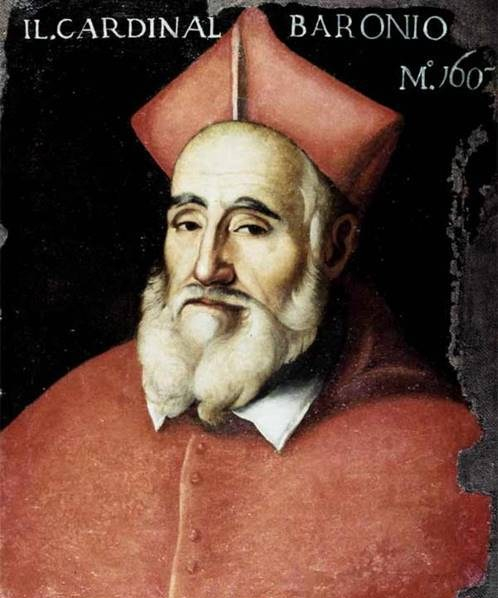
BaroniusColor

Portrait of Cesar Cardinal Baronius. (Source)

In a recent post, I quoted a letter sent by de Marquais, Abbot of St. Martin’s, to Cesar Baronius about humility and trust in the Providence of God whenever our work seems discouraging. The source I used, the Mediatrix Press edition of Lady Amabel Kerr’s biography of Baronius, has been a great read thus far. In the same chapter, I also found this excellent passage from the Annals, presumably also translated by Lady Kerr herself. She takes it from the dedication of the sixth volume of the Annals.

“No man, however distinguished in intellect or excellent in virtue, is sufficient of himself to handle sacred things. This is clearly demonstrated in Scripture by the example of that artificer who, though employed on only the mechanical structure of the place wherein God was to be worshipped, was declared by Moses to be thereby specially united to divine things. ‘The Lord has filled Bezaleel with the Spirit of God,’ said he, ‘with wisdom and understanding and knowledge and learning, and to work in gold, silver and brass, and in engraving stones and in carpenter’s work. Whatever can be devised artificially He hath given his hand.’ Yet Moses adds that even this work, so well done by aid of the Holy Spirit, was not to be used for God until it had been blessed. If then he who handled only the materials intended for the future service of God had to be himself given to God, how much more is expected of him on whom falls the burden of expounding those things which belong to the truth of the Church. Without doubt he should be ever filled with the Spirit of truth, so that he may complete his work standing firm in the truth.” (qtd. in Kerr 156-57)

As someone who hopes to someday write actual theology, I find these words both challenging and profound. I love the idea that a book can be a kind of little Tabernacle. I hope to carry out my own workacademic, creative, and whatever I can throw up on this blogin just such a spirit.

Too often, it seems that contemporary theologians treat their field as part of the Humanities rather than Divinity. They are overly concerned with political questions, or theories of signification and interpretation, or some such narrow province. On the other hand, some would go too far and forget the other side of the truth that Baronius expounds through his metaphor. The theologian, like Bezaleel, prepares a human work fit for a divine dwelling, but it is indeed a human work. It should speak a human language.

The proper posture, I think, is somewhere between the two. In other words—theologians must remember that their vocation, like all vocations, is theandric. The Sophiological Renaissance led by Michael Martin and the other folks over at Jesus: The Imagination seems to be a good example of that balance applied to actual religious writing. So is the deeply Eucharistic monastic theology of Dom Mark Daniel Kirby. In both of these (very different) cases, the writers achieve the divinity-humanity balance in their theology by hewing close to the sacraments and the sacramental worldview. As Sergius Bulgakov said, “one should imbibe theology from the bottom of the Eucharistic Chalice.”

I like to think that Cardinal Baronius might agree.

The Poetry of St. Philip Neri

SanFelipeRed

He would be 502 years old today. (Source).

In honor of St. Philip Neri’s birthday today, I reproduce here the translations of two of his three surviving sonnets, taken from the Liturgia Latina collection of Oratorian materials. That site reports that the translations from the original Italian are by Fr Henry Ignatius Dudley Ryder, of the Birmingham Oratory.

I.

The soul derives from God her being high,
In one keen instant out of nothing brought,
Not painfully through second causes wrought;
How should she, then, submit to things that die?

To hope, desire, to joy, to enmity;
To her confusion by these guides mistaught,
Of One confronting her she knoweth naught,
One glimpse of Whom would lift her to the sky.

How should the baser nature dare rebel
Against the higher, nor, as meet, consent
To do its bidding, but essay to quell?

Why prison bars the aspiring soul prevent
From leaving earth, above the stars to dwell,
To die to self, to live to God, intent.

II.

I love, and loving must love ceaselessly,
So whole a conquest in me love hath won;
My love to Thee, Thy love to me doth run,
In Thee I live, and Thou dost live in me.

Surely the day is nigh when I may flee
From this dark gaol, for ever to have done
With vanity and blind oblivion,
Where, exiled from myself, I used to be.

Earth laughs and sky, green branches and soft air,
The winds are quiet, and the water still,
No sun before has shed so bright a day;

The gay birds sing, love’s joy is everywhere;
My heart alone has no responsive thrill,
My powers flag and shrink from joy away.