My Favorite Scary Movies

Lloyd

What’ll ya have? (Source)

It’s nearly the Eve of All Hallows, and that means it’s time for some spooky stuff. I thought I’d offer up my top 10 favorite horror films for your viewing enjoyment.

I’ll begin with a few honorable mentions, including horror comedies. In no particular order: Sweeney Todd (2007), Halloween (1978), The Rocky Horror Picture Show (1975), The Exorcist (1973), Dracula: Dead and Loving It (1995), What We Do in the Shadows (2014), The Silence of the Lambs (1991), Young Frankenstein (1974), The Others (2001), and Shaun of the Dead (2004). All of these are pretty good films on their own terms, and you should watch them. But for the following list, I wanted to highlight a few I though were especially worth re-viewing this Halloween.

I generally dislike slashers and body horrors, so you won’t see any of the Saw, Grudge, Hostel, Alien, or Ring series here. My tastes run towards the Gothic, psychological, occult, Lovecraftian, and atmospheric. My list reflects that tendency. I don’t claim it will satisfy everyone. Finally, while I have generally tried to avoid SPOILERS, I think I may have left one or two. So abandon all hope, ye who enter here.

10. Jack Frost (1997)

jack-frost-1997-snowman-attack

When he kills this guy, he says, “I only axed ya for a smoke.” And chuckles. Really. (Source)

Admittedly, this is a very bad film. It holds a whopping 7% on Rotten Tomatoes, and I’ve never been able to get through the whole thing myself. But what I have seen makes me esteem Jack Frost as one of the corniest and campiest of horror B-movies. And I adore B-movies, so this one’s gonna stand in for all the crap I could have chosen instead.

The plot is pretty straightforward. A psychopathic serial killer is being transported to death row when his car gets in an accident with a massive container truck full of a biological reagent. He is burned by the acid and seemingly melts away. However, his DNA fuses with the snow and takes on a new form as a Killer Mutant Snowman, hell-bent on terrorizing the community that sentenced him. Hilarity ensues. Complete with over-the-top gore, the very cheapest of special effects, completely maladroit music, a ridiculous sex scene, some of the worst acting you will ever watch, and dad-level one-liners (no, but really), this Christmas-themed whopper of a flop will liven up your Halloween.

9. Les Yeux Sans Visage (1960)
yeux-sans-visage2_0

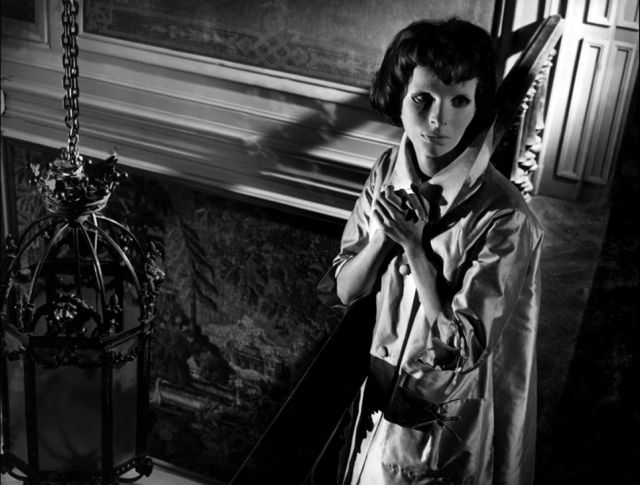
Les Yeux Sans Visage – a classic of French horror, with profound Feminist undertones. (Source)

Now on to something actually creepy. This French horror film by Georges Franju is not overly scary, in the sense that it lacks jump scares or the typical fare of, say, slashers or sex-crazed body horrors. But it’s definitely worth seeing, as at times it actually becomes a poignant exploration of power and acceptance. Also, it inspired an eponymous song by Billy Idol.

A mad scientist and his cohort of minions murder young girls in Paris so that he can steal their faces – literally. His daughter Christiane suffers from a terrible facial disfigurement after a motorcycle accident for which he was responsible, and in his guilt, he promises he will graft a new face onto her. Every attempt is unsuccessful. Christiane wanders the halls in an eerie white mask, and we are treated to a gruesome, close-up view of a face transplant. Ultimately, the story examines how men use female bodies as canvasses to represent and expiate their own guilt, especially for violence they have committed against women. It also examines the complicity of other women – the mad doctor’s closest assistant is a lady whom he successful healed after her own scarring accident.

A sensitive, beautiful, and tragic tale with a few disturbing scenes. Worth your time.

8. Repulsion (1965)
repulsion-hallway-copy

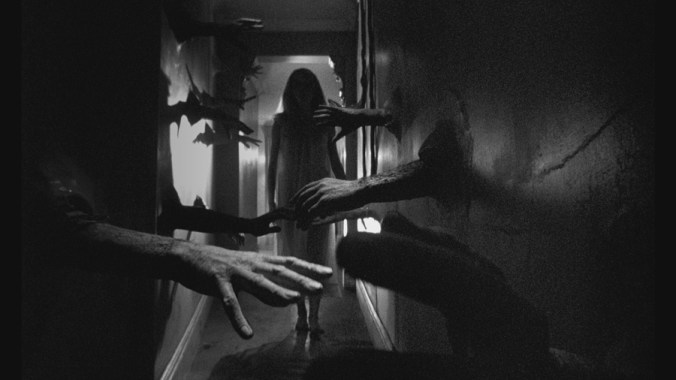
The famous hallway of hands sequence in Repulsion. (Source)

One of Roman Polanski’s early greats, Repulsion remains a standard of Psychological Thrillers. It features some of Polanski’s classic sequences and shots: the buskers, the hallway of hands, the decomposing rabbit. The film follows the mental breakdown of a young girl (played by a youthful Catherine Deneuve) on a weekend she spends alone in her apartment in Belgium. That may sound simple, but boy is there a lot going on. Sex, murder, insanity – not to mention painfully tight close-ups in an era when that was considered artistic. Repulsion is definitely one of the strangest and most harrowing films on this list.

7. Jaws (1975)

Jaws

Duh dum. Duh dum. (Source)

One of the greatest and most popular horror films ever made. Its instantly recognizable theme is one of the few horror scores to rise to the status of auditory icon. I would argue that it’s Steven Spielberg’s finest and scariest foray into the genre, much better than his trope-heavy Poltergeist (1982). The simplicity of Jaws is what makes it so effective as a nail-biter. There’s a murderous shark, and to hunt it, you have to become ever more isolated – and thus ever more vulnerable.

There are plenty of genuinely scary moments in the film, but I think one of the best is also one of the most understated: the tale of the USS Indianapolis. Here, too, the black magic is all in the simplicity. Quint tells a story. That’s it. But it’s one of the most disturbing stories ever told in a film (and what’s worse, it’s true). While all the cast give fantastic performances, Robert Shaw exceeds his peers by that one scene.

6. Psycho (1960)
psycho-3

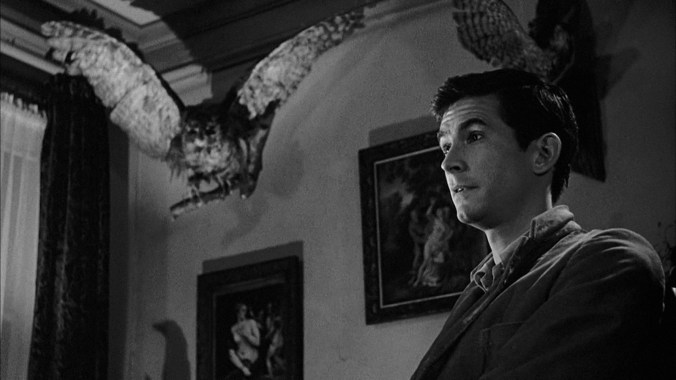
“We all go a little mad sometimes…” (Source)

I probably could have chosen several of Hitchcock’s films for this list. Some of his thrillers are remarkably good. Particular favorites include Strangers on a Train (1951), Vertigo (1958), and Rope (1948). But as far as frights go, nothing in the prolific director’s oeuvre surpasses his horrific masterpiece, Psycho. Long before M. Nigh Shyamalan attempted (and subsequently wrecked) the art of the twist ending, Psycho showed generations of directors how it was done. Ans like Jaws, Psycho gave us an iconic score, forever associated with an iconic scene.

Psycho was among the first real horror films I saw, one Halloween night many years ago. I’ve loved it ever since.

5. Eraserhead (1977)

Eraserhead

The woeful Henry Spencer in David Lynch’s first movie, Eraserhead (Source).

David Lynch is one of my favorite directors (I sometimes joke that Twin Peaks is my “second religion”). His first film, Eraserhead, has an affinity with the New Wave horror of Polanski et al. As in Repulsion, we are constantly made to feel the limits of the space the characters inhabit. But Claustrophobia is only one of the fears that Lynch explores. Eraserhead is a great meditation on the terrors that attend some of the most common experiences of life: work, sex, marriage, fatherhood. Jack Nance’s performance as Henry Spencer is riveting as it is tense, and the eerie Lady in the Radiator sequences foreshadow much of what Lynch would later use in his more famous works like Twin Peaks and Mulholland Drive. The film also probably wins the award for creepiest baby in cinematic history; even today, Lynch won’t reveal how they made it. If you like surrealism, body horror, or pencils, I recommend this classic for your consideration.

4. The Innocents (1961)
theinnocents

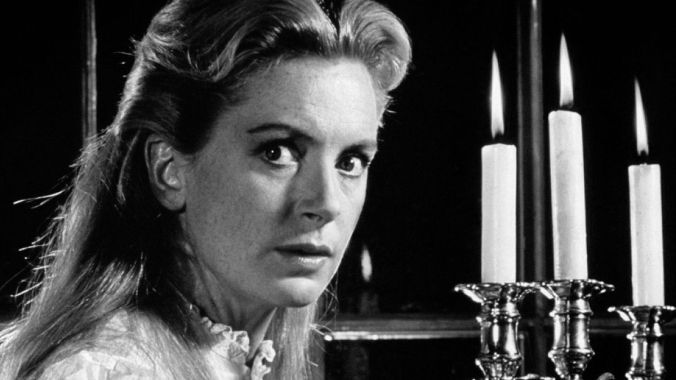
Deborah Kerr gives a masterful performance in this classic Gothic horror. (Source).

If you like your horror set in creepy old English manor homes, full of candlelight and the creak of ghosts on the stairs, then you’ll certainly love The Innocents. Based on Henry James’s classic novella, The Turn of the Screw, the film follows a governess, played by Deborah Kerr, who is sent to care for two orphans in the English countryside. As time passes, she starts to believe that the children are under the malign influence of ghosts. Is she insane? Or is she battling the forces of the supernatural?

While viewers still debate the meaning of the deeply ambivalent ending, one thing’s for certain; this film is a masterful example of mid-century Gothic horror. Not to be missed.

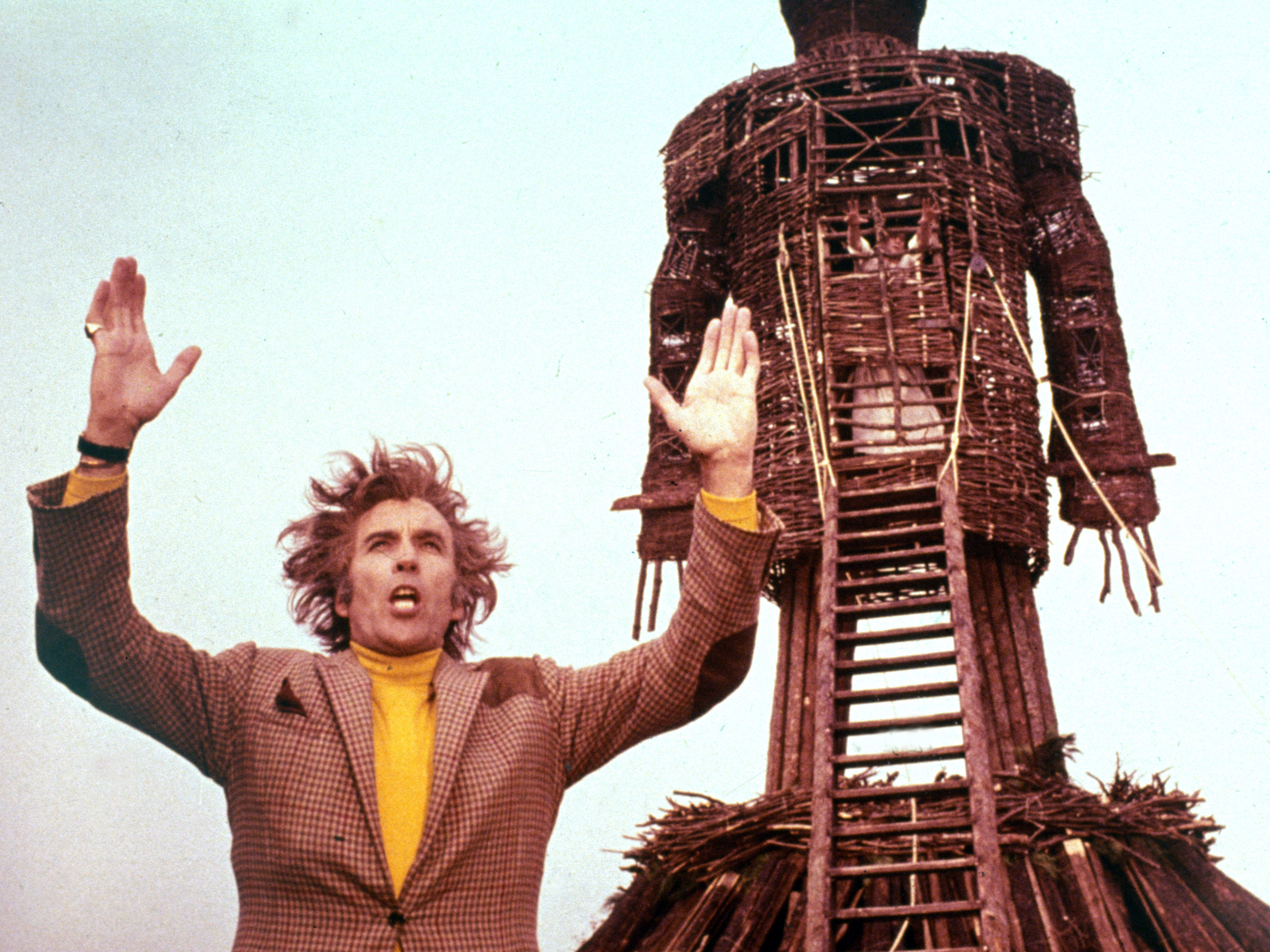
3. The Wicker Man (1973)
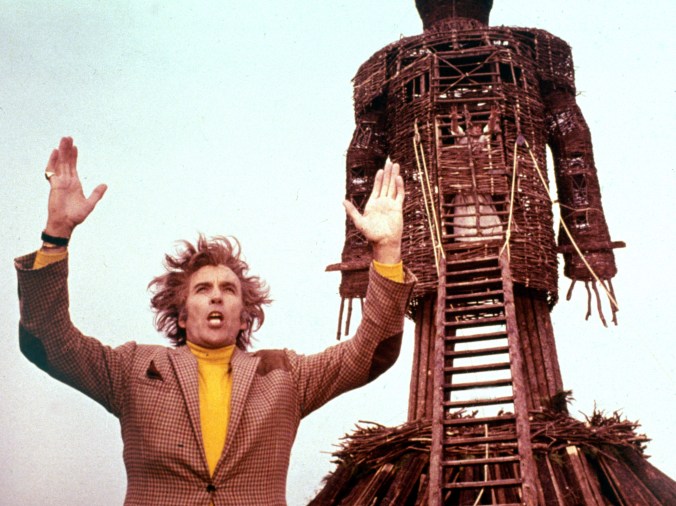
lord-summerisle-the-wicker-man2

Traditional British Values. (Source)

The Wicker Man, strictly speaking, really isn’t all that scary. But it is a very good story all the same, and Christopher Lee puts in a marvelous performance as Lord Summerisle. If you like folk-horror, a subgenre the English do better than anyone, you’ll enjoy this creepy little romp through a murderous, pagan island in Scotland. Arthur Machen would have loved it.

I find it somewhat amusing that Lee, a devout Anglo-Catholic, thought that the film was ultimately a Christian one in suggesting that even nice people can commit horrible acts if they are not within the fold of the Church. Maybe. But what a poor argument for Christianity it is! The protagonist is such an unlikable and censorious prude, and the villagers are such fun-loving heathens, that you end up not caring too much about the Christian policeman’s fate in the final showdown. Alas. I suppose I’m biased, though, as I’ve long thought that Catholics are just baptized pagans anyway. Incidentally, I think the community of Summerisle gives a pretty good picture of what the Benedict Option might look like in practice.

Don’t confuse this classic with the highly memeable 2006 sequel starring the one and only Nicolas Cage. There are creepy masks, but no full-on bear suits in Christopher Lee’s version. And definitely no bees.

2. The Shining (1980)
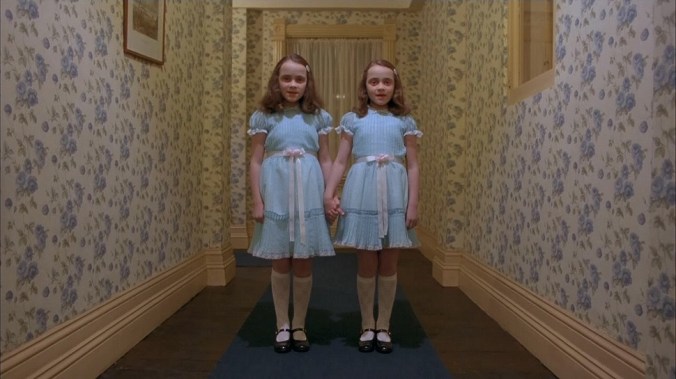
the-shining-HD-Wallpapers

“Come play with us, Danny.” (Source)

Stanley Kubrick’s horror masterpiece. Considered in purely artistic terms, there are no better films on this list. It shows what kind of art can happen when a genius director works with a genius actor (Jack Nicholson in one of the best performances of his career). More to our point – the frights are just as potent today as they were in 1980. Unlike a number of other works from the same decade, The Shining has retained its creepiness. It terrified and disturbed me the first time I saw it, and while I mainly pay attention to its formal and aesthetic qualities now, I still jump now and then when I watch it. I will never not find that man in the dog/bear suit (you know the one) absolutely terrifying, and I will never not relish the conversations with Lloyd and Grady with a certain perverse glee.

I could probably go on and on about how great this film is. But why bother? Just watch it yourself. You won’t be disappointed.

1. The VVitch
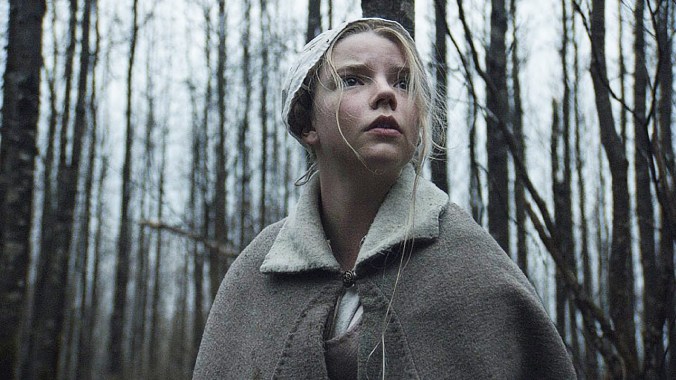
WitchWoods

“What went we out into these woods to find?” (Source)

Horror has gotten much better lately, with genuinely artistic offerings from bold new directors. The Babadook (2014), Goodnight Mommy (2014), It Follows (2014), The Blackcoat’s Daughter (2015), The Eyes of My Mother (2016), It Comes at Night (2017), and Get Out (2017), among others, have all renewed the genre. But my favorite among the new horror is The Witch (2016). Genuinely creepy, trope-laden without being clichéd, atmospheric, Gothic, full of painstakingly reproduced sets and costumes from Puritan New England, and written entirely in 17th century English, The Witch represents an enthusiastic return to the old legends of Early Modern witchcraft. And it is beautifully shot. At times, it looks like the film that Goya would produce if he lived in our time. There is a black goat. It will change the way you look at the animals. In short, it is a cinematic triumph for A24, a studio that has proven itself to be one of the leaders of the new horror.

I love The Witch for all those reasons – but also because it presents a world in which Christianity is taken seriously. That rather startling quality has been in short supply among horror films since Terrence Fisher’s Hammer flicks of the 1960’s and 70’s. We see these characters as real, dignified people afflicted by indisputably real forces of the supernatural. In the world of The Witch, the Devil is real and so are his servants.

The film can also be read as a profound meditation on the doctrine of original sin. The ruin of the whole family follows from the pride of the father as we see it at the movie’s start. They are effectively damned as soon as they leave the village. There is perhaps some irony in the fact that the Church of Satan both endorsed and promoted the film. It is the only really Calvinist movie I’ve ever seen; no other has so deftly and deeply explored the Reformed idea of reprobation.

Halloween is naturally a time to seek out a good scare. If you’re looking to do that with a movie, I can think of no better option than The Witch. But you’ll get more than that. The Witch immerses us in a world we can hardly fathom, a world where supernatural evil lurks just behind the treeline and in the pale light of an attic. Dipping into that world can be salutary. After all, maybe it’s a good idea on the Eve of All Hallows – the night before the feasts of the Saints in Heaven and the Holy Souls in Purgatory – to spend some time first meditating on the damned.


 

30,000 Views

30000words

Huzzah. (Source)

Today, I hit 30,000 views on my blog. I’ve also nearly reached 20,000 discreet visitors. I can’t say I ever envisioned The Amish Catholic getting this big, especially within the first year of starting.

Thank you to everyone who has taken the time to read what I write and publish here. And thank you especially to all those who have publicized, responded to, or written about my work. There are so many of you that I would fear to leave anyone out if I named names. Please know that I am aware of your generosity and consideration. I hope I can continue to produce content that piques your interest.

A Word of Thanksgiving

image

Our Lady of Walsingham, pray for us. (Source).

Today, on the double feast of Our Lady of Ransom and Our Lady of Walsingham, I was blessed to consecrate myself totally to the Mother of God at the Church of her Immaculate Heart, otherwise known as the Brompton Oratory. Thank you to everyone who prayed for me en route to this wonderful occasion. I look upon it as a momentous date, a renewal of my entrance into the Church four years ago,

The date and place are especially meaningful to me. I have long had a devotion to Our Lady of Walsingham, Patroness of England. During the stresses of my final year at Virginia, I entrusted all my major projects–in particular my thesis and my graduate school applications–to her. And over the course of the last few years, my love for St. Philip Neri and his sons has grown into a true devotion to the Oratorian way. Brompton was where that began for me, almost two and a half years ago. I date the start of my friendship with St. Philip to my first overawed trip to the Oratory in 2015. And I pronounced my vow of consecration at the altar of Our Lady of the Rosary, a grace that reminded me of all the wonderful Dominicans I have known over the short course of my life as a Catholic.

So thank you to all those who have prayed for me. And please pray still, that I might not forget my vow as the inevitable distractions, delights, and stresses of grad school set in.

A Sophianic Documentary

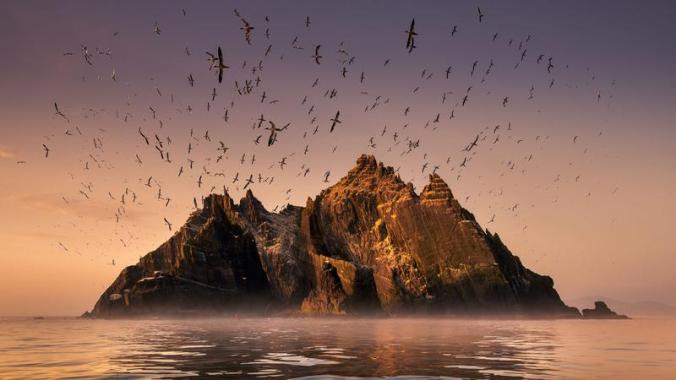
Skelligs

The Puffins of Little Skellig, featured in the show. (Source)

Recently, I had the good fortune of watching Ireland’s Wild Coast, a PBS piece. I must recommend it in the highest possible terms. You can watch the trailer here. From PBS’s description:

Emmy Award-winning wildlife cameraman Colin Stafford-Johnson takes viewers on an authored odyssey along Ireland’s rugged Atlantic coast – the place he chooses to make his home after 30 years spent shooting some of the world’s most celebrated wildlife films.

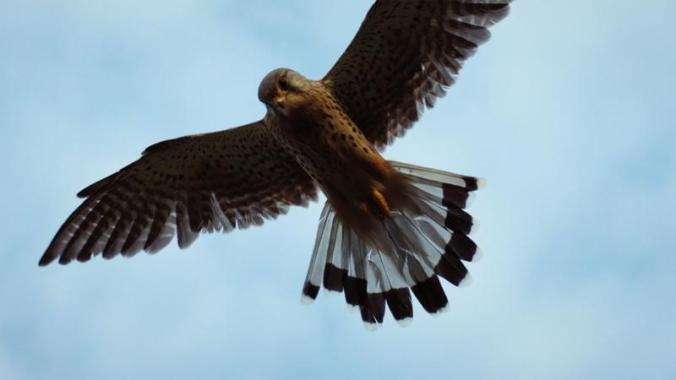
The show goes far beyond what we’re used to in the usual nature documentaries. Stafford-Johnson’s skill with the camera is peerless. Many of his shots are photographic gems in their own right. His birds are a particular delight to watch. He captures them as they move in stillnessKestrel, Eagle, Swan. Brought together with beautiful music and sensitive narration over the course of two hours, the gorgeous shots elevate each other to the level of true documentary art.

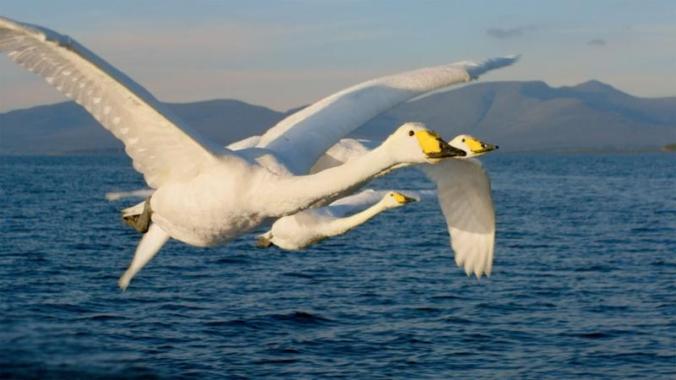
WildGeese

Irish Swans, photo by Colin Stafford-Johnson. (Source)

Stafford-Johnson couldn’t be more different than, say, David Attenboroughdistant, officious, illustrative, objective, professorial. In a word, British.

Instead, he has given us a distinctly Irish documentary. Every scene is infused with an Irish sensibility. Gone is the slightly stuffy, very British narration conveying little more than scientific data about the life cycle and behavior of various animals; gone the humanitarian appeals for conservation or legislative action on climate change; gone, too, the very American emphasis on spectacle and action. While there’s some information about the creatures that inhabit the west coast of Ireland and the threats they face, it comes across in a very different way. British and American nature shows are prose, and sometimes clunky, technical prose at that. Ireland’s Wild Coast is pure poetry. Or even—dare I say it—a prayer.

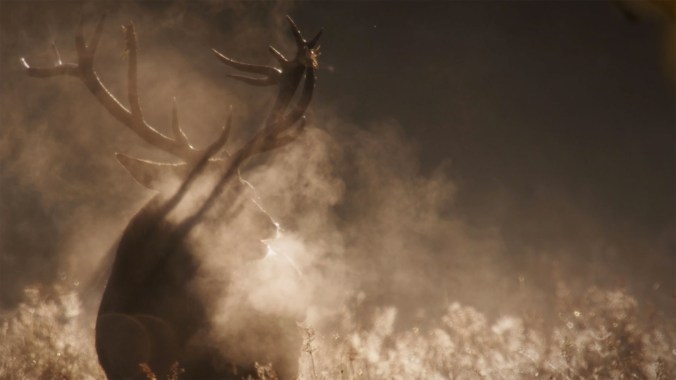
At every turn, we can sense Stafford-Johnson’s affection for and intimacy with his subject. For example, Stafford-Johnson rather touchingly says that a stag in rut “has only one thing on his mind: fatherhood.” He admires the tenacity of the humble lamprey; “Any creature that has been around for that long has got life sorted.” He has a wonderful tendency to humanize the animals he films. Surrounded by humpback whales at rest after feeding, he says, “I like to think that other animals can be happy.” In some sense, that’s the whole point of Ireland’s Wild Coast. To show us the joy of the natural world, and help us rekindle our wonder in it.

Likewise, Stafford-Johnson’s environmental concerns are usually framed by a winsome sense of home. These animals are Ireland; they belong to the land and sea; they form an integral part of his home, and must be preserved as such. The Irish sense of place, an obsession that has formed the country’s art, literature, and politics for centuries, colors Stafford-Johnson’s narration in more ways than one. For this film is not just a nature documentary. At the Skelligs, at Great Blasket, at Corcomroe, and in his traditional rowboat, Stafford-Johnson reflects on the Irish people in their history and culture. He wistfully wonders what kind of life the men who built the beehive huts of Skellig Michael might have led. He contemplates the dissolution of the monasteries. And he tells us a few old Irish legends along the way.

RedDeer

Red Deer Stag, by Colin Stafford-Johnson. Featured in the film. (Source).

The viewer is led to contemplate nature and history through a poetic lens. We become fellow-travelers with Stafford-Johnson as he winds his way up the West Coast on a watery pilgrimage. Any student of Sophiology will recognize in Ireland’s Wild Coast a perfect example of truly Sophianic art. As Michael Martin writes at the beginning of his essential text, The Submerged Reality: Sophiology and the Return to a Poetic Metaphysics:

For sophiology, especially as articulated from the 17th century onward, asks us to attend to the grace of God, his presence, in Creation: a presence which, despite the world’s fallenness, can only be described (in the words of Genesis) as “good.” (3)

That’s precisely the message that Stafford-Johnson most powerfully communicates. Not that the earth is in danger; not that wild animals live interesting and impressive lives; not even that Ireland has a unique and valuable ecosystem on its west coast. Nothing so pragmatic as that. Rather, we are left with the powerful sense of the goodness of creation. We are led to delight in it.

In watching the film—in rewatching it—in writing this piece—I am reminded not only of the lessons of latter-day sophiologists, but of that sophiologist malgré lui, Gerard Manley Hopkins. Specifically, the words of his great sonnet, “God’s Grandeur.”

And for all this, nature is never spent;
There lives the dearest freshness deep down things;
And though the last lights off the black West went
Oh, morning, at the brown brink eastward, springs —
Because the Holy Ghost over the bent
World broods with warm breast and with ah! bright wings.

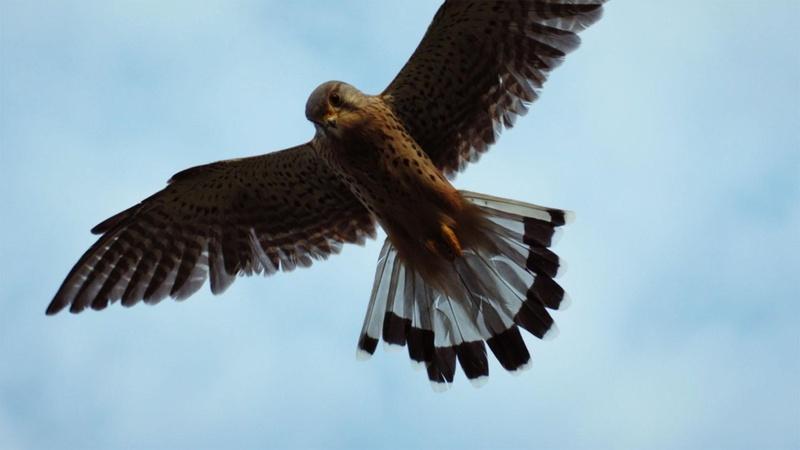
No words so perfectly describe the Kestrel of Corcomroe as it hovers, hesitates, and then glides down with Pentecostal grace upon its unsuspecting prey.

Kestrel

The Kestrel, shot by Colin Stafford-Johnson. It is impossible to understand how beautiful this bird is without seeing it in motion. (Source).

Excerpts for St. Austin’s Day

Saint-Augustine-Doctor-of-the-Church

St. Augustine, Ora Pro Nobis. (Source)

I read this passage from the Confessions today and it instantly became one of my favorites selections from St. Augustine. The translation by Maria Boulding OSB is much prettier, but it’s not public domain. What follows is Book X, Chapters 6-7 (Para. 8-11).

Not with uncertain, but with assured consciousness do I love You, O Lord. You have stricken my heart with Your word, and I loved You. And also the heaven, and earth, and all that is therein, behold, on every side they say that I should love You; nor do they cease to speak unto all, so that they are without excuse. Romans 1:20 But more profoundly will You have mercy on whom You will have mercy, and compassion on whom You will have compassion, otherwise do both heaven and earth tell forth Your praises to deaf ears. But what is it that I love in loving You? Not corporeal beauty, nor the splendour of time, nor the radiance of the light, so pleasant to our eyes, nor the sweet melodies of songs of all kinds, nor the fragrant smell of flowers, and ointments, and spices, not manna and honey, not limbs pleasant to the embracements of flesh. I love not these things when I love my God; and yet I love a certain kind of light, and sound, and fragrance, and food, and embracement in loving my God, who is the light, sound, fragrance, food, and embracement of my inner man— where that light shines unto my soul which no place can contain, where that sounds which time snatches not away, where there is a fragrance which no breeze disperses, where there is a food which no eating can diminish, and where that clings which no satiety can sunder. This is what I love, when I love my God.

And what is this? I asked the earth; and it answered, I am not He; and whatsoever are therein made the same confession. I asked the sea and the deeps, and the creeping things that lived, and they replied, We are not your God, seek higher than we. I asked the breezy air, and the universal air with its inhabitants answered, Anaximenes was deceived, I am not God. I asked the heavens, the sun, moon, and stars: Neither, say they, are we the God whom you seek? And I answered unto all these things which stand about the door of my flesh, You have told me concerning my God, that you are not He; tell me something about Him. And with a loud voice they exclaimed, He made us. My questioning was my observing of them; and their beauty was their reply. And I directed my thoughts to myself, and said, Who are you? And I answered, A man. And lo, in me there appear both body and soul, the one without, the other within. By which of these should I seek my God, whom I had sought through the body from earth to heaven, as far as I was able to send messengers— the beams of my eyes? But the better part is that which is inner; for to it, as both president and judge, did all these my corporeal messengers render the answers of heaven and earth and all things therein, who said, We are not God, but He made us. These things was my inner man cognizant of by the ministry of the outer; I, the inner man, knew all this— I, the soul, through the senses of my body. I asked the vast bulk of the earth of my God, and it answered me, I am not He, but He made me.

Is not this beauty visible to all whose senses are unimpaired? Why then does it not speak the same things unto all? Animals, the very small and the great, see it, but they are unable to question it, because their senses are not endowed with reason to enable them to judge on what they report. But men can question it, so that the invisible things of Him . . . are clearly seen, being understood by the things that are made; Romans 1:20 but by loving them, they are brought into subjection to them; and subjects are not able to judge. Neither do the creatures reply to such as question them, unless they can judge; nor will they alter their voice (that is, their beauty), if so be one man only sees, another both sees and questions, so as to appear one way to this man, and another to that; but appearing the same way to both, it is mute to this, it speaks to that— yea, verily, it speaks unto all but they only understand it who compare that voice received from without with the truth within. For the truth declares unto me, Neither heaven, nor earth, nor any body is your God. This, their nature declares unto him that beholds them. They are a mass; a mass is less in part than in the whole. Now, O my soul, you are my better part, unto you I speak; for you animate the mass of your body, giving it life, which no body furnishes to a body but your God is even unto you the Life of life.

What then is it that I love when I love my God? Who is He that is above the head of my soul? By my soul itself will I mount up unto Him. I will soar beyond that power of mine whereby I cling to the body, and fill the whole structure of it with life. Not by that power do I find my God; for then the horse and the mule, which have no understanding, might find Him, since it is the same power by which their bodies also live. But there is another power, not that only by which I quicken, but that also by which I endow with sense my flesh, which the Lord has made for me; bidding the eye not to hear, and the ear not to see; but that, for me to see by, and this, for me to hear by; and to each of the other senses its own proper seat and office, which being different, I, the single mind, do through them govern. I will soar also beyond this power of mine; for this the horse and mule possess, for they too discern through the body.

And I’ll add this paragraph from Chapter 17 (Para. 26), which strongly reminds me of Cardinal Newman’s project in the Apologia Pro Vita Sua:

Great is the power of memory; very wonderful is it, O my God, a profound and infinite manifoldness; and this thing is the mind, and this I myself am. What then am I, O my God? Of what nature am I? A life various and manifold, and exceeding vast. Behold, in the numberless fields, and caves, and caverns of my memory, full without number of numberless kinds of things, either through images, as all bodies are; or by the presence of the things themselves, as are the arts; or by some notion or observation, as the affections of the mind are, which, even though the mind does not suffer, the memory retains, while whatsoever is in the memory is also in the mind: through all these do I run to and fro, and fly; I penetrate on this side and that, as far as I am able, and nowhere is there an end. So great is the power of memory, so great the power of life in man, whose life is mortal. What then shall I do, O Thou my true life, my God? I will pass even beyond this power of mine which is called memory— I will pass beyond it, that I may proceed to You, O Thou sweet Light. What sayest Thou to me? Behold, I am soaring by my mind towards You who remainest above me. I will also pass beyond this power of mine which is called memory, wishful to reach You whence You can be reached, and to cleave unto You whence it is possible to cleave unto You. For even beasts and birds possess memory, else could they never find their lairs and nests again, nor many other things to which they are used; neither indeed could they become used to anything, but by their memory. I will pass, then, beyond memory also, that I may reach Him who has separated me from the four-footed beasts and the fowls of the air, making me wiser than they. I will pass beyond memory also, but where shall I find You, O Thou truly good and assured sweetness? But where shall I find You? If I find You without memory, then am I unmindful of You. And how now shall I find You, if I do not remember You?


Poem/Song: “On the Strange and Lamentable Tale of the Witches of Saluda”

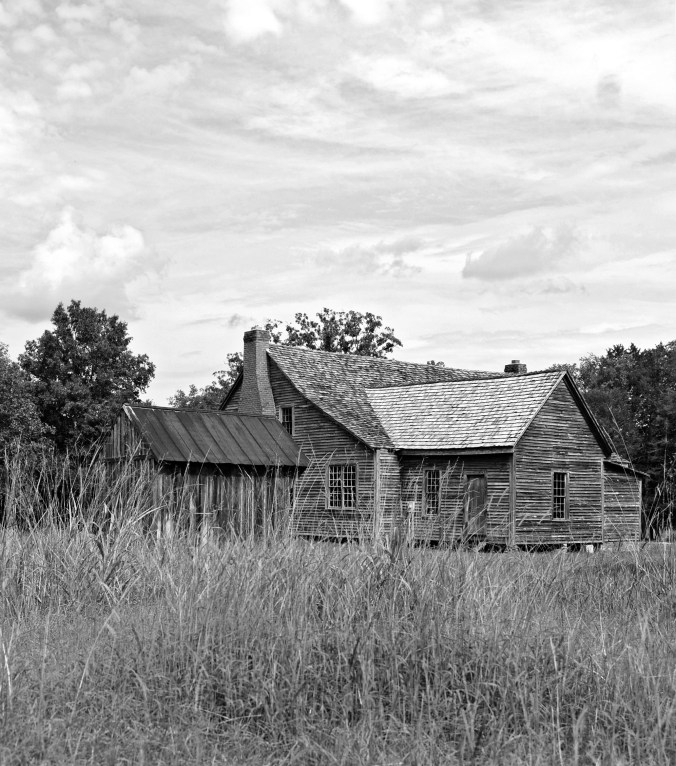
Bonham_House_1

The Bonham House, Saluda, SC (Source).

It’s been a while since I posted any original wordcraft, so here’s a poem I wrote recently. The last part is a song. I wanted to hearken to the Scotch-Irish traditions of the poor folks who settled the Carolinas. You can hear me sing it on the embedded audio I have included.

On the Strange and Lamentable Tale of the Witches of Saluda

I. The Town

I saw them dancing at the old waterworks
with torchlight in their eyes, huge
gates to unseen countries
of the damned and dying.
Off in the woods, the fog
snaked through like a hungry hound bent
low over the scent
of some lesser beast.
The pines keep our secrets from us,
so we can forget.
Didn’t you know that even the
goats and horses have eyes, ears,
loose lips muttering imprecations
under their breath? Never
look over your shoulder
at a crossroads. Men have died,
petrified, for less.
Or else they shoot into space
and freeze in the rictus of their fathers,
grinning madly at the dead sun
below. I have drawn
salt from the shadow of your footsteps,
I have planted rows of teeth in my head.
What dragons will come
when I bring a scythe
to the harvest?

II. The Purlieu

You hardly know how dark
the young pine woods can be.
Not a patch of tall trees, mind you,
but ones that stand
just about twice your size.
Still plenty of silent life ahead of them.
You can see them at the edge of evening,
surrounding a field surrounding
a low crop of tombstones
all asunder and blurred
by the rain’s improvident hand.
The trees wait there, wordless,
dusk-bleached, lined up like so many
carious teeth. But they are not
what draws my eye
the fathomless
dark that spreads behind
like a growling and
hungry gullet.

III. The Back Yard

It will not go away.

Momma said to come to the table,
no use passing your life
by the back window
daydreaming.

But I could see it pacing the lawn as I ate.

Huge, black,
unblinking, white
of tooth.
I don’t think it ever sleeps.
The heat of the noonday and the
shadow that flies by night
do not afflict it
the stones in its shoes
and the rancid water it sips
out of our traschan lids
do not injure it—
the play of the neighbors
and the tumult of the street
do not distract it.
I have not yet seen it blink.
I have not yet seen it turn its gaze
from the house.
It watches.
I don’t think it ever sleeps.

Momma says
daddy woudn’t have tolerated
any such foolishness.
I don’t know.

It makes not a sound.
I think it knows what we talk about
in the house.
I think it knows when we rise and fall
to our prayers.
I think it listens to what we confess,
to our fights, to the whisper of the rain.

I don’t want to go out there.
I don’t want it to get it.
I don’t think it ever sleeps.

IV. Found in a Buried Notebook, Written in Red Ink

Don’t turn your back to the trees
or walk up the weed-cracked pavement
beneath the sign that reads
CAR  ASH CO N LAUNDRY
and don’t keep the pottery you dig up
in your garden
bonewhite under the red
clay and grey sand. Don’t
venture to the edge of the field that
smells like salt
and don’t keep your teeth in a shoebox
(it might become a skull)
and don’t knock on walls
where there should be a door
or take down the portraits
of the nameless.
Don’t ponder what might have
broken the sign from the fencepost
or written its replacement
in an unknown script.
Don’t let your children go to the post office alone.
Don’t let your daughter play with the dolls
she doesn’t remember receiving.

V. The Song of the Lost Daughters


The young girls singing thread silk in their hair
Io Hymen Hymenaee
Io Hymen Hymenaee
Discarding the rest of the clothes that they wear
Io Hymen Hymenaee
Io Hymen Hymenaee

They join with the voices of the torchbearing throng
Io Hymen Hymenaee
Io Hymen Hymenaee
And soon they forget every other sweet song
Io Hymen Hymenaee
Io Hymen Hymenaee

Songs that illumine the queer, darkened lands
Io Hymen Hymenaee
Io Hymen Hymenaee
Like the water you pour over bloody hands
Io Hymen Hymenaee
Io Hymen Hymenaee

Her lace crown covers her eyes as they lead
Io Hymen Hymenaee
Io Hymen Hymenaee
Her into a thicket that smells of ripe seed
Io Hymen Hymenaee
Io Hymen Hymenaee

To hide from the angels that watch in the trees
Io Hymen Hymenaee
Io Hymen Hymenaee
And teach her the sacred rites of the bees
Io Hymen Hymenaee
Io Hymen Hymenaee

“An will ye cam back to yer mother so fine?”
Io Hymen Hymenaee
Io Hymen Hymenaee
“Ah will ye return to me, daughter of mine?”
Io Hymen Hymenaee
Io Hymen Hymenaee

“Ah mother, dear mother, I can’t come at all”
Io Hymen Hymenaee
Io Hymen Hymenaee
“Until I’ve repeated our first mother’s fall”
Io Hymen Hymenaee
Io Hymen Hymenaee

“The Sabbath is waiting, the dance oh so dear”
Io Hymen Hymenaee
Io Hymen Hymenaee
“To teach us the meaning behind every fear”
Io Hymen Hymenaee
Io Hymen Hymenaee

They never did see her again in the day
Io Hymen Hymenaee
Io Hymen Hymenaee
But once on a new moon, as old people say
Io Hymen Hymenaee
Io Hymen Hymenaee

Seven years waiting and seven years won
Io Hymen Hymenaee
Io Hymen Hymenaee
Seven years burning, but far from the Sun
Io Hymen Hymenaee
Io Hymen Hymenaee

Beware, all me daughters, what hides in the air
Io Hymen Hymenaee
Io Hymen Hymenaee
And never thread silks so fine in your hair
Io Hymen Hymenaee
Io Hymen Hymenaee

A Prayer Request for St. Mary’s Day

OurLadyWalsinghamStBede

The National Shrine of Our Lady of Walsingham, St. Bede, Williamsburg, VA. (Source)

Of your charity, please pray for me. Today I begin a 33-day retreat for Marian Consecration. Normally I would not wish to broadcast such a spiritual undertaking on my blog, but since I know several of you, I would rather avail myself of your prayers than keep silent.

Astute Kalendar watchers will know that if I start today, on the Feast of Our Lady, Queen of Heaven, then the day of consecration will fall on September 24th. That’s the feast of Our Lady of Walsingham (well, technically not since it’s on a Sunday this year, but I don’t really care). I’ll be in London. Please pray that I might be able to pronounce the prayer at the Brompton Oratory if at all possible, and more importantly, that I might truly and obediently submit to Mary’s gentle guidance in all things.

Hail, holy Queen, Mother of mercy,
hail, our life, our sweetness and our hope.
To thee do we cry, poor banished children of Eve:
to thee do we send up our sighs,
mourning and weeping in this valley of tears.
Turn then, most gracious Advocate,
thine eyes of mercy toward us,
and after this our exile,
show unto us the blessed fruit of thy womb, Jesus.
O clement, O loving, O sweet Virgin Mary!

V. Pray for us, O Holy Mother of God,
R. That we might be made worthy of the promises of Christ.

Amen.

Original Art: Some Recent Work

Here are some more of my August projects.

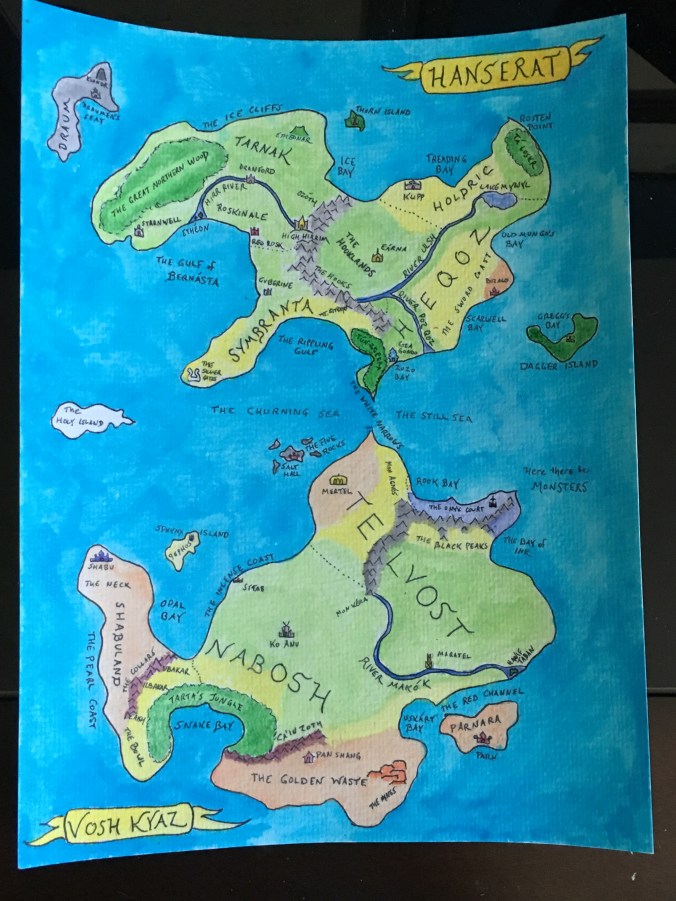
image.jpeg

“Map of Hanserat, Vosh Kyaz, and the Isles.” Photo by artist. An imaginary map I came up with a while ago and wanted to see in color.

image

“Under the Sycamore Trees.” Photo by artist. We are like the dreamer…

image.jpeg

“Gluttony.” Photo by artist. I may do a series on the seven deadly sins.

An Addendum on Charlottesville

LightShoneinDarkness

Fascists surrounding student protesters on the steps of the Rotunda, UVA, Charlottesville, Virginia. This photo was taken last Friday night, August 11th, 2017. (Source).

One last word.

Although it does not come from yesterday’s readings, a verse has been threading through my mind for the course of the weekend. Nazis brought burning torches onto the Lawn that was once my home, but those torches cast no light. They bristled with a darkness blacker and thicker than the shadows that lay all around in the night. The real illumination came from those few brave students under the statue of Jefferson, who resisted the onslaught of wicked men streaming down the steps of the Rotunda. Watching their courage, I can only think of those words from St. John the Divine:

“And the light shineth in darkness; and the darkness comprehended it not.