“But There, Besides the Altar, There, is Rest”

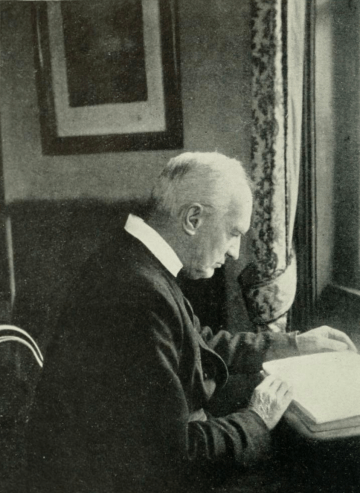
Ernest_Dowson.jpg

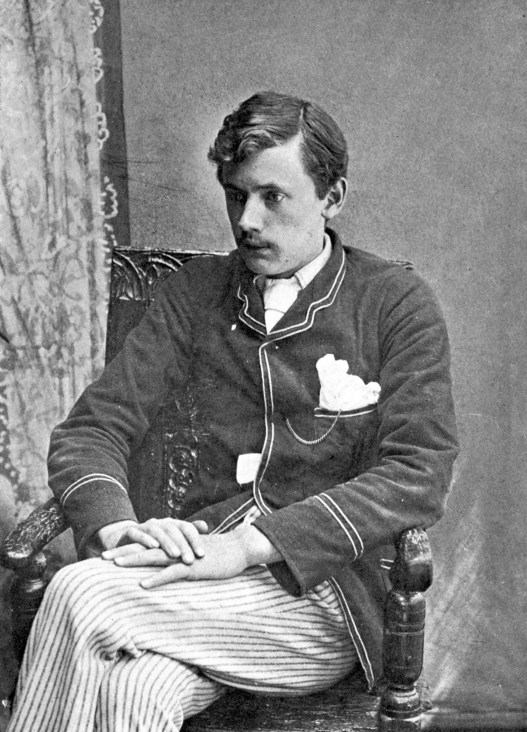
Ernest Dowson – a frail, unhappy poet driven by wild passions. Also a Roman Catholic. (Source)

Recently, I have discovered the work of the poet Ernest Dowson (1867-1900). He has swiftly become a favourite. His Decadent verse originated the phrases “gone with the wind” and “the days of wine and roses.” He was also a Catholic convert. His poetry often explores the contrast between the perishable delights of the world and the undying realm of the supernatural. In Dowson, we see the forked path that comes with the recognition of the world’s vanity: the choice lies between hedonistic decadence and the rigors of ascesis and contemplation. These two monastic poems express precisely that tension in his sad life as well as his powerful artistic vision.

Nuns of the Perpetual Adoration

Calm, sad, secure; behind high convent walls,
These watch the sacred lamp, these watch and pray:
And it is one with them when evening falls,
And one with them the cold return of day.

These heed not time; their nights and days they make
Into a long, returning rosary,
Whereon their lives are threaded for Christ’s sake;
Meekness and vigilance and chastity.

A vowed patrol, in silent companies,
Life-long they keep before the living Christ.
In the dim church, their prayers and penances
Are fragrant incense to the Sacrificed.

Outside, the world is wild and passionate;
Man’s weary laughter and his sick despair
Entreat at their impenetrable gate:
They heed no voices in their dream of prayer.

They saw the glory of the world displayed;
They saw the bitter of it, and the sweet;
They knew the roses of the world should fade,
And be trod under by the hurrying feet.

Therefore they rather put away desire,
And crossed their hands and came to sanctuary
And veiled their heads and put on coarse attire:
Because their comeliness was vanity.

And there they rest; they have serene insight
Of the illuminating dawn to be:
Mary’s sweet Star dispels for them the night,
The proper darkness of humanity.

Calm, sad, secure; with faces worn and mild:
Surely their choice of vigil is the best?
Yea! for our roses fade, the world is wild;
But there, beside the altar, there, is rest.


Carthusians

Through what long heaviness, assayed in what strange fire,
Have these white monks been brought into the way of peace,
Despising the world’s wisdom and the world’s desire,
Which from the body of this death bring no release?

Within their austere walls no voices penetrate;
A sacred silence only, as of death, obtains;
Nothing finds entry here of loud or passionate;
This quiet is the exceeding profit of their pain:

From many lands they came, in divers fiery ways;
Each knew at last the vanity of earthly joys;
And one was crowned with thorns, and one was crowned with bays,
And each was tired at last of the world’s foolish noise.

It was not theirs with Dominic to preach God’s holy wrath,
They were too stern to bear sweet Francis’ gentle sway;
Theirs was a higher calling and a steeper path,
To dwell alone with Christ, to meditate and pray.

A cloistered company, they are companionless,
None knoweth here the secret of his brother’s heart:
They are but come together for more loneliness,
Whose bond is solitude and silence all their part.

O beatific life! Who is there shall gainsay,
Your great refusal’s victory, your little loss,
Deserting vanity for the more perfect way,
The sweeter service of the most dolorous Cross.

Ye shall prevail at last! Surely ye shall prevail!
Your silence and austerity shall win at last:
Desire and mirth, the world’s ephemeral lights shall fail,
The sweet star of your queen is never overcast.

We fling up flowers and laugh, we laugh across the wine;
With wine we dull our souls and careful strains of art;
Our cups are polished skulls round which the roses twine:
None dares to look at Death who leers and lurks apart.

Move on, white company, whom that has not sufficed!
Our viols cease, our wine is death, our roses fail:
Pray for our heedlessness, O dwellers with the Christ!
Though the world fall apart, surely ye shall prevail.

Elsewhere: Newman Against the Nazis

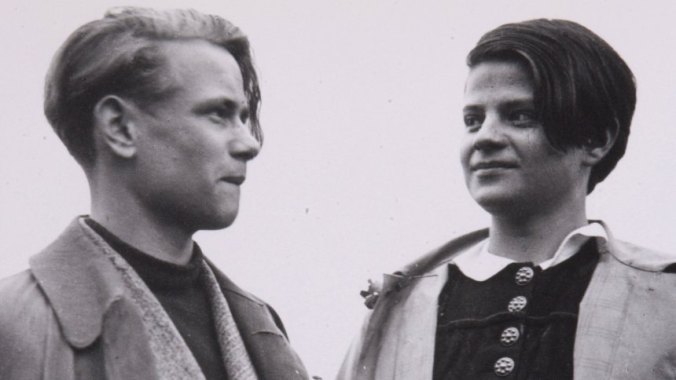
Werner und Sophie Scholl

White Rose members Hans and Sophie Scholl. (Source)

A big thanks to Fr. David Abernethy of the Pittsburgh Oratory for bringing to my attention an article in the Catholic Herald about the influence of Cardinal Newman’s thought on die Weiße Rose. Apparently the Doctor of Conscience was an important impetus for their resistance to Nazi oppression. From the article:

The man who brought Newman’s writings to the attention of the Munich students was the philosopher and cultural historian Theodor Haecker. Haecker had become a Catholic after translating Newman’s Grammar of Assent in 1921, and for the rest of his life Newman was his guiding star. He translated seven of Newman’s works, and on several occasions read excerpts from them at the illegal secret meetings Hans Scholl convened for his friends. Strange though it may seem, the insights of the Oxford academic were ideally suited to help these students make sense of the catastrophe they were living through.

Haecker’s influence is evident already in the first three White Rose leaflets, but his becomes the dominant voice in the fourth: this leaflet, written the day after Haecker had read the students some powerful Newman sermons, finishes with the words: “We will not be silent. We are your bad conscience. The White Rose will not leave you in peace! Please read and distribute!”

Read the whole thing. And pray that Bl. John Henry Newman might, by his intercession, assist us in the struggle against every tyranny.

A Spanish Mystic of the Sacred Heart

Providence sometimes ordains that we should come across new friends in Heaven at exactly the right time. This happy accident of grace has just occurred to me.

SacredHeartTimesSix.jpg

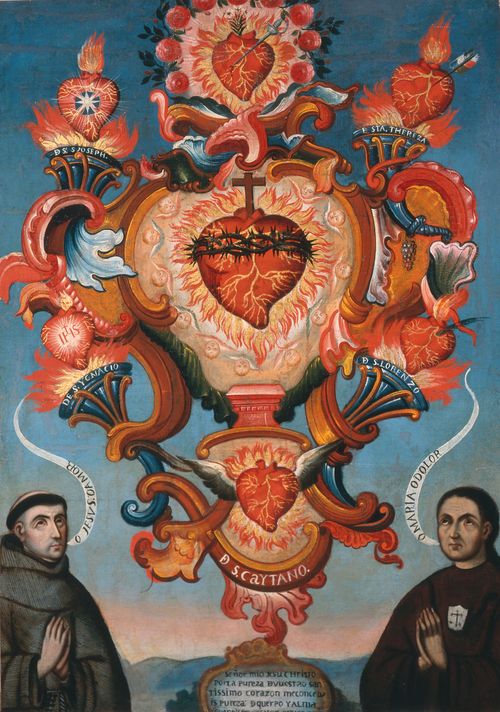
Holocausto de Corazones al Sagrado Corazon de Jesus, 17th century Mexican. (Source)

I’ve been reading about the Jesuits of the late 17th and early 18th centuries quite a lot recently in connection with my research. My admiration for them has grown tremendously. I always used to have a devotion to the Jesuit martyrs of Elizabethan and Jacobean England, and to an extent, I still do. But the Continental Jesuits who did so much to combat the spread of Jansenism are a marvel to behold. For all my jokes about the suppression of the Jesuits and my appreciation of Pascal, I have to say that the Jansenists were a nasty bunch. The more one studies their history and doctrines, the colder one feels. Thus, I especially admire those tireless evangelists of the Sacred Heart such as St. Claude de la Colombière, whose feast we celebrated yesterday. Along with this revived interest in the Continental Jesuits, I’ve found myself drawn to the Sacred Heart in recent weeks.

librohoyos

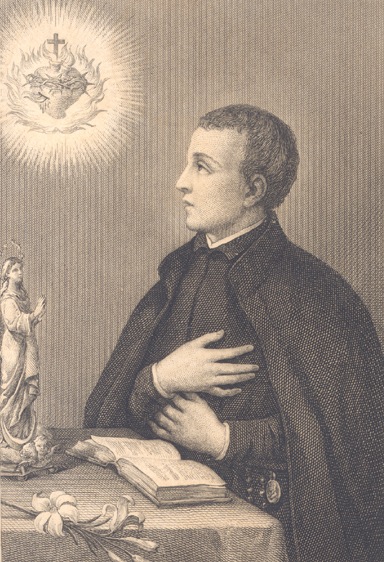
Bl. Bernardo Francisco de Hoyos S.J. (Source)

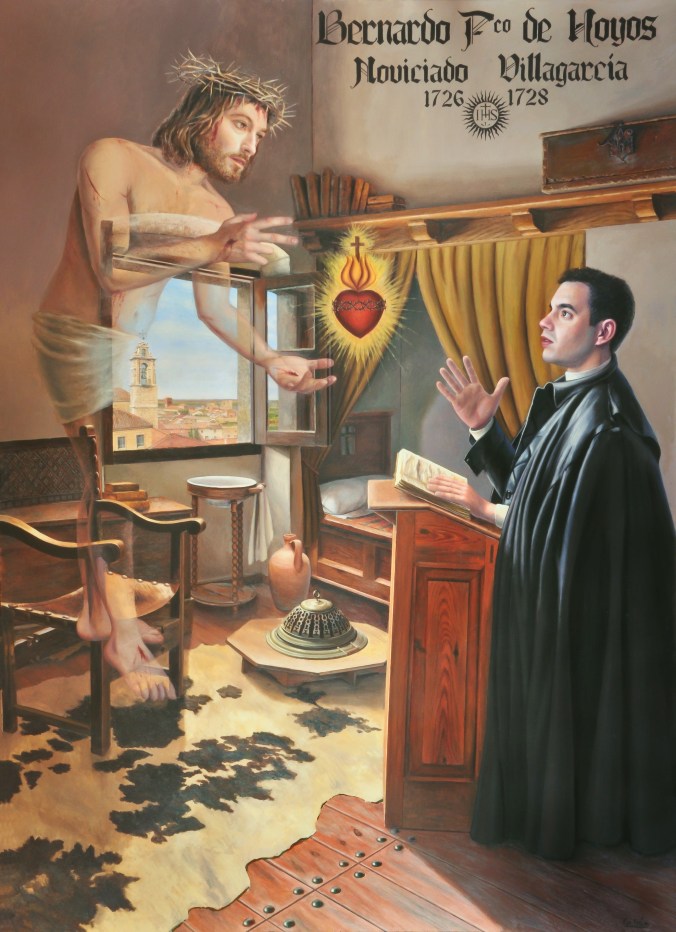
Into this recent ferment of the spirit came an unexpected intrusion of grace. As I was scrolling through Facebook, I saw that in one of my Catholic groups, someone had posted an article about a mystic and asked what we all thought. I opened the link and discovered a new and remarkable saint: the Blessed Bernardo Francisco de Hoyos, S.J.

The Blessed Bernardo entered the Jesuit novitiate in 1726 when he was not yet fifteen. In the early years of his formation, he felt a strong attraction to the (then) Blessed John Berchmans, a model of Jesuit youth, seeking to emulate him in all things. The young saint later had a powerful “dark night of the soul” that involved demonic torments. When he came out on the other side, however, the Lord appeared to him in some of the most remarkable visions of the age. To wit:

Always holding my right hand, the Lord had me occupy the empty throne; then He fitted on my finger a gold ring…“May this ring be an earnest of our love. You are Mine, and I am yours. You may call yourself and sign Bernardo de Jesus, thus, as I said to my spouse, Santa Teresa, you are Bernardo de Jesus and I am Jesus de Bernardo. My honor is yours; your honor is Mine. Consider My glory that of your Spouse; I will consider yours, that of My spouse. All Mine is yours, and all yours is Mine. What I am by nature you share by grace. You and I are one!” – The Visions of Bernard Francis De Hoyos, S.J., Henri Béchard, S.J.

bernardfrancishoyos

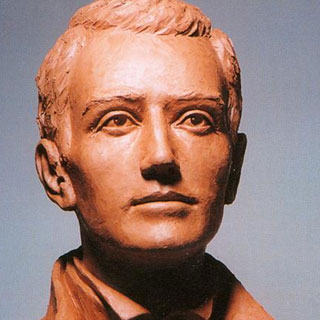
A modern rendition of Bl. Bernardo. (Source)

Assuming this quote is accurate – like the author from whom I took it, I am unable to verify it (Bechard’s book is extremely rare) – it evinces an eminent degree of spiritual maturity. Dom Mark Daniel Kirby reports on more of the young saint’s experiences:

On August 10, 1729, the Saviour, covered with His Precious Blood, appeared to Bernardo, and showing him the wound in His Side, said, “Rejected by humanity, I come to find my consolation with chosen souls.” Bernardo’s experience closely resembles that of Saint Margaret Mary Alacoque fifty-three years earlier in the Visitation Monastery of Paray-le-Monial in France.

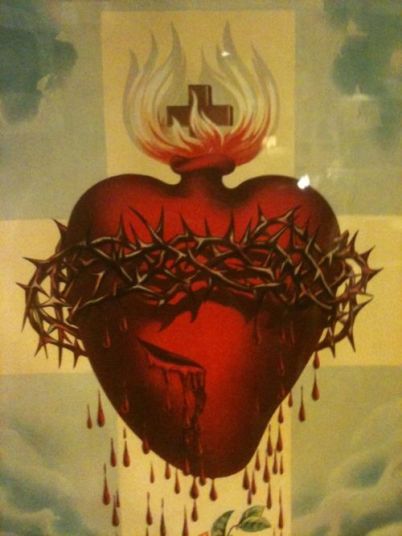
SacredHeartprint

The Sacred Heart of Jesus. (Source)

It should be no surprise to us, then, that Bl. Bernardo was a profound devotee and propagator of the Sacred Heart of Jesus. In 1732, when he was only 22, the Lord entrusted him with the mission of spreading love for the Sacred Heart, both “as a means of personal sanctification and as an effective means for accomplishing the apostolate.” That year, he consecrated himself to the Sacred Heart using St. Claude’s formula. Shortly after, he collaborated on a book about the devotion entitled The Hidden Treasure (alas, I don’t know if it has been translated into English). His brief priesthood – he died of typhus less than a year after ordination – was a total gift to the Sacred Heart. He was known to say, “Oh, how good it is to dwell in the Heart of Jesus.” These were, no doubt, the words of one who dwelt there indeed.

Bl. Bernardo was beatified in Valladolid on April 19, 2010. He is a special patron against the sin of impurity, perhaps because his own chastity was sealed in a mystical marriage to Jesus.

One of the things that truly struck me about Bl. Bernardo’s story – aside from his devotion to the Sacred Heart, which is, as I mention, timely – was his youth. He was only a year older than me when he died. To think that someone could achieve such heights of holiness in such a short time is a wonderful encouragement.

But of course, the growth of a soul is not, strictly speaking, a matter of our own effort. It is the work of the Holy Ghost in us. Bl. Bernardo is an example of what happens when we open ourselves totally to the operations of the Holy Ghost. Not everyone will receive visions. In fact, very few souls are so privileged. But they are given to the Memory of the Church so that we who are less favored may take some inspiration by their example and glimpse more perfectly some aspect of Our Savior. Christ is the one light caught by so many prisms through the centuries. Bl. Bernardo is one such pure glass, shining through the ages to light our way. May he pray for us in this Lenten season.

Bernardo_Fco_de_Hoyos.jpg

Bl. Bernardo Francisco de Hoyos’s vision of the Sacred Heart. (Source)

Fr. Bowden’s Meditations for Lent

870px-Kramskoi_Christ_dans_le_désert

Christ in the Desert, Ivan Kramskoi, 1872. (Source)

Some of my readers will no doubt recognize the name of Fr. Sebastian Bowden of the London Oratory. He achieved some small notoriety as the priest who nearly converted Oscar Wilde in the 1870’s. He was also a well-respected spiritual teacher, though sadly neglected today. I would like to make some of his wisdom available, especially as it bears on the season we enter on this Ash Wednesday.

Here’s Fr. Bowden’s advice for Lent:

Consider the bearing that Lent has upon Death. Lent is given us as a time of preparation, and the way it is spent has great influence on the times that follow it: a carefully spent Lent will bring about a careful month after it, and the influence of that may go on through the year. So, we may look upon each Lent as a bringing us nearer to a good state for death, by making a fresh mark on our life:—for as we live so we must die. Therefore enter fully into this spirit: withdraw as far as you possibly can from all outer things, in thought, during this season: let the things of Time go to a distance, and be as nothing to you. Be alone with God, and try simply to learn more and more where you are, and what you are worth, in His eyes only; and thus prepare yourself for joining Him in Eternity.

Give yourself thoroughly to the Spirit of the Passion. Do not look, in anything you do, for success, pleasantness, or comfort: expect crosses, failures, disappointments, and take all these readily:go to meet them, receive all with perfect resignation from God’s handstake their impress on your soul. Aim, in preparation for death, at caring for nothing so much that you will not be ready in a moment to give it up.

Remember that, perfect and infinite as are the merits of Christ’s Passion and Death, there is one thing still wanting to them:that is, our part in them: our taking and accepting His sufferings as ours, and bearing them with Him. Without this, His Passion remains worthless. To what purpose is the Head crowned with thorns, if the Members remain dead, paralyzed, mortified and motionless? And so it is if we, who are Christ’s Members, will not enter with Him into His Passion, and will to suffer with Him. Let us, therefore, now, go in with Him into the life of suffering, giving ourselves to Him completely. It is difficult and painful to human nature to face the thought of a penitential life, but it must be done if we would be His true followers. And at this season it should be done specially by some outward thing:no lessening of food or sleep for those who need strength to work; but, still, in some wayif it is only by restraint of attitude, by some posture at times different from the ordinaryno matter what, but by some meanswe should daily remind ourselves that it is Lent.

Of course, it is hard to realize the good of the Cross: it often seems to our eyes so purposelessso gratuitousas well as so hard. It is in Faith alone that we can bear it; human nature must feel and suffer by it,. Let us try, during Holy Week, for a “broken heart”: that is, not feeling, but the certain conviction of our own nothingness and the nothingness of everything but God’s will. It is not merely the having, or the not having, to suffer this or the other thing: it is in all that we must be crushed: it is that there is absolutely nothing of importance except to do the Will of God: and this is the Cross.

The Sacrifice [acceptance of crosses or voluntary renunciation] always seems greater than we expected: when the Cross presses inward it must take hold of us. But we must treat it by looking beyond, remembering that, after all, it is all, in reality, but nothing; living in daily Faith in God, and Hope; and reminding ourselves that all will pass. Feeling, at the moment, we cannot help. (Spiritual Teaching of Fr. Sebastian Bowden of the London Oratory, 1921, pp. 17-20)

Screen Shot 2018-02-14 at 3.25.35 AM.png

Fr. Sebastian Bowden of the London Oratory. (Source)

I would add two brief thoughts that come from a later portion of the book. They seem admirably suited to our meditation on this penitential day, the start of a journey of penance that will not end until we face the cross.

The best way of realizing our Free Will is St. Philip’s way: “Lord, keep Thy hand on my head, or I shall betray Thee.” This consciousness of how easily we may at any moment commit any sin, however great, is simply the truth. It is the experience of everyone who knows anything of human nature, and especially of every priest. He knows it first for himself, and then for others. This it is that fills our prisons with criminals: the sinfulness of human naturegreed and avarice, lust and passion. To know our own weakness is our only safeguard. (p. 98)

Recollect that it was Christ on the Cross that redeemed the world: not His miraclesnot His life of preachingbut His naked body offered on the Cross to God. And so it must be with us if we would follow Him: the will simply to suffer must be oursto this our whole lives must be bent. It is not by great and heroic deeds that we are to succeed in Eternity: it is by the daily round of silent, humble suffering of whatever God sends. We are to become what He was: holocausts: to be stripped of Self on all sides:of our will, of our powers, of our very individuality if He chooses, so as simply to be in His hands to do what He likes with. Remember that here we see everything exactly as it is not: to us, success seems to lie in what showsin active deeds, in energy, in strength and power. But this is not so before God; and when we die we shall see it all in its right light. Let us live, therefore, for the things which are great in Eternity, though not in Time, and be patient. (pp. 79-80)

May we all learn from Fr. Bowden’s sound practical wisdom and make a well and holy Lent.

temptation1824.jpg

The Temptation in the Wilderness, John St. John Long, 1824. (Source)

One Year of “The Amish Catholic”

Flammarion1.jpg

The Flammarion Engraving. It somehow seemed appropriate. (Source)

It has now been officially one year of The Amish Catholic. What a ride. I’ve had 50,874 views, and a total of 31,385 visitors from every continent except Antarctica. I’ve had 2 views in the Holy See. I am particularly proud of those 2 readers in Uzbekistan.  I have been cited in The Catholic Herald and Liturgical Arts Journal, not to mention several other blogs I admire and respect. Everything has taken off rather more quickly than I thought.

Thank you to everyone who has made the last year such a rewarding experiment. An especially great thank you to those kind enough to share, comment upon, react to, or otherwise mention my blog. I know you’re all busy, and I appreciate whatever time you can spare to read my ramblings. A big thanks in particular to those few – you know who you are – who have recommended my blog on their own sites or through their own platforms. You have been more than generous.

I hope to continue The Amish Catholic in a spirit of fellowship, inquiry, and freedom. When I started, I had no idea where it would lead me. But I’ve had fun and made the acquaintance of some wonderful people along the way. I feel almost as if I’ve carried on a year-long conversation with you, my readers. Sometimes we talk about The Young Pope; sometimes we talk about Mormon artists. Sometimes we laugh at church politics, and sometimes we peruse the odd birds of Catholic history. Sometimes we pray together, and sometimes we weep together. Let’s have another year of it!

Thank you for your support and your continuing encouragement. May God bless you all with good friends, good graces, good laughs, good art, and good wine.

Elsewhere: A Brief Note on the Napoleonic Church

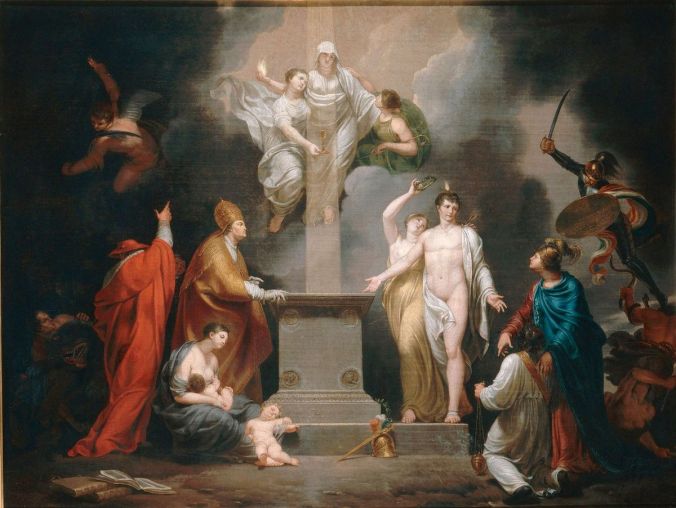
1200px-Allégorie_du_Concordat_de_1801

Allegory of the Concordat of 1801, Pierre Joseph Célestin François. Here’s some heavy-handed metanarrative for you. (Source)

Or, rather, the post-Napoleonic Church. Fascinating stuff about canonical life after Napoleon over at Canticum Salomonis. Some of my own research covers precisely this period, so I appreciate finding a contemporary Catholic blogger willing to post excerpted material of this nature. One does rather wish that he (I’m assuming it’s a he) had also provided the name of the original author, or at least the date of publication. Alas. The content is still very interesting.

A Letter on Loneliness

Veronese-Cristo-nell-orto-del-Getsemani-1024x797

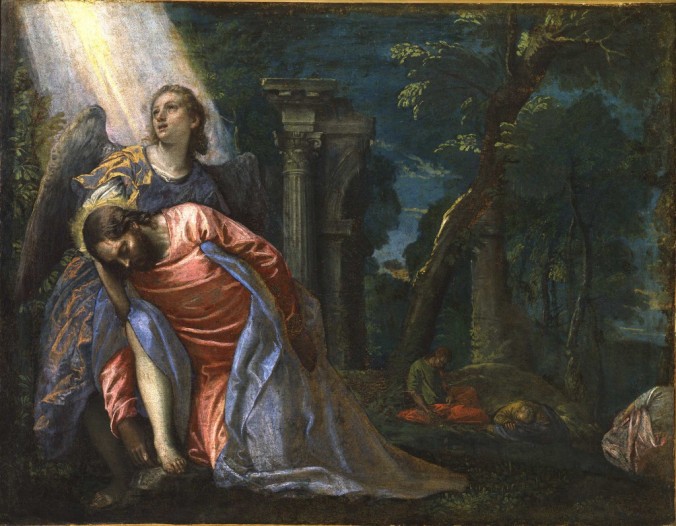
Christ in the Garden of Gethsemane, Veronese. Pinacoteca di Brera (Source)

My Dear Brother Josiah,

I received your last correspondence with a mixture of joy and sorrow. Joy, for all the good news you shared of our friends and familiars; sorrow, for those matters closer to your own heart that weigh so heavily upon your soul. Normally, I would not venture to offer unsolicited advice. However, as you have come to me seeking counsel, I will try to speak from what little light I have been granted. I will offer you, I hope, nothing but the constant teaching of the saints, nor anything I would not myself seek to follow. So much of what I must share is rooted in my own experience, the fruit of suffering not in all respects unlike your own.

You tell me that you worry about God’s blessing. You write that, in view of your griefs, you no longer trust that the Lord will bless you. This is a failure of Christian hope, but an understandable one. Faced with one reversal after another, it is easy to despair. I will point you first to the book of Job, a well from whose water I know you have already imbibed in more bitter times. What else could I tell you? The key practical thing is to recollect often those graces you have received. Savor them. Go over each, holding them close to your heart in memory. Make space in your week – better yet, your day – to ponder the grand and little mercies of God. I commend to you one of the very greatest pieces of wisdom I have received, that “a grace remembered is a grace renewed.” Continual recollection means that we are never really bereft of those graces once delivered unto us.

Look over your current state of life. The world, at least, sees your success. Many would desire your place. Thank God for what He has seen fit to give you so far.

But I know how incomparably small all of those worldly triumphs seem next to the losses you’ve suffered. I see what you mean when you say that you don’t trust God to bless you anymore. You aren’t speaking of those tangible blessings the world prizes in its vanity. You speak instead of the love of those taken from you. That golden blessing is worth all the others combined.

And so, we come to what seems to me to be the basic problem; not despair, but loneliness. The chill that stains even the brightest happiness and reveals the joys of this world to be fool’s gold. Have you considered loneliness in itself? Perhaps you have. It is a dark and loathsome thing. Perhaps you have found it buried down in your soul. A void. A hole that, like a carious tooth, aches and aches until it cries out for your full attention. A little black space at the bottom of things. You carry it around with you and never set it down. Grief carved it out, shaped it to its own image, and colors it even today.

I don’t know if you will always bear that burden. Some of us must. But I would encourage you to embrace it. That emptiness is, in the words of R.S. Thomas, “a vacuum he may not abhor.” Come close to the void. Peer at it. Ecce lignum crucis! It is the cross you have been given. Fasten your heart to its center with the very nails of Our Lord’s passion. Accept His invitation, and you will be able to endure those long and painful hours when hope fails. One day, when you are least expecting it, something may very well happen. You may be at prayer in your room. You may be savoring the Eucharist at Mass. You may be finishing the sorrowful mysteries of the rosary. But suddenly, unbidden, the Holy Ghost will visit you. The darkness will turn to dazzling light. By some strange alchemy known only in heaven, the emptiness will all at once turn into a full fountain of molten gold. The cavern will become a cup that runneth over. The silence will become song beyond sound or human voice. And your heart will be seized by the beautiful and terrifying realization that the Living God sees you. If only for a moment, you will know what it is to be “alone with the Alone.” Then will your heart become one with His. Then will you know a communion that obliterates all loneliness and a joy that erases all grief.

This moment cannot be rushed. God will not come but in His own way and in His own time. All the same, one can prepare.

First and foremost, take your loneliness and grief to the sacraments. When you are at the offertory or some other convenient point at the Mass, give your heart to the Eucharistic Christ. Ask to be alone with Him in the Tabernacle. Cleave to it as to the one rock of safety in a stormy sea. Consider, too, how Our Lord suffers loneliness in the Tabernacle. Think how He is neglected in His tabernacles through all the world. Think how He desires your consolation – yours! Truly, He wishes to make that emptiness in your soul His true and everlasting Tabernacle. Will you deny your Lord? For in the Tabernacle, He is at once most suffering and most glorious. So, too, where you are most suffering, He will render you most glorious.

Second, make a point of consciously drawing near to Christ crucified in your daily prayer. One thing I’ve done in the past – though, I confess, I have lately been lax about it – is to pray the Divine Mercy chaplet and dedicate each decade to one of the Holy Wounds. Start by contemplating Our Lord’s feet, His physical presence on Earth during His lifetime and evermore in the Eucharist. Consider His comings and goings, and how He willingly ceases all of that to offer Himself to the Father on the cross. Then consider His left hand, the Kingly hand that holds the orb of the world. Ponder the ways of His Providence. Take heart in His mercy towards the penitent and His just judgment of the wicked. Praise Him for His true and final victory over the forces of evil, for scattering the proud in their conceit. Then, move to His right hand, the Priestly hand of blessing. Think of how He has transformed all things by the peace wrought with His right hand, under the sign of His blessing. Look forward to the world as it shall be on the day of His Wisdom’s Triumph. It is a world we can already enter at the Mass. Bring your gaze up to the Holy Face, wounded by the crown of thorns. Offer him your anxieties, your fears for the future, and all those worries that come from not knowing what you must do or why some calamity has transpired. Consider the crown of thorns as the mortification of your very reason. As Our Lord unquestioningly accepted the will of His Father, may you do the same. But remember to gaze into the Holy Face as into the very countenance of the Living God. Ponder Jesus Christ in His humanity. God is a person; nor is he just any person, but a person who suffered all that we suffer, and more. Finally, move to the wound in the Holy Side and the Sacred Heart. Give yourself up to as pure an expression of love for your Savior as you can muster. Consider the flood of water and blood that fell from those triumphant gates, so rudely torn open. Think, if you can, of the power so much as one drop of either precious liquid would have to redeem not just one soul, but millions and millions of universes teeming with the souls of the very worst sinners. Ponder what it means that you may receive the Precious Blood at even a low Mass. Fix your gaze beyond the Holy Side, passing into the darkness of Our Lord’s chest. Dwell upon the Sacred Hear in its quiet and eternal radiance. Know that Our Lord’s chest cavity is so very much like the void to which I have already alluded, and so like the Tabernacle. For in both, we find the Heart of God! Imagine yourself receiving the Sacred Heart in the Eucharist. Meditate upon the immense fire of Love pulsing there until the last shudder of death – and, as you come to the Trisagion, recall how that love blazed forth again on Easter Morn, never to be extinguished.

Third, keep in mind the words of St. Philip Neri. Amare Nesciri – “Love to be unknown.” One thinks of St. Benedict. In his rule, St. Benedict enjoins his children to overcome the temptations of lust with a similarly simple phrase, “Love chastity” (RB IV). St. Philip’s words carry many meanings. They are a wonderful program of humility, of perfection, of freedom, but also of loneliness and grief. Love to be unknown. Find God in the moment when no one else notices you. Don’t do what you do to be recognized, as the Scribes and Pharisees (Matt. 6:3, 16, Luke 18:9-14). Be content that God sees and knows you. It will take time to grow into this practice, but you will come to recognize its benefit. You may someday find someone to share or alleviate the yoke of your sorrows – maybe even someone to love. But until then, embrace Solitude as St. Benedict would have us embrace Chastity; that is, as a beloved spouse. Focus on that task, the one you have been given for now, and the rest will come to you as God sees fit in His own time. I would wager that it will make you happier and help you love others more perfectly.

Fourth, do not depart from under Mary’s mantle. If you wish to see the very picture of loss, I will show you the woman who, though the only one free of sin among the whole human race, suffered the loss of her parents, her husband, and her son. Turn your eyes to Mary. The sorrows of her Immaculate Heart demand your attention. We have no greater advocate and comfort in our own suffering than Mary, in union with her eternal spouse, the Paraclete.

Finally – hardest of all – you must forgive. Jesus’s death was not just a perfect sacrifice because He was an innocent and willing victim. He forgave His murderers. If we are to have a share in that death, we must learn the extremely difficult discipline of forgiveness. It is the only way we can be truly free.

I would be remiss in giving you these counsels if I did not add with all due caution that, insofar as any of it applies to me, I often fail. But I feel no shame in saying so, since Our Lord is magnified in weakness. Don’t rely only on my words, narrow and feeble as they are. If anything I have said is contradicted by the example of the saints and the teaching of God’s holy Church, refer to their superior model. After all, I’m not a priest. I’m not even all that well versed in theology. Seek out a spiritual father who can help your soul more intimately than a friend can.

For all that, be assured of my prayers and affection. I hope you find the hope that can only come from the Lord, my dear brother. May He bless you and keep you, and make His face shine upon you, and be gracious to you; may He turn His countenance upon you, and give you peace.

In Christ,

RTY
God is Real, Not Nice

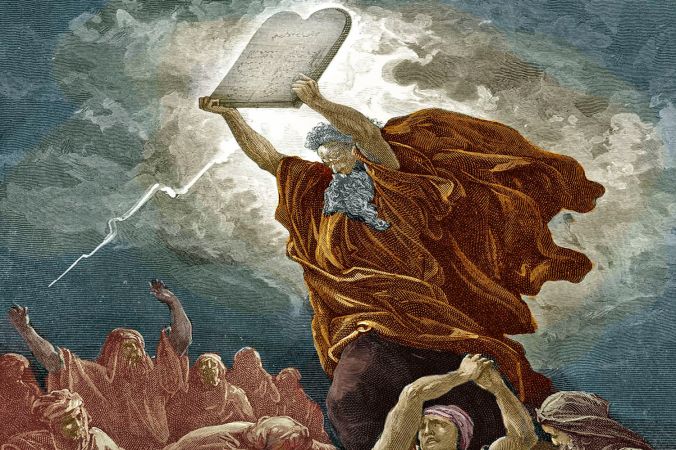
Moses-and-the-Ten-Commandments-GettyImages-171418029-5858376a3df78ce2c3b8f56d.jpg

Colorized detail of Moses Breaking the Tables of the Law, by Gustave Dore. (Source)

Rabbi Samson Raphael Hirsch, the spiritual father of Modern Orthodox Judaism, launched his movement in the nineteenth century with an assault on the Frankfurt Reformers entitled “Religion Allied to Progress.” Hirsch decries the new forms of liberal, secular religion he saw animating the well-to-do populations of Jews in Germany.

“But behold! The prophet of the new message came into their midst with the cry of ‘religion allied to progress’; he filled the blank, pacified their conscience and wiped out their shame. With this magic word he turned irreligion into Godliness, apostasy into priesthood, sin into merit, frivolity into virtue, weakness into strength, thoughtlessness into profundity. By this one magic phrase he distilled the ancient world-ranging spirit of the Torah into a single aromatic drop of perfume so fragrant that in the most elegant party dress they could carry it round with them in their waistcoat pockets without being ashamed. By means of it, he carved out of the ponderous old rock-hewn Tablets of the Law ornamental figures so tiny that people gladly found room for them on smart dressing tables, in drawing-rooms and ballrooms. By means of this one magic phrase he so skilfully loosened the rigid bonds of the old law with its 613 locks and chains that the Divine Word which until then had inflexibly prohibited many a desire and demanded many a sacrifice, henceforth became the heavenly manna which merely reflected everybody’s own desires, echoed their own thoughts, sanctified their own aspirations and said to each one: ‘Be what you are, enjoy what you fancy, aspire to what you will, whatever you may be you are always religious, whatever you may do–all is religion; continue to progress, for the more you progress the further you move from the ancient way, and the more you cast off old Jewish customs the more religious and acceptable to God will you be….'”

These prophetic words came to mind as I was reading Dr. Ulrich Lehner’s excellent new offering, God Is Not Nice (2017). Published by Ave Maria Press, the book is a cannon-blast through America’s spiritual miasma. His target? The false image of God as a nice guy. I’m afraid that, as the book shows, He isn’t very “nice” at all. He’s so much better than that.

Each chapter considers one of God’s attributes as revealed in the Scriptures, the Magisterium, and Church History. How wonderful to come across a work of theology that isbrace yourselfactually about God! Gone are the boring and programmatic encumberments that so often clog up the pages of the theological press. Lehner is centrally concerned with God’s character, and only secondarily with what that must mean to us, His creations.

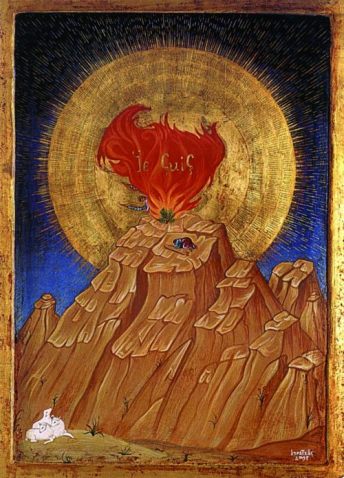
TheBurningBush.jpg

Lehner drinks deeply of the Scriptures. He often returns to Old Testament narratives of encounter with a God who surpasses every expectation. (Source)

It is also one of the most erudite pieces of popular religious writing I have ever read. Sprinkled in among the obligatory references to the Inklings are much heavier hitters. One finds ideas drawn from Martin Buber, Gabriel Marcel, John Crowe Ransom, Rodney Stark, Robert Spaemann, Dietrich von Hildebrand, and many more. Lehner’s prodigious knowledge of philosophy was especially apparent, as he deftly maneuvered between classical Thomism and recent German thoughtnot exactly the fare one expects from a major Church Historian. God Is Not Nice also has the distinction of being the only book of popular devotion I’ve encountered that speaks favorably of Erich Fromm (and cribs some of his ideas). It is to Lehner’s credit as a teacher that the reader never feels as if he’s suddenly entered rare air. He presents some difficult concepts with a simplicity that never sacrifices substance. An eighth grader could read and, more importantly, understand the text. So could an Evangelical. The book never ceases to be Catholic, but one is hard-pressed to find many insights that are so uniquely Papist as to dissuade Protestant readers. Its broad appeal comes not from a watering down of the Faith’s distinctives, but a consistent penetration of those things which lie at the very heart of the Christian life.

The book is also imbued with a deep humanity. First, Lehner’s understated humor crops up now and again, such as the time he casually compares the Prosperity Gospel preachers to Nazis (62). Or when, at the start of a chapter on intimacy with God, he writes, “Nakedness in public is a clear no-no” (80). It is difficult to imagine Lehner writing that line with a straight face, and impossible to read it with one.

The humanity of the text lies in its content as well as its style. Although Lehner hardly ever proposes specific ideas for spiritual renewal, the call to conversion is constant, simple, and universal enough that it all feels eminently practical. It works in large part because Lehner never invests his project with the unwieldy freight of, say, the hopes and failures of socially conservative American Christianity. This book is not The Benedict Option. Sure enough, Lehner is critical; for example, I was surprised to see such a forthright condemnation of the Enlightenment from an author who has made it is his life’s study. But Lehner never carries his criticism into the unpleasant realm of polemic, as Dreher so often does in his own book. What matters to Lehner is the individual human soul, not the social conditions under which the Church must forge her way through history. He is realistic about the quotidian quality of our spiritual lives. Everything must come back to the individual’s relationship with God, a relationship largely shaped by the perfectly ordinary moments of our day. The book never leaves this vision.

That isn’t to say that Lehner advocates a purely individualistic spirituality, like some eighteenth-century revivalist, red in the face, handkerchief flailing. I was struck many times by the familial note in Lehner’s work. Instead of shying away from appearing in his own workthe hallmark of a bloodless academicLehner grounds his spiritual call to arms in his own life. Lots of the book’s wisdom is drawn from its author’s experience of parenting. We read, in a chapter on God and suffering:

In fact, many of our children learn from the first hour of Sunday school that God wants everybody to be happy. Some parents might object that a different image of God would terrify children. I don’t think so – and I am speaking with the experience of parenting five kids. (100)

Or elsewhere, in a discussion of the Redemption:

A nice god might pardon us without care for our repentance, but so would a terrible parent who is not interested in us becoming mature and responsible persons. (118)

Or this charming anecdote, while pondering human freedom and what we really mean when we say that the Lord is “a God of Surprises”:

Of course, God is omniscient regarding all our actions and thoughts, but he leaves us our freedom and seems to choose to be surprised. I cannot help but compare this to my own parenting. When my younger children prepare a surprise present for my birthday, I usually find traces in the kitchen and the living room: crayons, pieces of paper, glue sticks, and first drafts with ‘Happy Birthday’ on them. Nevertheless, I choose to be surprised when they hand me their work of art. I think that with an omniscient God, it must be somehow like this. (126)

It thus didn’t come as too great a surprise when, at the end of his text, Lehner turned to a brief yet powerful meditation on St. Joseph. In some sense, St. Joseph is the paragon of all that Lehner advocates. He dwelt with God day to day in an intimacy unclouded by the various pretty illusions to which we all fall prey. Instead, St. Joseph drew the strength he needed from a true knowledge of God’s character. That knowledge created a great love and humble awe in him. For us, as for the Frankfurt Jews of Hirsh’s day, God is little more than a plaything or bric-a-brac, “relegated to a mantelpiece long ago and…only taken down on Sundays.” (106).

It was not so with St. Joseph. He knew the awful and living God as a human being, as one beloved. But for St. Joseph, that God wasn’t “nice.” After reading Lehner’s book, we too may be lucky enough to know that God’s not nice. He’s real.

“The Fair and Fatal King”

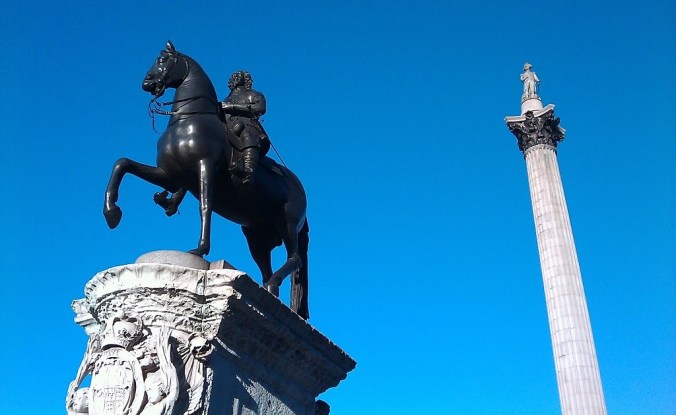
CharlesStatue1

Two heroes, one square: Charles I and Nelson. (Source)

Today may be the anniversary of Louis XVI’s execution, but I just found a wonderful poem about His Majesty Charles I that I wanted to share with my readers. Something to meditate upon before the 30th.

By the Statue of King Charles at Charing Cross

Lionel Johnson
To William Watson

Sombre and rich, the skies,
Great glooms, and starry plains;
Gently the night wind sighs;
Else a vast silence reigns.

The splendid silence clings
Around me: and around
The saddest of all kings,
Crowned, and again discrowned.

Comely and calm, he rides
Hard by his own Whitehall.
Only the night wind glides:
No crowds, nor rebels, brawl.

Gone too, his Court: and yet,
The stars his courtiers are:
Stars in their stations set;
And every wandering star.

Alone he rides, alone,
The fair and fatal King:
Dark night is all his own,
That strange and solemn thing.

Which are more full of fate:
The stars, or those sad eyes?
Which are more still and great:
Those brows, or the dark skies?

Although his whole heart yearn
In passionate tragedy,
Never was face so stern
With sweet austerity.

Vanquished in life, his death
By beauty made amends:
The passing of his breath
Won his defeated ends.

Brief life, and hapless? Nay:
Through death, life grew sublime.
Speak after sentence? Yea:
And to the end of time.

Armoured he rides, his head
Bare to the stars of doom;
He triumphs now, the dead,
Beholding London’s gloom.

Our wearier spirit faints,
Vexed in the world’s employ:
His soul was of the saints;
And art to him was joy.

King, tried in fires of woe!
Men hunger for thy grace:
And through the night I go,
loving thy mournful face.

Yet, when the city sleeps,
When all the cries are still,
The stars and heavenly deeps
Work out a perfect will.

A View of the Sacraments in the Age of Enlightenment

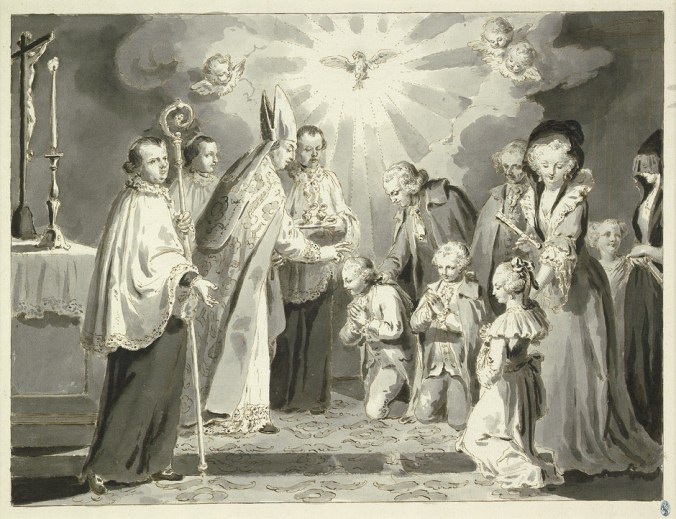
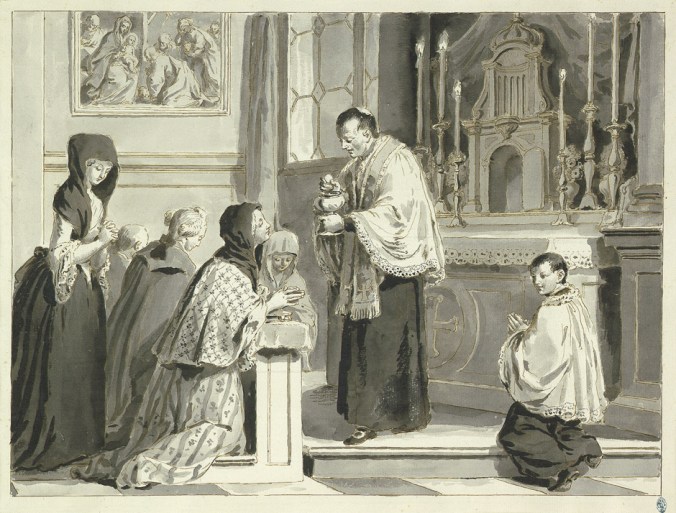
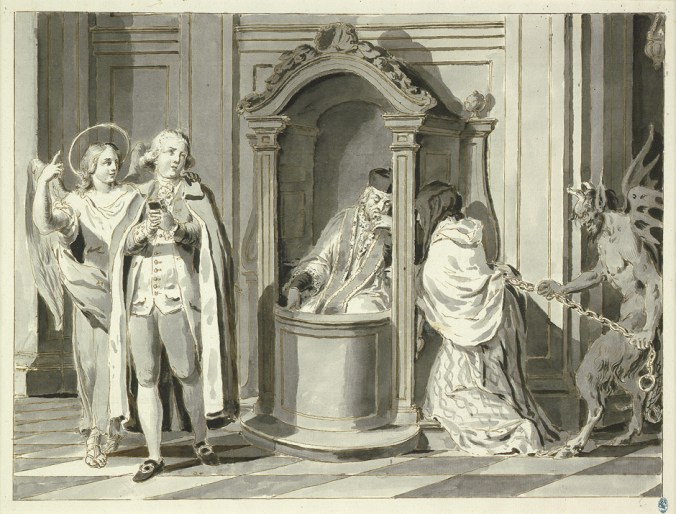
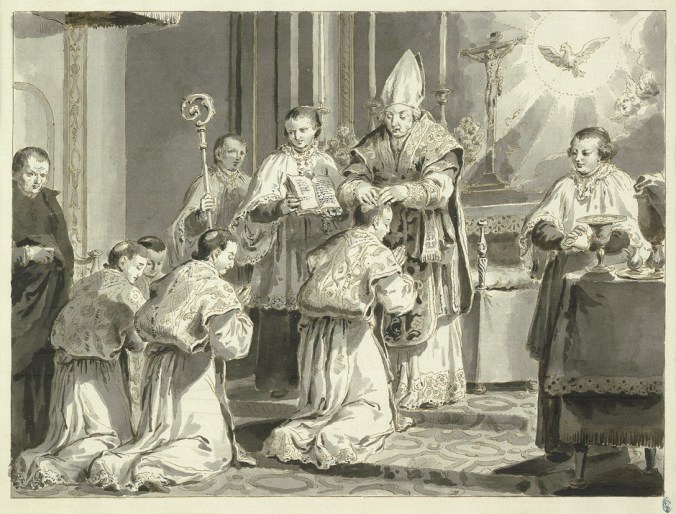
I just stumbled across Pietro Antonio Novelli’s engravings on the Seven Sacraments, completed in 1779. They give a fascinating view of ecclesiastical life in the late 18th century – Novelli would have moved to Rome from Venice about this time, so it’s unclear which part of Italy these were drawn from. Either way, they’re worth a look through. All are taken from Wikimedia Commons.

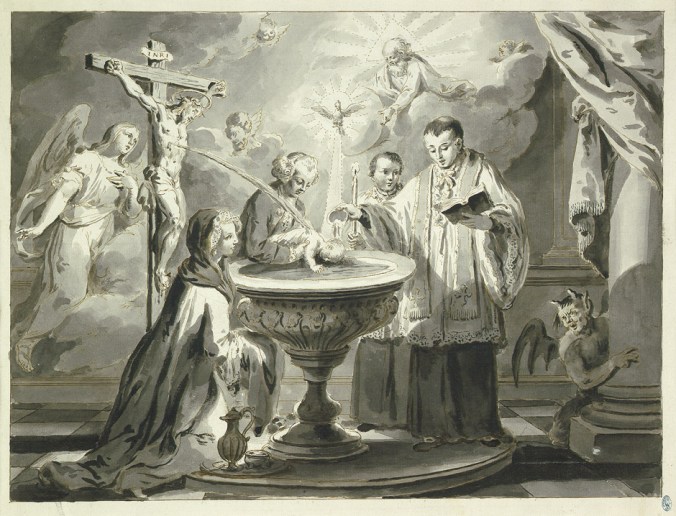
NovelliBaptism

Baptism. Note the prominent Angel and Devil.

NovelliConfirmation

Confirmation. Strong and sound emphasis placed upon the role of the Holy Ghost.

NovelliEucharist

The Eucharist. The arrangement of the Altar and rail suggests that this is a low mass. Very odd that the Priest has no chasuble, but surplice and stole.

NovelliConfession

Penance. Once again, we see the Angel-Devil dichotomy. Lovely open confessional, too.

NovelliHolyOrders

Holy Orders. It is entirely unclear to me where the Altar is supposed to be in this image. Nevertheless, the Bishop is wearing a wig, which answers a question of Fr. Hunwicke’s.

NovelliMarriage

Holy Matrimony. A fairly straightforward scene with lovely, somewhat spare Neoclassical church architecture in the background.

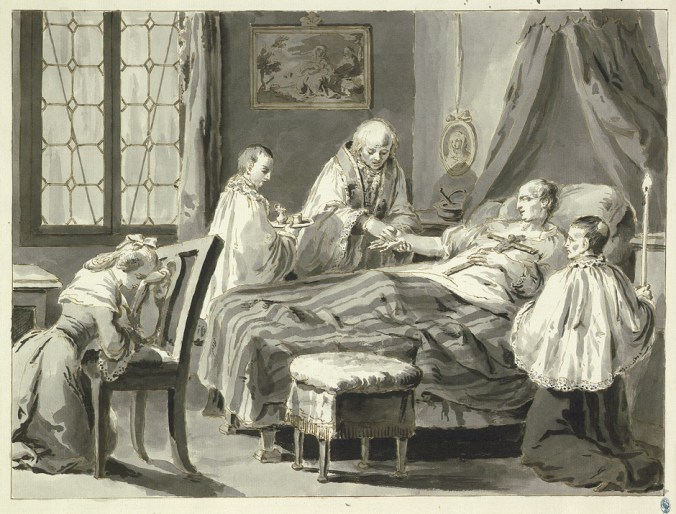
NovelliUnction

Unction. The attendance of two servers is a custom long since out of fashion. One rather wonders when their presence was removed from the rubrics.