On Faith and the Priesthood of Christ

And he led them out as far as to Bethany, and he lifted up his hands, and blessed them. And it came to pass, while he blessed them, he was parted from them, and carried up into heaven. And they worshipped him, and returned to Jerusalem with great joy: And were continually in the temple, praising and blessing God. Amen. – Luke 24: 50-53

Many years ago, shortly after the start of my faith journey, I received some very good advice from an Anglican friend of mine. Or rather, I received a very good prayer. She told me that whenever she was anxious or worried or stressed about anything, she resorted to a prayer that ran like this:

“Jesus Christ is my High Priest, and He will always see me through.”

There is much consolation in these simple words, as I have had frequent occasion to learn in the years since then. And, to be honest, I am most drawn to Christ in the mystery of His High Priesthood. I often find myself asking Him to pray for me, not in the sense that one asks a friend or a saint to pray, but as one can only ask a sovereign and perfect intercessor. This sense of Christ as High Priest has become part of the basic structure of my own faith. Yet today’s feast, the Ascension of Our Lord into Heaven, invites us all to dwell upon this mystery in a more explicit way.

The Ascension from the Très Riches Heures du Duc de Berry ©Photo. R.M.N. / R.-G. OjŽda (Source)

It is a curious fact of the Church’s kalendar that in those solemnities when she most fervently celebrates the Incarnation, she also insists most firmly upon the hiddenness of God. In Christmas, we observe Christ born in a lowly shed at night, disclosing His presence only to those shepherds who resemble Him in their poverty, humility, and obscurity. Today’s feast of the Ascension is composed of a similar doubling. It brings before our eyes the Incarnation in its most radical implications—while reminding us that we live in and with Christ’s apparent absence.

It is, therefore, a salutary lesson in the virtue of Faith. I think that we too often lose sight of what Faith really is. Scripture tells us: “Now faith is the substance of things hoped for, the evidence of things not seen” (Heb. 11:1 KJV). But what does this really mean?

God’s absence is felt in two ways. First, we feel it through the insistent reality of evil. The agony of the world we live in is too great, too universal, and too obvious to need any underlining. The Church is no different. How many malicious and mediocre priests seem to cloud the pure light of the Gospel! Their sin weighs more heavily, for they have been given a greater charge. Yet there is some comfort in the High Priesthood of Christ. If our earthly priests falter and fail, Christ never will. He remains forever a spotless offering in the sight of the Father, and His blood is all-cleansing. The invisible pontiff of an invisible, all-embracing, and everlasting temple, Christ never abandons His children, who linger below with expectant eyes.

Let us pass on to the second sense in which God hides Himself, leaving us with, in the words of R.S. Thomas,

this great absence
that is like a presence, that compels
me to address it without hope
of a reply.

R.S. Thomas, “The Absence”

The past is forever dead to us, an enormous absence, a distantly glimmering mirage that fades even as we approach it. Sacred History, even supported by texts and archaeology, is not a special case. There is a sense in which the facts of the Incarnation, Death, and Resurrection of Christ are no different here. We may participate in them, but we cannot directly experience them as historical events, in historical time.
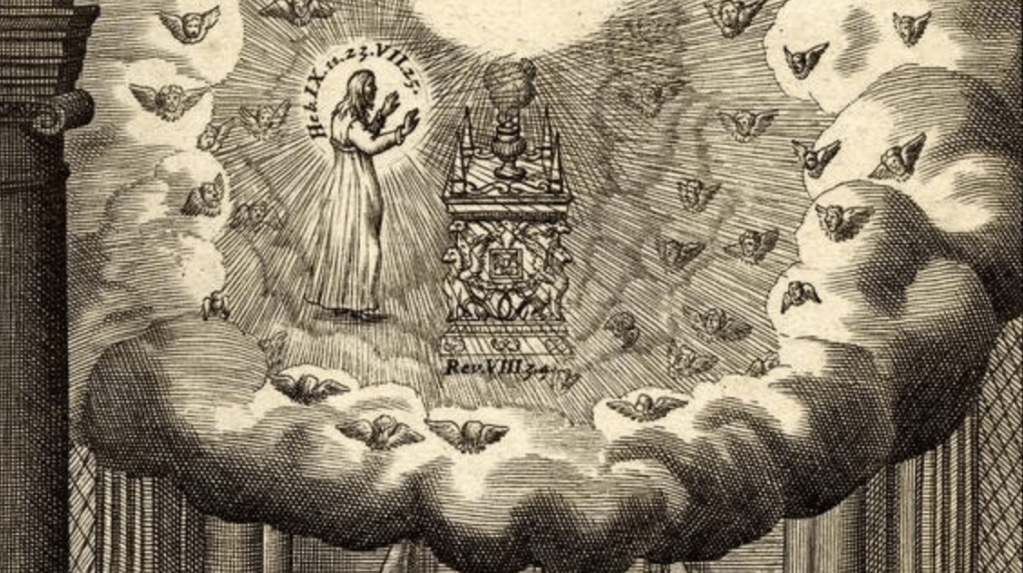
The great High Priest in Heaven. (Source)

So, what are we to do? How do we deal with the fact that God’s acts of revelation lie hidden behind the curtain of time? Quite simply, we must have faith. We must declare that faith is not certainty and not knowledge, but an engraced movement to trust those little lights given unto us. Those lights are, mainly, Scripture and Tradition, particularly the Liturgy, in which the Church as a body transcends the limits of earthly time through her collective remembrance. There is a tendency in Catholicism to downplay the “memorial” function of liturgy. This is a mistake. In fact, there is a sense in which the essence of the Liturgy (or rather, the Liturgies of the various Catholic Churches) is memory. But it is the memory of the Church as the very Body of Christ, a memory which realizes and re-presents the object of remembrance, not mere empty symbolism. Orthodox theologians have been better on this point than Western ones, perhaps because they have not been so fearful of the specter of Zwingli. But I digress.

All of this is to say that we cannot state with the certainty of historical science whether Sacred History is true. There is no real evidence for most of revelation, and we should not let the apologists delude us on this point. They’re far more addled by modernity than they realize. But by grace we can and should leap boldly across the chasm of our natural uncertainty, avoiding the Scylla of Apologetic Positivism and the Charybdis of Naturalistic Doubt. The result is not knowledge, which has no meaning here, but faith.

We would all be better off in a position of greater epistemological humility. For instance—let’s be honest—we have absolutely no knowledge of what happens after death. The data is inconclusive: annihilation, a flash of light, reincarnation, hauntings, purgatory, heaven and hell. We know nothing. It may seem like a commonplace, but it bears repeating, that our fate after death is a mystery. All we can do is have faith that what we have been promised is true. But none of this is certainty, not even for our own salvation. Do you know you will be saved? No. For no one can know what comes after death. Eternal hellfire or an infinity of mute blackness or a strange new human life could come instead. The only thing to do is to pray for mercy “in fear and trembling,” placing our faith in the Hidden God (Philip. 2:12).
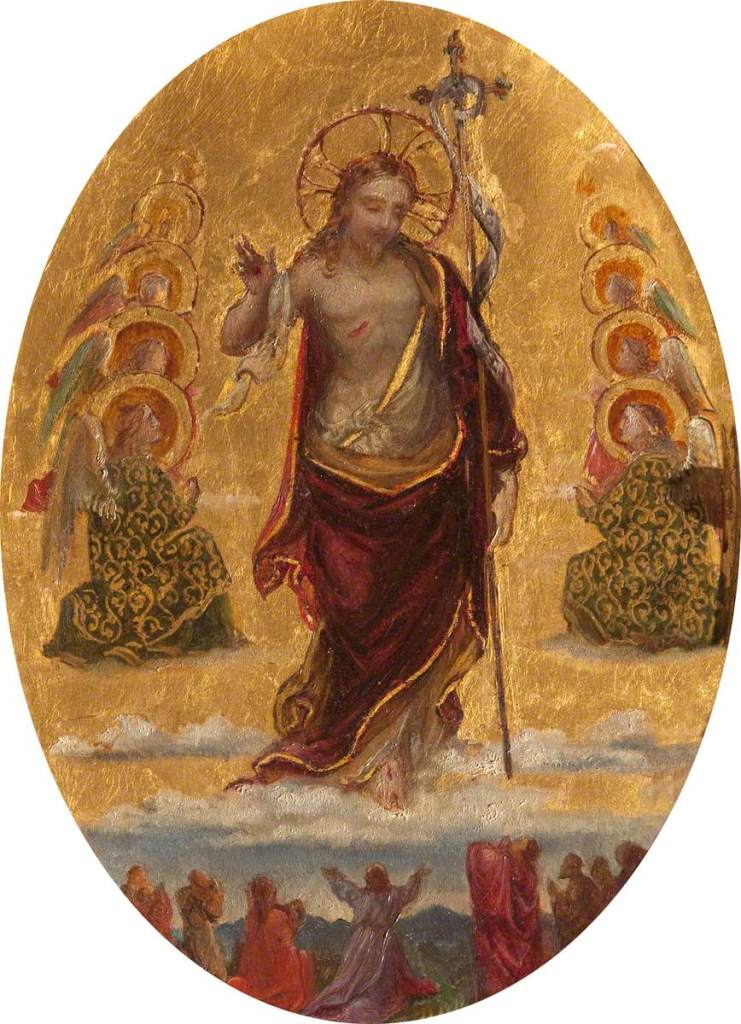
Rebecca Dulcibella Orpen, The Risen Christ (The Ascension), National Trust, Baddesley Clinton (Source)

Do not say to me that you “know” these things because you “know” your Bible or because you “know” Church teaching or even because you “know” Jesus. To be frank, I don’t believe it. In fact, I’m not confident we can know God at all, in the sense of positive knowledge. God’s existence is not like a mathematical theorem or the date of the Battle of Waterloo. Nor do I think you can know God or any of His saving mysteries like you can know another person. You cannot see God; you cannot touch Him; you cannot hear Him like you can hear a friend or lover or even a stranger passing in the street. Simply put, I don’t believe that our “knowledge” of God, the Infinite and loving ground of Being, should be called “knowledge” at all. In fact, I rather suspect that this fixation with “knowledge” has been a very substantial problem for the Church throughout her history.

To interject a personal note; I look back at my life and I sometimes wonder if I ever really knew Christ. There are others I doubt as well. False mystics and visionaries abound, as the Church chokes on her own prelest. But when I look at my own case, I remain unsure. I certainly know a lot about the Church, and have ever since I eagerly began RCIA nearly ten years ago. But did I know Christ? Was I just enamored with my own exaltation, with the fool’s-gold assurances of spiritual certainty, with the glittering baubles that float like empty bottles down the Tiber? Is it even possible to know Him? Or must we just choose, by grace, to have faith—to place our confidence in Him, trusting that He will guide us through the overwhelming darkness of uncertainty which is the very tissue of our lives?

I have come around to the latter position. The virtue of Faith has nothing to do with knowledge per se, and is as far from certainty as East from West. It is granted to us precisely because we lack certain knowledge of the immense realities it comprehends, and probably must by our very nature. Eliot writes in “Burnt Norton” that “Human kind/cannot bear very much reality.” We forget our weakness too easily.
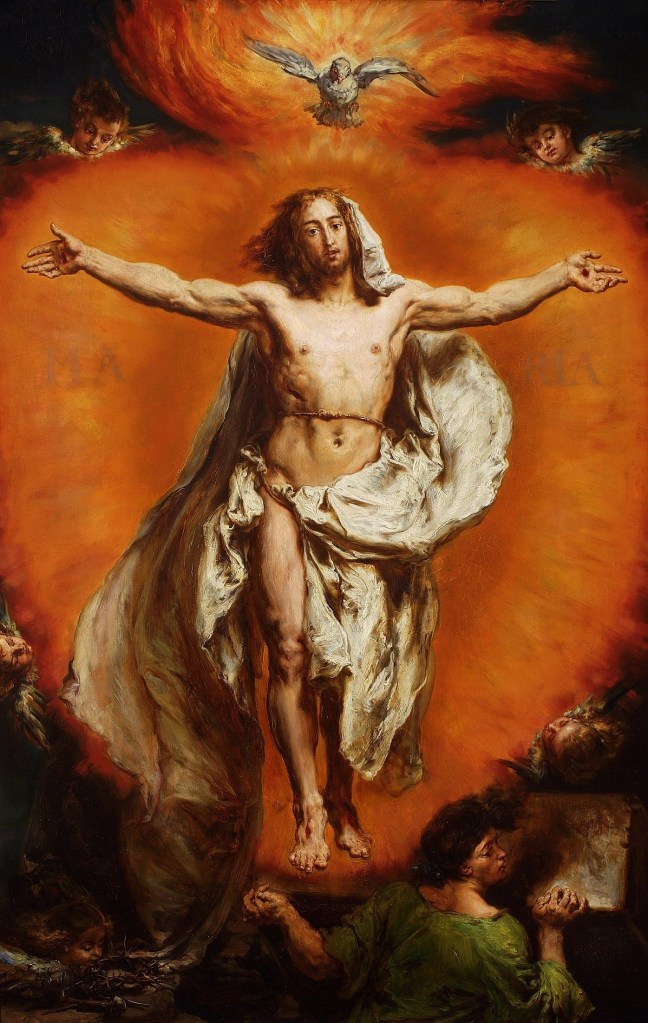
Jan Matejko, The Ascension of Christ, 1884 (Source)

Happily, the substance of our faith does not reside in the natural faculties of understanding. As Pascal says, “It is the heart which experiences God, and not the reason. This, then, is faith: God felt by the heart, not by the reason.” In a sense, the Ascension is the true beginning of the Christian faith in history, for it inaugurates our sensible separation from Christ. Our eyes grow dim, but not our hearts. The blindness of nature is transformed into sight by grace.

In Exodus, God tells Moses that “Thou canst not see my face: for there shall no man see me, and live.” (Ex. 33:20 KJV). The Ascension is the triumphant reversal of these words. For today, a man greater than Moses, a man greater than Enoch and greater than Elijah, but a man all the same, sees the Face of the Father. He has “ascended into Heaven, and sitteth on the right hand of God, the Father Almighty.” Godhead wraps Himself in human nature, and humanity is plunged into the abyss of everlasting Light. A human being stands at the threshold of eternity. The Ascension brings humanity into the very Holy of Holies of the cosmos. We truly participate in this Ascension if we unite ourselves to Christ through the grace given us, especially the grace of the sacraments. If we one day enjoy the Blessed Vision of the Divine Essence, it will be through the eyes of our High Priest, our Head, the Lamb who is the Lamp of the New Jerusalem (Rev. 21:23). John Donne puts it thus:

Behold the Highest, parting hence away,
Lightens the dark clouds, which He treads upon;
Nor doth he by ascending show alone,
But first He, and He first enters the way.

John Donne, “Ascension”

By grace, we shall follow these luminous steps, someday. So many saints have – including today’s great saint, Philip Neri, Apostle of Rome. Their stories remind us that now is the time of faith, and hope, and the charity that breathes life into both.   

If the Ascension is a lesson in Faith, it is just as much a lesson in Hope. It shows us which way we must go. It tells us that we must look to the hills, from whence cometh our help (Ps. 121:1). We need go neither backwards nor forwards, neither to the East nor to the West—but rather, up. Up, into the hidden mystery of the Divine Life. Our help is not from man but from the God-Man, the one who brought our very nature beyond the veil of the celestial temple. And what do the Apostles do? They imitate their Head and repair to the visible and earthly temple, there to sing and praise and preach the Gospel of the Lord. So have all the saints throughout the long, dark centuries since the Ascension. And so should we.  

But even as we tabernacle in the visible Church, we are truly cloistered in the heart of the Most High. As St. Paul writes to the Colossians,

If ye then be risen with Christ, seek those things which are above, where Christ sitteth on the right hand of God. Set your affection on things above, not on things on the earth. For ye are dead, and your life is hid with Christ in God.

Colossians 3:1-3

Let us pray with the Apostles that we might one day ascend with Christ. And let us ever hold in remembrance that Jesus Christ is our High Priest, and He will always see us through.
An Ecclesiological Note

Perhaps the fundamental flaw of our ecclesiology is that we think the Church was founded. By that I mean, that Christ came, set up the Church, sent the Holy Spirit, and it’s all been moving onward, outward, and upward ever since. One points to the words of Our Savior – “thou art Peter, and upon this rock I will build my church; and the gates of hell shall not prevail against it” – and leaves the question at that. (Matt. 16:18). A somewhat more sophisticated version of this argument extends the Church’s life – her gestation, if you will – into the covenants of the Old Testament.

This kind of ecclesiology weds the Church to the vicissitudes of history, and the necessary fruit of this unhappy union is a Tradition that oscillates between mythopoetic antiquarianism and charismatic presentism. Tradition is either an ark to carry us across the sea of changes, or the constantly renewed speech-act of the Pope, or people, or Council, or some ill-defined combination of the three. And whether one reads this historical narrative in a traditionalist or a progressive key, one always ends up interpreting the story of the Church in the light of the past’s dying embers.

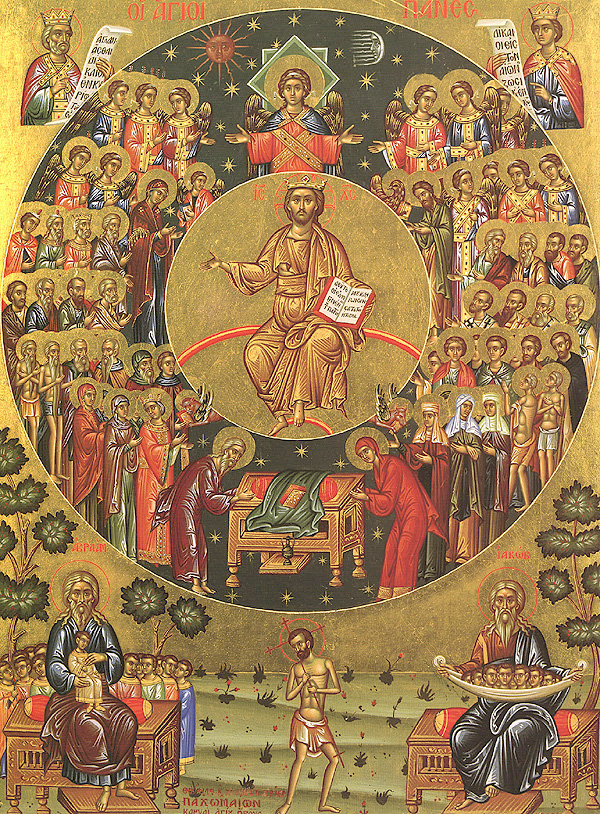
Icon of the Synaxis of All Saints. (Source)

But that is not the model of the Church we find in Scripture. The Church which is the Holy City, the New Jerusalem, the Redeemed Heaven and Earth, all this is the self-same Church that sojourns in history (Rev. 21:1-2). But in the Apocalypse we observe her at her true birth beyond time. It is in the culminating moment of all creaturely existence, in her final and lasting Union with God in His essence eternal, that the Church takes her true being. It is the bright light of that ageless day which illuminates history, and not the ever-dimming torches of chronological time. Indeed, history furnishes no light of its own, only dim reflections of God’s glory that we misunderstand in uncountable ways. In the words of the Apostle, “For now we see through a glass, darkly; but then face to face: now I know in part; but then shall I know even as also I am known.” (1 Cor. 13:12).

In the same letter, he writes, “And when all things shall be subdued unto him, then shall the Son also himself be subject unto him that put all things under him, that God may be all in all.” (1 Cor. 15:28). Here we have an image of the eschaton – that redeemed dimension in which everything that is, is Christ, by the grace of participation in Him. The eschaton is thus non-different from both Christ and the Church. All souls participating in the eschaton likewise share in Christ’s singular mediation before the Father, albeit in ways proper to their scope. Humans are His Body, the Angels are His High Priestly garments, and the new heavens and the new earth are the temple. For the eschaton – the Wedding Feast of the Lamb – mediates God’s salvific action with creaturely, chronological reality (Rev. 19:9). It is like the upmost layer or outer shell of time, giving all creation its true shape. It is the blissful union by which God weds the cosmos.

A genuinely eschatological ecclesiology, an ecclesiology that takes apocalypse seriously, must demote any definition of Catholicity that relies too heavily upon the unstable facts of history. If the Church is, as the Apostle writes, “the pillar and ground of the truth,” then it must be rooted in a life that exists beyond the vicissitudes and fallibility of the creaturely world. (1 Tim. 3:15). However, this raises a question of knowledge with soteriological ramifications.

Too often we hear from Catholics (or Orthodox) in an apologetic mood that “We know we are in the True Church because we have Apostolic Succession.” No, you are in the Church because you are saved by the grace of Christ; your Judgment has already taken place beyond time, your eternal place in glory allotted, your soul blissfully united to the Lord – but you haven’t consciously arrived there yet. This is the mystery of Predestination, but not, as commonly misconceived, in a linear, chronologically anterior direction. Election does not happen before time, but above it – or rather, both before and after history. When St. Paul writes, “And whom he predestinated, them he also called. And whom he called, them he also justified. And whom he justified, them he also glorified,” he is fundamentally describing a single divine work in the eschaton. (Rom. 8:30). To be in the Church is to be a child of God. However, the grace of divine adoption is eschatological in both its root and in its orientation. Scripture says, “He that overcometh shall inherit all things; and I will be his God, and he shall be my son.” (Rev. 21:7). And elsewhere, “Behold, the tabernacle of God is with men, and he will dwell with them, and they shall be his people, and God Himself shall be with them, and be their God.” (Rev. 21:3). This image, which comes from one of the final visions of St. John, depicts the Church’s eschatological life, and not her earthly existence. Thus, only the Saints in Heaven are the Church, properly speaking; the damned have no part in Christ’s Body. Ultimately, there is no third category.

The True Church is thus, like God Himself, hidden. She abides in and beneath the purple trappings of worldly glory, but takes no part in it. The tendrils of grace that reach down from the supernal world move invisibly and invincibly to the hearts that are hers; they are as so many crooked and narrow paths up to the temple, lit by the lamp of Revelation. As the Psalmist sings, “Thy word is a lamp unto my feet, and a light unto my path.” (Psalm 118/119: 105).

This is not to say that apostolic succession is unimportant. It has its uses, insofar as it preserves and passes on the saving truth of the Scriptures and Creeds, the threefold order of ministry, and the seven sacraments by which we receive certain graces. In this sense, it is a gift of God’s condescension to us mortals. But apostolic succession is not constitutive of the Church’s essence. Only final participation in the eternal life of Christ can do that.

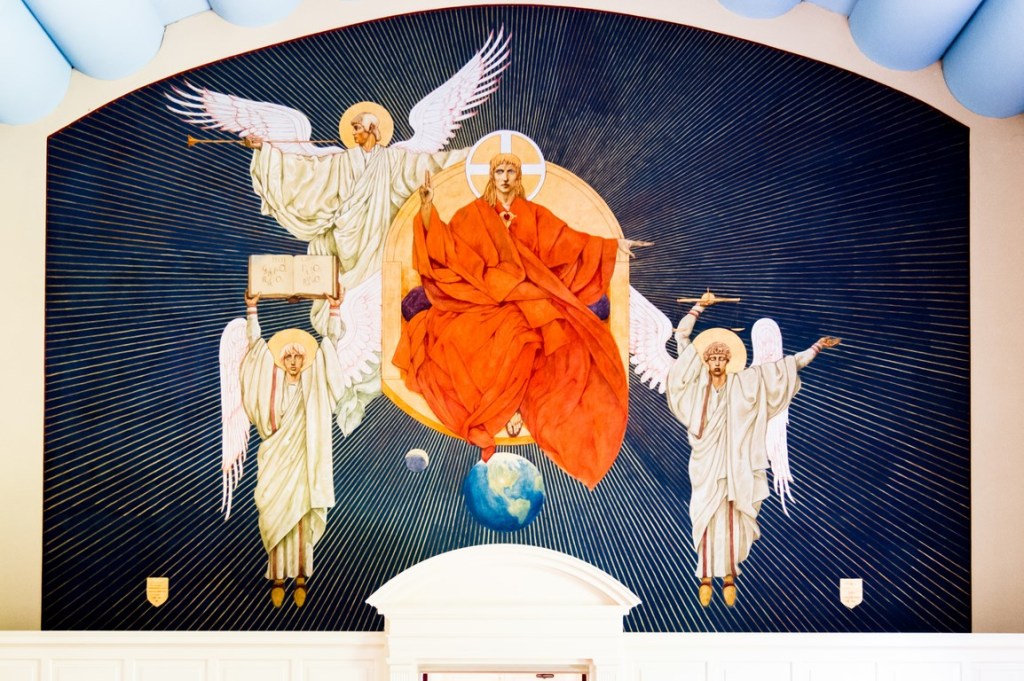
Christ the Judge, mural in St. John’s Episcopal Church, Memphis, TN. Mural by John DeRosen. (Source)

Which brings me to a question I have been wrestling with lately: what is Catholicity? When we confess in the Nicene Creed that the Church is “Catholic,” what does that really mean? The common answers one usually hears on this point are either “communion with the Pope” or “possesses apostolic succession.” The first of these is an irrelevant, Ultramontane fable. The second simply confounds the question of Catholicity with the question of Apostolicity.

My own attempt at an answer would divide the question thus: we may speak of what Catholicity looks like, and we may speak of what Catholicity is. Catholicity looks like those things I have already mentioned: teaching the faith of the Scriptures and Creeds, prayerfully distributing the seven sacraments, and preserving the threefold ministry of bishops, priests, and deacons in apostolic succession. In what it seems to be, Catholicity means wholeness. But Catholicity is participation in the eschatological Church which is already united to Christ, that is, the whole body of the saved, whosoever and wheresoever they might be. In this sense of its utmost reality, Catholicity means universality. Thus, Catholicity means different things when applied to the Church visible and the Church invisible, with the latter taking priority.

The temporary Church visible and the everlasting Church invisible are never completely commensurate. But one can nevertheless “work out your own salvation with fear and trembling” more confidently in a church with these elements, and where one can be reasonably sure that the priest is offering a true oblation to the Father. (Phil. 2:12). One can never truly be sure that one is a member of the Universal Church simply by virtue of the necessary historical features I have outlined. A Christian can still be damned, even if he is a churchgoer; surely, no Catholic who is paying attention could say otherwise. As we move through time, who can know whether any of us will prove to be Saints in that last and most surprising Day? “Watch and pray.” (Matt. 26:41). As M. Quesnel said of the two thieves at the Crucifixion, “Un se convertit à la mort, espérez; un seul, craignez.”

I said earlier that this issue is a question of knowledge with implications for our salvation. But that’s not quite true. One’s adherence to the True Church is not a question of knowledge, even with all the best historical or empirical evidence we can gather. It is, rather, a question of faith. Too many Catholics are uncomfortable with real faith. The over-exalted epistemic claims of our church means that far too often we treat our doctrines and even our own salvation as matters of knowable fact, and end up forgetting that “faith is the substance of things hoped for, the evidence of things not seen.” (Heb. 11:1). Let us pray to receive the grace of rediscovering epistemic humility, for with it, faith will follow.

On Joy

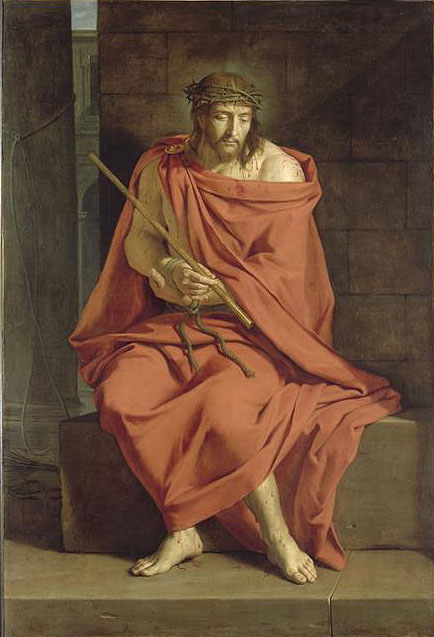
Le Christ aux outrages, Philippe de Champaigne, 17th c. (Source)

“Jesus Christ will be in agony until the end of the world” – Blaise Pascal

We shall not be blamed for not having worked miracles, or for not having been theologians, or not having been rapt in divine visions. But we shall certainly have to give an account to God of why we have not unceasingly mourned.” – St John Climacus

Recently I have had occasion to consider the role of joy in the Christian life. While I don’t believe that any particular emotions as such are intrinsic to Christianity, I sometimes feel that there is in the Church’s culture a kind of low-level idolatry of affective joy that makes it a good in itself and, more poisonously, demonizes those who do not share in it. This rather shallow (and ultimately false) view of joy as relentless and mandatory happiness has at times eclipsed the demands of the Cross, and has little to offer the suffering, the infirm, the distressed, the depressed, the sorrowful, the anxious, and the temperamentally gloomy. Are they to be excluded from heaven if they cannot force a smile? This soft and implicit Pelagianism of the emotions is a greater discouragement to souls than an honest reckoning with the sorrows of life and the terrible demands of the Cross.[1]

So, I thought I would put down a few very brief meditations on true and false joy. I would not wish to speak in absolute and general terms, but rather, out of the fullness of my heart, and all that I – a mere layman – have gleaned from seven years in the faith, the reading of Scripture, and the study of the Church’s spiritual history.

St. Paul tells us that joy is a fruit of the Spirit; he does not promise us that we shall have all those fruits at all times, or that they grow in us for own profit alone.[2] If I may alter the metaphor a bit for illustrative purposes (without in any way denying the truth St. Paul teaches), I would say that joy is the flower, and not the root or the fruit, of the Christian life as such.[3] It is chiefly given to us by God so that we might advance His Kingdom. Like the pleasant blooms of spring, joy is meant to attract souls who do not yet know the grace of God, and thereby to spread the life of the spirit. As soon as we have it, we must give it away. It is like an ember in our hands – giving light and heat, but liable to burn us if we hold on to it. For who are we to keep it, we who are nothing? And so, we should not be surprised if even this true joy is fleeting, and given to us only in rare occasions as a special grace. For the joy of God is not like the joy of the world. The former is rare as gold, and the latter as common as fool’s gold.

And as fool’s gold will not purchase what true gold can buy, so does a false joy fail in this paramount duty of conversion. We should not force ourselves to seem happier than we really are; a certain virtuous attempt at good cheer in the face of sorrow is always welcome, and we generally should not air our griefs too freely. I believe this virtue, built upon a detachment from our worldly disposition, is what the Apostle refers to when he tells us to “Rejoice always.”[4] But let us not delude ourselves into thinking that this human cheer can ever compare with the supernatural joy that comes only from God, and which many just souls have not been granted. To do so approaches dishonesty, both to ourselves and to our neighbor. Let us not pretend that our faith cheers us more than it really does; let us instead recognize that it promises us suffering, and a yoke that, though light, is nevertheless still a yoke.[5] And under that yoke, someone else will lead us where we do not wish to go.[6]

Joy is only true if it comes from, is ordered to, and brings us back to the Cross. The joy that God gives is always stained with the Precious Blood. But even then, we are not entitled even to this joy in our present life; rather, we are given the Cross as our inheritance. For what is the world if not a land of false joys? They come from nothing, they come to nothing; in their essence, they are nothing. Well and truly does the Sage condemn it all as vanity.[7] Well and truly does the Psalmist speak of it as “the valley of the shadow of death.”[8] Well and truly do we address the Mother of God from “this valley of tears.” We can do no other.

This life of the Cross is a gradual annihilation – what the French call anéantissement – a fearsome but salutary tutelage in humility and in the growing recognition of our own nothingness. To live and die on the Cross is to say every day with St. John the Baptist that “He must increase, I must decrease.”[9] Yet how hard this is! We lose sight of the fact that at the end, when we are nothing again, we can grasp the God who is No-Thing, the One who is beyond the traps, illusions, trinkets, clutter, disappointments, and, indeed, the joys of this world. We efface ourselves now so we may one day face Him. We mourn our sins today so we may rejoice in attaining God on the last day.

That is the true joy of the Cross – that, in mounting it, we can see God. But how rare is such a grace in this life! Most of us are caught up into the business of the world. Most of our lives are a long distraction. Most of us will only achieve the vision of God after the sorrows of this life and the pains of purgatory. And so, let us never forget that to be a Christian is to let Christ suffer and die in us, so that one day, we too may rise with Him.[10]


[1] James 4:4.

[2] Galatians 5:22-23.

[3] The root is faith, and the fruits are redemptive suffering and acts of charity.

[4] 1 Thessalonians 5:16.

[5] Matthew 11:28-30.

[6] John 21:18.

[7] Ecclesiastes 1:2.

[8] Psalm 22 (23): 4.

[9] John 3:30.

[10] Galatians 2:20; 2 Corinthians 4:11; 2 Timothy 2:11; Philippians 1:21

Two Reflections on the Present Crisis

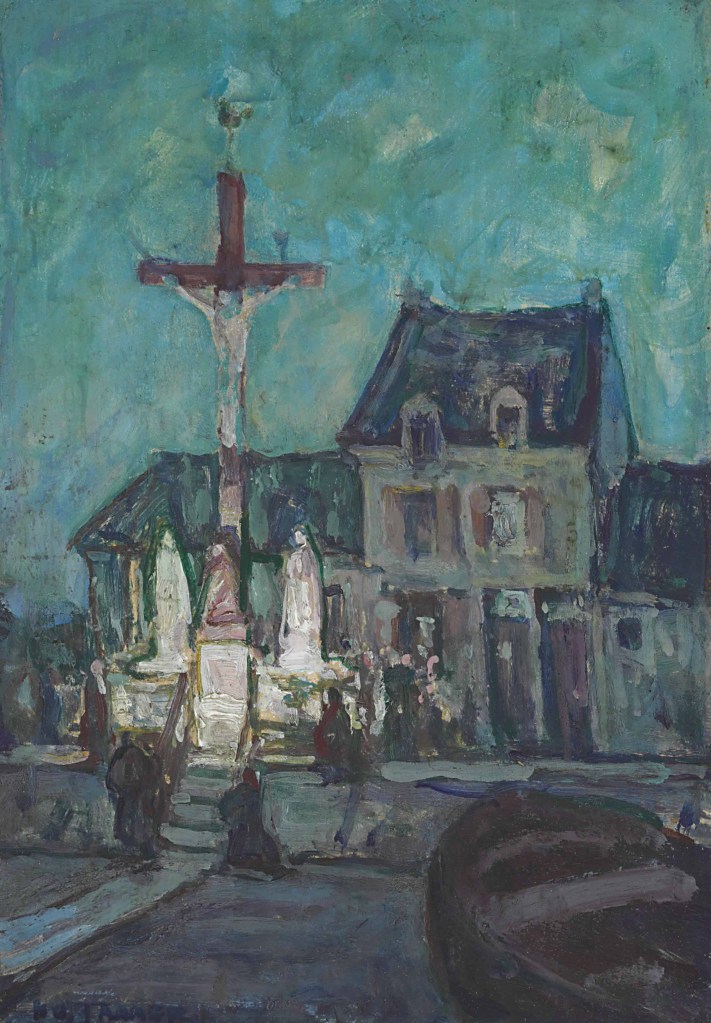
Fishermen’s Devotions, Étaples, Henry Ossawa Tanner, c. 1916 (Source)

I must refer my readers to two very moving pieces written by two dear friends of mine. Both are intensely personal and both are profound meditations on the present moment as a lived reality. The first is an almost Pascalian intervention from Mr. Jackson Wolford, who writes that our first task in this crisis – before any interpretations of what is going on all around us – is to witness the suffering. The second is a quiet reflection on impending fatherhood from Mr. Nathan Goodroe. He considers what it means to face the birth of a child in the midst of suffering through an extended look at the Holy Family’s trek to Bethlehem. We may be in Holy Week, but I still found his words to be very timely. In fact, both are. Please give them a read.

Propositions for the Pious

I offer the following propositions to my readers in a spirit of inquiry. Are these not edifying, pious, and – in many cases – straightforwardly true maxims? I have arranged them in thematic paragraphs, but beyond that, they do not issue from my hand. They are indeed far older maxims, drawn from the writings of certain noteworthy Catholic divines. Nevertheless, I should be very curious what my readers think of them – especially those with a theological background.

Are these not, on the whole, quite salutary? Do they not breathe the spirit of the best Fathers and Doctors, especially of those glorious Patriarchs of the West, SS Augustine and Thomas? Or, if anyone should find anything objectionable in them, what is the flaw? I ask sincerely. Those with ears to hear, let them hear.

In vain, O Lord, do You command, if You do not give what you command. Thus, O Lord, all things are possible to him for whom You make all things possible by effecting those same things in him.

All knowledge of God, even natural knowledge, even in the pagan philosophers, cannot come except from God; and without grace knowledge produces nothing but presumption, vanity, and opposition to God Himself, instead of the affections of adoration, gratitude, and love. As there is no sin without love of ourselves, so there is no good work without love of God.

A mark of the Christian Church is that it is catholic, embracing all the angels of heaven, all the elect and the just on earth, and of all times. What is the Church except an assembly of the sons of God abiding in His bosom, adopted in Christ, subsisting in His person, redeemed by His blood, living in His spirit, acting through His grace, and awaiting the grace of the future life? The Church or the whole Christ has the Incarnate Word as head but all the saints as members. The Church is one single man composed of many members, of which Christ is the head, the life, the subsistence and the person- it is one single Christ composed of many saints, of whom He is the sanctifier. There is nothing more spacious than the Church of God; because all the elect and the just of all ages comprise it.

It is useful and necessary at all times, in all places, and for every kind of person, to study and to know the spirit, the piety, and the mysteries of Sacred Scripture. The reading of Sacred Scripture is for all. The sacred obscurity of the Word of God is no reason for the laity to dispense themselves from reading it. The Lord’s Day ought to be sanctified by Christians with readings of pious works and above all of the Holy Scriptures. It is harmful for a Christian to wish to withdraw from this reading. It is an illusion to persuade oneself that knowledge of the mysteries of religion should not be communicated to women by the reading of Sacred Scriptures. Not from the simplicity of women, but from the proud knowledge of men has arisen the abuse of the Scriptures and have heresies been born. To snatch away from the hands of Christians the New Testament, or to hold it closed against them by taking away from them the means of understanding it, is to close for them the mouth of Christ. To forbid Christians to read Sacred Scripture, especially the Gospels, is to forbid the use of light to the sons of light, and to cause them to suffer a kind of excommunication. To snatch from the simple people this consolation of joining their voice to the voice of the whole Church is a custom contrary to the apostolic practice and to the intention of God.

A method full of wisdom, light, and charity is to give souls time for bearing with humility. and for experiencing their state of sin, for seeking the spirit of penance and contrition, and for beginning at least to satisfy the justice of God, before they are reconciled.

To suffer in peace an excommunication and an unjust anathema rather than betray truth, is to imitate St. Paul; far be it from rebelling against authority or of destroying unity.

Nothing engenders a worse opinion of the Church among her enemies than to see exercised there an absolute rule over the faith of the faithful, and to see divisions fostered because of matters which do not violate faith or morals. Truths have descended to this, that they are, as it were, a foreign tongue to most Christians, and the manner of preaching them is, as it were, an unknown idiom, so remote is the manner of preaching from the simplicity of the apostles. and so much above the common grasp of the faithful; nor is there sufficient advertence to the fact that this defect is one of the greatest visible signs of the weakening of the Church and of the wrath of God on His sons. Stubbornness, investigation, and obstinacy in being unwilling either to examine something or to acknowledge that one has been deceived daily changes into an odor, as it were, of death, for many people, that which God has placed in His Church to be an odor of life within it, for instance, good books, instructions, holy examples, etc. Deplorable is the time in which God is believed to be honored by persecution of the truth and its disciples! This time has come…. To be considered and treated by the ministers of religion as impious and unworthy of all commerce with God, as a putrid member capable of corrupting everything in the society of saints, is to pious men a more terrible death than the death of the body. In vain does anyone flatter himself on the purity of his intentions and on a certain zeal for religion, when he persecutes honest men with fire and sword, if he is blinded by his own passion or carried away by that of another on account of which he does not want to examine anything. We frequently believe that we arc sacrificing an impious man to God, when we are sacrificing a servant of God to the devil.

Springtime Sophiology from St. Nicodemus

GateAddisons

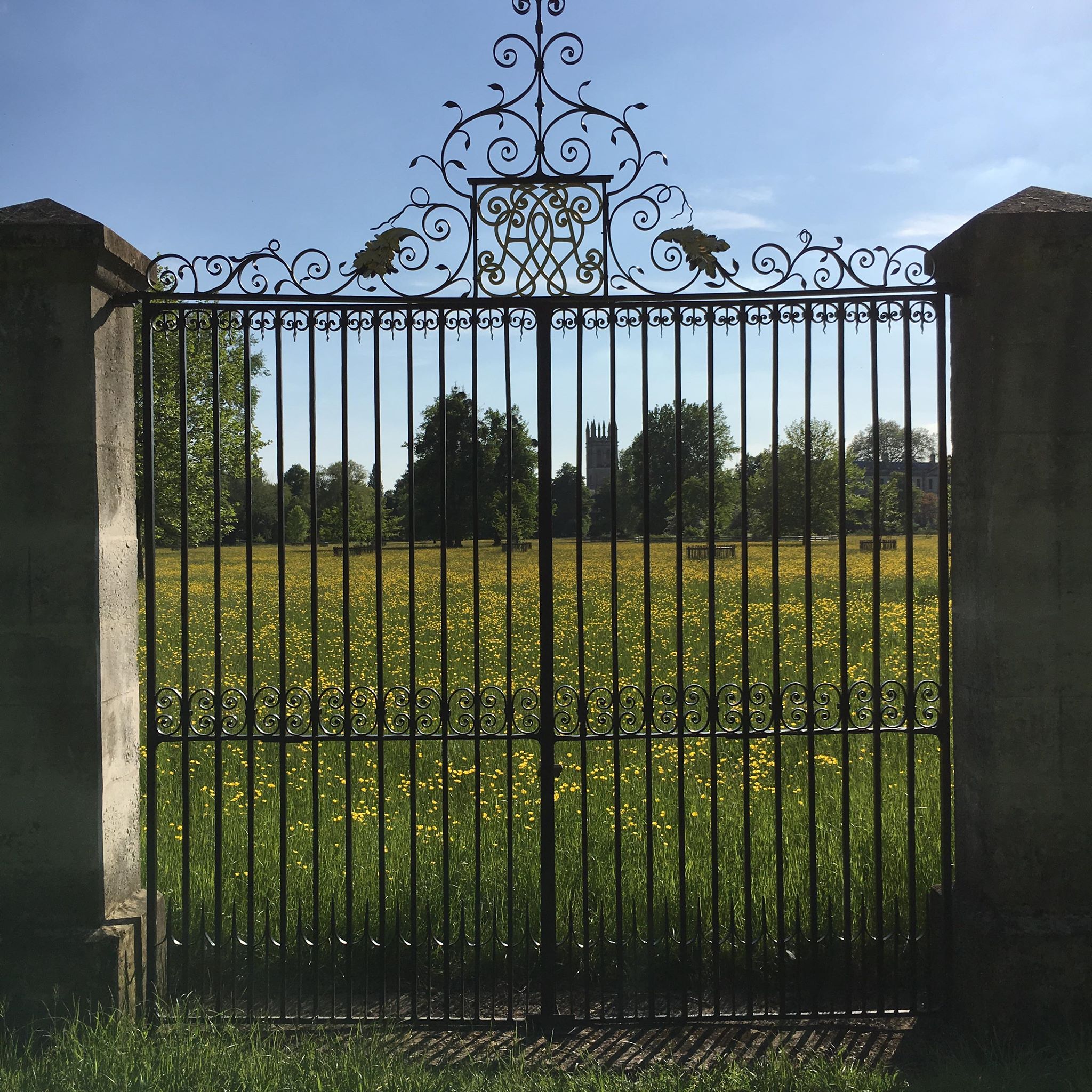
Gate on Addison’s Walk, Magdalen College, Oxford. Photo by author.

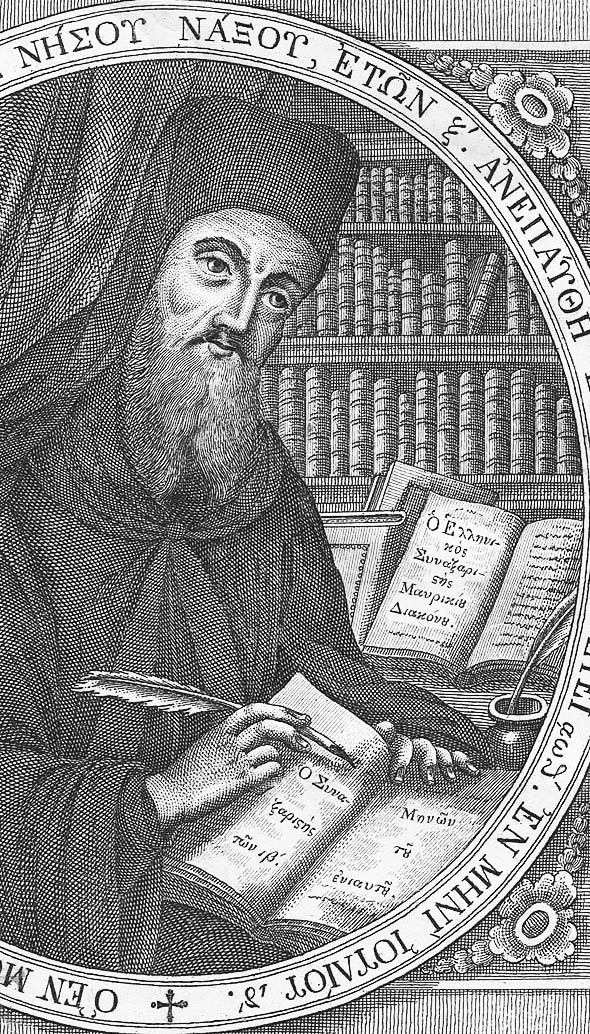
Now there are of course those who do not use the senses and the subsequent meditation on creation and Holy Scripture to rise through them to the knowledge and love of God, who both spoke the Scriptures and created the world. On the contrary, such people use this sense perception simply for human aggrandizement, for the marvel and mere pleasure of the corruptible beauty in creatures, and for other bodily purposes. Or, at least, they simply remain on the level of the limited purposes of the creatures and of the Scriptures. They thus neglect to proceed further, to rise to the catholic and comprehensive view of things, to God’s wisdom through which all things are known and in which all the reasons for each creature are to be found, according to St. Maximos. “The Lord by wisdom founded the earth…When he established the heavens, I was there” (Prv. 3:19, 27). St. Basil the Great too had something to say on this point: “There are indeed certain reasons why the primordial wisdom of God was laid as a foundation to nature at the time of creation.” Now, those who do not rise – through the reason endowed in nature and in the Holy Scriptures – to the hypostatic Logos of God, those who do not love Him “through whom all things were made” (Jn 1:3), as most of the worldly philosophers do not, all of these people act contrary to the Creator’s purpose in nature and in Holy Scripture. And according to the wise and most insightful Kallistos, the thought of such people has lost its natural tendency and has become unnatural. This has occurred because they use the means as ends in themselves, and the causes as results, and they love the gifts more than the Giver and the creatures more than the Creator, as St. Augustine has said. Since creation was not created for itself, but for the vision and glory of its Creator, it is not proper that it should be seen and admired for its own sake, but rather for the sake of its Creator. It is the same with the mirror which one does not look at for its own sake, but for the sake of the one reflected in it.

nicodemus-IN-2.jpg

St. Nicodemus of the Holy Mountain (Source)

We may add, finally, that the secondary goal and purpose for the creation of the senses is so that the material body may be able to enjoy through them material nourishment, growth, and life. Truly, I do not know what to marvel at most: the “palace” that is so intricately constructed or the “king” who dwells therein. But of these two, I must certainly marvel most at the master artist and the Creator who with infinite wisdom not only created both of them, but also united the mind and body in such perfect harmony.

Quoted from Chapter One of A Handbook of Spiritual Counsel by Nicodemos of the Holy Mountain, Trans. Peter A. Chamberas, Paulist Press, 1989, pages 73 and 74. 

“And the Light Shineth in Darkness; and the Darkness Comprehended It Not.”

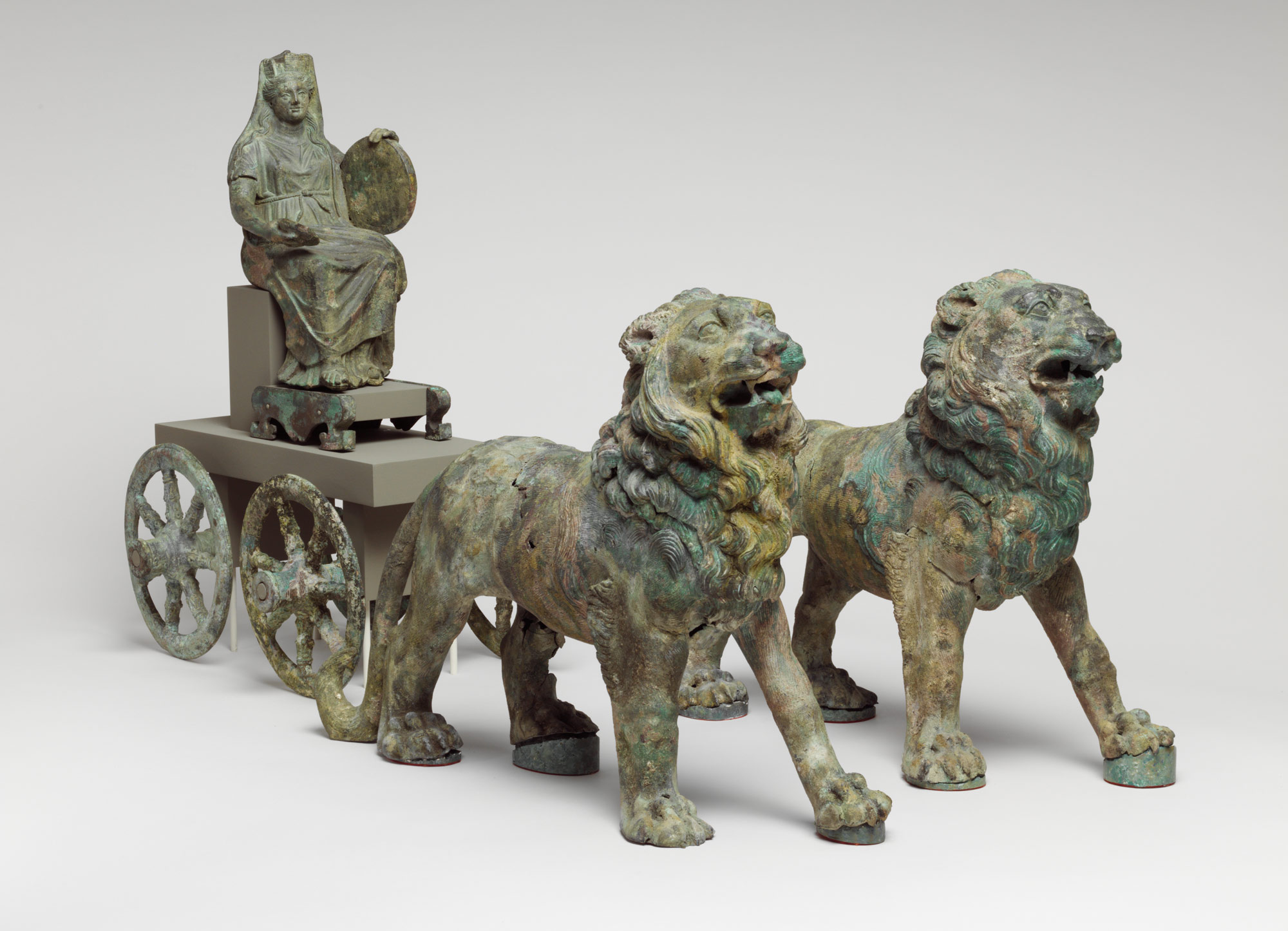
Cybele.jpg

Cybele, the Magna Mater, on her triumphal car pulled by two lions. Has there ever been a more perfect likeness to the Whore of Babylon? (Source)

March 24th is the traditional Dies Sanguinis of the ancient Roman calendar, when the painted eunuch-priests of Cybele and the votaries of Attis in their Phrygian caps would join with the servants of warlike Bellona in the most vile public atrocities. On that day, hideous pipes stirred the wicked throng into a fever of unutterable terror, and as the revelers danced in an ever more demoniac fashion, they mutilated their flesh and let out copious torrents of blood upon the stones of forum and temple. Then they drank from their own spilled blood, descending even lower than the beasts in their frenzy and taking on instead the aspect of lustful aegypans. The summit of these evil ecstasies came when, before the altar of the Magna Mater, devotees castrated themselves. Only thus could they enter the service of that infernal priesthood.

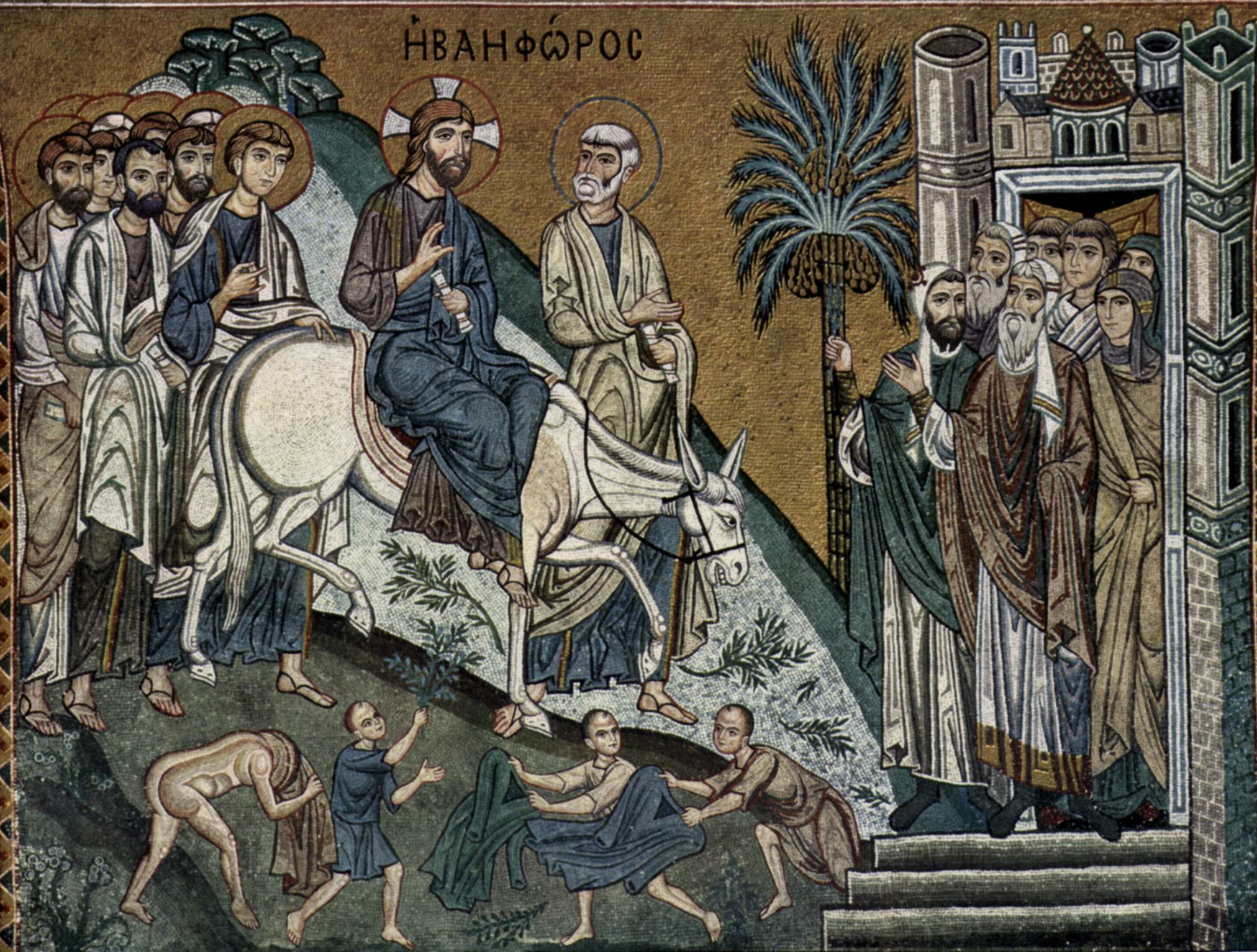
vhod-gospoden-v-ierusalim_palermo

The Triumphal Entrance of Christ, mosaic, Palermo. (Source)

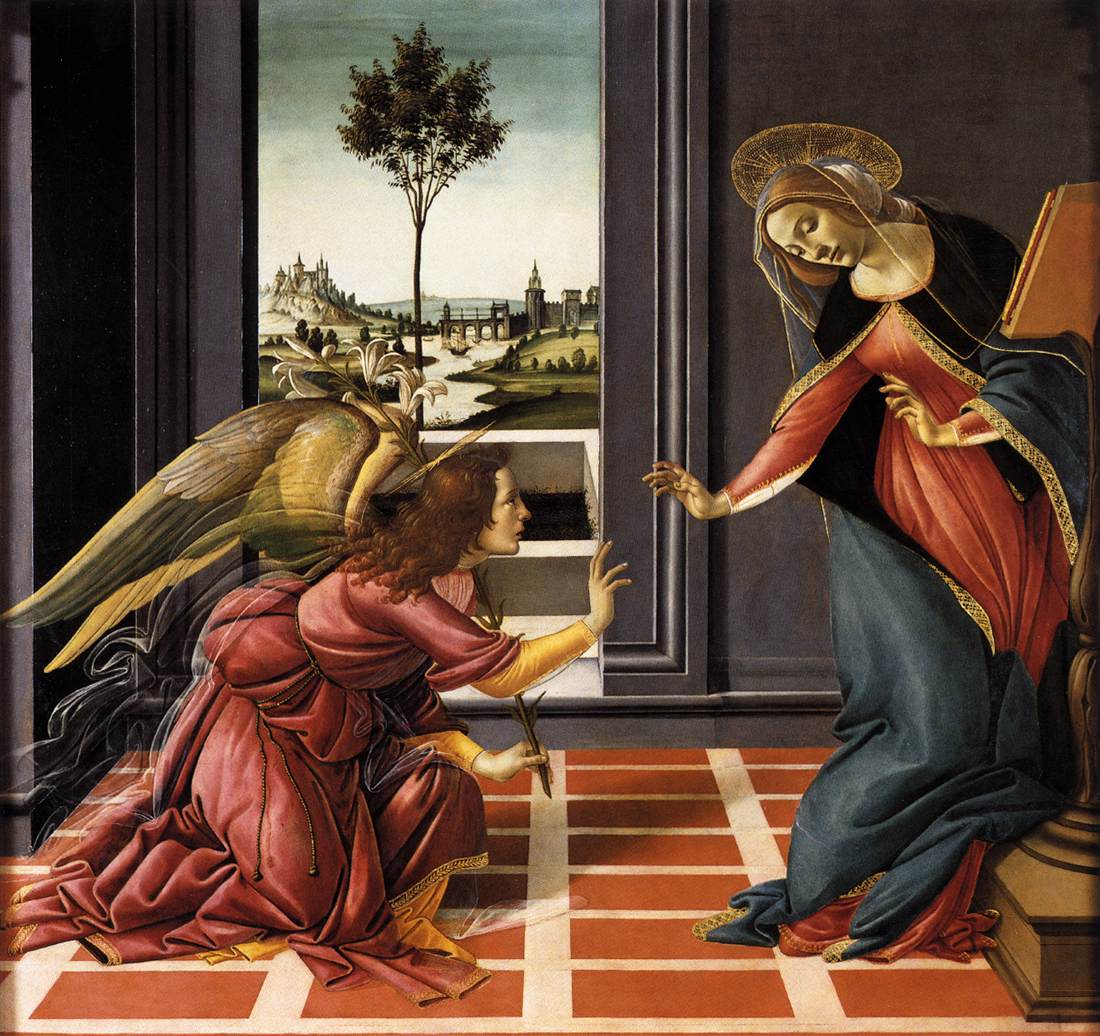
This was the culture that Christianity conquered. And it is with these satanic rites in mind that we look forward to a double feast of rather a different sort tomorrow. For tomorrow, on the 25th of March, we celebrate Palm Sunday and the Annunciation, falling providentially on the same day.

“And the light shineth in darkness; and the darkness comprehended it not.”

Botticelli,_annunciazione_di_cestello_02

The Cestello Annunciation, Botticelli, 1489-90. My favorite of all Annunciations. (Source).


Terrible as An Army Set in Array

GuadalupeHead

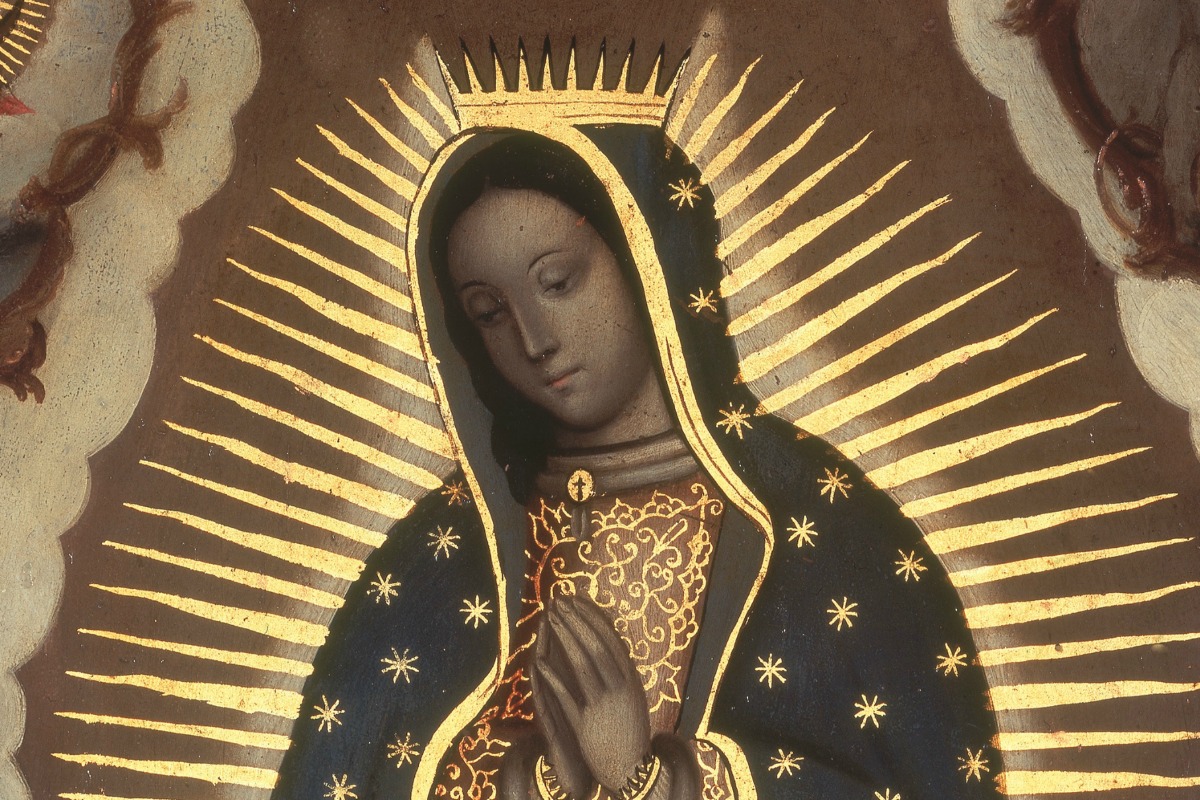
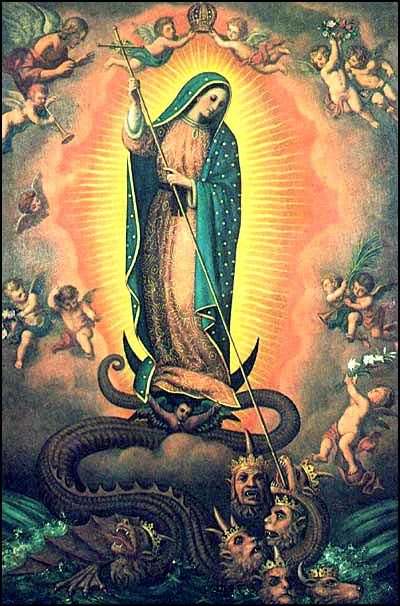
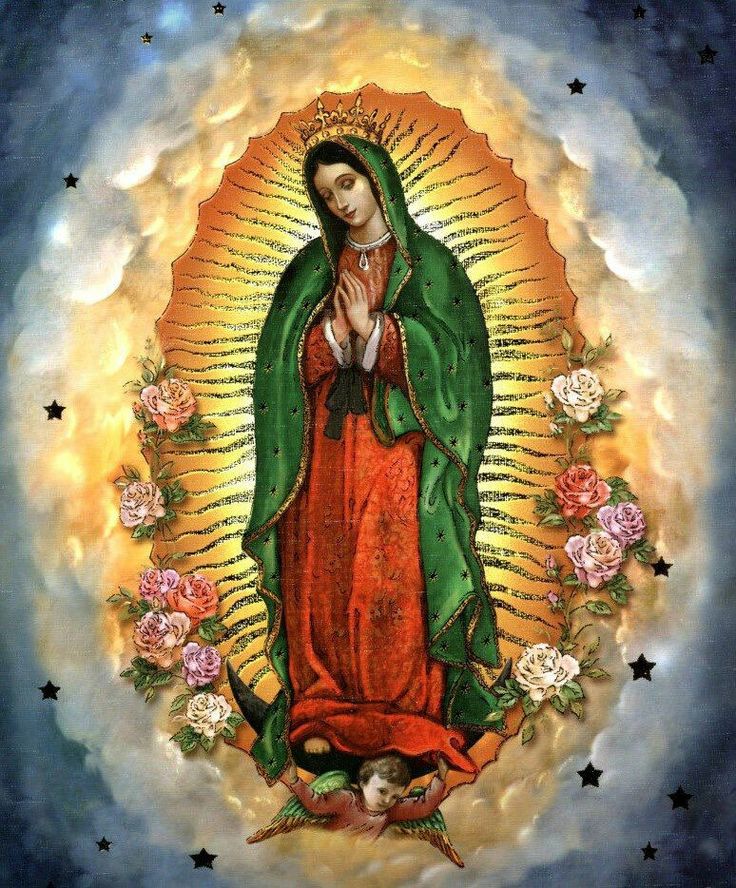
Our Lady of Guadalupe, pray for us. (Source)

“Your deed of hope will never be forgotten by those who tell of the might of God. You are the highest honor of our race.”

Thus does the whole Church sing at Mass today, on the Feast of Our Lady of Guadalupe. And no mean words are they! The Psalm is drawn from the Book of Judith – a frequent verse for feasts of Our Lady – and it lands on our ears like a shout of proleptic joy in this season of preparation and penance. The liturgy draws two special comparisons between Mary and the women of the Old Testament: Mary as the new Eve, and Mary as the second Judith. Today’s feast draws its special energy, its exegetical verve, from the mystical connection between Mary and Judith.

trinityguadalupe

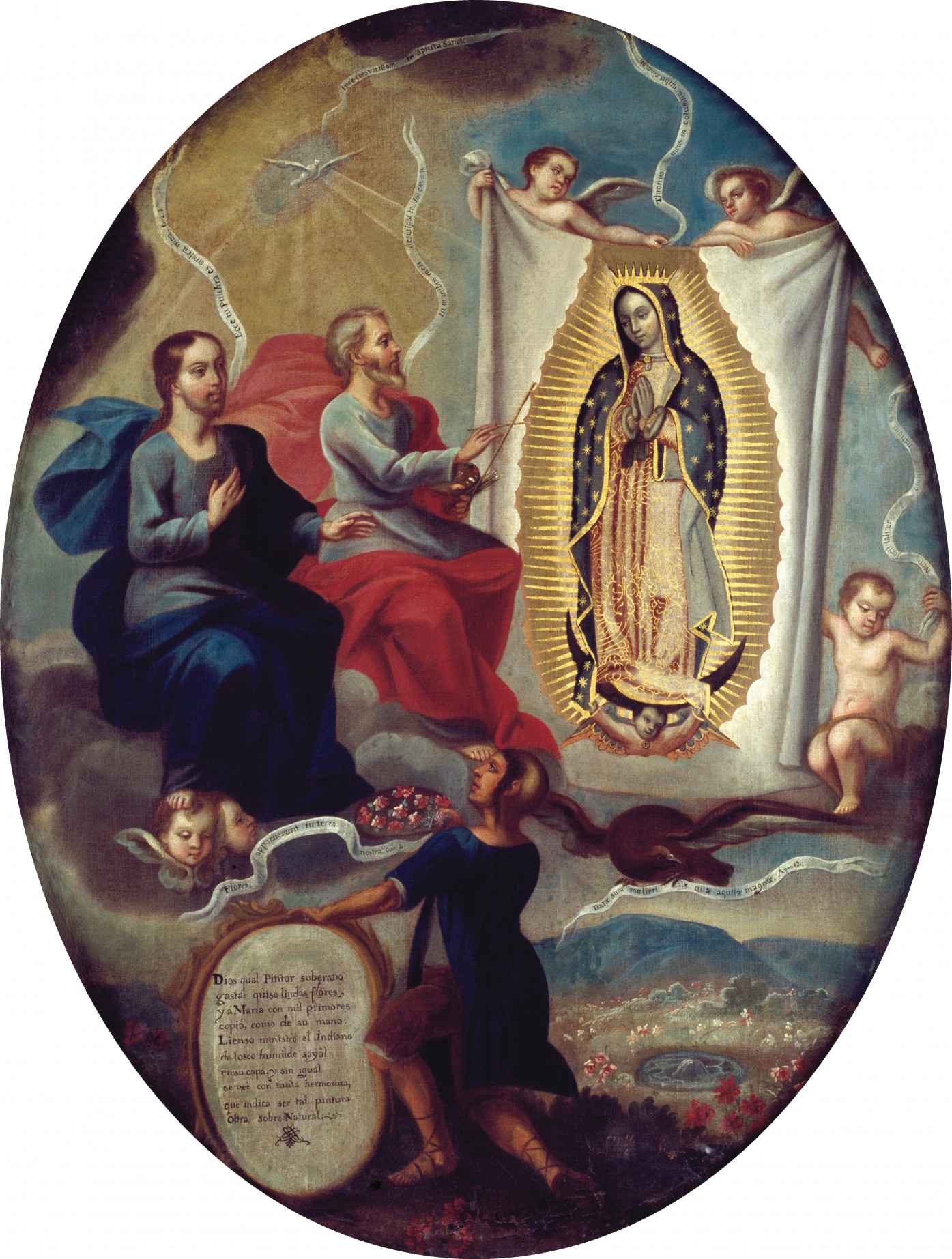
Our Lady of Guadalupe painted by the Trinity. An image worth meditating on. (Source)

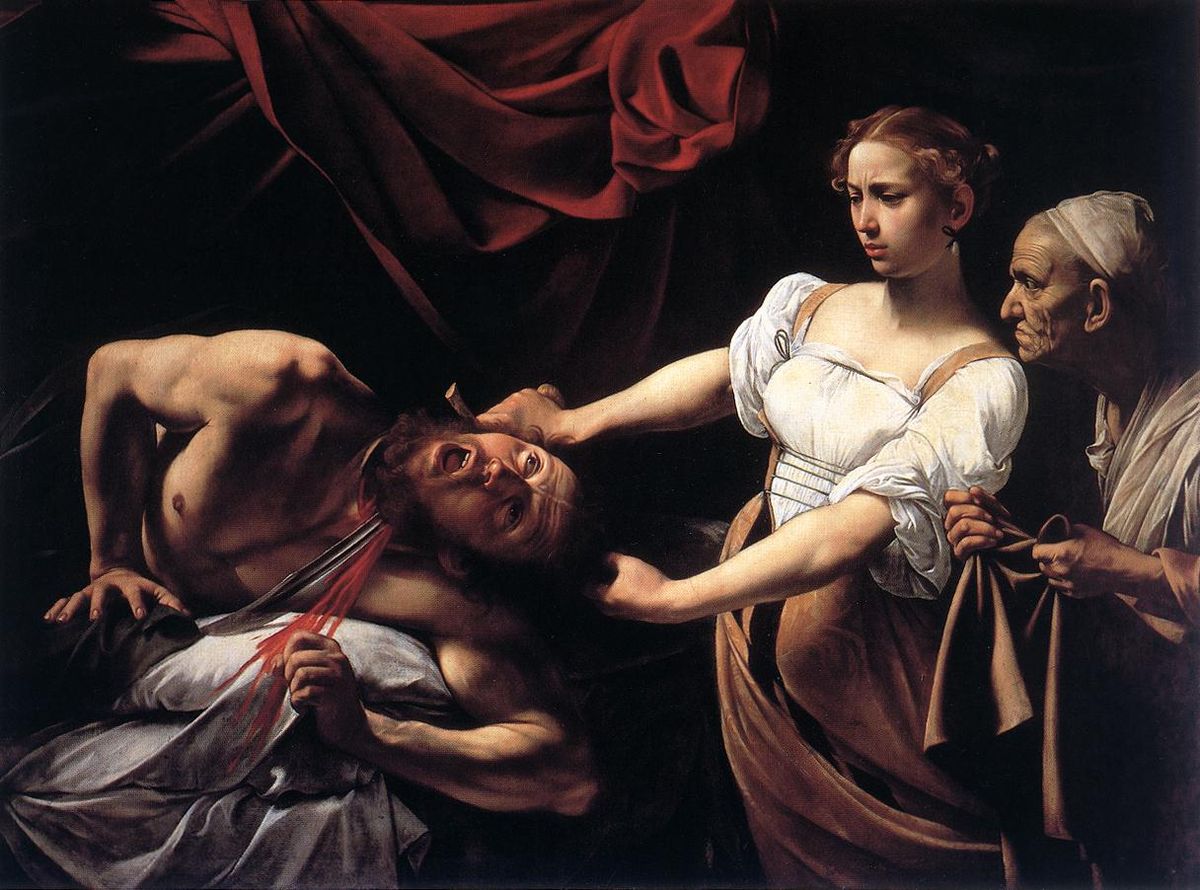
The particular verse that the Church applies to Mary comes from Uzziah’s praise of Judith after she has already beheaded Holofernes the Assyrian. Let us turn briefly to the immediately preceding passage.

Then she took the head out of the bag, showed it to them, and said: “Here is the head of Holofernes, the ranking general of the Assyrian forces, and here is the canopy under which he lay in his drunkenness. The Lord struck him down by the hand of a female! Yet I swear by the Lord, who has protected me in the way I have walked, that it was my face that seduced Holofernes to his ruin, and that he did not defile me with sin or shame.” All the people were greatly astonished. They bowed down and worshiped God, saying with one accord, “Blessed are you, our God, who today have humiliated the enemies of your people.” (Judith 13:15-17).

Then come our Psalm verses.

JudithBeheading

Judith Beheading Holofernes, Caravaggio, c. 1602. (Source)

Why would the Church draw our attention to this violent episode on a feast of Our Lady falling so soon after the Immaculate Conception? Haven’t we just contemplated her Sophianic existence? Haven’t we just basked in the light of the Holy Spirit resting upon her Immaculate Heart? Why must we leave those pleasant snow-caps of the spirit? Why turn instead to this grisly tale of murderous deliverance?

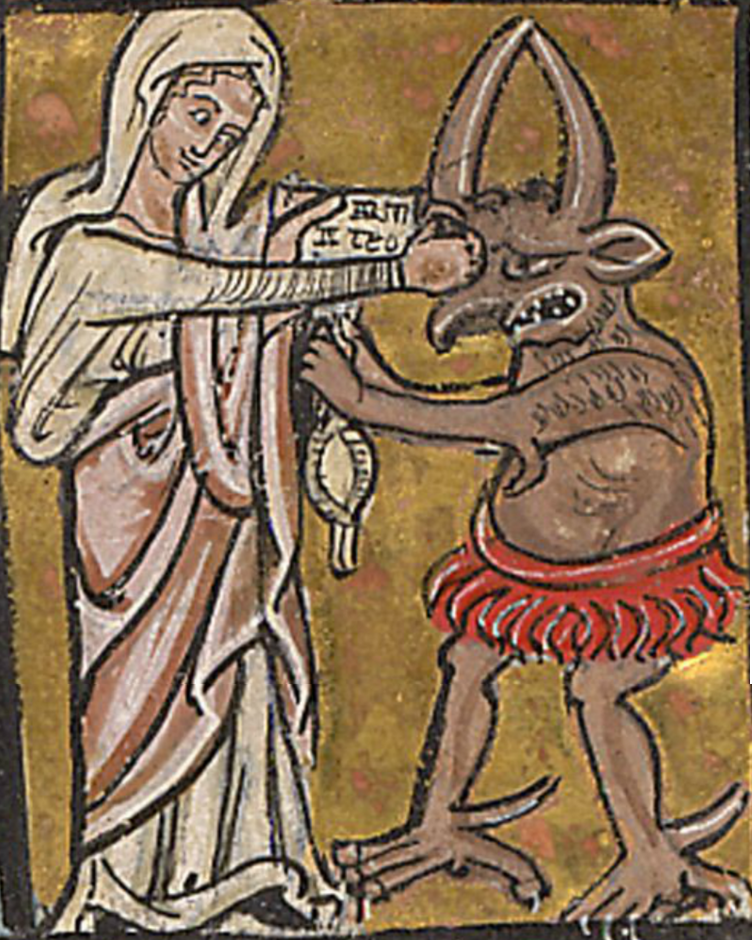
We must recall that, although Mary is all sweetness and concord to those who love her Son, she is the terror of demons. Her litanies and devotions include many titles that evoke the clamor of warfare: “Tower of David,” “Tower of Ivory,” even “Gate of Heaven.” She crushes the head of the Serpent. The sword that pierces her heart becomes, by the union of her suffering with that of her Son, a fearful weapon in her mighty hands.

MaryPunchingDevil

“Hail Mary, full of grace, punch the devil in the face.” (Source)

The story of Guadalupe is just one example of Our Lady exercising this power. Her appearance on Tepeyac, and the miracle wrought on the tilma of St. Juan Diego, was the beginning of the end of Aztec paganism. The demons that held that great people in thrall to the murderous rites of human sacrifice were totally vanquished. Like Judith, Mary rode out from Heaven into the  very camp of the enemy. Like Judith, she conquered. Like Judith, she proclaimed her victory with a visible sign – only, Our Lady’s sign was far more glorious. Judith held up the head of the vanquished foe, the bloody remains of a wicked oppressor. The Mother of God gave us her own image, miraculously imprinted into the convert’s cloak.

Judith delivered the Jews from the army of the Assyrians. Mary came forth to Tepeyac to convert the Mexican people, lifting from them the demonic yoke of a bloodthirsty paganism. What a glorious victory she won! Nine million Aztecs converted within the first ten years of the apparitions. Even today, she continues to spur us to conquer those terrible forces of injustice that oppress so many of God’s people. The collect prayer for today’s feast reads:

O God, Father of mercies, who placed your people under the singular protection of your Son’s most holy Mother, grant that all who invoke the Blessed Virgin of Guadalupe, may seek with ever more lively faith the progress of peoples in the ways of justice and of peace. (Source; emphasis mine)

These days it is rather in vogue to lament a certain kind of triumphalism that is built on self-centered pride. But too often we forget that there is another triumphalism, the shout of a people who have seen their salvation coming from the Lord:

Blessed are you, daughter, by the Most High God,
above all the women on earth;
and blessed be the LORD God,
the creator of heaven and earth
(Judith 13:18).

The Church herself enjoins us to celebrate the works and ways of God through His chosen instruments. And in today’s Mass, we are called to join that praise to the sacrifice of Christ in the Eucharist.

GuadalupeHeresy

Our Lady of Guadalupe, Victrix over All Heresies and Demons. (Source)

In considering Our Lady of Guadalupe and the zeal with which she overcame the forces of evil and in contemplating the beauty of her miraculous portrait, a verse of Scripture comes to mind.

“Who is she that cometh forth as the morning rising, fair as the moon, bright as the sun, terrible as an army set in array?” (Cant. 6:10 DRA)

We who have seen the tilma through the eyes of faith know the answer.

GuadalupeRoses

Our Lady of Guadalupe, Mystical Rose. (Source)

On the Coronation of the Coredemptrix

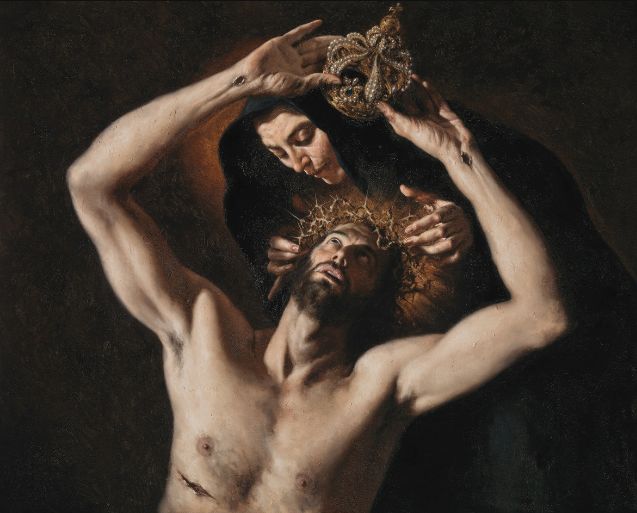
Corredenzione2

Corredenzione, by Giovanni Gasparro. This painting convinced my heart of the doctrine of the Co-Redemption of Mary. (Source).

It is appropriate on this Feast of Our Lady’s Coronation and Everlasting Queenship that we contemplate the fleeting thrones of this lesser world. Let us commemorate the loss of two great English dynasties, fixed on this day by Providence.

On Aug. 22, 1485, His Majesty King Richard III was defeated on Bosworth Field by a usurper from the House of the Tudors. The Red Dragon of Wales eclipsed the White Rose of York; years later, T.S. Eliot would wear the flower every 22nd of August.

RIII-Banner-RIIIF

The Personal Standard of Richard III. (Source).

On Aug. 22, 1642, His Majesty King Charles I raised the Royal Standard at Nottingham. This act has widely been considered the formal start of the English Civil War that would end in Puritan dictatorship, the slaughter of the Irish and Scots, and the martyrdom of the King himself for the doctrine of Episcopacy.

RoyalStandardStuarts.jpg

The Royal Standard of the Stuarts, 1603-1649. (Source).

Consider the leaden weight of these crowns. Worn by men alternately noble and feeble, loyal and inconstant, heroic and fearful, they rot away with the passage of time. The gilt of their craft and the earthly acclaim of their subjects have gone the way of all flesh. Those crowns are memories, but even in memory they do not earn the glory and affection they once inspired. Their reputations are occulted with cumbersome connotations. Richard has been much maligned ever since his death, in part by no less a personage than Shakespeare himself. Charles, a more complicated figure, has been swallowed up by his role as the symbolic center of Tory anxieties and Whig acrimony for the better part of four centuries. More bitterly, both kings “Accept the constitution of silence/And are folded in a single party.” They have become an unimportant datum of historical trivia for most people, even in England.

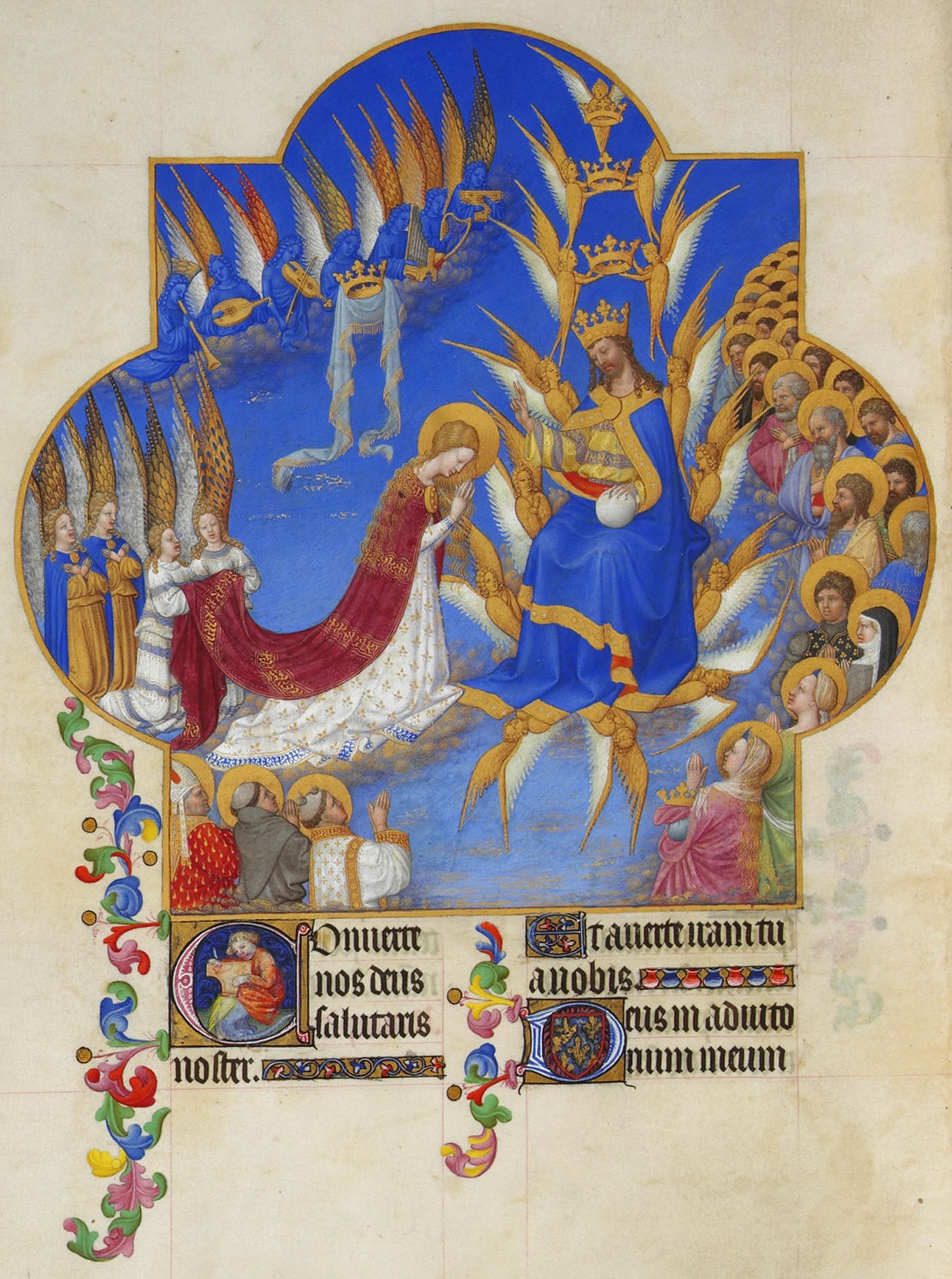
the-coronation-of-the-virginLimbourg.jpg

The Coronation of the Virgin, by the Limbourg Brothers. (Source)

How unlike those crowns is that won by Mary! She who was immaculately conceived and preserved from every stain of sin never sullies her crown by any failure of virtue. Having borne the Son of God in her womb, no other glory could ever outstrip what she has already known in her perpetually virginal maternity. Assumed into heaven, she is preserved from the terrible corruption of the grave. And now, as the Church celebrates the Octave Day of the Assumption, we contemplate the eternal joy which her coronation engenders in all the ranks of the blessed. All generations have called her blessed, and all will forevermore. She will never be reduced in the eyes of the world, because no one is more perfect in the eyes of God.

Has there ever been so marvelous a creature as Mary? Can we name, in the orderly chaos of the creation, a being more closely united to the Trinity? Who else among mere mortals has been lauded as “More honorable than the Cherubim, and more glorious beyond compare than the Seraphim?” In her burns the fire of charity; in her grows the ground of humility; in her flows the water of purity; in her soars the mighty wind of patience. She is the New and Sophianic Eve, in which the Wisdom of God is most clearly manifest.

And why? Because she is the threefold Mother of the Redeemer. First, by her Fiat, she assents to a physical maternity of the Word Incarnate. Second, by the sorrows of her Immaculate Heart at the Cross, she wins a sacramental maternity of Christ in the Eucharist. And third, by her prayer in the Cenacle on Pentecost, she gains a mystical maternity of Christ in the whole Church. This threefold motherhood is but one theandric maternityand thus we see the Trinitarian character of Our Lady’s co-redemption. She and she alone of all mankind is so favored and so bound to the work of Christ.

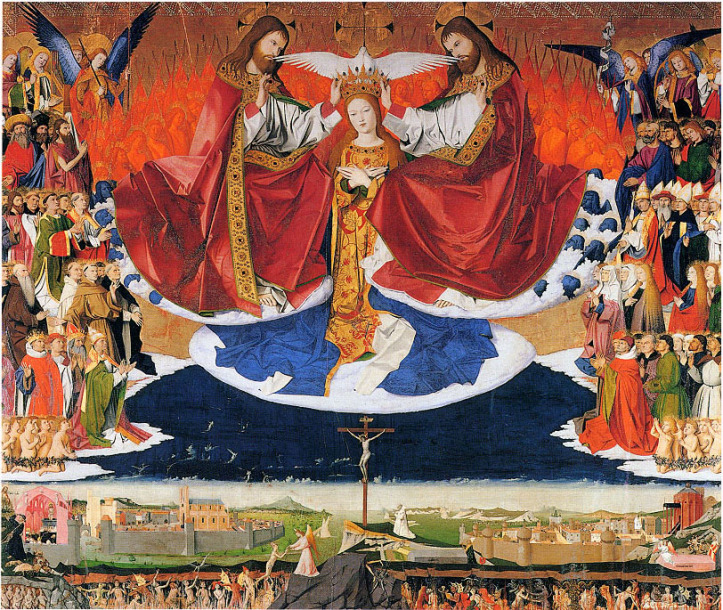
art-and-liturgy-enguerrand-quarton-coronation-of-the-virgin-1454

Coronation of the Virgin, Enguerrand Quarton. 1454. (Source). Mary crowned by the Trinity is surely an icon of the Eschaton.

A friend of mine passed on this passage from St. Amadeus of Lausanne, a Cistercian most famous for his eight homilies in praise of the Mother of God. He took it from Universalis, which gives the full liturgy of the hours online. Thus, the Church particularly commends these words to us on this holy day:

Observe how fitting it was that even before her assumption the name of Mary shone forth wondrously throughout the world. Her fame spread everywhere even before she was raised above the heavens in her magnificence. Because of the honour due her Son, it was indeed fitting for the Virgin Mother to have first ruled upon earth and then be raised up to heaven in glory. It was fitting that her fame be spread in this world below, so that she might enter the heights of heaven on overwhelming blessedness. Just as she was borne from virtue to virtue by the Spirit of the Lord, she was transported from earthly renown to heavenly brightness.

So it was that she began to taste the fruits of her future reign while still in the flesh. At one moment she withdrew to God in ecstasy; at the next she would bend down to her neighbours with indescribable love. In heaven angels served her, while here on earth she was venerated by the service of men. Gabriel and the angels waited upon her in heaven. The virgin John, rejoicing that the Virgin Mother was entrusted to him at the cross, cared for her with the other apostles here below. The angels rejoiced to see their queen; the apostles rejoiced to see their lady, and both obeyed her with loving devotion.

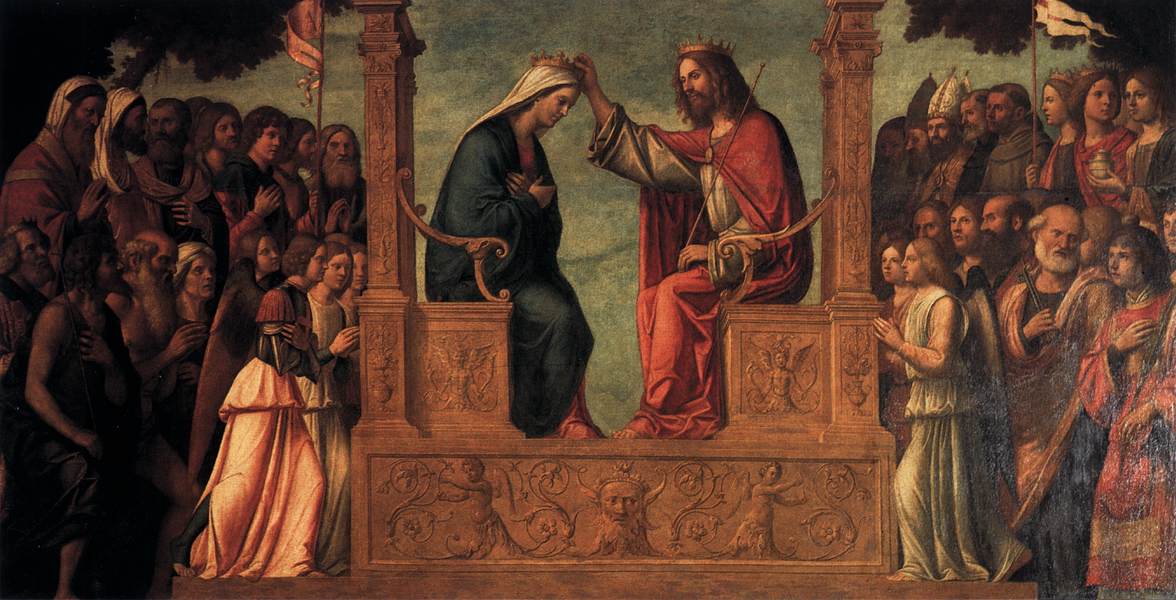
the-coronation-of-the-virginCimaThe Coronation of the Virgin, Cima da Conegliano. (Source).

Dwelling in the loftiest citadel of virtue, like a sea of divine grace or an unfathomable source of love that has everywhere overflowed its banks, she poured forth her bountiful waters on trusting and thirsting souls. Able to preserve both flesh and spirit from death she bestowed health-giving salve on bodies and souls. Has anyone ever come away from her troubled or saddened or ignorant of the heavenly mysteries? Who has not returned to everyday life gladdened and joyful because his request had been granted by the Mother of God?

She is a bride, so gentle and affectionate, and the mother of the only true bridegroom. In her abundant goodness she has channelled the spring of reason’s garden, the well of living and life-giving waters that pour forth in a rushing stream from divine Lebanon and flow down from Mount Zion until they surround the shores of every far-flung nation. With divine assistance she has redirected these waters and made them into streams of peace and pools of grace. Therefore, when the Virgin of virgins was led forth by God and her Son, the King of kings, amid the company of exulting angels and rejoicing archangels, with the heavens ringing with praise, the prophecy of the psalmist was fulfilled, in which he said to the Lord: At your right hand stands the queen, clothed in gold of Ophir.

WomanClothedWiththeSun

An illustration of “The Woman Clothed With the Sun.” (Source)

St. Amadeus is right; “Has anyone ever come away from her troubled or saddened or ignorant of the heavenly mysteries? Who has not returned to everyday life gladdened and joyful because his request had been granted by the Mother of God?” We who still struggle with sin on the path to beatitude cannot hope to achieve our goal if we will not be with and like Mary. We, too, are promised crowns. The scriptures mention five: the imperishable crown (1 Cor. 5:24-25), the crown of rejoicing (1 Thess. 2:19), the crown of righteousness (2 Tim. 4:8), the crown of glory (1 Pet. 5:4), and the crown of life (Rev. 2:10). Our Lady wears all these and seven more, for she is the “woman clothed with the sun, and the moon under her feet, and upon her head a crown of twelve stars” (Rev. 12:1 KJV). Are these other seven stars the seven gifts of the Holy Spirit, her spouse? Or the seven cardinal virtues? Or the seven sacraments that constitute the Church? Or the seven lesser ranks of the angels in praise of their queen? Impossible to say. Mary is not only the fountain of all holiness, but the mother of the Church’s deepest mysteries.

How might I end this praise of Our Lady that could properly continue ad infinitum? By returning to those lesser crowns with which I began.

Earthly splendor is no great thing. It can only be built on sufferingeither our own or that of others. Even when turned to good (as, I would argue, Charles I attempted to use his power), it reflects something of our fallen state. It is slippery, contingent, and as mortal as we are. But the glory of heaven is without end. Incorrupt and incorruptible, it abides in the gaze of the Father. Mary, above all creation, receives this kind of glory. She, the New Eve to the New Adam, mirrors Him in all things. Let us run after the course she trod before us, the course of Her Son’s redemption! Only by pursuing a life like Christ’s can we hope for a reward like Mary’s.

May she pray for us as we celebrate her feast today.

coronation-of-the-virgin-fra-angelico-big.jpg

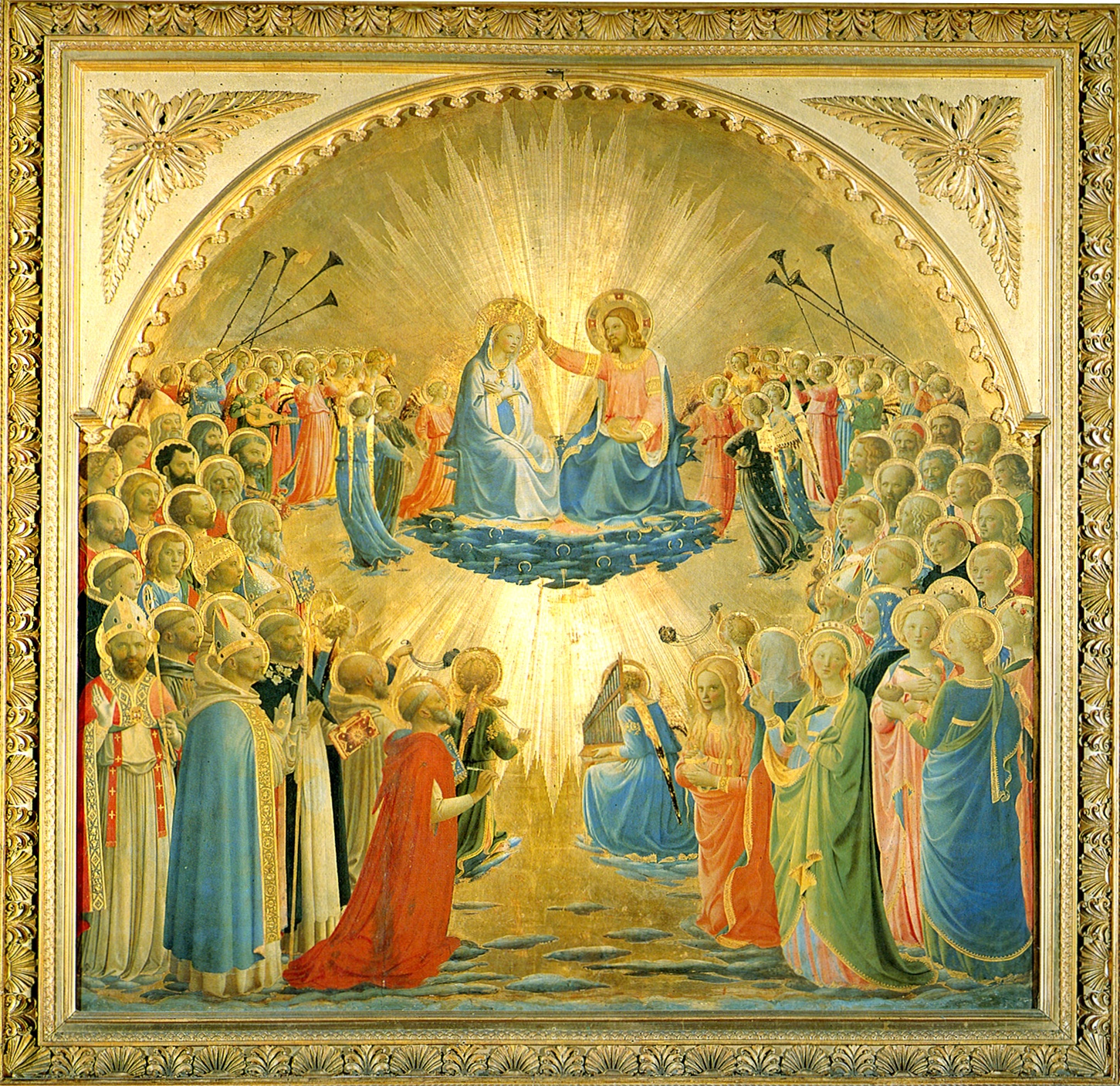
“Coronation of the Virgin,” Fra Angelico. (Source). The Blessed Angelico returned to this subject throughout his career, but this version, hanging in the Uffizi Gallery, is my favorite.