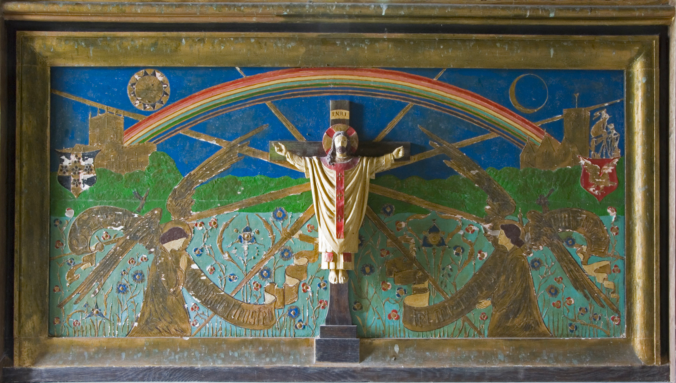
Another View of the Sacraments in the Eighteenth Century

A while back I produced a short post entitled “A View of the Sacraments in the Age of Enlightenment.” Here I give you another series of similar images, this time from the hand of Giuseppe Maria Crespi, also known as “Lo Spagnuolo.” These paintings from 1712, so reminiscent of Rembrandt, hang in the Gemäldegalerie, Dresden. Originally commissioned by Cardinal Pietro Ottoboni, that towering figure of late Baroque culture, they passed posthumously up to Germany, where they made their way into collection of the Elector of Saxony.

Let me begin by saying that, as with the information in the above paragraph, all of the images can be found at Wikipedia.
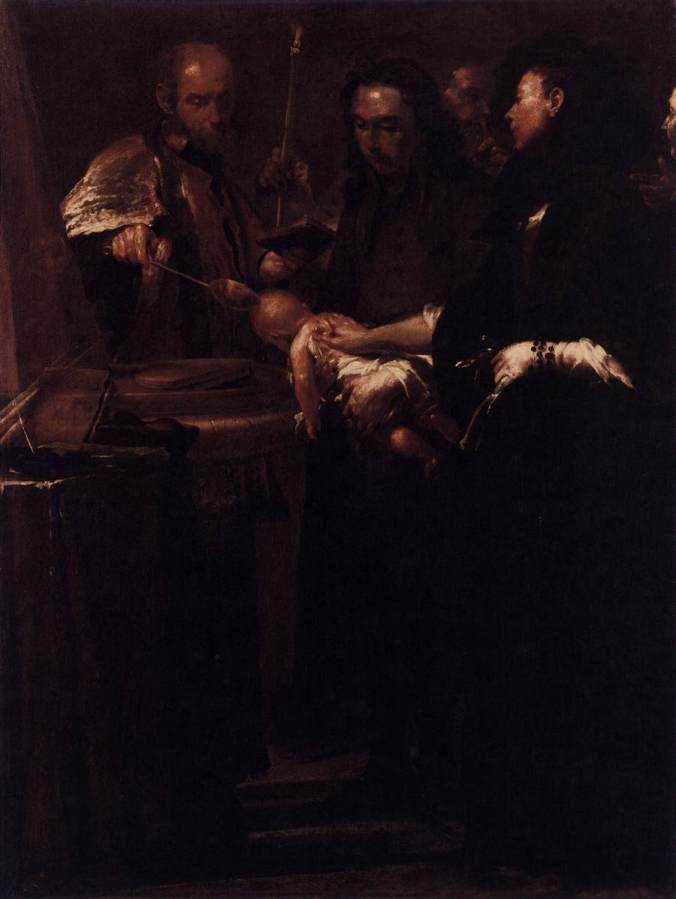
Giuseppe_Maria_Crespi_-_Baptism_-_WGA05763

“Baptism.” Crespi’s sparing use of light demonstrates the central conjunction of the scene. Allowing our eyes to wander along the central line of illumination, we follow the arm of the priest pouring water on the head of the outstretched infant to the mother’s rosary-wrapped wrist just beyond. I am convinced that the use of light in all of these images is the key to their meaning. Crespi uses light to illustrate the work of sacramental grace, and darkness to emphasize the mortality, evanescence, and weariness of our ordinary world. “The people in darkness have seen a great light” – thus spake Isaiah.
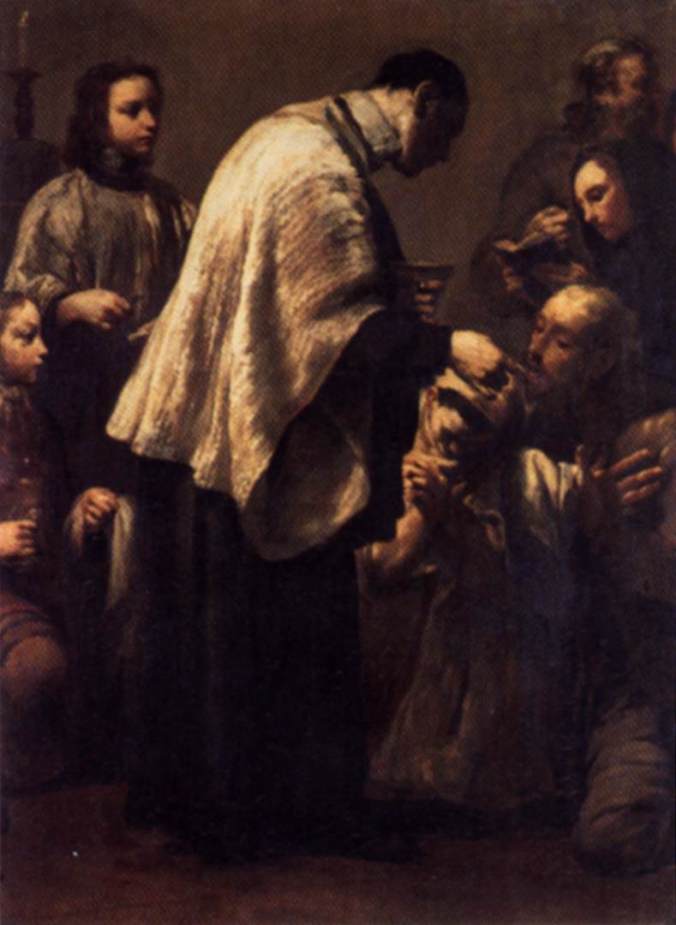
Giuseppe_Maria_Crespi_-_Communion_-_WGA05766

“Communion.” The priest’s face is shrouded in darkness, and rightly so. It is not he who offers the bread of life, but Christ in him. Interesting collar, too. Sure looks familiar. Cardinal Ottoboni was patron of the Congregation of the Oratory at Rome for some time, and it’s entirely possible that Crespi would have taken the Oratorians as his model here. Besides that, the setting of the scene is strikingly barren. Crespi’s choice to leave out the probable altar rail lends the scene an intimacy that captures the very heart of the worship here portrayed.

Giuseppe_Maria_Crespi_-_Confirmation_-_WGA05765

“Confirmation.” Crespi’s lightest and most colorful piece in the series. The vivid red-orange of the boy’s robes call to mind the tongues of flame that appeared on Pentecost, as does the (relatively) diffuse light bathing the scene. The brightest part of the image is the Bishop’s arm, only just anointing the boy’s head.  The strong predominance of vertical and diagonal lines in this piece only reinforce the sense of descent. Like all the paintings, the scene here is crowded without being cramped. Crespi seems to have penetrated to the deeply ecclesial nature of the sacraments. The sacraments are what give the Christian community its underlying spiritual cohesion and form. To quote De Lubac, “The Eucharist makes the Church.”
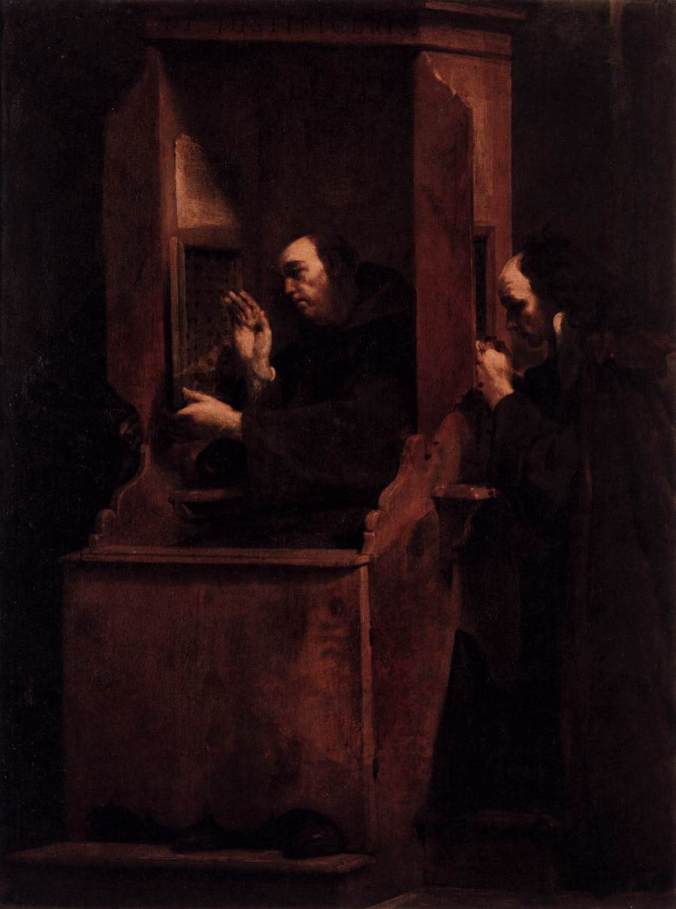
Giuseppe_Maria_Crespi_-_Confession_-_WGA05764

“Confession.” Quite in contrast to “Confirmation,” we come to Crespi’s darkest piece in the series. The overwhelming color is black. Confession is the sacrament that deals most straightforwardly with the reality of sin. The narrow contraction of the light – it comes only from one side, and very weakly. The formal likeness between confessor and penitent reminds us of the condition of sin common to all men. This painting is also the only one in the series where we don’t see a crowd. Only two figures are visible. In the end, we are always “alone with the Alone.”
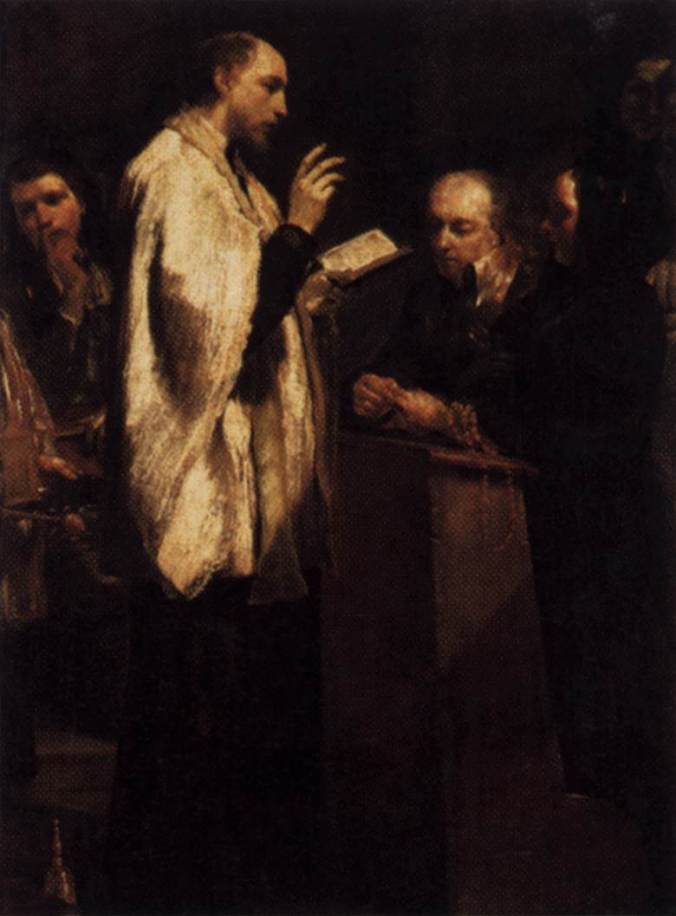
Giuseppe_Maria_Crespi_-_Matrimony_-_WGA05769

“Matrimony.” Perhaps the most human of Crespi’s scenes. But we find unusual notes, things I can’t quite interpret with satisfaction. For a painting of matrimony, we hardly see the couple. Indeed, the bride has almost been swallowed up by the shadows. Nigra sum sed formosa. Perhaps. The priest stands like a pillar of cloud before them, blessing their union. That seems straightforward enough. Yet why is the man on the left holding his hand to his mouth, as if to signal silence? Perhaps because the matter of this sacrament is always properly taken in secret…
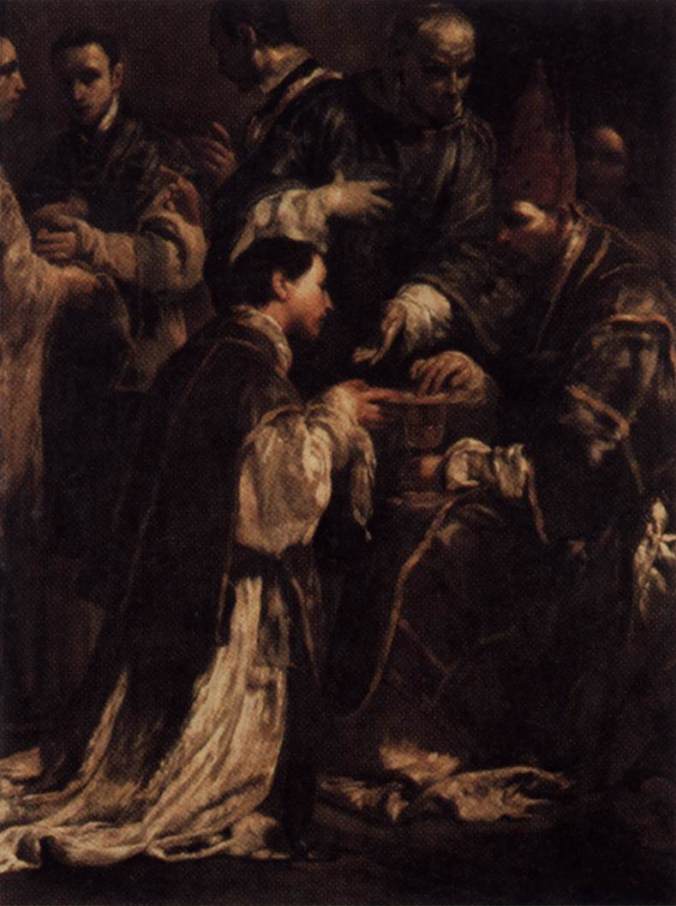
Giuseppe_Maria_Crespi_-_Ordination_-_WGA05768

“Ordination.” This composition is a swirling mix of blacks, browns, subtle golds, and occasionally, whites. The point that stands out most is the break in this overall scheme – the youthful, rosy visage of the ordinand, coupled with the slightly ruddy shadows that fall across his hand. What a contrast with the other figures, all of whom are shrouded in darkness and invested with a manifest pallor. Here is an image of youth, a prospect of renewal against a backdrop of dignified decay.
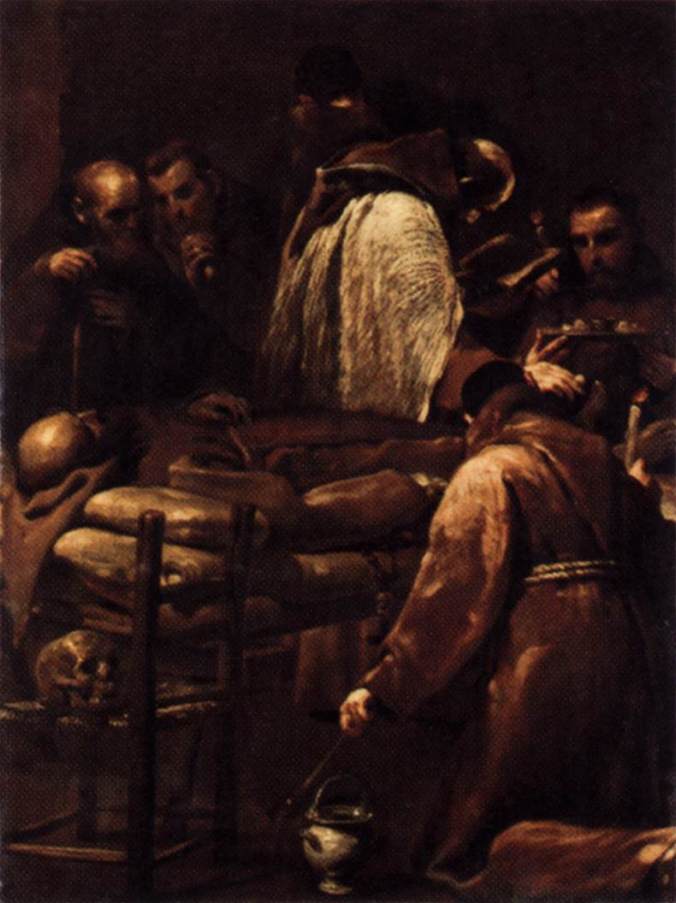
Giuseppe_Maria_Crespi_-_Extreme_Unction_-_WGA05767

“Extreme Unction.” At last we come to the end, the place of the skull. It is only fitting that Crespi should choose to depict a collection of Franciscans for this sacrament. Religious life is always a preparation for death. Yet the bright patch of light improbably illuminating the shoulder of the attendant friar contrasts starkly with the shadowy body of the dying father and points to new hope.

Spring According to Pre-Raphaelites

Spring is here, and the Pre-Raphaelites are going to tell you how to celebrate.

WalterCraneSpringIf you’re not just lying about languidly in a meadow, you’re not really doing it right, are you?
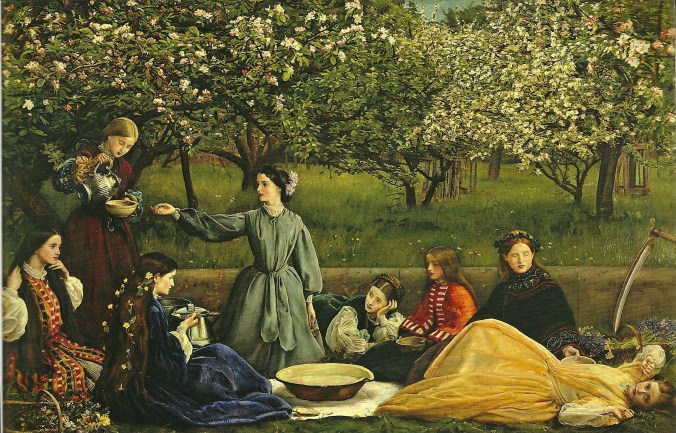
SpringAppleBlossoms.jpgIt is also acceptable to lie there with an audience, preferably one enjoying a lovely picnic. And everyone must be the same gender and should, if at all possible, be dressed in very uncomfortable clothing.

Spring_Buckland
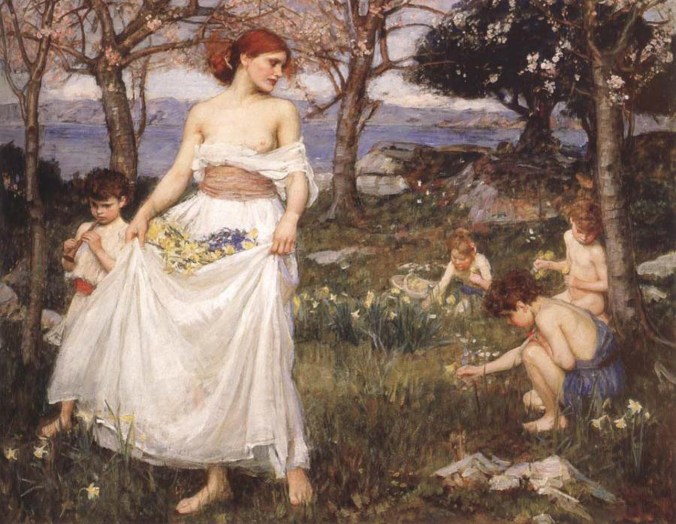
After you have wallowed in the flowers, be sure to pick some and stare vacantly into the middle distance.

john_william_waterhouse_10_a_song_of_springtime.jpg And of course, you should be arrayed in an artfully disheveled white dress. To get that shabby chic look, you know?
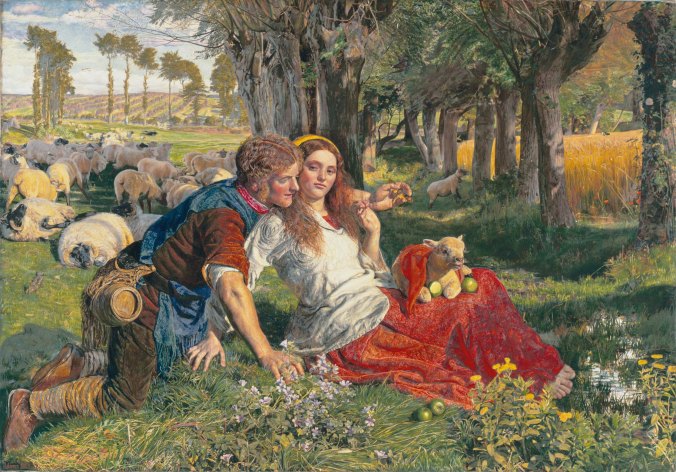
HirelingHolmanHunt.jpgHow you dishevel it is up to you.
InnerBeautyWaterhouse
Never let a gust of wind pass without posing.

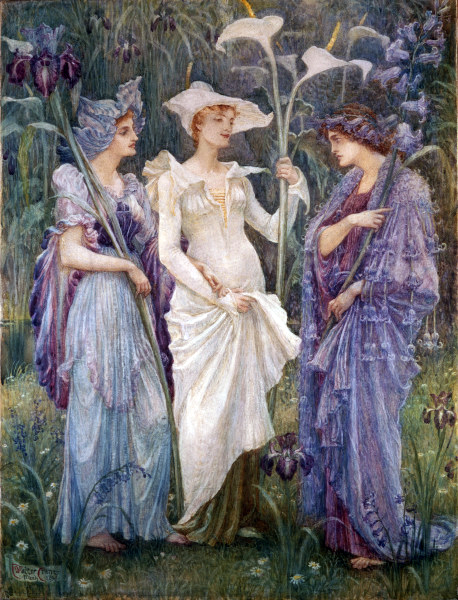
WalterCraneSignsofSpring
When it comes to flower-staffs, the bigger, the better.

the_fairy_wood
Only travel with an entourage of little people, so as better to accent your royal mien and bearing.

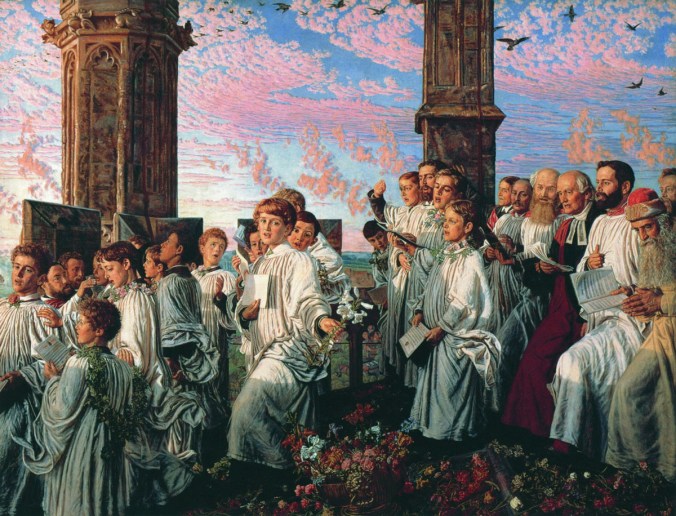
William_Holman_Hunt_-_May_Morning_on_Magdalen_Tower
Choir boys will also do.

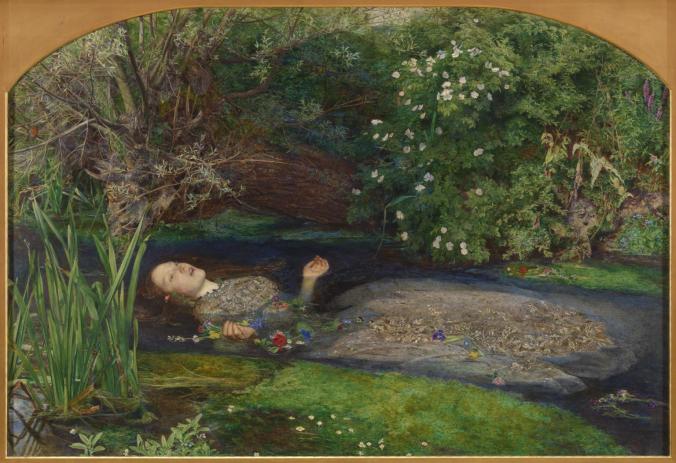
Ophelia 1851-2 by Sir John Everett Millais, Bt 1829-1896
Spring is a lovely time for a refreshing dip.

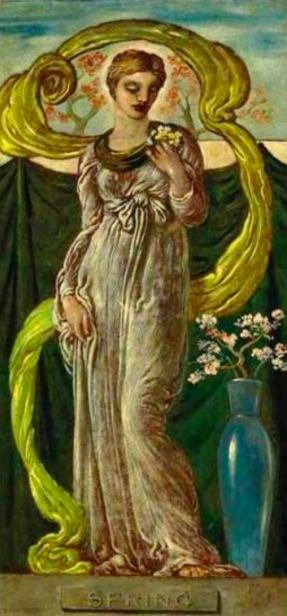
Screen Shot 2018-04-21 at 9.54.52 PM.png
You know you’re having a good Spring day when, so enraptured by the little blossoms you’re holding, you don’t even notice your long green scarf blowing away.

The_Awakening_of_Adonis_-_John_William_Waterhouse_(1899)
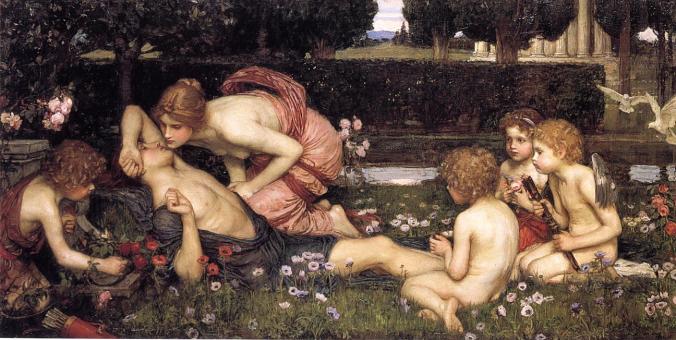
If you happen to find half-naked classical youths asleep in a garden, surrounded by putti and doves, and stuck in an extraordinarily improbable pose, don’t worry. This is normal in Spring.

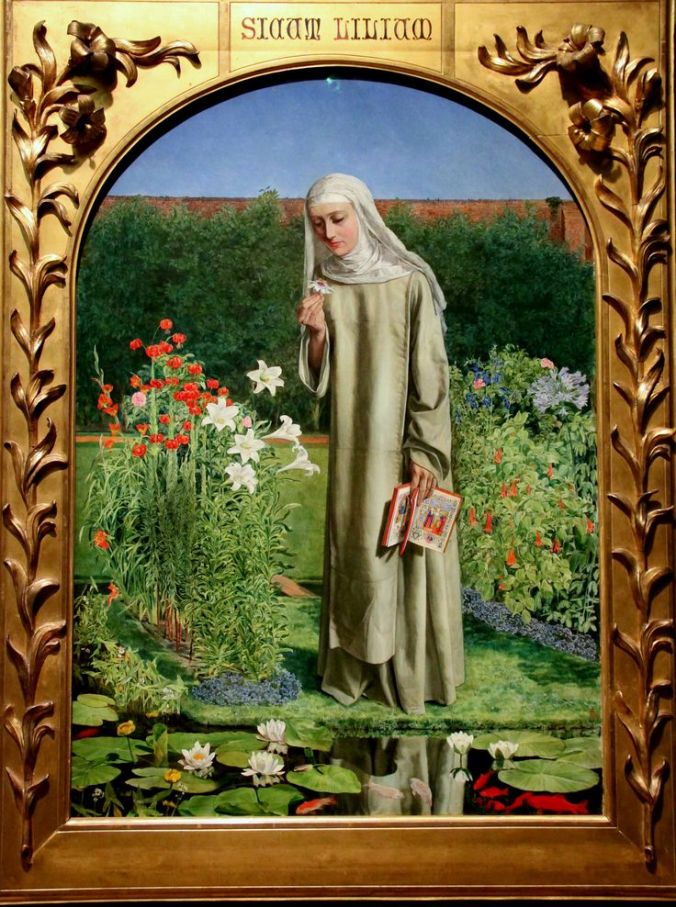
SicutLiliumPreRaph
Likewise, wild nuns emerge from hibernation and range freely again in the Spring.

Edward_Burne-Jones_-_The_Beguiling_of_Merlin.jpg
While it’s important to enjoy the season, it’s even more important not to get too caught up in it. This time of the year is when people are most at risk of being sealed into trees by nymphs.

The-Enchanted-Garden-of-Messer-Ansaldo-1-e1480773352693
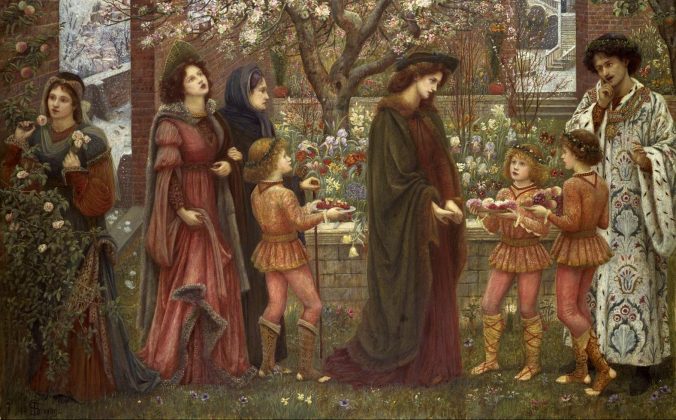
But surely the best thing about Spring is that it’s no longer Winter!

(Images from here, here, here, here, here, here, here, here, here, here, here, here, here, here, here)


Nostalgia Without Illusions

Ravilious-Wilmington-Giant

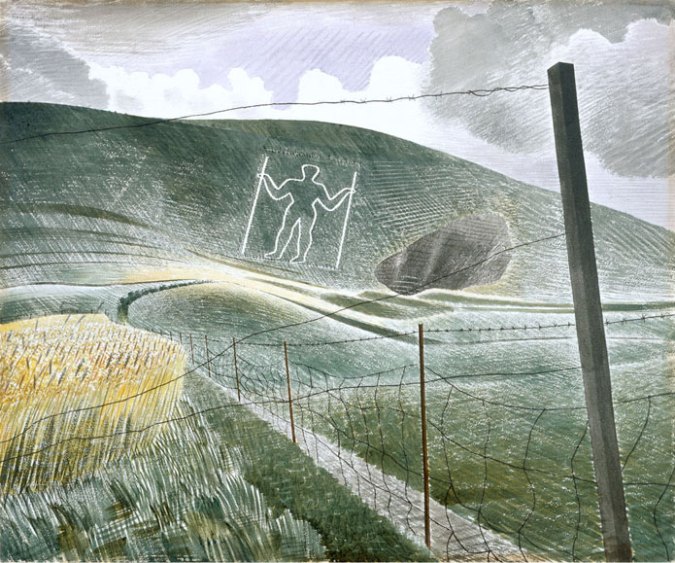
The Wilmington Giant, Eric Ravilious (Source)

Recently I read an article about a genre of music that had previously been unknown to me: Hauntology. In a nutshell, Hauntology is a throwback to the eerie, folksy world of British childhood in the 1970’s. The author summarizes the genre’s affective impact as “strange, melancholy disquiet.” Apparently music is being made today (and has been for some time) that conjures all at once that decade’s public broadcasting for children, the acoustic sounds of the English folk tradition, psychedelia, pagan chants, and synthesizers. Most of this material has been released through a few different labels: Ghost Box, Clay Pipe, and Trunk Records. Each specializes in a different variation of the general theme. On the whole, though, they all produce music that’s unsettling and evocative of a very particular place and time in the last century. There is something autumnal, something anachronistic, something broken in it all. In short, it’s music that’s haunted.

Many of the albums have cover art inspired by Eric Ravilious or John Nash or Sir Stanley Spencer or even Rex Whistler, those painters who so marvelously captured the quiet unease of the British landscape and its denizens. And the multimedia satirical phenomenon that is Scarfolk fits right into the broader movement. Hauntology is more than just a style of music. It’s an aesthetic.

In this respect, Hauntology is to the 1970’s what Vaporwave is to the late 1980’s and 90’s, or, for that matter, what David Lynch’s entire corpus is to the 1950’s.

vaporwavemall.jpg

Malls built in the early years of Bush I are the stuff of Vaporwave dreams. (Source)

Vaporwave derives its critical bite as well as its occasional airy ephemerality from a unifying sense of dread. Much the same could be said of Hauntology. Only instead of the zombie-like ascent of neoliberal late capitalism under the glittering haze of digital culture and advertising, Hauntology is still preoccupied with the anxieties of the analog age. Orwellian dystopia, the loss of the British countryside, and the destruction of innocence all hover under the surface. It’s drawing upon creepy public service announcements rather than Japanese soft drink commercials. Hauntology is to British Folk Horror as Vaporwave is to Cyberpunk.

BlueVelvet

A scene from Blue Velvet (1986), one of David Lynch’s most distinctive films. It set the tone for much of what was to follow in its powerful evocation and ultimately ruthless subversion of mid-century norms (Source).

The common denominator is nostalgia, but a nostalgia free of illusions. Each of these aesthetic representations of a remembered decade – Lynch’s 1950’s, Hauntology’s 1970’s, and Vaporwave’s Digital Age – contains a degree of attachment to that particular time. Usually because the main creators involved in producing the aesthetic grew up then, and thus they draw upon the dreamlike haze which alternately gilds and clouds our world in youth. But it’s all shot through with the very real understanding that the past was not as wonderful as we would like to believe. Something nasty lurks just beyond our peripheral vision. We cannot help remember, but in that remembrance, terror awaits.

I’m an American, and only in my early twenties. 1970’s Britain wasn’t a world I ever knew. Nevertheless, I immediately connected with the emotional phenomenon behind Hauntology. Certain relics of that earlier time appeared every now and then in childhood, and even those that weren’t directly from the United Kingdom of the 1970’s often bring to mind that same feeling of remembered unease. Many of Don Bluth’s films animate precisely this strange, sensitive part of my memory. So do Stephen Gammell’s original illustrations of the Scary Stories to Tell in the Dark books. So does The October Country, Ray Bradbury’s wonderful short story collection (which itself significantly predates the main era of Hauntology). So does anything by Lynd Ward. So do parts of Pink Floyd’s The Wall. So does that horrible movie, The Plague Dogs. There are probably more examples I could summon up if I thought about it long enough. I am no stranger to “strange, melancholy disquiet.”

I’ve always liked that sensation, and I’ve always been drawn to other peoples’ nostalgia. As such, I’m super pleased to have discovered Hauntology.

St. Francis de Sales on the Passion of Christ

frankydesales.jpg

St. Francis de Sales, pray for us. (Source)

In my final post of Wednesday spiritual masters, here is a passage from Part V, Chapter XIII of St. Francis de Sales’s Introduction to the Devout Life. I thought it was particularly appropriate for Holy Week.

The Love Which Jesus Christ Bears Us

Consider the Love with which our Dear Lord Jesus Christ bore so much in this world, especially in the Garden of Olives and on Mount Calvary; that Love bore you in mind, and through all those pains and toils He obtained your good resolutions for you, as also all that is needful to maintain, foster, strengthen and consummate those resolutions. How precious must the resolutions be which are the fruits of our Lord’s Passion! and how dear to my heart, since they were dear to that of Jesus! Saviour of my soul, Thou didst die to win them for me; grant me grace sooner to die than forget them. Be sure, my daughter, that the Heart of our most Dear Lord beheld you from the tree of the Cross and loved you, and by that Love He won for you all good things which you were ever to have, and amongst them your good resolutions. Of a truth we have all reason like Jeremiah to confess that the Lord knew us, and called us by our name or ever we were born, the more that His Divine Goodness in its Love and Mercy made ready all things, general and individual, which could promote our salvation, and among them our resolutions. A woman with child makes ready for the babe she expects, prepares its cradle, its swaddling clothes and its nurse; even so our Lord, while hanging on His Cross, prepared all that you could need for your happiness, all the means, the graces, the leadings, by which He leads your soul onwards towards perfection.

Surely we ought ever to remember this, and ask fervently: Is it possible that I was loved, and loved so tenderly by my Saviour, that He should have thought of me individually, and in all these details by which He has drawn me to Himself? With what love and gratitude ought I to use all He has given me? The Loving Heart of my God thought of my soul, loved it, and prepared endless means to promote its salvation, even as though there were no other soul on earth of which He thought; just as the sun shines on each spot of earth as brightly as though it shone nowhere else, but reserved all its brightness for that alone. So Our Dear Lord thought and cared for every one of His children as though none other existed. “Who loved me, and gave Himself for me,” S. Paul says, as though he meant, “for me alone, as if there were none but me He cared for.”

Let this be graven in your soul, my child, the better to cherish and foster your good resolutions, which are so precious to the Heart of Jesus.

60,000 Views and Counting

Screen Shot 2018-03-26 at 9.48.30 PM.png

It’s been an (un)earthly delight to have you all.

Thank you to all all the many thousands who have, collectively, given me about 61,000 views over the course of my blog’s existence. I always enjoy receiving your feedback, and I appreciate the time and consideration you give my work. A big thank you to those who not only read my work, but share and recommend it. May you all have a very blessed Holy Week.

“And the Light Shineth in Darkness; and the Darkness Comprehended It Not.”

Cybele.jpg

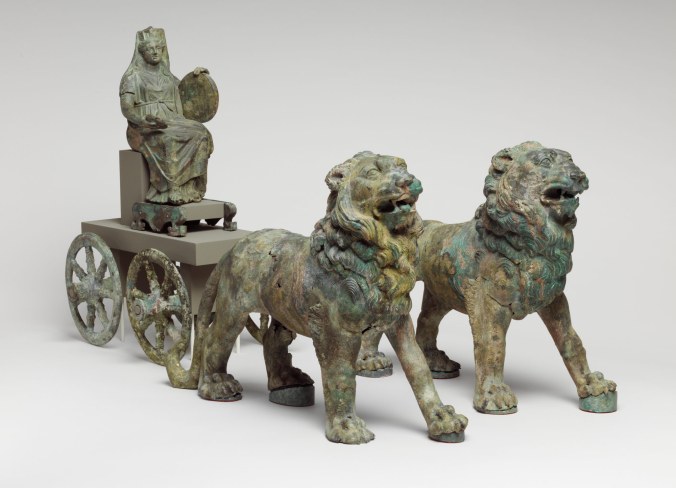
Cybele, the Magna Mater, on her triumphal car pulled by two lions. Has there ever been a more perfect likeness to the Whore of Babylon? (Source)

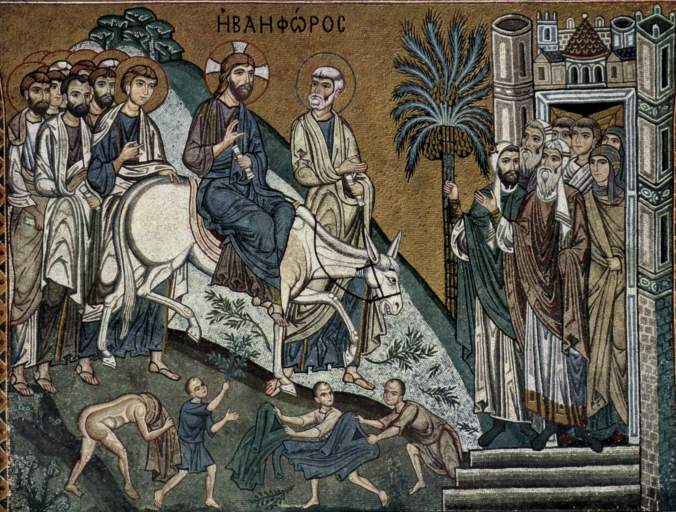
March 24th is the traditional Dies Sanguinis of the ancient Roman calendar, when the painted eunuch-priests of Cybele and the votaries of Attis in their Phrygian caps would join with the servants of warlike Bellona in the most vile public atrocities. On that day, hideous pipes stirred the wicked throng into a fever of unutterable terror, and as the revelers danced in an ever more demoniac fashion, they mutilated their flesh and let out copious torrents of blood upon the stones of forum and temple. Then they drank from their own spilled blood, descending even lower than the beasts in their frenzy and taking on instead the aspect of lustful aegypans. The summit of these evil ecstasies came when, before the altar of the Magna Mater, devotees castrated themselves. Only thus could they enter the service of that infernal priesthood.
vhod-gospoden-v-ierusalim_palermo

The Triumphal Entrance of Christ, mosaic, Palermo. (Source)

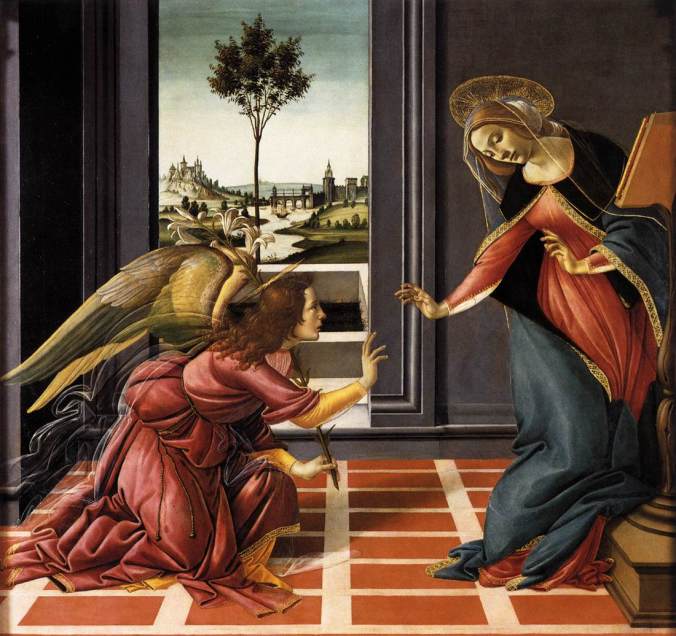
This was the culture that Christianity conquered. And it is with these satanic rites in mind that we look forward to a double feast of rather a different sort tomorrow. For tomorrow, on the 25th of March, we celebrate Palm Sunday and the Annunciation, falling providentially on the same day.

“And the light shineth in darkness; and the darkness comprehended it not.”

Botticelli,_annunciazione_di_cestello_02

The Cestello Annunciation, Botticelli, 1489-90. My favorite of all Annunciations. (Source).


St. Alphonsus on Christ’s Suffering

S_Alfonso02.jp

May St. Alphonsus pray for us always. (Source)

This Wednesday’s spiritual teacher is St. Alphonsus Liguori, Doctor of the Church and founder of the Redemptorists. He was known for his moral theology as well as his Mariological and devotional writings. Here is something Lenten by St. Alphonsus drawn, paradoxically, from The Incarnation, Birth, and Infancy of Jesus Christ (trans. 1927). The bibliographic information can be found on the page from which I took this text. 

The Desire that Jesus Had to Suffer for Us

Baptismo habeo baptizari; et quomodo coarctor, usquedum perficiatur?
“I have a baptism wherewith I am to be baptized; and how am I straitened until it be accomplished?”
—Luke, xii. 50.

I.
Jesus could have saved us without suffering; but He chose rather to embrace a life of sorrow and contempt, deprived of every earthly consolation, and a death of bitterness and desolation, only to make us understand the love which He bore us, and the desire which He had that we should love Him. He passed His whole life in sighing for the hour of His death, which He desired to offer to God, to obtain for us eternal salvation. And it was this desire which made Him exclaim: I have a baptism wherewith I am to be baptized; and how am I straitened until it be accomplished? He desired to be baptized in His Own Blood, to wash out, not, indeed, His Own, but our sins. O infinite Love, how miserable is he who does not know Thee, and does not love Thee!

II.
This same desire caused Him to say, on the night before His death, With desire I have desired to eat this pasch with you. By which words He shows that His only desire during His whole life had been to see the time arrive for His Passion and death, in order to prove to man the immense love which He bore him. So much, therefore, O my Jesus, didst Thou desire our love, that to obtain it Thou didst not refuse to die. How could I, then, deny anything to a God Who, for love of me, has given His Blood and His life?

III.
St. Bonaventure says that it is a wonder to see a God suffering for the love of men; but that it is a still greater wonder that men should behold a God suffering so much for them, shivering with cold as an infant in a manger, living as a poor boy in a shop, dying as a criminal on a Cross, and yet not burn with love to this most loving God; but even go so far as to despise this love, for the sake of the miserable pleasures of this earth. But how is it possible that God should be so enamoured with men, and that men, who are so grateful to one another, should be so ungrateful to God?

Alas! my Jesus, I find myself also among the number of these ungrateful ones. Tell me, how couldst Thou suffer so much for me, knowing the injuries that I should commit against Thee? But since Thou hast borne with me, and even desirest my salvation, give me, I pray Thee, a great sorrow for my sins, a sorrow equal to my ingratitude. I hate and detest, above all things, my Lord, the displeasure which I have caused Thee. If, during my past life, I have despised Thy grace, now I value it above all the kingdoms of the earth. I love Thee with my whole soul, O God, worthy of infinite love, and I desire only to live in order to love Thee. Increase the flames of Thy love, and give me more and more love. Keep alive in my remembrance the love that Thou hast borne me, so that my heart may always burn with love for Thee, as Thy heart burns with love for me. O burning heart of Mary, inflame my poor heart with holy love.

Christ_Carrying_the_Cross_1580.jpg

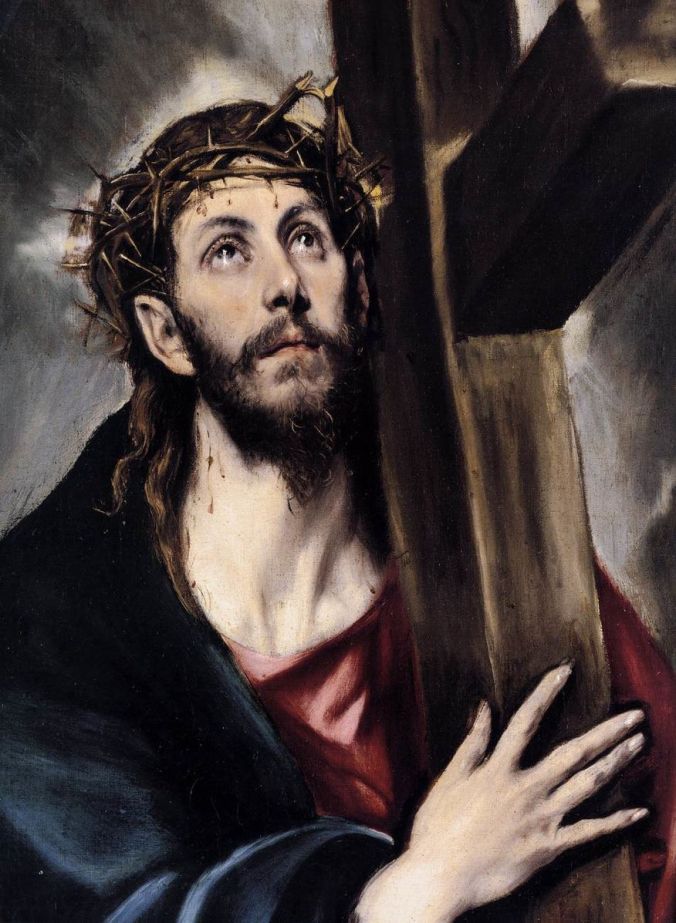
Detail of Christ Carrying the Cross, El Greco, 1580. (Source)

Newman on the Sorrowful Mother

slovakia_lady_sorrows

Our Lady of Sorrows, Pray for Us. (Source)

Continuing my Lenten series of Wednesday spiritual masters, here are two meditations from Newman on Our Lady’s dolours. They are taken from his Meditations and Devotions. We should never forget the terrible suffering of Our Lady at the foot of the cross. Her unique woes rendered her the Co-Redemptrix of Mankind.

Mary is the “Regina Martyrum,” the Queen of Martyrs

Why is she so called?—she who never had any blow, or wound, or other injury to her consecrated person. How can she be exalted over those whose bodies suffered the most ruthless violences and the keenest torments for our Lord’s sake? She is, indeed, Queen of all Saints, of those who “walk with Christ in white, for they are worthy;” but how of those “who were slain for the Word of God, and for the testimony which they held?”

To answer this question, it must be recollected that the pains of the soul may be as fierce as those of the body. Bad men who are now in hell, and the elect of God who are in purgatory, are suffering only in their souls, for their bodies are still in the dust; yet how severe is that suffering! And perhaps most people who have lived long can bear witness in their own persons to a sharpness of distress which was like a sword cutting them, to a weight and force of sorrow which seemed to throw them down, though bodily pain there was none.

What an overwhelming horror it must have been for the Blessed Mary to witness the Passion and the Crucifixion of her Son! Her anguish was, as Holy Simeon had announced to her, at the time of that Son’s Presentation in the Temple, a sword piercing her soul. If our Lord Himself could not bear the prospect of what was before Him, and was covered in the thought of it with a bloody sweat, His soul thus acting upon His body, does not this show how great mental pain can be? and would it have been wonderful though Mary’s head and heart had given way as she stood under His Cross?

Thus is she most truly the Queen of Martyrs.

VirgendelosDolores

Virgen de los Dolores, Private Collection, Puebla, Mexico. (Source)

***

Mary is the “Vas Honorabile,” the Vessel of Honor

St. Paul calls elect souls vessels of honour: of honour, because they are elect or chosen; and vessels, because, through the love of God, they are filled with God’s heavenly and holy grace. How much more then is Mary a vessel of honour by reason of her having within her, not only the grace of God, but the very Son of God, formed as regards His flesh and blood out of her!

But this title “honorabile,” as applied to Mary, admits of a further and special meaning. She was a martyr without the rude dishonour which accompanied the sufferings of martyrs. The martyrs were seized, haled about, thrust into prison with the vilest criminals, and assailed with the most blasphemous words and foulest speeches which Satan could inspire. Nay, such was the unutterable trial also of the holy women, young ladies, the spouses of Christ, whom the heathen seized, tortured, and put to death. Above all, our Lord Himself, whose sanctity was greater than any created excellence or vessel of grace—even He, as we know well, was buffeted, stripped, scourged, mocked, dragged about, and then stretched, nailed, lifted up on a high cross, to the gaze of a brutal multitude.

But He, who bore the sinner’s shame for sinners, spared His Mother, who was sinless, this supreme indignity. Not in the body, but in the soul, she suffered. True, in His Agony she was agonised; in His Passion she suffered a fellow-passion; she was crucified with Him; the spear that pierced His breast pierced through her spirit. Yet there were no visible signs of this intimate martyrdom; she stood up, still, collected, motionless, solitary, under the Cross of her Son, surrounded by Angels, and shrouded in her virginal sanctity from the notice of all who were taking part in His Crucifixion.

KlauberDolorosa

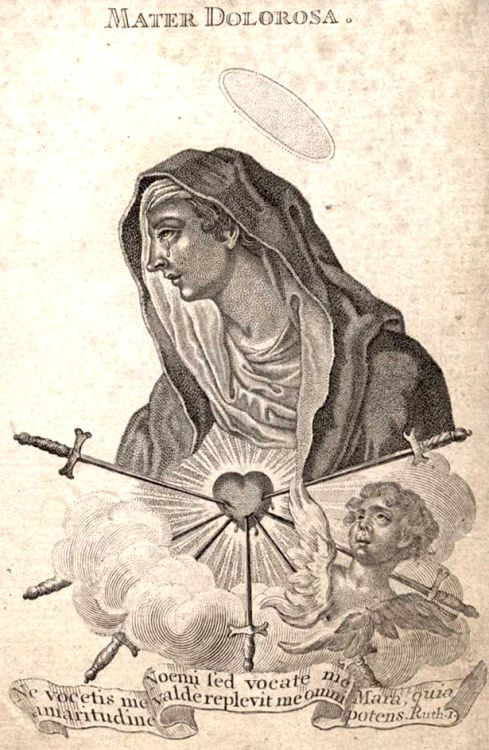
Mater Dolorosa, Klauber. (Source)

Elsewhere: An Anglo-Catholic Designer You Should Know

Screen Shot 2018-03-13 at 1.40.54 AM.png

A reredos by John Coates-Carter. (Source)

Over at Liturgical Arts Journal, you will find a very good, brief introduction to an ecclesiastical architect of the Arts and Crafts Movement, John Coates-Carter. He is most famous for his design of the (extraordinary) abbey on Caldey Island. Most of his work can be found in Wales. Perhaps because of his regional interest, I had never heard of him before. Yet his altarpieces are about as Anglo-Catholic as you can get. They have all of the features I noted in my article on AC aesthetics; they’re earthy, colorful, idealized, with a hint of the illustrative verging on the cartoonish. And most importantly, the are deeply human. Anglo-Catholicism restored the human face to British ecclesiastical art. We can see that tendency in the luminous angels and vibrant peasants that appear in Coates-Carter’s sacral art. Do go have a look.

CaldeyIsland

Caldey Abbey, designed by John Coates-Carter. (Source)

Fénelon on the Return to God

Fenelon

François de Salignac de la Mothe-Fénelon, Archbishop of Cambrai in the age of Louis XIV (Source)

Continuing my Lenten series of Wednesday spiritual masters, I present to you here a letter by Archbishop Fénelon to an officer, often identified as the Chevalier Colbert. The translation I am using comes from 1877, but I would also recommend to you the version by fellow Wahoo Chad Helms in the 2006 Paulist Press edition of Fénelon‘s Selected Writings. It struck me by its beauty and force of feeling, as well as its Lenten spirit. 

You have forgotten me, sir, but it is impossible for me to forget you. Something in my heart continually recalls you, and makes me want to hear of you, as I have more especially felt during the campaign and its perils. Your forgetfulness only makes me feel the more. The friendship you showed me once is of a kind never to be forgotten; and when I recall some of our conversations, my eyes are filled with tears. I trust that you remember how pleasant and hearty they were. Have you found anything since then more acceptable than God? Have the truths which then satisfied you failed? Is the pure light of the kingdom of God quenched? Has the world’s nothingness acquired some fresh value? Is that which was but a wretched dream not still the same? Is the God to Whom you poured out your soul, and Who filled you then with a peace beyond all earthly ken, no longer to be loved? Has the eternal beauty, ever so fresh to pure eyes, no longer charms for you? Is that source of heavenly joy, of unmarred happiness, which springs from the Father of Mercies and God of Consolation, dried up? No, for He has filled me with an urgent desire to recall you to Him. I cannot resist it: for long I have hesitated, and said to myself that I should only worry you. Even as I began this letter, I laid down a limit of discretion to myself; but after the first few words, my heart burst its bounds. Even should you not answer, or should think me absurd, I should not cease to speak sorrowfully to God of you, when unable to speak to you yourself any more. Once more, sir, forgive me if I exceed all due limits. I know it as well as you, but I feel irresistibly urged: God has not forgotten you, since He stirs up so eager a desire for your salvation in me.

What does He ask of you, save to be happy? Have you not realised that one is happy in loving Him? Have you not felt that there is no other real happiness, whatever excitement may be found in sensual pleasures, apart from Him? Since, then, you know where to find the Fountain of Life, and have of old drunk thereof, why would you seek foul, earthly cisterns? Bright, happy days, lighted up by the soft rays of loving mercy, when will ye return? When will it be given me to see this child of God reclaimed by His powerful Hand, filled with His favour, and the blessings of His holy Feast; causing joy in Heaven, despising earth, and acquiring an inexhaustible fund of humility and fervour from his experience of human frailty?

1280px-Rembrandt_Harmensz_van_Rijn_-_Return_of_the_Prodigal_Son_-_Google_Art_Project2

The Return of the Prodigal Son, Rembrandt van Rijn, c. 1661-69. (Source)

I am not dictating what you should do. God will Himself make that plain to you according to your needs, so long as you hearken inwardly to Him, and despise boldly that which is despicable. Do whatever you will, only love God, and let His Love, revived in your heart, be your guide. I have often thanked Him for having shielded you amid the perils of this campaign, in which your soul was even more exposed to risk than your body. Many a time I have trembled for you: put an end to my fears, and fill my heart with gladness. None can possibly be greater than to find myself once more with you in the house of God, united in heart and soul, looking together to one glorious hope, and the Coming of our Great God, Who will fill us with the flood of His pure delights. Your ears are not yet closed to the sublime language of truth, your heart is made to feel its charms. “Taste and see” the pleasant bread daily spread for us at our Father’s table. Why have you forsaken it? With such support, who can fear that anything else will be lacking? Even if you do not feel strong enough to regain the happy position where you were, at least answer me, at least do not shun me. I know what it is to be weak; I am a thousand times weaker than you. It is very profitable to have realised what one is; but do not add to that weakness, which is inseparable from human nature, an estrangement from the means of strength. You shall regulate our intercourse; I will only speak to you of such things as you are willing to hear. I will keep God’s secret in my heart, and shall be always, with unchanging affection and regard, etc.