Christmas With Quesnel

This year, for Christmas, I wanted to present a brief, original translation of Pasquier Quesnel’s edifying Réflexions Morales. The following passages, which concern the second chapter of St. Luke, are taken from the 1693 edition, Volume III, pages 30-37. All Biblical citations are from the Douay-Rheims.
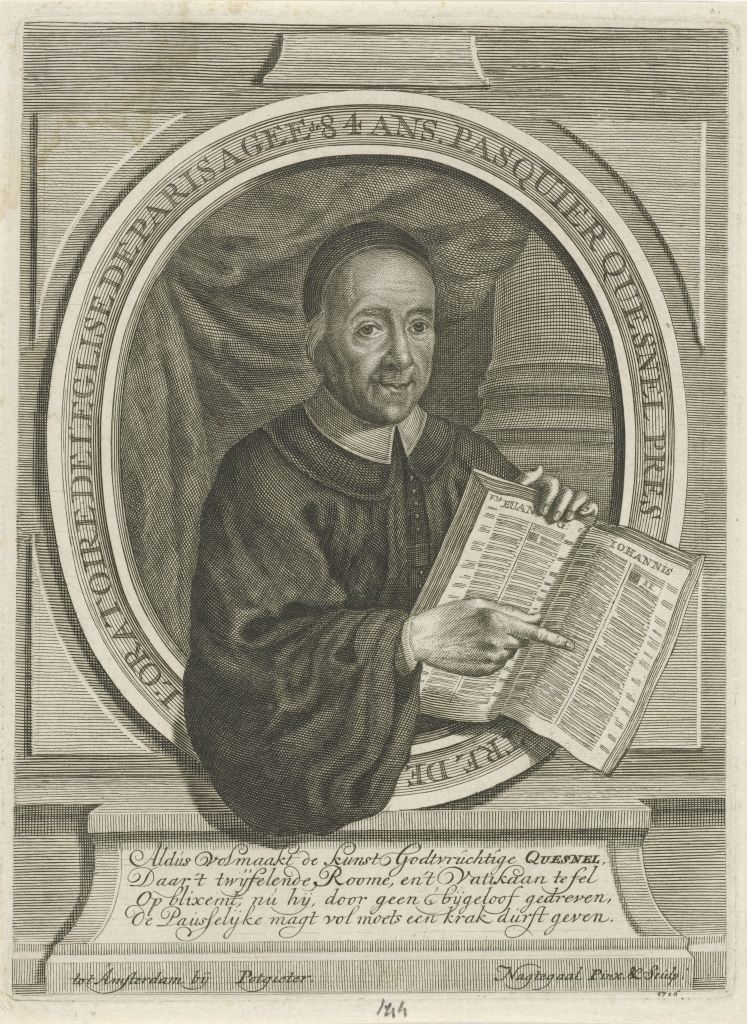
Dutch portrait of M. Quesnel, Priest of the French Oratory (Source)

The Birth of the Incarnate Son of God – Luke 2:1-7

  1. And it came to pass, that in those days there went out a decree from Caesar Augustus, that the whole world should be enrolled.
  2. This enrolling was first made by Cyrinus, the governor of Syria.

The greatest princes often give themselves to great movements and take up magnificent designs without knowing the reason why. Augustus imagined working for the glory of his name and the splendor of his reign – and his orders, by orders more powerful and more absolute than his own, served to accomplish the prophecies that were unknown to him, at the birth of a king he would never know, and the establishment of a monarch that would subjugate his own and all others. This is what happens in every age, and we think not of it.

3. And all went to be enrolled, every one into his own city.
4. And Joseph also went up from Galilee, out of the city of Nazareth into Judea, to the city of David, which is called Bethlehem: because he was of the house and family of David,
5. To be enrolled with Mary his espoused wife, who was with child.
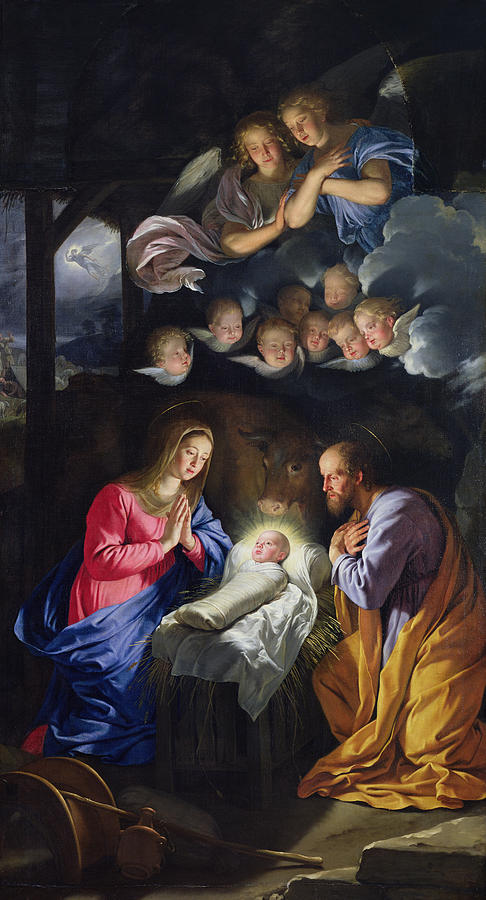
Nativity, Philippe de Champaigne (Source)

There is nothing here that seems to happen by chance; and yet, all is ordained by Providence to assure and fix by a public testimony the knowledge of the time and the place of the birth of the Messiah and the origin of the house of David.

The Son of God, recorded from his birth as a real man, acknowledges, so to speak, his obedience, his humility, and the accomplishment of his promises. It is well visible from this that his grandeur, predicted by the angel, is not a human grandeur.

The poverty, fatigue, and subjugation in which Joseph and Mary find themselves are the preparation for the gift that they are going to receive from God.

Let us learn to submit ourselves to every creature for God, and principally to the royal power, in seeing Jesus Christ begin to obey from his birth and before his birth.

6. And it came to pass, that when they were there, her days were accomplished, that she should be delivered.

Jesus Christ subjected himself to the laws of nature and to a prison of nine months. He hides the glory of His birth, in being born in an unknown place; teaches us to detach ourselves from our country and from all the present world, in being born in a voyage; recommends to us poverty, mortification, and humility, in being born in a borrowed place, deprived of all conveniences and help.

What instructions for us from this first moment, if we know how to hear them well! Let us listen to them in a spirit of adoration and annihilation.

7. And she brought forth her firstborn son, and wrapped him up in swaddling clothes, and laid him in a manger; because there was no room for them in the inn.

Jesus Christ is the firstborn of the Virgin; we are, in a certain sense, the next-born.

His humiliation in the infirmity of childhood is all the more worthy to be adored, as it seems the more unworthy of His grandeur and His wisdom. Rejected by men, he borrows the dwelling of beasts. May human pride blush as long as it is pleased to have a God become a child of a day and a moment, reduced to the captivity of swaddling-clothes, to the lowliness of a manger, and to the dwelling of beasts, to race again to the help of His creatures – and to be rejected! It is the glory of the Christian that his God has desired to do and to suffer all that for his salvation. It is his honor to adore Him, to recognize Him as his king, and to render him homage in all His states.

The Shepherds – Luke 2:8-20

8. And there were in the same country shepherds watching, and keeping the night watches over their flock.

9. And behold an angel of the Lord stood by them, and the brightness of God shone round about them; and they feared with a great fear.

Jesus Christ manifests Himself to the simple and the poor rather than to the learned and the rich. He reserves to the vigilant shepherds the knowledge of the mysteries and duties of religion; the negligent ones are left in their shadows.

Thou dost begin from this moment, Lord, to show who are those whom Thou hast chosen for Thy Kingdom, and who are the ones whom Thou hast cast off.
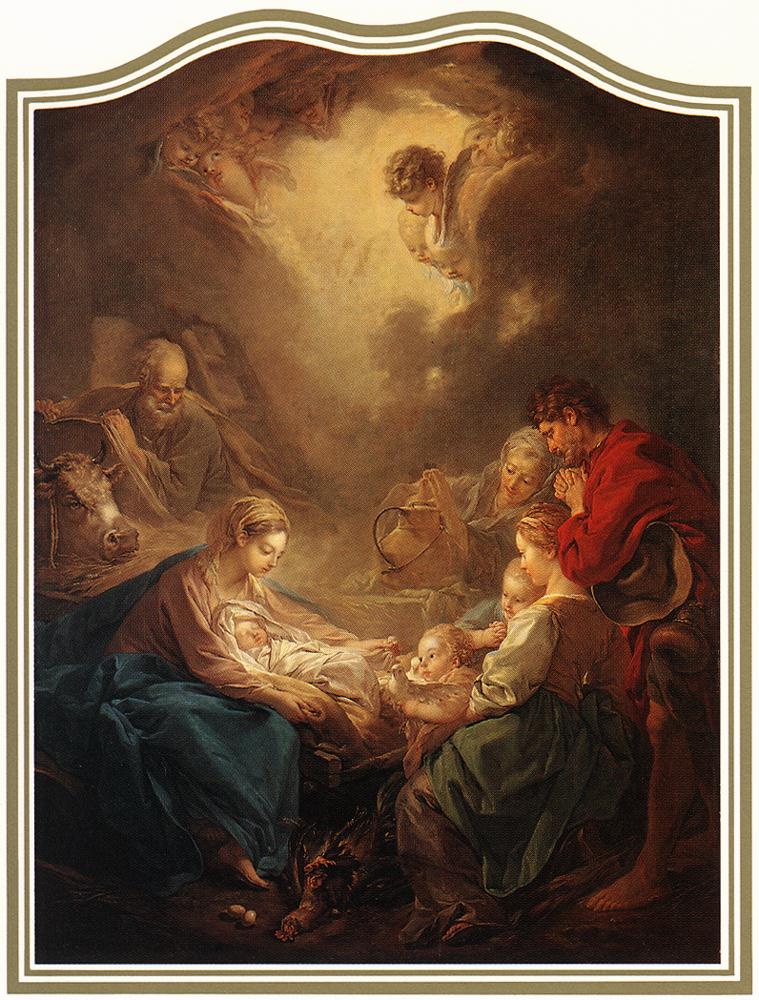
The Light of the World, François Boucher, 1750 (Source)

10. And the angel said to them: Fear not; for, behold, I bring you good tidings of great joy, that shall be to all the people

The birth of Jesus is the joy of this world, and the world did not know it. The world has its vain joys, its criminal joys, and by these it is unworthy to share in the joy of the birth of the Savior. It is the image of what happens every day; men have a heart closed to the things of God, in proportion to the extent to which they have one open to the pleasures and greed of this world.

11. For, this day, is born to you a Saviour, who is Christ the Lord, in the city of David.

Abridgement of all the grandeurs of Jesus exposed to the faith of the shepherds, and which God formed in their hearts by the exterior sign of the light which surrounded them. As son of David and heir of the promises, he had a royal birth; as Savior, a sovereign goodness; as Christ, the fullness of the Spirit of God and of the sacerdotal and prophetic unction; as the Lord, a divine power.

What must we not hope of a Savior in whom one finds a sovereign power joined to an infinite goodness, which he annihilates for us?

12. And this shall be a sign unto you. You shall find the infant wrapped in swaddling clothes, and laid in a manger.

Is it there, Lord, the mark of Thy grandeurs, the ornaments of Thy royalty, the throne of Thy glory? O crèche, worthier than all that the world has of great riches and precious things, may I learn at your feet that it is by humility that Jesus comes to reign and that there is only “this path which leads to his kingdom!”

Pride is the character of the sons of Adam; humility, the mark of the Son of God and of the elect.

13. And suddenly there was with the angel a multitude of the heavenly army, praising God, and saying:

God, bringing honor by the celestial spirits to his Son, annihilated in infancy, teaches those of the earth, for whom He comes, what homage they owe Him in this state.

The angels remain happy to raise up by their praises the glory of a newborn infant, and to adore Him as their God. Will men be disdainful?

The crèche of the Savior is a scandal to the Jews and folly to the Greeks as much as the Cross; His infancy as well as His death is the pitfall of human pride. But it is the power of God for the salvation of those who have faith, and even the object of adoration for the angels.

Adoration of the Shepherds, Eustache La Sueur (Source)

14. Glory to God in the highest; and on earth peace to men of good will.

The two principal motives of the Incarnation are the glory of God and the reconciliation of mankind.

God promises peace on earth to those whom He loves, but not repose.

The peace of God consists in His love, through whatever trouble and whatever storms this love may expose the Christian.

The peace that reigns on earth in these times only marks the birth of God in peace.

15. And it came to pass, after the angels departed from them into heaven, the shepherds said one to another: Let us go over to Bethlehem, and let us see this word that is come to pass, which the Lord hath shewed to us.

When God inspires someone to search out Jesus Christ, to render Him some duty, to apply one’s self to one of his mysteries, we must not neglect it.

The angel does not order the shepherds to go to Bethlehem; but rather makes known and proposes the good to faithful souls so as to make them undertake it. It is thus to a good Christian and to a pious lady to say to them: Jesus Christ is in this poor tabernacle as in a manger, wrapped up in the appearances of bread, abandoned by all the world – He is in this poor one, almost naked, lodged in a miserable hut, lacking everything.

This is the image of the holy assemblies of zealous persons, who, profiting from exhortations and the light of their visible angels, mutually encourage each other to visit the Blessed Sacrament, poor households, and foundlings, in honor of Jesus the poor infant, swaddled and sleeping in a manger. Let us go to Bethlehem, the “house of the bread” of Heaven. May it please God that those who are outside this house, that is, outside the Church, might encourage each other to go look for Jesus Christ to taste there what our Savior causes us to know!
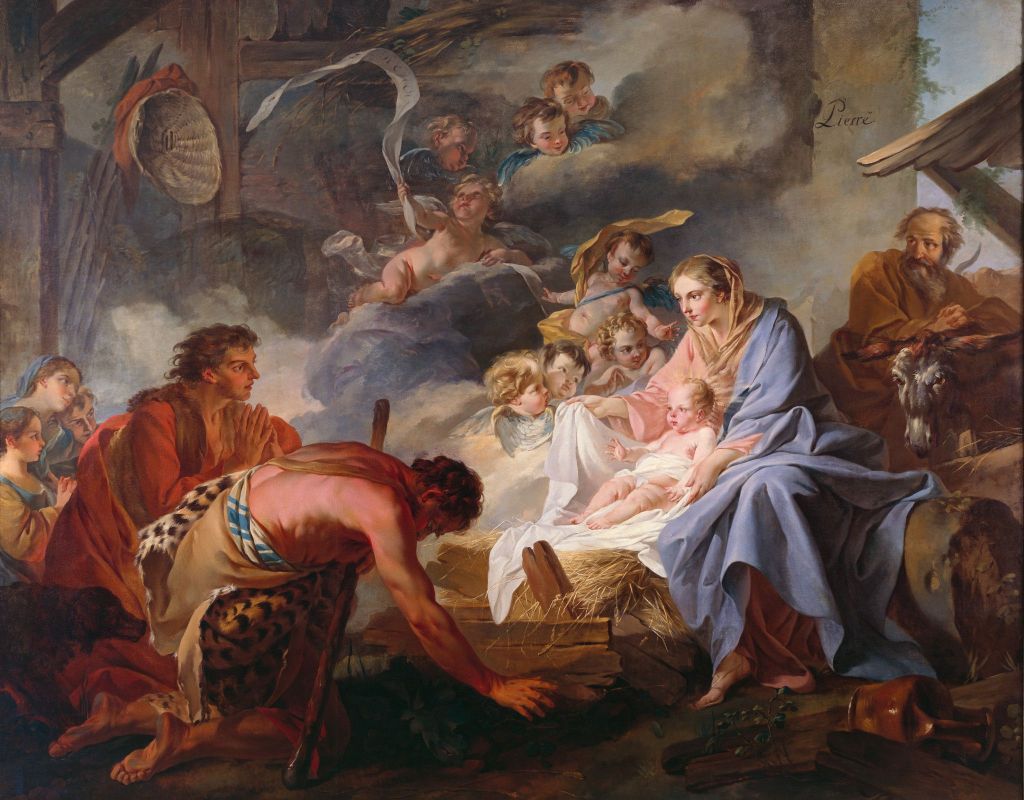
The Adoration of the Shepherds, Jean Baptiste Marie Pierre, 1745 (Source)

16. And they came with haste; and they found Mary and Joseph, and the infant lying in the manger.

Will not sinners blush from the luxury and the delicacy of their beds, seeing the Son of God in a manger?

When a good work presents itself, far from losing time, we must follow the movement of grace without delay, for fear lest it pass, and for fear that another will take from us either the occasion or the beginnings of a holy work.

This reversal of order, the bride named before the bridegroom, creatures before the Creator, marks well the reversal made by the Incarnation. Mary is truly the Mother of God, and this dignity grants her the first rank in His house.

17. And seeing, they understood of the word that had been spoken to them concerning this child.

These shepherds believe the word of the angel without reasoning about it; they see the lowness and poverty of the manger, without being scandalized, and reflect on all, without being troubled. This is the advantage of a humble, simple, and submissive faith.

What false reasonings do the Philosophers make! How many apparent contradictions are embraced by the beaux esprits of the world!

18. And all that heard, wondered; and at those things that were told them by the shepherds.

The shepherds, first apostles of the infant Jesus, are faithful in announcing the news of His birth. God blesses the simplicity of their report in causing it to be believed everywhere.
God does not love and does not bless that human prudence which believes it must hide the apparent lowliness of the mysteries of religion. It belongs to man to obey and to suppress nothing, and to God to cause belief by inspiring faith.

19. But Mary kept all these words, pondering them in her heart.

Mary, consecrated and elevated to Jesus Christ, full of his mysteries, and entirely applied to the collection of virtue, spirit, and grace, condemns the forgetfulness and negligence in which Christians live with regards to what the Savior has done for them.

It is not easy to profit from the mysteries and the truths of the Gospel, and to preserve them in one’s memory; one must sustain them in the presence of Our Lord, and meditate upon them often, according to the example of the Blessed Virgin.

She is the teacher and the first model of Christian meditation upon the life of Jesus Christ. Let us profit in the school of our holy Mistress.

20. And the shepherds returned, glorifying and praising God, for all the things they had heard and seen, as it was told unto them.

The shepherds imitate her in adoring and glorifying God. This is the first effect of faith, the first duty of religion, a tribute of recognition that we owe to the gifts of God.

The praise of these good people is as simple as their faith, and that is what God loves.

Thus should true Christians return to their own homes from the Church where they came to adore Jesus Christ and to listen to the preaching of His mysteries, His virtues, and His maxims.

A Prayer from Port-Royal on Saint Augustine’s Day

Saint Augustine, Philippe de Champaigne, c.1645-50 (Detail) – (Source)

On Saint Augustine – A Prayer of M. Hamon

O God, who, after having shown to us in Saint Augustine the very excess into which corrupt nature causes us to fall, hast also caused us to see in him the strength and the empire of Thy Grace over our hearts, grant us, we beseech thee, so perfect a knowledge of our extreme misery and of Thy infinite mercy, that, expecting everything from Thee, and nothing from ourselves, we might hope fully in Thee by defying ourselves completely.

O God, who in embracing Saint Augustine with Thy Love, and in elevating him above all men by the knowledge of Thy Truth, hast placed him in Thy Church as a fiery and shining lamp, so that he might illuminate and defend her by his doctrine, and console and edify her by his sanctity; grant, by the help of his charitable intercession, that we might imitate his virtues; and, at his example, rejoicing only in the truth, and having taste only for the fruits of charity, we might despise this mortal life by the hope and feeling of the all-divine life which Thou hast promised us; so that, loving Thee alone, we might also place all our happiness in Thee alone.

Thus we beseech thee by Jesus Christ our Lord. Amen.

(From Jean Hamon, Entretiens d’une âme avec Dieu, New Edition (Avignons, 1740), pp. 405-06; original translation by The Amish Catholic)

Elsewhere: A Review about Magic in Modernity

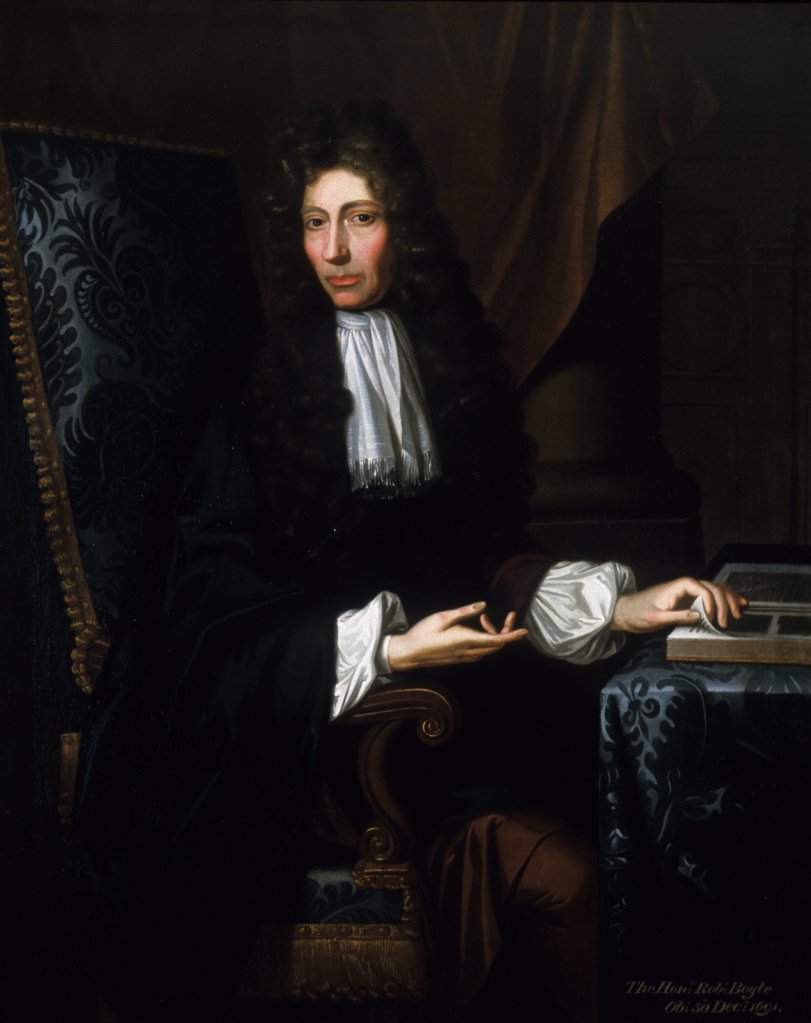
Portrait of Robert Boyle, Father of Modern Chemistry. A scientist distinguished by his open-minded and empirical attitude towards paranormal, supernatural, and magical phenomena. (Source)

I am pleased and proud to announce that I have a book review up at the Genealogies of Modernity Blog. I examine a compelling recent work by historian of science, Michael Hunter. The Decline of Magic: Britain in the Enlightenment (Yale UP, 2020) is well worth your time. I think it provokes really intriguing questions about the process of disenchantment – a transition that Hunter effectively describes as the methodological eclipse of Francis Bacon and Robert Boyle by Isaac Newton. You’ll understand what I mean when you read the review (and the book), so please head on over and give it a read-through!

Thank you to the GoM Blog for hosting my writing, and especially to Mr. Terence Sweeney for kindly asking me to contribute. It was an honor and a pleasure to write for a platform with such intriguing content.

An Interview on Anglican Occultism

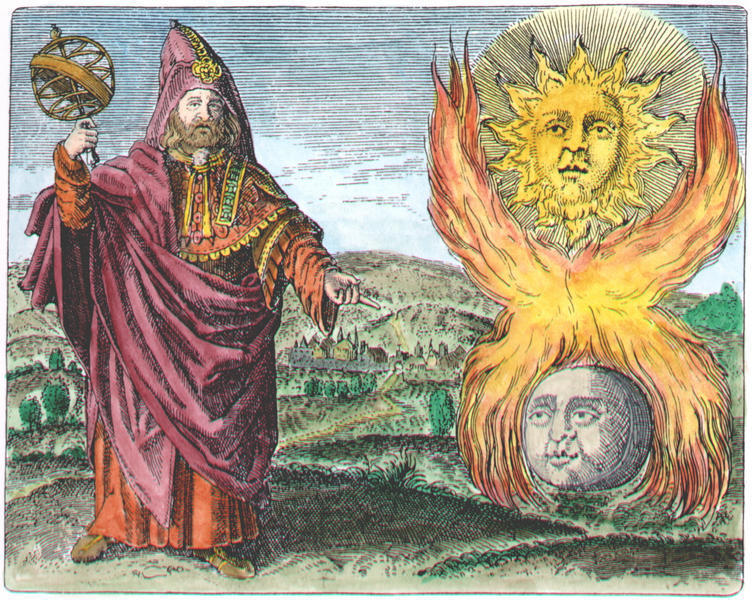
Hermes Trismegistus (Source)

Recently I had the great honor of being interviewed on the podcast Poststructuralist Tent Revival (PTR) about my research into Anglo-Catholic hermeticism and occultism in the late 19th and early 20th centuries. Thanks especially to Jacob Given for a great conversation. Please consider subscribing to PTR‘s Patreon! They do some really great stuff.

And for those who want to learn a little more about the broader phenomena I discuss here, you might want to check my brief article in The Church Times, Dec. 2018, on the same subject. While it doesn’t go as deeply as my actual academic work did, it gives an overview of the landscape.

Elsewhere: Speaking of Jansenism

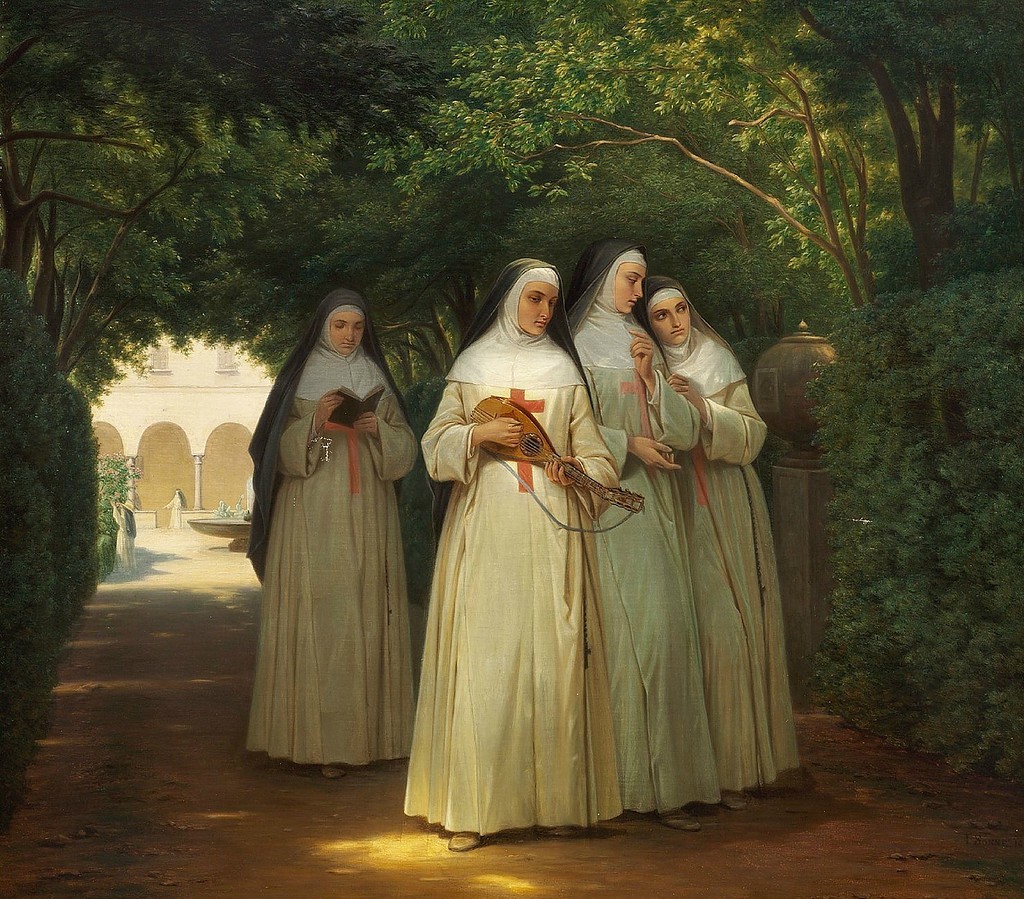
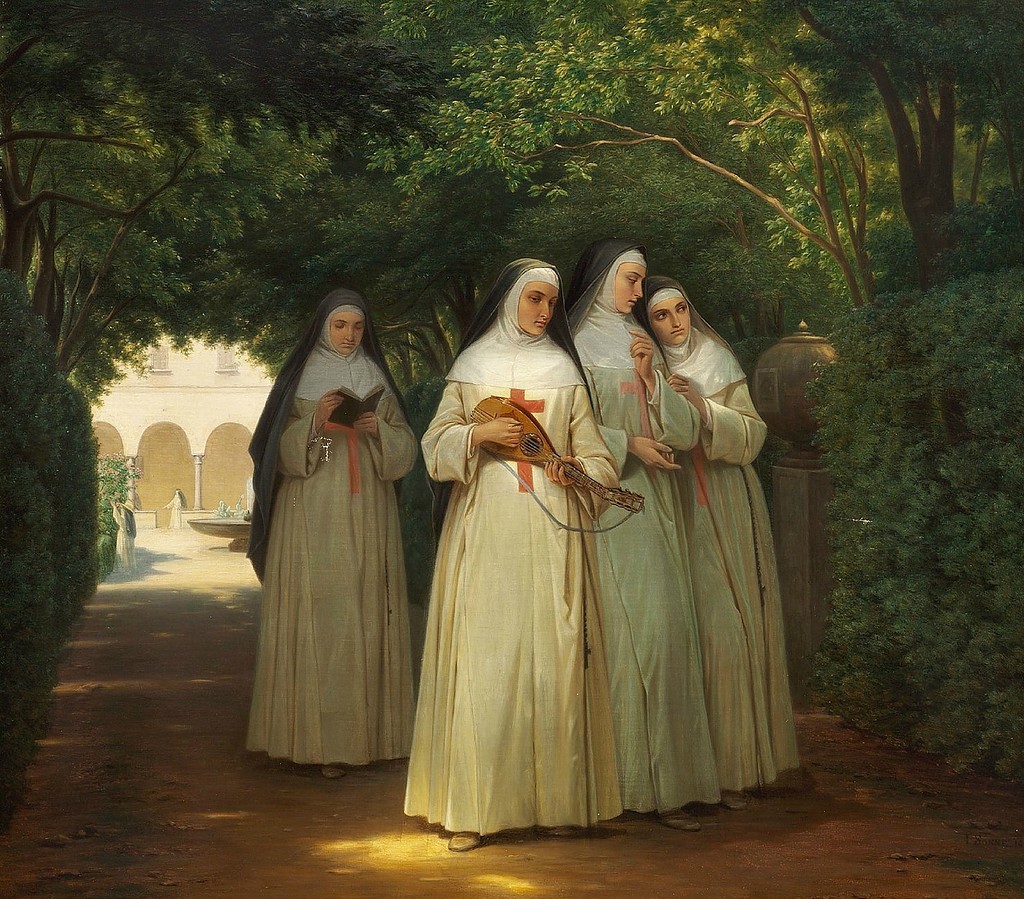
Jorgen Sonne’s 1866 Nuns walking in a cloister garden in Rome. He has, whether intentionally or not, given them the habit of Port-Royal-des-Champs. (Source)

I refer my readers to two articles that have recently appeared in the Notre Dame Church Life Journal. The first, which came out about a month ago, is an excellent piece by Dr. Shaun Blanchard showing that our polemical use of the term “Jansenism” is seriously mistaken. The second is an article I wrote, a church-historical study in which I both defend the Jansenists from various degrading misconceptions as well as point out some parallels between their situation and our own. I’m also very pleased that the Catholic Herald picked it up for Wednesday’s “Morning Catholic Must-Reads.”

This is not the first time I have tackled the issue, having previously pointed out the rhetorical and ecclesiastical-political resemblances between Pope Francis’s critics and the French Jansenists. I am more sure than ever of that similarity, and may yet elaborate it again should I deem it helpful for the present conversation. Regardless, I certainly will write more about Jansenist history and theology – watch this space.

I should add that I am particularly grateful to Dr. Blanchard for his kind aid in the preparation of my piece, and Dr. Artur Rosman for his editorial patience.

The Ratzinger Letter: A Failure

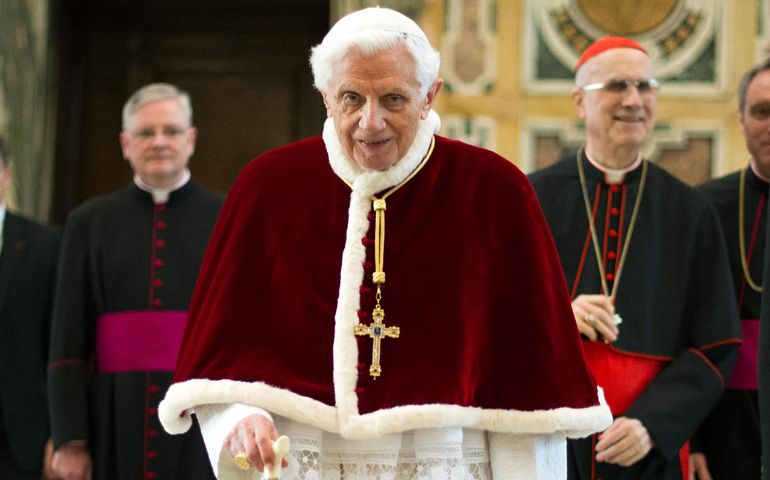
The Pope-Emeritus’s letter was a deeply unhelpful document on the whole. (Source)

In the ongoing sexual abuse crisis that has wracked the Roman Catholic Church, it is helpful to remember that the evil transpires on both spiritual and historical planes. That is to say, we can productively speak of sexual abuse as a spiritual attack upon the Church’s absolute purity, a purity she receives from Christ, her spouse and head. The violations committed by priests and religious is a stain upon that purity but nevertheless leaves the fundamental holiness of the Church intact. And this because the Church has no holiness that is not primarily the holiness of Jesus. All that is good in her flows from Him.

However, we can maintain this truth while simultaneously recognizing deep underlying structural problems in the Church’s culture and modus operandi. The holiness of the Church comes from above, not below; in the course of human history, we have often seen great evils nurtured within the very breast of the Church as a human institution. The sex abuse crisis is one such horror. Only a realistic attitude can bring us the reform that we so desperately need.

It’s because of this that I was disappointed to read Benedict XVI’s recent letter on the subject. There are certain passages that show the Pope-Emeritus’s continuing theological acumen. He writes movingly about the primacy of Faith, especially Faith in the Blessed Sacrament, as a foundational principle of renewal in our time. He also calls for a deeper ecclesial sensibility among the faithful. Catholics should meditate on these passages, which have a good deal of insight and even consoling power. His words on martyrdom are particularly profound and poignant, given his own impending mortality.

However, as a response to the egregious crimes committed by priests and other clerical personnel against innocents, the document represents a major failure.

This letter is a turgid, historically specious bit of sleight of hand. In treating the abuse crisis as a problem of laxity in moral teaching, the Pope turns sex abuse into a theological problem. He is closer to the heart of things when he discusses the evolution of the disciplinary measures in Canon Law and the various difficulties thrown up by legal “reforms” in the middle of the century. However, he also dissolves the very real psychological and social factors that permitted a culture of tolerance for pedophilia within the church to flourish for so long. Ratzinger writes, “Why did pedophilia reach such proportions? Ultimately, the reason is the absence of God.” This is, strictly speaking, a spiritual truth. Had the Pope-Emeritus treated this as a statement about the souls of the pedophiles, for whom God must be in some way ultimately unreal, the statement would be entirely defensible. However, Ratzinger is speaking historically. He immediately seems to attribute to the spread of pedophilia to secularization in Europe.

After the upheaval of the Second World War, we in Germany had still expressly placed our Constitution under the responsibility to God as a guiding principle. Half a century later, it was no longer possible to include responsibility to God as a guiding principle in the European constitution. God is regarded as the party concern of a small group and can no longer stand as the guiding principle for the community as a whole.

Joseph Ratzinger

The problem is relativism – namely, secular relativism as an other, as something outside the life of the Church. We read, “The long-prepared and ongoing process of dissolution of the Christian concept of morality was…marked by an unprecedented radicalism in the 1960s.” According to the Pope, “Part of the physiognomy of the Revolution of ‘68 was that pedophilia was then also diagnosed as allowed and appropriate…It was theorized only a short time ago as quite legitimate, but it has spread further and further.” He takes the cause of recent pedophilia, and thus of the scandals within the Church, to be the sexual revolution.

But apart from Gayle Rubin, the filmmakers who got Jodie Foster and Brooke Shields naked, and the perverts at NAMBLA, who exactly were the people trying to normalize pedophilia? C.C. Pecknold suggests it might be those activists in favor of “abolishing age-of-consent laws since the 1970s.” Possibly. At any rate, the Pope provides neither names nor sources. It’s a serious enough claim that he owes us that courtesy. To what extent were these efforts merely marginal phenomena? He seems to take them as a synecdoche of the broader movement, however implausibly.

By appealing to an established right-wing boogeyman (sixties revolutionaries), he dissolves the problem into a theological haze. He makes no mention of the complex psychological reasons for abuse, simply posits that relativism leads to sexual license. Nor does he prove any causes to tie together his case studies. He just asserts that various phenomena are connected without supplying proof. Given the genre of the piece, perhaps this brevity is to be expected. But is this schema really representative of Ratzinger’s mentality as he handled sex abuse cases in his tenure as head of the CDF and, later, as Pope? If so, no wonder things were so long mismanaged and so often minimized. Sex abuse is not a matter of which moral theologians you’re reading, and to treat it as such is profoundly irresponsible.

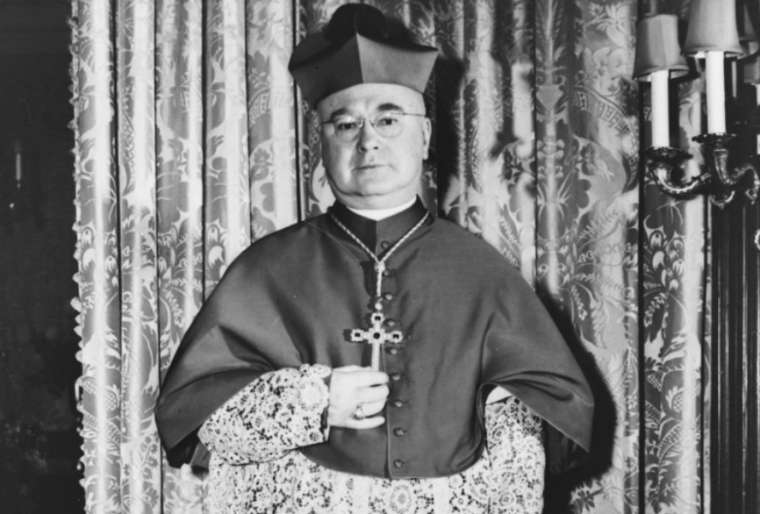
Francis Cardinal Spellman of New York, a voracious, predatory, and hypocritical homosexual who fostered a culture of abuse in his diocese in the 1950’s. Reports of him groping a West Point cadet during an interview have recently emerged. (Source)

The fact that Francis asked Benedict to prepare this statement suggests to me that it represents an attempt by both Popes to shoot the elephant (and scapegoat) in the room, namely, the homosexuality of the clergy. This phenomenon has become the cause célèbre of conservative and traditional Catholics trying to understand the sex abuse crisis. It has also been recently highlighted in a largely credible if somewhat sensationalist way by the gay activist Frédéric Martel, whose book on clerical homosexuality Catholics should read (if with a grain of salt). Too sharp a focus on homosexuality (a) doesn’t actually solve the problem of clerical sex abuse and (b) is too dangerous for all ideological camps (no pun intended) within the clerical establishment. Ratzinger’s letter here shifts the focus away from that particular systemic and more or less quantifiable phenomenon and onto an amorphous if politically-charged abstract. While I can’t be sure, the missive seems to be designed to influence Ratzinger’s own partisans and lead them away from the gay issue.

After all, the one narrative that Ratzinger doesn’t tell us is the one most favored by conservatives. Namely, as Pecknold puts it, “by the late 1980s the homosexual hierarchies that ruled now were descending, with greater frequency, into pedophilia.” But this is not what the Pope writes. In a passage worth quoting at length, Ratzinger tells us,

In various seminaries homosexual cliques were established, which acted more or less openly and significantly changed the climate in the seminaries. In one seminary in southern Germany, candidates for the priesthood and candidates for the lay ministry of the pastoral specialist [Pastoralreferent] lived together. At the common meals, seminarians and pastoral specialists ate together, the married among the laymen sometimes accompanied by their wives and children, and on occasion by their girlfriends. The climate in this seminary could not provide support for preparation to the priestly vocation. The Holy See knew of such problems, without being informed precisely. As a first step, an Apostolic Visitation was arranged of seminaries in the United States. As the criteria for the selection and appointment of bishops had also been changed after the Second Vatican Council, the relationship of bishops to their seminaries was very different, too. Above all, a criterion for the appointment of new bishops was now their “conciliarity,” which of course could be understood to mean rather different things. Indeed, in many parts of the Church, conciliar attitudes were understood to mean having a critical or negative attitude towards the hitherto existing tradition, which was now to be replaced by a new, radically open relationship with the world. One bishop, who had previously been seminary rector, had arranged for the seminarians to be shown pornographic films, allegedly with the intention of thus making them resistant to behavior contrary to the faith. There were — not only in the United States of America — individual bishops who rejected the Catholic tradition as a whole and sought to bring about a kind of new, modern “Catholicity” in their dioceses. Perhaps it is worth mentioning that in not a few seminaries, students caught reading my books were considered unsuitable for the priesthood. My books were hidden away, like bad literature, and only read under the desk. The Visitation that now took place brought no new insights, apparently because various powers had joined forces to conceal the true situation. A second Visitation was ordered and brought considerably more insights, but on the whole failed to achieve any outcomes. Nonetheless, since the 1970s the situation in seminaries has generally improved. And yet, only isolated cases of a new strengthening of priestly vocations came about as the overall situation had taken a different turn.

Joseph Ratzinger

That first line is the only explicit reference to homosexuality in the entire letter. In his his forceful First Things follow-up, Archbishop Chaput confirms this point:

He remains silent on what many see as the continuing resistance of Rome to candidly name the core issue of the clergy abuse problem, which is not primarily a matter of clerical privilege but rather a pattern of predatory homosexuality.

Archbishop Charles Chaput

Ratzinger is quick to move from the various gay circles among the seminarians of yesteryear to the presence of women in seminaries, and then on to theological liberalism in general. This is not the argument, put forward by so many, that homosexuality in the priesthood leads to sex abuse. It’s a broader case, one that sees homosexuality as only one part in a constellation of radicalism.

And it’s a radicalism that emphatically has its origins outside of the Church. Archbishop Chaput builds on Benedict, writing,

But priests and bishops have no miraculous immunity to the abnormality bubbling around them. Ratzinger locates the seed of the current crisis in the deliberate turn toward sexual anarchy that marked much of Europe in the 1960s, and the complete failure of Catholic moral theologians to counter it—a failure that more often resembled fellow-traveling.

Archbishop Charles Chaput

This is nothing less than an abdication of moral responsibility. The 1960’s did not produce pedophilia, ephebophilia, or the longstanding culture of omertà among the hierarchy (see the extensive research carried out by, inter alia, Richard Sipe). Indeed, predatory sexuality has been in the Church for a long time. I refer the reader to the cultures created by Cardinal Spellman in New York, Cardinal O’Connell in Boston, and Cardinal Wright in Worcester. The permissiveness in these dioceses was in place before the sexual revolution hit, and in each we see major flare-ups of the child sex abuse crisis. We could look back even further. There were pedophiles in the circle of St. Joseph Calasanz, and he died in 1648!

The cover-up, too, has a long life. As Ulrich Lehner has pointed out, the old practice used to be that religious orders had to destroy any incriminating files every five years; the use of special prisons for clergy and religious only added to the secrecy of the early modern ecclesiastical disciplinary apparatus. All of these points undermine the basic historical narrative Ratzinger tells us – namely, that the sexual revolution and subsequent buckling of Catholic moral theology lead to a simultaneous spread of pedophilia and a complete failure of the ecclesiastical establishment to respond.

One of the less edifying elements in the letter is that Ratzinger took the time to engage in subtle if unmistakeable academic score-settling throughout. Speaking of an ethicist he disagreed with, Ratzinger writes,

I shall never forget how then-leading German moral theologian Franz Böckle, who, having returned to his native Switzerland after his retirement, announced in view of the possible decisions of the encyclical Veritatis splendor that if the encyclical should determine that there were actions which were always and under all circumstances to be classified as evil, he would challenge it with all the resources at his disposal. It was God, the Merciful, that spared him from having to put his resolution into practice; Böckle died on July 8, 1991.

Joseph Ratzinger

Leaving aside the question of whether Böckle was right (and he wasn’t), the slight chuckle with which Benedict describes his death is extraordinarily petty. What a tawdry, sorry, cynical intervention from the ailing pontiff.

The letter fails in its description of the sources of pedophilia and ephebophilia. Yet at least Ratzinger attempts to make a case for why the priesthood has seen such widespread sexualization, with such prominent lapses, over the course of the last few decades. His letter does not, however, address the cover-up at all. If anything, he seems to end the letter on a rather troubling note:

Today, the accusation against God is, above all, about characterizing His Church as entirely bad, and thus dissuading us from it. The idea of a better Church, created by ourselves, is in fact a proposal of the devil, with which he wants to lead us away from the living God, through a deceitful logic by which we are too easily duped. No, even today the Church is not just made up of bad fish and weeds. The Church of God also exists today, and today it is the very instrument through which God saves us.

Joseph Ratzinger

I suppose that, on the spiritual level, the Pope is not wrong here. But it does rather seem to me that he is perhaps too concerned with the reputation of the Church – a holy body, yes, but also one riddled with both sexual predators and the venal men who protect them. In trying to end on a hopeful message, the Pope sounds a false note. He seems to have erased the mysterium iniquitatis. The effect is one of minimization of grave evil rather than a proper and reforming zelus domus Domini.

Yet the most frustrating feature of this letter, beyond its occasional historical errors and indulgence in the petty sparring of academia, is that it feeds into a narrative that conservative Catholics have used for years to exonerate themselves in the sex abuse crisis. That narrative chalks up clerical sex abuse to post-conciliar laxity alongside the sexual revolution. If only, these conservatives and traditionalists say, if only we hadn’t gone off the rails in 1968. Sex abuse becomes the exclusive property of ecclesiastical liberals.

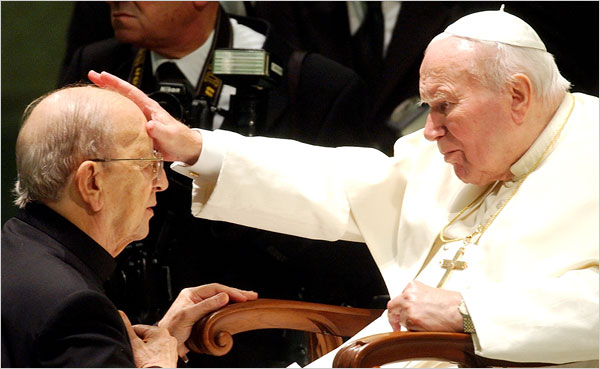
Fr. Marcial Maciel and Pope St. John Paul II, who admired and protected the Mexican sexual predator for years. (Source)

But this is a false narrative. It’s a lie – a half-truth, perhaps, but still a lie – that conceals the suffering of victims prior to that age as well as all those who have suffered abuse at the hands of conservative and traditionalist clergy. Men for whom the Revolution did not transpire. There are many examples of this kind of thing. One only needs to point to Marcial Maciel, Carlos Urrutigoity, Tony Anatrella, Fernando Karadima…the list goes on. None of these men were liberals. Some worked closely with John Paul II and Benedict XVI. Yet the narrative in this letter cheapens the experience of their victims and lulls conservatives and traditionalists into a false sense of self-righteous security – exactly the opposite of what we need if we are ever to get a handle on the problem of clerical sex abuse wherever it should rear its ugly head. It’s a narrative that helps us look the other way as more and more innocents get hurt. And it’s gravely irresponsible for the Pope-Emeritus to propagate this lie.

Thus passes a great theologian.

How to Celebrate Lent like a French Princess

Mesdames Victoire, Adélaide, and Louise, three of the pious daughters of Louis XV, known collectively as “Mesdames de France” or “Mesdames Tantes” after the accession of Louis XVI. Only Adélaide married; Louise later became a Carmelite prioress at Saint-Denis before having the extremely good fortune to die in 1787. Source

The inimitable John McManners, late Regius Professor of Ecclesiastical History at the University of Oxford, provides a window into the world of late Ancien Régime piety (or, rather, its dearth) in his monumental Church and Society in Eighteenth-Century France. He writes:

“To what extent was the fast of Lent observed? It was commonly said that the austerities of the penitential season were endured only by the poor. According to the Lenten pastoral letter of the archbishop of Sens in 1779, the rich often obtained medical certificates allowing them to eat what they liked. This was the fashionable thing to do. ‘Look at our bourgeois citizen and his wife in their (draper’s) shop, observing Lent strictly,’ said teh Jesuit Père Croisset in his Parallel des moeurs de ce siècle et la morale de Jesus-Christ (1727): ‘their fortune changes…and scarcely has the tape measure dropped from their hands than you see them putting on airs like people of quality and asking for dispensations from fasting.’ This class distinction was observed even in the kitchens of the Bastille: on the first Friday of his imprisonment, Marmontel gloomily at the meatless meal provided, not knowing that it had been meant for his servant. In any case, there were plenty of succulent dishes within the rules, for those who could afford them.

Empress Maria Theresa of Austria in the garb of a penitent (Source)

“Lent was the season to have tubs of fresh butter sent in from the countryside, and to ensure plentiful supplies of fish and water birds (the tes of an allowable fowl was: did the gravy remain uncongealed after fifteen minutes? – so a bishop gravely advised Mme Victoire, Louis XV’s pious but comfortable daughter). The peasant, whose existence is a perpetual Lent anyway, said Voltaire, awaits episcopal permission to eat his farmyard eggs, while the bishop himself looks forward to expensive dishes of soles. Certainly, things were well organized at Versailles. ‘A ray of grace has descended on us,’ wrote the duc de la Vallière in April 1756; ‘we fasted for three days a week during the whole of Lent, but on condition that we suffered no deprivations.’ Preachers were well aware that those with money and leisure could organize an attractive Lent for themselves: an occasional walk in a procession (a penitent’s garb was no disadvantage to a good-looking woman), extra time in bed to recuperate from privations, and food more delicately cooked and served than usual. ‘For some – God grant that there are none in my congregation today,’ thundered the Oratorian Surian, ‘Lent is a more agreeable time, in a sophisticated way, than the other seasons of the year.'”

(Vol. I, pg. 86-87).

Ah, the trials of the penitential season!

Anglo-Catholics and the Occult: My Church Times Debut

The Abbey in the Oakwood, by Caspar David Friedrich.


The Church Times have just published an article in which I summarize some of my research on the connection of Anglo-Catholics and the occult world. I’d like to thank my supervisor, Dr. Sarah Apetrei, and co-supervisor, the Rev. Canon Robin Ward, for their support throughout all of this. I’d also like to thank Fr. James Lawson for the early help he provided as well as Dr. Michael Yelton and those various other figures who have discussed the matter with me over the past year, often in words of encouragement. Hopefully the full paper will be published someday. For now, read here

Blessed Bernardo Francisco de Hoyos and the Challenge of Holiness

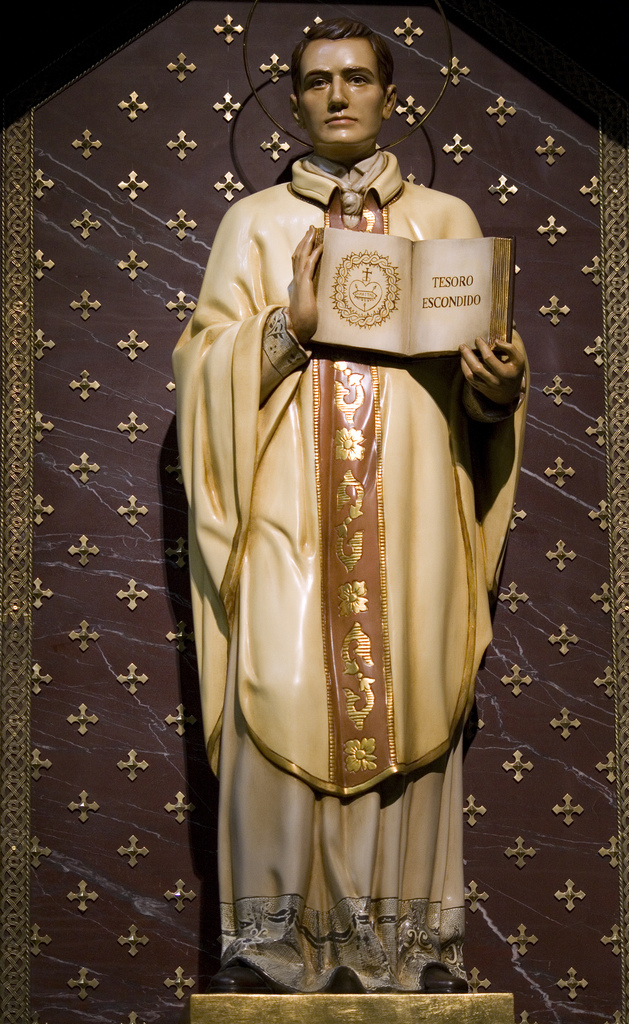
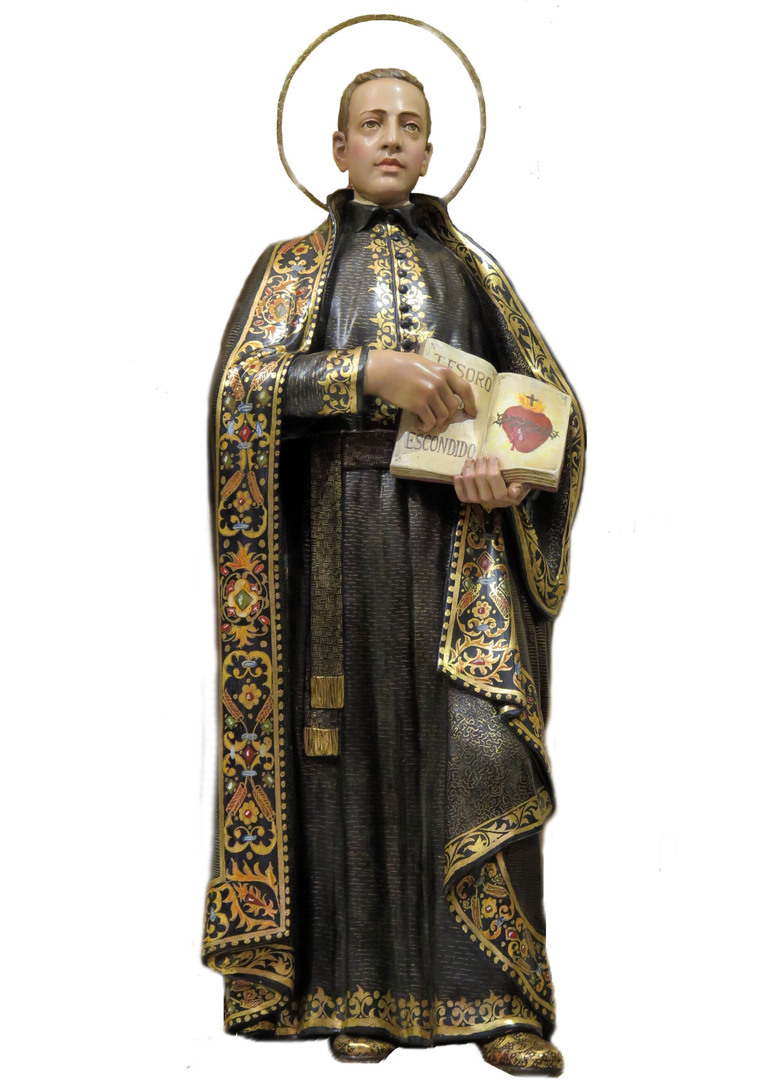
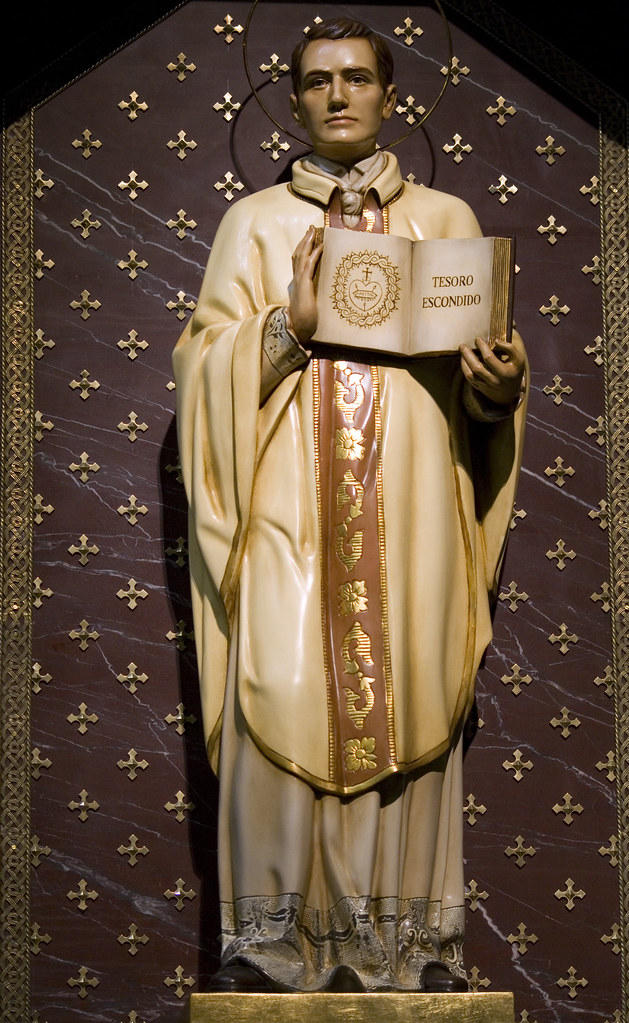
A statue of the Blessed Bernardo Francisco de Hoyos. (Source)

Earlier this year, I discovered a new friend in heaven – the Blessed Bernardo Francisco de Hoyos (1711-1735), a Jesuit mystic of the Sacred Heart. Today is his feast. I like Blessed Bernardo for a lot of reasons. I admit, it’s hard to get a great sense of his life story, as so many of the materials about him (or by him) are untranslated from their original Spanish. Nevertheless, a few things are clear.

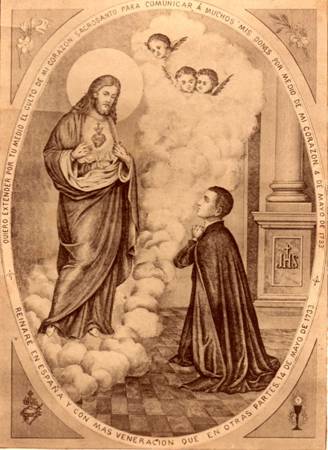
We share a devotion to the Heart of Jesus. Blessed Bernardo received private revelations of Jesus in which he was shown the Sacred Heart, culminating in a monumental mystical union. While strange phenomena are by no means unheard-of in the lives of the saints, Bernardo’s story is unusual insofar as many of his experiences were more typical of female mystics. The Sacred Heart devotion itself was often seen (and ridiculed by Jansenists) as an effeminate innovation that oozed sentimentalism. It’s hard to square that view with the very real rigor of Blessed Bernardo’s Jesuit life. As usual, simple narratives tend to fail when placed against a far more interesting reality.

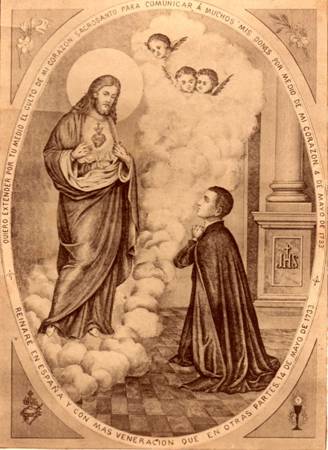
A devotional image of the Blessed Bernardo receiving a vision of the Sacred Heart. (Source)

The Spanish priest died when he was only 24. I will be 24 in a little over a month. It’s hard to imagine coming to the same heights of sanctity and intimacy with Jesus in such a short time. I look at my own spiritual life – scattered with sins and shortcomings, easily worn out, so often caught in a kind of lax scrupulosity – and I wonder how Bernardo did it.

Of course, it does rather help if you enter a Jesuit novitiate at the age of 14, as Bernardo did. That’s a good ten years of arduous ascetic labor and practice at prayer. All the same, lots of men entered religious life as youths in the early modern era. Not all of them achieved mystical marriage, one of the highest states of the interior life. And that even with many decades in the habit.

It occurs to me that, at the recent Vatican Youth Synod, stories like the Blessed Bernardo’s were mostly absent. The challenge of sanctity – indeed, its romance and adventure – were tepidly drawn at best. The tone of the discussions and of the later summary document may have been interpreted by some as a compassionate, realistic, and open-minded approach to the realities of life in the 21st century. But surely there was more than a touch of Dostoevsky’s Grand Inquisitor about the whole thing. You know the style. Holiness really is too hard, so we should make things easier – allow them to reach some other goal, some lesser goodness that isn’t holiness at all.

Yes, he may be a pious youth who’s terribly, terribly wan. But he’s in heaven, and you’re not. (Source)

The experience of all the saints, but especially mystics like Father Bernardo Francisco de Hoyos, runs counter to this maudlin spirituality.

The truth is much more dangerous, and much more exhilarating. Holiness demands heroic virtue. We are called to be heroes. But true heroism looks very different than what this world – or what a worldly hierarchy – thinks it is. It is a life of risk and sacrifice and no small discomfort. But the rewards it gives are beyond all telling.

Blessed Bernardo knew that. He knew that the only true recompense that the Christian will receive is Christ Himself. And so he went unflaggingly forward to the work he was given as a missionary of the Sacred Heart. His entire life was a brief, bright blaze of love for Jesus. In this, he rather resembles that other great devotionalist, Fr. Faber, who died at the age of 49, a full 27 years before Cardinal Newman. Souls like these are gifts to the whole Church. They kindle the love of God in their fellows and light the path to His holy mount.

But they also present us with a challenge. By incarnating the charity of God in such a visible way, they invite us to the same labors of love. All of us are called to gaze upon the Sacred Heart. Holiness is not an adventure closed to any of us, no matter how young (or old) we may be. If there is anything we can take from the story of Blessed Bernardo Francisco de Hoyos, priest, missionary, and mystic, it is this salutary truth.

Let us pray for the good Jesuit’s swift and sure canonization. And may he pray for us. (Source)

The Charism of Eccentricity

A-Priestridden-Village-BM

The 18th century was a Golden Age of clerical satire – and clerical eccentricity – in England. (Source)

What a day of loons it has been. After discovering the narrative of that wandering bishop which I brought to my readers’ attention earlier this afternoon, I have since come across two wonderful articles about the venerable tradition of eccentricity in the Church of England. The first is over at the Church Times. The Rev. Fergus Butler-Gallie, a curate in Liverpool, has written a book entitled A Field Guide to the English Clergy (One World Press, 2018). In his article at the CT, Butler-Gallie provides a taste of what is assuredly a very fun book indeed. Take just one of the bizarre figures he profiles:

William Buckland, a Victorian Dean of Westminster, became obsessed with eating as many animals as possible, from porpoise and panther to mole fricassee and mice on toast, even managing to gobble up the mummified heart of King Louis XIV while being shown round the Archbishop of York’s stately home.

He was no fool, though. The first person ever to excavate an entire dinosaur skeleton (although he was more interested in other prehistoric remains, writing on a desk made out of dinosaur faeces), he once disproved a supposed miracle in France by being able to prove (by taste, of course) that a supposed saint’s blood was, in fact, bat urine.

Or consider this parson:

The Revd Thomas Patten was a real-life Dr Syn, helping to run a smuggling operation on the north-Kent coast. Patten would preach interminably boring sermons until a parishioner held up a lemon, a sign that someone had agreed to buy his drinks for the evening at the tavern opposite, at which point he managed to terminate the service with astonishing alacrity (a ruse, I’m sure, no clergy reading this would even consider replicating).

If the rest of the book is as fascinating at these anecdotes suggest, it will be a classic in no time – right up there with Loose Canon and The Mitred Earl. Apparently it’s been getting rave reviews. (I’ll add that if any of you are looking for a Christmas gift for your favorite Catholic blogger, it’s going for under £10 at Amazon).

Today I also came across an article about one of Butler-Gallie’s subjects, the Rev. R.S. Hawker, also known as the “Mermaid of Morwenstow.” Alas, as I am not a subscriber to The Spectator, I cannot read it. Those who can are encouraged to do so.

One of my favorite clerical eccentrics whom I doubt that Butler-Gallie covers is the Rev. William Alexander Ayton, vicar of Chacombe in Oxfordshire.  You can read more about him in my article, “On the Wings of the Dawn – the Lure of the Occult.”

Though of course there are few stories of clerical eccentricity as amusing as the infamous dinner related by Brian Fothergill in his life of Frederick Hervey, Bishop of Derry. Fothergill tells us that

On one occasion when a particularly rich living had fallen vacant he invited the fattest of his clergy and entertained them with a splendid dinner. As they rose heavily from the table he proposed that they should run a race and that the winner should have the living as his prize. Greed contending with consternation the fat clerics were sent panting and purple-faced on their way, but the Bishop had so planned it that the course took them across a stretch of boggy ground where they were all left floundering and gasping in the mud, quite incapable of continuing. None reached the winning-point. The living was bestowed elsewhere and the Bishop, though hardly his exhausted and humiliated guests, found the evening highly diverting. (The Mitred Earl, 27).

Ballyscullion

Hervey also built what must have been one of the greatest gems of British Palladian architecture, Ballyscullion House. Alas, it is no longer extant, but has been reduced to a respectable if far less elaborate mansion. (Source) For a 3D model, see here.

If there’s one thing for certain, it’s that Anglicanism as lived in history is not a dry religion.

Allow me to indulge in a bit of crude cultural observation. It occurs to me that the national church of the English would inevitably partake of that quintessential English quality – eccentricity. Americans don’t produce real eccentrics. We breed individualists and, less commonly, outright weirdos. But the great British loon is mostly unknown to us. Eccentricity requires a certain localism, even an urban one, that has been mostly lost in the sprawling homelands of the American empire. Suburbs don’t produce eccentrics.

And more to the point, why should strangeness be so unwelcome in the Church? Why should the Church be bland and conformist and comfortable? Why must we labor on through the nauseatingly boring bureaucratic lingo and platitudinous sound-bites that so often seem to make up the bulk of our ecclesisatical discourse? Where is the sizzling fire cast to earth? Where is the light and heat of the Holy Ghost? In reviewing the proceedings of the recent Youth Synod, I was dismayed to find so little that genuinely spoke of the sacred. It so often seems that our Bishops are more interested in crafting a Church of the self-righteous liberal bourgeoisie than they are in the Church that Jesus left to His Apostles.

Eccentricity may not be a strategy, but it’s at least has the potential to become a reminder that the supernatural reality is completely other. As that Doctor of the Church, David Lynch, once said, “I look at the world and I see absurdity all around me. People do strange things constantly, to the point that, for the most part, we manage not to see it.” Well, God does far stranger things far more often than we do. Eccentrics – especially the Fools for Christ – can speak to that.

Butler-Gallie gets at this well in his article when he writes,

Church of England with more rigour and vigour might have its appeal, but the evangelising potential of the strange increasingly appears to be a casualty of the drive to be more, not less, like the world around us. An embracing of our strangeness, failings, and folly might free us to eschew conversion via tales of our usefulness — be that in pastoral wizardry, wounded healing, or nifty management speak — and, instead, “impress people with Christ himself”, as suggested by Ignatius of Antioch (who, though not an Anglican, did share his fate with the 1930s Rector of Stiffkey, both being eaten by a lion).

…Perhaps less strangeness is a good thing. It is certainly an easier, safer thing from the bureaucratic and behavioural point of view. I’m more inclined, however, to agree with J. S. Mill — hardly a friend of the Church of England — who suggested that “the amount of eccentricity in a society has generally been proportional to the amount of genius, mental vigour, and moral courage it contained. That so few dare to be eccentric marks the chief danger of our time.” Or, to put it another way, a Church that represses its strangeness is one that is not more at ease with itself and the world, but less.

I can only applaud this point. Ross Douthat said much the same in my own communion when, in response to the Met Gala last Spring, he suggested we “Make Catholicism Weird Again.” Or what Fr. Ignatius Harrison CO was getting at when he gave that wonderful sermon on St. Philip Neri’s downright oddity. And though Flannery O’Connor may never have actually said it, I can’t help but agree that “You shall know the Truth, and the Truth shall make you odd.” Indeed, my readers will know that I have hammered on about this point ad nauseum. Butler-Gallie’s writing encourages me to keep at it until we in the Christian West more widely recognize the charism of eccentricity.

MitredMinuet

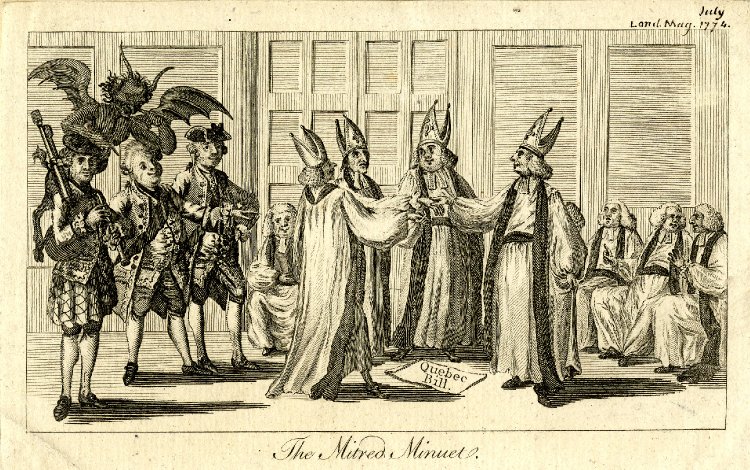
Prelates dancing to the Devil’s music. (Source)