Maurice Zundel on Prayer

zundel-800x450

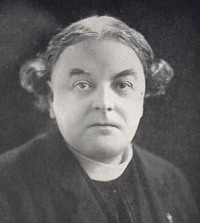
Maurice Zundel in old age. (Source)

Fr. Maurice Zundel was one of the great, if often-forgotten, theologians of the last century. Sometime student of Fr. Reginald Garrigou-Lagrange, he wrote various works of Catholic philosophy in conversation with existentialism, Protestantism, and personalism. This wide-ranging and erudite scholarship led soon-to-be-Saint Paul VI to call him “a mystical genius.” However, he is best known in the Anglophone world for his writing on the liturgy. This extract is taken from his great work, The Splendour of the Liturgy (1943), translated by Edward Watkin for Sheed & Ward. It comes from his chapter on “The Collect” (pg. 61-67). I was struck by this passage’s profound depths of wisdom as well as its light,  imaginative style.

Prayer is the soul’s breath, the creature’s fiat in response to the Creator’s in that mysterious exchange which makes us God’s fellow-workers. Its purpose is not to inform God of needs which He knows infinitely better than we do ourselves, nor to move His will to satisfy them, for His will is the eternal gift of infinite Love. Its sole object is to make us more capable of receiving such a gift, to open our eyes to the light, to throw open the portals of our heart too narrow to give access to the King of glory. There is no need to importune God for our happiness, for He never ceases to will it. It is we who place the obstacle in its way and keep his love at arm’s length.

Jerusalem, how often would I have gathered thy children, as a hen gathers her chickens beneath her wings, and thou wouldst not.

This surely is the most poignant expression of the Divine Tragedy: ‘I would, I, thy Lord and thy Godbut thou, thou wouldst not.’ If we place this complaint side by side with the text already quoted from the Apocalypse, ‘I stand at the door and knock,’ we must conclude that God always hears man’s prayer, that He is the eternal answer to prayer, and that it is man who too often refuses to hear God’s prayer.

And prayer is precisely the response to Love’s eternal invitation, which is made with an infinite regard for our freedom. It is, therefore, superfluous to ask whether every prayer is heard. It is heard if and in so far as it is a genuine prayer. For genuine prayer is the opening of the soul to the mysterious invasion of the Divine Presence, and it is completely summed up in the final appeal of the Apocalypse: ‘Come, Lord Jesus.’ (61-62)

Throughout the chapter, Zundel strikes what we might call a sophiological note. He approaches the most basic substance of the Christian lifeprayerand carries on to the Eschaton, to spiritual nuptials, and to illumination from on high.

It remains true that there is no conversation without answers, no marriage of love without mutual consent. And it is a marriage of love that is to be concluded between God and ourselves. In this marriage whose intimate union must continually grow until its flower unfolds in eternity, prayer is our assent. There is no need to put it into words. It may be confined to a silent adherence, a simple look in which we give our entire being a calm silence in which, without adding anything of her own, the soul listens to Him who utters Himself within her by His single Word. And all prayer tends towards this transparent passivity which exposes the diamond of our free will to the rays of the eternal light. We can pray without asking for anything and without saying anything, that God may express Himself the more freely…

It is ultimately for the sake of God that the soul desires her own Beatitude, that no obstacle may thwart His love, that the world may realise its spiritual vocation, and that throughout creation all may be yea, as all is yea in God. (62-64)

Zundel notes that the peculiar genius of the Liturgy is the way it uses human spiritual needs as launchpads for a “flight” into the eternal. The Collects crystallize this function in that they often speak of our human wants. Zundel writes:

But their very sobriety forbids us to stop at their verbal surface. The soul has but to let herself go and she is launched on the open sea voyaging over abysses of light and darkness, of sorrow and peace. They are more than prayers, they are sacraments of prayer, formulas that induce the essential prayer which we have attempted to describe. (64-65)

MassMeaning

Would that we might be ever mindful of what is really taking place at every Mass! (Source)

Among Prayer-Book Anglicans, there used to be a very old custom of memorizing collects. I do wonder how many still keep it upcertainly, I don’t know of any Catholics who memorize collects. Imagine what would happen to our own spiritual lives, to say nothing of the Church militant, if we committed to learning a few by heart. If you’re looking for a beautiful English translation of the traditional collects, might I recommend a little volume published by W. Knott & Son. Otherwise, there’s another good alternative that came out around the same time. 

“But There, Besides the Altar, There, is Rest”

Ernest_Dowson.jpg

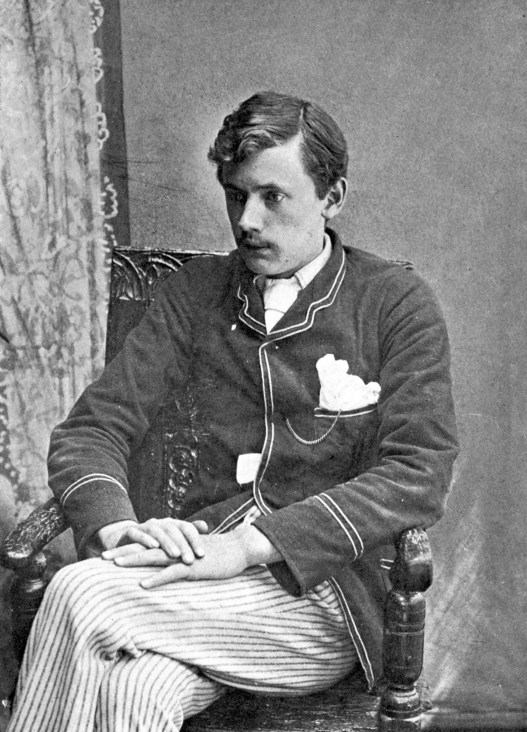
Ernest Dowson – a frail, unhappy poet driven by wild passions. Also a Roman Catholic. (Source)

Recently, I have discovered the work of the poet Ernest Dowson (1867-1900). He has swiftly become a favourite. His Decadent verse originated the phrases “gone with the wind” and “the days of wine and roses.” He was also a Catholic convert. His poetry often explores the contrast between the perishable delights of the world and the undying realm of the supernatural. In Dowson, we see the forked path that comes with the recognition of the world’s vanity: the choice lies between hedonistic decadence and the rigors of ascesis and contemplation. These two monastic poems express precisely that tension in his sad life as well as his powerful artistic vision.

Nuns of the Perpetual Adoration

Calm, sad, secure; behind high convent walls,
These watch the sacred lamp, these watch and pray:
And it is one with them when evening falls,
And one with them the cold return of day.

These heed not time; their nights and days they make
Into a long, returning rosary,
Whereon their lives are threaded for Christ’s sake;
Meekness and vigilance and chastity.

A vowed patrol, in silent companies,
Life-long they keep before the living Christ.
In the dim church, their prayers and penances
Are fragrant incense to the Sacrificed.

Outside, the world is wild and passionate;
Man’s weary laughter and his sick despair
Entreat at their impenetrable gate:
They heed no voices in their dream of prayer.

They saw the glory of the world displayed;
They saw the bitter of it, and the sweet;
They knew the roses of the world should fade,
And be trod under by the hurrying feet.

Therefore they rather put away desire,
And crossed their hands and came to sanctuary
And veiled their heads and put on coarse attire:
Because their comeliness was vanity.

And there they rest; they have serene insight
Of the illuminating dawn to be:
Mary’s sweet Star dispels for them the night,
The proper darkness of humanity.

Calm, sad, secure; with faces worn and mild:
Surely their choice of vigil is the best?
Yea! for our roses fade, the world is wild;
But there, beside the altar, there, is rest.


Carthusians

Through what long heaviness, assayed in what strange fire,
Have these white monks been brought into the way of peace,
Despising the world’s wisdom and the world’s desire,
Which from the body of this death bring no release?

Within their austere walls no voices penetrate;
A sacred silence only, as of death, obtains;
Nothing finds entry here of loud or passionate;
This quiet is the exceeding profit of their pain:

From many lands they came, in divers fiery ways;
Each knew at last the vanity of earthly joys;
And one was crowned with thorns, and one was crowned with bays,
And each was tired at last of the world’s foolish noise.

It was not theirs with Dominic to preach God’s holy wrath,
They were too stern to bear sweet Francis’ gentle sway;
Theirs was a higher calling and a steeper path,
To dwell alone with Christ, to meditate and pray.

A cloistered company, they are companionless,
None knoweth here the secret of his brother’s heart:
They are but come together for more loneliness,
Whose bond is solitude and silence all their part.

O beatific life! Who is there shall gainsay,
Your great refusal’s victory, your little loss,
Deserting vanity for the more perfect way,
The sweeter service of the most dolorous Cross.

Ye shall prevail at last! Surely ye shall prevail!
Your silence and austerity shall win at last:
Desire and mirth, the world’s ephemeral lights shall fail,
The sweet star of your queen is never overcast.

We fling up flowers and laugh, we laugh across the wine;
With wine we dull our souls and careful strains of art;
Our cups are polished skulls round which the roses twine:
None dares to look at Death who leers and lurks apart.

Move on, white company, whom that has not sufficed!
Our viols cease, our wine is death, our roses fail:
Pray for our heedlessness, O dwellers with the Christ!
Though the world fall apart, surely ye shall prevail.

The Year’s Top Posts: 2017

header_essay-original-ch-987332.jpg

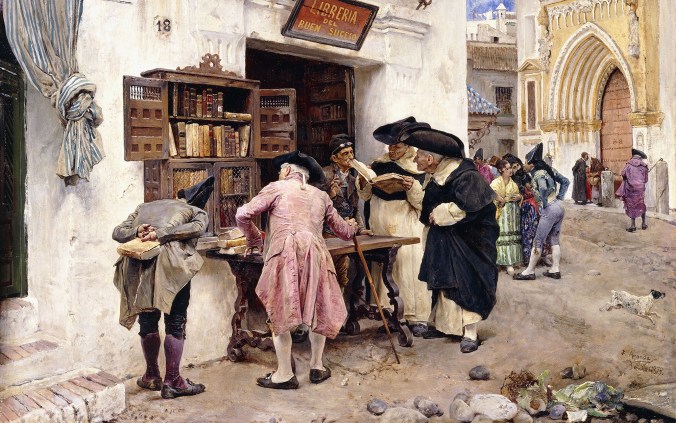
The Bibliophiles, by Luis Jimenez y Aranda. 1879. (Source)

Here are the Top 10 most viewed posts in 2017.

1. 100 Things I Would Rather Listen To at Mass than Hymns from the 70’s and 80’s, In No Particular Order

2. Worried About the Church? Here Are Some Cardinals Playing with Cats!

3. The Five Idols of Christmas

4. The Oratorian Option

5. Fr. James Martin and the Perils of Imaginative Religious Art

6. The Triumph of Color: Notes on the Anglo-Catholic Aesthetic

7. UVA’s Honor Referendum is Undemocratic

8. Benedict Shrugged

9. UVA’s Own Saint

10. When the Sacred is Strange: The Art of Giovanni Gasparro

I hope next year will be full of even more writing!


Terrible as An Army Set in Array

GuadalupeHead

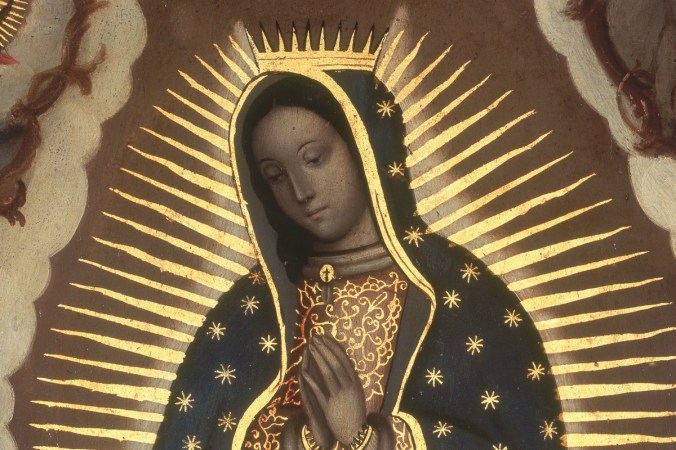
Our Lady of Guadalupe, pray for us. (Source)

“Your deed of hope will never be forgotten by those who tell of the might of God. You are the highest honor of our race.”

Thus does the whole Church sing at Mass today, on the Feast of Our Lady of Guadalupe. And no mean words are they! The Psalm is drawn from the Book of Judith – a frequent verse for feasts of Our Lady – and it lands on our ears like a shout of proleptic joy in this season of preparation and penance. The liturgy draws two special comparisons between Mary and the women of the Old Testament: Mary as the new Eve, and Mary as the second Judith. Today’s feast draws its special energy, its exegetical verve, from the mystical connection between Mary and Judith.

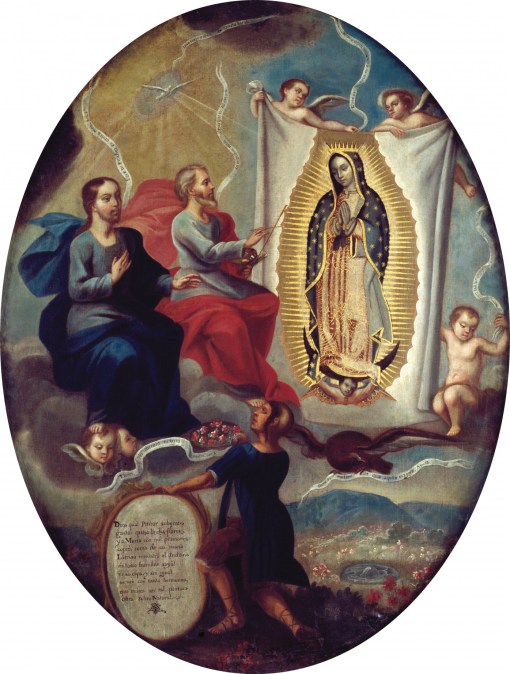
trinityguadalupe

Our Lady of Guadalupe painted by the Trinity. An image worth meditating on. (Source)

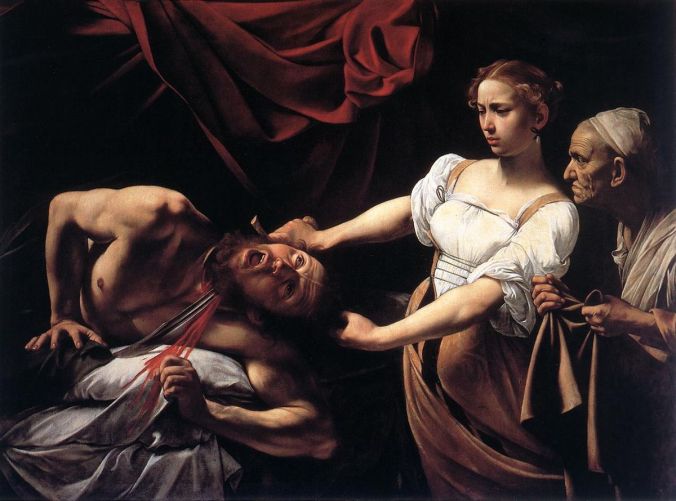
The particular verse that the Church applies to Mary comes from Uzziah’s praise of Judith after she has already beheaded Holofernes the Assyrian. Let us turn briefly to the immediately preceding passage.

Then she took the head out of the bag, showed it to them, and said: “Here is the head of Holofernes, the ranking general of the Assyrian forces, and here is the canopy under which he lay in his drunkenness. The Lord struck him down by the hand of a female! Yet I swear by the Lord, who has protected me in the way I have walked, that it was my face that seduced Holofernes to his ruin, and that he did not defile me with sin or shame.” All the people were greatly astonished. They bowed down and worshiped God, saying with one accord, “Blessed are you, our God, who today have humiliated the enemies of your people.” (Judith 13:15-17).

Then come our Psalm verses.

JudithBeheading

Judith Beheading Holofernes, Caravaggio, c. 1602. (Source)

Why would the Church draw our attention to this violent episode on a feast of Our Lady falling so soon after the Immaculate Conception? Haven’t we just contemplated her Sophianic existence? Haven’t we just basked in the light of the Holy Spirit resting upon her Immaculate Heart? Why must we leave those pleasant snow-caps of the spirit? Why turn instead to this grisly tale of murderous deliverance?

We must recall that, although Mary is all sweetness and concord to those who love her Son, she is the terror of demons. Her litanies and devotions include many titles that evoke the clamor of warfare: “Tower of David,” “Tower of Ivory,” even “Gate of Heaven.” She crushes the head of the Serpent. The sword that pierces her heart becomes, by the union of her suffering with that of her Son, a fearful weapon in her mighty hands.

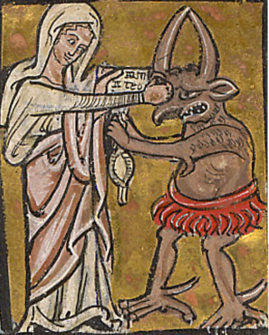
MaryPunchingDevil

“Hail Mary, full of grace, punch the devil in the face.” (Source)

The story of Guadalupe is just one example of Our Lady exercising this power. Her appearance on Tepeyac, and the miracle wrought on the tilma of St. Juan Diego, was the beginning of the end of Aztec paganism. The demons that held that great people in thrall to the murderous rites of human sacrifice were totally vanquished. Like Judith, Mary rode out from Heaven into the  very camp of the enemy. Like Judith, she conquered. Like Judith, she proclaimed her victory with a visible sign – only, Our Lady’s sign was far more glorious. Judith held up the head of the vanquished foe, the bloody remains of a wicked oppressor. The Mother of God gave us her own image, miraculously imprinted into the convert’s cloak.

Judith delivered the Jews from the army of the Assyrians. Mary came forth to Tepeyac to convert the Mexican people, lifting from them the demonic yoke of a bloodthirsty paganism. What a glorious victory she won! Nine million Aztecs converted within the first ten years of the apparitions. Even today, she continues to spur us to conquer those terrible forces of injustice that oppress so many of God’s people. The collect prayer for today’s feast reads:

O God, Father of mercies, who placed your people under the singular protection of your Son’s most holy Mother, grant that all who invoke the Blessed Virgin of Guadalupe, may seek with ever more lively faith the progress of peoples in the ways of justice and of peace. (Source; emphasis mine)

These days it is rather in vogue to lament a certain kind of triumphalism that is built on self-centered pride. But too often we forget that there is another triumphalism, the shout of a people who have seen their salvation coming from the Lord:

Blessed are you, daughter, by the Most High God,
above all the women on earth;
and blessed be the LORD God,
the creator of heaven and earth
(Judith 13:18).

The Church herself enjoins us to celebrate the works and ways of God through His chosen instruments. And in today’s Mass, we are called to join that praise to the sacrifice of Christ in the Eucharist.

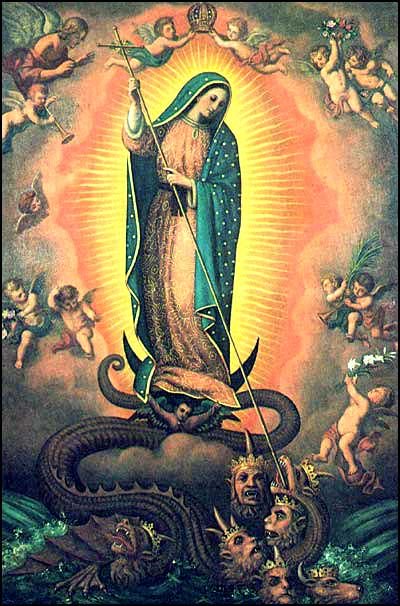
GuadalupeHeresy

Our Lady of Guadalupe, Victrix over All Heresies and Demons. (Source)

In considering Our Lady of Guadalupe and the zeal with which she overcame the forces of evil and in contemplating the beauty of her miraculous portrait, a verse of Scripture comes to mind.

“Who is she that cometh forth as the morning rising, fair as the moon, bright as the sun, terrible as an army set in array?” (Cant. 6:10 DRA)

We who have seen the tilma through the eyes of faith know the answer.

GuadalupeRoses

Our Lady of Guadalupe, Mystical Rose. (Source)

The Best Depictions of the Subtle Doctor

I’ve taken a major interest in Scotus recently. His Christology and Mariology seem to be treasures that remain largely unexploited by contemporary theologians, in part because he was recognized as being in the right about a doctrine that became dogma almost two hundred years ago. He is at the center of ongoing debates about the advent of secularism and modernity, debates which I am not competent to comment on at this time. Nevertheless, I thought it might be fun to examine some of the ways that Catholics (mostly Franciscans) have memorialized him in art over the course of the last several centuries. In some sense, the variety of depictions here tell a story of a lineage long overshadowed by other, more influential streams of thought. Thomism in particular has had a near perennial appeal within the Church, whereas Scotism, it seems, has largely been a niche concern. After all, Scotus has not yet been canonized or joined the ranks of the Doctors of the Church. This inequity arose from a variety of factors. No doubt, the fate of Scotism has come partially from Scotus’s own difficult style and vast intelligence. There’s a reason he’s called the “Subtle Doctor.”

May my small collection here help rectify that oversight on this, his feast day.

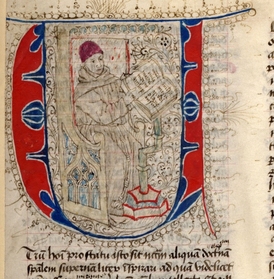
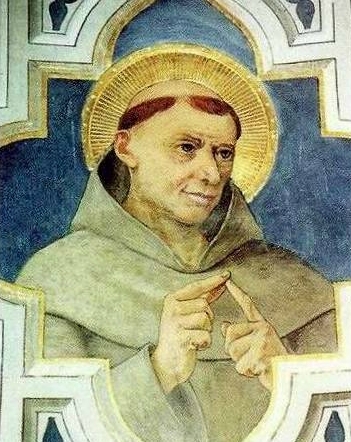
Bl John Duns Scotus-thumb-275x279-4957

John the Scot (c. 1266 – 8 Nov. 1308), appearing in what must be one of his earliest depictions: an illuminated capital. (Source)

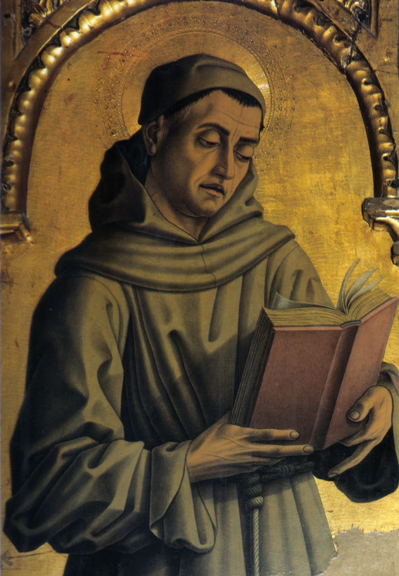
bl-john-duns-scotus

A Renaissance portrait of the Blessed John Duns Scotus. One point that people forget about Scotus is that he defended the rights of the Church against Philip IV, who had wanted to tax church properties. For his bold stance, he was exiled for a few years from Paris. (Source)

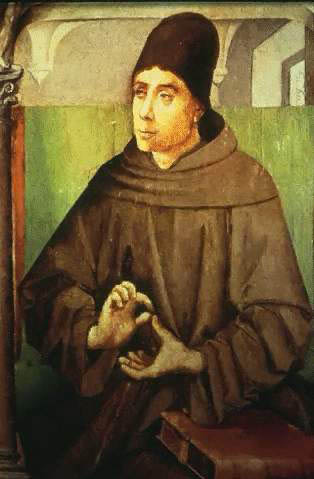
JohnDunsScotus_-_full

Perhaps the most famous, a late-Medeival, early-Renaissance portrait of Scotus. The name of the artist escapes me. (Source)

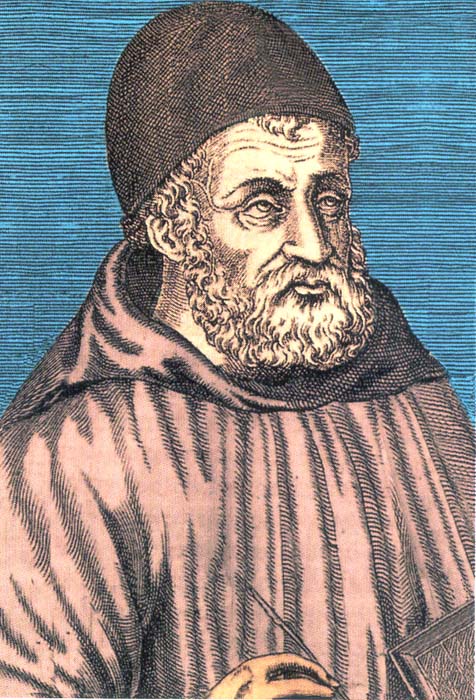
Beato_Giovanni_Duns_Scoto_B

An early modern engraving of Scotus, probably early to mid 15th century. (Source)

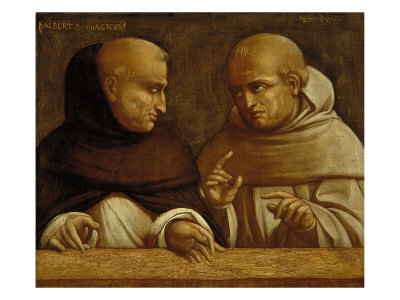
St Albert the Great & Bl John Duns Scotus

Here he is with St. Albert the Great, one of the Dominican Doctors. (Source)

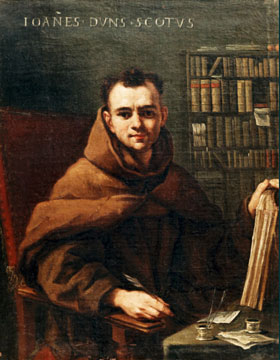
duns-scotus1

Scotus the Scholar. Age and provenance unclear; my guess is late 17th century, though it may be later. (Source)

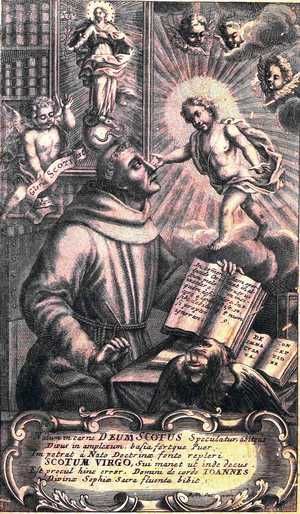
Scotus17thcentury

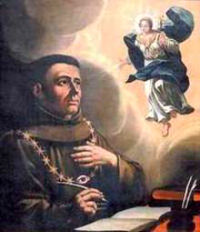
Scotus receiving a vision of the Christ Child, 17th or 18th century. Although chiefly remembered for his metaphysics and Mariology, Scotus made major contributions to Christology, defending the Patristic idea of Christ’s Absolute Primacy. (Source)

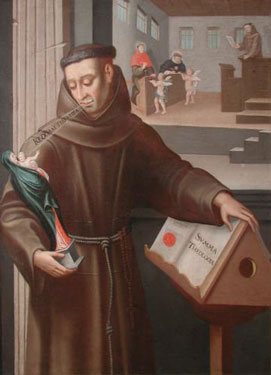
scotusstatue1

From the early modern period, it became typical to depict Scotus with representations of the Virgin Mary, whose Immaculate Conception he famously defended. This piece, probably from the 18th century, is one such example. It also contains a pretty clear criticism of Aquinas – Scotus looks away from the Summa to gaze lovingly at Mary (Source: this very friendly take on Scotus by a prominent popular Thomist)

11_08_duns_scotus2

A slightly more dramatic iteration of the same theme. Scotus is inspired by the Immaculate Conception. (Source)

ScotusChariot

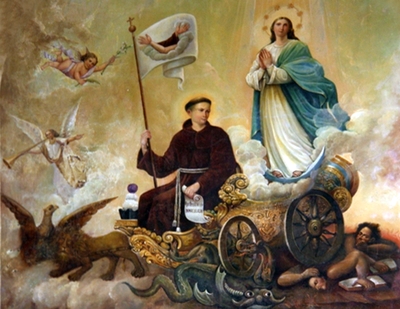
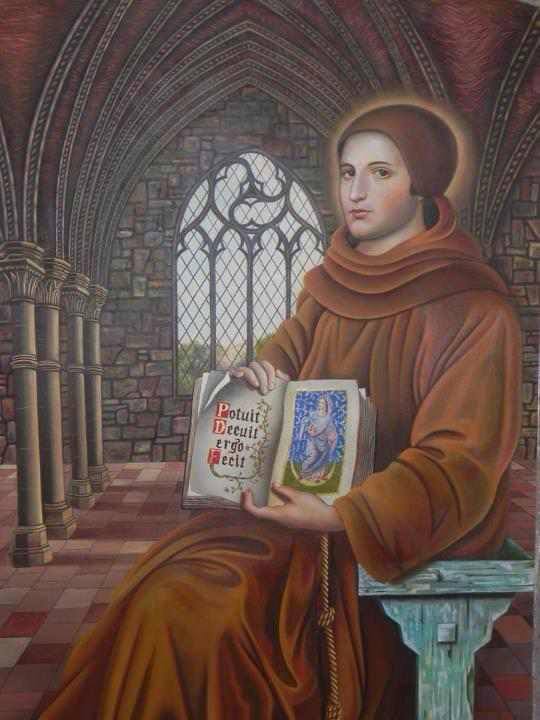
My single favorite image of Scotus is this ludicrously over-the-top Rococo depiction of Scotus and the Immaculate Conception triumphing over heresy and sin. He holds the arms (no pun intended) of the Franciscan order. His defense of the Immaculate Conception surpassed the doubts of even his own order’s great luminary, St. Bonaventure. And what a marvellously simple argument it was, too. Remember: POTVIT DECVIT ERGO FECIT. (Source).

Izamal Duns Scotus Adopte rest

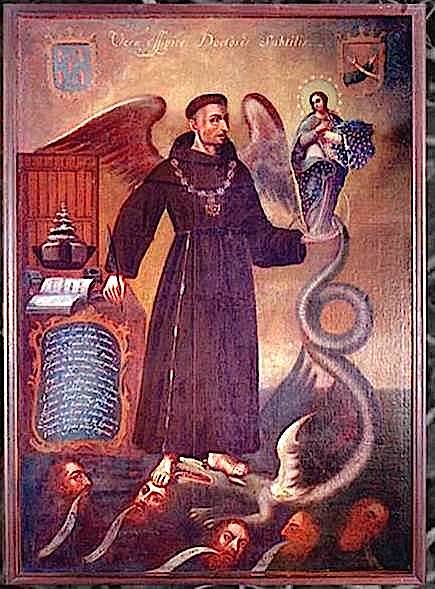
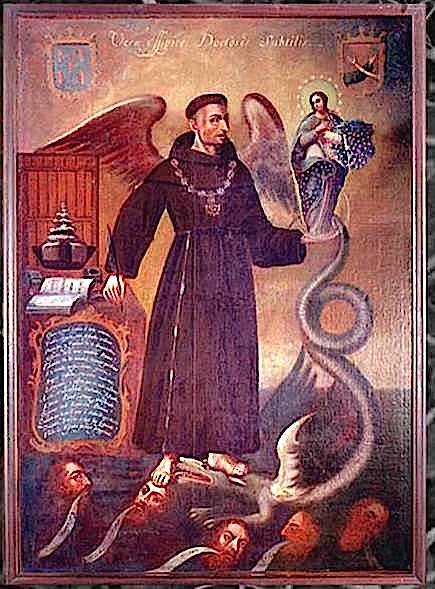
Likewise, this totally marvelous Colonial Mexican painting from the Franciscan monastery of Izamal, Yucatan, is something else. Rare is the saint granted wings in traditional iconography, though the trend was not uncommon in early modern Mexican art (Source)

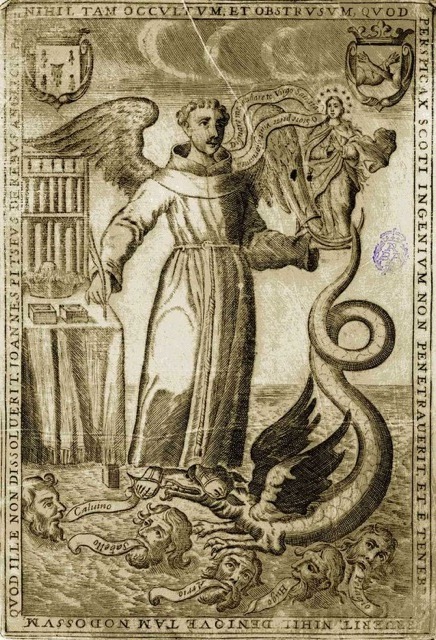
Joannes Pitseus, Scotus 1619

The mystery solved! This version by Johannes Pitseus comes from 1619, and served as a model for the Izamal piece. Here, it’s clearer that the heads represent various heretics, including Pelagius, Arius, and Calvin. (Source)

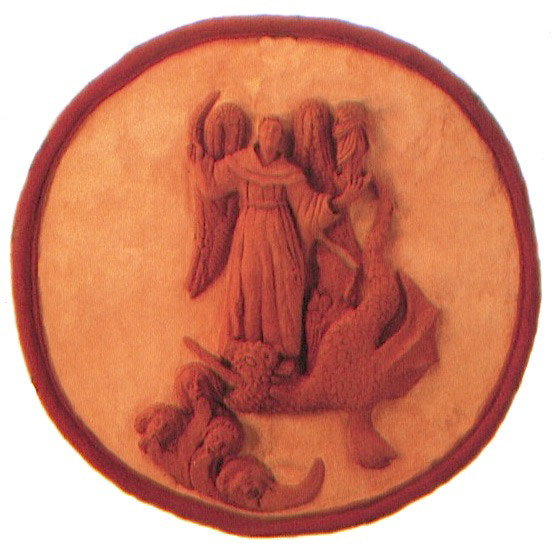
Landa Duns Scotus

This ceiling relief from Landa, Querétaro, uses the same iconographic lexicon. It seems that the Franciscans of colonial Mexico had a set of stock images to propagate devotion to their own saints. (Source)

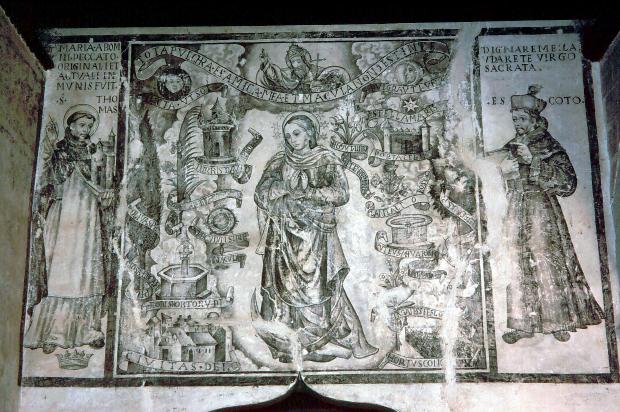
huej purisima

Here’s another unusual image of Scotus. In this mural of Mary Immaculate, or La Purísima, we see Scotus alongside St. Thomas Aquinas…and wearing a biretta! A remarkable addition, unique among all other depictions of the Subtle Doctor that I know of. (Source)

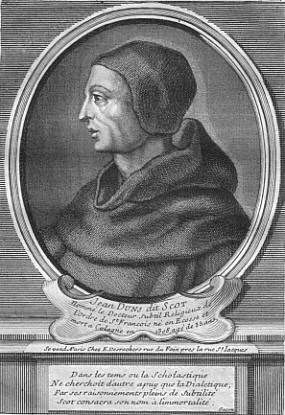
SCOTUS

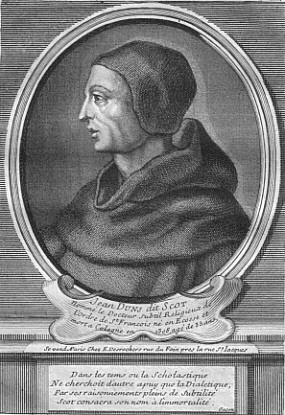
Moving away from Mexico, we come to this rather uninteresting French portrait of Scotus. Not all 18th century portraits of the man are elaborate bits of Franciscan propaganda. (Source)


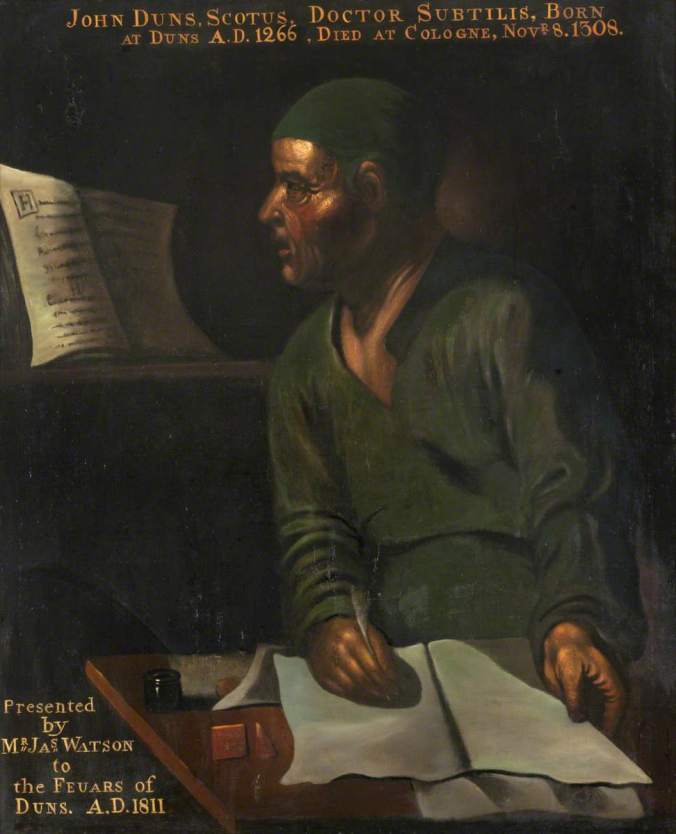
unknown artist; John Duns Scotus (1266-1308)

A late 18th or early 19th century depiction of Bl. John Duns Scotus. If this is in fact an English painting, its creation at a time of high and dry Anglican Protestantism poses interesting questions about the use of Scotus as a figure of national pride. (Source)

john-duns-scotus

I’m unsure of how old this image is; my guess, however, is that it represents a 19th century imitation of late Medieval and Renaissance style. (Source)

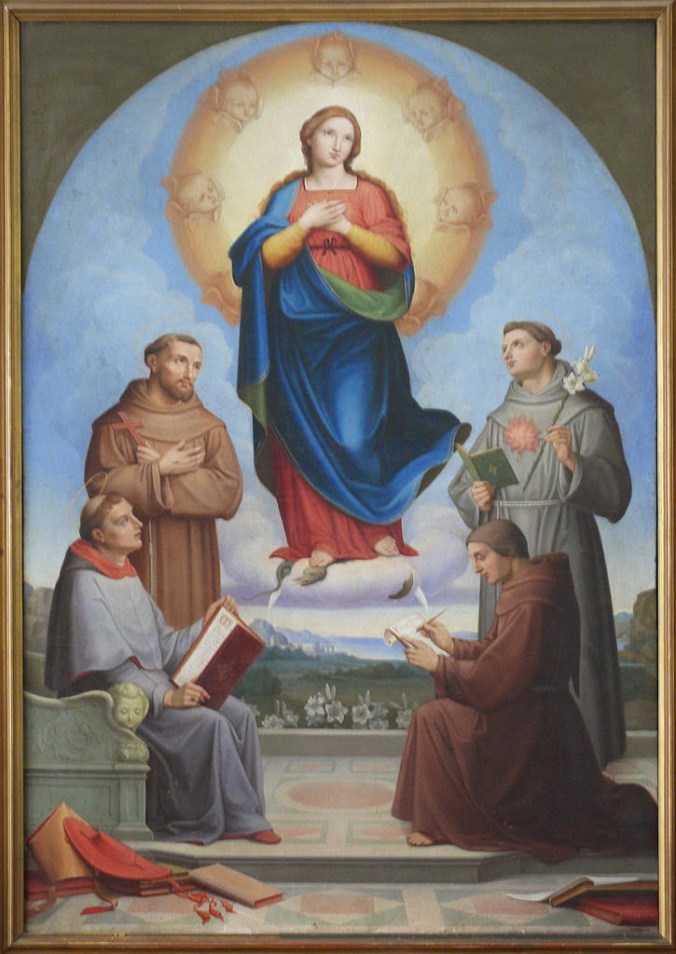
Albert Küchler (Brother Peter of Copenhagen) - Immaculate Conception with St. Bonaventure, Francis, Anthony and Blessed John Duns Scotus - Rome - Pontifical University Antonianum

A great 19th century painting of the Immaculate Conception by Danish Franciscan Albert Küchler. Scotus, who is on the bottom right, is here depicted alongside other Franciscan saints – S.s. Francis of Assisi, Anthony of Padua, and Bonaventure. (Source)

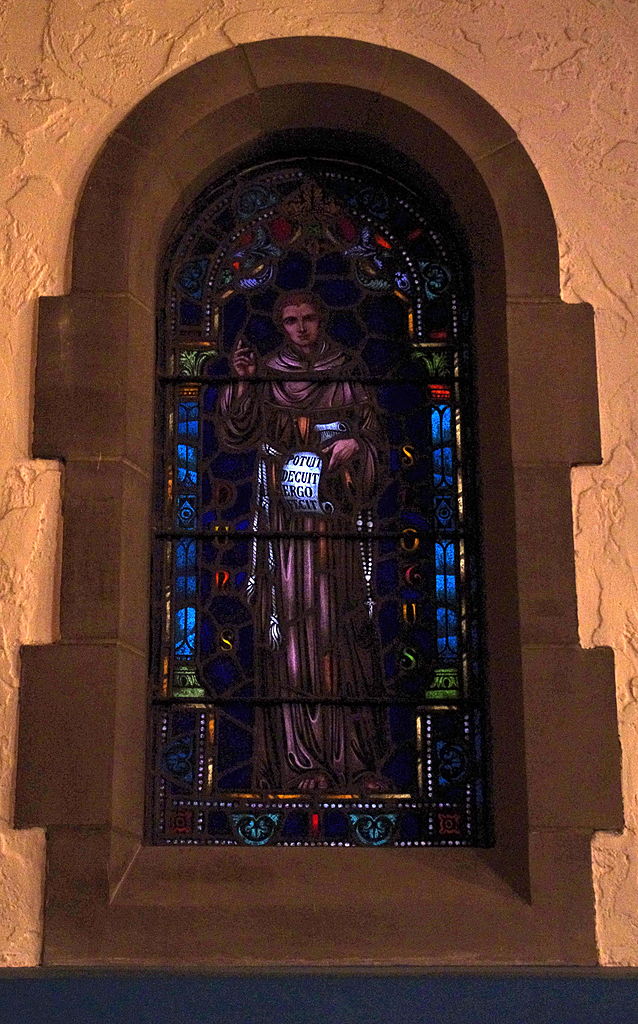
Immaculate_Conception_Church_(Columbus,_Ohio)_-_stained_glass,_Blessed_Duns_Scotus

This looks like a Harry Clarke window, though it may just resemble his style. In anyway, we see here Scotus holding a scroll with his famous argument for the Immaculate Conception epitomized – “He could do it, It was fitting He should do it, so He did it.” (Source)

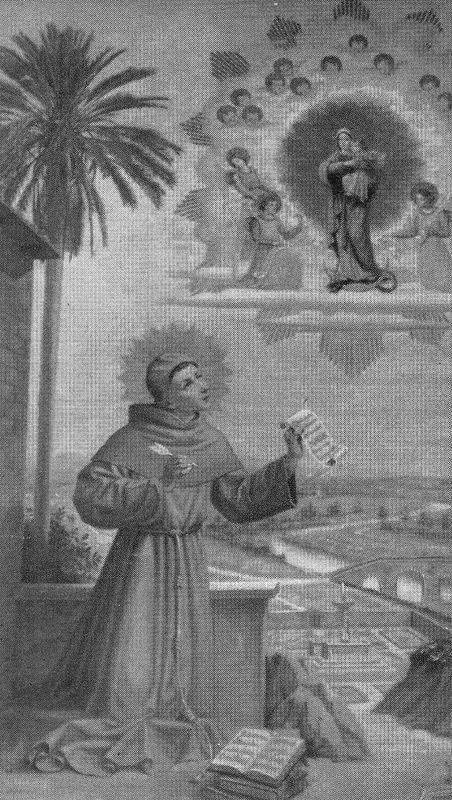
JohnDunsScotusImmaculata

John Duns Scotus, once again contemplating the Immaculate Virgin and offering his mighty works to her. (Source)

dunsscot.2

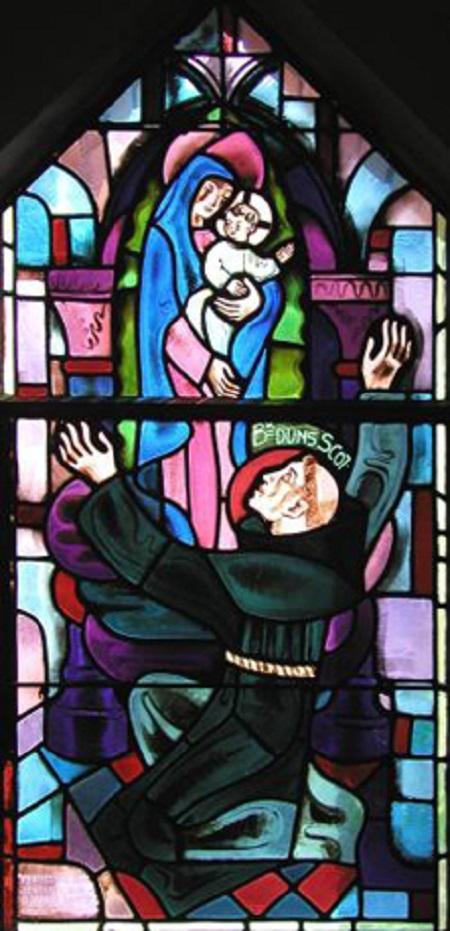
Another stained glass window, this time indubitably from the 20th century. We see here Scotus worshiping the Christ Child and his Immaculate Mother. (Source)

Johannes_duns_scotus_20060501

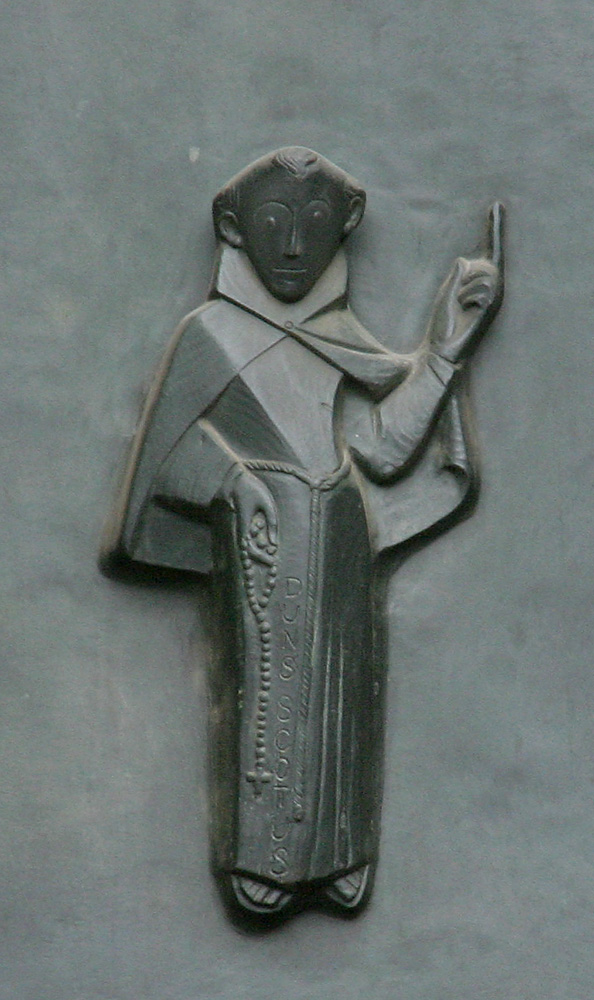
Scotus depicted in on the door of a Cologne Cathedral, 1948. He represents the supernatural gift of Understanding. (Source)

duns-scott_01

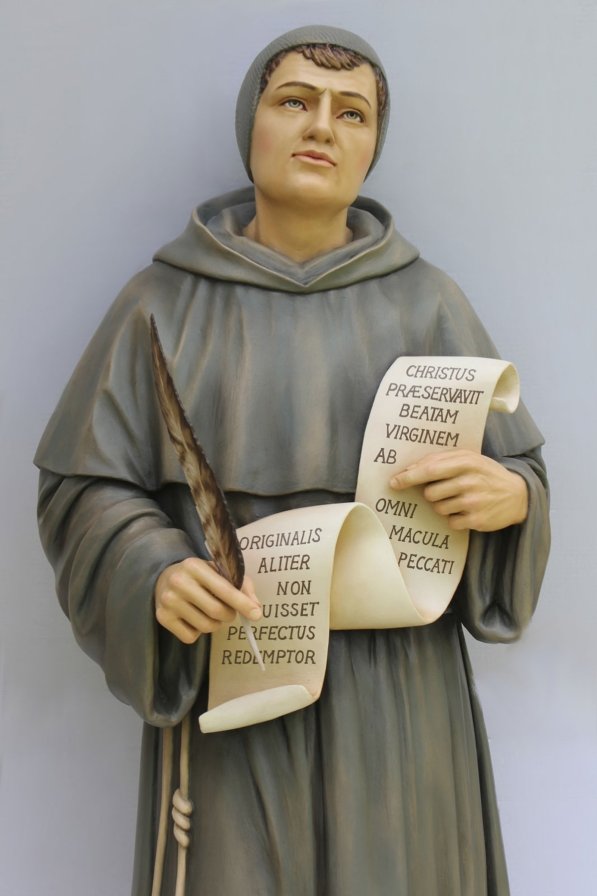
A contemporary statue of Scotus. (Source)

Scoto-2

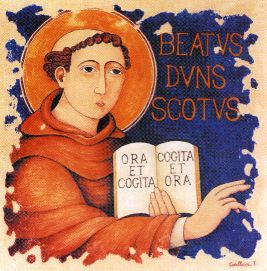
Scotus with a modification of the Benedictine phrase. “Pray and Think. Think and Pray.” Not a bad motto. (Source)


20thCScotus

A 20th or 21st century image of the Blessed Scotus (Source).

The Demonologist: Montague Summers

Montague_Summers01.jpg

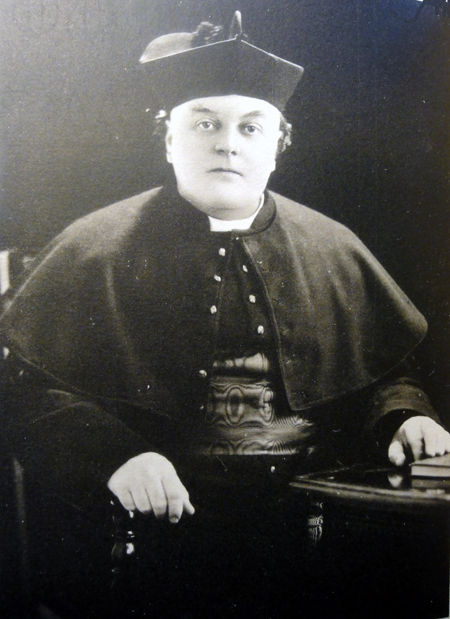
Montague Summers in clerical garb. (Source)

The history of the Church is a history of odd birds, but it is harder to find odder birds than those which inhabited the British Isles in the fruitful years of the Catholic Revival. The eccentricities of certain English clergy are well-known and well-beloved. One of the great flowers of this tendency was Montague Summers.

FlyingDevil

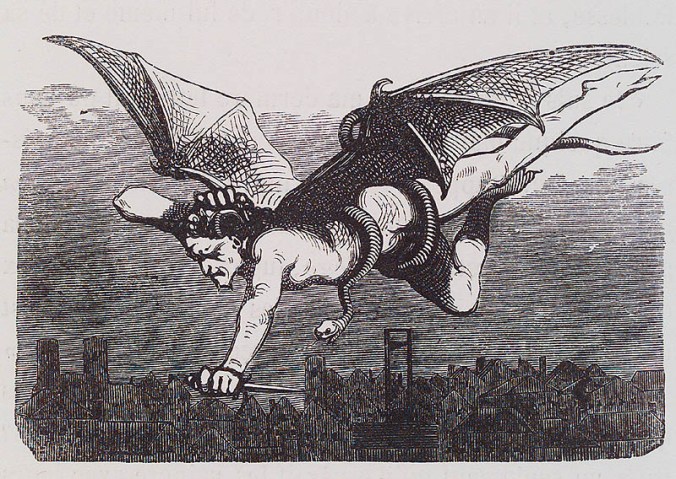
A flying devil. (Source)

Augustus Montague Summers was born in Bristol, the youngest of seven. Eventually he went on to study at Trinity College, Oxford, with the intent of seeking ordination in the Church of England. After some time at Lichfield Theological College, he was eventually deaconed and spent his curacy in Bath and the Bristol area. Even at this young stage, he garnered a reputation for eccentricity. In Ellis Hansen’s Decadent Catholicism, we learn the rather delicious fact that at seminary, “he was known to burn incense in his rooms and to wear purple silk socks during Lent” (qtd. by the Modern Medievalist).

This was as far as he made it in the ranks of the C of E, however. As the Oxford Dictionary of National Biography tersely puts it, “Rumours of studies in Satanism and a charge of pederasty, of which he was acquitted, terminated this phase of his career.” The latter charge may have had some truth to it. About this same time, he published a book of Uranian verse entitled Antinous and Other Poems (1907). His interest in pederastic and homosexual themes continued throughout his life. In 1940, he wrote a play about Edward II. Even more scandalously, “Despite his conservative religiosity, Summers was an active member of the British Society for the Study of Sex Psychology, to which he contributed an essay on the Marquis de Sade” (Source 1 and Source 2).

In 1907, though, Summers was out of a job. His hopes of becoming an Anglican clergyman seemed to have been quashed. But as they say, when the Lord closes one door, He opens another. We might imagine that Summers had something like this in mind when, two years later, he converted to Roman Catholicism. He also spent some time on the continent, allegedly for reasons relating to his health. Some have speculated that he might have received valid, if illicit, orders during this sojourn; others have said he spent his time exploring the black arts (vide the Modern Medievalist). We have almost nothing on which to base our speculations.

Now we see him coming to the full bloom of his later, famous eccentricity. It is in this formative period that he lays the foundation for the vivid persona that would make him such a cult literary and religious figure. I will quote the Oxford DNB at length:

On 19 July 1909 Summers was received into the Church of Rome and was granted the clerical tonsure on 28 December 1910; after this his clerical career became murky and remains so. He may have received minor orders as a deacon, but no record of his ordination has ever been found. During his lifetime, he was addressed as the Revd Montague Summers, celebrated mass in his own chapel and those of friends, adopted two names in religion, and invariably wore the dress pertaining to Roman priesthood; his appearance in soutane, buckled shoes, and shovel hat, later with an umbrella of the Sairey Gamp order, was familiar in London and Oxford. He became increasingly eccentric and was described as combining a manifest benignity with a whiff of the Widow Twankey. Some spoke of an aura of evil. It was charitably assumed by his friends that he was indeed a priest, and his devotion was never in question; his biographer Joseph Jerome (Father Broccard Sewell) records that all his life Summers wore the Carmelite scapular.

On a side-note, Fr. Brocard Sewell was a deeply strange man himself. But I digress.

If Summersor, as he was now calling himself, “Reverend Alphonsus Joseph-Mary Augustus Montague Summers”–had simply remained a slightly dubious cleric, we probably wouldn’t remember him. He might have become a little more than a footnote in the history of the Episcopi Vagantes so famous for dispensing illicit orders here and there. But he did not. Instead, he wrote. Prolifically.

Summers started off with genuine and important literary scholarship. Eventually, he even became a member of the Royal Society of Literature. He had certainly earned it with the sweat of his brow. He produced fairly good books on Restoration Drama, including major editions of previously neglected playwrights such as Aphra Behn. In this capacity, he had some connections with the world of the British stage; he was a founder of the Phoenix Theatre. He wrote an important monograph on Shakespeare.  In another work he also proved that the terrible Gothic novels that Jane Austen mentions in Northanger Abbey were all real books. Gothic literature remained a lifelong passion, in part because it dovetailed so well with his overriding obsessionthe occult.

vmps022

Montague Summers in clerical collar. (Source)

Summers is most famous today for his several books on witches, demons, vampires, ghosts, and other supernatural phenomena. He translated and edited the first English edition of the Malleus Maleficarum, that great tome of Medieval witch-hunting. He did the same with several other demonological manuals: The Demonality of Sinistrari, The Discovery of Witches by Hopkins, the Compendium Maleficarum of Guazzo, and the Demonolatry of Nicolas Remy. He wrote a text on The Physical Phenomena of Mysticism, in contrast with his somewhat headier and less decadent contemporary, Evelyn Underhill. He edited more than one collection of horror stories. He wrote three seminal texts on vampirism, one on lycanthropy, and four on various aspects of witchcraft. Following the best scholarship of the day, Summers endorsed the idea of the “Witch-Cult,” long suppressed by Christianity but operating sub rosa in Europe down the centuries (this hypothesis has long since been undermined by scholars across disciplines). He would often draw upon a huge range of historical, theological, ethnographic, and literary sources in constructing his arguments. All of his texts speak to his vast learning. It is probable that upon his death, Montague Summers knew more about the history and practice of the occult than any other Englishman then living.

The Modern Medievalist has preserved some charming anecdotes of the later, esoteric Summers over on his blog. We read, for example, the following passage from Ellis Hansen’s Decadent Catholicism:

…although Summers was a brilliant conversationalist, he had always a thick carapace of artificiality in his demeanor, a kind of mask that recalled the studied falsity of the classic dandy, not to mention the distrustful reserve of Walter Pater and John Gray. His style was decidedly aristocratic, Continental, and decadent, with the inevitable intimation of sexual impropriety. His friend writes of him, “He would often meet me with such an expression as Che! Che!, accompanied by a conspiratorial smile; or he would look closely at me and murmur, ‘Tell me strange things’.”

Or this remarkable scene drawn for us by Fr. Brocard Sewell:

Summers…could often have been seen entering or leaving the reading room of the British Museum, carrying a large black portfolio bearing on its side a white label, showing in blood-red capitals, the legend “VAMPIRES.”

Not to mention the fact that Summers went about town with a cane topped by a depiction of Leda and the Swan (vide the Modern Medievalist).
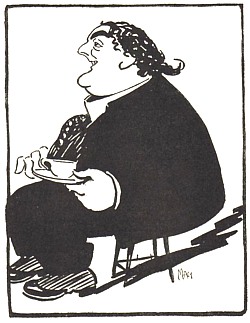
vmps011

A caricature of Summers from the Evening Standard, probably from 1925. (Source).

What distinguished Summers’ writing on these dark subjects is the absolute credulity with which he approaches his subject. Unlike his predecessor, Dom Calmet, who wrote about ghosts with ambivalence and vampires with manifest doubt, Summers did not hesitate to express his firm certainty about both (and much more). He believed in all the phenomena he wrote aboutthe whole ghastly parade of incubi and succubi, of witches dancing at the Sabbath, of vampires rising from the grave to seek the blood of the living, of werewolves stalking innocent Christians in the night. Everything that belonged to the netherworld was as real to him as the people you or I might meet in the street. His purple prose often slips into breathless passages of scholarly terror. Observe the following lines from Chapter Two of The Vampire: His Kith and Kin:

It has been said that a saint is a person who always cho[o]ses the better of the two courses open to him at every step. And so the man who is truly wicked is he who deliberately always cho[o]ses the worse of the two courses. Even when he does things which would be considered right he always does them for some bad reason. To identify oneself in this way with any given course requires intense concentration and an iron strength of will, and it is such persons who become vampires.

The vampire is believed to be one who has devoted himself during his life to the practice of Black Magic, and it is hardly to be supposed that such persons would rest undisturbed, while it is easy to believe that their malevolence had set in action forces which might prove powerful for terror and destruction even when they were in their graves. It was sometimes said, but the belief is rare, that the Vampire was the offspring of a witch and the devil.

Summers also stood apart from his thoroughly modern era in endorsing “Church-sanctioned methods of destroying” the monsters he wrote about (The Modern Medievalist).

And although his pages are littered with authoritative quotes from long-dead writers, Summers was not unaware of the dark streams that swirled about him in his own day. Richard Cavendish reports in a typically mordant passage from The Black Arts (1967) how Summers treated the claims of the twentieth century’s greatest occultist, Aleister Crowley:

Aleister Crowley could not pass over such an opportunity to scandalize his readers. ‘For the highest spiritual working one must accordingly choose that victim which contains the greatest and purest force. A male child of perfect innocence and high intelligence is the most satisfactory and suitable victim.’ Montague Summers took this seriously, as he took everything else, and quotes it with gratified horror, in spite of Crowley’s footnote in which he says that he performed this sacrifice an average of 150 times a year between 1912 and 1928! (Cavendish 238)

In spite of it all, Summers remained well-liked in certain circles. He moved among the literary elite of his own day, an eccentric among eccentrics. One of his friends, the actress Dame Sybil Thorndike, relates something of his personality:

I think that because of his profound belief in the tenets of orthodox Catholic Christianity he was able to be in a way almost frivolous in his approach to certain macabre heterodoxies. His humour, his “wicked humour” as some people called it, was most refreshing, so different from the tiresome sentimentalism of so many convinced believers.

His caricature in the Evening Standard captures something of this impish quality.

But although he was known and appreciated in his own day, he has been largely forgotten in the intervening decades. There have not been many books about Montague Summers, and he is not widely read. However, that will soon hopefully change. In recent years, Georgetown University has acquired Summers’ papers, once thought irrevocably lost. Fittingly, they have a peculiar provenance, having been “discovered languishing in an old farmhouse in Manitoba.” The story of how they got there is probably as strange as any of Summers’ own books. Georgetown’s collection has made possible a forthcoming biography by Matthew Walther that will hopefully rectify the longstanding neglect of this bizarre yet sincere writer.

But perhaps a question rises. Not every obscure author is worth reviving. Why bother with Montague Summers? A man of outdated style, of dubious subjects, and of very questionable morals to boot…what does he offer the modern reader?
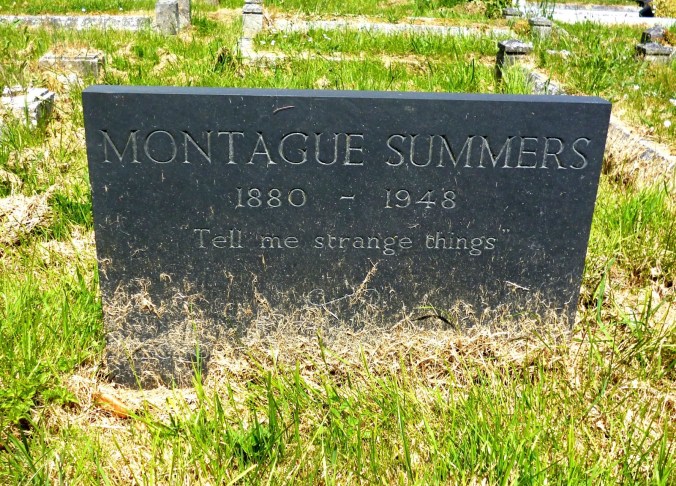
pope's grotto 082

The grave of Montague Summers. (Source)

The Modern Medievalist has a few thoughts on the matter.

Montague Summers is, at best, a good fit for the Institute of Christ the King and a throwback to an age when priests were also arbiters, makers, and preservers of high culture a la Antonio Vivaldi; at worst, a “daughter of Trent” who, if he ever actually was a priest to begin with, wasted his vocation on trivialities rather than the cure of souls.

Perhaps. I am not so convinced that Summers would have fit in any age. He was a decadent, and a great deal of decadence is contrarianism. Though the comparison with ICKSP is hilarious.

I think the message of Summers’s life and work can best be summed up in his epitaph.  On the black stone hat marks his grave in Richmond Cemetery, we read a simple phrase; “Tell me strange things.” These four words that he used to say to his friends encompass his whole life, packed as it was with “strange things.” Summers matters today not because he is a towering figure of literary talent, nor because his scholarly subjects are of vital importance, nor because he is a moral exemplar of impeccable religiosity. He matters because he can remind us to embrace the mystery of life. As we read in one of those plays that Summers so loved, “There are more things in heaven and earth, Horatio,/Than are dreamt of in your philosophy.” Summers lived by those words. The more I learn about the world, the more reason I see in them. And what better day to remember this humbling, bewildering, frightful truth than on All Hallows’ Eve?
A Challenge in Honor of the Sophianic Heart of Mary

ImmaculateHeartofMarySophianic

Sorrowful and Immaculate Heart of Mary, pray for us sinners. (Source).

August is consecrated to the Sorrowful and Immaculate Heart of Mary. Thus, it is a month in which the Church invites us to peer into the profound and luminous abyss of light at the very center of the Mother of God’s Sophianic life. In celebration of this occasion, I’ve decided to dedicate myself to producing or working on something creative every day for the rest of the month. Today, I have already written one poem and started an art project. The latter is especially exciting for me, as it’s been years since I last produced any real art. Too long, really. Pray for me in this sophiological endeavor! I would recommend the same challenge to any Catholic hoping to redeem this particular time.

Elsewhere: A New Anglo-Catholic Blog

Ordination 1956 by Norman Blamey 1914-2000

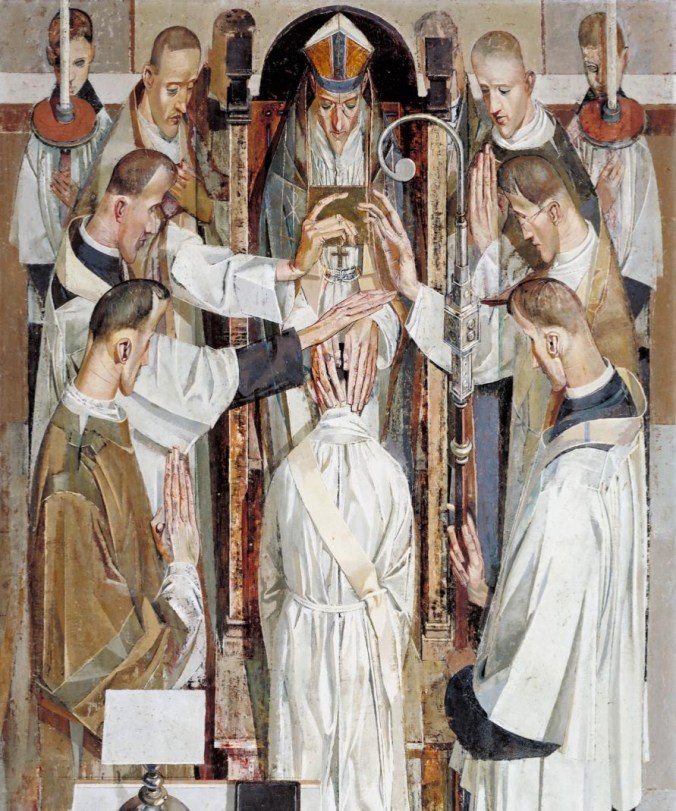
“Ordination,” by Norman Blamey, 1956. (Source)

My friend, Archbishop Mark Haverland, Primate of the Anglican Catholic Church, has just started a new blog called “Anglican Catholic Liturgy and Theology.” You really get what it says on the tin with this one. For those of us with an interest in Anglo-Catholic history, theology, and practice, Archbishop Haverland’s blog will no doubt prove to be a great resource.

A Norbertine Poem for the Sacred Heart

SacredHeartBlackBackground

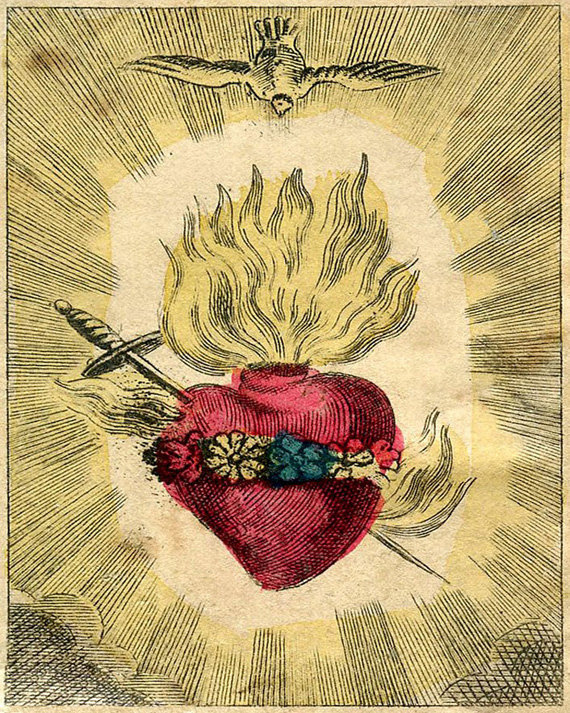
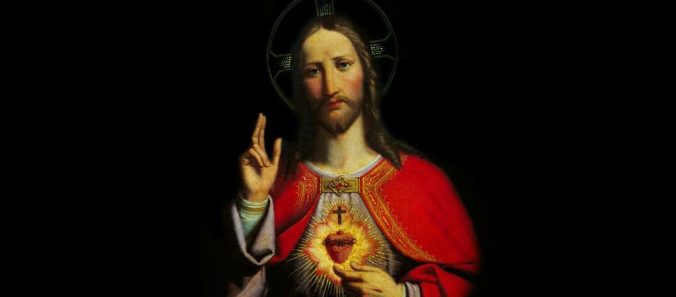
Most Sacred Heart of Jesus, have mercy on us. (Source).

I happened upon this wonderful poem by one Frater Simeon Charles Goodwin, O.Praem., a seminarian at St. Michael’s Abbey. It’s always a delight to find good rhyming verse with a tightly-wound meterand rich theology to boot! Throughout the text, we can detect hints of Chesterton and, in the very last couplet, the sensual, baroque Richard Crashaw. I offer it here for your enjoyment on this solemnity of the Sacred Heart.

The Sacred Heart

    by Simeon Charles Goodwin, O.Praem.

There is a heart that beat with love
When time could mark no beat.
It echoed with a triple-pulse
And surged in thunders sweet.

Too happy not to overflow
It laughed and all was made.
It sighed and angel hosts came forth
In myriad parade.

It sang the seas and skies to be,
Hummed forth the rolling hills.
It beamed out beast and bird in love,
A sweet and mighty will.

It breathed into the mire and muck,
Sweet nothings to the earth;
And clay was made creation’s crown,
Man made with God’s own worth.

And how that heart did pound with peace
When he and man would walk
In silent love in evening winds
Too full of love for talk.

Oh man was glad and God was glad
And all creation too,
But man in madness pierced God’s heart
And rent the world in two.

There is a secret hideaway
Where cosmoi come to cry,
With atrium no bigger than
The needle’s narrow eye.

And there the mighty waters wait
To burst on arid wastes.
Men need but kiss the lance-made lips
To learn how sweet blood tastes.